

Quick Answer
Price bookkeeping from expected delivery cost and a defined scope. Use hourly or diagnostic work when records are unstable, and fixed packages or retainers once monthly effort is predictable. Include reconciliation, review, follow-up, software, and allocated overhead in the cost estimate. Specify exclusions, document deadlines, payment terms, and how scope changes are approved.
Price from workload reality#
Step 1. Reset what a bookkeeping price is supposed to do. A usable price is not just a number that sounds competitive. It should reflect the work required and how the engagement will actually run. Market comparisons help with context, but they do not replace a pricing strategy built around the real workload.
That gap matters because pricing bookkeeping can be hard, even for bookkeepers. The challenge is aligning client expectations with the work required. A pricing strategy is how you set a price that stays competitive without ignoring what the engagement takes to deliver.
Step 2. Price from workload reality, not from headline rates. The useful inputs are straightforward: transaction volume, transaction complexity, and any additional services. Those are the inputs your pricing model should rest on. And not all transactions are equal. A client with 50 transactions a month is a very different job from one with 500+.
Before you add services, verify whether the client is closer to the 50-a-month case or the 500+ case. Then confirm which services are actually included. If you cannot state those two facts clearly, your quote is not ready. One common failure mode is pricing "monthly bookkeeping" as if every ledger behaves the same, then finding out the required workload is much higher than expected.
Step 3. Build your quote so it protects both scope and cashflow. A fair price is only half the job. You also need terms that make the engagement workable after the client says yes. That means deciding how you will price the work, where the boundaries sit, how payment terms will work, and what happens if scope changes. A low quote with vague scope can create more problems than a higher quote with clear assumptions.
This guide stays practical. You will build a reusable pricing method you can apply client by client. Choose the right model, define included and excluded work, structure the quote in the right order, set payment terms in writing, and set clear rules for scope changes. If your current approach is "pick a rate and hope," this gives you a better standard to work from.
What to prepare before you set bookkeeping prices#
Before you set a price, prepare a short pricing brief so your quote reflects the work you will actually deliver.
-
Define the package first. Decide whether you are offering core bookkeeping only or a broader package. A workable package states exactly what is included and how often each service is delivered, so scope is clear before numbers come up.
-
Map delivery frequency and boundaries. Write the expected reporting cadence and what is outside scope in plain language. This keeps implied work from getting folded into the same fee later.
-
Capture your internal pricing inputs. Track how long core tasks take and the value each service delivers to the client. These are essential inputs for fair pricing and become especially important if you use fixed pricing.
-
Set your review process for non-routine work. Decide how you will handle edge cases before you quote, including when to escalate items beyond routine bookkeeping. This keeps your pricing decisions consistent when work gets messy.
Benchmark the market without copying it#
Use market benchmarks for context, not as your quote. The goal is to understand range and structure, then price from your actual workload and delivery terms.
Compare services of similar depth, not an accountant’s broad hourly range against a bookkeeping retainer. Record whether cleanup, software, account count, reconciliation, report review, and client follow-up are included.
Use published offers to understand packaging, then date each observation. A promotional starting price or a creator’s example does not establish the fee for your client’s workload.
Before you trust any number, check source intent:
| Source type | What it is useful for | What to avoid |
|---|---|---|
| Provider pricing page | Current published scope and offer terms | Treating a starting or promotional fee as an all-in quote |
| Service description | Inclusions and exclusions | Comparing packages with different cleanup or reporting scope |
| Your completed client work | Actual delivery time and costs | Ignoring follow-up, review, and rework |
Before you compare price, force an apples-to-apples comparison. Use one comparison sheet with the same fields for every source: scope, transaction complexity, exclusions, revision limits, and turnaround commitments.
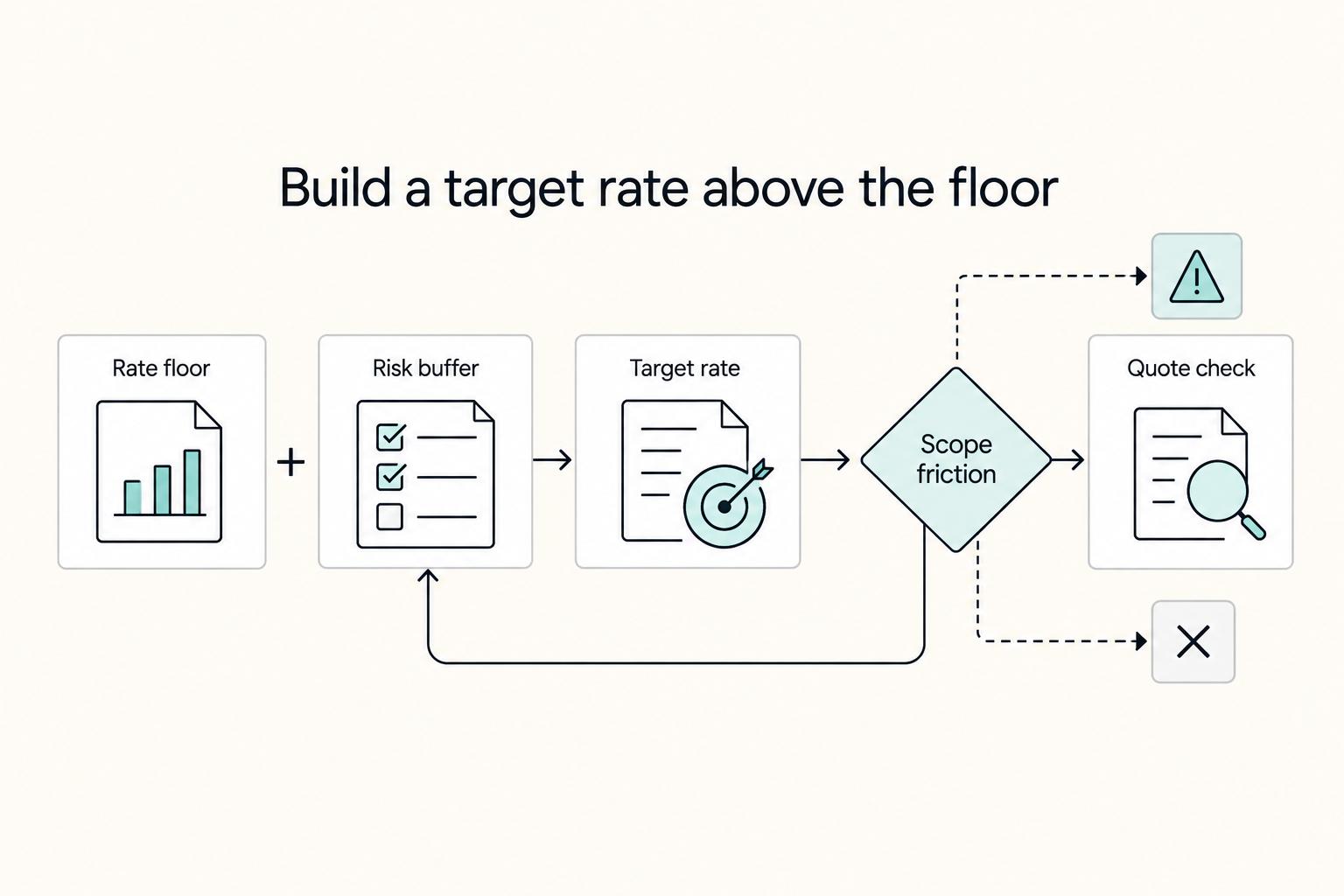
Estimate monthly delivery labor plus software and allocated overhead before setting the fee. If you use a target margin, divide cost by one minus that margin; adding the same percentage to cost produces a markup, not that margin. Check the result against comparable scope and client value.
Keep recurring and one-off work separate in the quote. A client with a six-month reconciliation backlog needs a cleanup estimate as well as the monthly service fee. Review the first completed close against estimated hours, then agree any scope or fee change before the next cycle.
Choose your pricing model and switch rules#
Choose the pricing model based on workload stability and scope risk, not just the headline fee. Most pricing problems come from scope drift, unclear deliverables, or unpredictable effort.
Step 1. Start with hourly when the ledger is unstable. Use an hourly rate when cleanup is likely, records are inconsistent, or reconciliation effort is hard to predict. This protects you from underquoting messy books. The tradeoff is that hourly billing is simple to run but can cap profit.
Step 2. Use scoped package pricing for repeatable deliverables. If the work is repeatable, such as monthly close, reconciliations, and standard reports, move to scoped package pricing. This fits clients who want clear deliverables and predictable fees. Keep scope control tight with written inclusions, exclusions, turnaround expectations, and a change-order clause, because fixed-fee work can reward efficiency but is vulnerable to scope creep.
| Model | Billing predictability | Upside or downside risk | Client trust impact | Scope-control strength |
|---|---|---|---|---|
| Hourly | Low to medium | Lower underpricing risk, but profit ceiling | Can create friction when hours vary | Strong if time and approvals are tracked |
| Scoped package pricing | High | Good upside if scope holds; downside if scope drifts | Strong when deliverables are explicit | Medium to strong with exclusions and change-order terms |
| Monthly retainer | High | Stable billing; margin risk if workload rises quietly | Strong for ongoing work with consistent outputs | Medium unless service boundaries are explicit |
| Value pricing | Medium to high | Higher upside when outcomes are clearly defined; downside when outcomes are vague | Strong when success measures are shared | Weak unless outcomes and exclusions are tightly written |
Switch from hourly to a package when you have enough completed cycles to estimate recurring effort and document the service limits. Repeated requests help define scope, but two cycles alone do not prove a stable cost base. Keep backlog cleanup separate from recurring delivery.
Step 4. Move to a monthly retainer once delivery is consistent. Use a monthly retainer when transaction patterns and reporting cadence are consistently predictable. If the task mix, follow-up load, and deliverables are steady month to month, a retainer usually reduces quoting friction and makes expectations clearer.
Use value pricing only when outcomes are specific and agreed in writing. If outcomes are not clearly measurable, stay with package or retainer pricing.
Define service scope and exclusions in writing#
Protect your margin by making scope explicit in writing: what is included, what is excluded, and how extra work gets approved before it starts.
| Item | How to scope it | Status |
|---|---|---|
| bank statement reconciliation | List it as a concrete deliverable and recurring task | Included work |
| monthly close tasks | List them as concrete deliverables and recurring tasks | Included work |
| financial statements | List them as concrete deliverables and recurring tasks | Included work |
| accounts receivable follow-up | Include it only if you provide it | Included work |
| tax preparation | Call it out as an add-on or separate engagement | Adjacent service |
| payroll | Call it out as an add-on or separate engagement | Adjacent service |
| Controller/CFO support | Call it out as an add-on or separate engagement | Adjacent service |
| historical cleanup before the engagement period | List it in a dedicated exclusions section | Out-of-scope trigger |
| new entity setup | List it in a dedicated exclusions section | Out-of-scope trigger |
| urgent close requests outside the agreed timeline | List it in a dedicated exclusions section | Out-of-scope trigger |
| documentation gaps, missing statements, or late source files | List it in a dedicated exclusions section | Out-of-scope trigger |
Step 1. Split the scope of work into included work and excluded work. Do not stop at "monthly bookkeeping." List concrete deliverables and recurring tasks such as bank statement reconciliation, monthly close tasks, financial statements, and accounts receivable follow-up only if you provide it. Define deliverables, timelines, and quality standards so a third party can see what you produce, how often, and what "done" means.
Step 2. Separate adjacent services before scope drifts. Keep neighboring services out of the base fee unless they are priced in. Call out tax preparation, payroll, and Controller/CFO support as add-ons or separate engagements. Clear boundaries up front prevent later misunderstandings about what bookkeeping includes.
Step 3. Add an out-of-scope trigger list. Use a dedicated exclusions section and list common trigger events, for example:
- historical cleanup before the engagement period
- new entity setup
- urgent close requests outside the agreed timeline
- documentation gaps, missing statements, or late source files
This gives you and the client a shared reference when work changes and helps prevent small unbilled additions from turning into revenue leakage.
Step 4. Require formal approval for extras before work begins. When a request falls outside scope, run it through the formal change process, using your change-order clause, before starting. Confirm the revised scope, fee, and timeline in writing first, then proceed. Treat the scope document as the live source of truth during delivery, not a one-time signature artifact.
Set payment terms that protect cashflow#
Set payment terms in one place before work starts, then follow them the same way every cycle. Clear terms define when and how you expect to be paid, help protect cash flow, and reduce confusion that can turn into disputes.
| Term | What to document | Operational note |
|---|---|---|
| Payment structure | Use one primary structure for similar engagements | Use a deposit with recurring billing or full prepayment for smaller fixed-scope work |
| Invoicing cadence | Put the invoicing schedule in the same agreement section as the due-date rule, accepted payment methods, and late-fee policy | This gives both sides one source of truth |
| Invoicing execution | Use the same trigger, sender, and reference format each cycle | Payments are easier to match and follow up |
| Payment references | Keep invoice number, billing period, and payment reference aligned across your agreement, invoice, and payment request | Proof-of-payment disputes are less likely |
| Pause rule | State lawful notice, timing, and permitted suspension or termination conditions | Protect access to records and account for filing or payroll deadlines |
Step 1. Choose one payment structure and apply it consistently. Use one primary structure for similar engagements instead of reinventing terms for each client. You can use a deposit with recurring billing or full prepayment for smaller fixed-scope work, but keep the rule consistent so your team and your clients know what happens first.
Step 2. Keep invoicing cadence, due dates, and late-payment terms together. Put the invoicing schedule, due-date rule, accepted payment methods, and late-fee policy in the same agreement section. This gives both sides one source of truth and reduces later "we understood it differently" conflicts.
Step 3. Make invoicing execution predictable. Inconsistent or delayed invoicing is a common failure point that leads to late payment or underpayment. Use the same trigger, sender, and reference format each cycle so payments are easier to match and follow up.
Step 4. Reduce payment-matching friction, especially across borders. Prefer payment methods and workflows that give clear status visibility and clear references. Keep invoice number, billing period, and payment reference aligned across your agreement, invoice, and payment request so proof-of-payment disputes are less likely.
Step 5. Agree overdue handling before delivery. State notice, permitted work suspension, and restart terms in the engagement. Check applicable professional and legal duties before pausing time-sensitive work or withholding records; a generic pause clause does not override those duties.
Build and send a quote that is hard to dispute#
Use a quote format that makes scope, assumptions, and approvals explicit before the price, so the client can see exactly what they are accepting.
Lead with the quote in a fixed order#
Use this sequence every time: scope summary, assumptions, price model, payment schedule, exclusions, acceptance line.
In the scope summary, name the exact bookkeeping tasks included, such as transaction categorization and bank and credit card reconciliation, because "bookkeeping" can mean different things to different providers. In the price model line, state which model you are using and why: hourly is simple but can cap upside, fixed-fee can improve efficiency but raises scope-creep risk, and value-based pricing can take more setup time.
Attach a one-page assumptions sheet#
Base it on the client's operating facts: active ledger, for example, QuickBooks Online, reporting deadlines, and monthly document handoff timing. Keep each assumption testable so you can spot changes and reprice them instead of arguing about them later.
If you need help tightening your internal setup before quoting, see How to Calculate Your Billable Rate as a Freelancer and How to Manage Bookkeeping for Your Freelance Business.
Write verification checkpoints into the quote#
Name who confirms opening balances, who approves monthly reports, and what happens when source documents are late. Assign one owner per checkpoint so responsibility is clear.
Monthly reconciliation helps catch errors and discrepancies before they compound, but only when records arrive on time.
Add a quote expiry and a start-date condition#
Include a price validity window and a start-date condition so old quotes do not sit open while scope changes silently. If assumptions change after the validity window, reissue the quote instead of treating the original as current.
Common pricing mistakes and recovery actions#
Most pricing breakdowns come from weak scope and weak enforcement, not the number on the quote. Fix them quickly: bookkeeping quality directly affects cash flow, tax exposure, missed deductions, and decision quality.
| Mistake | Recovery | Article detail |
|---|---|---|
| Competing only on a low hourly rate | Re-anchor the price to deliverables and controls in the agreement | Use reconciliation workload, report timing, document handoff, and approval checkpoints |
| Blending tax preparation and bookkeeping services without boundaries | Split the scope and reissue with add-on pricing | Keep core bookkeeping separate; if records show mixed personal and business spending, require dedicated business checking and credit accounts before expanding scope |
| Overdue invoices | Follow agreed notice and permitted remedies | Account for filing/payroll deadlines and record-access obligations |
| No scope-change mechanism | Add a change-order clause now and retrofit active clients at renewal | For cleanup, urgent closes, or new reporting requests, issue a short written change order with the added work, price, and timeline before work starts |
Mistake 1: Competing only on a low hourly rate. Recovery: re-anchor the price to deliverables and controls in the agreement: reconciliation workload, report timing, document handoff, and approval checkpoints. If the client cannot map price to tasks and controls, your pricing is still too abstract.
Mistake 2: Blending tax preparation and bookkeeping services without boundaries. Recovery: split the scope and reissue with add-on pricing. Keep core bookkeeping separate, then add tax prep intentionally. If records show mixed personal and business spending, require dedicated business checking and credit accounts before expanding scope.
Mistake 3: Letting payment terms drift. Follow the agreed notice and lawful remedies, record the decision, and confirm how time-sensitive tasks and client records will be handled. Keep invoice, notice, and payment confirmation together.
Mistake 4: No scope-change mechanism. Recovery: add a change-order clause now and retrofit active clients at renewal. For cleanup, urgent closes, or new reporting requests, issue a short written change order with the added work, price, and timeline before work starts.
Finalize your pricing system and reuse checklist#
Use one repeatable checklist for every new client so your quote is clear, scoped, and easier to approve.
- Confirm the service lane before pricing.
Decide whether this is core bookkeeping only or includes add-ons such as payroll, tax preparation, or Controller/CFO support. Keep add-ons separate from the base scope. For core work, name concrete deliverables like reconciling bank and credit card accounts; treat items like accounts receivable and accounts payable support as optional unless they are explicitly included.
- Collect workload evidence before choosing a fee model.
Review real records, not just a verbal summary. Check accounts payable and accounts receivable workload, general ledger complexity, reconciliation volume, document handoff reliability, and report approval flow. If records are incomplete or key details are still unclear, keep the engagement diagnostic or hourly until scope is stable.
- Match the pricing model to workload volatility.
Use an hourly rate when effort is still variable or cleanup risk is high. Use a monthly retainer when recurring work is predictable. Use scoped package pricing when deliverables are fixed and explicit, and use value pricing only when the outcome and boundaries are clearly agreed.
- Lock payment and change terms in one place.
Put deposit or prepayment, invoicing cadence, due dates, late-fee policy, pause rule, and change-order terms in the same agreement section. The test is simple: a third party should be able to read that section and understand when you invoice, when work pauses, and how scope changes are approved.
- Send a proposal that is specific and reusable.
Customize the proposal with scope, assumptions, pricing, payment schedule, exclusions, and acceptance steps. Confirm local requirements and your competence before adding regulated accounting or tax services. Use How to Calculate Your Billable Rate as a Freelancer to check the cost base.
This gives you a repeatable pricing system instead of a one-off quote and reduces disputes by making boundaries explicit upfront.
Related: A Guide to Value Pricing for Accounting and Bookkeeping Services.
Want a quick next step if you are pricing bookkeeping services? Try the free invoice generator.
Frequently Asked Questions
How much do bookkeeping services cost for a small business?
There is no useful universal fee without a scope. As an illustrative calculation, ten monthly delivery hours at an internal labor cost of $35 plus $50 of software and allocated overhead gives a $400 cost estimate. At a 30% target margin on this included cost base, the fee is $400 ÷ 0.70, or about $571.43. This is not a market quote; add omitted costs and price cleanup separately.
Should I charge hourly or monthly retainer?
Use hourly pricing when the workload is still uncertain, then move to a monthly retainer once the monthly scope is predictable. Hourly billing is simple but can cap profit upside, while fixed fees reward efficiency but expose you to scope creep if the boundaries are weak.
What should be included in a bookkeeping package?
Spell out the core tasks in concrete terms: transaction recording, bank statement reconciliation, monthly close work, and the reports you will deliver. Reconciliation should be explicit, since it means checking internal records against bank statements for discrepancies or missing transactions. Also list exclusions in writing, especially tax preparation, payroll, and any Controller or CFO support.
When should I switch from hourly to a fixed package?
Switch once the same work repeats cleanly enough that you can describe it as a defined monthly service instead of an estimate. Before you change the model, verify that scope boundaries, document handoff timing, and report approvals are no longer moving targets.
How do I avoid underpricing new clients?
Quote only after you have a small evidence pack: recent transaction volume, reconciliation burden, expected reporting cadence, and any known backlog. Underpricing usually starts when quoted scope does not match the real records and reconciliation effort. If the client cannot provide records that support the quote, keep it hourly or issue a limited diagnostic first.
Which payment terms protect cashflow best?
Agree invoicing cadence, due dates, payment method, and overdue handling in one place. Prepayment can reduce unpaid exposure, while invoice-after-delivery terms may fit an established client. Any late fees or work pause must be lawful and consistent with professional duties; document notice and handling of time-sensitive work.
How do I handle out-of-scope requests without conflict?
Do not start extra work on a friendly email thread and sort out pricing later. Use a short written change order that states the added work, revised price, and updated timeline, then get approval before you begin. That document can prevent disputes about whether "small extras" were included.
Try a related tool
Researched and edited by the Gruv editorial team. Gruv builds cross-border billing, payouts, and finance-operations software for global businesses.
Sources
Includes 1 external source outside the trusted-domain allowlist.
Educational content only. Not legal, tax, or financial advice.
Related Posts
How to Calculate a Freelance Rate You Can Actually Get Paid On
A workable rate is not the neat number a calculator produces. It is the number that still works after you account for real billable capacity, non-client time, scope drift, and the gap between sending an invoice and receiving cleared cash. Start with hourly math even if you do not plan to bill hourly, then turn that number into a quote with clear `payment terms`.

Freelance Bookkeeping: Invoices, Receipts, and Month-End Close
Freelance bookkeeping connects what you earned, what a client owes, what a provider received, and what reached your bank. It also records expenses and the evidence behind them. Clear records help you identify missing payments and resolve mismatches; they cannot guarantee faster payment or prevent every dispute.

The Freelance Payment Penalty: A Modeled Audit of Platform Fees, FX Spreads, and Payout Delays
The money rarely disappears through a single, easy-to-spot fee. The real loss is stacked. A marketplace takes its commission, a processor adds a charge for international cards, a bank or payment company converts the currency at a spread, a platform holds the funds before release, and a wire sheds a little to intermediaries on the way in. Each layer looks defensible on its own, but the worker feels the combined result as a smaller deposit and a later payday.