
Quick Answer
To adjust status from a K-1 visa to a green card, marry the original U.S. citizen petitioner within 90 days of admission, then file Form I-485 from inside the United States with the required support forms and evidence. Include strong proof of a bona fide marriage, keep your packet consistent, avoid travel without approved advance parole, and respond promptly to biometrics, RFEs, and address changes.
From Fiancé(e) to Permanent Resident: A Project Manager's Guide to Adjusting Status#
To adjust status from a K-1 to a green card, focus on four things: confirm eligibility, file the right forms, submit enough evidence, and avoid preventable filing or travel mistakes. This guide covers the U.S.-based adjustment process, the core forms, your evidence strategy, and the decisions that most affect how smoothly the case moves.
Step 1. Confirm what changed when you entered on a K-1. A K-1 entry starts the adjustment phase. It does not finish your immigration process. USCIS says you must marry the U.S. citizen petitioner within 90 days of admission, and the marriage must be bona fide. After that, you can apply for lawful permanent residence from inside the United States through adjustment of status. If you do not marry the original petitioner, USCIS says you generally cannot adjust through another green card category.
Step 2. Define your filing set before you build the packet. Your anchor application is Form I-485. Form I-864, Affidavit of Support is the financial support contract used in this process. If you need work authorization while the case is pending, USCIS directs applicants to Form I-765. If you may need to travel, review Form I-131 early. Leaving the United States with a pending I-485 and no advance parole is generally treated as abandonment.
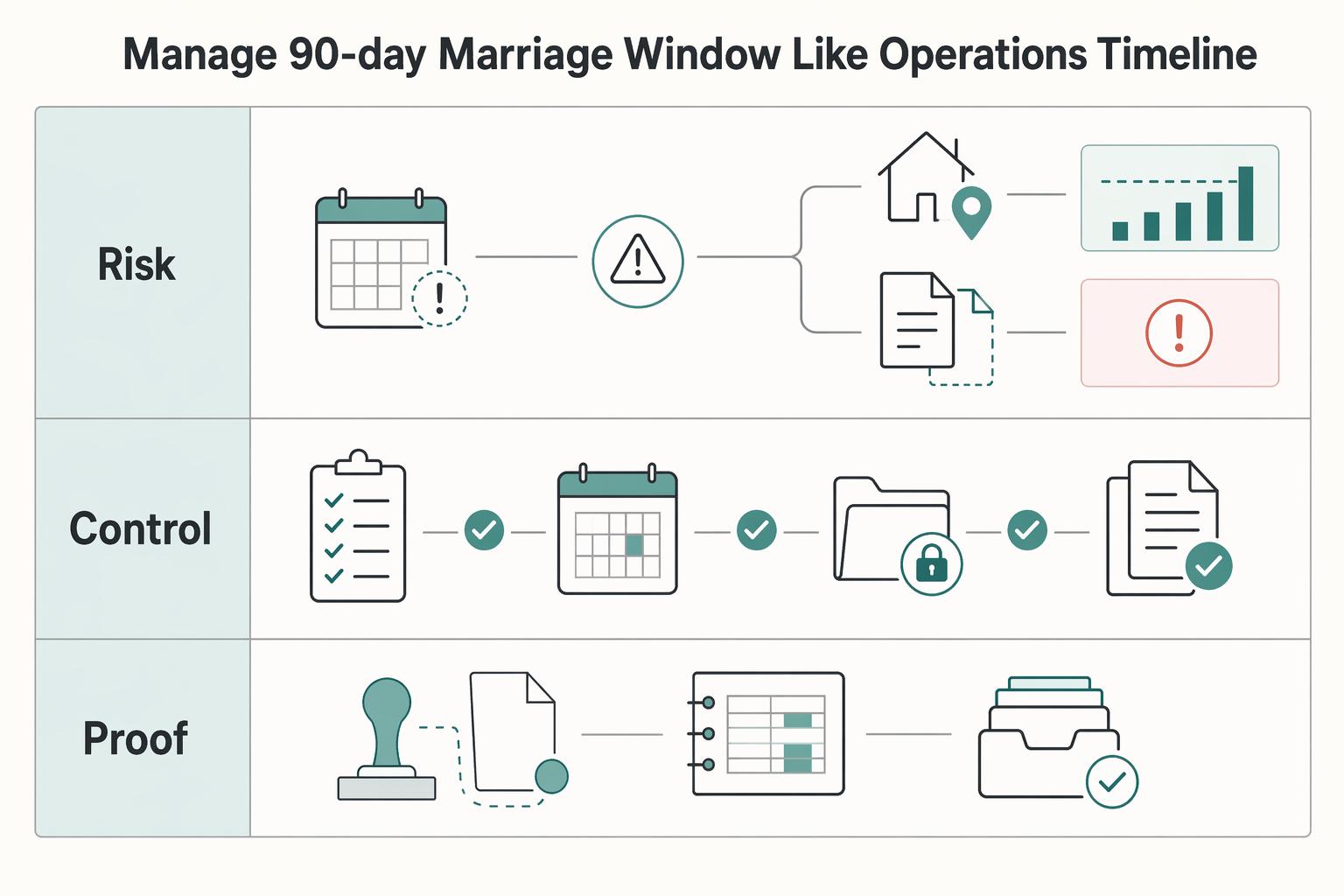
Step 3. Run the case in three phases. Phase 1 is case building: assemble eligibility and relationship evidence, and verify form accuracy. Phase 2 is filing and intake: submit the packet, receive notices, and complete biometrics. Phase 3 is active case management: respond to any Request for Evidence, update your address within 10 days if you move, and prepare for interview if scheduled.
Delays often come from incomplete packets, thin evidence, and avoidable filing or travel errors. The next sections show you how to keep those problems out of your case.
You might also find this useful: A Guide to the K-1 Fiancé(e) Visa Process.
Phase 1: Building Your Irrefutable Case (The Pre-Filing Strategy)#
If you want a cleaner filing and fewer surprises later, treat Phase 1 as risk control. Set up your document system first, then build the packet. That makes later decisions faster to check and easier to explain if questions come up. The checklist below focuses on organization and consistency; confirm immigration-specific requirements for your exact case from current official guidance before filing.
Step 1. Set up one joint project HQ#
Start with one shared folder that both of you can access. A simple structure like this works well:
01 Identity and civil documents02 Marriage documents03 Relationship evidence04 Financial documents05 Drafts06 Final filing set
Use consistent file names from day one. A format like YYYY-MM-DD_DocumentType_Person_V01.pdf makes later review much easier. Examples: 2026-03-10_BankStatement_Joint_V02.pdf, 2026-03-14_MarriageRecord_CertifiedCopy_V01.pdf.
Split ownership early so nothing important gets lost between you:
- You: identity records, prior immigration history, personal history details
- Your spouse/partner: financial records, plus signature-dependent items
- Shared: relationship evidence, gap checks, duplicate cleanup
As a checkpoint, both of you should be able to find the latest final version of any key file in under 30 seconds.
Step 2. Complete prerequisites in dependency order#
Handle the steps that make later documents possible before you start assembling the packet. In practice, that usually means verifying current process requirements, completing the required civil steps, and then getting the official record you plan to rely on.
This matters because downstream updates depend on finalized records. If you build too early, you usually end up with placeholders, inconsistent versions, and extra rework. If your case has a deadline or sequencing rule tied to entry or marriage, verify the current requirement before you rely on it.
Checkpoint: review the issued marriage record for exact name spelling, date, and place before you build the rest of the packet around it.
Step 3. Build relationship evidence by decision value#
Not all relationship evidence is equally useful. Start with documents that are objective, dated, and easy to review. Use lower-clarity items as support, not as the core of your case.
| Evidence area | Gather first | Good add-ons | Common weak evidence to avoid relying on alone |
|---|---|---|---|
| Shared finances and obligations | Documents already issued in both names, or formal add-on records tied to account/policy/housing updates | Recurring statements over time, beneficiary updates, ongoing shared-expense records | Brand-new accounts with no activity, isolated transfer screenshots, cropped images without names/dates |
| Shared address and daily life | Records that consistently place both of you at the same address or linked household obligations | Memberships, travel records, mail pattern over time | Conflicting addresses, undated screenshots, unlabeled home photos |
| Relationship timeline and social context | Small labeled photo set plus a clean timeline | Third-party statements, invitations, family event records | Large unlabeled photo dumps, repetitive statements, context-free social posts |
If a document needs heavy explanation to be useful, move it to the supplemental pile.
Step 4. Pressure-test financial documentation early#
Do not leave financial prep until the end. A weak or inconsistent financial package can slow down an otherwise solid filing, so test it early.
| Check | What to review |
|---|---|
| Role check | Confirm who is expected to provide financial documents under current rules |
| Income proof package | Collect tax records, wage or pay documentation, and short notes for gaps or variable periods |
| Backup plan | Identify alternate supporting records early if primary records may not be sufficient |
| Consistency check | Make sure names, dates, and figures align across all supporting files |
Run those four checks before you assemble the filing. Before you file, verify the current financial standards and required document list for your case. Then create a one-page index that maps each figure to the exact supporting file.
Phase 2: Assemble and Submit One Coordinated Packet#
Once your evidence is in shape, switch from collection to execution. First confirm that the filing basis still works, then assemble and submit one coordinated packet. That approach makes consistency checks easier than treating each form like a separate mini-case.
Step 1. Verify filing basis before assembly#
Before you assemble the packet, confirm the baseline K-1 adjustment requirements and record consistency:
| Filing basis check | What to verify |
|---|---|
| Marriage timing | You married the original U.S. citizen petitioner within 90 days of admission |
| Location at filing | You are physically present in the United States when filing |
| Adjustment form | You are properly filing Form I-485 for this adjustment request |
| Record consistency | Your marriage, identity, and entry records align |
If you did not marry the original petitioner, USCIS says you generally cannot adjust through another category based on that K-1 entry.
Keep the marriage certificate, K-1 entry evidence, and identity records together. Make sure name, date of birth, and admission details match across them. If your name changed after marriage, carry that change consistently through the whole packet.
Step 2. Prepare one coordinated form set#
Build the filing as one package with clear dependencies. Each form has its own role, but together they need to tell one consistent story.
| Form | Purpose | Dependency note |
|---|---|---|
| I-485 | Core application to adjust to lawful permanent resident status from inside the U.S. | Required anchor filing for this path; all identity and history details must match supporting records |
| I-864 | Legally binding financial support contract from the sponsor | Required for most family-based immigrants; sponsor evidence should be complete and internally consistent |
| I-765 | Request for employment authorization | Situational: include if you need work authorization while I-485 is pending |
| I-131 | Request for travel/parole documentation (including advance parole) | Situational: if you may travel while I-485 is pending, plan this up front because leaving without advance parole generally abandons the application |
| I-693 | Medical exam and vaccination record from a designated civil surgeon | Generally required for adjustment; keep the civil surgeon envelope sealed if you submit it. Verify current filing-date handling requirements |
Step 3. Assemble for officer readability#
A clean packet does not guarantee approval, but it can reduce avoidable friction. The goal is simple: help the officer find the legal basis, supporting evidence, and key records without hunting through the file.
| Recommended packet practices | Common assembly mistakes |
|---|---|
| Match packet order to your index (or cover-letter index, if you use one) | Random order that buries core eligibility documents |
| Keep each form with its own supporting evidence | Mixing sponsor, identity, and relationship records together |
| Use clear, legible copies of key identity and entry records | Cropped, dark, partial, or unreadable scans |
| Keep I-693 sealed and grouped with the filing it supports | Opening or misplacing the medical envelope |
| Use current direct-filing instructions for the I-485 mailing address | Mailing to an outdated address |
Use the USCIS I-485 evidence checklist as a cross-check, not as a substitute for the form instructions and legal requirements.
Step 4. Run final QA, then submit together#
Before mailing, do one full consistency review across identity, entry, marriage, and sponsor documents. This is the last easy chance to catch mismatched details.
| Final check | What to review |
|---|---|
| Identity and entry details | Names, dates of birth, A-Number (if any), passport number, entry details, and current address match everywhere |
| Sponsor income | Sponsor income figures are consistent with the financial evidence you included |
| Form edition | Multi-page forms use the same current edition throughout |
| Fees | Filing fees and edition checks were verified against current USCIS instructions |
| Mailing address | Mailing address matches the current USCIS direct-filing instructions for Form I-485 |
Include a short cover letter if useful. It is not required, but it can help if it does three things:
- States the legal basis
- Lists the packet contents in filing order
- Confirms final completeness before mailing
Phase 3: Manage the Case After Filing, Including the Interview#
After filing, the job shifts from assembly to case management. Use this phase as an organization framework, and verify current official instructions for any procedural decisions.
Step 1. Run a simple post-filing timeline#
Do not treat the case as passive once it is filed. Start one running timeline and update it whenever something changes.
- Record key case events, such as the filing date, mailing proof, notice dates, and follow-up actions.
- Save each notice in two formats: PDF and printed copy.
- Keep your mailing address accurate and reliable for physical mail.
If progress looks slow, check current official information first. Then decide whether to contact USCIS, speak with counsel, or use another escalation path. Before you escalate, keep dated notes and copies of everything.
Step 2. Maintain evidence with a monthly checklist#
The easiest interview prep is steady maintenance. If you update evidence a little at a time, you do not have to rebuild your records later.
This is a personal organization checklist, not an official USCIS-required evidence list.
| Category | What to keep updating | Quick quality check |
|---|---|---|
| Financial | Joint account statements, shared credit activity, insurance records | Both names, correct address, clear dates |
| Housing | Lease or mortgage updates, utility records, home/renter insurance | Address consistency across documents |
| Daily life | Shared subscriptions, travel records, household purchases, routine records tied to shared life | Download early so records are not lost later |
| Social proof | Photos with context, invitations, dated messages, event traces | Add short labels: date, place, people |
Focus on traceable continuity, not sheer volume.
Step 3. Protect pending status#
While your case is pending, work and travel decisions can create problems. Treat both as areas where you should verify first and act second. Confirm current rules before you rely on them.
Keep a small status-protection folder with your pending-case notices, identity documents, and any approved interim documents related to work or travel. Also, do not treat forum timelines as policy, even when many people are repeating the same thing.
Step 4. Rehearse for consistency, not performance#
If an interview is scheduled, prep is not about sounding polished. It is about making sure your documents, your timeline, and your answers line up.
Build one interview set that is easy to carry and easy to review together, as your own prep format rather than a required binder structure:
- Filed forms and filing copy
- Receipt and other case notices
- Identity, entry, and marriage records
- Updated shared-life evidence, organized by month or category
- One-page relationship timeline
Then do a consistency check together on key dates, address history, major events, and details that appear in your forms. On the day, confirm logistics in advance and decide who is carrying the original documents.
Step 5. Do the post-approval handoff immediately#
If the case is approved, close the admin loop right away. That keeps routine life from lagging behind your status.
- Update records that affect daily operations, such as employment records if needed, state ID or driver records, and banking or institution profiles.
- Store approval and card copies securely.
- If approval is conditional, calendar the next filing milestone now and verify the current Form I-751 timing and requirements.
For the next stage, see A Guide to Conditional Green Cards and Removing Conditions (Form I-751).
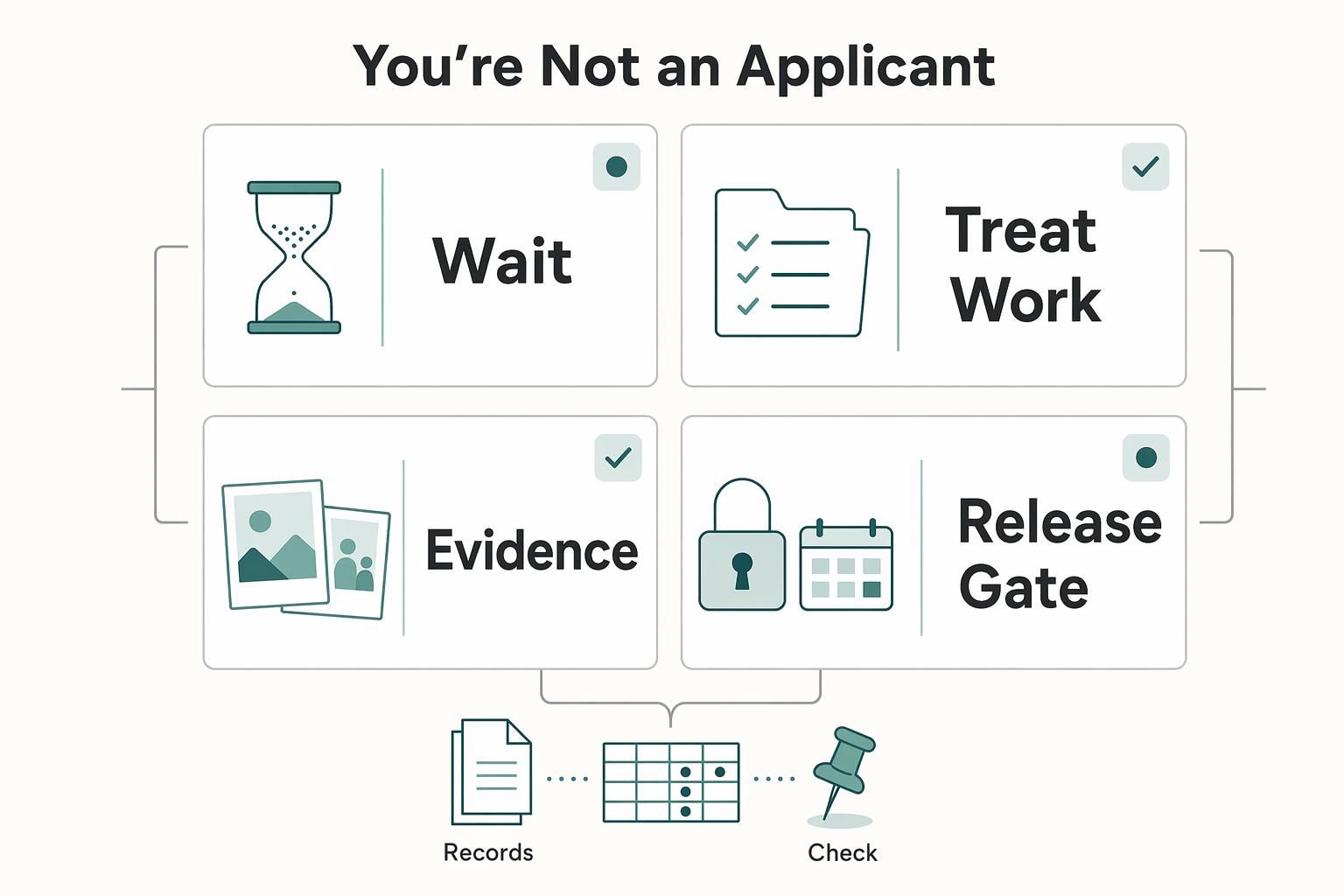
You're Not an Applicant; You're the Project Manager of Your Future#
The throughline in this process is simple: keep your case accurate, current, and easy to verify at every milestone. In practice, the cases that avoid preventable delays usually do the boring work early: confirm the filing basis, submit one consistent packet, track every notice, and keep building shared-life evidence while the case is pending.
What you control now:
- Role clarity: Keep the K-1 entrant and the U.S. citizen petitioner clearly identified across every form, record, and supporting document.
- Filing accuracy: Verify the form set, fees, editions, and mailing address on the day you file.
- Post-filing readiness: Keep your address current, protect pending status, and refresh your shared-life evidence before any interview.
| Passive behavior | Early behavior |
|---|---|
| Wait and assume details will sort themselves out | Keep one organized filing set and update it as the case moves |
| Treat work or travel like routine decisions | Verify the current rule before you rely on it |
| Stop collecting evidence after mailing the packet | Add dated joint records each month so interview prep is lighter |
| Let approval paperwork sit in a drawer | Update records and calendar any next filing milestone immediately |
If your case later includes a conditional-residence step, calendar the next filing milestone and verify the current timing before you rely on it. For that stage, see A Guide to Conditional Green Cards and Removing Conditions (Form I-751).
Once your status path is clear, you can contact Gruv to confirm what setup is available for your use case.
Frequently Asked Questions
Can you work while your case is pending?
No. A pending I-485 does not give you work authorization by itself. If you need to work, file Form I-765 and wait until you have valid work authorization in hand before starting employment.
Can you travel after filing?
Usually not. USCIS generally treats departure without approved advance parole while the I-485 is pending as abandonment, and even with travel documents return is not guaranteed. Confirm whether any status based exception applies to your situation before traveling.
What evidence matters most, and how should you prep for the interview?
The strongest evidence is consistent, current proof of a real shared life. Bring organized, updated financial, housing, insurance, daily-life, identity, entry, and marriage records, plus your filed packet, notices, and a short relationship timeline. Review dates, addresses, and major events together so your documents and answers line up.
Do you need a medical exam again if you already had one for the K-1 process?
Do not assume your earlier K-1 medical automatically satisfies adjustment requirements. Verify the current Form I-693 instructions before filing, including current USCIS handling rules. Missing I-693 when required, or submitting an unsealed civil surgeon envelope, can cause rejection or delay.
How much does this cost?
Do not rely on older posts or articles for costs. Verify each fee on filing day with the USCIS Fee Calculator and filing-fees page, because incorrect fees can cause rejection. Your budget may include Form I-485, Form I-765, Form I-131, the medical exam, and translation or copying costs, depending on your case.
Before you file, what should you confirm one last time?
On filing day, confirm that you married the U.S. citizen petitioner within 90 days of K-1 admission and that your I-485 packet is complete for your category, including Form I-864 when required. Recheck fees, Form I-693 handling, and the current USCIS mailing address. Make sure your mailing address is stable, you are ready to report any move within 10 days, and you will wait for any needed work or travel approval before acting.
Try a related tool
Researched and edited by the Gruv editorial team. Gruv builds cross-border billing, payouts, and finance-operations software for global businesses.
Sources
Educational content only. Not legal, tax, or financial advice.
Related Posts

The 2026 Global Digital Nomad Visa Index for 50+ Countries
Start with legal fit, not lifestyle filters. The practical order is simple: choose a route you can actually document, then decide where you want to live. That single change cuts a lot of wasted comparison work and stops you from falling in love with places that were never a real filing option.

183-Day Rule Tax Myths That Trigger Residency Filing Mistakes
If you are a mobile freelancer or consultant, start here: the "183 day rule tax" idea is not a single universal test. It is a shortcut phrase people use for different residency rules that do not ask the same question. If you mix federal and non-federal residency logic, you can create filing risk even when your travel calendar looks clean.
K-1 Fiancé(e) Visa Process: Timeline, Eligibility, Filing, and 90-Day Marriage Rule
Think of the **K-1 path** as a series of gates, not a single application. The order is `Form I-129F` with `USCIS`, `DOS` visa processing, U.S. entry if a `K-1 nonimmigrant visa` is issued, marriage within `90 days` of admission, and then `Adjustment of Status` toward a `Green Card`.