
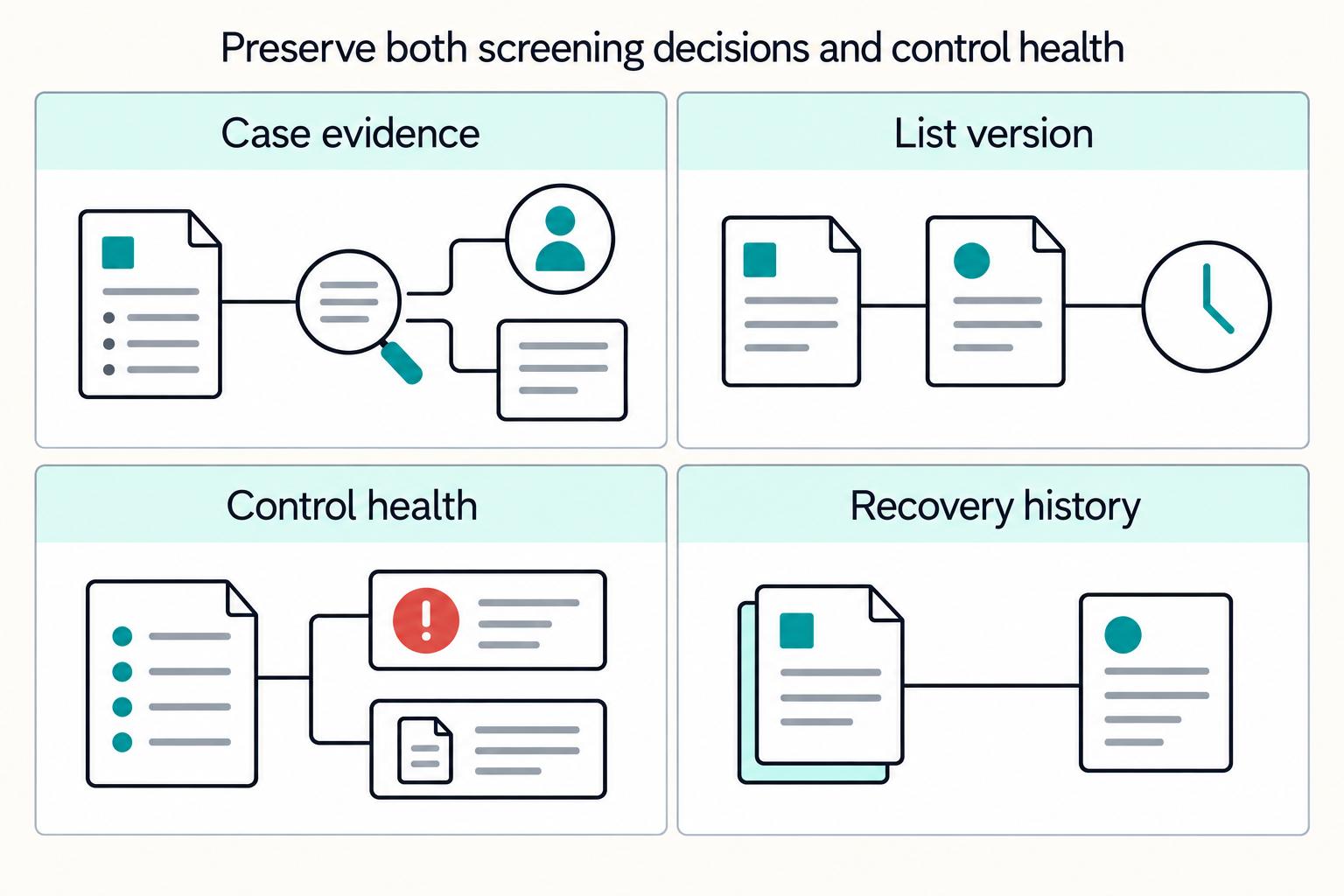
Run sanctions screening at onboarding, right before payout approval, and on a periodic rescreening cadence. The most important checkpoint is the release-stage hold, because it can still stop a disbursement when a potential SDN hit appears. Keep decision evidence tied to the exact list artifact and timestamp, including ingest validation and rollback history. Use similarity scoring to order reviews, not to auto-clear alerts, and escalate ambiguous ownership or program-interpretation cases before release.
A common failure is treating sanctions screening like background monitoring with no release consequence. Post-settlement alerts can still support investigation, but they are a weaker primary control. A potential SDN hit should create a clear pre-execution hold point for review, tied to the OFAC SDN List snapshot or list package your system actually used.
SDN_ENHANCED.XML. These support automated checks and help show which list version informed a decision.The operating constraint is simple. Updates do not follow a fixed timetable. Names are added or removed as needed, not on a guaranteed daily or weekly schedule. Your control should therefore prove the source file, retrieval or publish time, parse success, and list version used for each decision. Even a basic last-updated check helps. For example, one SDN List Data Center snapshot shows "Last Updated: 4/3/2026." OFAC's FAQ guidance on list updates is a better control reference than assuming a daily batch.
That scoring is useful, but limited. OFAC's sanctions list search FAQ notes that fuzzy logic applies only to name fields, while other fields use character matching. Scores can help order a queue, but they do not confirm or clear a match on their own. When a possible hit appears, do additional research before release.
This guide follows that operating reality. It covers where to run SDN and broader global watchlist checks in the payout lifecycle, what evidence to retain so decisions can be reconstructed, and when alerts should move from operations to compliance or legal. The aim is disciplined coverage without building controls your teams cannot sustain.
If you want a deeper dive, read A Guide to OFAC Sanctions Screening for Global Businesses.
Set the governance decisions in policy before you configure screening and reporting workflows. If you skip that step, different teams will apply different standards, and you will struggle to explain decisions consistently.
Step 1: Define scope and unresolved points in writing. Document which sanctions lists and broader watchlist sources are in scope, which parties and payout stages you will screen, who owns the legal or compliance decision, and the effective date. If treatment is still unclear for a program, geography, or party type, say so plainly and route it for a decision before implementation.
Step 2: Freeze a version-one baseline after sign-off. Write down exactly what is in scope for launch: the list bundle, trigger points, ownership rules, and evidence requirements. Also state what is intentionally out of scope for now. A clear baseline is better than implied coverage, and it gives engineering, operations, and audit teams one standard to work from.
Step 3: Split policy authority from day-to-day operations and keep records. Assign one owner for policy decisions and one owner for queue and case operations. Document operational decisions against approved policy and keep the required records. That record discipline matters because choices such as list scope, rescreening cadence, and escalation rights affect later changes.
Start with evidence, not tooling. OFAC does not publish one universal screening checklist, so you need a documented, risk-based approach that fits your actual controls.
Step 1: Gather your current compliance policies and control documentation. Begin with the latest approved policies, procedures, and control narratives used in current customer and payment operations. Use them to confirm where identity and ownership information, escalation paths, and case handling already exist, so screening fits into current operations instead of becoming a parallel process.
Verification point: include authoritative rule sources, not only vendor summaries. For U.S. exposure, capture the relevant OFAC implementing regulations and Sanctions Programs and Country Information pages, and keep a recency check against OFAC FAQs, updated August 21, 2024.
Step 2: Map the payment surfaces where a party or payment may need review. Document your real end-to-end flows, then mark where screened parties appear and where action is still possible.
The useful output here is a working table or diagram that shows where party or payment data enters, where holds are possible, and which team owns each decision point.
Step 3: Build a source inventory for sanctions data and downstream consumers. List each sanctions data source, update path, and internal consumer so scope and ownership are explicit. Include vendor dependencies, if any, legal or policy ownership of source scope, business approval ownership for changes, and the systems that consume list data.
Verification point: define each source by actual scope, not by feed name alone. If your launch scope includes the SDN and Blocked Persons List or other OFAC program content, name that directly so engineering and operations are working from the same baseline.
Related: OFAC Compliance for Payment Platforms: How to Screen Every Payout Against the Sanctions List.
Define the boundaries explicitly: what is approved now, what is pending, and what is still unknown. For sanctions operations, that usually means list scope, party scope, trigger points, and jurisdiction or product boundaries. If you do not publish those boundaries, teams will read feed labels as complete coverage and make inconsistent decisions.
Create a coverage register that separates candidate list bundles from approved coverage. You can track labels such as the SDN and Blocked Persons List, other OFAC program content, and broader global watchlist sources already approved in policy, but treat labels as placeholders until approval is documented.
For each row, record jurisdiction or product intent, party scope, owner, approval status, and the internal policy or legal record that supports inclusion. Verification point: each row should show the approver, effective date, and last review date.
Set coverage as a documented policy choice, not a tooling assumption. State which lists, party types, trigger points, and operational evidence requirements are in scope for launch, and what is intentionally out of scope for now.
Also record the approving owner, effective date, and any change restrictions in your governance process. A fixed launch baseline is easier to test than coverage that exists only by implication.
Publish one market-variance rule with fixed statuses. Use the same status set in policy, launch checklists, and operations tooling.
| Status | Meaning |
|---|---|
| Required | Rollout is blocked until sanctions coverage is active and approved |
| Recommended | Coverage should be used where data and operations support it, but partial rollout is allowed |
| Not enabled yet | Market is out of scope for now, with a named owner and review date |
| Unknown | No one should assume coverage exists |
Publish unknowns where operators actually work, not in private notes. If legal review is pending, a list bundle is configured but unapproved, or record-keeping obligations are not operationalized, state that directly in control notes, case tooling, and launch checklists.
Mark list scope, party scoping, refresh cadence, and enforcement assumptions as Unknown unless a separate policy source approves them.
Keep a lightweight evidence pack: the current register, approval record, effective date, and open issues log. A practical test is whether a new analyst can answer, from that pack alone, which coverage is approved for a market and which scope items are still unknown.
Related reading: How to Evaluate PCI DSS, SOC 2, and ISO 27001 for Payment Platforms.
Put sanctions triggers where they can still stop funds from moving: at onboarding, immediately before release, and through periodic rescreening. That layered design helps keep screening current as parties, lists, and payout context change.
| Trigger point | Purpose | Operational note |
|---|---|---|
| Onboarding | Catch obvious risk early when you create or approve a payee or business profile | Not permanent clearance; case records should show who was screened, which list bundle or version was used, when it ran, and the outcome |
| Before payout release | Hold a potential match for review before settlement | Last chance to prevent disbursement; do not skip the release-time decision |
| Periodic rescreening | Close the gap when a previously cleared party is later listed or newly linked to restricted exposure | Define one written cadence, assign ownership, and track due dates in case or account records |
Run screening when you create or approve a payee or business profile. Use your approved list bundle, including OFAC sanctions lists and other watchlist sources defined in your scope.
Onboarding checks catch obvious risk early, but they are not permanent clearance. OFAC measures can range from blocking property of designated parties to broader transaction prohibitions, and prohibitions can vary by program.
Verification point: case records should show who was screened, which list bundle or version was used, when it ran, and the outcome.
Run a pre-payout screen immediately before funds are released. If a potential match appears, hold the payout for review before settlement.
This is the critical control point because it is your last chance to prevent disbursement. In high-velocity flows, combine entity-level checks with transaction-time checks. In lower-volume flows, keep onboarding plus strict pre-release holds, but do not skip the release-time decision.
Operator test: if money can leave without a sanctions decision tied to that release event, the pre-payout control is not reliable.
Set periodic rescreening for active parties after onboarding. This closes the gap when a previously cleared party is later listed or newly linked to restricted exposure.
Do not assume a universal interval from the available grounding. Define one written cadence that your operations team can test, assign ownership, and track due dates in case or account records.
Program awareness matters here. OFAC prohibitions vary by program, and some can apply to non-U.S. persons, so cross-border payout books still need explicit trigger logic.
Match trigger intensity to payout velocity and operating model. The goal is to control both failure modes: missing true risk and creating avoidable over-blocking.
| Operating pattern | Minimum trigger design | Main tradeoff |
|---|---|---|
| High payout velocity | Onboarding, transaction-time pre-payout screening, periodic rescreening | More alert and review load, lower chance of releases based on stale screens |
| Lower payout volume | Onboarding, strict pre-release screening, periodic rescreening | Slower release decisions, tighter manual control |
| Batch-heavy payouts | Onboarding plus pre-batch and pre-release checks | Batch timing can hide stale screens if checks happen only once upstream |
Prove that screening is active with two cadence controls: list refresh cadence and rescreening cadence. For list refresh, record upstream publication time, ingest success time, and production publish time for OFAC and other approved lists. Then alert on lag or breaks against your internal standard. For rescreening, track last screened date, next due date, and exceptions. Your operations team should be able to verify, from records alone, that screening ran before release on current list data.
Need the full breakdown? Read Global Payment Processing Infrastructure Choices for Platforms.
Tune matching in tiers, then escalate based on risk and data quality, not score alone. The point is to avoid both errors: treating every fuzzy hit as a true match, or suppressing alerts so aggressively that real risk becomes easier to miss.
Set separate bands for exact, close, and weak matches across the sanctions lists you screen, for example the OFAC SDN and Consolidated lists, and keep names and aliases separate from identifier fields. For OFAC Sanctions List Search, only the name field uses fuzzy logic. Other fields use character matching logic.
Use OFAC's search behavior as a reference point when you define your internal bands. A score of 100 indicates an exact match, lowering the minimum name score broadens results, and a minimum name score of 50 returns names the tool treats as 50% similar. Your policy should state which band your team may auto-clear, which should hold, and which needs more data before any decision.
Verification point: each alert record should show the matched field, whether it was a primary name or alias, the threshold or band applied, and the list bundle version used.
When confidence is ambiguous and payout risk is high, route to manual review before release. When confidence is low and profile data is weak, collect better KYC or KYB data before deciding.
Lowering thresholds broadens the result set, but it can also increase alert volume. Over-screening slows operations, while under-screening increases exposure. When the profile is incomplete, treat the alert as a data-quality escalation instead of forcing a clear or reject decision.
Do not retune from gut feel. Require analysts to tag cleared alerts with a false-positive reason so you can see where noise is actually coming from.
Use a compact taxonomy such as common-name collision, alias-only mismatch, incomplete KYC or KYB data, identifier mismatch, and ownership ambiguity. Then review category counts on a fixed cadence and log each tuning change with before-and-after alert volume and disposition mix.
For internal control strength, require second-person review on high-ambiguity ownership cases. Treat this as a policy control, not as a claim that second-person review is always legally required.
Keep a complete case file: ownership analysis used, entities and owners screened, documents reviewed, and the written rationale for the decision. Close the case only after reviewer sign-off.
For a step-by-step walkthrough, see OFAC, PEP, and Adverse Media Screening Decisions for Payment Platforms.
Set escalation ownership before alerts arrive. Every sanctions case should have a clear current owner, a clear decision-maker, and a traceable approval path. Potential matches should not sit in an unowned queue, especially when payout release depends on the outcome.
Use named roles with defined authority boundaries at each stage. At minimum, make clear who investigates potential matches and who makes the final disposition.
Keep authority explicit in policy: who can place a hold, who can clear, and who can approve release. Verification point: each case file should show current owner, escalation timestamp, hold status, and final approver.
Do not rely on ad hoc judgment alone. Document internal triggers that require review or escalation, such as:
For many teams, sanctions screening is not just an operations preference, and failures can carry serious consequences. Also separate sanctions-list routing from broader watchlist routing. Sanctions lists are a type of watchlist, but they are not the same thing, and treating them as identical can create compliance problems.
Use a short set of internal outcomes so similar facts are handled consistently. Treat these as internal control labels, not universal regulatory categories, and require written rationale for every outcome.
| Outcome | Use |
|---|---|
| Clear | Resolved as false positive with support for release |
| Hold | More investigation or better KYC or KYB data needed before funds move |
| Reject | Onboarding or transaction should not proceed |
| Terminate relationship | Relationship should not continue based on risk decision |
Potential matches need investigation before you proceed, so each escalated case should contain enough evidence to support and defend the decision. At minimum, keep alert details, list source and version, matched fields, KYC or KYB records used, analyst notes, hold and release timestamps, and final disposition.
If legal reviewed the case, log the handoff and retain the conclusion summary. A disposition without supporting evidence is a control gap.
This pairs well with our guide on Continuous KYC Monitoring for Payment Platforms Beyond One-Time Checks.
Treat list ingestion as a control gate. Publish from one canonical path only, and block promotion to production screening if integrity checks fail.
Use one approved ingestion path and make it the only publish source for production screening systems. Route all downstream consumers from that same published copy.
This keeps results consistent when lists change quickly. It also helps when scope expands, since OFAC maintains several lists with different purposes. Verification point: for each published update, record source, retrieval time, file version, publish decision, and the version active in production.
Document which formats you accept and any parser fallback behavior you allow. Keep that order explicit and stable in operations.
The key is internal consistency, not a regulator-mandated sequence. Log fallback events so degradation is visible and reviewable.
Before promotion, run integrity checks that confirm the file can be parsed and is usable by your screening application. If a check fails, keep the current known-good version active and investigate.
Then manage change volume with deltas where possible. Full rescreening after every update is expensive and often unnecessary. Exposing deltas to screening engines lets you focus on added, modified, and removed records.
Keep the prior published version available so you can recover quickly from a bad ingest event without creating a screening blind spot.
Your rollback record should show the previous active version, failed file reference, validation result, approver, and the timestamp when normal processing resumed.
An evidence pack is only audit-ready if you can reconstruct both the decision and the control state at the time. Make evidence capture mandatory before case closure, and keep case evidence separate from control-health evidence.
Use an internal minimum field set to replay the decision for every alert or blocked payout: screened party, trigger point, exact list version used, match details reviewed, analyst actions, final disposition, and step-by-step timestamps. Map those timestamps to your OFAC and AML controls so reviewers can see what fired and when.
Record list context precisely. Capture which in-scope list produced the hit and the published version identifier used at screening time, not a generic note like "current list."
Use a simple replay check on closed cases: Which version was active, what matched, who decided, and why the case was cleared, held, rejected, or escalated? If those answers depend on memory or free text alone, the pack is too thin. Store the reviewed match snapshot, not just the latest profile state. Otherwise, list updates or profile edits can break traceability.
Case records alone are not enough. Also retain control-operation evidence: screening job health, list update logs, failed and retried jobs, publish events, and exception queues with aging.
This is where mundane failures show up: delayed files, missing fields, or screening against an older snapshot. Your records should show the active published version, prior rollback version, and version tagging for changed records.
If an update fails validation, your trail should show that the prior good version stayed active, who approved that decision, and when normal updates resumed. Run a routine reconciliation across scheduled jobs, completed jobs, and the production-active list version. Treat misalignment as a control exception.
Use one evidence store with role-specific views so each function can act quickly without unnecessary noise.
| Audience | What they need to see | What to avoid |
|---|---|---|
| Compliance | Open alerts, aging, analyst actions, list versions, escalations, final dispositions | Finance-only payout totals without case context |
| Legal | Potential matches, ownership uncertainty, rationale, prior similar cases, blocked or rejected decisions | Full queue noise from low-confidence false positives |
| Finance | Blocked payouts, release status, amount, beneficiary, operational aging, settlement impact | Sensitive investigative notes beyond need to know |
| Risk owners | Trends by product, customer type, geography, false-positive categories, unresolved exceptions | Raw case narratives for every alert |
This separation keeps accountability clear: compliance manages queue control, legal handles hard calls, finance tracks held funds and releases, and risk owners monitor patterns.
Treat identity-data quality as a formal dependency and set a periodic attestation cadence based on your risk profile. That cadence is a management choice, not a published OFAC requirement.
Sample the fields that most affect screening quality in your program, such as legal names, aliases, dates, and country data. If false positives rise or ambiguous matches remain unresolved, check KYC or KYB data quality before changing screening thresholds.
Define retention with compliance and legal based on your jurisdictional obligations and investigation needs. Preserve an immutable event trail, restrict full-case access by role, and provide masked or summary views where teams only need payout status and release decisions.
The final test is restoration: pick a historical case and confirm you can reconstruct the list version, alert details, analyst timeline, escalation path, and payout state from retained records. If you cannot, the pack is not audit-ready.
Use this evidence checklist to map control owners, job health logs, and escalation records in one place using the Gruv docs.
Put the sanctions decision before money movement. In Gruv terms, a conservative control design is to avoid executing a payout or releasing a batch until sanctions status is reviewed and recorded. OFAC prohibitions vary by program, so exact checkpoint timing should be defined per program rules.
A common pattern is to gate sanctions review at payout request time, then check again before batch release. The first gate can stop risky requests early. The second can catch changes while a payout is waiting in queue, approval, or retry.
Use an explicit state such as pending sanctions review or held for sanctions so downstream systems do not treat an incomplete check as clear. Keep retries idempotent in Gruv so reprocessing does not create duplicate release instructions.
A quick control test is to sample a payout and confirm you can show request time, sanctions decision time, release authorization time, and the actor or service that moved it from hold to clear.
A sanctions hold is operational only if it is visible in the money trail. Link the payout request, sanctions decision or case, release or reject action, and resulting ledger posting into one traceable chain. Traceability should work both ways:
If a payout is released, record who approved release and which hold was lifted. If it is rejected, avoid recording it as a generic cancel or expire path.
If provider updates arrive asynchronously, do not let timing override an active sanctions hold. A provider update like processing or paid should not auto-advance a payout when an internal sanctions hold is still active.
On each material status change, reconcile internal sanctions state, outbound instruction log, provider status, and ledger state. If they conflict, route to an exception queue instead of silent auto-healing. Use consistent internal hold semantics across providers, even when provider status vocabularies differ.
Keep sanctions outcomes aligned with KYC, AML, and payout routing gates. A sanctions clear should not override unresolved compliance risk, and routing logic should not bypass a sanctions hold by switching provider paths.
Program variance is the key control point. OFAC sanctions can require blocking property or broadly prohibit transactions, and prohibitions vary by sanctions program. Some OFAC prohibitions also apply to non-U.S. persons. For hard cases, document the program context and confirm review against the applicable OFAC implementing regulations and sanctions program information.
If you enforce one consistency rule, make it this: clear, hold, reject, and escalate should mean the same thing across KYC, AML, sanctions, and payout operations.
The main recovery pattern is simple: separate what your source evidence actually supports from what your organization has chosen as policy. In sanctions work, teams often over-read feed labels, vendor summaries, or old control documents and then operationalize assumptions as if they were settled requirements.
Do not treat a feed label or vendor summary as proof that every relevant sanctions list, party type, or jurisdiction is covered. The safer path is to verify actual scope against your approved policy and the authoritative OFAC materials you rely on.
Recover by labeling each rule as evidenced, policy choice, or not yet evidenced. For each control in policy, keep the approving authority or internal decision record attached to that rule.
Do not imply ownership from the fact that a list is ingested or a screen runs. Document who owns source scope, who owns operational review, and who owns the records needed to support the control.
Recover by recording owner, effective date, and change history for each obligation. If a control cannot be traced to either source evidence or an internal approval record, treat it as implementation behavior, not governed policy.
When a cross-border payout raises program-scope questions, treat it as an explicit decision instead of letting operations infer the answer from routing or geography alone. Cross-border payout books still need clear trigger logic because OFAC prohibitions vary by program and some can apply to non-U.S. persons.
Recover by documenting why the case was treated as a program-scope or legal-review question, where the decision applies, and who accepted the treatment.
The strongest recovery move is operational discipline around record-keeping and audits. Make case closure contingent on complete evidence fields, including reviewer, timestamps, rationale, and the data version used.
Recover weak retention by sampling closed cases and rejecting any that cannot be reconstructed end to end. If you cannot prove how a decision was made, your control is not audit-ready.
Treat sanctions screening as unfinished until scope, trigger points, escalation, ingestion, and evidence all work together before payout release.
Define list scope first. Confirm your baseline U.S. sanctions-list coverage for the programs you operate under, then add broader global coverage where your policy or market exposure requires it. Teams should be able to state, in writing, what is covered and what is not.
Set trigger points that control money movement. Run screening at onboarding, during transactions, including pre-payout, and through periodic rescreening. A control is only effective if potential hits route to hold-and-review before release, not after settlement.
Tune matching with data quality in mind. Match logic should fit your risk, not just queue volume. When identifiers are weak, improve underlying customer and counterparty data before closing alerts. Spreadsheet-only, last-minute screening is a reliability risk in fast-moving operations.
Assign escalation rights before hard cases appear. Document who can clear false positives, place or maintain holds, and decide on rejection or termination, and when to involve legal. This matters because OFAC prohibitions can vary by program and can include blocking or transaction-prohibition questions.
Validate list ingestion on each update. If you use a Sanctions List Service or another source, treat ingestion as a control step: verify parse success, format compatibility, publish timing, and rollback readiness before data goes live.
Prove operation with an audit trail. Keep records that reconstruct decisions end to end: list version, match details, reviewer, timestamps, disposition, rationale, and exception aging. Sample recent cases to confirm the trail is complete without manual reconstruction.
If any box is still soft, treat it as an open control risk. The process is only reliable when it can stop a payout when needed, handle data failures, and leave a clear audit trail. If you need to validate sanctions hold or release controls against your payout setup and market coverage, talk with Gruv. ---
In practical terms, SDN screening typically means checking payee and related-party names, plus any available identifiers, against sanctions data before release decisions. OFAC administers and enforces sanctions, and many programs can require blocking property and interests in property or prohibiting certain transactions. When a potential match appears, a prudent approach is to pause and review before payout.
Use the SDN List as a core U.S.-linked control, but do not assume it is sufficient in every market or risk context. This evidence does not establish that UN or EU coverage is universally required, so broader watchlist scope should be an explicit policy decision. Keep sanctions screening and broader watchlist screening distinct so coverage assumptions stay accurate.
There is no single mandatory universal OFAC refresh or rescreening cadence in this source set. Define your own cadence, assign ownership, and keep evidence that updates were published to production screening. For each alert decision, consider retaining the list or data version used at that time.
False positives can rise because sanctions name screening relies on similarity matching. In OFAC Sanctions List Search, fuzzy logic applies only to the name field, the default score is 100 for an exact match, and lowering toward 50 broadens results. Triage should prioritize stronger identifiers you already hold, and if those fields are weak, improve the underlying customer or business data before closing the case.
Keep records that let you reconstruct each decision end to end. A practical record set can include the data version used, returned match results, reviewer, timestamps, disposition, and written rationale. Also retain evidence that controls operated as designed, such as screening-data update and alert-handling logs.
Escalate to legal when the case moves beyond straightforward identity resolution and requires legal interpretation. That includes potential true SDN matches, possible blocking or transaction-prohibition consequences, or uncertainty about how restrictions apply, including for non-U.S. persons who may be subject to certain OFAC prohibitions. Operations can close clear false positives, but unresolved ambiguity should not be cleared for speed.
A financial planning specialist focusing on the unique challenges faced by US citizens abroad. Ben's articles provide actionable advice on everything from FBAR and FATCA compliance to retirement planning for expats.
With a Ph.D. in Economics and over 15 years of experience in cross-border tax advisory, Alistair specializes in demystifying cross-border tax law for independent professionals. He focuses on risk mitigation and long-term financial planning.
Includes 3 external sources outside the trusted-domain allowlist.
Educational content only. Not legal, tax, or financial advice.

Move fast, but do not produce records on instinct. If you need to **respond to a subpoena for business records**, your immediate job is to control deadlines, preserve records, and make any later production defensible.
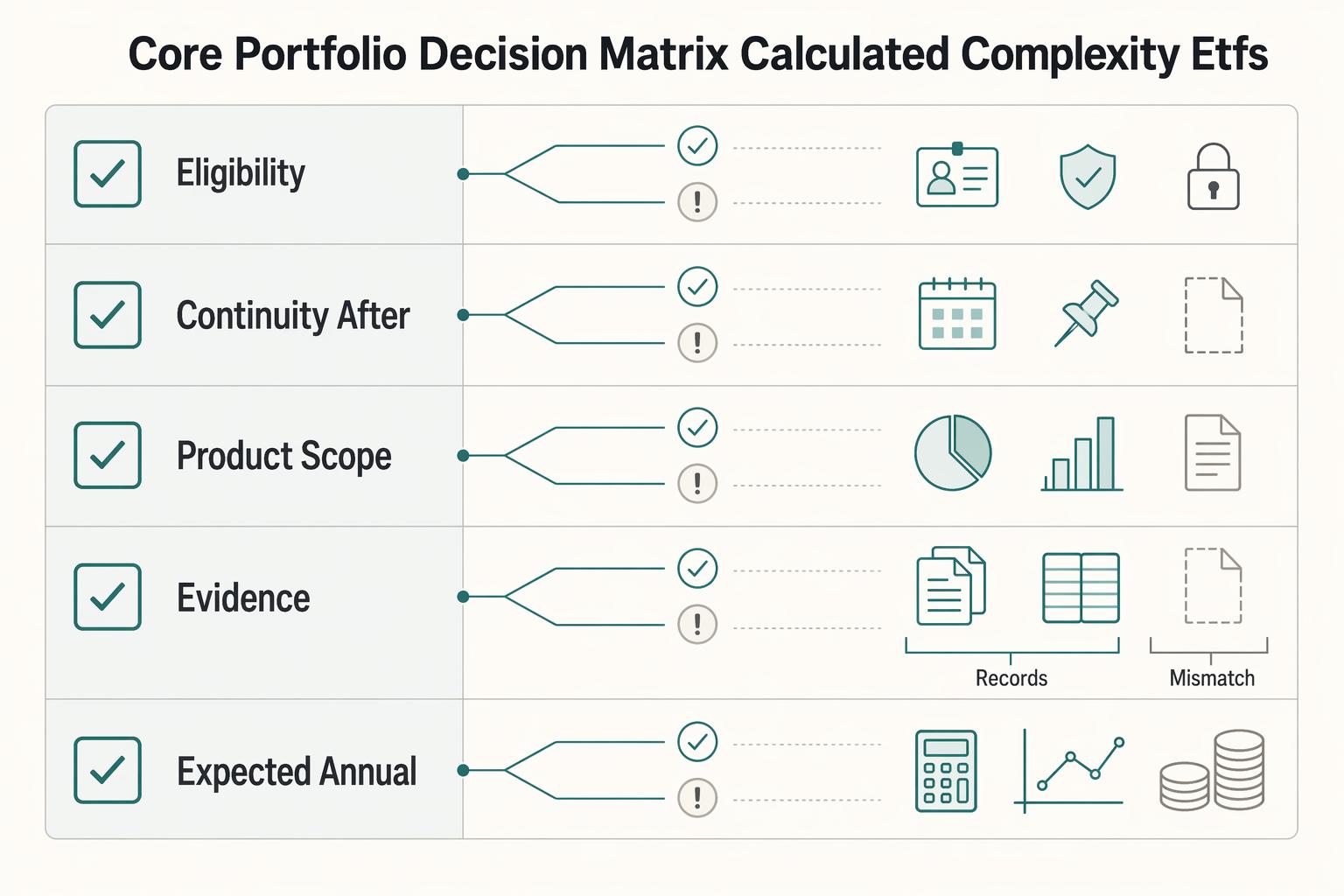
The real problem is a two-system conflict. U.S. tax treatment can punish the wrong fund choice, while local product-access constraints can block the funds you want to buy in the first place. For **us expat ucits etfs**, the practical question is not "Which product is best?" It is "What can I access, report, and keep doing every year without guessing?" Use this four-part filter before any trade:

Stop collecting more PDFs. The lower-risk move is to lock your route, keep one control sheet, validate each evidence lane in order, and finish with a strict consistency check. If you cannot explain your file on one page, the pack is still too loose.

