
Quick Answer
OFAC sanctions screening checks transaction parties and relevant ownership against applicable sanctions restrictions. Investigate potential matches and record the decision before releasing payment. A name search alone cannot establish whether an unlisted entity is blocked, whether a transaction is prohibited, or whether an authorization applies.
Build sanctions review into payment approval#
Treat OFAC sanctions screening as a payment control, not a formality. If your business touches cross-border counterparties or transactions that may fall under U.S. jurisdiction, screening can help protect your ability to move money when pressure is high. The Office of Foreign Assets Control (OFAC), within the U.S. Treasury, can block property, freeze assets under U.S. jurisdiction, and prohibit certain transactions involving sanctioned parties, countries, or regions.
This is not only a large-enterprise issue. Certain OFAC prohibitions can also apply to non-U.S. persons, so smaller firms and independent professionals can face blocked or delayed transactions too. In practice, you can have a signed contract and an approved invoice, then still get stuck because checks were late, unclear, or undocumented.
This guide focuses on three things: define what gets checked, set clear timing, and keep decision records that hold up under review. Start with a minimum control set and run it consistently:
- Check parties that can affect funds movement, including counterparties, payees, and intermediaries.
- Check at defined points in your process, including when key payment details change.
- Record the decision trail: who reviewed, what was checked, when it was checked, and whether it was cleared, escalated, or held.
Aim for a risk-based approach, not perfect prediction. OFAC guidance describes five essential compliance components: management commitment, risk assessment, internal controls, testing and auditing, and training. For a smaller business, the goal is clear ownership and repeatable checks you can explain with documents.
Use this test from day one: if someone outside your team asked why a payment was released, could you show the record in under five minutes? If the answer is no, your exposure is operational and compliance-related because your team cannot prove what happened.
Keep one tradeoff in view: success is not zero alerts. Success is staying operational when sanctions risk appears because your checks, timing, and records are already in place.
Define OFAC screening before you pick any tool#
Define the decision before you choose software. Sanctions screening can fail when policy is unclear, even when tooling is strong.
The Office of Foreign Assets Control (OFAC), part of the U.S. Department of the Treasury, administers and enforces U.S. sanctions programs. Those programs are not identical, so prohibitions vary by program and matches must be reviewed in context.
The Specially Designated Nationals and Blocked Persons List (SDN List) identifies blocked persons. Ownership also matters: under OFAC’s 50 Percent Rule, an entity is blocked when one or more blocked persons own it directly or indirectly, 50% or more in aggregate, even if it is not separately listed. A clean name search therefore does not replace ownership due diligence.
Do not treat SDN coverage as complete coverage. OFAC also maintains other sanctions lists with different prohibitions, so your baseline scope should include relevant non-SDN OFAC lists. OFAC also does not maintain one master country blacklist that resolves every case.
Use a practical rule: if your process involves U.S. persons, design screening as a required control before funds move. Before comparing tools, set these policy points in writing:
- Which lists are screened by default, including SDN and other relevant OFAC lists.
- How ownership checks are handled, including the 50% threshold.
- What triggers escalation for a potential match.
- What due diligence is required before clearing a potential match.
- What evidence is retained for each clear, hold, or escalation decision.
Make that document concrete enough that two reviewers would reach the same call on the same case. If one reviewer clears while another escalates with the same facts, the problem is not search quality. The problem is an unclear decision standard.
At this stage, choose tools against your written policy. A useful filter is whether the product can support list scope, capture reviewer notes, and retain case history tied to a payment event. If a tool cannot support those basics, it creates rework even if search results look good.
Screening is one control, and potential matches still require additional due diligence before proceeding.
Know which OFAC lists you are actually screening#
Start with list mapping, not generic labels. Record the exact list name in every case file instead of writing sanctions list checked.
OFAC Sanctions List Search uses fuzzy logic for name searches and checks both the SDN List and the Non-SDN Consolidated Sanctions List. The Non-SDN Consolidated Sanctions List includes named lists such as:
- Foreign Sanctions Evaders List
- Sectoral Sanctions Identifications List
- List of Foreign Financial Institutions Subject to Correspondent Account or Payable-Through Account Sanctions
Keep those names visible in your process and records so each hit is tied to the correct source. For a live transaction, begin with one triage question from OFAC FAQ 5: is the hit against an OFAC list or targeted countries, or from another list source? If it is a non-OFAC list hit, route it to that list's keeper.
You can also use a one-page list scope register for reviewers and approvers. Include:
- Exact list name searched
- Whether the check is automatic or manual
- The event that triggers screening
- The owner for exceptions and escalation decisions
This register reduces guesswork during handoffs. When a payment is urgent, teams may default to shortcuts. A clear list record helps prevent that drift because the reviewer can point to the exact source and disposition path without reopening basic questions.
If you keep this document tight and current, it can serve as an early quality gate. It shows whether your team is actually screening what it thinks it is screening.
Set screening checkpoints at the moments that matter#
A one-time clear result can become stale once transactions are active, so set checkpoints around risk moments, not only onboarding. This is a risk-based control: OFAC administers multiple programs, programs vary in scope, and exposure can change across customers, transactions, and geography.
| Checkpoint | When | Control purpose |
|---|---|---|
| Onboarding | Before approving a new counterparty | Can establish a baseline screening result |
| First payment | Before a first payment | Run in case details changed after intake |
| Live transaction | Before releasing a live transaction | Run a fresh sanctions check and record the decision context |
| Material update | After updates to party, ownership, transaction, or geographic details | Re-check when key risk data changes |
| Batch release | Final pre-release checkpoint for the batch | Can catch records that were clear earlier but changed before execution |
When funds are about to move, run a fresh sanctions check and record the decision context, such as the reviewer, party searched, and result. If a potential match cannot be resolved quickly during a live transaction, escalate before release.
A practical sequencing rule helps here: screening at onboarding can establish a baseline, while pre-payment screening can confirm the baseline still holds at the moment of financial exposure. Treat those as different controls with different purposes.
Responsibility should be explicit at each checkpoint. If a checkpoint has no named owner, unresolved cases can sit in limbo while payment pressure builds. In most teams, that is when avoidable mistakes appear.
Use OFAC search results correctly when fuzzy matching creates noise#
In a live transaction, treat every alert as unresolved until you can identify what triggered it and record why the case was cleared, escalated, or held. Start with a consistent triage pass before any payment decision.
Reviewer checklist for each potential hit#
| Review item | What to check or record |
|---|---|
| Party name | Confirm the party name against your records |
| Location details | Compare available location details |
| Identifiers | Compare available identifiers |
| Hit source | Record whether the hit appears tied to the SDN List, another OFAC sanctions list, targeted countries, or something else |
| Program code | If a program code is shown, include it in your notes |
| Decision note | Write a plain-language decision note that explains why you cleared or escalated |
Make the first branch explicit: is the hit against OFAC sanctions lists or targeted countries, or is it for another reason. If it is another list type, route it to the authority responsible for that list. If you cannot tell what triggered the hit, stop and contact your screening software provider before release.
Apply your documented review approach consistently, and record the transaction context behind your decision.
Program context still decides the outcome. OFAC sanctions can differ by program, and outcomes can range from blocking property to broader transaction prohibitions. If a reviewer cannot explain a clearance decision in plain language, treat the case as unresolved and escalate before funds move.
Two failure patterns to avoid are clearing a near match too quickly because the payment is urgent and escalating everything because criteria are vague. Clear triage rules can help reduce both errors.
Use short decision notes that another reviewer can audit quickly. Good notes usually state what matched, what did not match, and why the final call was reasonable at that moment.
Separate review holds from final sanctions decisions#
Use clear, escalate, and hold as internal review states. A temporary hold while investigating a potential match is different from legally blocking property. After confirming a match, determine the applicable prohibition and any authorization before deciding the final action.
Document each decision path, because the existence and adequacy of your program can matter in enforcement context.
Use this internal triage template, then assign owners and response times for your risk profile. It does not replace the legal disposition.
| Lane | Owner (example) | SLA (internal example) | Required evidence |
|---|---|---|---|
| Clear | Trained reviewer | Defined by risk tier | Identity checks and list context support a clear match distinction, with a plain-language rationale |
| Escalate | Compliance or legal reviewer | Immediate for high-risk cues | Hit details, transaction context, open questions, and why the reviewer cannot clear |
| Hold for review | Payments owner with compliance escalation | Before release | Unresolved match or interpretation; investigation and final legal action still pending |
For a confirmed match, OFAC FAQ 5 distinguishes blocking property from rejecting prohibited transactions without a blockable interest. Check applicable authorizations or exemptions first. Record the resulting action and any reporting duties; an internal approval cannot override a prohibition.
Use OFAC program and country guidance as a check so teams do not overgeneralize across programs. Ask: what does this specific program prohibit, and does this transaction touch that prohibition, including cases where certain prohibitions may apply to non-U.S. persons.
If evidence conflicts, do not clear for convenience. Hold payment and escalate with a compact case file. Include search output, identity comparisons, relevant program or country notes, and a plain-language summary of what is unresolved.
Also set release authority in writing. A case can be legally reviewed and still move incorrectly if payment approval rights are unclear. Keep the final release gate tied to documented disposition and named sign-off.
When teams adopt these lanes, review quality improves because people stop debating labels and focus on evidence. The lane is only the container; the case record is the decision.
Keep an audit-ready evidence pack for every screened party#
Your controls are most audit-ready when every screening decision can be reconstructed end to end. Weak records can undermine an otherwise reasonable decision because reviewers need to see what was checked, who decided, and why funds were released or held.
Treat each case as one traceable chain, not scattered notes. OFAC programs can prohibit different things, including blocking property or broader transaction limits, so documentation is part of the decision itself.
Practical evidence pack for every party#
| Evidence item | What the record includes |
|---|---|
| Party data used at screening time | Legal name and meaningful name variants |
| Matched-list context | Which sanctions list or program drove the result |
| Reviewer notes | Plain-language explanation of why the case was cleared, escalated, or held |
| Final disposition | Owner, timestamp, and approval or exception reference |
| Payment linkage | Payout or transaction reference so screening and release stay connected |
Keep your decision log anchored to four linked events: intake record, screening result, approval or exception, and payout action. If those records live in separate tools without a shared case ID, you can lose sequence and accountability.
For a decision that depends on a specific prohibition or authorization, retain the relevant regulation or license and its effective date alongside the case record.
Add a recurring quality checkpoint on prior clears. Sample older decisions, rerun checks, and verify the original reasoning still holds against the relevant program-specific prohibitions.
A useful review habit is to test whether the evidence pack can answer five questions quickly. Check who was screened, which list context was relevant, what the reviewer concluded, who approved the decision, and how that decision connected to payment release. If one answer is missing, fix the record before the next cycle.
Treat documentation quality as a live control, not an after-action task. Backfilling notes later usually produces vague language and lost context.
Catch the failure modes small teams miss until it is expensive#
Expensive failures can come from coverage gaps and weak records, not just from the screening tool itself.
The first miss is scope. Teams may screen customers but miss transaction counterparties and business partners tied to outbound payments. If a party can receive funds or route funds, keep them in scope before release so direct or indirect exposure is not left open.
| Failure mode | Why it gets expensive | Practical control |
|---|---|---|
| Customers screened, payment-side parties skipped | Exposure can still flow through outbound payments | Screen all payment-side parties before release |
| All hits treated as equal | Teams over-block low-risk cases or clear higher-risk cases too fast | Decide using list and program context, not name similarity alone |
| No escalation owner | Exceptions linger while payouts move under deadline pressure | Assign a named owner and backup for hold or release decisions |
| Weak records | You cannot reconstruct what was checked or why a decision was made | Keep one case record with timestamps, reviewer notes, and final action |
The second miss is interpretation. A hit tied to one sanctions program should not be handled the same way as a hit tied to another. OFAC sanctions can range from blocking property to broader transaction prohibitions, and those prohibitions vary by program, so dispositions should reflect list and program context.
The last two misses can appear together: no clear escalation path and no defensible documentation. Use a simple gate: if reviewer notes do not support a clear decision in plain language, hold and escalate. Before release, require documented approval, the list and program context used, and the timestamp of the final check.
You can catch these issues early with lightweight internal sampling. Pull a few recent cases and check whether scope, escalation owner, and final notes are all present. That simple check can reveal weak points that later create payment delays. Under pressure, teams tend to optimize for speed, so controls should be designed for that moment, not for calm days.
Keep country and program changes from breaking your process#
Your process stays reliable only if your screening logic is reviewed when program conditions change. OFAC states that prohibitions vary by program, and sanctions can range from blocking property and interests in property to broader prohibitions involving an entire country or region. One blanket rule for every hit can fail over time.
Assign one owner to monitor published sanctions updates and route changes into operations. Trigger a review when relevant list or program updates appear, when you open a new payment corridor, or when payout patterns increase exposure. Keep routine screening and the update process connected.
For each triggered review, record a short change-control note:
- What changed and when it took effect.
- Which clear, escalate, or hold decision rules changed.
- Which active counterparties or queued payouts were re-checked.
- Who approved the update and who handled backfill checks.
- What temporary guardrails apply until re-checks are complete.
Keep scenario testing practical: run one low-risk case and one borderline case against the updated rules, and confirm reviewers reach the same result twice. If decisions drift, pause release and clarify the rule language before payouts continue.
A practical rule helps under pressure: if a program change alters match interpretation, hold affected payouts until revised logic is documented, approved, and applied to open cases.
Connect screening to payment operations and system controls#
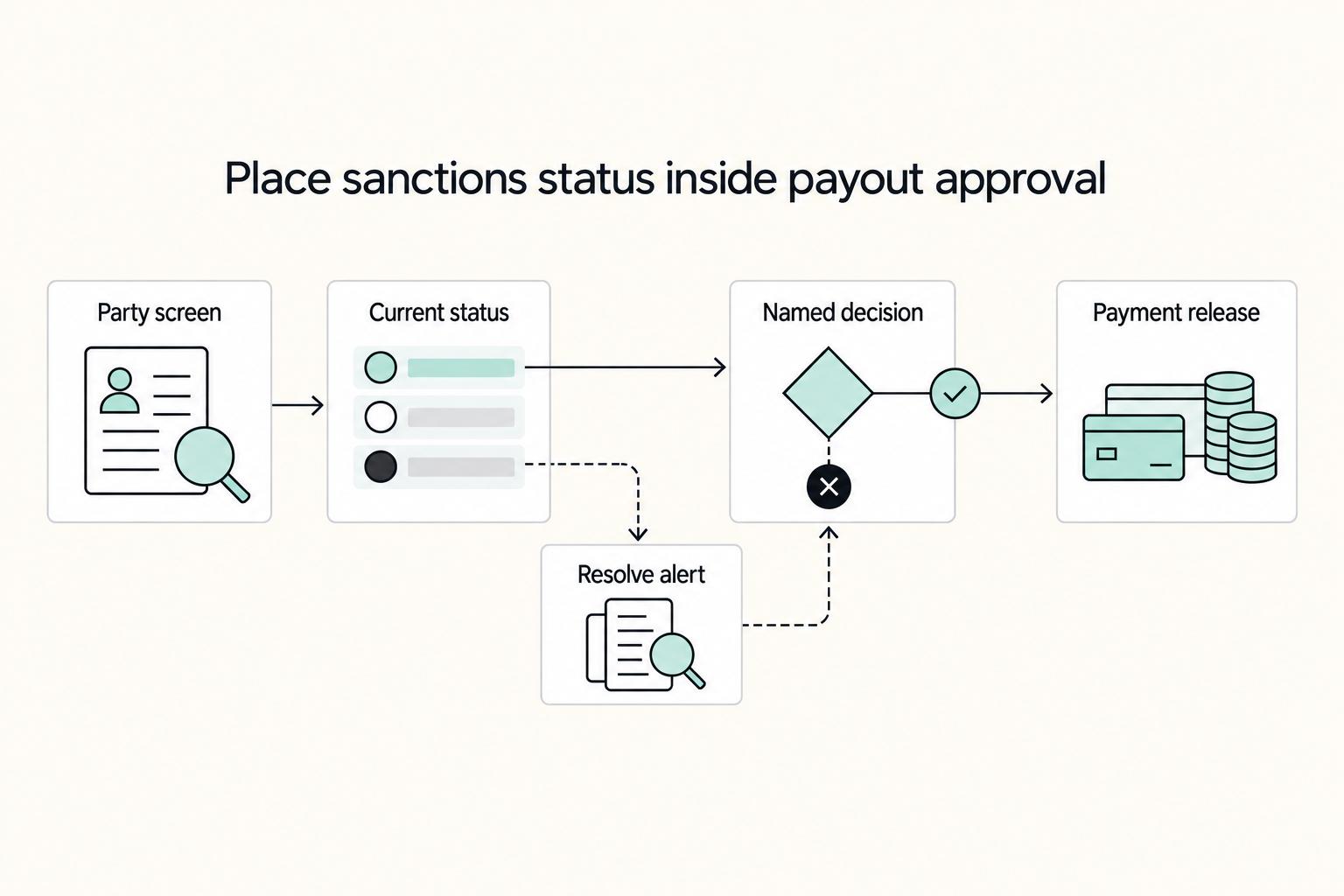
Put screening directly in payout authorization so no payment is released with a stale or unresolved status. Treat sanctions screening as an internal control in the payment flow, not a separate task that can be skipped under deadline pressure.
This fits a risk-based sanctions compliance program: controls should be routine, testable, and tied to clear evidence before release. OFAC guidance emphasizes internal controls plus testing and auditing, and a risk-based program should be designed around auditable decisions.
| Payment control point | Example state before release | Evidence to retain |
|---|---|---|
| Authorization gate | Cleared for this payment event; unresolved or prohibited cases cannot release | Decision timestamp, reviewer, case reference |
| API retry path | Retry preserves instruction identity and revalidates current sanctions eligibility before execution | Idempotency key, prior decision reference, immutable state history |
| Batch approval | Team verifies no unresolved screening states at approval time | Batch approval record and exception disposition |
| Reconciliation close | Settlement records map back to the same final screening case | Payout reference mapped to final case outcome |
For API-led teams, one option is idempotent state handling so retries do not produce contradictory outcomes. For finance teams, connect screening outcomes to batch approval and reconciliation records so the audit trail stays intact.
A practical cadence is to screen at onboarding, during transactions, and through periodic re-screening, then verify the payout gate itself in routine control checks. If checks show the gate failed on a payment path, pause that path until the control is corrected and approvals are traceable again.
Keep execution in view: controls only work when they are part of normal approval behavior. If people can bypass the gate during busy periods, the design is incomplete even if your policy document is strong.
One useful checkpoint is a pre-release exception list for each batch. If any case still sits in escalate or hold without final sign-off, hold the batch until it is resolved.
Turn this into a 30-day operating habit#
Make this a repeatable monthly routine: assign owners, require evidence, and test how your process handles change before money moves. The goal is not to add extra admin. The goal is to reduce decision drift so urgent payments do not bypass controls.
Week 1. Finalize scope and decision rules in one document#
Finalize scope and decision rules in one working document. Define which sanctions lists and checks your team uses, who can approve exceptions, and what evidence is required for each outcome: clear, escalate, or hold.
Build your decision matrix around program context, not one blanket rule. OFAC states sanctions can range from blocking property to broad transaction prohibitions, and prohibitions vary between programs. Your evidence-pack template should capture searched name variants, matched list name, reviewer rationale, timestamp, and final disposition.
Finish the week with a practical output checklist:
- A current list scope register with named owners.
- A lane matrix that maps clear, escalate, and hold decisions.
- A case note template that forces plain-language reasoning.
- A release gate rule that prevents payment when required fields are missing.
Week 2. Put two required checkpoints in place with named owners#
Put two required checkpoints in place with named owners: onboarding and pre-payment review. The onboarding owner runs the initial screen, and the payment owner runs a fresh check before funds move and logs the timestamp.
Use a strict handoff rule so ambiguity does not release money:
- If onboarding finds a potential match, keep payment on hold until escalation is resolved.
- If pre-payment review finds a new potential match, reopen the case even if onboarding cleared it.
- If owner or timestamp is missing, do not approve payment.
Run a few live or recent cases through this sequence and capture friction points. This step can expose handoff gaps as well as search issues. Fix handoff language immediately so the rule is clear under deadline pressure.
Week 3. Run a retro on recent clear, escalate, and hold decisions#
Run a retro on recent clear, escalate, and hold decisions. The test is simple: can someone explain each decision from the case record alone?
Tighten documentation where it breaks first, especially escalation paths and rationale quality. If reviewers cannot tell who decides a borderline case, the control is not ready.
Focus the retro on repeat defects instead of one-off mistakes. Examples include missing list context, unclear reason for clearance, and payment approval notes that do not match the screening record. Resolve those defects in templates and approval steps, not only in team reminders.
By the end of the week, your team should be able to review a case file and answer three questions quickly. Ask what triggered review, why the decision was made, and who approved release.
Week 4. Run one end-to-end sanctions-update drill#
Run a sanctions-update drill: select an actual OFAC list or program update, identify the affected parties and queued payments, rerun the relevant checks, and record the resulting decisions.
Test whether the update reaches the payment gate. Confirm the source and effective date, the owner who changed the rule, and which cases were rechecked. A revised policy that never reaches queued payments leaves the control incomplete.
Close the month with one final control check: pick an in-scope payment and trace it from intake to release using your evidence pack. If any link is missing, fix that gap before the next payment cycle. That single test keeps your policy, screening checks, and payment approvals aligned in day-to-day operations.
Frequently Asked Questions
What is OFAC sanctions screening in plain terms?
In plain terms, OFAC sanctions screening means checking people, businesses, or transaction parties against sanctions restrictions before proceeding. OFAC is the Office of Foreign Assets Control, which administers and enforces U.S. economic and trade sanctions. In practice, the goal is to identify restricted parties or targeted-country risk early.
Who needs OFAC screening if they are not a large enterprise?
Company size is not the deciding factor. OFAC strongly encourages organizations subject to U.S. jurisdiction, including foreign entities doing business in or with the United States, to use a risk-based sanctions compliance approach. If your work touches U.S.-linked activity, build controls that match your actual risk.
Is OFAC Sanctions List Search enough by itself?
No. OFAC Sanctions List Search is OFAC's web-based search service, but a search result alone is not the full sanctions decision process. You still need a review and disposition process to decide whether to clear or escalate a potential hit.
Why does OFAC search return potential matches that look close but not exact?
OFAC’s tool uses fuzzy logic for names, so similar names can produce potential matches. Compare the full list entry with identifiers, nationality, address, and other available party details. A name-similarity score alone does not establish identity or decide whether payment is permitted.
What should I do immediately after a potential sanctions match?
First, determine what the hit is tied to: the SDN List, another OFAC sanctions list, or a targeted country. Then review the result before deciding how to proceed. Treat a potential match as a signal to investigate, not an automatic final conclusion.
How often should I re-screen counterparties in an active business relationship?
Do not assume a single universal interval fits every business. Use a risk-based cadence and keep it routine as part of your sanctions compliance program. Update that cadence as your risk profile changes.
Researched and edited by the Gruv editorial team. Gruv builds cross-border billing, payouts, and finance-operations software for global businesses.
Sources
Educational content only. Not legal, tax, or financial advice.
Related Posts

The Freelance Payment Penalty: A Modeled Audit of Platform Fees, FX Spreads, and Payout Delays
The money rarely disappears through a single, easy-to-spot fee. The real loss is stacked. A marketplace takes its commission, a processor adds a charge for international cards, a bank or payment company converts the currency at a spread, a platform holds the funds before release, and a wire sheds a little to intermediaries on the way in. Each layer looks defensible on its own, but the worker feels the combined result as a smaller deposit and a later payday.

How to Respond to a Subpoena for Business Records
Move fast, but do not produce records on instinct. If you need to **respond to a subpoena for business records**, your immediate job is to control deadlines, preserve records, and make any later production defensible.
A US Expat's Guide to Investing in UCITS ETFs to Avoid PFIC Issues
The real problem is a two-system conflict. U.S. tax treatment can punish the wrong fund choice, while local product-access constraints can block the funds you want to buy in the first place. For **us expat ucits etfs**, the practical question is not "Which product is best?" It is "What can I access, report, and keep doing every year without guessing?" Use this four-part filter before any trade: