
Quick Answer
Use Basic/Pro/Enterprise when customers need distinct service packages. Add usage allowance and overage only with a clearly defined event, sustainable rates and auditable metering. Calculate the bill and margin at normal, heavy and bracket-boundary quantities, then document plan-change timing and discount precedence.
How to Structure Basic, Pro, and Enterprise Plans#
For a payment platform, a core pricing decision is whether your tiers create a clear path from entry-level adoption to larger contracts without making billing hard to run. This guide focuses on practical Basic/Pro/Enterprise design, not generic SaaS packaging.
Separate the service package from its charging formula. Basic, Pro and Enterprise describe entitlements; a volume or graduated ladder changes the usage price. Customers need to understand both what they can use and how usage changes the bill.
A workable design matches your catalog, contract and invoice. Confirm recurring fees, allowances and usage charges can be represented together, then test a normal month, heavy month and plan transition.
Who this list is for and how to choose a strategy#
Use this guide when you are making a real monetization change, not just refreshing a pricing page. If you are choosing between Tiered pricing, Usage-based billing, and Per-transaction pricing this planning cycle, pick the model your product, finance, and sales teams can all explain and operate with minimal exceptions.
| Model | Article note | Detail |
|---|---|---|
| Tiered pricing | Can create a clearer upgrade path | The docs note tier design can support upgrades as needs grow |
| Usage-based billing | Needs specific integration design work | Avoid starting here if metering logic is still unsettled |
| Per-transaction pricing | Can be straightforward to read and bill | Define the successful business event, rate and settlement-independent billability rule. |
- Use this if packaging, billing logic, and sales motion all change together
This is for founders, product, finance, and revenue operators changing plan structure, metering, invoice shape, and contract handling. Stripe Billing supports recurring billing, usage-based billing, and sales-negotiated contracts. The decision is operational, not cosmetic. Your model has to hold up when customers upgrade, exceed allowances, or ask for custom terms.
- Apply four filters in order
Compare contribution under the same account workloads, upgrade clarity, implementation effort and sales exceptions. A quoted processing tariff alone does not establish your platform margin.
With those filters in place, the default question gets simpler. Start with the tier structure that covers the broadest part of your market, then add usage or contract complexity only where it solves a real problem.
Use feature packages when customer needs differ#
If your customers fall into clear maturity bands, a Good-Better-Best Basic/Pro/Enterprise structure is a practical starting point. It can create a clean upgrade path and let self-serve and sales-led deals coexist in one billing setup. Just do not rely on feature gates alone when your costs rise with usage.
Why this structure works#
Stripe describes tiered pricing as setting costs by level or quantity and frames Good-Better-Best as a common way to design those tiers. That can fit platforms where customers need different operating depth at different stages. In practice, an entry tier can focus on core acceptance and payouts, while higher tiers add controls, reporting, and contract workflows as needs grow.
Compared with a single flat recurring offer, this structure can make plan differences easier to see. Stripe's pricing models also separate flat-rate, tiered, and usage-based approaches, which helps keep packaging and billing logic explicit instead of blending them together.
A practical tier map#
Use this as a working model, not an industry-standard template.
| Tier | Primary job |
|---|---|
| Basic | Core service, required controls and minimum invoice verification. |
| Pro | Automation, controls, and richer admin workflows that reduce operator effort. |
| Enterprise | Standard package plus quote-based negotiation for specific commercial terms. |
Keep baseline security, required compliance controls, cancellation and enough billing detail to verify charges available in every tier. Premium automation, reporting depth and support scope can distinguish paid packages.
Where teams usually get hurt#
One common mistake is absorbing high-usage accounts at the same recurring fee. The usage-billing docs call out the operational requirements: usage must be recorded and reported, and usage-based charges are collected in arrears. If your costs scale with a measurable unit, pair feature tiers with a usage boundary, allowance, or overage path once metering is reliable.
What to verify before launch#
Before launch, make sure each tier has a clear billing path and upgrade path in your billing system. Test Basic signup, Basic-to-Pro upgrade, Pro renewal, and the Enterprise quote flow. If customers crossing your intended Pro boundary still trigger manual credits or one-off discounts, the model needs more work.
Related: Flat-Rate vs Tiered vs Per-Seat Pricing: A Decision Framework for SaaS Platforms.
Use a base fee and overage when consumption changes costs#
When payment volume is uneven, a hybrid model can be more practical than a flat Pro fee. Use a baseline subscription with overage after an included allowance. That keeps a predictable recurring base while charging more when usage moves beyond plan intent.
This can sit directly on top of Basic/Pro/Enterprise. The key change is commercial logic: Pro and Enterprise stop relying on one flat fee to cover every usage pattern.
Why this works better than a flat Pro fee#
The documentation describes this as a fixed-fee-and-overage model: a recurring charge plus separate billing for usage above an included limit. It also frames the approach as predictable billing with flexibility to scale. Recurly and Chargebee describe the same pattern from a billing perspective: usage varies, plans include limits, and excess usage is billed as overage.
For platforms with uneven usage, that tradeoff can be practical. A pure recurring fee is simple, but heavy usage can outgrow the flat price. Pure transaction pricing aligns charges to usage, but your revenue then moves with customer activity.
Where each model wins and where it hurts#
| Model | Revenue predictability | Buyer friction | Implementation complexity in billing | Margin risk |
|---|---|---|---|---|
| Pure subscription | High baseline predictability from fixed recurring charges | Can be easier to explain | Lower. Simple recurring setup | Can rise when usage varies widely |
| Subscription plus overage | Baseline predictability with charges above allowance | Depends on how clearly allowance and overage are explained | Higher. Needs recurring + usage prices, metering, monitoring, and invoice testing | Can be more controlled than pure subscription if usage tracking is clean |
| Pure transaction pricing | Lower predictability because charges vary with customer usage | Varies with fee presentation and contract terms | Moderate. Usage tracking is core | Lower flat-fee exposure, but higher revenue volatility |
A concrete packaging pattern for Pro and Enterprise#
Illustrative Pro plan: $200/month includes1000 completed transactions; extra transactions cost$0.10 each. At1500, the bill is$200+(500×$0.10)=$250 before tax. With$50 fixed delivery cost and$0.04 per transaction, cost is$110 and gross margin=($250−$110)/$250=56%. At3000, revenue is$400, cost$170 and margin57.5%. These inputs are invented; include your actual processor, support and failure costs.
Enterprise can keep the same structure with negotiated commercial terms through sales-negotiated contracts. Stripe Billing positions recurring billing, usage-based billing, and sales-negotiated contracts as options you can combine.
The critical design choice is the allowance boundary. If you cannot explain what is included and when overage starts in one sentence, buyers will treat overage as a surprise fee.
What Stripe Billing needs before this is real#
This is not a single setting. The setup guidance requires both recurring and usage prices in the product catalog, so catalog design, invoicing logic, and customer messaging must use the same unit and threshold. Two operator controls matter most:
Usage alerts can prompt review, and a billing threshold can trigger earlier invoicing. Delayed aggregation can overshoot that threshold; it is neither a hard service cap nor proof of paid cash. Enforce any promised usage limit in the service, including in-flight work, subject to agreed entitlements.
Validate invoice behavior before rollout: base subscription invoice, allowance consumption, first overage event, period-end true-up, and threshold-triggered invoice behavior.
The failure modes to watch#
Choose an explicit plan-change policy. For this example, package and allowance changes apply at renewal; preserve the old price and usage window until then. If you permit mid-cycle changes, version entitlements, included allowances and rates at their effective time and test their allocation.
A second risk is customer confusion. Hybrid pricing can be harder to explain than simple tiered pricing because buyers have to understand both included entitlement and excess charges. Before go-live, make sure you can produce:
- the metered unit definition
- included allowance by plan
- overage calculation method
- sample invoices for normal and overage months
- rules for mid-cycle plan changes and contract exceptions
For volatile volume, this can be a practical compromise: clear allowance in Pro, narrow Enterprise exceptions, and invoice behavior tested in your billing system before scale. Related reading: Continuous KYC Monitoring for Payment Platforms Beyond One-Time Checks.
Choose volume or graduated usage ladders deliberately#
If larger accounts still fit your package but not your unit economics, add a volume ladder to the usage component in Pro and Enterprise. That gives scaling customers a clearer expansion path without forcing a full custom deal too early.
Keep the feature bundle fixed, then reduce per-unit price at defined quantity levels. That preserves premium packaging while still rewarding growth in a way buyers can follow.
Illustrative ladder before any separate allowance: units1–1000 cost$0.10; units above1000 cost$0.08. At1000 units, both methods charge$100. At1001, all-unit volume pricing charges1001×$0.08=$80.08, so one extra unit lowers the bill. Graduated pricing charges1000×$0.10+1×$0.08=$100.08. At1500, volume charges$120 and graduated charges$140. Decide whether that volume price cliff is intentional and sustainable; these rates are invented.
| Plan zone | Where volume pricing starts | Where flat-rate pricing still applies | Where sales approval is required |
|---|---|---|---|
| Basic | Often nowhere; keep Basic simple for self-serve buying. | Full plan price remains flat. | Rare in this model; avoid making Basic depend on manual approval. |
| Pro | Start on the metered usage component with explicit quantity brackets. | Keep base subscription and feature bundle flat-rate. | Exceptions only, for example nonstandard terms or one-off discounts. |
| Enterprise | Continue the ladder when the model is still standard and usage is the main scaling variable. | Flat-rate can still cover platform access, support scope, or premium features. | Often needed when terms move beyond the standard ladder, especially for large volume or unique models. |
The critical design choice is the unit definition. Use the same unit everywhere: catalog setup, contract language, invoice labels, and customer communication. If bracket boundaries are not obvious in a line-item example, disputes are likely.
Define which quantity selects the bracket and whether included units count toward it. Keep the bracket table and effective price version with the billed event population; labels alone cannot distinguish volume from graduated math.
A common risk is margin leakage from stacked concessions. If ladder discounts and negotiated Enterprise concessions both apply, expansion revenue can flatten faster than expected. Keep one commercial variable flexible at a time: standard volume brackets in Pro, and documented exceptions in Enterprise only through approval.
Before launch, test sample invoices for:
- the first bracket where the lower rate applies
- a customer exactly on a bracket boundary
- a mid-cycle move from Pro to Enterprise
Keep an internal evidence pack with the bracket table, unit definition, sample invoices, and approval rules for custom terms.
Use a visible free-to-paid boundary#
Freemium to paid tiers works best when the free plan has clear, enforceable limits that naturally point users to paid tiers. If you cannot name the exact limit that should trigger an upgrade, the free plan is probably not ready.
Freemium is simple in principle: basic functionality is free, and richer functionality is paid. The execution risk is also well documented, and many teams underestimate how hard it is to build a free tier that is useful but still creates a real reason to upgrade.
Use strict boundaries, not vague "lite" packaging#
Make limits concrete: included transaction quantity, automation access or support scope. Tell customers what happens at the limit and keep legally required controls and invoice verification available. A free plan should have an explicit sustainable cost allowance.
For your own tiers, keep the line between free, paid, and enterprise easy to explain in both product entitlements and billing terms.
Pair packaging with billing mechanics#
Treat tier design and billing math as one system. The tiered-pricing model is built for non-linear pricing as quantity or usage changes, and it can be combined with flat rates. If paid plans include usage-based components, define those rules upfront.
Run a quick operational check before rollout: one free-to-paid upgrade, one account crossing a usage threshold, and one downgrade path. This check helps catch mismatches between app entitlements, billing catalog rules, and invoice labels. If you need a deeper comparison, see Freemium vs. Paid Tiers: Which Pricing Model Works for Payment Platforms?.
You might also find this useful: Per-Seat Pricing for B2B Platforms That Scales Without Billing Drift.
Best strategy for complex buyers is Enterprise contracting on top of standard tiers#
For procurement-heavy buyers, consider using Enterprise contracting as an overlay on your standard Basic/Pro/Enterprise catalog, not as a replacement for it. Keep the plan structure recognizable and negotiate only defined commercial terms. That helps strategic deals close without creating a separate pricing system.
Use a standard package with a narrow set of negotiable terms, such as commitment, allowance, overage rate and support scope. Record their precedence over public pricing and their effective dates; do not combine discounts accidentally.
Where the enterprise overlay helps#
This works best when the account still fits your standard packaging in substance. Keep the tier identity intact, and handle exceptions through contract terms such as commitment structure, support scope, and billing treatment.
Stripe Billing supports recurring billing, usage-based billing, and sales-negotiated contracts, and Stripe Quotes can package recurring and one-off items, with discounts and taxes, and convert accepted quotes into a subscription or one-time invoice.
What should stay fixed#
Customization is useful, but broad exception handling can erode pricing discipline and reporting clarity. Keep these stable unless there is a clear commercial reason to change them:
- Base package identity, for example Pro vs Enterprise
- Core entitlements tied to that package
- Usage metric definitions and invoice labels
- Approval rules for discounts and non-standard terms
Operator check before rollout#
Before sales offers enterprise terms at scale, run one end-to-end contract flow in your billing stack. Create the quote, include expected recurring and one-off items, apply approved discount and tax treatment, convert after acceptance, and verify invoice labels, plan names, and internal SKU mapping.
This control matters over time. Zuora notes some customers can remain governed by prior packaging or contract terms, so exceptions can persist over time. For payment platforms, a practical rule is to negotiate around the tier, not through it.
For a step-by-step walkthrough, see SOC 2 for Payment Platforms: What Your Enterprise Clients Will Ask For.
What to gate by tier and what not to gate#
Gate durable, differentiated value by tier, and avoid gating the minimum billing visibility customers need to verify charges. This keeps packaging meaningful without adding avoidable billing support friction.
- Gate durable value that maps to willingness to pay.
Good-Better-Best is most useful when each tier reflects a clear increase in value and service level, not just a longer feature list. Stripe ties tiered pricing to willingness to pay, and Zuora describes feature-level gating as a lever for upsells, trials, and tier scaling. In practice, feature-level entitlements that deliver ongoing operational value are often the cleanest tier differentiators.
- Do not gate baseline reconciliation visibility.
Customers still need enough detail to verify bills. Microsoft describes reconciliation files as detailed records of each charge and credit, including usage-based and non-usage-based lines. You do not need identical reporting across every SaaS tier, but gating the minimum data needed to understand invoices, credits, and usage lines can create avoidable support load.
- When cost scales with usage, meter it instead of removing access.
In the illustrative Pro plan, the fixed fee buys access and1000 completed transactions; only the excess is billed at$0.10. Meter the billable business event once even if several API calls or retries occur. Keep internal failure costs in your economics without treating them as extra successful transactions.
- Apply an operational test before hard-gating.
If removing a feature is likely to increase reconciliation confusion or support escalation, consider usage pricing or contract terms instead of strict feature gating. Before rollout, run a downgrade scenario with real invoice lines and usage charges. If the account still needs manual explanation to reconcile charges and credits, the gate may be in the wrong place.
Margin leakage and failure modes before launch#
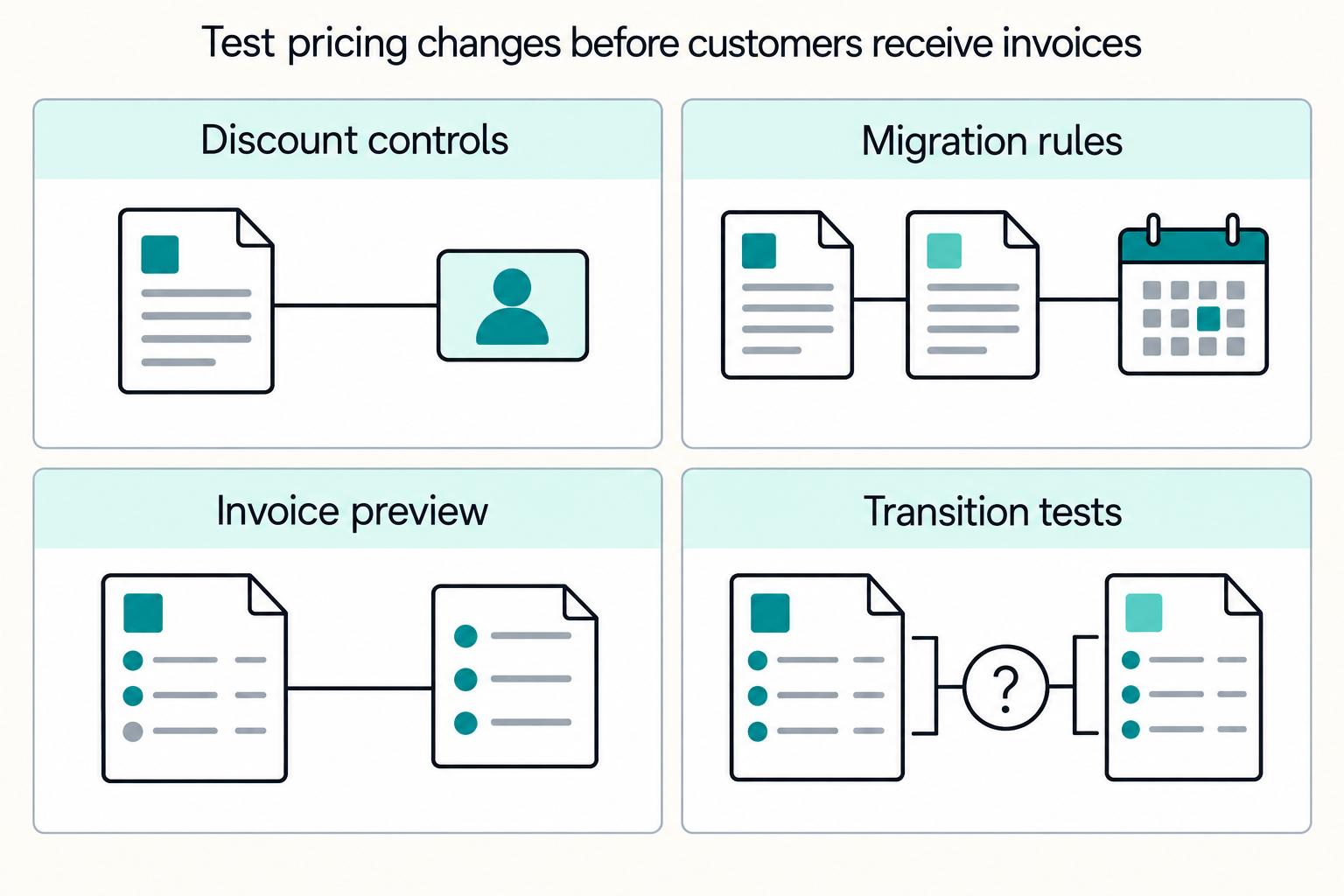
Margin leakage usually shows up after launch through discount exceptions, unclear plan migrations, and untested invoice behavior, not just through list price. The practical job before launch is to close those gaps while changes are still cheap.
- Stop discount stacking before it hides inside enterprise deals.
Illustrative $100 charge: additive discounts of5%,10% and15% reduce it by$30 to$70. Applied sequentially, $100×0.95×0.90×0.85=$72.675, rounded to$72.68; the discount is$27.33. State stacking order, eligible components and rounding, and assign one owner to approve combined concessions.
- Define Freemium, Pro, and Enterprise migration rules before go-live.
Document upgrade and downgrade timing, access, allowance and rate treatment. Stripe prorates eligible fixed advance subscription charges; metered usage is billed for actual units and is not prorated through that mechanism. A downgrade must honor already-paid entitlements and agreed change rights.
- Do not sell pricing structures your billing system cannot render clearly.
Test whether the invoice matches your contract across fixed fees, actual usage, discounts and permitted changes. Keep a durable usage ledger with event/business ID, customer, unit, occurrence time, billing window, completion and applicable price version. Reconcile accepted meter totals and invoice lines; provider finite deduplication does not replace local atomic event/effect handling.
- Run a pre-launch transition test pack under both billing assumptions.
Test boundary quantities and transitions, duplicate/rejected/late events and unknown provider outcomes. Keep retry keys within provider/account/operation/payload/time-window scope; reconcile unknown outcomes before a new create. Apply reviewed late events before finalization, or preserve finalized bills with linked corrections/credits. Do not silently rewrite customer history.
Rollout sequence and verification checkpoints#
A practical rollout sequence is straightforward: finalize packaging, verify billing mechanics, then set approval rules. Reverse that order and you can end up selling terms your billing setup or finance policy cannot support.
| Step | Checkpoint |
|---|---|
| Finalize packaging logic | Each offer tier maps to a named recurring price, any usage meter, and a clear migration path before exceptions are approved |
| Map billing mechanics | Confirm the model works across subscriptions, usage-based billing, and sales-negotiated contracts; validate invoice previews and any quote flow |
| Controlled cohort launch | Use a partial, time-limited rollout on a smaller production subset; review conversion, post-billing retention, and support contacts tied to invoice or plan confusion |
| Decision log | Document where Tiered pricing applies, where Sales-negotiated contracts are allowed, and where exceptions are blocked; state evidence limits |
Before launch, pressure-test your tier and overage assumptions with the pricing calculator.
Conclusion#
Choose the package and arithmetic your customers can predict and your costs can sustain. Approve a stressed bill and a boundary calculation before expanding the pilot.
If you are still choosing between model families, compare your assumptions with Usage-Based Pricing for Payment Platforms: Per-Transaction vs. Subscription before finalizing your tier structure.
If you want a practical review of your packaging, billing logic, and rollout constraints, talk to Gruv.
Frequently Asked Questions
What is tiered pricing for a payment platform?
Tiered pricing can mean two different things, so define the term upfront. In one sense, it is a flat-rate service-tier model, for example Basic, Pro, Enterprise. In another, it means unit price changes as usage or quantity moves through pricing tiers.
How is tiered pricing different from usage-based billing and volume pricing?
Usage-based billing charges customers based on actual usage. Volume pricing applies one unit price to all usage based on the final tier reached in the billing period, while graduated pricing prices each tier slice separately and sums the total. If you charge a subscription plus overage, you are running a mixed model.
When should we use Basic Pro Enterprise instead of per-transaction pricing?
Use Basic, Pro, Enterprise when you want customers choosing packaged service levels at a flat recurring price. Use per-transaction pricing when you want charges to track actual usage more directly. If you need both, you can combine flat tiers with metered overage.
What should be gated by tier features limits support or price?
Do not assume a universal checklist exists for exactly what must be gated by tier. A practical approach is to package durable value in the tier and meter variable consumption separately. Keep the gating logic simple enough that customers can predict what changes their bill.
What are the top risks of tiered pricing and how do we mitigate them?
A core risk is customer backlash when pricing changes are perceived as unfair, not just expensive. Another risk is choosing a commercial design your billing setup cannot represent cleanly. Mitigate by defining pricing rules explicitly and validating invoice and contract behavior before broad launch.
How do we prevent margin leakage when mixing subscription and usage charges?
Make the recurring fee, included usage, overage rule, and usage meter explicit in your catalog and billing setup. Combine that with threshold monitoring so you can catch customers crossing usage limits in time. Then test invoice scenarios across low, medium, and high usage so overage and discounts behave as intended.
Do we need enterprise custom contracts from day one or after Pro maturity?
There is no fixed trigger that applies to every platform. Sales-negotiated contracts are a valid billing motion, but that does not mean every early deal should be custom. Anchor standard tiers first, then introduce limited contract flexibility once quoting, invoicing, and renewals run cleanly end to end.
Try a related tool
Researched and edited by the Gruv editorial team. Gruv builds cross-border billing, payouts, and finance-operations software for global businesses.
Sources
Includes 2 external sources outside the trusted-domain allowlist.
- docs.stripe.com/subscriptions/pricing-models/tiered-pricingtrusted
- docs.stripe.com/products-prices/pricing-modelstrusted
- executiveeducation.wharton.upenn.edu/thought-leadership/wharton-at-work/2025/04/t...trusted
- stripe.com/resources/more/tiered-pricing-101-a-guide-fo...trusted
- stripe.com/billingtrusted
- docs.zuora.com/en/zuora-billing/set-up-zuora-billing/build-...external
- docs.zuora.com/en/zuora-billing/set-up-zuora-billing/billin...external
Educational content only. Not legal, tax, or financial advice.
Related Posts
Freemium vs Paid Tiers for Payment Platforms
For a payment platform, this is not an abstract free versus paid debate. The real question is whether freemium or paid tiers create the customer mix you want at a cost and revenue pace your business can sustain. In practice, the choice comes down to growth quality, support load, and when monetization starts.

Choosing Per-Transaction or Subscription Pricing for Payment Platforms
For a payment platform, the right pricing model is the one your unit economics and billing operations can actually support, not the one that looks cleanest on a pricing page. In practice, teams usually choose among three mechanics: usage-based billing, per-transaction pricing, and recurring subscriptions, or combine usage-based and recurring charges where supported. Each one changes revenue behavior, invoice logic, and margin risk.
Freelance Online Educator Guide for Cross-Border Platform Launches
This guide is for platform founders and operators deciding whether a freelance online educator vertical is worth exploring before they commit product and go-to-market budget.