
Quick Answer
Prioritize an operator-first sequence in your freelance online educator guide: pick one business model, validate market operability, and launch only after one end-to-end payment path is reconciled. Use corridor-level pricing for United Kingdom and European Union flows, including FX effects, retry overhead, and tax-related support load. Keep compliance staged, with stronger checks at payout-risk moments, and defer any market where release rules, escalation ownership, or evidence quality are still unresolved.
Evaluate the educator vertical before product spend#
This guide is for platform founders and operators deciding whether a freelance online educator vertical is worth exploring before they commit product and go-to-market budget.
Most of that guidance is written for freelancers themselves, including beginner setup playbooks and advice on running teaching as a business. Company-side material exists too, but it focuses on finding, hiring, and onboarding educators rather than cross-border launch operations.
Use this as your decision frame: cutting out a middleman can help freelance teachers keep more of what students pay, but billing, invoicing, dispute handling, and other payment operations then have to be handled directly. Country-specific compliance thresholds and cross-border payout reliability are not established by these sources, so you still need separate validation in your rollout plan.
Related: A Canadian Freelancer's Guide to Setting Up a US Stripe Account.
Define the three business models and pick one primary bet#
Start with model choice, not feature choice. Define the value you will create and deliver, then test whether you can charge for it in a way that can sustain operations over time.
Separate lanes before sizing demand#
For this launch decision, define three working lanes and keep them separate early:
- Independent online educators selling directly to learners or buyers
- Freelance teacher's guide creators doing adjacent content work
- Employer-side hiring models where an organization sources educators
Keep these lanes separate in planning. If you cannot state the customer, paid action, and delivered output in one sentence per lane, the model definition is still too loose.
Choose one primary bet from your first revenue motion#
Choose one primary bet for phase one. Prioritize the constraint tied most directly to your first revenue event, and sequence the rest after that.
This is a prioritization rule, not a universal law. It's meant to avoid building two products before either has a clear path to revenue.
Avoid mixed launch offers unless lanes are clearly defined#
Avoid launching one blended offer across full-time tutors, freelancer pools, and staffing agencies until each lane has a clear customer, paid action, and delivered output.
Also keep legal-source confidence separate from product assumptions. On FederalRegister.gov, the page for "Independent Contractor Status Under the Fair Labor Standards Act" states that the web version is not an official legal edition and advises verification against an official edition. Use the printed PDF checkpoint on document 2020-29274 (86 FR 1168, published 01/07/2021) when legal interpretation matters.
Write a one-page go/no-go memo#
Before build or GTM approval, lock a one-page memo that covers:
- target user and buyer
- primary monetization path
- value created and delivered
- first expected revenue event
- what is explicitly out of scope for phase one
- assumptions that still require verification
If a reviewer cannot quickly tell whether your phase-one bet is supply-side, demand-side, or a narrowly defined adjacent creator lane, the scope is still too mixed.
For a step-by-step walkthrough, see How to Start Freelancing as an HR Consultant Across Countries.
Set market priority with payment and compliance feasibility#
Pick markets you can actually operate. Demand matters, but only after the payment flow and compliance path are clear end to end.
Rank by operability, then demand#
Set your review order only after you can describe the full money path for each market. That means how funds are collected, whether they are held until approval (if you use escrow), when commission is deducted, and how disputes are handled.
If your shortlist includes multiple countries or regions, use that as a planning queue, not as a validated demand ranking.
Use one matrix for every market#
Before approving GTM spend, document each market with the same fields so the comparison stays clean.
| Market | Collection flow defined | Release model defined (including hold-until-approval, if used) | Commission deduction point defined | Compliance path documented | Support burden estimate | Decision |
|---|---|---|---|---|---|---|
| Market A | Yes / No | Yes / No | Yes / No | Yes / No | Low / Medium / High | Advance / Hold |
| Market B | Yes / No | Yes / No | Yes / No | Yes / No | Low / Medium / High | Advance / Hold |
| Market C | Yes / No | Yes / No | Yes / No | Yes / No | Low / Medium / High | Advance / Hold |
For multi-region rollout, score each corridor you plan to support instead of treating a whole region as one block.
Validate one real transaction path#
Advance a market only after you can prove one full path: payment captured, lesson or deliverable completed and approved, commission deducted, release status reconciled, and dispute handling path documented. This is usually where trust and quality-control risk first shows up in remote marketplaces.
Defer unresolved markets#
If payout mechanics or compliance handling are still unclear, defer that market. Use a hard gate: no launch decision until the payment release rule, escalation path, and support ownership are explicitly documented.
Need the full breakdown? Read Microsoft Dynamics 365 for Payment Platforms: Finance Module Setup and Payout Integration Guide.
Build your prerequisites and evidence pack before GTM#
Treat this phase as a documentation gate, not a marketing push. Launch only when leadership can review one pack that clearly separates confirmed evidence, assumptions, and unknowns.
Build the pre-launch packet#
Create a pre-launch packet with five labeled artifacts: pricing hypotheses, compliance assumptions, payout assumptions, exception-handling rules, and open operating constraints. Keep assumptions visibly marked, especially for payout and compliance items, because the available sources are stronger on continuing and online education than on marketplace payout operations. For each artifact, assign an owner, last-updated date, and approval status.
Keep competitor evidence narrow and observable#
Build competitor evidence notes narrowly and from direct observation only. For any external guides you review, log only visible elements such as audience, offer structure, trust signals, visible pricing, and whether they focus on setup, hiring, or quality control.
Then compare those observations against the UPCEA Hallmarks of Excellence and ACE's quality screen for scope of practice, structured learning, and content value. That helps you separate table stakes from real differentiation.
Mark verification checkpoints before launch#
Define verification checkpoints before launch and mark each one as pending until evidence exists. For collection, payout, recovery, and reconciliation checkpoints, specify what proof is required, where it will be stored, and who signs off. If success and failure evidence are not defined in advance, defer GTM.
Maintain an explicit unknowns list#
Keep an explicit unknowns list and require written leadership approval of that risk. Include missing conversion and earnings benchmarks, missing payout success evidence, unresolved operating restrictions, and open compliance questions not backed by source material or vendor confirmation. If evidence searches return weak or empty results, record that directly instead of filling the gap with assumptions.
If you want a deeper dive, read A Guide to Liability Clauses for Freelance AI/ML Engineers.
Choose platform model and monetization mechanics#
Choose the model you can reconcile to real payout events with clear, repeatable reporting. The right choice is not the highest headline margin; it is the one your team can price, reconcile, and defend in terms.
Define the revenue event#
Pick one primary revenue model and define the exact event that creates revenue.
| Model | Revenue trigger | Where it usually fits | Operational pressure points |
|---|---|---|---|
| Marketplace take-rate | A learner pays for a lesson, session, or project, and the platform keeps a percentage or fee | Supply-led launches where educator activation and payout reliability are central | Revenue must align with charge timing, payout timing, refunds, and disputes. Fee pressure can grow with volume as gateway and payout costs compound. |
| SaaS subscription for educator tools | The educator pays a recurring monthly or annual fee for software access | Offers like scheduling, content delivery, invoicing, or admin support where value is not only payment volume | Less payout complexity if you are not routing buyer funds, but failed recurring payments and cross-border card costs still affect margin. |
| Hybrid transaction plus subscription | Subscription covers core tools, then transaction fees apply when payments flow through the platform | EdTech startups that want recurring revenue plus transaction upside | Hardest to explain and reconcile. You need clear rules for when a user is billed as a software customer, when they are a payee, and which fees apply to each flow. |
Use one verification check before moving forward: can finance point to a single source of truth for the revenue event by model and user type?
Write down fee mechanics before launch#
Fee mechanics drive both margin and support load, so define them in writing before launch.
| Fee item | Amount | When it applies |
|---|---|---|
| Monthly active account | $2 per monthly active account | An account is active in any month payouts are sent |
| Payout sent | 0.25% + 25¢ per payout sent | Charged based on total payouts at month end |
| Instant Payouts | 1% of payout volume | When Instant Payouts are used |
| Domestic card processing example | 2.9% + 30¢ | Domestic cards |
| International card add-on example | +1.5% | International cards |
| Currency conversion add-on example | +1% | When currency conversion is required |
| ACH Direct Debit | 0.8% with $5.00 cap | Where ACH Direct Debit applies |
| Managed Payments | 3.5% per successful transaction | On top of standard processing fees; country pricing pages can supersede method-table fees |
Under Stripe Connect, pricing ownership can be Stripe-handled or platform-handled. If Stripe bills connected accounts directly, your platform does not incur additional account, payout-volume, tax-reporting, or per-payout fees. If your platform handles pricing, you can collect fees from users and earn per transaction, while remaining responsible for Stripe processing fees.
For platform-handled pricing, document the billing checkpoints clearly:
$2per monthly active account, where an account is active in any month payouts are sent.0.25% + 25¢per payout sent, charged based on total payouts at month end.1% of payout volumefor Instant Payouts.- Stripe processing examples such as
2.9% + 30¢domestic cards,+1.5%international cards, and+1%when currency conversion is required. 0.8% (ACH) with $5.00 capwhere ACH Direct Debit applies.- Managed Payments adds
3.5%per successful transaction on top of standard processing fees, and country pricing pages can supersede method-table fees.
Also define these four mechanics explicitly:
- Fee timing
- FX spread policy
- Refund ownership
- Dispute handling
Practical rule: if reconciling platform revenue to payout events requires frequent manual fixes, treat that model as not launch-ready yet.
Assign owners to legal touchpoints#
Map legal touchpoints to clear owners before product copy goes live.
| Owner | Scope | Examples |
|---|---|---|
| Product | Educator-facing pricing and flow explanations | Pricing disclosure; refund and dispute explanations; role transitions (payer, payee, subscriber) |
| Legal | Terms and liability | Educator terms; marketplace or subscription terms; liability clauses |
| Ops | Exception states and support handling | Held funds; returned payouts; refund escalations; account support handling |
Use one checkpoint: terms are only ready when they match actual money movement and payout behavior in operations.
Choose between a direct processor and modular rails#
Choose direct processor setup versus modular rails based on the level of control you need and the operating capacity you have.
Use a direct processor setup (for example, Stripe) when you need simpler implementation and one system for charges and payouts. Consider modular collection, wallet, and payout rails when you already need multiple providers or payout paths and can operate the added reconciliation complexity. Modular rails can reduce vendor concentration risk, but they also increase integration and operational burden.
Final readiness test: run a sample month with successful charges, one refund, one dispute, and one failed payout retry. If finance cannot explain the money movement consistently, the model is not GTM-ready.
Related reading: QuickBooks Online + Payout Platform Integration: How to Automate Contractor Payment Reconciliation.
Design pricing that survives payouts, FX, and tax friction#
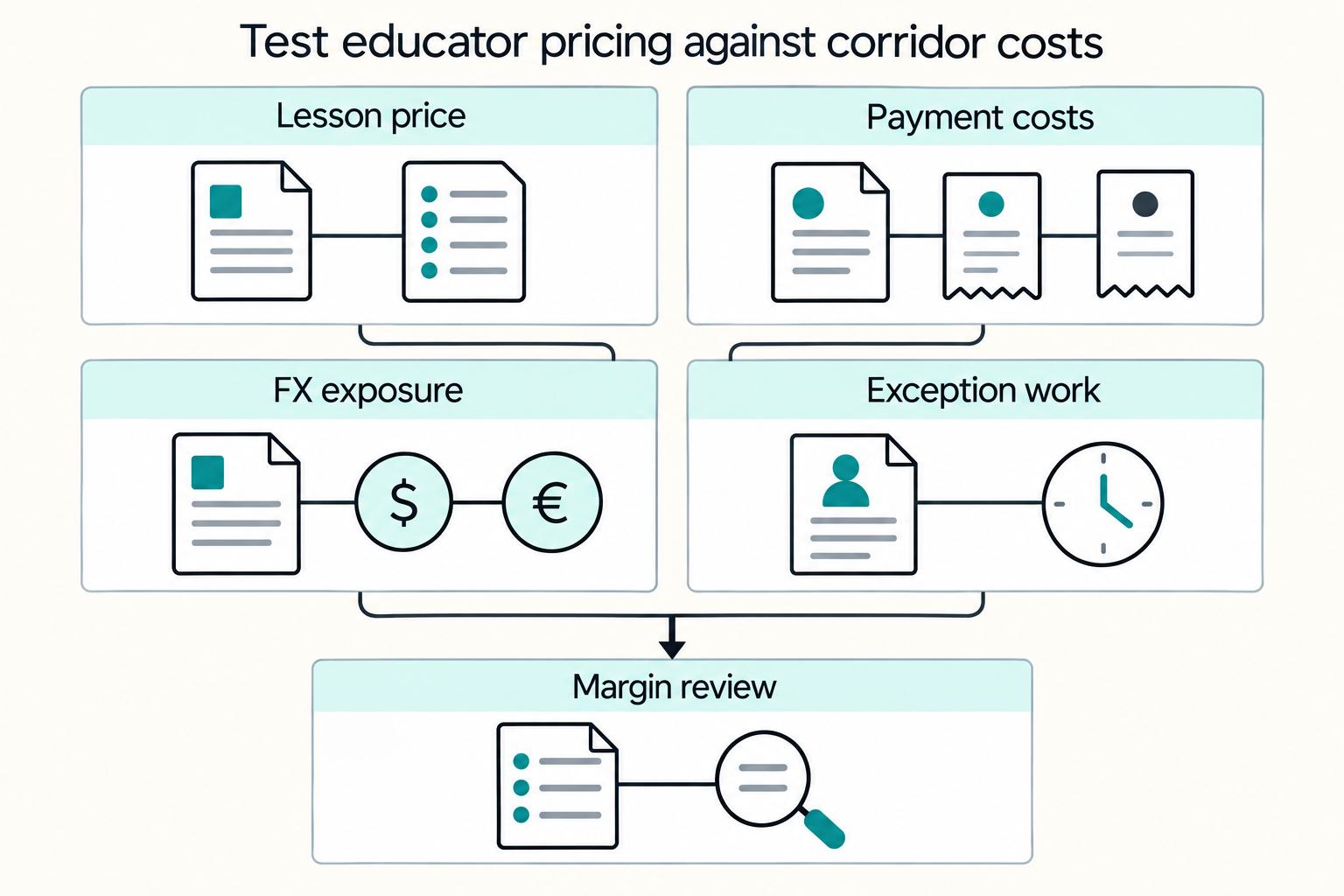
Launch with fewer, clearer plans and country-specific constraints, not one global price card. If you cannot show margin after payout costs, FX impact, retry overhead, and tax handling by corridor, your headline take rate is not ready for a decision.
The revenue event is already defined. Now you need to test whether margin still holds after money moves between learners, your platform, and educators in the United Kingdom and the European Union.
Model margin by market corridor#
Build one margin sheet per market corridor, not a blended global model. Start with gross lesson price, then deduct processor cost, payout cost, expected FX impact, expected failure or retry overhead, and any tax reserve that can change effective take rate.
| Corridor | Gross lesson price | Processor and payout cost inputs | FX and settlement note | Tax flag | Support overhead | Net margin check |
|---|---|---|---|---|---|---|
| United Kingdom learner to United Kingdom educator | Your listed lesson price | Use your collection and payout assumptions | No cross-currency if both sides settle in GBP | Check whether pricing copy or invoices create UK tax handling questions | Include expected cost of failed payout follow-up | Margin should remain positive after one retry scenario |
| United Kingdom learner to European Union educator | Same lesson price or corridor-specific price | Separate collection cost from cross-border payout cost | Add reserve for multi-currency settlement and timing gaps | Review VAT exposure and invoicing treatment before launch | Include added support load if payout details fail or funds are delayed | Test margin after FX reserve and delayed payout window |
| European Union learner to United Kingdom educator | Corridor-specific if needed | Keep collection and payout assumptions separate by leg | Model conversion where it actually occurs so you do not double-count | Review whether EU VAT treatment changes platform or educator flow | Include manual review and tax support time | Do not launch if margin only works in a no-exception case |
Verification check: finance should be able to explain each line from provider states and policy documents, not spreadsheet assumptions.
Tie pricing tiers to payout reality#
Tie pricing tiers to payout reality, because payout promises shape support load and margin. If a tier promises faster or more frequent payouts, price it as an operational commitment.
Define three plan variables per market in writing:
- Payout frequency
- Minimum payout threshold
- Who absorbs failed disbursement or returned payout costs
Start with a small menu and add restrictions only where payout behavior is materially different by country. If a higher tier creates more payout attempts and exception handling, keep a visible margin buffer or tighter eligibility rules.
Stress test cross-border educator supply#
Stress test cross-border educator supply before you treat it as a core lane. Multi-currency settlement and delayed payout windows can erase margin that looked healthy in domestic modeling.
Answer three questions for each corridor:
- Where does currency conversion happen: collection, payout, or both?
- Does margin still hold when payout is delayed and support volume rises?
- What evidence pack will ops use when exceptions happen (payout logs, FX policy, refund ownership, and user-facing payout timing promise)?
If those answers are not clear, keep that corridor out of phase one.
Model tax-aware UK and EU scenarios#
Model tax-aware UK and EU scenarios before launch so pricing reflects real operating friction. This is a pricing discipline step, not a substitute for legal advice.
| Region | Point | Detail |
|---|---|---|
| United Kingdom | Registration route | Sole traders register by registering for Self Assessment |
| United Kingdom | Earnings trigger | Earning more than £1,000 in a tax year can trigger that requirement |
| United Kingdom | Reporting date | Required cases must be reported to HMRC by 5 October 2025 for the referenced prior tax year |
| United Kingdom | Online filing | Online filing can be done on or after 6 April following tax-year end; a Unique Taxpayer Reference is needed to use the online filing service |
| United Kingdom | Filing risk | Missing the filing deadline can trigger penalties |
| United Kingdom | Records | HMRC guidance says records such as bank statements or receipts are needed for correct return completion |
| European Union | VAT source status | Volume 2 The VAT Treatment of the Platform Economy is risk-spotting context, not binding law; the report states it reflects the views only of the authors |
For the United Kingdom, keep these cited operator facts in scope. Sole traders register by registering for Self Assessment. Earning more than £1,000 in a tax year can trigger that requirement. Required cases must be reported to HMRC by 5 October 2025 for the referenced prior tax year. Online filing can be done on or after 6 April following tax-year end, and a Unique Taxpayer Reference is needed to use the online filing service. Missing the filing deadline can trigger penalties. These points do not by themselves define platform-level VAT obligations, but they can create onboarding and support overhead that affects pricing.
For the European Union, treat Volume 2 The VAT Treatment of the Platform Economy as risk-spotting context, not binding law. The report states it reflects the views only of the authors, so confirm legal conclusions separately before relying on VAT-sensitive assumptions in take-rate planning.
For UK and EU corridors, keep a short tax evidence folder with invoice logic, educator tax-status questions, record-keeping expectations, and escalation notes. HMRC guidance says records such as bank statements or receipts are needed for correct return completion, so do not imply payout exports alone are enough. If these flows are core, align finance and legal on a scenario sheet alongside A Guide to VAT MOSS for UK Freelancers Selling Digital Services to the EU. Then price only the corridors you can defend operationally.
Before locking price tiers, run a quick sensitivity check with the payment fee comparison tool so your margin assumptions hold after processing and payout costs.
Implement payment collection and payout rails in the right order#
Once pricing is set, the next priority is traceability. Roll out collection and payouts in stages so failures are easier to isolate before you add FX complexity.
Align collection with booking state#
Treat payment and booking flows as operationally connected, even if they come from separate vendors. Define how booking statuses map to payment statuses so learners, educators, and support all see a consistent view.
If you use ACH, keep timing and state risk explicit. ACH is not real-time, commonly takes 2 to 3 days, and follows 3 core steps. The initiating party is responsible for verifying account validity and sufficient funds. In practice, that means you should not treat "submitted" as "ready for payout."
Add ledger visibility before payouts#
Before you add payout complexity, make sure the internal record is reliable. A payment rail moves funds between payer and payee. Your platform still needs its own record of what happened, in what order, and whether it was already applied to balances or payout eligibility.
Add stable internal IDs and provider IDs so retries can be matched to existing records instead of applied twice. If your provider uses webhooks, test duplicate delivery in staging and confirm one economic event is recorded once.
Map provider states before educator onboarding#
Ideally, do this before educators accrue earnings. Document how provider states map to platform actions, then adjust the model to your provider's actual lifecycle.
| Provider state (example) | Platform meaning | Ops action | Guardrail |
|---|---|---|---|
| Credited | Funds are recognized in ledger | Attach payment, booking, timestamp, currency | Do not mark as paid out until payout confirmation |
| Held | Funds exist but are not releasable yet | Record hold reason and owner | Do not show as available balance |
| Returned | Prior movement failed or reversed | Review payout details and retry history | Do not auto-retry without cause review |
| Under-review | Payment or payout is being checked | Pause release actions and preserve payloads | Do not use ad hoc status definitions |
For exceptions, keep one evidence pack: raw provider payload, internal event log, booking reference, payout-attempt timestamps, and the user-facing message shown at the time.
Use a build-vs-buy checkpoint before expanding rails#
Before adding more rails, confirm you can close at least one full reconciliation cycle with your current flow. Start narrow, then expand.
Modern B2B tooling can support bulk payouts, invoice matching, FX conversion, and automated reconciliation, and integrated processing can reduce reconciliation delays and FX loss. The practical gate is simple: if finance cannot reconcile bookings, collections, ledger movements, and payouts end to end for a full cycle, defer broader cross-border FX rollout.
This pairs well with our guide on Create a Freelance Brand Style Guide You Can Use Every Day.
Add compliance gates without killing conversion#
Use staged compliance gates. Keep initial onboarding light, then apply stronger checks when payout risk is materially higher under your policy.
Tier checks by risk and payout timing#
Collect only what you need to create the educator account and route the user to the right country and tax path. Move deeper identity or business checks to later, policy-defined risk moments, such as before payout or after clear account-risk changes.
Keep the product promise explicit: an educator can, if policy allows, complete profile setup and start receiving bookings before full payout eligibility is granted. This can reduce onboarding friction while still blocking fund movement until required checks are complete.
Separate educator checks from buyer checks#
Do not let one side's review state block unrelated flows. If an educator is under payout review, buyer checkout and booking can still run if policy allows. If a buyer is under review, educator profile or payout-detail updates should not be blocked by default.
Make this separation visible in system states and support tooling so teams do not improvise case-by-case logic.
Build country-specific tax document paths#
Make tax operations country-aware from day one. VAT or GST applies in more than 170 countries, VAT or GST are not charged in the U.S. per the source, and country differences can materially change registration, invoicing, reporting, and remittance duties.
| Market class | What to assume | What to capture operationally |
|---|---|---|
| United States | No VAT/GST collection per source | Tax profile, invoicing, and recordkeeping path |
| VAT/GST country | Liability may apply; registration can depend on presence, goods location, and local threshold triggers | Data needed to determine liability, issue compliant VAT invoices, file required reports, and remit |
| Multi-country seller | Rules vary by country and complexity rises quickly | Country matrix for registration, invoicing, reporting, and remittance ownership |
For VAT or GST jurisdictions, keep tax profile data, registration status, invoice outputs, and filing ownership in one place. If contracts are part of onboarding, keep signed agreements with an audit trail.
Define escalation rules before review cases happen#
Set escalation ownership and messaging before the first hold reaches production. Even when external review timelines are uncertain, you still need an internal first-response target, update cadence, and clear user communication on what is restricted and what can continue.
Standardize the escalation evidence pack so support, finance, and compliance can move quickly. Include the provider hold or review notice, internal event log, submitted tax profile, payout-attempt history, and the exact user-facing message shown at the time.
You might also find this useful: How to Start Freelancing as a Photographer With Better Payment Decisions.
Plan onboarding for educator supply and hiring demand#
If you serve both educators and hiring teams, make the user type explicit at the start instead of forcing everyone through one generic flow. A single funnel can ask the wrong first questions and reduce relevance.
Start with user type#
Start with a clear first choice: educator, hiring team, or both. This keeps positioning clear and lets you align onboarding to intent from the beginning.
Use a simple verification check after signup: can your team tell which side of the market the account belongs to without guessing from free text? If not, the split is still too vague.
Keep the educator track focused on profile readiness#
For educator supply, focus on the inputs needed to create a usable educator profile and move the account through the right next steps. Keep early questions specific to teaching identity and delivery format.
Avoid mixing in hiring-team fields on this path. When educator onboarding includes unrelated buyer inputs, relevance can drop.
Structure the demand track around staffing needs#
For hiring demand, start with talent-needs discovery before downstream staffing decisions. A practical checkpoint is to review current position descriptions with management and team leads, then set explicit staffing goals.
If those inputs are not captured clearly, demand onboarding is less likely to support consistent staffing follow-through.
State your market position plainly#
Say plainly whether the product serves educators, hiring teams, or both. Broad targeting can weaken relevance, so clear positioning helps intent match.
Failure modes and recovery paths in the first 90 days#
In the first 90 days, treat failure handling as a core operating motion, not an exception path. Define the failures you expect, assign owners, review recovery weekly, and use a clear internal pause rule when reliability slips. In this window, avoid outcome promises and focus on controllable reliability signals.
Treat common failures as normal#
Start with failure modes that are visible in the evidence: payout delays/returns/holds, weak payment-status or fee transparency, and onboarding drop-off.
Classify each case before you try to fix it. Keep delayed, returned, held, and under-review states separate, because transfer timing alone can vary. For example, some rails can take 3-5 days, and mixed labels hide root causes.
Track onboarding drop-off with the same discipline as payment failures. If many users disengage inside a 90-day window, early weekly checks are more useful than waiting for monthly summaries.
Assign one owner to each failure type#
Set ownership before incidents happen so no case stalls in triage:
- Ops owner for payout failures, returns, retries, and payment-status communication
- Risk/compliance owner for held or under-review cases and document follow-up
- Product owner for onboarding blockers and status visibility in the user flow
For each incident, keep one case packet with the core evidence trail. Include account ID, booking ID, payment event ID, payout event ID, ledger reference, timestamps, current status, and the latest provider or webhook message.
Review the same four metrics every week#
Use a short weekly review, even at low volume, so early issues do not hide in a thin data set.
| Metric | What it tells you | Verification check |
|---|---|---|
| Successful payout rate | Whether funds are arriving as expected | Confirm delayed vs returned vs held classifications |
| Mean time to resolve payout failures | How long payout issues stay open after detection | Sample closed cases and confirm documented root cause |
| Onboarding completion rate | Whether activation stalls before value delivery | Break out drop-off points, especially before payout readiness |
| Payment-status transparency issues | Whether users can clearly see status, timing, and fees | Review cases and confirm each issue has an owner and closure status |
Also treat evidence freshness as a risk check: some inputs are only current as of January 2026, so revalidate assumptions before changing thresholds or assigning blame. Before major investments, do independent research and consult qualified advisors or mentors.
Apply a hard stop or continue rule#
Use this as an internal operating rule: if core payout reliability or onboarding stability keeps missing your documented target across weekly reviews, pause expansion activity until the issue is understood and closed.
During the pause, fix in order: classification, event mapping, user messaging, then backlog handling. Resume only when the next review shows stable recovery backed by case evidence.
Conclusion and copy/paste launch checklist#
Do not scale GTM on market appeal alone. Scale only when launch readiness is backed by operating evidence, and for any UK lane, by verifiable Self Assessment and filing readiness.
Use this signoff block before expansion spend and treat any unchecked item as a stop signal:
text [ ] Relevant business structure documented (sole trader or company) [ ] Self Assessment need confirmed for the previous tax year [ ] HMRC notification deadline captured (5 October when applicable) [ ] Record-keeping process in place for accurate return completion [ ] Filing route confirmed for the case (HMRC online vs software/forms where excluded) [ ] Existing Self Assessment account reactivated before filing (if applicable) [ ] Payment deadline tracked (31 January)
For UK readiness, treat the compliance box as checked only when the evidence is explicit:
| UK checkpoint | What to verify | Why it matters |
|---|---|---|
| Business structure choice | Confirm whether the relevant party is operating as a sole trader or a company | HMRC describes sole trader as the simplest structure to set up and keep records for. It also states sole traders have unlimited liability, while company owners are liable only up to their investment value. |
| Self Assessment notification | Confirm whether HMRC must be told by 5 October for the previous tax year return | HMRC states you must tell HMRC by 5 October if you need to complete a return for the previous year, and late notification could lead to a penalty. |
| Filing readiness | Confirm records are being kept, that any existing account is reactivated before filing, and that the filing route fits the case | HMRC says records are needed to complete returns correctly, warns filing may be delayed without reactivation of an existing account, and states some cases (including partnerships) cannot use the online filing service and must use commercial software or other forms. |
Keep the UK dates and thresholds explicit in your notes where relevant: prior-year example window 6 April 2024 to 5 April 2025, notification date 5 October 2025, online filing on or after 6 April after tax year end, payment deadline 31 January, and the sole-trader earnings trigger £1,000.
If any box is unchecked, delay expansion and close the gap before scaling acquisition. If the UK compliance box lacks structure choice, deadlines, record-keeping evidence, account reactivation where needed, or the correct filing route, it is still unchecked.
After your launch checklist is complete, review Gruv Payouts to confirm the operational fit for compliance-gated disbursements, status tracking, and (where enabled) batch execution in your target markets.
Frequently Asked Questions
How do I start freelancing as an online educator if I run a platform, not a classroom business?
Start with operator sequencing: test feasibility, then verify the payment flow, then lock your compliance approach before you scale GTM. In practice, one useful checkpoint is an end-to-end test where payment outcomes are clear and completed work is invoiced. That keeps early decisions tied to operating evidence, not signup volume alone.
Which platform should online educators use first in a new market?
Use the platform you can verify in real operations, not the one with the strongest marketing page. You need clear payment outcomes, including failed-payment handling, a workable onboarding path, and records your team can actually use when issues appear. If those basics are unclear, treat that option as unproven.
How should pricing be set for cross-border online educator marketplaces?
Set pricing from expected net outcomes, not headline competitor prices. Include payment friction, refund risk, and support overhead in the model from day one. For example, one cited education platform states email support within 24 hours and no live phone support, which is a reminder that support design affects unit economics.
What is the difference between hiring freelance educators and building educator supply?
Hiring-side execution is mostly about buyer confidence and defensible process. Supply-side execution is mostly about activation, payment readiness, and clean invoicing for completed work. Choose your first operating focus based on which side must work first for revenue.
Do I need VAT handling from day one?
If your launch touches UK VAT exposure, treat VAT handling as an immediate workstream. HMRC describes VAT Notice 700 as the main guide to VAT rules and procedures, and it points to VAT Return guidance (VAT Notice 700/12) and record-keeping guidance (VAT Notice 700/21); the page is shown as last updated on 18 September 2025. For EU-facing planning, keep a documented near-term decision path and avoid assuming VAT MOSS specifics from these sources alone.
Can I launch in the United States, Canada, and the United Kingdom at the same time?
This guide does not validate one right sequencing model across those three markets. A practical approach is to launch only where payment behavior, VAT handling, and support operations are already evidenced. If one market is still ambiguous, stage the rollout instead of running all three in parallel.
What is the minimum payments stack to launch safely?
At minimum, you need to detect payment outcomes clearly and run one shared recovery path when failures happen. A known early failure mode is a declined payment, sometimes surfaced as a Decline Notice, so your team should have a consistent way to identify, resolve, and communicate those cases. Keep the process traceable enough that support and operations are working from the same case record.
Try a related tool
Researched and edited by the Gruv editorial team. Gruv builds cross-border billing, payouts, and finance-operations software for global businesses.
Sources
- blogs.chapman.edu/alumni/2016/05/09/10-steps-to-becoming-a-fre...trusted
- bridge.edu/tefl/blog/get-started-freelance-english-teac...trusted
- bridge.edu/tefl/blog/start-an-online-english-teaching-b...trusted
- federalregister.gov/documents/2021/01/07/2020-29274/independent-...trusted
- georgiasouthern.edu/academics/continuing-professional-education/...trusted
- hbs.edu/managing-the-future-of-work/Documents/Buildi...trusted
- online.hbs.edu/blog/post/types-of-business-modelstrusted
- scholarship.law.unc.edu/cgi/viewcontent.cgitrusted
Educational content only. Not legal, tax, or financial advice.
Related Posts
Freelance Liability Clauses That Limit Risk Without Stalling the Deal
Start with one written freelance contract, then negotiate liability-related terms from that same text. That keeps payment, scope, and risk terms tied to the same deal. If you skip that step, both sides are more exposed to misunderstandings and avoidable disputes.

A Canadian Freelancer's Guide to Setting Up a US Stripe Account
Start with your Canadian Stripe account if your goal is to protect margin without adding U.S.-entity complexity. It is often the simpler path, and with the right payout setup you can receive USD without forcing immediate conversion.
VAT MOSS and Non-Union OSS for UK Freelancers Selling to the EU
If you sell digital services from the UK to EU customers, treat UK VAT MOSS as historical and [Non-Union OSS](https://vat-one-stop-shop.ec.europa.eu/one-stop-shop_en) as the current route to assess. You cannot use UK VAT MOSS for sales made from 1 January 2021 onwards. For UK sellers who are not established and have no fixed establishment in the EU, the relevant OSS branch is the **Non-Union scheme**.