
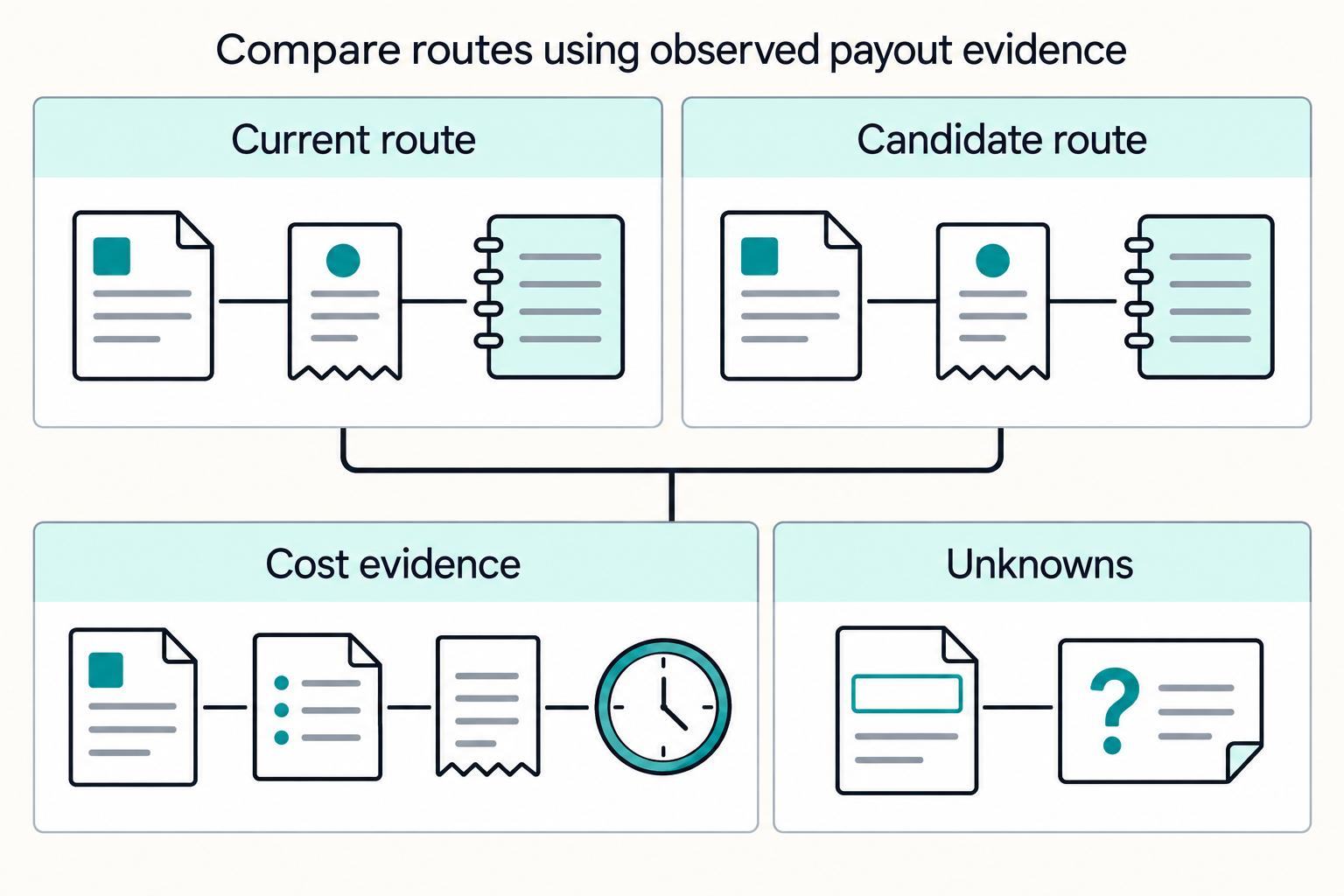
Quick Answer
Start with a corridor-level baseline, then route decisions by delivered outcome instead of posted fees. To reduce cross-border payout costs, test wire versus local rail options on a controlled payout batch, and switch only when cost per successful payout, delivery variance, and exception load improve together. Enforce execution order (`compliance gate -> quote -> conversion -> payout`) and require clean provider-reference mapping to internal payout IDs before scaling volume.
Why payout costs stay high even when your fee card looks low#
A low fee card rarely tells you what a payout really costs. Margin can still leak through additional cross-border charges and operational friction that never showed up in the vendor pitch.
Step 1. Name the costs that sit outside the headline fee#
Cross-border fees are broader than the line item your provider labels as a transfer charge. Financial institutions also price for currency conversion risk and the operational cost of moving money across countries. Those charges can quietly drain profitability if you are not tracking them. Even small per-transaction charges add up fast once you are paying hundreds or thousands of contractors, creators, or sellers.
A practical checkpoint is simple: pull one recent payout batch and compare four amounts for the same payouts: what you expected to send, what your provider debited, what your ledger recorded, and what recipients actually received. If those do not reconcile cleanly, treat it as a total-cost issue, not a headline-fee issue.
Step 2. Define who should care and what problem this guide solves#
This guide is for the people who own the payout outcome: founders, product leaders, finance teams, ops leads, and engineering owners running contractor, creator, or marketplace payouts. If your job is to move funds internationally on a repeat basis, the problem is not payment acceptance or treasury in the abstract. It is how to send money across borders at lower effective cost without creating more failures, support tickets, or compliance exposure.
That scope matters because the cheapest-looking option on paper is often the wrong one in production. Local bank details and local payment rails are often presented as a way to reduce fees, but you should treat them as one lever in your cost model, not as a guarantee that cross-border charges disappear. You need to judge routes by total delivered cost, predictability, and operational effort.
Step 3. Use a decision-ready sequence, not a pricing screenshot#
The point of this guide is to give you a usable sequence: baseline the real cost stack, choose rails by corridor, enforce the right execution order, and tighten reconciliation before you scale any change. If a route looks cheap but creates more returns or manual work, count that as a cost increase.
For a rail-by-rail comparison, see Cross-Border Payments for Platform Operators.
Gather the minimum data and controls before you change routing#
Before you change routing, make sure you have a clear baseline, named owners, and tested launch gates on a controlled payout batch. That keeps cost decisions tied to real delivery outcomes, not headline pricing.
Step 1. Build a 90-day corridor baseline. Break results out by destination country, currency pair, and payout type (for example, contractor, creator, or seller payouts). For each slice, track effective cross-border fee, FX conversion cost, and return or failure rate. If cards are part of the flow, keep foreign transaction fee data separate because that fee is charged to the cardholder by the issuing bank, not to the merchant or platform.
Step 2. Lock decision ownership before testing routes. Finance owns target cost and acceptable variance. Ops owns exception SLAs and escalation paths. Engineering owns idempotent execution and observability so retries and status updates do not create duplicate payouts or false success signals.
Step 3. Prepare a market evidence pack. For each market, capture KYC/KYB status, AML requirements, payout eligibility rules, and provider coverage notes. For business recipients, capture the Legal Entity Identifier (LEI) when available, since it provides a unique cross-border entity reference that can improve matching consistency.
Step 4. Enforce hard launch gates on a controlled batch. Do not go live until reconciliation, provider status mapping, and rollback are tested on a limited payout batch. Confirm that each provider reference maps to your internal payout ID and that failures can be handled without manual spreadsheet repair.
For a direct comparison of payout rails, see Choosing SWIFT or Local Bank Transfers for Cross-Border Platform Payouts.
Map your real unit economics before picking new rails#
To lower payout cost, model the payout you actually deliver, not the headline fee. At corridor level, split rail cost, FX cost, exception cost, and manual handling so hidden drivers are visible before you change routing.
Step 1. Break one payout into named cost lines. Start with one completed payout and force every cost into a line item:
- rail fee charged by your provider or banking path
- correspondent/intermediary bank deductions
- FX spread or slippage between quoted and executed conversion
- return, repair, or resubmission handling
- manual ops time at your internal cost rate
Compare total cost in one reporting currency without counting the same deduction twice. As an illustrative example, a route for 100 payouts might incur $200 in provider fees, $150 in FX cost, $100 in intermediary deductions, and $50 in repair work: $500 in total. If only 95 payouts complete, cost per successful payout is $500 / 95, or about $5.26. Compare a candidate route on the same amounts, dates, completed-payout definition, and cost basis; include failed attempts and setup or prefunding costs where you absorb them.
Step 2. Compare current wire routing vs a local-rail option by corridor. Use the same columns for each corridor so tradeoffs are comparable.
| Corridor | Current wire transfer path | Local payment rail option | Speed | Predictability | Failure handling | Compliance overhead | Unknowns |
|---|---|---|---|---|---|---|---|
| High-volume corridor | Current provider + correspondent chain | Local route if supported | Measure submission-to-recipient-availability timing for the actual route | Measure actual delivery variance | Record return ownership and reference mapping | Record market-specific checks | Routing transparency, missing fee detail, reconciliation gaps |
| High-return corridor | Current provider path | Local rail candidate | Use observed delivery timing | Compare quoted vs delivered outcomes | Record repair effort and refund timing | Record additional operational checks | Missing status codes, unclear deductions |
| Margin-pressure corridor | Current provider path | Local rail candidate | Measure real settlement behavior | Measure unexplained delays or shortfalls | Measure ops work per failed payout | Record country-specific requirements | Any provider data gaps |
Keep the Unknowns column explicit. If you cannot separate rail fees from correspondent deductions, that is a decision risk, not a documentation detail.
Step 3. Set switching thresholds before you review provider pitches. Define route decisions in advance. If a wire corridor shows high variability, frequent returns, or unexplained deductions, prioritize local routing even with higher setup effort. Standard bank-transfer paths can be slower and include correspondent-bank costs, so variability is often structural rather than one-off.
Also pressure-test coverage claims. "180+ countries" is not enough on its own; settlement behavior in each country determines real performance. Your decision should be explicit for each corridor: keep current route, test local routing, or pause until unknowns are resolved.
If your payout flow runs through multiple entities, see Intercompany Payments for Multi-Entity Platforms in Cross-Border Transfers.
Choose corridor strategies with explicit tradeoffs#
Do not force one route across every payout type. Use local bank details plus a local currency account for high-volume, repeat corridors, and keep a simpler cross-border path for low-volume or volatile corridors until your own results show a clear upside.
Match the route to corridor shape, not provider marketing#
High-volume repeat flows usually justify local receiving details and local currency balances because fewer intermediary hops can improve delivered-amount predictability and reconciliation. If you are running frequent payouts in the same markets, small per-payout leakage compounds quickly.
For low-volume or irregular corridors, keep the simpler path first and measure real outcomes. A lower headline fee can still lose once onboarding friction, return handling, or funding complexity is included. Switch only when your corridor data shows a clear improvement in cost per successful payout, exception rate, or delivery variance.
Cross-border routing depends on which providers and payment systems can exchange instructions, funds, and status information. A local last-mile rail can reduce intermediary hops without removing the cross-border funding and conversion steps. Verify the complete route rather than assuming local receiving details prove domestic execution throughout.
Your checkpoint is operational: verify the actual settlement path, beneficiary detail requirements, and return-code visibility on a controlled payout batch before you reroute production volume.
Decide whether you are optimizing for certainty or lower effective cost#
If urgency is the priority, it can be worth paying slightly more for better delivery certainty and clearer status visibility. Late contractor and seller payouts often create more support load and trust damage than a modest fee increase.
If margin pressure is the priority, optimize for lower effective cost with tighter cutoffs, quote handling, and payout windows. Otherwise, savings can disappear into FX spread, manual repair, and missed batch timing. FX spread is the gap between the wholesale rate and the rate your provider offers, so a corridor with a lower listed fee can still be expensive.
A common failure mode is switching routes for price, then hitting program-level compliance differences, beneficiary format constraints, or uneven provider support by market. That usually means more exceptions and resubmissions, not just delay.
Document one route per payout scenario, then record the blocker#
Keep one explicit route decision per scenario so product, finance, ops, and engineering are aligned.
| Payout scenario | Default route bias | Primary optimization | Switch only when | Constraint to record |
|---|---|---|---|---|
| Creator weekly payouts | Local bank details plus local currency account | Predictability and lower repeat leakage | Settlement path and reconciliation are verified on a controlled batch | Market coverage, program eligibility, beneficiary detail format |
| Contractor milestone payouts | Simpler cross-border path first | Flexibility for irregular amounts and recipients | Baseline data shows clear cost and reliability upside from local routing | KYC/AML review timing, onboarding friction |
| Marketplace seller settlements | Depends on payout cadence and support burden | Balance cost with delivery certainty | Returns, shortfalls, or support tickets show current path is unstable | Provider support by market, reserve or settlement rules |
Treat your per-market evidence pack as the release gate: KYC/KYB status, AML requirements, payout eligibility rules, and provider coverage notes. If that is incomplete, the route is not ready even if pricing looks better.
One corridor can be optimized for certainty, another for margin, and a third left unchanged until unknowns shrink. That is controlled execution, not inconsistency.
Implement payout flow in the right order so savings survive production#
To preserve payout savings in production, use one documented flow and run it consistently. Faster and more transparent multi-currency payments are becoming the expectation, and regulatory pressure is moving in the same direction, so inconsistent execution gets expensive as volume grows.
Define one operating flow and make each step visible#
Pick a single end-to-end flow for each payout scenario and keep it stable across teams. The goal is simple: everyone should be able to see what happened, when it happened, and who owns the next action.
On a controlled payout batch, confirm that status changes are timestamped and visible to finance, ops, and engineering. If that visibility is missing, exceptions are harder to explain and resolve.
Make retry behavior predictable#
Keep one durable payout reference across transport retries. Retry an unresolved request only under the provider’s idempotency rules using the same key and parameters; do not switch providers or rotate keys while execution is unknown. Verify and deduplicate provider events, then post each economic effect once. A second submission can erase the apparent saving from a cheaper route.
A useful test is simple: replay the same event path in a test environment and verify you reach the same final state.
Handle FX timing with explicit policy#
Treat quote timing as an execution control, not a background detail. If your policy says a quote is no longer usable, re-quote before conversion or submission instead of pushing forward under unclear rate conditions.
This keeps cost outcomes and reconciliation cleaner when payout queues get busy.
Keep traceability intact across systems#
Maintain a clear link between your internal payout records and provider-side records from first submission through final ledger outcomes. That traceability shortens investigations and reduces reconciliation friction when something breaks.
Related reading: Cross-Border E-Invoicing Controls for Platform Payouts.
Add compliance and tax checks without creating payout gridlock#
Use compliance gates to make payout eligibility explicit early, and keep review depth proportionate so controls do not turn into operational gridlock.
Define pre-creation eligibility and make decisions visible#
Before payout creation, decide which checks are true blockers and which are monitoring signals, then record the result in the payout workflow. For each blocked payout, keep a clear decision code, review timestamp, and rule owner so finance, ops, and engineering can see the same reason without manual escalation.
Apply a proportionate oversight model#
The October 2024 CPMI report on linking fast payment systems concerns governance and oversight of interlinking arrangements. It provides useful context for understanding cross-border risk ownership, but does not authorize lighter customer checks for a platform. Set review depth under your own applicable program rules and retain the decision record.
Keep tax and audit artifacts machine-readable#
If your payout program depends on tax documentation, store artifact status and version in the payout record used for the release decision. Retention and traceability matter most after funds move, so you should be able to trace which payouts relied on which approved artifact state.
If you need the country-by-country legal layer behind these controls, use a separate checklist rather than burying it inside payout code paths. The practical next read is Cross-Border Compliance Checklist for Platform Payouts: Licenses Registrations and Reporting by Country.
Automate batches and reconciliation so cost gains do not erode#
Cost gains usually erode in execution, not pricing, so make payouts predictable: batch routine disbursements, route exceptions clearly, and reconcile on a fixed operating rhythm.
Schedule recurring disbursements into a payout batch with fixed approval windows#
Batch routine payouts when provider pricing, approval controls, and cutoffs make it worthwhile. Freeze the approved batch, run final checks, and submit through the selected route. Batching alone does not reduce per-transfer charges; compare any fee savings with added waiting time, prefunding cost, and operational effort.
Send anything that misses cut-off or fails validation to a visible exception queue. Keep urgent payouts on a separate off-cycle path so they do not distort routine batch performance or cost-to-serve metrics.
Standardize provider failures into action buckets your team can execute without debate#
Map provider failures into actions such as paced retry, correct details, investigate unknown execution, or cancel a confirmed unexecuted instruction. Retry only when replay is safe and permitted. An ambiguous timeout belongs in reconciliation, not automatic resubmission through another route.
Validate the mapping with regular sampling: if different operators choose different actions for the same failure code, your process still depends on tribal knowledge.
Reconcile provider events to ledger journals on a set cadence, and treat the ledger as your financial source of truth#
Use a reconciliation cadence your team can sustain, and make mismatch investigation part of normal operations. In practice, many teams run this daily even when settlement spans multiple business days, because the goal is fast exception detection, not perfect real-time matching.
A centralized orchestration layer can reduce the technical debt and operational silos created by one-to-one regional integrations, but only if provider events land in a shared journal model. Track corridor-level cost-to-serve alongside fees, including manual touches per payout, exception resolution time, and return investigation cycle time.
Fix the failure modes competitors usually skip#
Do not dump these cases into a generic "payment issue" queue. If you want lower payout cost without shifting losses into operations, classify them consistently and require the same evidence pack before escalating to finance or engineering. That discipline is what keeps your cost data reliable enough to use.
| Failure mode | Check first | Action |
|---|---|---|
| Receipt shortfall | Compare the requested amount, submitted amount, provider-confirmed amount, and received amount | Document exactly where the change appears; do not adjust pricing or route assumptions until one operator can show the change point from records and IDs |
| Delayed delivery | Classify the delay by process stage and owner | Use status and approval timestamps to identify where progress stopped before deciding the next action |
| Reconciliation mismatch | Confirm transaction identifiers and event history are coherent | Escalate only after the mismatch is clearly defined |
| Repeated compliance-related blocks | Review whether required records and controls were complete at the right point in your workflow | If the block appears after queue entry, prioritize fixing intake and control timing, not just downstream review |
Put this into action this quarter#
Turn this into a quarter plan by phasing corridor rollout: narrow the scope, prove outcomes, then expand only after controls are stable.
- Pick two corridors and freeze scope. Choose repeat routes where current and candidate paths can be compared using the same payout sizes, recipient eligibility, and measurement period. Let observed delivery and total cost drive the decision.
- Prove gains with a before/after view finance and ops both trust. Measure by corridor: effective cost per payout, failure/return rate, and manual effort. Include the full cost stack you actually absorb: cross-border fee, FX, deductions where they occur, and exception-handling work. Keep traceability intact so each provider reference maps to one internal transaction ID.
- Enforce execution order before moving traffic. Run
compliance gate -> quote -> conversion -> payout. This reduces avoidable rework from eligibility blocks, stale quotes, and payout reversals. - Expand only after controls are steady in production. Add corridors when reconciliation is consistently clean, failure codes are operationally usable, and compliance artifacts are complete enough to avoid post-submission document chasing.
Copy/paste checklist:
- Baseline cost stack by corridor (
cross-border fee, FX, failures, manual ops) - Pick route strategy per corridor (
wire transfervslocal payment rail) - Enforce execution order (
compliance gate-> quote -> conversion -> payout) - Productionize
payout batchautomation and failure-code handling - Verify
KYC/AML/tax artifact readiness (W-8,W-9,Form 1099)
Tax-document collection does not by itself determine a reporting form. U.S. reporting and withholding depend on payer duties, payee status, payment type, source of income, and exceptions. A W-9 can establish U.S. taxpayer details; a W-8 series form can support foreign-status documentation. Foreign status alone does not make every contractor payment reportable on Form 1042-S. Store the applicable determination separately from KYC and payout eligibility.
Frequently Asked Questions
What are the main drivers of cross-border payout costs for platforms?
The biggest drivers are usually cross-border fees, FX markups, intermediary bank deductions, and the manual work created by poor payment visibility. Wire transfer paths are especially prone to extra cost because a payout can pass through several banks before it reaches the beneficiary. Processing delays matter too, because slow or opaque settlement creates more support work and more exception handling.
What is the fastest way to reduce costs without rebuilding the whole payout stack?
Start with the largest measured cost driver in one repeat corridor. A local route may help, but test a controlled batch against your current route using total cost per successful payout, recipient availability, and exception effort. Change routing only when eligibility, funding, status visibility, and reconciliation all support the improvement.
Do cross-border fees still apply when there is no currency conversion?
Yes, they can. No FX conversion does not mean no cross-border fee, because charges can still come from international processing, bank networks, regulatory handling, or intermediary banks on the route. If the beneficiary receives less than expected, check where the deduction happened before assuming your pricing or FX setup is wrong.
When should we choose local payment rails over wire transfers?
Choose local rails when you have repeat volume in a corridor and a wire path that keeps accumulating fees or timing uncertainty. Local rails can reduce intermediary hops and make settlement feel more like a domestic payment, but they are not available in every corridor. Your checkpoint is simple: confirm coverage, required local bank details, and whether the payout program supports that rail before you switch.
How do we lower payout costs without increasing payout failures?
Do not treat routing as a finance-only change. Cost reduction holds up only when compliance checks and reconciliation controls are in place, including KYC or KYB status, monitoring, auditability, and reconciliation between provider events and your ledger. A common failure mode is pushing payouts onto a cheaper route while keeping weak status visibility, which can turn savings into more manual investigations.
What should product, finance, ops, and engineering implement first?
Start with a corridor baseline, then assign owners: finance for cost targets, ops for exception handling, product for corridor priorities, and engineering for payout integration and status ingestion. Test a controlled payout batch before broader rollout. The go or no-go check is whether reconciliation works, provider status mapping is clear, and failures are monitored closely during rollout.
Try a related tool
Researched and edited by the Gruv editorial team. Gruv builds cross-border billing, payouts, and finance-operations software for global businesses.
Sources
Educational content only. Not legal, tax, or financial advice.
Related Posts
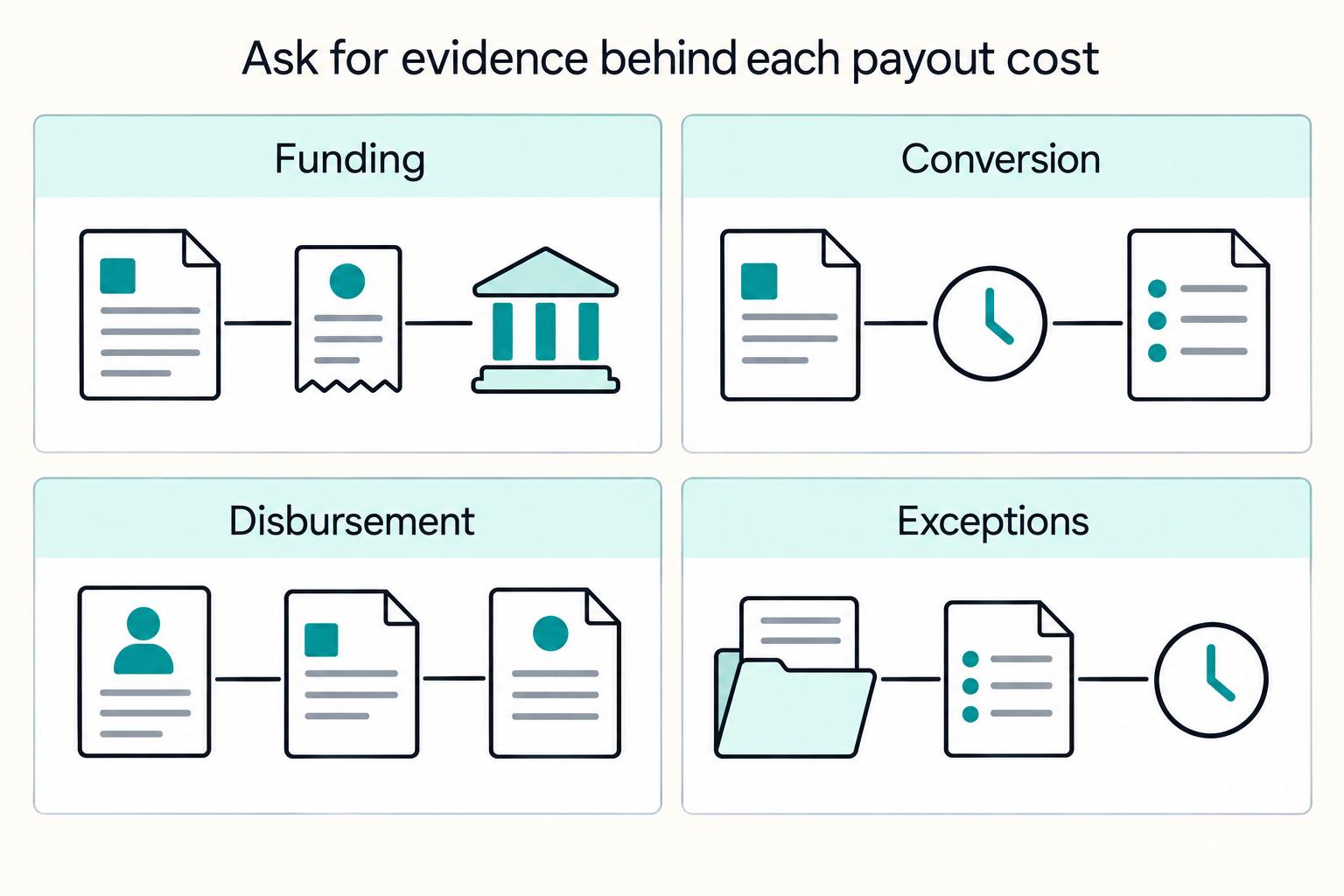
The Cost of a $100 Contractor Payout to Ghana
A contractor invoice for USD 100, a sender budget of USD 100 and a transfer of USD 100 before fees are different starting points. Agree which amount is owed and who bears charges before comparing Ghana payout routes. The useful output is a reconciled sender outlay and net contractor receipt, rather than one headline transfer fee.
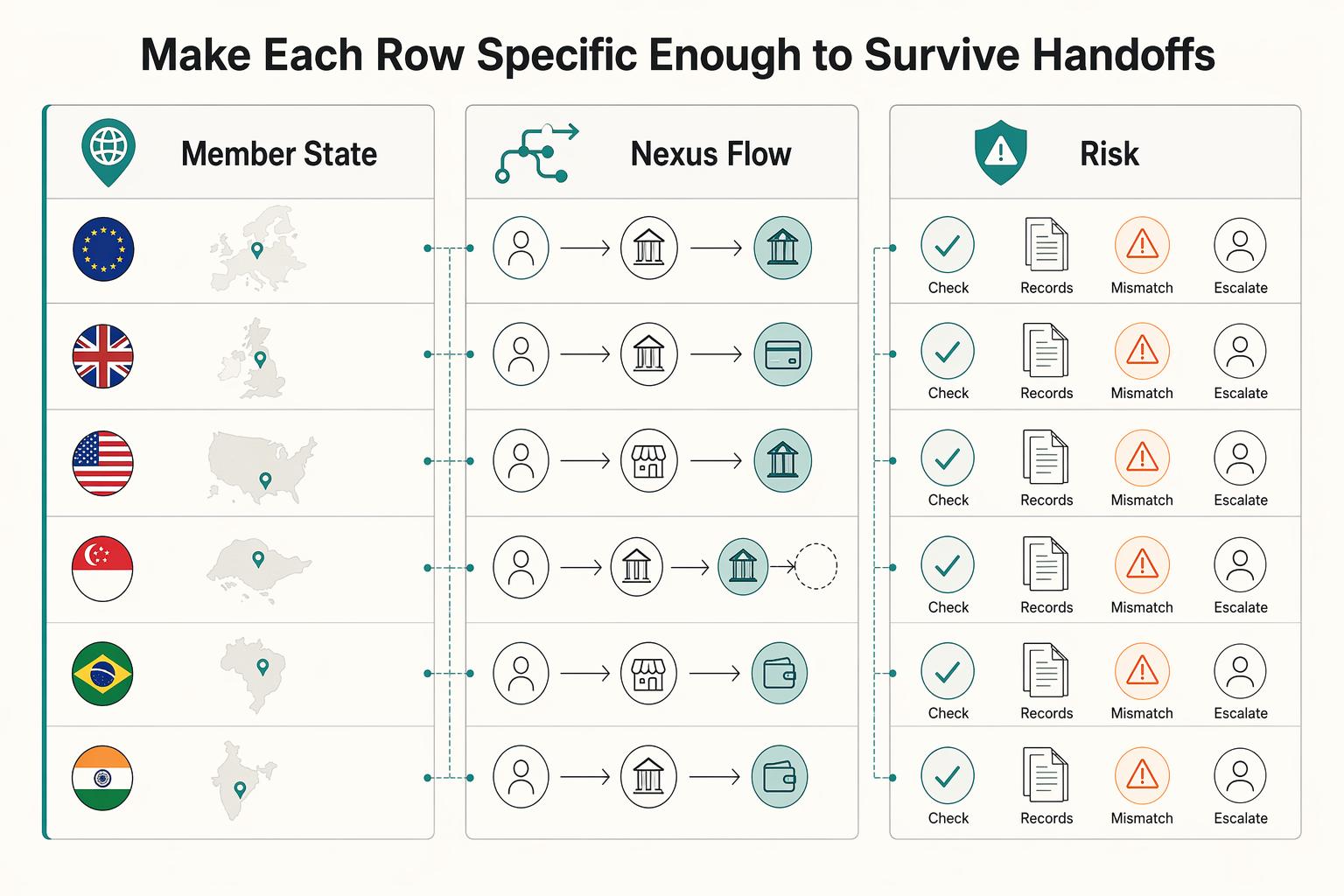
Country-by-Country Launch Rules for Platform Payout Compliance
Treat each new payout country as a go or no-go decision. It may be blocked by law, blocked by operations, or cleared only with conditions. This guide helps compliance, legal, finance, and risk teams make that call early, assign ownership, and keep an evidence trail that holds up later.
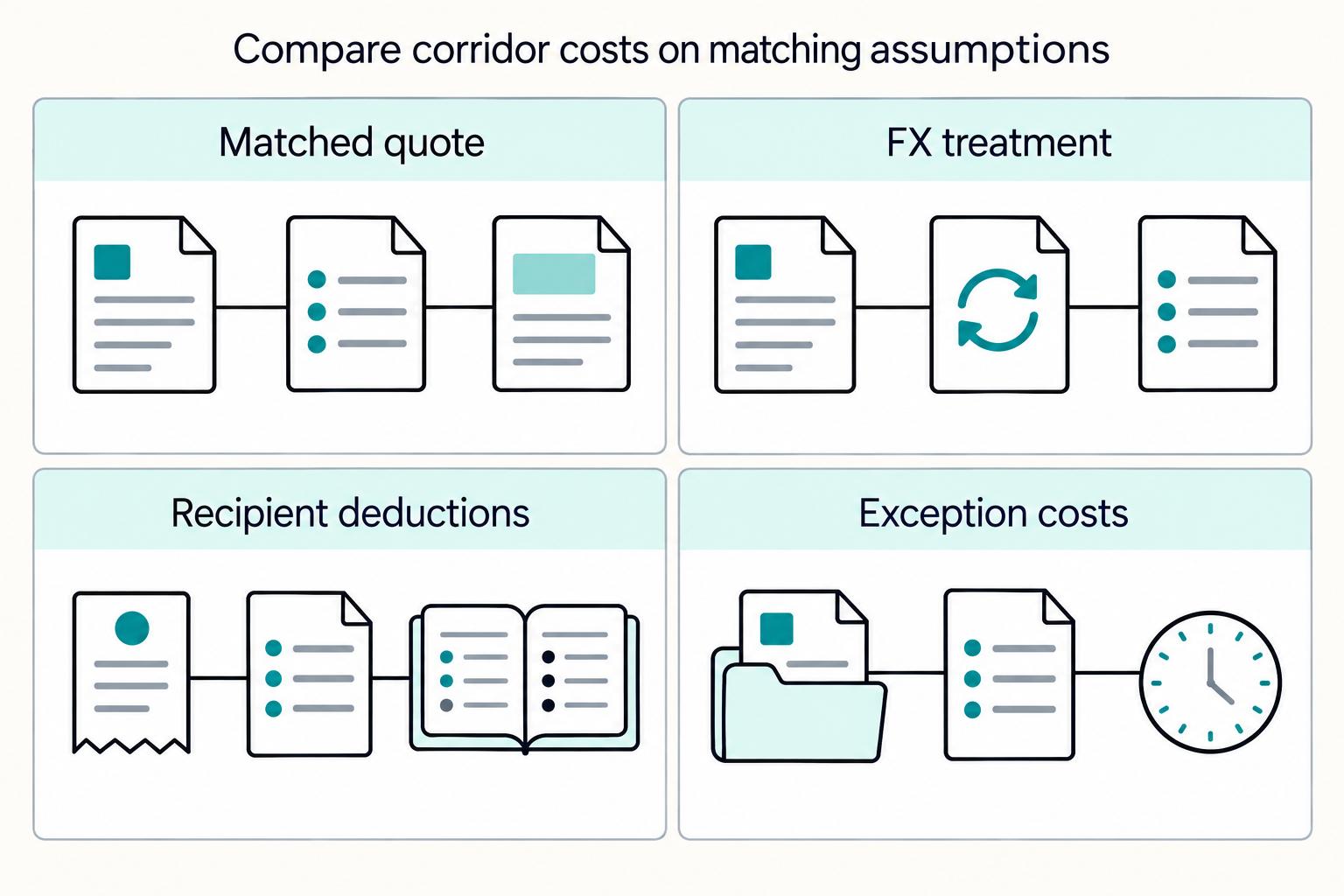
How Platform Operators Choose Cross-Border Payout Rails by Corridor
The hard part is not choosing one "best" rail. It is choosing the right rail for each corridor and payout type, where cost, speed, access, and transparency pull in different directions. For any route, the practical question is simple: for this country pair, payout size, and recipient experience, which path gives you acceptable delivery, controllable cost, and audit-ready evidence?