
Quick Answer
Platforms support cross-border e-invoicing credibly by treating it as a controlled data operation, not a PDF workflow. Build lane-specific invoice states, separate compliance status from payment status, and require traceability from the structured payload to the provider or authority response, Ledger journal, and payout outcome. Then apply blocking, reporting, and archive rules by jurisdiction, not with one global flow.
What Cross-Border E-Invoicing Controls Mean for Platform Payouts#
Step 1: Treat cross-border e-invoicing as a data operations problem, not a PDF problem.
If you are working on cross-border electronic invoicing, the hard part is rarely generating a document. It is moving structured invoice data through validation, reporting, posting, and payout decisions without losing traceability. In the strict sense, e-invoicing is the digital exchange of invoice data in a structured format that supports automated processing, so your design has to survive machine checks, not just human review.
That matters because cross-border design is fragmented by default. Global, regional, national, and proprietary invoice standards all coexist, and the reporting model changes by jurisdiction. Some markets are moving toward near real-time reporting through Digital Continuous Transactional Reporting and Continuous Transaction Controls, while others still rely on later reporting. If your team starts from the idea of one invoice flow for every country, you are building rework into the model from day one.
Verification point: before you discuss UI or provider choice, confirm that your target corridors actually support the structured invoice, delivery, and reporting pattern you plan to use.
Step 2: Anchor the work around Ledger, Reconciliation, and Settlement.
This guide is for finance, ops, and product owners who need operating control points, not a policy overview. In practice, you need to know three things for every invoice event: what was issued or received, what compliance status it reached, and what financial record or money movement depended on that status. If any one of those links is weak, close gets noisy fast.
One early test is simple: can you trace one invoice from payload creation to provider or authority response, then to the exact Ledger journal and the payout decision that followed? If not, stop and fix the event chain before rollout. A common failure mode is treating payment completion as proof that the invoice was accepted or properly reportable. Those are different states, and mixing them causes reconciliation drift later.
Step 3: Design for compliance where supported, resilience under failure, and audit readiness at scale.
The goal is not full automation everywhere, because the legal and technical path is not uniform across borders. The better target is an operating model that borrows from proven domestic and regional foundations, then adds clear ownership, evidence capture, and exception handling for cross-border variation. That matters even more as CTC adoption grows and policy direction, especially in the EU, continues toward e-invoicing based digital reporting for cross-border trade.
Make your baseline evidence pack explicit from day one: the structured invoice payload, the validation result, the provider or authority response where applicable, and the journal linkage that shows how the invoice affected the books and downstream payout. If you cannot produce that set on demand, you may have invoice throughput, but you do not yet have an audit-ready cross-border invoicing operation.
What to prepare before you touch invoice logic#
Do not build invoice flows until scope, ownership, evidence, and blocking checks are settled. Most early rework in cross-border e-invoicing comes from getting those four basics wrong, not from schema mapping. This is also where teams usually need vendor onboarding documentation and a clean bank code and routing reference.
- Define the corridors you are actually supporting.
Map seller country, buyer country, entity issuing the invoice, payout path, and whether nonresident VAT obligations may apply. Keep digital reporting mandates separate from issuance rules, because periodic invoice-data submission to authorities is not the same thing as structured invoice exchange. A useful checkpoint is a corridor sheet that marks where coverage is confirmed, where it varies by market or program, and where legal treatment is still unknown. Do not assume domestic logic extends cleanly to nonresident or cross-border transactions.
- Assign owners before any build starts.
You need named control owners across Finance, Payments Ops, and Product for e-invoicing, reporting, and any Continuous Transaction Controls (CTCs). Cross-functional ownership is not optional. It is a prerequisite for implementation and ongoing compliance. If nobody owns authority rejection handling, or if Product owns issuance while Finance owns reporting with no handoff rule, your first month-end exception queue will prove it.
- Set your minimum evidence pack.
Define the objects you must retain for every invoice event: the structured payload, the provider or authority response where applicable, the audit trail, and the Ledger journal linkage. Verification point: pick one sample invoice and confirm you can retrieve all four objects without asking three teams for screenshots.
- Verify blocking dependencies that can stop money movement.
KYC, KYB, AML, and VAT validation need explicit gate rules. In the EU, VIES can help confirm whether a business is registered to trade cross-border within the EU, but it is a search engine pulling live results from national VAT databases, not proof of full VAT compliance. Treat VIES failures and timeouts as dependency events to route, not as silent passes. Also note that UK (GB) VAT number validation ceased in VIES on 01/01/2021.
Map your operating states from invoice creation to archive#
If your invoice states are vague, fix them before rollout. This is where reconciliation drift usually starts: one team thinks an invoice is "done" because money moved, another thinks it is "done" because a provider accepted the file, and Finance still cannot prove what happened.
| State | Trigger or condition | Evidence or note |
|---|---|---|
| Issued | Submission leaves your platform | Provider message ID is returned |
| Accepted | Might require a business response | Keep the provider reference and the timestamp of the state change |
| Rejected | Peppol Invoice Response status code RE | Reasons may be more than one; rejection of the invoice does not necessarily mean rejection of the commercial transaction |
| Reported | Might require the filing or authority reference to be written into the audit trail | Retrieve any tax authority reference and the timestamp of the state change |
| Archived | Final evidence pack is retained and retrievable | Do not treat a provider or government portal as the archive of record; German guidance cites a 10 year storage period, while portal records may be deleted after 28 days after creation or a status change |
- Name the lifecycle states you will actually operate.
Use a simple internal sequence such as draft, issued, accepted or rejected, corrected, reported, and archived. Treat that as your operating model for structured e-invoicing, not as a claim that every jurisdiction uses the same labels. An electronic invoice is structured data that can be processed automatically, so each state should reflect a machine-observable event, not a person saying "looks good."
- Attach each transition to one event and one owner.
For every move between states, define the triggering event, the team accountable for handling exceptions, and the evidence you store. A workable rule is one transition, one event, one owner. For example, "issued" might exist only when the submission leaves your platform and a provider message ID is returned; "accepted" might require a business response; "reported" might require the filing or authority reference to be written into the audit trail.
The checkpoint is straightforward: pick one invoice and confirm you can retrieve the structured payload, the provider reference, any tax authority reference, the timestamp of each state change, and the owner queue that handled it. If you need screenshots or Slack history to reconstruct that path, your state design is not ready.
- Split technical, compliance, and commercial outcomes.
Do not let payout status stand in for invoice acceptance. In Peppol contexts, this matters immediately: a technical response and a business response are not the same thing. The Peppol CTC addendum explicitly distinguishes Message Level Response, which is technical, from Invoice Response Message, which is business-facing. And if an invoice is rejected, Peppol Invoice Response uses status code RE, with reasons that may be more than one.
That split avoids a common failure mode: the buyer or network rejects the invoice document, but the underlying sale still exists. Peppol is explicit that rejection of the invoice does not necessarily mean rejection of the commercial transaction. If you collapse those two facts into one status, downstream teams will misread cash, revenue, and compliance positions.
- Archive from your own records, not from a portal view.
Archive should mean the final evidence pack is retained and retrievable, not that a portal once displayed the invoice. Retention is jurisdiction-specific, but the archive rule needs to exist in your model. As one concrete example, German federal guidance cites a 10 year storage period for invoices under section 14b UStG, while portal records may be deleted after 28 days after creation or a status change. That is a strong warning not to treat a provider or government portal as your archive of record.
Choose your compliance path by jurisdiction, not by preference#
If a market uses prevalidation, treat tax authority acceptance as a release gate for payout-dependent actions. If a market only requires post-transaction digital reporting, funds movement can proceed under control, but only with explicit exception flags and reporting deadlines attached.
The state model from the last section matters here because the same invoice cannot move under the same rules everywhere. E-invoicing and digital reporting are related, but they are not the same operating constraint. In practice, one path can require invoice data to be checked or cleared before you act, while another allows reporting after the transaction on a periodic basis.
Step 1: Classify each market by compliance path#
Start by assigning each jurisdiction to one of two working buckets:
- Invoice prevalidation under Continuous Transaction Controls (CTCs)
A CTC architecture can include pre-clearance with real-time reporting, and OECD material describes DCTR models as typically requiring near-real-time reporting of invoices or transaction data to tax authorities. In these markets, your issue flow should not treat "sent to provider" as enough. Your checkpoint is authority acceptance or the equivalent regulated confirmation that the invoice can progress.
- Post-transaction digital reporting mandates
Digital reporting can be periodic rather than real-time clearance. The practical difference is that you may issue and pay first, then submit required data to authorities on the required cadence, provided you can still meet the reporting obligation.
Your first verification step is simple: for one market, point to the exact evidence that supports the bucket you chose. That evidence might be a tax authority notice, a formal program rule, or current implementation guidance. If your team cannot show why a jurisdiction sits in the prevalidation bucket, do not build a blocking rule yet. Mark it as unresolved.
Step 2: Tie settlement behavior to the bucket, not to internal preference#
Where prevalidation is required, do not release final payout actions until acceptance is confirmed by tax authorities. That does not mean you must freeze every operational activity, but it does mean you should not let payout release, final receivable recognition steps, or irreversible downstream actions rely on an invoice that may still fail compliance acceptance.
Where only periodic reporting applies, controlled payout is usually the better operating choice. Let the transaction proceed, but attach a reporting SLA, an exception flag, and an owner. The failure mode here is common: teams assume "not real time" means "can be cleaned up later," then month-end close turns into a chase for missing reportable data.
One concrete date that should be on your matrix is 1 July 2030 for EU Digital Reporting Requirements affecting cross-border B2B transactions under current ViDA rollout communications. Even if your build is earlier or narrower, that date is a useful roadmap trigger because it changes the future shape of some EU cross-border reporting lanes.
Step 3: Build a jurisdiction matrix that includes tax obligations, not just invoice format#
Do not stop at "CTC" or "reporting." Your matrix should include the tax obligations that change data requirements and evidence packs:
- VAT or GST treatment
- Withholding tax exposure
- Nonresident treatment under International tax
- Registration route or simplification option
- Known timing rules
- Unknowns that still need resolution
For VAT, note that businesses supplying goods or services in several EU countries may need a VAT number in each country unless a simplification applies. Also note that the EU OSS schemes are available to taxable persons established inside and outside the EU, which can materially change your nonresident operating design. For remote digital sales, OECD-linked implementation material also describes simplified VAT/GST registration and accounting approaches for nonresident suppliers.
For withholding, record the document dependency, not just the rate. A useful baseline example is US-source income, where foreign persons can be subject to a 30% withholding rate, subject to applicable rules and treaty treatment. That means your evidence pack may need tax forms and beneficial owner status before you can safely finalize invoice handling or payout treatment.
The red flag is a matrix with blank cells hidden in comments or tickets. If timelines, thresholds, or penalties are unclear, write unknown in the matrix and assign an owner and due date. Unknowns are not clerical gaps. They are implementation risks that can break reconciliation, payout timing, or tax reporting later.
If you need a deeper pass on the tax side, use Cross-Border Invoicing: How to Handle VAT GST and Withholding Tax on International Invoices as the companion detail layer.
Build the issuing flow with hard checkpoints#
Once you have the jurisdiction path, make the issuing sequence non-negotiable. The rule is simple: do not post the final Ledger journal or mark an invoice eligible for payout until the compliance checkpoint required for that corridor has actually passed.
Step 1: Create the invoice payload and validate tax-critical fields#
Create the invoice payload and validate tax-critical fields before submission. Start with one canonical payload for the invoice, then validate the fields that change tax treatment: VAT, GST, and Withholding tax. The exact field set will vary by market, so the check here is not "all tax fields everywhere." It is "all tax fields required for this jurisdiction matrix entry are present and internally consistent."
Then convert or map that payload into the required Structured invoice format. A structured invoice is not just a PDF attached to an email. It is a message bound to a defined syntax so it can be exchanged and processed automatically. If your team cannot show which syntax a lane requires, stop before release and mark that lane as unresolved rather than guessing. For your platform build, keep the same schema contract in invoice API integration so your issuance logic and your compliance checks do not drift.
Step 2: Submit once, retry safely, and store the response artifact#
Submit once, retry safely, and store the response artifact. For markets or providers that perform checks before forwarding, assume there is a meaningful response after submission, not just a fire-and-forget send. The Agenzia Entrate guidance is a useful operating model here: the exchange layer can carry out checks and provide a delivery receipt that evidences the invoice reached the recipient.
Use Idempotent retries on submission requests. If a connection drops after you send the invoice, you need to be able to repeat the request without creating a second invoice object or a second downstream action. The verification point is concrete: for any invoice, you should be able to retrieve the internal invoice ID, the idempotency key, the provider or authority reference, the status returned, and the stored receipt or rejection artifact.
A common failure mode is posting the journal when the provider says "received" but the authority or exchange layer later rejects or times out. In prevalidation lanes, that creates a false sense of issuance and pushes cleanup into close.
Step 3: Make webhook handling duplicate-tolerant before updating state or journal entries#
Make webhook handling duplicate-tolerant before you update state or journal entries. Replayed events happen. Your webhook processor should treat each external event ID as consumable once, record that it was seen, and make state transitions idempotent too. If the same acceptance event arrives twice, you should still have one invoice record and one Ledger posting.
A useful rule is simple: no event should be able to create both a new invoice state and a new journal unless you can prove it has not already been applied. If you cannot prove that, quarantine it for review.
Step 4
Link payment confirmation to invoice state, not the other way around, and keep logs minimal but traceable. Payment arrival can update operational status, but it should not override compliance status. In Continuous Transaction Controls (CTCs) or similar prevalidation lanes, keep payout ineligible until the required authority or provider acceptance is on file. In post-transaction reporting lanes, you may allow controlled payout earlier, but only if the reporting obligation remains attached to the invoice state.
For logs, keep the Audit trail rich in references and thin on personal data. Store invoice ID, corridor, tax treatment version, submission timestamp, response code, receipt reference, state transitions, and linked journal ID. Do not default to storing full PII in every log line when an identifier or token preserves traceability for finance exports and investigations.
Build the receiving flow that survives real-world mismatches#
The receive side needs the same hard gate as issuance, and usually more discipline. If you create accounting entries or release money before inbound validation finishes, you turn a supplier-data problem into a Ledger, close, and payout problem.
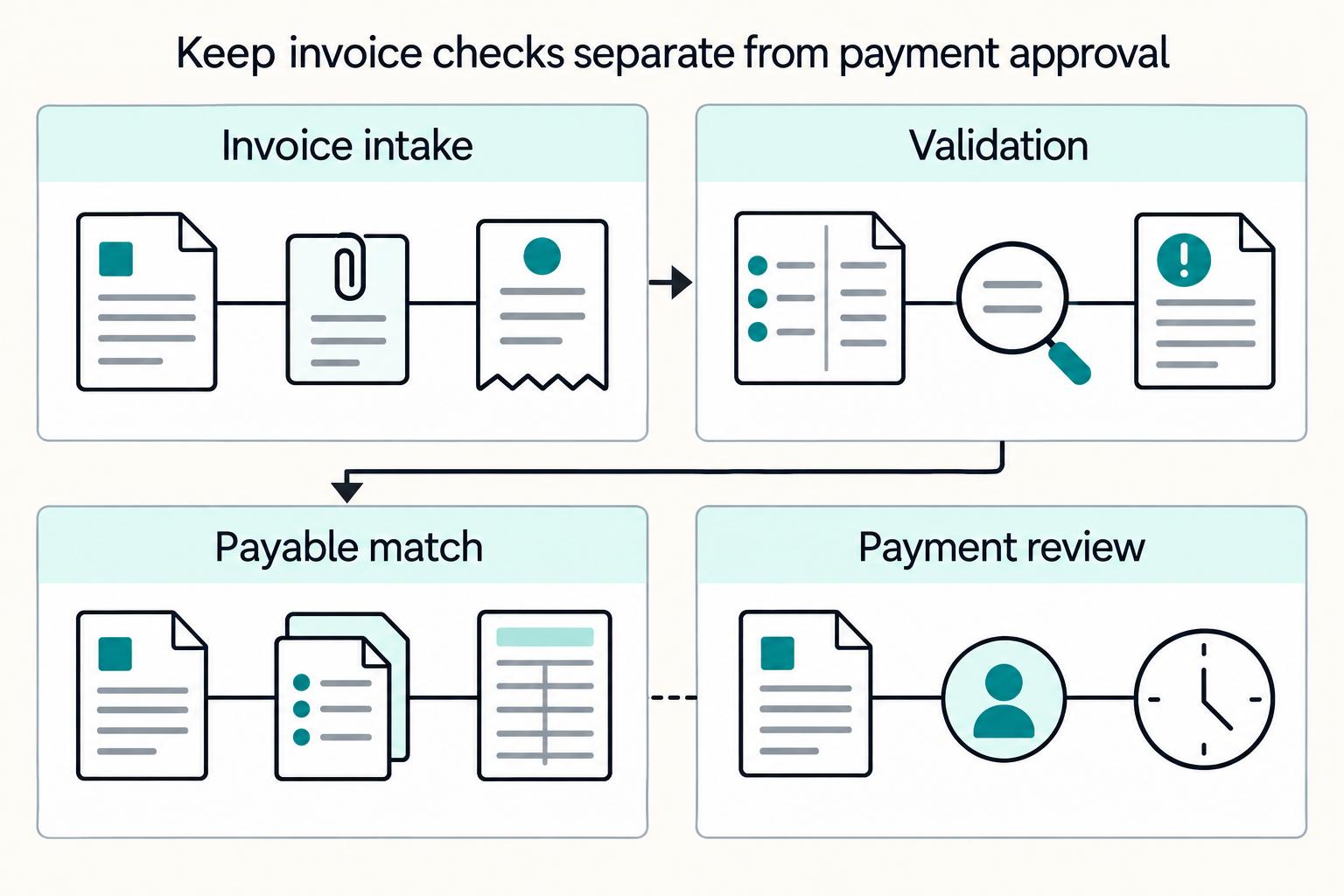
Step 1 Receive the supplier invoice, then validate it before you post or pay anything. That order matters. A practical receive sequence is: intake the invoice, check the schema and tax fields, match it to the payable context, then create the accounting entry and queue it for Reconciliation and payment review. Oracle's payables guidance is blunt on this point: before you can pay or create accounting entries for an invoice, you must validate it. That is the same intake-to-review sequencing used in invoice processing platforms when your AP team and your payments reviewers need one shared state model.
Your validation should do more than parse the file. Check the tax-critical fields that affect treatment in the destination lane, including VAT, GST, and Withholding tax, and run the matching logic that tests whether variances are within your stated tolerance limits. If the invoice fails those checks, place a hold for the exception condition instead of letting it drift forward. For any received invoice, you should be able to show the intake timestamp, schema version, tax validation result, match result, hold code if present, and journal ID once posted.
Step 2 Match the invoice to the right payable context and confirm supplier tax identity before auto-posting. On cross-border payables, identity errors are not cosmetic. They can change tax treatment, reporting, and whether the invoice should be paid at all. For applicable EU flows, use VIES to validate the quoted VAT number, because it allows traders to check the validity of VAT numbers used in other EU member states. If the number cannot be validated where relevant, do not silently default the invoice into a normal payable path.
This is also where you map the actual obligation set for that payable. You may have VAT on one corridor, GST on another, and Withholding tax only for certain supplier and entity combinations. The failure mode to avoid is letting the supplier master decide tax treatment by habit when the invoice facts say otherwise. Store the checked tax identity, the date and time of the check, and the tax treatment version used for the decision so Finance can explain the result later.
Step 3 Decide your blocking policy before the first exception arrives. Not every receive-side error deserves the same response, but you need the rule written down up front. A practical split is:
- Block invoice-level payment release and any related
International EFTselection when the issue could change legal payee identity, tax treatment, or accounting validity. Examples include failed supplier tax identity checks, missing required tax fields, and unresolved exception holds. - Route to an exception queue when the issue is reviewable without losing traceability, such as a match variance that is outside auto-approval but still has enough context for AP to investigate.
That policy keeps close cleaner because receive-side exceptions do not stay local to AP. Oracle's close reporting makes the operational consequence clear: some exceptions can prevent the Payables accounting period from closing. Watch aged holds by reason, not just invoice counts. If one hold reason keeps appearing near month-end, fix the rule or the upstream data source rather than training people to work around it.
Step 4 Link tax-document readiness to the invoice record so payout decisions are traceable, not manual. Do not leave U.S.-linked document checks in email threads or side spreadsheets. Where those lanes apply, attach document status and reference metadata to the payable record and expose it to AP and payments reviewers.
| Evidence link | When it matters | What to track on the invoice or supplier record |
|---|---|---|
Form W-9 | When you need the payee's correct TIN for IRS information reporting | Status received or missing, document reference, date collected |
Form W-8 BEN | When a foreign beneficial owner submits it because the withholding agent or payer requests it | Status received or missing, form reference, date received |
Form 1099-NEC | When nonemployee compensation reporting applies | Whether the invoice is in scope for 1099 reporting and linked reporting reference |
FBAR on FinCEN Form 114 | Not invoice-specific in every case, but relevant where your entity has foreign-account reporting duties | Link the entity or account to the reporting track if aggregate foreign accounts exceeded $10,000 during the year; note the annual due date of April 15 |
The recommendation here is straightforward: post to Ledger only after inbound validation passes, but keep payment approval separate until the invoice has both exception clearance and any required document readiness on file. That split is what keeps an inbound mismatch from becoming a payout surprise at month-end.
Handle common failure modes before they hit month-end#
Month-end usually breaks because recovery rules are unclear, not because invoice volume is high. If you want a cross-border e-invoicing rollout without close-week surprises, define the recovery path for each failure type now and make one team responsible for each state change.
| Failure type | What it means | Action in the article |
|---|---|---|
| Schema rejection | Validation failed is usually a fix-and-resend case, not a waiting case | IBM Peppol guidance for code 1100: Fix or resend |
| Authority timeout | In a prevalidation flow, no authority response is not the same as rejection or acceptance | Handle it in its own lane instead of treating it as accepted |
| Async webhook delay | Webhook-driven updates are asynchronous by design | Do not create a second invoice, a second journal, or a second payout action |
| Duplicate events | Webhook endpoints might occasionally receive the same event more than once | Make processing duplicate-safe and make sure a journal or payment action is created exactly once |
| Currency or tax-data mismatch | Wrong currency, VAT, or tax-treatment data can turn a commercially valid invoice into a compliance exception | Hold the item and investigate the payable or receivable context rather than correcting it in the ledger first |
Step 1 Classify the failure before anyone retries it. Treat schema rejection, authority timeout, async webhook delay, duplicate events, and currency or tax-data mismatch as different problems with different next actions. A schema rejection is usually a fix-and-resend case, not a waiting case. IBM's Peppol guidance is explicit on validation failure code 1100: Validation failed and the action is Fix or resend.
Authority timeout needs its own lane. In a CTC or other prevalidation flow, no authority response is not the same as rejection, and it is definitely not the same as acceptance. Webhook delay is different again: webhook-driven updates are asynchronous by design, so the absence of an event for a short period should not create a second invoice, a second journal, or a second payout action.
Step 2 Retry safely, with a bounded window and a stop rule. Use Idempotent retries at the API layer so the same operation is not performed twice. Stripe's guidance is concrete here: idempotency keys can be up to 255 characters, and keys may be auto-removed after they are at least 24 hours old. That does not give you a universal retry window, so set your own by provider and jurisdiction, then stop retries once the item ages past that window or an operator starts manual correction.
For webhook consumers, assume duplicate delivery will happen. Stripe says webhook endpoints might occasionally receive the same event more than once, so your processing has to be duplicate-safe. A practical checkpoint is simple: for any invoice event, you should be able to show the event reference, idempotency key used for the submission, retry count, final processing result, and whether a journal or payment action was created exactly once.
Step 3 Escalate status divergence before close, not after. When the provider says submitted or accepted but the authority status is missing, delayed, or contradictory, route the item to human review instead of letting either side win by default. This matters most in Cross-border transactions where the wrong currency, VAT, or tax-treatment data can turn a commercially valid invoice into a compliance exception.
Currency and tax mismatches should also bypass auto-posting. If invoice currency, tax fields, and corridor rules do not line up, hold the item and investigate the payable or receivable context rather than "correcting" it in the ledger first. If you need a deeper tax treatment check, this is where VAT, GST, and withholding tax rules usually decide the outcome.
Step 4 Keep one Audit trail with two views. Payments Ops needs operational status such as submitted, retrying, delayed webhook, duplicate suppressed, or blocked from payout. Finance needs compliance status such as schema valid, authority accepted or rejected, corrected, reported, and posted to Ledger. Tie both views to the same invoice record and evidence set so Reconciliation works from one source of truth, not two competing spreadsheets. That is the same evidence model your finance team needs in payout reconciliation at scale.
One recommendation is worth being strict about: if unmatched items start breaching your close tolerance, freeze new corridor expansion until Reconciliation stability improves. New lanes add edge cases faster than your controls can absorb them, and close is the worst time to discover that.
Set governance checkpoints that prove the system is working#
If you want clean close and defensible reviews, make governance testable every week and traceable every month. The point is not more reporting. It is being able to prove, lane by lane, that invoice controls are working before Tax authorities or auditors ask for evidence.
Step 1 Run weekly checks by jurisdiction and invoice lane. For markets that use authority prevalidation or other Continuous Transaction Controls (CTCs), review prevalidation success rate, rejected invoice aging, and unresolved exception counts separately for issue-side and receive-side flows. Do not blend all corridors into one dashboard. A healthy domestic lane can hide a failing nonresident or cross-border lane, and current guidance shows these mandates are expanding into cross-border and nonresident transactions.
Your verification point is straightforward: for any sampled rejected item, you should be able to show current status, age, owner, next action, and whether payout or posting was blocked. The red flag is aging rejections with no named owner or repeated retries after the item has already moved into manual correction.
Step 2 Test monthly close traceability from Ledger to invoice to payout outcome. Pick a sample that covers your higher-risk jurisdictions and prove each invoice can be tied to its journal, payout outcome, provider or authority response, and reporting artifact where Digital reporting mandates apply. That evidence design matters because audit reviews commonly use transaction sampling rather than checking every record.
A practical checkpoint is whether invoice data can be compared to the other documents in your audit trail. If a sampled invoice cannot be traced across those records, treat that as a control failure, not a filing nuisance. The same traceability expectations show up in internal payment audit trails.
Step 3 Keep a living risk log for rule ambiguity and change. Track open questions under International tax and Nonresident VAT obligations, especially where local treatment, reporting timing, or nonresident scope is still unclear. Record the jurisdiction, source date, owner, decision needed, and rollout impact. This matters because regime trackers are explicitly subject to change, and even the EY tracker is only a snapshot as of 25 March 2026.
Conclusion#
Treat e-invoicing as a controlled state machine tied to compliance gates, not as a document feature. That is the practical line between a rollout that scales and one that turns into corridor-by-corridor rework.
- Confirm corridor scope and nonresident exposure first.
List each issue and receive lane by seller entity, buyer country, and tax posture, then mark possible VAT, GST, and withholding tax steps. Your verification point is simple: for any live corridor, you should be able to say whether it sits in a prevalidation model such as CTC systems, a near real-time reporting model such as DCTR, or a post-transaction reporting pattern. If you cannot classify the lane, do not automate payout behavior for it yet.
- Assign one owner for each lifecycle stage.
Split ownership across issue, receive, report, and archive, but make one named team accountable for each state change. The failure mode is shared responsibility with no actual decision owner, which is how rejected invoices age unnoticed while payment activity keeps moving. Cross-border models are still fragmented and often nationally concentrated, so ownership gaps show up faster once you leave a domestic setup.
- Decide jurisdiction-level blocking behavior instead of using one global rule.
Where acceptance or prevalidation matters, hold payout-dependent actions until that status is confirmed. Where the market only expects reporting after the transaction, you can allow movement with exception flags and reporting checkpoints, but only if Finance can see the compliance status separately from payment success. This is where many teams confuse a successful payout with a valid invoice.
- Enforce idempotent retries, exception queues, and clear replay handling.
Structured e-invoices are exchanged as data over regulated networks, so duplicate events, webhook delays, and authority timeouts are normal operating conditions, not edge cases. Your checkpoint is whether a replayed submission or webhook can ever create a second invoice record, a duplicate Ledger journal, or a second payout trigger. If the answer is yes, fix that before expanding another country.
- Require invoice-to-Ledger-to-payout traceability in every close cycle.
For a sample issued or received invoice, pull the payload, provider or authority response, correction history, journal link, and payout outcome in one review. You may not be legally required to keep this exact chain everywhere, but operationally it is the fastest way to prove completeness, investigate mismatches, and survive audit questions without manual reconstruction.
- Track unknown legal details as explicit risks until local guidance closes them.
Do not smooth over unresolved questions on nonresident scope, archive rules, timing, or format assumptions. Mandates are expanding to cross-border and nonresident transactions, and the safer move is to keep a living risk log with an owner, affected corridor, current assumption, and decision deadline. If you need a tax-scope refresher before rollout, use this companion guide on VAT, GST, and withholding tax for international invoices.
The practical end state is not universal perfection. It is a rollout that builds on proven domestic or regional foundations, makes jurisdiction differences explicit, and gives you evidence when something breaks.
Frequently Asked Questions
What is the minimum a platform must do to support cross-border e-invoicing credibly?
At minimum, a platform should issue and store invoices electronically where required, keep invoice status separate from payment status, and preserve an audit trail from the invoice payload to the Ledger journal and payout outcome. A good test is whether one sample invoice can be traced through submitted data, provider or authority response, correction history, and final posting outcome on demand.
How is e-invoicing different from digital reporting mandates and CTCs in practice?
E-invoicing means issuing and storing invoices electronically, while digital reporting means submitting invoice data to authorities. CTCs and broader DCTR designs add more continuous authority visibility or validation, so timing, blocking, and exception handling are stricter than in a periodic reporting model.
When should invoice prevalidation block payout execution?
Block payout-dependent actions when the jurisdiction or lane requires acceptance or prevalidation before the invoice is valid for compliance purposes. If the market only requires periodic reporting, payout can proceed with exception flags and reporting SLA checks instead. Do not treat a successful payment file as proof that the invoice was accepted.
Do nonresident sellers need to follow local e-invoicing or VAT-related rules?
Sometimes they do, because current guidance shows mandates expanding to cross-border and nonresident transactions. In the EU, OSS can simplify VAT registration, filing, and payment across EU sales, but it does not automatically resolve local invoice format, acceptance, or storage rules. OSS has Union, non-Union, and Import schemes.
Why does multinational rollout break even when domestic invoicing already works?
It usually breaks because domestic flows hide one-country assumptions about fields, timing, and error handling. Cross-border lanes add different reporting models, nonresident treatment, tax ID validation, and receive-side mismatches. If one corridor starts aging rejections or unmatched received invoices, pause expansion and fix that lane first.
What should we store as audit evidence for each issued and received invoice?
Keep the structured or received payload, the human-readable invoice copy, the provider or tax authority response, timestamps, the journal link, payout status, and any correction or resubmission record. If you relied on a VAT number check, store the result and timestamp. For EU checks, VIES is a search engine, not a database, so keep what you actually saw at the time. For EU VAT contexts, preserve authenticity, integrity, and legibility through the storage period, and OSS records may need to be retained for up to 10 years.
Can we start with one region and still avoid rework later?
Yes, if you build one common lifecycle and evidence model first and keep jurisdiction rules configurable. Rework usually comes from hardcoding one region's acceptance event, tax fields, or archive assumptions as universal. That matters especially in Europe, where VAT modernization proposals such as ViDA show that rule design keeps moving.
Researched and edited by the Gruv editorial team. Gruv builds cross-border billing, payouts, and finance-operations software for global businesses.
Sources
- ec.europa.eu/digital-building-blocks/sites/spaces/DIGITAL...trusted
- ec.europa.eu/digital-building-blocks/sites/spaces/DIGITAL...trusted
- ecfr.gov/current/title-31/subtitle-B/chapter-X/part-1...trusted
- europa.eu/youreurope/business/taxation/vat/check-vat-n...trusted
- irs.gov/forms-pubs/about-form-w-8-exptrusted
- irs.gov/businesses/small-businesses-self-employed/re...trusted
- oecd.org/en/publications/digital-continuous-transacti...trusted
- single-market-economy.ec.europa.eu/single-market/public-procurement/digital-pro...trusted
Educational content only. Not legal, tax, or financial advice.
Related Posts

The Freelance Payment Penalty: A Modeled Audit of Platform Fees, FX Spreads, and Payout Delays
The money rarely disappears through a single, easy-to-spot fee. The real loss is stacked. A marketplace takes its commission, a processor adds a charge for international cards, a bank or payment company converts the currency at a spread, a platform holds the funds before release, and a wire sheds a little to intermediaries on the way in. Each layer looks defensible on its own, but the worker feels the combined result as a smaller deposit and a later payday.

How to Respond to a Subpoena for Business Records
Move fast, but do not produce records on instinct. If you need to **respond to a subpoena for business records**, your immediate job is to control deadlines, preserve records, and make any later production defensible.

A US Expat's Guide to Investing in UCITS ETFs to Avoid PFIC Issues
The real problem is a two-system conflict. U.S. tax treatment can punish the wrong fund choice, while local product-access constraints can block the funds you want to buy in the first place. For **us expat ucits etfs**, the practical question is not "Which product is best?" It is "What can I access, report, and keep doing every year without guessing?" Use this four-part filter before any trade: