
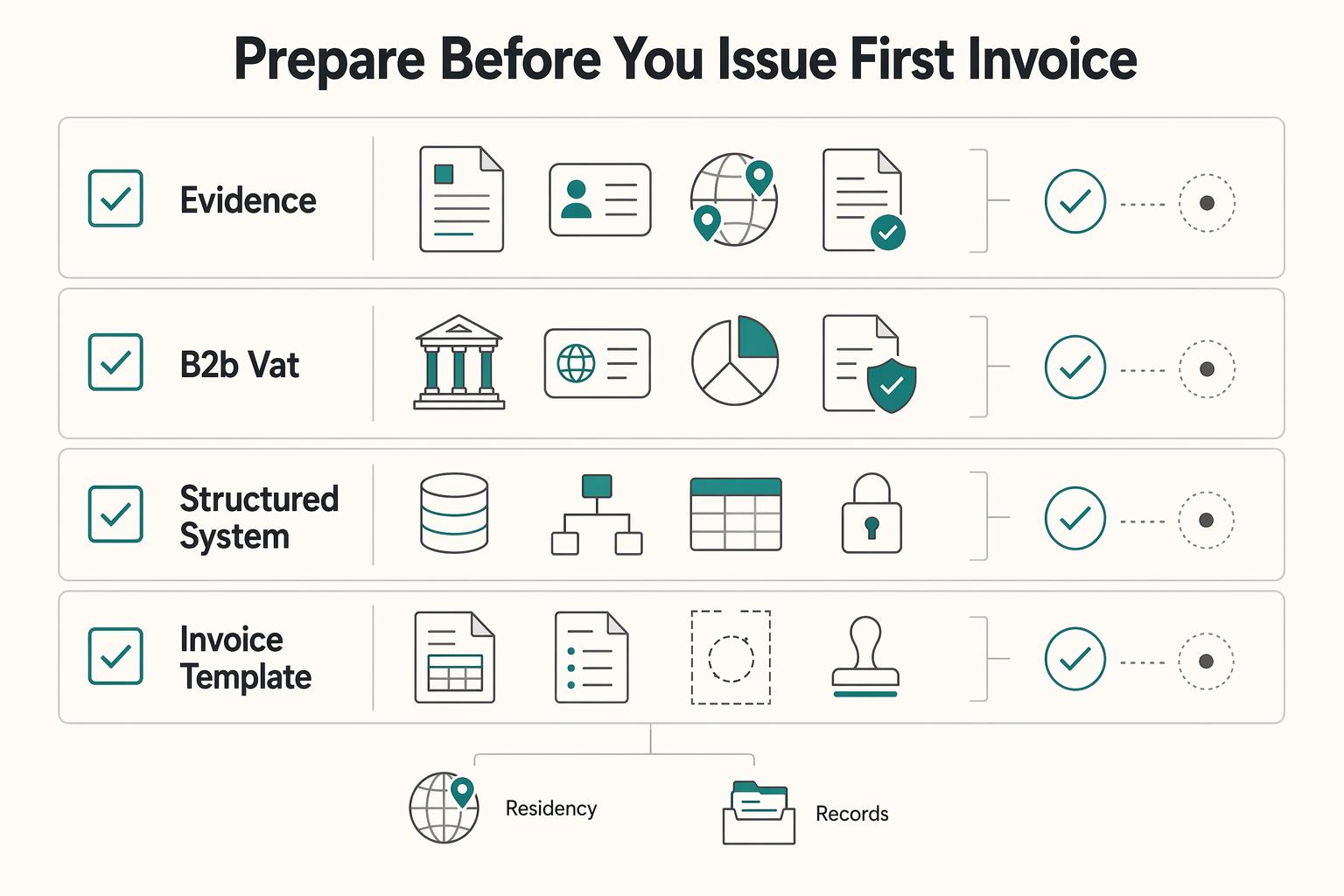
Quick Answer
Handle international invoices by separating indirect tax from withholding, deciding the tax treatment before you issue the invoice, and releasing only when evidence and approvals are complete. Scope the country corridor first, use a country decision matrix, validate required items such as EU VAT IDs in VIES where relevant, define the withholding owner and forms, then collect, settle, and reconcile in that order.
How VAT, GST, and Withholding Tax Affect the Invoice#
Treat cross-border invoicing as three linked decisions, not one: where indirect tax is due, whether withholding applies, and what evidence supports both positions. In workflows that touch VAT, GST, and withholding tax, the most expensive mistakes usually start with a narrow question such as, "What should appear on the invoice?" That is not enough. The invoice is only the visible output. The real control point is the decision you make before the invoice exists.
Start by splitting the tax review in two. VAT and GST are indirect consumption taxes. Withholding is a separate payment-side obligation. In the EU, VAT is a consumption tax framework for goods and services. In Australia, GST is a broad-based 10% tax on most goods and services. In the U.S., withholding rules define a withholding agent as the party responsible for withholding from certain payments to foreign persons. Those are different systems with different triggers, different evidence, and different owners.
That is why the same transaction can produce different answers in each lane. A service can sit outside one GST scope, require reverse-charge handling in another context, and still need withholding review based on payment source or classification. If your team collapses those into one generic "tax handled" decision, it becomes very easy to issue an invoice that looks clean and still create problems in payment, settlement, or reporting.
The operating sequence matters just as much as the technical tax position. Determine tax treatment first. Issue the invoice second. Collect, settle, and reconcile third. For EU B2B services, place of taxation is generally where the customer is established, and EU guidance says B2B invoicing is compulsory in most cases because the VAT invoice is the basis for VAT liability. That means your seller entity, buyer entity, country pair, service type, contract tax clause, and VAT ID status all need to be clear before release.
If you are claiming EU B2B treatment, check the VAT number in VIES. If validation is unclear, treat the case as unresolved and escalate instead of assuming reverse charge.
This guide is not a universal answer for every country pair. It is a practical execution guide for workflows that touch the EU, Australia, India, South Africa, the United States, and Canada. OECD VAT/GST guidance provides internationally agreed standards, but local law controls invoice, collection, and remittance obligations. Those local differences matter early, not after launch.
Australia notes that from 1 October 2016 some overseas-business to Australian-business transactions are not subject to GST. India's GST OIDAR guidance says reverse charge can apply when an offshore supplier serves a registered Indian business recipient. South Africa requires certain foreign electronic service suppliers to register for VAT when supplies exceed R1 million within 12 months, effective from 1 April 2019. Canada requires in-scope registered suppliers to charge and collect GST/HST on taxable supplies made in Canada, with digital-economy measures in effect from July 1, 2021. In the U.S., FDAP income from U.S. sources can trigger withholding at 30% or a lower treaty rate.
The practical takeaway is simple: scope the corridor first, separate indirect tax from withholding, and pause where classification, registration, or treaty treatment is unclear. That is how you keep invoicing from turning into a downstream cleanup project. For a Canada-U.S. example, see A Canadian Corporation's Guide to Invoicing a US Client.
What to prepare before you issue the first invoice#
Do not issue the first invoice until you can show three things: who the counterparty is, where the tax rules apply, and who approved the tax position. If any of those is missing, you do not have a release-ready file. You have an open question.
| Preparation area | What to have before release | Grounded note |
|---|---|---|
| Counterparty evidence pack | Legal entity, tax status, VAT registration status where relevant, transaction country pair | Gives you the facts you need to test place of taxation and document your VAT, GST, or withholding decision |
| EU B2B VAT validation | Live VAT number check in VIES before final approval | If VIES returns invalid, treat the case as unresolved rather than assuming reverse charge |
| U.S. withholding evidence | Residency form requested by the payer or withholding agent, such as Form W-8BEN | If treaty treatment may be relevant, the evidence needs to be complete before you rely on the treaty result |
| Structured system fields | Service type, seller location, buyer location, contract tax clause | If you do not have these as structured fields, the tax position ends up living in emails, comments, or ticket notes |
| Invoice template | Required invoice content such as supplier VAT identification data and reverse-charge wording where needed | The tax decision and the invoice format have to match |
| Recorded approvals | VAT/GST treatment, withholding tax treatment, invoice release | No invoice is issued unless all three approvals are recorded |
Start with a minimum evidence pack for each counterparty. Capture the legal entity, tax status, VAT registration status where relevant, and the transaction country pair. This is an operating control, not a universal legal format, but it gives you the facts you need to test place of taxation and document your VAT, GST, or withholding decision. The important point is not paperwork for its own sake. The point is that your tax outcome depends on the facts you can actually show later.
For EU B2B cross-border transactions, run a live VAT number check in VIES before final approval. If VIES returns invalid, the VAT number is not registered in the relevant national database, so treat the case as unresolved rather than assuming reverse charge. That is a release gate, not a suggestion. If U.S. withholding may apply, include the residency form requested by the payer or withholding agent, such as Form W-8BEN. If treaty treatment may be relevant, the evidence needs to be complete before you rely on the treaty result.
Your systems also need to store the fields your tax decision depends on. At minimum, that means service type, seller location, buyer location, and the contract tax clause. Location data matters because place of taxation determines which country's VAT rules apply, and service classification can change treatment across cross-border services. If you do not have these as structured fields, the tax position ends up living in emails, comments, or ticket notes. That makes it hard to approve, hard to audit, and easy to misapply when volume increases.
Invoice output matters too. If your invoice template cannot display the information your tax treatment requires, the process is already broken. In the EU, Article 226 includes supplier VAT identification data as required invoice content, and reverse-charge cases need wording indicating reverse charge. If Canada digital supplies are in scope, capture whether sales are direct or through a distribution platform, because charge-and-collect responsibility can differ. The tax decision and the invoice format have to match. Otherwise you get reissues, payment delays, and manual overrides.
Finally, assign explicit owners for three approvals: VAT/GST treatment, withholding tax treatment, and invoice release. Finance, product, and legal are common owners, but clear accountability matters more than exact titles. Use one release rule across the workflow: no invoice is issued unless all three approvals are recorded. That keeps invoice release from becoming implied tax approval and reduces unresolved withholding risk at payment time.
A useful way to think about preparation is this: before the first invoice, you are not just setting up a customer. You are setting up a repeatable decision record. The customer profile, evidence pack, matrix row, ownership fields, invoice template, and approval record all need to work together. If one part is missing, the first invoice may still go out, but the second, twentieth, or hundredth invoice will expose the weakness.
Map tax ownership before you touch pricing or terms#
Make ownership explicit before you agree pricing. If remittance responsibility is still unclear at quote stage, keep terms provisional and block invoice finalization until legal or tax sign-off is recorded. This is the point where many teams move too fast. They settle the commercial price, assume tax will "follow the invoice," and only later discover that the owner of the tax obligation is not the party they expected.
Start by separating the decision by tax family:
VAT/GSTis the indirect tax lane tied to the taxable supply and place of taxation.Withholding taxis a separate lane tied to income payments.Payroll tax exposureis its own lane when worker or employment-related facts are present.
| Tax lane | Main question | Possible remittance owner | Minimum evidence to store |
|---|---|---|---|
| VAT/GST | Who accounts for indirect tax on the supply? | Supplier, customer, or appointed VAT withholding party | Seller and buyer location, service type, VAT/GST status, tax basis |
| Withholding tax | Must tax be deducted from the income payment? | Payer or other withholding agent | Required residency/tax forms, treaty position if used, contract payment clause |
| Payroll tax | Does the arrangement trigger worker-related withholding or employment-tax duties? | Employer, local payer, or other obligated entity under local law | Worker status assessment, contracting facts, local presence notes |
Use a simple checkpoint: every deal record should show three separate ownership decisions, not one generic "tax handled" flag. That one change removes a large amount of ambiguity. It forces the team to say not only what the tax outcome is, but who is responsible in each lane and what evidence supports that responsibility.
Then assign the remittance owner in each lane. In EU VAT, the basic rule is supplier liability, but liability can shift to the customer under Article 196 conditions. Do not assume supplier-side remittance by default. That assumption creates downstream problems because the contract language, invoice wording, and internal controls may all point in the wrong direction.
For withholding, identify who controls or makes the income payment. The withholding agent is the party with control, receipt, custody, disposal, or payment of that income, and that party is liable for tax required to be withheld. Reflect that in commercial terms by clarifying whether amounts are gross, net of withholding, or adjustable. If you skip that point at pricing stage, finance inherits the dispute later.
Do not mix VAT withholding regimes with income withholding. VAT withholding rates are jurisdiction-specific, not global defaults. More importantly, they sit in a different lane from income withholding. The fact that the word "withholding" appears in both contexts does not make them the same decision.
If ownership is unresolved, use provisional wording and pause finalization. A short clause is enough: tax treatment, remittance responsibility, and withholding adjustments remain subject to final tax review. The goal is not to over-lawyer every quote. The goal is to avoid locking in commercial language that assumes a tax result you have not approved.
Before a quote becomes an invoice, require these fields in every lane: tax family, remittance owner, approval owner, and evidence location. Do not treat one lane as a proxy for another. A completed VAT/GST review is not a withholding approval. A withholding form on file is not proof of indirect tax treatment. The controls need to stay separate even when the deal team experiences them as one transaction.
Add a platform gate so payout execution cannot proceed when ownership fields are missing. At minimum, require structured fields for indirect-tax owner, withholding owner, payroll exposure flag, approval timestamp, and evidence link. Validate this control on live records. The invoice, settlement record, and payout instruction should carry the same ownership outcome. If they do not, reconciliations and manual adjustments become likely.
Determine VAT or GST treatment with a country decision matrix#
Build the matrix before invoice generation and use it as a release control. If a corridor, customer status, or exception row is missing, pause issuance until that row is complete. The matrix is where you turn general tax guidance into a decision system that operators can actually use.
Set the matrix at corridor level, not as a generic country note. Use these minimum columns: jurisdiction pair, transaction type, place-of-supply rule, reverse-charge mechanism, and invoice wording required. Add evidence required and approval status so operators can release or hold in one pass.
| Jurisdiction pair | Transaction type | Place-of-supply rule or test to record | Reverse-charge mechanism | Invoice wording required |
|---|---|---|---|---|
| EU seller to EU business customer | B2B cross-border services | Validate customer VAT ID in VIES before treating as cross-border B2B | May apply where your documented conditions are met | For reverse-charge rows, include the customer VAT number and a notation that "reverse charge applies" |
| Australia to nonresident business recipient | Cross-border B2B services | Test ATO Item 3 conditions, including whether the recipient is not in Australia when the thing supplied is done, and whether effective use or enjoyment takes place outside Australia | Do not assume an EU-style reverse-charge result | Use an Australia-specific review note, not generic EU reverse-charge wording |
| Nonresident supplier to customer in India | OIDAR from outside India to a person in India | Use the cross-border place-of-supply rule and keep OIDAR as its own row | Supplier in non-taxable territory can be liable for IGST for specified OIDAR supplies | Flag nonresident OIDAR invoice review, do not reuse generic export text |
| Foreign electronic service entity to South Africa customer | Electronic services | Track VAT registration trigger status | Confirm whether a reverse-charge rule applies with the relevant authority | Flag registration status and local invoice review |
The point of this matrix is not only to document rules. It is to stop release when the rule set does not fit the transaction. Operators should be able to look at the corridor, match it to a row, verify the evidence, and either release or hold. If they have to improvise, the matrix is too thin.
Handle exceptions with dedicated rows, not comments. For Australia, require direct checks for the two Item 3 conditions above, and require evidence for each check. That keeps you from coding "cross-border B2B" too broadly when the actual recipient presence or use pattern points elsewhere. A comment buried in a note field is not a control. A dedicated row with required evidence is.
Keep nonresident rows narrow by service category. For India, these grounded rules are OIDAR-specific, so a row labeled only "nonresident supplier to India" is too broad to trust. The more generic the row, the more likely the team will reuse it for a service that does not fit the same treatment. For South Africa electronic services, include the R1 million threshold check for the 12-month period and track the rule-date context, 1 April 2019 and amendment effective 5 January 2023, in your control notes. The threshold and date context belong in the row because they are part of the decision to register, charge, and review invoicing locally.
Use VIES as a hard validation gate for EU reverse-charge rows. VIES returns Valid or Invalid, so if validation fails, do not apply B2B reverse-charge assumptions until the customer record is corrected and rechecked. Store the checked VAT number, VIES result, and timestamp with invoice evidence. If you need a process refresher, use How to verify a European VAT number using the 'VIES' system.
Make the matrix usable for finance, not just tax. Include the invoice wording required, the evidence required, and the approval status in the same view. If the row requires local review, say so. If the row depends on a live VAT validation, say so. If the row is narrow to OIDAR, say so. A matrix that only a tax specialist can interpret will not protect a live invoicing workflow.
A good practical test is whether the matrix prevents bad reuse. EU reverse-charge wording should not leak into Australia-specific rows. Generic export wording should not be reused for nonresident OIDAR rows. "Cross-border B2B" should not be used as a catch-all label when local conditions change the answer. The matrix should narrow the decision, not blur it.
Finally, use the matrix as a change control tool. If you discover a corridor that is missing, add the row before the next invoice is released. If a row has repeated exceptions, split it into narrower rows. If local review keeps overriding a row, that row needs to be rewritten. The matrix is not static documentation. It is a release control that should improve as real transactions expose weak spots.
This pairs well with our guide on How a US graphic designer should handle VAT when invoicing multiple EU clients.
Decide withholding treatment before final invoice terms#
Treat withholding as its own approval gate, separate from VAT/GST. Do not finalize invoice terms until withholding applicability, responsibility, and evidence are defined for the specific corridor. This matters because withholding affects what the payer may deduct, what documents need to be in place before payment, and how the commercial amount should be understood.
| Withholding item | Grounded requirement or example | Before release |
|---|---|---|
| Withholding owner | Record who acts as the withholding agent | That owner should be visible in the deal record, the payment workflow, and the approval trail |
| Service classification | U.S. personal services use Form 8233; non-personal-services treaty claims use Form W-8BEN | Classification can change treaty paperwork |
| Treaty-reduced rate | Apply only when pre-payment documentation is complete and supports residency and beneficial ownership | If eligibility is incomplete, do not apply treaty rates yet |
| Reporting workflow | U.S. deposit and annual reporting workflow and Form 1042-S; Canada non-resident withholding and NR4 return workflow | The owner needs to be named before the invoice is released |
| Commercial amount | Clarify whether amounts are gross, net of withholding, or adjustable | If the parties have not agreed, the invoice terms are incomplete |
Start by confirming whether withholding applies for the payment type, and record who acts as the withholding agent. The withholding agent is the party with control, receipt, custody, disposal, or payment of the income, and that party is liable for tax required to be withheld. That owner should be visible in the deal record, the payment workflow, and the approval trail. If the owner is unclear, the invoice terms are not final.
Check service classification before terms are locked, because classification can change treaty paperwork. For example, U.S. personal services use Form 8233, while non-personal-services treaty claims use Form W-8BEN. That is not a formatting detail. It changes the evidence package. If the team issues the invoice first and asks for documents later, the payment workflow inherits uncertainty that could have been resolved earlier.
Apply treaty-reduced withholding only when pre-payment documentation is complete and supports residency and beneficial ownership. If eligibility is incomplete, do not apply treaty rates yet and note that terms may be adjusted after valid documents are received. That keeps the workflow honest. It avoids turning a hoped-for treaty result into a default commercial assumption before the evidence exists.
Capture remittance and reporting ownership before finance approval, including the jurisdiction-specific evidence package expected by the tax authority. For example, U.S. deposit and annual reporting workflow and Form 1042-S, or Canada non-resident withholding and NR4 return workflow. The exact workstream may sit with finance, payroll, or a local team, but the owner needs to be named before the invoice is released.
This is also where commercial language needs discipline. If the parties have not agreed whether the amount is gross, net of withholding, or adjustable, the invoice terms are incomplete. A withholding question that stays unresolved until payment is not a finance inconvenience. It is a pricing and obligation issue. Record that explicitly.
The safest operating principle is simple: withholding is not a footer note on the invoice. It is a pre-invoice approval lane with its own owner, forms, and release conditions.
Need the full breakdown? Read How a US photographer can license photos to a UK magazine and handle withholding tax.
Build invoice data requirements into product and operations#
Turn tax decisions into required system fields, not ticket notes. In practice, missing mandatory tax fields should block invoice release, because warnings often become reissues, reconciliation breaks, and reporting mismatches. The invoice workflow should not rely on memory or manual interpretation where the decision depends on structured facts.
Start with the fields already identified in the evidence pack and ownership map. At minimum, product and operations should be able to store and pass through these fields: legal entity, tax status, VAT registration status where relevant, transaction country pair, service type, seller location, buyer location, contract tax clause, indirect-tax owner, withholding owner, payroll exposure flag, approval owner, approval timestamp, and evidence link. These are not "nice to have" fields. They are the data points that determine whether the invoice can be issued correctly.
Where the VAT or GST decision depends on corridor-level rules, the selected matrix row should also be a structured field. That way the system does not just know that a tax review happened. It knows which approved rule was applied. If a row requires VIES validation, the system should store the checked VAT number, VIES result, and timestamp with the invoice evidence. If a row requires local review, the release status should remain on hold until that review is recorded.
Invoice output needs the same discipline. In the EU, Article 226 includes supplier VAT identification data as required invoice content, and reverse-charge cases need wording indicating reverse charge. That means product and operations cannot treat invoice formatting as separate from tax logic. If the system cannot produce the required wording or show the relevant identification data, the tax decision cannot be implemented cleanly.
Use country-specific outputs where the treatment depends on country-specific logic. For reverse-charge rows, include the customer VAT number and a notation that "reverse charge applies." For Australia-specific rows, use an Australia-specific review note, not generic EU reverse-charge wording. For nonresident OIDAR review in India, flag the invoice for nonresident OIDAR review and do not reuse generic export text. For South Africa electronic services, surface registration status and local invoice review in the workflow. The common error here is template reuse. A single invoice engine can support multiple treatments, but only if the underlying logic is explicit.
Canada adds another field that should be captured early: whether sales are direct or through a distribution platform. Charge-and-collect responsibility can differ, so operations needs that field before the invoice is generated, not after finance asks why collection was handled a certain way.
The best design is boring and strict. If mandatory tax fields are missing, invoice release stops. If the evidence link is empty, invoice release stops. If the selected matrix row is not approved, invoice release stops. If the withholding owner is blank, payout execution stops. Those blocks are not process friction for their own sake. They are the controls that keep tax treatment, invoice content, and settlement behavior aligned.
For a step-by-step walkthrough, see How to use Paddle to handle sales tax and VAT for a SaaS product sold globally. Before release gates go live, validate buyer VAT IDs directly in your matrix workflow with the VAT Number Validator.
Run invoice issuance and payment posting in a fixed sequence#
Use a fixed sequence and resist the temptation to skip steps when a deal is time-sensitive. The correct order is straightforward: confirm the counterparty and evidence pack, validate the matrix row, confirm withholding treatment and documents, release the invoice, collect payment, post settlement, and then reconcile. When teams compress these steps or run them in parallel without hard gates, tax issues move downstream.
Before invoice release, confirm that the seller and buyer legal entities are correct and that the country pair is recorded. Confirm that the service type is mapped, the contract tax clause is stored, and the ownership decisions are complete in each lane. For EU B2B rows, confirm the live VIES check. For withholding-sensitive payments, confirm the required form is on file and the withholding owner is recorded. If any of those items is unresolved, do not issue the invoice.
At issuance, make sure the invoice content matches the approved treatment. If the row is an EU reverse-charge row, the invoice should carry the customer VAT number and wording that reverse charge applies. If the row requires local review notes or registration-status checks, the invoice output and hold logic should reflect that. The invoice is not where the decision is made, but it is where the approved decision becomes visible.
When payment is collected and posted, compare the settlement to the approved commercial terms. If the transaction was approved on a gross basis, the posted amount should be consistent with that position. If withholding was expected, the settlement record should not silently overwrite the approved treatment. The payment workflow should show the same withholding owner and evidence link that existed at release.
Carry the ownership outcome through the full chain: invoice, settlement record, and payout instruction. That was already a platform gate at the deal stage, but it matters again when money moves. If the invoice says one party accounts for indirect tax, while the settlement record assumes another, you have created a reconciliation problem before month end even starts.
Use exception queues for unresolved items rather than manual side handling. An invalid VIES result, incomplete treaty documentation, unclear platform status in Canada, or a local-review flag for a narrow nonresident row should stop standard processing and move the transaction into review. The point of a fixed sequence is not speed at any cost. It is repeatability without hidden tax assumptions.
Reconcile tax, settlement, and ledger with monthly control points#
Monthly reconciliation is where you prove that the tax position approved at release still matches what happened in invoicing, settlement, and ledger posting. Do not wait for a filing cycle to discover that the invoice logic and the payment logic drifted apart.
Start with a three-way comparison across the invoice, settlement record, and payout instruction. These records should carry the same ownership outcome for indirect tax, withholding, and payroll exposure where relevant. If they do not, find out where the divergence started. Most of the time, one team changed the operational treatment after release because a required field or document was missing earlier.
Then reconcile by tax lane, not just by customer balance. For VAT/GST, compare the corridor row used, the invoice wording applied, the evidence captured, and the ledger classification. For withholding, compare the payment classification, form on file, withholding owner, and any jurisdiction-specific reporting workflow recorded in finance. A balance-only reconciliation can miss the fact that the wrong tax lane carried the transaction.
Use monthly control points to review unresolved or narrow cases. Revisit invoices that were released after local review. Revisit transactions that depended on Australia Item 3 conditions, India rows limited to OIDAR, South Africa electronic-services rows that require threshold tracking, and transactions that depend on Canada digital-economy measures. These are the areas where broad coding creates the most rework.
Check threshold and status fields that change over time. South Africa electronic-services rows should show whether the R1 million threshold in the 12-month period was monitored, with the relevant control notes around 1 April 2019 and 5 January 2023. Canada rows should still show whether the sale was direct or through a distribution platform. EU reverse-charge rows should still show the checked VAT number, VIES result, and timestamp. Monthly review is the time to confirm that the evidence stayed attached to the transaction and did not disappear into a separate system.
Also review approval completeness. Every released invoice should show recorded approval for VAT/GST treatment, withholding treatment, and invoice release. If approvals exist only in email or chat, the control is weaker than it looks. The goal is to be able to trace a transaction from corridor, to tax treatment, to invoice content, to settlement behavior, to ledger outcome without reconstructing the story manually.
A good monthly control question is this: if someone picked a transaction at random, could they tell from the system of record why the tax treatment was chosen, who owned it, what evidence supported it, and whether payment and ledger followed the same logic? If the answer is no, the issue is usually not the tax rule. It is the workflow design. For a related example, see Australia Tax Residency for Digital Nomads With GST and ABN Checkpoints.
Handle country exceptions and nonresident edge cases early#
Do not treat country exceptions as cleanup items. In cross-border invoicing, they often decide the workflow before the first invoice is sent. If you know a corridor is narrow, nonresident, or dependent on a specific service classification, isolate it early and keep the treatment narrow. If you are relying on a cross-border B2B treatment, validate the VAT number in VIES and record the result. If the result is invalid, treat the case as unresolved.
| Jurisdiction | Narrow rule or trigger | Operational check |
|---|---|---|
| EU | If you are relying on a cross-border B2B treatment, validate the VAT number in VIES and record the result | If the result is invalid, treat the case as unresolved |
| Australia | From 1 October 2016 some overseas-business to Australian-business transactions are not subject to GST | Test the ATO Item 3 conditions directly and use an Australia-specific review note rather than EU reverse-charge wording |
| India | India's GST OIDAR guidance says reverse charge can apply when an offshore supplier serves a registered Indian business recipient | Keep India as a narrow OIDAR row in the matrix and in invoice review |
| South Africa | Certain foreign electronic service suppliers must register for VAT when supplies exceed R1 million within 12 months, effective from 1 April 2019 | Retain the amendment effective 5 January 2023 in the control notes and track registration status |
| Canada | In-scope registered suppliers must charge and collect GST/HST on taxable supplies made in Canada, with digital-economy measures in effect from July 1, 2021 | Capture whether sales are direct or through a distribution platform |
| United States | FDAP income from U.S. sources can trigger withholding at 30% or a lower treaty rate | Payment classification, withholding owner, and treaty documentation all need to be in place before terms are final |
Australia should not be forced into an EU frame. Australia notes that from 1 October 2016 some overseas-business to Australian-business transactions are not subject to GST. In the matrix, that means you should test the ATO Item 3 conditions directly. Check whether the recipient is not in Australia when the thing supplied is done, and whether effective use or enjoyment takes place outside Australia. Use an Australia-specific review note rather than EU reverse-charge wording.
India needs similar discipline. The grounded rule set here is about GST OIDAR. India's GST OIDAR guidance says reverse charge can apply when an offshore supplier serves a registered Indian business recipient. That is why India should stay as a narrow OIDAR row in the matrix and in invoice review. A label such as "nonresident supplier to India" is broader than the rule set you are relying on.
South Africa electronic services are another area where registration status is part of the operational decision. South Africa requires certain foreign electronic service suppliers to register for VAT when supplies exceed R1 million within 12 months, effective from 1 April 2019. The control notes should also retain the amendment effective 5 January 2023. That is not just a tax-technical detail. It affects whether local invoice review and registration-status tracking belong in the process.
Canada requires its own narrow handling too. Canada requires in-scope registered suppliers to charge and collect GST/HST on taxable supplies made in Canada, with digital-economy measures in effect from July 1, 2021. That makes the direct-versus-distribution-platform field operationally important. If the workflow does not capture that distinction, charge-and-collect responsibility can be handled inconsistently.
In the U.S., do not let invoice release outrun withholding review. FDAP income from U.S. sources can trigger withholding at 30% or a lower treaty rate. That means the payment classification, withholding owner, and treaty documentation all need to be in place before terms are treated as final. If the transaction may involve U.S. personal services, Form 8233 matters. If it is a non-personal-services treaty claim, Form W-8BEN matters.
The pattern across these jurisdictions is the same: local law controls invoice, collection, and remittance obligations, and narrow fact patterns should stay narrow in your system. If classification, registration, or treaty treatment is unclear, pause and confirm locally before you scale invoice volume.
Prevent the five failure modes that create rework and penalties#
Most rework in cross-border invoicing comes from a small set of repeatable failures. If you design the workflow to stop these five, you remove a large share of avoidable cleanup.
1. Treating the invoice as the only decision#
The first failure mode is deciding only what appears on the invoice and leaving indirect tax, withholding, and evidence unresolved behind the scenes. The invoice then becomes a false signal that the transaction was fully reviewed. In reality, the team has only chosen a visible output without deciding the payment-side obligation or the support for the tax position.
The fix is the sequence used throughout this guide: determine tax treatment, then issue the invoice, then collect, settle, and reconcile. No release before the tax lane decisions are recorded.
2. Using one generic "tax handled" flag#
The second failure mode is collapsing VAT/GST, withholding, and payroll exposure into one generic status. This usually happens because teams want a simple approval marker. The result is ambiguity. A completed VAT review is mistaken for a withholding approval, or a form on file is mistaken for place-of-supply analysis.
The fix is explicit lane-by-lane ownership. Every deal record should show the tax family, remittance owner, approval owner, and evidence location in each lane.
3. Releasing before evidence is complete#
The third failure mode is treating evidence as something that can be cleaned up later. That is where invalid VAT numbers, missing treaty forms, and unclear platform status become payment problems instead of pre-release decisions. In the EU, an invalid VIES result should keep the case unresolved. In withholding-sensitive corridors, incomplete treaty documentation should prevent treaty-reduced treatment from being applied.
The fix is hard release gates. Missing mandatory fields, missing evidence links, missing approvals, or invalid VIES results should stop the workflow.
4. Reusing broad corridor logic where the rule is narrow#
The fourth failure mode is coding a broad country or corridor rule and then stretching it across transactions that need narrower treatment. Examples from this guide include using a generic "nonresident supplier to India" row where the grounded rule is OIDAR-specific, or reusing EU reverse-charge wording in Australia-specific GST analysis. Broad labels feel efficient, but they hide the condition that actually drives the result.
The fix is a corridor-level matrix with narrow rows, dedicated exception rows, country-specific invoice wording, and evidence requirements attached to each row.
5. Letting invoice, settlement, and ledger drift apart#
The fifth failure mode is operational drift after the invoice is released. One team approves a treatment, another posts the payment differently, and a third books the ledger entry based on what actually happened rather than what was approved. By month end, the organization has three versions of the same transaction.
The fix is to carry the same ownership outcome and evidence links through the invoice, settlement record, payout instruction, and ledger reconciliation. If the records do not match, treat that as an exception immediately, not as a filing-period surprise.
If you want one practical rule to remember, it is this: ambiguity early becomes manual work later. Most penalties and rework do not start with a complicated law. They start with an unresolved owner, a missing field, an unvalidated VAT number, or a document that everyone assumed someone else had collected.
Copy and paste weekly control checklist, frequently asked questions, and conclusion#
Weekly control checklist#
Use this as a short operating review. The purpose is not to re-do the full tax analysis every week. It is to confirm that the workflow still forces the right questions at the right time.
Counterparty and evidence
- Confirm that new counterparties have a minimum evidence pack with legal entity, tax status, VAT registration status where relevant, and transaction country pair.
- Confirm that service type, seller location, buyer location, and contract tax clause are stored as structured fields.
- Confirm that evidence links are present and accessible for released invoices.
EU VAT checks
- For EU B2B cross-border rows, confirm that a live VIES check was completed before release.
- Confirm that the checked VAT number, VIES result, and timestamp are stored with invoice evidence.
- If VIES returned invalid, confirm the case was treated as unresolved and escalated rather than released on assumption.
Ownership checks
- Confirm that each deal record shows separate ownership decisions for VAT/GST, withholding tax, and payroll exposure where relevant.
- Confirm that remittance owner, approval owner, and evidence location are recorded in each lane.
- Confirm that no invoice was released with a generic "tax handled" flag standing in for the lane-by-lane decision.
Matrix checks
- Confirm that each released invoice maps to an approved corridor row.
- Confirm that narrow rows remain narrow, including Australia Item 3 rows, India OIDAR rows, and South Africa electronic-services rows.
- Confirm that country-specific invoice wording is used where required and that EU reverse-charge wording is not reused outside the relevant rows.
Withholding checks
- Confirm whether withholding applies for the payment type and that the withholding agent is identified.
- Confirm that required forms are on file before treaty-reduced treatment is applied.
- Confirm that U.S. personal-services and non-personal-services treaty documentation are not being treated as interchangeable.
- Confirm that finance has recorded the relevant reporting workflow where required, including
Form 1042-SorNR4when applicable.
Invoice and system controls
- Confirm that missing mandatory tax fields block invoice release.
- Confirm that the invoice template can display the required invoice content for the approved treatment.
- Confirm that direct-versus-distribution-platform status is captured for Canada where in scope.
Payment and posting#
- Confirm that invoice, settlement record, and payout instruction carry the same ownership outcome.
- Confirm that unresolved cases are routed into review rather than handled manually outside the system.
- Confirm that payment posting did not silently overwrite the approved withholding treatment.
Monthly-prep spot checks#
- Review South Africa threshold tracking for the
R1 milliontest in the12-month period. - Review local-review rows for release discipline and evidence completeness.
- Review exceptions created from invalid VIES results, missing treaty documents, or missing ownership fields.
Conclusion#
The safest way to run cross-border invoicing is to make the decision path visible before the invoice exists. Separate VAT or GST from withholding. Map ownership before pricing is locked. Use a corridor-level matrix with narrow rows. Build required tax data into the system. Release only when approvals and evidence are complete. Then carry the same decision through payment, settlement, and reconciliation.
If you keep that order, most problems stay small and fixable. If you skip it, the invoice may go out on time, but the real work shows up later in reissues, payment disputes, manual adjustments, and reporting risk. When you operationalize this workflow, map invoice, settlement, and payout events to implementation patterns in the Gruv docs.
Frequently Asked Questions
Can the same transaction require both VAT or GST review and withholding review?
Yes. That is one of the main points of the workflow. VAT and GST are indirect consumption taxes, while withholding is a separate payment-side obligation. The same transaction can produce different answers in each lane.
If an invoice looks correct, does that mean tax approval is complete?
No. Invoice appearance is not the same as tax approval. You still need the lane-by-lane decision, the supporting evidence, and the recorded approval before release.
What should we do if VIES returns invalid?
Treat the case as unresolved. Do not assume reverse charge. Correct the customer record, recheck, and escalate if needed before release.
Can we use one global cross-border service rule for every corridor?
No. This guide is built around corridor-level decisions because local law controls invoice, collection, and remittance obligations. Australia, India, South Africa, Canada, the EU, and the U.S. each need narrow treatment in the areas covered here.
Is a quote enough to lock the tax result?
Not if ownership is unresolved. If remittance responsibility is unclear at quote stage, keep the terms provisional and block invoice finalization until legal or tax sign-off is recorded.
Why is the direct-versus-platform distinction important in Canada?
Because charge-and-collect responsibility can differ. If Canada digital supplies are in scope, operations should capture whether sales are direct or through a distribution platform before invoice generation.
Why keep India rows narrow to OIDAR?
Because the grounded rule set in this guide is OIDAR-specific. A broader row such as "nonresident supplier to India" would invite reuse for services that do not fit the same treatment.
What is the biggest process mistake to avoid?
Using one generic "tax handled" decision. That usually hides unresolved ownership, incomplete evidence, or a missing withholding review. It also makes invoice release look like tax approval when it is not.
Researched and edited by the Gruv editorial team. Gruv builds cross-border billing, payouts, and finance-operations software for global businesses.
Sources
- dor.wa.gov/taxes-rates/use-taxtrusted
- ecfr.gov/current/title-26/chapter-I/subchapter-A/part...trusted
- ecfr.gov/current/title-26/chapter-I/subchapter-A/part...trusted
- irs.gov/individuals/international-taxpayers/withhold...trusted
- irs.gov/individuals/international-taxpayers/claiming...trusted
- legalinstruments.oecd.org/public/doc/350/50c924b3-21f3-4564-9d4d-345a5...trusted
- oecd.org/en/publications/international-vat-gst-guidel...trusted
- uscode.house.gov/view.xhtmltrusted
Educational content only. Not legal, tax, or financial advice.
Related Posts

The Freelance Payment Penalty: A Modeled Audit of Platform Fees, FX Spreads, and Payout Delays
The money rarely disappears through a single, easy-to-spot fee. The real loss is stacked. A marketplace takes its commission, a processor adds a charge for international cards, a bank or payment company converts the currency at a spread, a platform holds the funds before release, and a wire sheds a little to intermediaries on the way in. Each layer looks defensible on its own, but the worker feels the combined result as a smaller deposit and a later payday.

How to Respond to a Subpoena for Business Records
Move fast, but do not produce records on instinct. If you need to **respond to a subpoena for business records**, your immediate job is to control deadlines, preserve records, and make any later production defensible.

A US Expat's Guide to Investing in UCITS ETFs to Avoid PFIC Issues
The real problem is a two-system conflict. U.S. tax treatment can punish the wrong fund choice, while local product-access constraints can block the funds you want to buy in the first place. For **us expat ucits etfs**, the practical question is not "Which product is best?" It is "What can I access, report, and keep doing every year without guessing?" Use this four-part filter before any trade: