
Quick Answer
Use Paddle as Merchant of Record to handle much of the transaction-side sales tax and VAT work, but keep internal control of classification, testing, and records. Define which jobs Paddle owns, map each SKU by delivery type, validate checkout and invoicing flows by market and payment path, and keep evidence, owner assignments, and recurring reviews so tax results stay accurate as products and markets change.
Start here if you want Paddle to reduce tax risk without blind spots#
Start with boundaries, not setup screens. Paddle can take a lot of payment and sales-tax operations work off your team, but you still need verification, oversight, and records.
This guide is for small SaaS teams selling across borders who want clearer cash-flow visibility and cleaner month-end operations. The goal is to define a clear split between what a Merchant of Record executes and what your team still owns.
Step 1 Define what Paddle is actually taking off your plate#
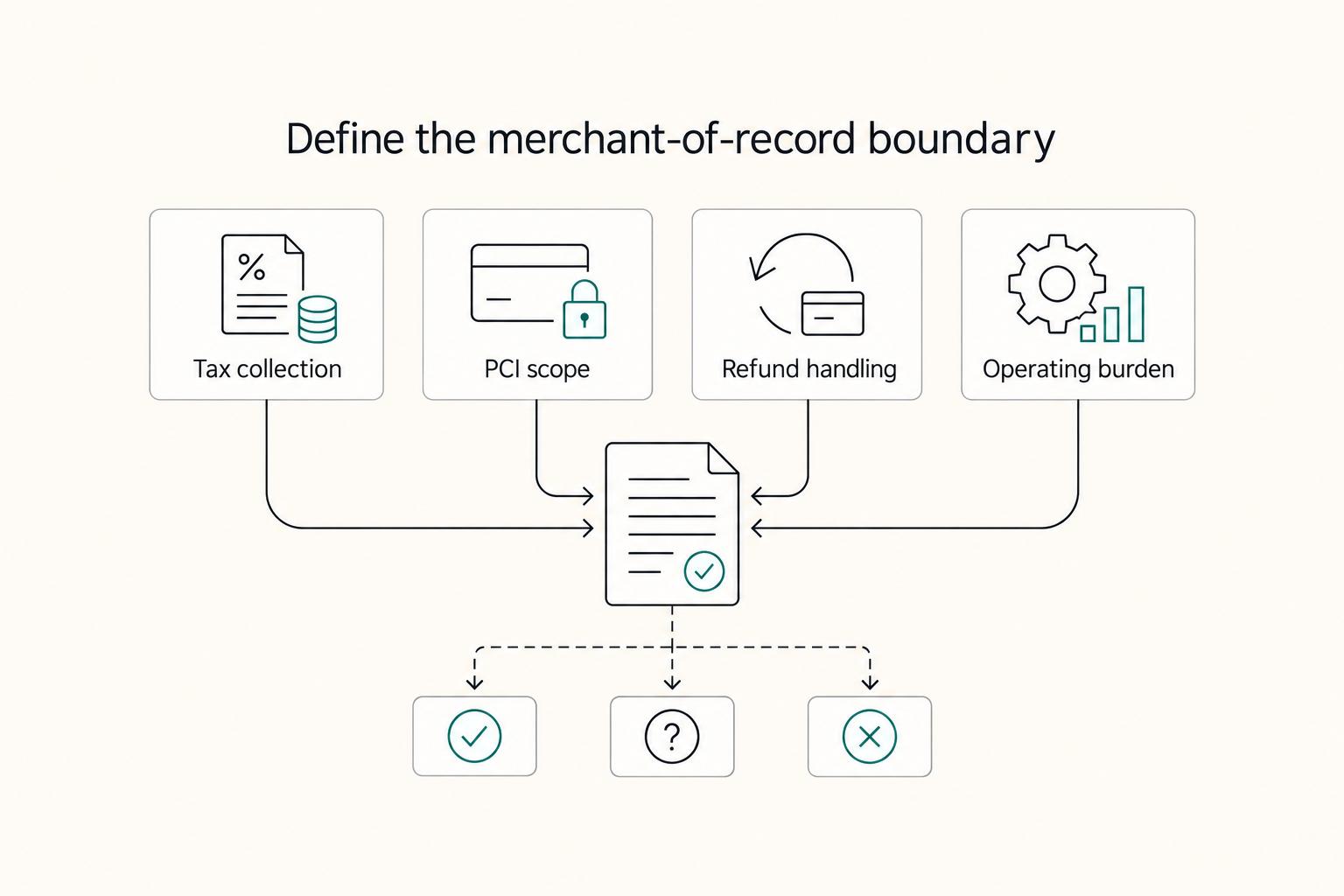
A Merchant of Record (MoR) is the legal entity that sells to the end customer, so write the scope down early.
| What MoR support can take on | What your team should still do |
|---|---|
| Sales-tax collection | Confirm your setup matches what you actually sell |
| PCI compliance | Review outcomes and exceptions |
| Refunds and chargebacks | Keep decision records and evidence |
| Operational burden tied to international payments and sales-tax compliance | Re-check assumptions when products or rules change |
If your biggest friction is payment operations and sales-tax execution across markets, this model is usually worth serious consideration. Your checkpoint here is simple: write down the exact jobs you expect Paddle to handle so ownership is clear before reconciliation or audit questions show up.
Step 2 Name the responsibilities that do not disappear#
Using Paddle shifts operational burden. It does not remove your need for oversight.
Keep four controls owned internally:
- Validate product and checkout configuration against what you sell.
- Make sure reporting is detailed enough to review outcomes by market.
- Assign a named owner for exceptions, support follow-up, and evidence storage.
- Revisit assumptions when packaging, flows, or rules change.
The wrong model is "MoR means we stop thinking about tax." The practical model is "MoR handles major execution tasks, while we prove our setup is accurate and defensible."
Step 3 Treat reporting as tax control, not just finance hygiene#
Reporting is part of compliance control, not just back-office cleanup.
Reporting gives you a usable view of cash flow, and analytics help you review what actually happened. Without that visibility, your team is operating blind. In practice, do not stop at "payments are coming in." Keep reporting that lets you review outcomes and trace decisions with a clear paper trail.
Decide if Paddle fits your product before you configure anything#
Decide fit by product classification and risk profile first, then configure. Start by checking whether your offer is truly Software accessed by the cloud or part of a mixed catalog where tax treatment changes by item and delivery method.
Step 1 Classify how customers receive each offer#
Before touching checkout settings, label each offer as Software accessed by the cloud, Downloadable software, or Tangible software. This is your first checkpoint for taxability, and mixed catalogs may need to be split by type for tax handling.
| Offer type | Customer receives it | Handling cue |
|---|---|---|
| Software accessed by the cloud | Customer does not download or install anything locally | Closer to the cloud-access model |
| Downloadable software | Customer downloads or installs something locally | Mixed catalogs may need to be split by type for tax handling |
| Tangible software | Offer includes physical components | Document the split before assuming one tax treatment applies |
For each SKU, confirm whether the customer downloads or installs anything locally. If not, you are closer to the cloud-access model. If bundles mix hosted access with downloadable or physical components, document that split before assuming one tax treatment applies.
Step 2 Confirm edge-case eligibility with Paddle in writing#
If your product may sit near restricted financial categories, pause and confirm eligibility directly with Paddle before launch. Do not rely on forum comments or older comparison posts as approval.
Keep written confirmation with your product description, checkout flow summary, and planned SKU names. Use it as a control record if your scope changes later.
Step 3 Choose based on your biggest operational risk#
Choose the model that addresses your actual risk, not the one that sounds easiest.
If your main risk is handling registration, collection, and remittance across jurisdictions, include a Merchant of Record (MoR) model in your evaluation. Tax rules vary by jurisdiction, customer location changes which rules apply, and some places require both state and local handling. Do not assume MoR removes all seller obligations in every jurisdiction.
If your main risk is deep custom billing logic or catalog complexity, compare the tradeoffs before you commit. Do not assume one standardized tax setup will fit every SaaS product, and do not treat older U.S. state snapshots as current authority without validating them against current guidance and a tax professional.
Related: Paddle vs. Stripe: A Comparison for SaaS Founders.
Gather your tax and operations inputs before touching settings#
Do not start in the dashboard. Build the inputs you will validate against in production first. The goal is simple: test your real catalog, real markets, and real checkout paths, not a generic setup.
Step 1 Map every SKU by delivery type#
Create a one-row-per-SKU sheet with offer name, short description, delivery method, billing model, and one delivery label that reflects how the buyer receives the product.
For bundles, split components that change how the buyer receives the product, such as hosted access plus a downloadable asset. Your checkpoint is whether someone outside the product team can tell if the buyer downloads, installs, or only accesses the product in a browser.
Step 2 List current and next markets explicitly#
Build a market list with two sections: Your current account market/region and Additional target markets. If your fee reference is the U.S. PayPal pages, that current market is United States (US). Under each, mark:
- where you already have paying customers
- where you plan active expansion next
- where sales are incidental for now
Use precise market names and codes where available. Bad market mapping creates bad assumptions early, especially when payment treatment depends on whether a transaction is domestic or international, and when some markets are grouped for international rate handling.
Step 3 Create one dated source of truth#
Set up one shared, versioned folder before anyone changes checkout settings. Keep:
- the SKU map and market list
- the named internal owner for tax and billing review
- a short assumptions note tied to tax and billing review
- dated evidence such as screenshots, support replies, policy pages, and PDFs
Record the last-updated date on external pages you rely on. For example, PayPal fee pages show dated updates (for example, February 19, 2026 on Consumer Fees and February 9, 2026 on Merchant Fees), provide a printable PDF, and point to a Policy Updates page. That does not define Paddle tax behavior, but it does improve your evidence trail for payment-path assumptions used in testing and reconciliation.
Step 4 Capture the real checkout and invoice paths#
Document exactly how buyers can pay and what document they receive afterward. If you plan to support cards, PayPal, or Apple Pay, track each as a separate path and note any invoice differences you observe by market or buyer type.
Do not assume advertised payment options are active in your implementation by default. Use a simple validation matrix with rows for payment path, invoice type, and priority market so your highest-volume paths are tested before launch.
Split responsibilities so nothing falls through the cracks#
Turn your source-of-truth folder into an owner map before you enable anything. In a Merchant of Record setup, a control without a named owner is not production-ready.
| Vendor claims or behaviors to verify and store | What your team still owns |
|---|---|
| Tax behavior for your SKU and market mix | Compare live checkout outcomes with your documented expected treatment, and name one approver for mismatches. |
| Invoice behavior and post-sale adjustments | Define how finance handles a correction invoice when recalculation is needed. One practitioner account says usage data can be corrected later, including more than once. |
| Handling of buyer legal-detail changes such as company name and address | Define when changed legal details trigger credit, reissue, or manual review in your records. One practitioner account says these details can change mid-cycle. |
| Any privacy and security trust materials you rely on | Confirm scope against your actual data flow and keep a dated copy of what you relied on. |
| Policy or product update channels | Assign one person to monitor updates, log changes, and decide when tax tests must be rerun. |
| Support and exception path for tax or invoice issues | Set an internal escalation rule when observed behavior conflicts with your documented expected treatment. |
Use four required fields on every control row: owner, backup owner, evidence link/file, and last verified date. If any field is blank, the control is not done.
Name a person, not a department. "Finance" or "Ops" is not ownership. One person should own review, one should maintain evidence storage, and one should handle escalation decisions.
Write the escalation rule now, before the first mismatch: pause the affected SKU or market, capture evidence, open vendor support, and resolve the conflict before you scale. Include checkout evidence, transaction or invoice records, buyer location used in testing, payment path, and the dated policy or support response you expected to match.
Configure Paddle tax settings in the right order#
The order matters. Set up products first, configure checkout and invoicing paths second, test location-driven tax outcomes third, and log every decision before go-live. This is an operational safety order, not a claim that Paddle requires this exact sequence.
Step 1 Set product records before trusting tax outcomes#
Start in Paddle Catalog. If you use Paddle Invoicing, Paddle states you must set up a Product first before sending an invoice.
Do this before downstream testing so each live SKU has a clear product record and a documented assumption in your source-of-truth folder. Paddle's 2025 SaaS tax guide warns that tax treatment is not standardized across jurisdictions and is easy to get wrong, so unclear product setup creates avoidable rework later.
Step 2 Configure checkout and invoicing flows next#
Once product setup is stable, configure the purchase paths you will actually offer. Paddle says the same tax logic applies to Paddle Checkout and its Invoicing tool, but you should still validate both flows in your own implementation.
| Invoicing item | What the article says |
|---|---|
| Checkout and invoicing tax logic | Paddle says the same tax logic applies to Paddle Checkout and its Invoicing tool, but you should still validate both flows in your own implementation. |
| First-time invoice details | Paddle requires customer details including email, company name, and any VAT or sales tax registration numbers. |
| Valid sales tax IDs | Valid sales tax IDs can revise tax and update the final total shown to the customer. |
| Exempt customers | Route certificate documentation through Paddle buyer support for review before exemption is applied. |
| Invoicing status | Invoicing is described as beta. |
| Product fulfillment | Invoicing does not handle product fulfillment. |
| Invoice composition | Invoicing does not support multiple line items or multiple quantities on one invoice. |
For first-time invoicing, Paddle requires customer details including email, company name, and any VAT or sales tax registration numbers. Paddle also says valid sales tax IDs can revise tax and update the final total shown to the customer. For exempt customers, route certificate documentation through Paddle buyer support for review before exemption is applied.
Flag the limits early: Invoicing is described as beta, it does not handle product fulfillment, and it does not support multiple line items or multiple quantities on one invoice.
Step 3 Test location logic across jurisdiction scenarios#
Before you take live payments, verify location handling directly. Paddle says sales tax is applied using customer country and state or province, so this is the key checkpoint.
Run controlled tests for at least two destinations with different location combinations, then compare expected and observed totals in checkout or invoice outputs. Repeat the same cart across the payment paths you offer to catch implementation-level drift before customers do.
Step 4 Record decisions in a changelog tied to legal assumptions#
Treat each configuration change as a tax decision. Log the SKU, flow used, jurisdictions and payment paths tested, observed result, evidence file, owner, and date.
Tie each entry to the tax-rule assumption your team used, plus the Paddle doc date you relied on. Keep freshness visible. The Paddle tax guide says the information was current as of 1st October 2025.
Run scenario tests for US and EU before going live#
Before launch, verify that tax outcomes stay consistent across the buyer locations and payment methods you actually plan to support. One successful checkout is not enough. Paddle notes that routing can change by location and payment method, and failed payments can be retried through another processor.
Use this as a launch gate for priority markets. If expected and observed results do not match in a market you plan to launch first, treat that as a blocker for that market until you resolve the gap.
Step 1 Build a compact matrix in Sandbox (Test Mode)#
Run a small, repeatable matrix in Sandbox (Test Mode) that covers the key variables: buyer location, payment method, and any product setups with different expected tax treatment.
| Buyer location | Product setup | Payment method | Expected check |
|---|---|---|---|
| Priority United States state | Primary product setup | Default method | Sales tax result matches your documented assumption for that state and setup |
| Same United States state | Alternate setup (if applicable) | Same method | Result matches the alternate documented assumption |
| Priority European Union country | Primary product setup | Second offered method | VAT result matches your documented assumption |
| Same European Union country | Alternate setup (if applicable) | Another offered method or retry path | VAT result matches the alternate documented assumption and transaction record matches checkout output |
Step 2 Separate product setups on purpose#
If you offer product setups with different expected tax outcomes, test them as separate scenarios. Keep location and payment method constant while changing only the product setup so you can isolate mismatches.
If the result does not match your expectation, check product records, SKU mapping, and checkout or invoicing mapping before moving on.
Step 3 Add a U.S. state-level edge checkpoint#
Include at least one priority-state scenario where your internal state-level assumption needs explicit verification.
Compare observed output to the exact state and product-setup assumption in your changelog. If it does not match, treat it as a real pre-launch issue.
Step 4 Test method and retry behavior, not just first-pass totals#
Do not stop at the first successful total. Validate the payment methods you actually offer and include at least one failed-payment or retry path where possible. Routing and retry behavior can change the transaction path even when the front-end total looks correct.
After each run, review the unified transaction dashboard and confirm that location, method, approval outcome, and routing behavior align with your expected result.
Step 5 Save evidence with your Paddle config history#
Keep an evidence pack for each scenario so mismatches are easier to investigate later. Store it with your Paddle configuration history.
For each pass or fail run, capture:
- checkout or invoice screenshot showing tax result
- transaction ID
- buyer location used
- product setup tested
- payment method and whether retry occurred
- date, reviewer, and expected assumption
For a step-by-step walkthrough, see The Best Software for Calculating and Remitting Sales Tax.
Connect billing, records, and reconciliation so finance can trust the numbers#
Treat reconciliation as a launch requirement. If the sale, tax label, and cash movement do not tie out, month-end close can break.
Step 1 Build one traceable record per transaction
Do not rely on checkout alone. For each sale, keep one record that ties your bookkeeping entry to the source invoice and payment record from your billing system.
Keep these fields together:
- invoice number or document reference
- transaction ID
- buyer jurisdiction used for tax
- tax type label
- product variant, cloud access or download
- gross amount, tax amount, and net amount
- settlement or payout reference
- exception status
Use a small U.S. and EU sample as a checkpoint. Finance should be able to trace booked amounts back to the invoice and tax assumption without extra interpretation.
Step 2 Tag by jurisdiction and tax type before month-end
Tagging is what makes review fast and defensible. At minimum, tag by jurisdiction, tax type, product variant, and period so finance can review indirect tax without rereading every line item.
Step 3 Keep indirect-tax reconciliation separate from annual filing workflows
Keep sales-tax and VAT reconciliation separate from tasks like FBAR and Form 8938 work. These should be handled in separate workflows.
Form 8938 follows the annual return process and does not replace FBAR. The core point here is separation: do not mix indirect-tax reconciliation with annual filing work that has different requirements.
Step 4 Use one exception queue with clear ownership
Create one queue for mismatches and failed assumptions, with a named owner and a response SLA that fits your operation. Send missing tags, invoice and payment mismatches, conflicting tax labels, and retry-path anomalies into that queue with the transaction ID, invoice copy, expected treatment, reviewer, and resolution date.
Put recurring monitoring in place so your setup stays current#
Monitoring is what keeps a good launch from drifting into a bad operating state. Treat it as an ongoing control, not a one-time setup. A practical internal cadence is a light monthly check, then a deeper quarterly retest in your highest-revenue regions.
Step 1 Set a cadence your team can actually maintain#
Use your monthly pass to check for drift across the jurisdictions you sell into. Look for changes in checkout behavior, internal assumptions, and the metrics you use as early warning signals.
Use the quarterly pass to retest the regions that create the most revenue risk if tax handling is wrong, and use benchmarks to inform target setting and forecasting.
Close each monthly review with a clear outcome: no change or change found, ticket opened.
Step 2 Re-verify platform assumptions, not just tax assumptions#
Monitor the Paddle pages and materials your team relies on, and re-verify any compliance-related wording your team uses before treating it as current. If your team references items related to SOC or GDPR, treat those as assumptions that need re-verification when wording or page location changes.
If you use third-party implementation content, log the publication date and treat it as secondary. A WooCommerce-focused guide published on February 18, 2025 describes Paddle as a payment option for WooCommerce and Easy Digital Downloads and says tax calculations are automated, but current behavior should still be verified in your own flow.
Step 3 Keep a "last verified" log#
When issues appear, your team should be able to confirm what was last checked, by whom, and with what evidence in minutes, not hours.
Keep one log with:
- item checked
- last verified date
- owner
- source URL or document name
- evidence, such as a screenshot, document copy, support thread, or transaction ID
- result
- next review date
Step 4 Retest after checkout or plugin changes#
If you sell through multiple stacks, retest after updates to checkout or plugins, including WooCommerce and Easy Digital Downloads paths. You do not need to assume every update changes tax behavior. You do need to verify whether anything changed.
Run a live-like transaction on each affected path, then compare invoice details, tax label, and recorded amounts to your expected treatment. This catches small data-capture regressions before they turn into reconciliation exceptions.
Fix the mistakes that cause the biggest tax surprises#
Untested assumptions can create major tax surprises. Fix these four issues early so you can defend outcomes during filing, refunds, and reconciliation.
Step 1 Separate product and offer labels in your catalog#
Mistake: treating every SKU as the same. Fix: use clear, distinct catalog labels and apply them consistently in your product map, checkout checks, and invoice review.
This is a control step, not a legal shortcut. For each high-volume SKU, confirm the catalog label, invoice description, and your internal expected-treatment note all match.
Step 2 Use current guidance, then verify in live flows#
Mistake: relying on older guidance as proof. Fix: prioritize current provider documentation, then re-validate outcomes in live or live-like checkout flows across your key jurisdictions.
If a secondary source is dated or unclear on updates, treat it as background. One referenced guide shows November 12, 2025 as its update date, and a reported live test still found incorrect assignment for British Columbia, Canada. Use jurisdiction checkout tests as your checkpoint, not static guidance alone.
Step 3 Keep internal ownership even with a merchant of record#
Mistake: assuming an MoR removes all internal tax work. Fix: keep named internal owners for policy checks, evidence, and escalation.
A Merchant of Record (MoR) is described as acting as a reseller and assuming responsibility for sales tax management, but tax tools may still not cover all compliance needs. In many PSP/compliance-tool setups, sellers may still be responsible for filing and remitting sales tax. Process misalignment is also described as a common SaaS failure mode, so keep clear ownership when observed behavior conflicts with your expected treatment.
Step 4 Keep a proof trail for each critical decision#
Mistake: making sales-tax decisions without durable evidence. Fix: store the same proof set each time: test result, screenshot, transaction ID, config-change note, support confirmation, and last-verified date.
That proof trail can help your team resolve disputes faster and trace whether an issue came from configuration drift, stale assumptions, or platform behavior.
Related reading: How to Set Sales Quotas for a SaaS Team.
Copy and paste this pre-launch checklist#
Use this as a strict go or no-go gate. Do not launch until all four checks pass, even if Paddle is already configured as your Merchant of Record.
| Check | Pass condition | If not |
|---|---|---|
| Product fit with Paddle | Each live SKU maps to the product type you defined, and you have current documentation or direct written confirmation tied to your actual product. | Treat broad SaaS labels as insufficient for edge-case products or unusual categories. |
| Responsibility split | The split between MoR coverage and your internal controls is documented, with named owners for verification, evidence, and escalation. | If VAT checks, exception review, or tax-policy updates have no owner, this check is not passed. |
| Real checkout scenario tests | Expected treatment matches observed output in the exact checkout paths for your priority markets, and records are visible in analytics, refunds, and dispute workflows. | If a priority market fails, pause launch and resolve it first. |
| Monitoring and evidence plan | An owner, a review cadence, and a single audit-evidence location are set before launch. | This check passes only when the re-check process is clear and finance or support can find the evidence quickly. |
Step 1 Confirm product fit with Paddle#
Confirm each live SKU maps to the product type you defined, then confirm Paddle is a fit for that SaaS category in your target markets. Treat broad "SaaS" labels as insufficient for edge-case products or unusual categories.
Pass only when you have current documentation or direct written confirmation tied to your actual product. Store that proof with your launch records.
Step 2 Confirm the responsibility split#
Document the split between MoR coverage and your internal controls before launch.
Paddle states it assumes compliance liability and handles sales-tax calculation and remittance across 200+ markets, but your team still needs named owners for verification, evidence, and escalation.
If VAT checks, exception review, or tax-policy updates have no owner, this check is not passed.
Step 3 Run real checkout scenario tests#
Run scenario tests through the exact checkout paths buyers will use in your priority markets, including cross-border cases.
For each scenario, compare expected treatment with observed output, then confirm records are visible in analytics, refunds, and dispute workflows.
Do not accept partial passes. If a priority market fails, pause launch and resolve it first.
Step 4 Set the monitoring and evidence plan#
Set an owner, a review cadence, and a single audit-evidence location before launch.
For each critical tax decision, keep the same proof set: screenshots, transaction IDs, config-change notes, support confirmations, and a last-verified date.
This check passes only when the re-check process is clear and finance or support can find the evidence quickly.
Before launch, pressure-test your owner matrix and market coverage against Gruv Merchant of Record for business.
Final takeaway and next step#
Use Paddle to reduce tax operations workload, but treat a Merchant of Record as risk reduction, not full risk transfer. It can handle rate calculation, collection, filing, and remittance, but you still need to confirm that your setup matches your product, customer type, and jurisdiction.
Step 1 Start with a controlled market cluster#
Start with a controlled market cluster, not a global rollout. A SaaS subscription can be taxable in one U.S. state and exempt in another, so avoid one-rule-for-everywhere assumptions.
Pick priority jurisdictions, confirm your product setup in Paddle, and validate live checkout outcomes against your expected treatment. In the U.S., keep economic nexus thresholds across all 50 states in view. For cross-border B2B VAT, account for reverse charge mechanisms where they apply.
Your checkpoint is not just that tax appeared. It is that tax appeared, or did not appear, for the expected reason in the expected jurisdiction, with evidence saved.
Step 2 Test jurisdiction by jurisdiction before you scale#
Test jurisdiction by jurisdiction before you scale. If tax behavior in a priority market does not match your expectation, pause expansion and fix that mismatch first.
Keep a lightweight evidence pack:
- checkout screenshots for each priority scenario
- transaction IDs tied to those screenshots
- invoice copies where available
- a short changelog of what you configured and why
- written confirmation for edge cases when available
This discipline matters. Failing to collect and remit sales tax can create exposure to back taxes, penalties, interest, and, in severe cases, criminal prosecution. Unresolved tax issues can derail expansion and damage investor and customer confidence.
Step 3 Re-check when your product setup or markets change#
Keep this as an operating habit, not a one-time launch task. Re-check when your product setup, markets, customer mix, or checkout behavior changes.
U.S. treatment remains state-specific, and cross-border B2B VAT can trigger reverse charge mechanisms. Next step: pass your checklist in one cluster, save proof, then add jurisdictions only after the first group behaves as expected. For a deeper refresher on MoR boundaries, read What is a Merchant of Record (MoR) and How Does It Work?.
When you are ready to validate rollout assumptions market by market, talk with Gruv.
Frequently Asked Questions
Is SaaS always taxable when you sell through Paddle?
No. The article says SaaS taxability depends on who the customer is and where they are located, and there is no standardized system across jurisdictions. Treat SaaS as a starting category, not a final tax answer.
Does Paddle handle both U.S. sales tax and international VAT automatically?
Paddle states it acts as Merchant of Record and is registered in over 100 jurisdictions worldwide, which points to broad U.S. sales-tax and VAT coverage. But results are not one size fits all. U.S. treatment varies by state, and VAT outcomes still depend on location and transaction details.
What does Merchant of Record actually remove from my team’s workload?
It can remove much of the transaction-side tax burden because Paddle is the seller of record and states it handles transaction responsibilities, including issuing compliant invoices. It does not remove internal review, legal review on edge cases, or the need to confirm your setup matches your product and markets.
How do I verify Paddle is applying tax correctly in different U.S. states?
Verify tax by state, not with one national assumption. Check whether both state and local tax apply, compare expected treatment with live checkout output for each priority state, and keep the supporting records together.
Is Paddle a fit for every SaaS business model and category?
No. Merchant of Record coverage does not mean every SaaS model or category is automatically in scope. Confirm fit against current Paddle documentation for your exact product, especially for edge cases.
What should I check first if tax results in checkout look wrong?
Start by checking how the customer and location are classified for the transaction, because the article says tax outcomes depend on who the customer is and where they are located. In the U.S., also verify whether local tax should apply in addition to state tax.
How often should a small team re-validate tax settings after launch?
Do not assume there is a single mandatory cadence. Re-validate when your markets or setup change, when invoice or report outputs look unexpected, and spot-check recurring charges because tax still needs to be correct on each billing cycle.
Try a related tool
Researched and edited by the Gruv editorial team. Gruv builds cross-border billing, payouts, and finance-operations software for global businesses.
Sources
Includes 1 external source outside the trusted-domain allowlist.
Educational content only. Not legal, tax, or financial advice.
Related Posts
Value-Based Pricing for Freelancers Under Real Payment Risk
Value-based pricing works when you and the client can name the business result before kickoff and agree on how progress will be judged. If that link is weak, use a tighter model first. This is not about defending one pricing philosophy over another. It is about avoiding surprises by keeping pricing, scope, delivery, and payment aligned from day one.

Paddle vs. Stripe: A Comparison for SaaS Founders
**Paddle vs Stripe is a risk-ownership decision first, so choose the setup that keeps cashflow stable when tax, refunds, and disputes show up together.** If you are the CEO of a business-of-one, you are not just picking a checkout. You are deciding who carries the operational burden when things get messy.

What is a Merchant of Record (MoR) and How Does It Work?
**Payment chaos drains margin through fee creep, payout uncertainty, and dispute-handling overhead, so build a risk-first get paid system before you optimize growth.**