
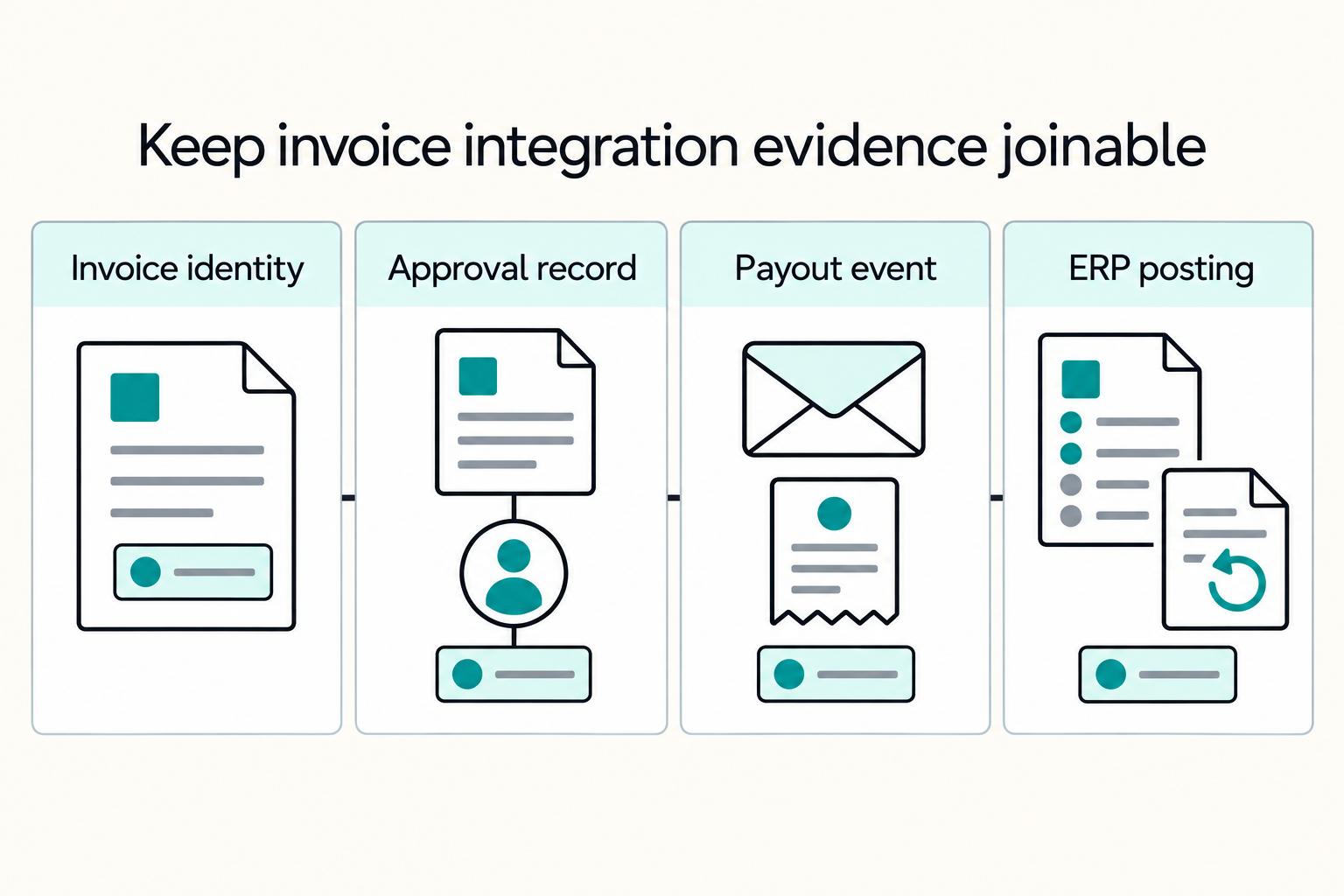
Quick Answer
Map six owned stages before choosing software: intake, validation, approval, payment release, payout execution, and reconciliation close. Then automate normalization, duplicate checks, and webhook status sync, but keep release overrides manual until KYC/KYB/AML, VAT checks, and W-8 or W-9 records are complete. Prove readiness with one traced transaction from source invoice to payout status to Ledger Journal evidence in ERP.
How invoice processing platforms work#
Treat invoice processing as an operating sequence, not a shopping list of OCR, approvals, and payout features. For platform teams, the core question is straightforward: can your setup carry an invoice from receipt through approval and payment while preserving control, traceability, and ownership across finance, engineering, and payments ops?
- This is a decision list, not a feature roundup.
The goal is to help you choose an end-to-end path from invoice receipt to payment release. This is not one task. It spans multiple steps, teams, and owners. The useful question is not "does this tool scan invoices?" but "can we receive, verify, approve, and pay invoices in one accountable sequence?" Some platforms combine extraction, approval routing, payment execution, and accounting reconciliation. Others solve only one slice.
- It is written for platform operators, not AP in isolation.
If you run contractor, marketplace, or embedded payments flows, your invoice process can touch third-party onboarding, verification, and payouts alongside AP. That can be a different operating problem from standard bill pay inside one legal entity. You need clear ownership for spend approval, recipient readiness, and how the final payment event lands in your accounting system with enough detail to reconcile later.
- The goal is an executable sequence with tradeoffs and checkpoints.
You should leave with a practical way to choose a platform path and the control points that show whether it will hold up in production. Software choice depends on your size, geography, and payment complexity, so this guide stays focused on decisions you can verify: where intake happens, where approvals live, when payment is released, and what evidence exists at each step. Payout capability alone does not close the loop if payment events cannot be tied back to AP records and accounting entries.
- Treat every recommendation as a verification checklist.
Coverage, compliance expectations, and release controls vary by market and program, so there is no universal design you can copy without local checks. FATF Recommendations (amended October 2025) are implemented by countries through measures adapted to local circumstances. VAT works the same way: the EU has common rules, but member states apply country-specific details, and cross-border treatment depends on internationally agreed guidance. Even if a provider supports payouts in 118+ countries, confirm verification, tax handling, and release evidence for the exact markets you serve.
Who this list is for and how to judge options#
Use this list if you need one operating path across AP and ERP/accounting posting, with clear ownership from receipt through payment. If you only need OCR invoice capture and not a structured workflow from receipt to approval, posting, and payment, you are probably evaluating a component rather than an end-to-end path. Use these criteria to compare options:
- End-to-end stage coverage
Start with scope: can the system carry invoices from receipt to approval, posting, and payment? OCR is useful, but it is still text extraction, not the full AP process.
- Control depth
Look for decision-level auditability, not just a final status. You should be able to see who approved what and when.
- Integration reliability
If sync depends on webhooks (HTTP callbacks), test failure behavior. Reliable delivery depends on correct, consistent, timely endpoint responses, and dropped notifications may not be recoverable.
- Workflow and timeline visibility
Confirm invoice movement is structured and trackable from receipt onward, and that teams can see the timeline from receipt to payment.
- Reconciliation quality
Require a trace from source invoice records to subledger journal account entries and into ledger posting and payment in your ERP or accounting system. If that lineage is hard to validate during testing, treat it as a potential gap.
For pre-payment workflows, What Is a Proforma Invoice? How Platforms Use Pre-Payment Invoices in Contractor Workflows explains where pro forma invoices fit.
The receipt to payment stages that must exist in your operating model#
Map the stages before you automate them: intake, validation, approval, payment release, payout execution, and reconciliation close. If any stage lacks an owner, evidence artifact, or release condition, that work usually comes back as manual cleanup at month end.
- Map the six stages and assign real owners.
Keep these as separate stages even when a single UI blends them. The controls are different at each point. Oracle Payables requires invoice validation before payment or accounting entries, and Dynamics 365 AP treats approval as a distinct step through an invoice approval journal or the Vendor invoice page.
| Stage | Input artifact | Owner | System of record | Failure mode | Release condition |
|---|---|---|---|---|---|
| Intake | Vendor invoice entered manually or received electronically; if funding comes first, Payment Links or Stripe-hosted Checkout record | AP or platform ops | AP intake tool or payments platform | Duplicate invoice, missing supplier, missing pay-in evidence | Invoice record created and source artifact attached |
| Validation | Captured invoice, supplier record, coding or match data | AP | ERP or AP product | Tax, coding, or match exception | Validation passed |
| Approval | Validated invoice | Budget owner plus AP | AP product, such as a Dynamics 365 invoice approval journal | Rejected, stale approver, limit breach | Approval log complete |
| Payment release | Approved invoice plus policy checks and funding proof | Finance ops | Internal release service or payout platform | Internally held for review, insufficient funds, missing policy clearance | Explicit release decision recorded |
| Payout execution | Released instruction, recipient details, batch reference | Ops and engineering | Payout provider | Failed, returned, canceled, or batch-level exceptions | Provider accepts payout and status tracking starts |
| Reconciliation close | Payout event, fees, FX data, settlement details, journal reference | Finance and recon | ERP and general ledger | Unmatched settlement, missing journal evidence | Journal evidence tied out in the applicable system |
- Require evidence at every stage, not just a final status.
A final status is not enough for finance, ops, or audit. Intake evidence can be a vendor invoice or, in fund-first models, a Payment Link confirmation or a redirect to a Stripe-hosted payment page. Approval still needs its own log.
Use one live transaction as a checkpoint. Trace the source invoice or pay-in confirmation, validation result, approval record, payout status history, and journal evidence. In Oracle, transfer to general ledger can produce an Accounts Payable Journal Entry Audit Report.
- Add the international branch early.
Cross-border flows usually break first when they are bolted on later. After approval, branch explicitly for funding arrival, FX timing, and batch payout handling. Airwallex Global Accounts support incoming transfers and transaction retrieval for reconciliation.
Record FX timing as evidence. Airwallex FX quotes provide a guaranteed rate for an agreed period of time, so store the quote reference and when it was taken. For multi-recipient runs, Batch Transfers support bulk payouts across countries and currencies, so design for batch-level exceptions.
- Treat failure states as normal operating states.
Model failed, returned, canceled, retried, and internal hold behavior in the same map as the happy path. Keep "held" as your internal release state unless your provider explicitly defines it.
Do not force one payout taxonomy across systems. Stripe Global Payouts and the payouts list API show different status sets. Webhooks also need retry-safe handling. Stripe retries undelivered events for up to three days, and Airwallex retries failed deliveries over about three days and includes stable event IDs. Deduplicate by event ID, and use idempotency keys on state-changing payout calls so retries do not create duplicate payouts.
Once that stage map is solid, the next decision gets simpler: automate the repetitive steps first and keep money-moving judgment under tighter control.
Related: AI in Accounts Payable: How Payment Platforms Use Machine Learning to Process Invoices Faster.
What to automate first and what to keep manual#
Automate repetitive, low-judgment work first. Keep money-moving decisions under human control until your duplicate, retry, and verification controls are reliable.
| Step | Recommendation | Checkpoint |
|---|---|---|
| Intake normalization | Start in AP intake and normalize incoming invoices into one standard record with supplier, invoice number, amount, invoice date, and source attachment | Sample invoices from different channels and confirm supplier name, invoice number, and amount match the source document |
| Duplicate checks and status sync | Automate duplicate control and status sync in your ERP integration through webhooks | Log processed event IDs and skip repeats; duplicate events should still produce one status record, one audit trail, and no extra payout attempt |
| High-risk exceptions | Keep high-value approvals, unusual vendor payment-detail changes, and payout-release overrides tied to KYC and verification outcomes in a human queue first | Overrides need clear evidence of what changed, who approved it, and why release is still allowed |
| Advanced extraction and auto-release | Delay advanced AI extraction and keep release manual if you cannot enforce an idempotency key on every payment-triggering call | Force a timeout, retry with the same key, and confirm one payout, one release record, and one reconciled event trail |
- Automate intake normalization first
Start in AP intake, not payout release. Normalize incoming invoices into one standard record with supplier, invoice number, amount, invoice date, and source attachment so teams stop rekeying the same data. Dynamics 365's vendor invoice automation and machine-readable metadata support this path. The practical win can be fewer manual-entry errors without forcing immediate approval-policy changes.
Before scaling, sample invoices from different channels and confirm supplier name, invoice number, and amount match the source document. If teams still correct basic header fields every day, fix upstream invoice standards before you add more automation.
- Automate duplicate checks and status sync next
Once intake is normalized, automate duplicate control and status sync in your ERP integration through webhooks. This is repetitive, testable, and lower risk than auto-releasing funds. It also helps keep invoice, approval, and payout states aligned across systems.
Build replay safety into the first version. Webhook endpoints can receive the same event more than once, so log processed event IDs and skip repeats. Do not call sync complete unless duplicate events still produce one status record, one audit trail, and no extra payout attempt.
- Keep high-risk exceptions manual
Manual review should focus on questionable invoices and high-impact exceptions. Keep high-value approvals, unusual vendor payment-detail changes, and payout-release overrides tied to KYC and verification outcomes in a human queue first.
This is a fraud and control decision, not a workflow preference. BEC often shows up as a familiar vendor sending "updated" payment details, and verification outcomes can directly affect whether payment or payout capabilities are allowed or disallowed. Overrides need clear evidence of what changed, who approved it, and why release is still allowed.
- Delay advanced extraction and auto-release until prerequisites are proven
If exception volume is still high, delay advanced AI extraction and stabilize inputs first: required fields, accepted formats, supplier naming rules, and correction ownership. Automating unstable inputs can expand the exception queue instead of shrinking it.
Apply a stricter gate to payout release. If your team cannot enforce an idempotency key on every payment-triggering call, keep release manual. Retries must not execute the same payment action twice. Test this by forcing a timeout, retrying with the same key, and confirming one payout, one release record, and one reconciled event trail.
The strongest platform options and the use case each one actually fits#
Pick the platform that is strongest at your real bottleneck. Based on the public evidence in this section, HighRadius and Coupa have the clearest enterprise AP and ERP-control evidence. Rillion is a balanced AP-plus-payment option, Rho is practical for unified bill pay with accounting connectivity, and Airwallex has the clearest published API/webhook and cross-border payout evidence in this set.
| Platform | Best for | Key strengths | Practical limits | Stage coverage from AP to payment visibility | Builder lens (API/webhooks, cross-border, reconciliation) | Integration burden |
|---|---|---|---|---|---|---|
| HighRadius | Large businesses focused on AP automation and ERP sync | Built for large businesses; 50+ pre-built ERP connections; API-based cloud ERP integration | Public detail here is thin on payout execution, webhooks, and exception handling; Ledger Journal depth not verified; "live within 6 months" still needs implementation validation | Strong on AP intake, automation, and ERP sync; unclear on payout rails and post-payment visibility | API support for cloud ERP is stated; webhook maturity, cross-border payout support, and deep reconciliation behavior are not clear here | Not established; scope to your ERP market |
| Rillion | Mid-sized and large teams that want AP controls plus payment automation | ERP integration; 3-way PO matching; payment methods include virtual cards, ACH, enhanced ACH, eChecks, wire transfer, and checks | Public sources here do not clearly show API/webhook depth, cross-border breadth, or Ledger Journal-level reconciliation | Covers invoice capture, matching, approval, and payment methods; downstream payment visibility needs validation | Ask for event model, retry behavior, and ERP posting proof | Not established; validate during solution design |
| Rho | Teams that want one place to send, approve, and pay bills with accounting connectivity | Unified bill-pay flow; direct API connection to NetSuite; broad global transfer reach is documented | AP module does not currently support non-USD international wires; public webhook detail is limited; deeper enterprise procurement controls are not established | Strong from bill intake through approval and payment, especially domestic and USD flows; non-USD AP wire support is a clear gap | NetSuite API connection is a strong integration signal; webhook maturity and reconciliation depth should be tested in demo | Not established; validate against your accounting and payment requirements |
| Coupa | Enterprises running formal procure-to-pay with governed ERP export | P2P flow coverage (requisition through invoice approval); invoice API supports create/update/query; three invoice-to-ERP integration options plus Export Flag control | Full-scale implementations are commonly partner-led; payment rails and cross-border payout capability are not established; public exception-handling depth is limited | Very strong through P2P and invoice-to-ERP export; weaker public evidence for payout execution and payment-state visibility | Mature invoice API and ERP integration patterns; eventing and downstream reconciliation design still need validation | Commonly partner-led for full-scale implementations |
| Airwallex | Platform teams needing bill pay plus global payouts and event-driven automation | Bill pay covers upload, approve, pay, and reconcile; APIs for finance automation and embedded finance; webhooks with stable event IDs for retries; payouts in 200+ countries/regions and 90+ currencies | Public detail is lighter on heavy enterprise AP controls, for example PO-matching depth; complex AP exception behavior and ERP Ledger Journal mapping are not fully shown here | Broad coverage in these sources from bill pay through payout execution and reconciliation visibility | Explicit webhook and API evidence is published in this set; verify ERP posting and close-process behavior before procurement | Not established; depends on API and ERP-policy requirements |
- HighRadius use case: Enterprise AP modernization where the main problem is ERP-connected invoice control, not payout rail orchestration.
- Rillion use case: AP teams that need faster PO-backed approvals and a practical path from invoice processing into multiple payment methods.
- Rho use case: NetSuite-centered teams that want unified bill workflows, with a clear check on non-USD international wire requirements.
- Coupa use case: Larger enterprises that need governed P2P and controlled invoice export into ERP as a formal implementation program.
- Airwallex use case: Platform builders prioritizing API and webhook-driven payment operations and cross-border payout coverage, with ERP reconciliation tested early.
Those fit calls usually lead to the next decision: what to buy, what to build, and where a hybrid split keeps delivery moving.
Choosing build, buy, or hybrid without stalling delivery#
A split model can work when your needs are not one-sided. Buy for AP speed and controls. Build where payout logic is your product, and combine both when policy changes at different speeds.
| Model | Best when | Boundary | Check |
|---|---|---|---|
| Buy AP layer | Your bottleneck is invoice intake and approval friction | Buy the AP surface for intake, matching, and approvals | Verify that finance can change approval or tolerance rules without an engineering release, then trace one invoice through ERP posting and month-end reconciliation output |
| Build payout decision layer | Your value depends on how and when users are paid | Keep payout orchestration in your own layer | Own payout timing and policy gating when they affect user experience or margin |
| Hybrid | Finance policy and payment policy move at different speeds | Bought layer handles capture, approval logs, and standard ERP handoff; built layer handles payout release conditions and risk checks | If approval-policy changes repeatedly require engineering releases, reassess the split |
A strict build-or-buy choice can be too rigid for fast-moving operations. AP workflows, payout release logic, and reconciliation requirements can move on different timelines.
1. Buy the AP layer when your pain is intake, matching, and approvals#
If your bottleneck is invoice intake and approval friction, buy that surface. Commercial AP tools are built to reduce manual handling, improve accuracy, and enforce matching tolerances so reviewers are pulled in only when needed.
You are offloading undifferentiated heavy lifting. In vendor review, verify that finance can change approval or tolerance rules without an engineering release, then trace one invoice through ERP posting and month-end reconciliation output.
2. Build the payout decision layer when control is part of your product#
If your value depends on how and when users are paid, keep payout orchestration in your own layer. Platform payment stacks can support payout timing control, whether on-demand or automated, and pre-disbursement risk controls.
The reason to build here is control, not just cost. Own payout timing and policy gating when they affect user experience or margin.
3. Use hybrid when finance policy and payment policy move at different speeds#
Hybrid is often the practical path for platforms: buy AP-heavy intake and approvals, but keep payout orchestration and payment-risk policy inside your own service boundary. That gives you faster time to value from proven tools while keeping differentiation where it matters.
Keep ownership clean: the bought layer handles capture, approval logs, and standard ERP handoff; the built layer handles payout release conditions and risk checks. If approval-policy changes repeatedly require engineering releases, reassess the split because AP controls may be sitting in the wrong layer.
4. Treat Merchant of Record and Virtual Accounts as options, not shortcuts#
Merchant of Record (MoR) can simplify legal payment responsibility and shift major tax and compliance execution duties, including VAT/GST and KYC/AML. Virtual Accounts can improve tracking with unique identifiers while transactions post to the linked physical account for consolidated reporting.
Use them only after coverage checks. Supported markets and program access are not universal, and eligibility or rail limits can still apply. That includes approval-gated rails or per-transaction limits such as 10 million PHP on PESONet.
For a step-by-step walkthrough, see Designing an End-to-End Accounts Payable Workflow for Platforms.
Compliance and payment release checks that prevent expensive mistakes#
Define payout release as a policy gate, not an approval afterthought. Even with an approved invoice, release should fail closed when identity, tax, or VAT checks are incomplete, because expensive mistakes often surface after approval.
1. Gate payout on identity and screening status, not just onboarding completion#
Use explicit pre-release states: Know Your Customer, Know Your Business, AML screening status, and VAT validation where required. For U.S. bank-regulated flows, Customer Identification Program controls are mandatory under 31 CFR 1020.220, so release decisions should reference current verification results, not a generic "onboarded" flag.
For legal entities, keep beneficial-ownership checks visible in your KYB logic. Baseline Customer Due Diligence text in 31 CFR 1010.230 still requires identifying beneficial owners at new account opening. A February 2026 NCUA notice says FinCEN issued exceptive relief removing repeat checks at each new account opening for credit unions, but AML/CFT obligations still continue. The operating takeaway is unchanged: keep policy-based release controls, even when one collection step changes.
Make the checkpoint auditable: verification timestamp, screening result, and the exact account or entity record used for the decision. If holds are overridden in chat or email without retained evidence, month-end review becomes guesswork.
2. Make VAT and tax forms release criteria with year-aware logic#
Treat VAT validation as a release criterion for relevant EU cross-border cases, but do not treat VIES as final truth. VIES is a search engine, not a database, and returns valid or invalid based on national-system data. Store the result, country, VAT number, and check date, and route invalid or unavailable outcomes to review instead of auto-releasing payment. Where VAT status is business-critical, request supporting tax-registration evidence because VIES data can lag.
Apply the same discipline to tax forms. Form W-9 provides the TIN for information reporting; Form W-8BEN is provided by a foreign beneficial owner to the withholding agent or payer when requested. In practice, require W-9 status before release for U.S. payees, and require the appropriate W-8 before release for foreign payees when payer obligations require it.
Keep 1099 logic configurable by tax year. Form 1099-NEC is due January 31, and the e-file threshold is 10 aggregated information returns. Instruction language still references $600, while IRS Publication 1099 states the threshold increases to $2,000 after 2025, with inflation indexing beginning in 2027. Hardcoding one threshold will misclassify payees.
3. Treat FEIE and FBAR as owned signals for U.S. persons abroad, not universal onboarding gates#
For global contractors, assign clear ownership for FEIE and FBAR-related signals even if your platform does not prepare filings. These are U.S. taxpayer filing regimes, not universal onboarding requirements. FEIE is claimed on Form 2555 attached to Form 1040 or 1040X. FBAR is filed on FinCEN Form 114 when aggregate foreign account value exceeds $10,000 during the calendar year, due April 15 with an automatic extension to October 15.
Operationally, designate a named owner, often tax ops or support, for location and account context that affects year-end reporting support. Do not block all non-U.S. contractors for FEIE or FBAR. Do enforce a clear handoff rule: when a U.S. person abroad requests foreign-account or earnings records, route to the owner and ensure payout records can produce a clean annual history. For more on monitoring after onboarding, see Continuous KYC Monitoring for Payment Platforms Beyond One-Time Checks.
Integration checklist finance and engineering can execute together#
If finance cannot trace one invoice from approval to payout to ERP posting without manual joins, the integration is not ready to scale.
- Define canonical entities and IDs first
Use your internal record model as the system of traceability, then link provider and ERP objects to it. Keep stable IDs for the entities you use most, for example invoice, approval decision, payment event, payout, reversal, and any Ledger Journal reference you need downstream.
Keep external IDs as attributes, not replacements for internal keys, because systems often expose references in different shapes and events can arrive before accounting entries exist. Test one invoice path end to end and confirm finance can follow approval, payout, and posted journal without spreadsheet workarounds.
- Make retries safe with webhooks and an idempotency key rule
Require an idempotency key on every state-changing endpoint that can create or release payment. Stripe documents idempotency for safe retries and returns the same result for repeated requests with the same key, including 500 errors, so retries do not need to create duplicate side effects.
Do not rely on indefinite key reuse. Stripe notes keys may be removed after they are at least 24 hours old. For webhook handling, support both automatic retries and manual replay. Stripe automatically resends undelivered events for up to three days and supports recovery from events created in the last 30 days, including the delivery_success filter. Adyen retries three times immediately and then uses a retry queue for up to 30 days.
- Set ERP posting contracts before mapping fields
Define posting rules before implementation so status and accounting meaning stay consistent across systems. Dynamics 365 mapping rules can bring ERP master data, but mapping alone is not proof that posting is correct.
Lock down status mapping, settlement timing, fees, FX fields where relevant, and reversal behavior. Document reconciliation math explicitly, for example Stripe balance data supports amount - fee = net, and use provider settlement outputs such as Adyen's Settlement details report to validate transaction-level tie-outs.
- Verify duplicate prevention and reconciliation before launch
Treat duplicate and validation controls as launch checks, not assumptions. Oracle requires invoice validation before payment or accounting entries and can hold duplicates to prevent payment; SAP also documents duplicate checks to avoid accidental double payment.
Run three pre-launch tests on the full flow. Submit a known duplicate and confirm it cannot be paid. Replay older webhook events within each provider's documented window and confirm closed items do not reopen. Then tie a sample set to AP reports, provider settlement output, and ERP or Ledger Journal postings. If one failed, returned, or reversed payout cannot be explained from source invoice to final journal entry, fix the integration before increasing volume.
If you are turning this checklist into API contracts and webhook runbooks, use Gruv's developer docs to map idempotent retries, status events, and reconciliation flows.
Failure patterns listicles skip and how to contain them#
One damaging failure pattern is simple: payment-impacting exceptions have no clear owner. Once IDs, retries, and posting rules are in place, route each exception into a named queue with an owner and group SLA, not a generic support inbox.
| Failure pattern | Containment | Key record or signal |
|---|---|---|
| Approval passed, but payout did not become money moved | Queue any record with an approval decision but no payout ID, or with a payout state that moved backward, into a payout-release exception queue owned by ops | Invoice ID, approval decision ID, payout ID, and current provider status |
| Virtual Accounts received funds, but nothing matched | Route these cases into an unmatched-funds queue | Bank reference, remitter name, amount, currency, and intended invoice or customer record |
| Payout released, then returned later | Reopen the original payout record first instead of creating a new payment request right away | Tie the return transaction back to the original payout and ledger-journal impact before reissuing |
| Delayed webhooks and partial batch failures | Handle late success, late failure, and replayed events; move one bad recipient to a batch-exceptions queue rather than block the full run | Stripe retries failed webhook deliveries for up to 3 days in live mode; Airwallex documents PARTIALLY_BOOKED batches and item-level BOOKING_FAILED states |
- Approval passed, but payout did not become money moved
Approval is not a terminal state. In a documented Airwallex-connected approval flow, a payment can be approved and later come back as failed, so your status model should separate at least Approved, Released, Sent, and Failed or Returned.
Queue any record with an approval decision but no payout ID, or with a payout state that moved backward, into a payout-release exception queue owned by ops. Finance should be able to open one record and see invoice ID, approval decision ID, payout ID, and current provider status without manual joins.
- Virtual Accounts received funds, but nothing matched
Virtual Accounts can reduce ambiguity, but unmatched transfers still happen. Stripe notes unmatched transfers remain in customer balance until manual reconciliation, and unreconciled funds can be returned after more than 75 days.
Route these cases into an unmatched-funds queue with bank reference, remitter name, amount, currency, and intended invoice or customer record. Avoid vague "payment received" tickets with no transfer evidence.
- Payout released, then returned later
Release is not settlement. Stripe documents that payouts can fail to arrive and return in a separate transaction, typically within 2 to 3 business days, with longer timing possible by recipient country.
Reopen the original payout record first instead of creating a new payment request right away. If you reissue before tying the return transaction back to the original payout and ledger-journal impact, you increase duplicate-payment risk.
- Delayed webhooks and partial batch failures
Delayed webhooks are expected and should be handled as part of steady-state operations. Stripe retries failed webhook deliveries for up to 3 days in live mode, so state logic needs to handle late success, late failure, and replayed events.
For payout batches, design for partial success. Airwallex documents PARTIALLY_BOOKED batches and item-level BOOKING_FAILED states, so one bad recipient should move to a batch-exceptions queue rather than block the full run.
The go live scorecard for the first 30 days#
For the first 30 days, judge go-live on control evidence, not activity volume. If traceability is weak or payment-impacting exceptions keep aging, pause expansion and close the control gaps before adding more automation.
- Operational truth metrics
Track first-pass approvals, payout success rate, exception aging, and reconciliation completion time. Define payout success from actual payout states, not internal release labels, and keep processing, posted, failed, returned, and canceled visible so ops can see whether approvals became money moved.
- Traceability from AP to books
Each sampled payment should reconcile from the AP event to the payout record, then to the Ledger Journal and ERP export. A reviewer should be able to see invoice ID, approval decision, payout ID, reconciliation reference, and ERP posting reference in one place with minimal manual joins. If you use automatic payouts, keep transaction-to-payout association intact to simplify reconciliation.
- Weekly audit sample of compliance evidence
Consider a weekly sample during month one to catch drift early, while treating cadence as risk-based rather than universally fixed. Check that legal-entity records include beneficial-owner due diligence, validate EU VAT status through VIES where relevant, and confirm tax-document completeness for the applicable W-8 and W-9 populations.
- Rollback trigger before scale-up
Set a written threshold for unresolved payment-impacting exceptions and treat it as a release gate. If returned payouts, unmatched items, or missing tax documents exceed that threshold, pause automation expansion and fix control gaps before scaling further.
If your invoice workflow depends on webhook-driven approvals or payment triggers, Webhook Payment Automation for Platforms: Production-Safe Vendor Criteria covers the vendor criteria in more detail.
Conclusion#
The decision is not which demo looks cleanest. It is whether you can operate and prove the full path from invoice receipt to payout close. You need named owners, explicit release gates, and evidence that holds up at period close.
- Choose a stage-owned model, not just a discovery shortlist.
An invoice workflow is the sequence from receipt to payment. For platform teams, that cannot stop at intake and approval. You should be able to show who owns intake, validation, approval, payment release, payout execution, and reconciliation, plus the artifact that proves each stage happened.
Control depth is the real separator. If one user can approve and release payment alone, separation of duties is already broken. Internal controls are not only about audit posture. They support reliable operations as exceptions increase.
- Map owner, artifact, and failure handling before you pick a platform path.
For each step, confirm there is a system of record and a usable failure state. Held, failed, returned, retried, and closed should be explicit, not collapsed into a generic error.
Require an Idempotency Key on payment-triggering calls so retries do not duplicate operations. For event-driven updates, validate webhook failure behavior in practice: can your team replay undelivered events and reconcile state when deliveries are retried for up to three days? If that is unclear, the path is not fully designed.
- Use a time-boxed operating scorecard as a stability check, not a guarantee.
A clean operating period can expose weak joins between approval, payout, and reconciliation. AP benchmarking commonly tracks cycle time from invoice receipt until payment is transmitted, which is a practical anchor for measuring the full path.
Keep traceability through payout close. A payout reconciliation report should let you map each payout to its underlying transaction batch, and automatic payouts can help preserve that linkage. The finance checkpoint is straightforward: can you trace a payment event to the payout it settled in, then to the corresponding accounting entry, without manual guesswork?
Expand automation only when the process can handle retries, exceptions, and reconciliation checks over a full operating cycle without heroic manual stitching. That is when automation starts reducing surprises instead of pushing them downstream.
When your team is deciding between buy, build, or hybrid for payout orchestration, talk to Gruv to validate market coverage, compliance gates, and rollout fit before implementation.
Frequently Asked Questions
What is the complete invoice processing path for platforms from receipt to payment?
A complete path links payout outcomes and accounting evidence, not just approval. A documented flow can include invoice validation and invoice-to-PO or receipt matching, then reconciliation and handoff to ERP for payment processing. In some setups, invoice reconciliation creates the payment request that is sent to ERP.
How is platform invoice processing different from standard AP automation?
Automated invoice processing is a subset, while AP automation covers a broader end-to-end payment lifecycle. Platform teams also have to manage payout states, asynchronous webhook events, compliance gates, and post-approval failures such as returns. Approval and accounting alone are not enough if you cannot show whether funds actually moved.
Which stages should we automate first, and which should stay manual initially?
Automate repeatable, low-judgment controls first: invoice validation, invoice-to-PO or receipt matching, idempotent payment-triggering API calls, and webhook-driven status sync into ERP. Keep manual review for high-risk exceptions, recipient bank-detail changes, and payout-release decisions with unresolved compliance or tax-document questions.
What controls must be in place before releasing payment?
Before release, invoice validation and exception holds should be active controls, not informal checks. Confirm recipient details and required tax and compliance records for your program and jurisdiction, such as W-9 or W-8BEN where relevant, beneficial-owner verification for legal entities, and VIES checks for EU VAT numbers when applicable. If required evidence is missing, do not release payout.
What are the most common invoice-to-payment failure points in cross-border operations?
Common failure points include incorrect account or recipient-institution identifiers, OFAC-related remittance requirements, delayed webhook event delivery, and post-release payout returns. Closed recipient accounts can return funds instead of completing payout, and returns can take up to 5 business days. In SEPA flows, keep and expose standardized reason codes rather than collapsing outcomes into one generic failure status.
How do approvals, compliance checks, and reconciliation connect in one operating flow?
They should connect through linked records and status evidence across approval records, payment events, payout records, and ledger entries. Webhooks should update those states as asynchronous events arrive, with retry-safe handling and deduplication built in. Then confirm subledger accounting transfers cleanly to the general ledger so reconciliation does not depend on manual stitching.
Try a related tool
Researched and edited by the Gruv editorial team. Gruv builds cross-border billing, payouts, and finance-operations software for global businesses.
Sources
- bsaaml.ffiec.gov/manual/AssessingTheBSAAMLComplianceProgram/03trusted
- csrc.nist.gov/glossary/term/Separation_of_Dutytrusted
- ecfr.gov/current/title-31/subtitle-B/chapter-X/part-1...trusted
- ecfr.gov/current/title-31/subtitle-B/chapter-X/part-1...trusted
- fbi.gov/how-we-can-help-you/scams-and-safety/common-...trusted
- fbi.gov/contact-us/field-offices/philadelphia/news/f...trusted
- federalreserve.gov/frrs/regulations/section-1010230-beneficial-...trusted
- irs.gov/forms-pubs/about-form-w-9trusted
Educational content only. Not legal, tax, or financial advice.
Related Posts

The Freelance Payment Penalty: A Modeled Audit of Platform Fees, FX Spreads, and Payout Delays
The money rarely disappears through a single, easy-to-spot fee. The real loss is stacked. A marketplace takes its commission, a processor adds a charge for international cards, a bank or payment company converts the currency at a spread, a platform holds the funds before release, and a wire sheds a little to intermediaries on the way in. Each layer looks defensible on its own, but the worker feels the combined result as a smaller deposit and a later payday.

How to Respond to a Subpoena for Business Records
Move fast, but do not produce records on instinct. If you need to **respond to a subpoena for business records**, your immediate job is to control deadlines, preserve records, and make any later production defensible.

A US Expat's Guide to Investing in UCITS ETFs to Avoid PFIC Issues
The real problem is a two-system conflict. U.S. tax treatment can punish the wrong fund choice, while local product-access constraints can block the funds you want to buy in the first place. For **us expat ucits etfs**, the practical question is not "Which product is best?" It is "What can I access, report, and keep doing every year without guessing?" Use this four-part filter before any trade: