
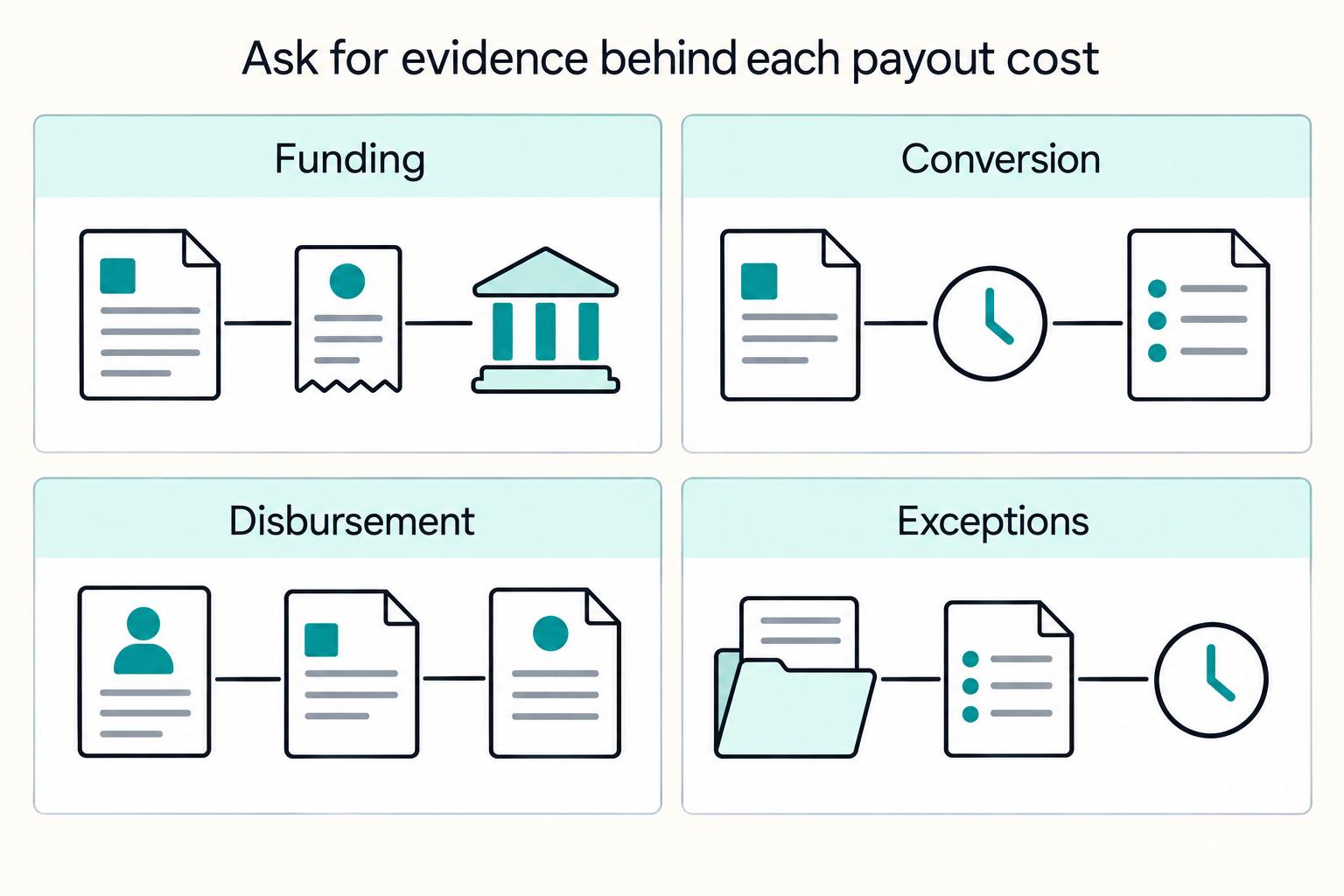
Quick Answer
Compare Ghana payout quotes using the sender’s full cash outlay and the contractor’s net GHS receipt at a stated benchmark rate. Fixed fees, FX pricing and local deductions can make small payments expensive, but $12 is not an established corridor price. Keep expected exception labor separate from money deducted from the contractor and verify the provider’s licensed role and commercial route.
Define what the $100 represents#
A contractor invoice for USD 100, a sender budget of USD 100 and a transfer of USD 100 before fees are different starting points. Agree which amount is owed and who bears charges before comparing Ghana payout routes. The useful output is a reconciled sender outlay and net contractor receipt, rather than one headline transfer fee.
There is no verified universal USD 12 price for this corridor. The worked example below shows how a USD 100 budget could deliver the equivalent of USD 88 using explicitly invented fees and rates. Replace every assumption with a dated commercial quote for your sending entity, funding currency and recipient destination.
Work through a gross-budget example#
Assume the platform has a total USD 100 budget. The comparison benchmark is GHS 12 per USD at the quote time. A provider deducts a USD 4 funding/transfer fee, converts the remaining USD 96 at GHS 11.50 per USD and deducts a GHS 48 local payout fee. These figures are teaching assumptions, not a current Ghana exchange rate, provider tariff or regulatory charge.
| Step | Calculation | Result |
|---|---|---|
| Budget before charges | USD 100 | USD 100 |
| After sender-side deduction | 100 − 4 | USD 96 |
| GHS before local fee | 96 × 11.50 | GHS 1,104 |
| Wallet or bank credit | 1,104 − 48 | GHS 1,056 |
| USD equivalent at the same benchmark | 1,056 ÷ 12 | USD 88 |
| Difference from budget | 100 − 88 | USD 12, or 12% |
That USD 12 difference comprises USD 4 in funding/transfer charges, USD 4 of FX shortfall relative to the benchmark and USD 4 of local fees. The FX component is 96 × (12 − 11.50) ÷ 12 = USD 4. This is a benchmark comparison, not proof of the provider’s profit or a claim that the benchmark rate was executable.
Do not add an advertised FX spread again to the USD 12: the reduced conversion rate is already reflected in the net receipt. If the recipient later withdraws cash and pays another charge, record that separately from the GHS 1,056 account credit. If no cash withdrawal occurs, do not assume a cash-out fee.
Calculate funding for a net-receipt obligation#
If the contract requires receipt equivalent to USD 100 at the assumed GHS 12 benchmark, the target is GHS 1,200. A USD 100 budget that delivers GHS 1,056 underpays that illustrative obligation. The destination currency and contractual FX rule should determine the real target; a reporting benchmark does not rewrite the invoice.
With the same invented fee structure, solve (funding − 4) × 11.50 − 48 = 1,200. Required funding is (1,200 + 48) ÷ 11.50 + 4 = USD 112.5217, before provider rounding. Quote USD 112.53 or the provider’s valid amount and verify the resulting net receipt. The approximately USD 12.53 extra funding differs from the USD 12 shortfall in the gross-budget example because more dollars must pass through the conversion leg.
If fees are percentage-based, capped or tiered, use the actual schedule rather than this fixed-fee formula. Persist quote ID, expiry, rate and promised net amount. If the quote expires before submission, requote and reapprove any changed obligation or sender cost.
Separate payment charges from exception labor#
Operational work can make a route expensive without reducing the contractor’s receipt. Suppose 5% of payments need 20 minutes of investigation and the fully loaded labor rate is USD 30 per hour. Expected handling cost is 0.05 × (20 ÷ 60) × 30 = USD 0.50 per attempted business payment. Those are assumptions to replace with measured results.
Do not deduct that USD 0.50 from the contractor’s GHS balance or label it a provider fee. Keep it in the platform’s cost-to-serve model. If a failed payment also incurs a nonrefundable provider charge, record that cash cost separately. Refunds of payout principal reverse money movement; they are not fee savings or new income.
Compare both completed and unresolved obligations. Dividing cost only by successful payments can hide unsuccessful attempts, while counting every technical retry as a new business payout inflates the denominator. Choose and state the denominator, and retain the number of provider attempts per obligation.
Verify the Ghana route before using its price#
The Bank of Ghana licensed-PSP register identifies legal entities and categories. For example, it lists MobileMoney LTD as a dedicated electronic money issuer. The licence-category page distinguishes issuer, enhanced PSP and other roles. A brand logo or wallet destination is not evidence of the whole cross-border funding chain.
The Bank’s August 2025 inward-remittance guidelines govern specified PSP/MTO arrangements and distinguish EPSP partnerships from DEMI termination roles; DEMIs are excluded from direct MTO partnerships in that framework. Review the actual provider entities, approvals and payment purpose. These remittance provisions do not establish permission for every commercial contractor payment.
Tell the provider that the transfer pays for services, and obtain confirmation of the supported business sender, sending country, recipient type, funding method and destination. Domestic GHS transfer capability does not establish an international commercial route. Do not mislabel an invoice payment as family support to fit a consumer product.
Compare quotes on the same basis#
| Evidence | Why it matters |
|---|---|
| Gross funding and payer fee | Shows whether charges are additional or deducted from the budget. |
| Rate, timestamp and expiry | Separates a firm execution quote from a market reference. |
| Net GHS account credit | Allows like-for-like comparison at the same benchmark. |
| Recipient bank/wallet and any cash-out choice | Distinguishes delivery from subsequent access costs. |
| Failed/returned payment fee rules | Shows whether principal and charges return together. |
| Completed delivery and reconciliation references | Proves the quoted amount became the recorded recipient credit. |
A verified all-in quote can be sufficient to compare delivered value when the full sender outlay and net recipient amount are clear. A detailed breakdown helps explain differences and resolve disputes, but lack of separate line items does not by itself prove inefficiency. Compare quoted net receipts for the same obligation, not a free local transfer against a fully funded cross-border route.
Batching may reduce a fixed charge per obligation, but verify which fees are actually per batch and which remain per recipient. Do not postpone an agreed payment date solely to improve unit economics. Similarly, a faster route deserves a premium only when the actual approval-to-credit timing meets the recipient’s need.
Close the ledger before calling the route cheaper#
- Link invoice currency and amount to the quote, funded balance, provider instruction and recipient credit.
- Record sender-paid charges, deducted charges and FX comparison separately; avoid double-counting delivered-value shortfall.
- Match returned principal and refunded or retained fees to the original payment. Leave unresolved amounts open.
- For a timeout, investigate the original reference before another attempt or alternate rail. A missing response does not establish failure.
- Report net receipt, full cash fees, expected handling cost and approval-to-credit time for a consistent cohort.
The contractor’s own income-tax position and the payer’s applicable reporting or withholding obligations require their own determination. They are not automatically Ghana transfer fees, and an individual foreign-earned-income exclusion or foreign-account report does not explain the landed cost of this payment. Compare the contracted route using its actual records. See SWIFT versus local bank transfers for the rail-selection tradeoff.
Frequently Asked Questions
Does a $100 contractor payout to Ghana always cost $12?
No. The USD 12 shortfall here comes from invented fees and exchange rates in a teaching example. Obtain a current route-specific quote and verify the net GHS credit.
Why does a $100 net obligation require more than $112 in the example?
Funding must cover the fixed sender fee, the destination fee and conversion at the assumed provider rate. Solving the stated formula gives USD 112.5217 before rounding.
Should exception labor be counted as a recipient deduction?
No. Expected investigation labor is platform cost to serve. Count actual provider fees separately and preserve the contractor’s agreed net-receipt obligation.
Can an all-in quote be compared reliably?
Yes, if full sender outlay, net destination receipt, timing and route eligibility are clear. Use the same benchmark and obligation for both quotes.
Researched and edited by the Gruv editorial team. Gruv builds cross-border billing, payouts, and finance-operations software for global businesses.
Sources
Educational content only. Not legal, tax, or financial advice.
Related Posts
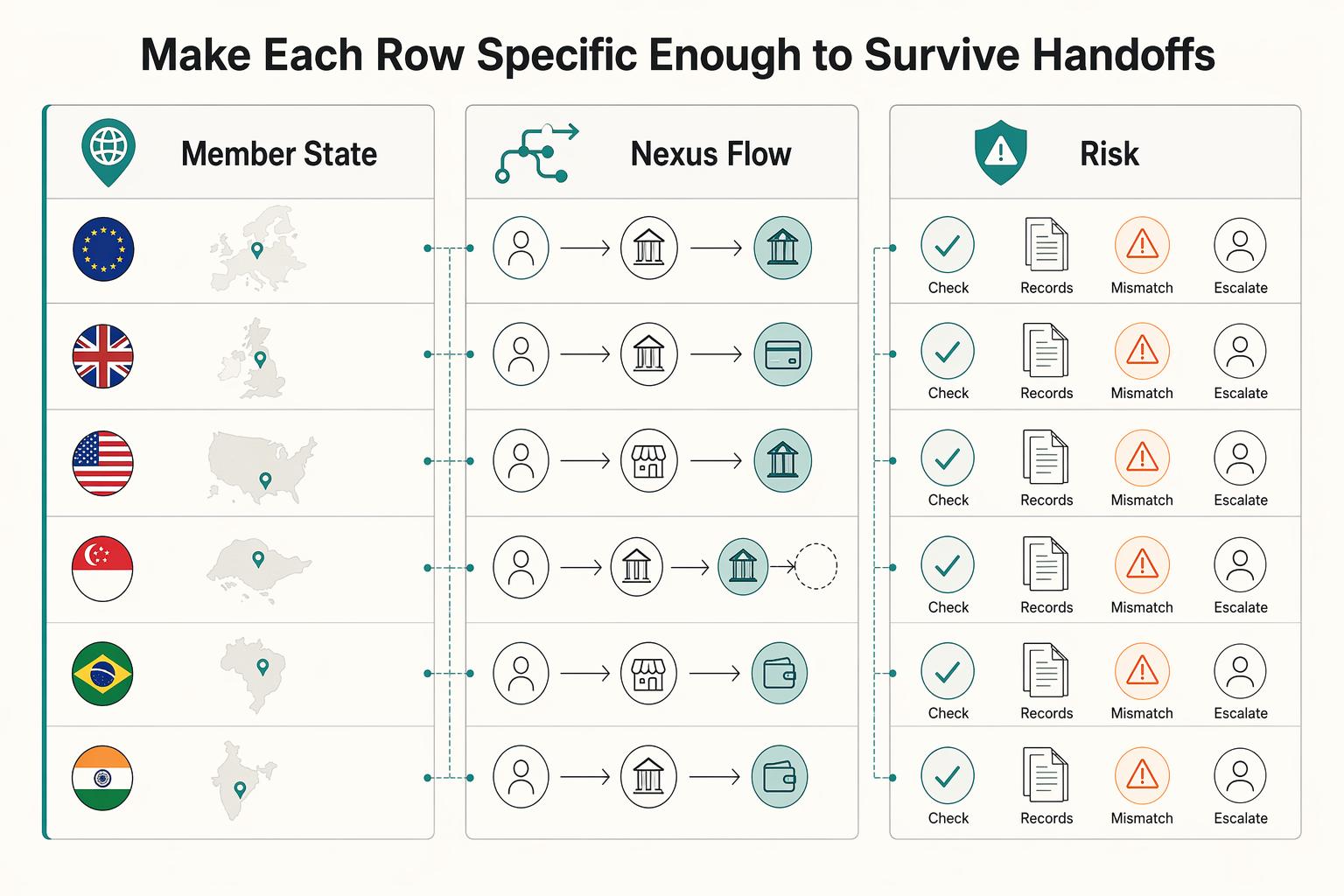
Country-by-Country Launch Rules for Platform Payout Compliance
Treat each new payout country as a go or no-go decision. It may be blocked by law, blocked by operations, or cleared only with conditions. This guide helps compliance, legal, finance, and risk teams make that call early, assign ownership, and keep an evidence trail that holds up later.

Pay US Subcontractors From Canada: Tax, FX and Records
To pay a US subcontractor from Canada, identify the legal supplier, confirm where the services are performed, agree the invoice currency and establish the applicable withholding/reporting path. Then approve the work, fund the payment and reconcile the result. US tax status, Canadian tax residence and physical work location are separate facts.

How to Pay US-Based Freelancers from the UK
Your ability to attract and keep strong US freelance talent depends less on budget than on how you operate. Strong freelancers often work like serious one-person businesses, and they start evaluating you from the first interaction. Compliance and payment handling are not back-office details. They are early proof that you will be easy to work with, careful with details, and worth prioritizing.