
Quick Answer
Classify the intercompany movement as loan, equity, service settlement, reimbursement or pooling before choosing a rail. Record the entities, purpose, currencies, terms, approval and local restrictions. Central treasury and local pre-funding can coexist; select supported routes by required destination availability, cost and recovery evidence. Use one durable funding intent, resolve ambiguous timeouts before replacement, and separate delivery deduplication from financial posting. Reconcile source debit, fees, FX, destination credit and both entity positions at a common cutoff. Intragroup principal is eliminated under consolidation rules, while external costs and applicable FX effects can remain.
Define the legal transfer before choosing the funding model#
A platform can successfully send money from one group company to another and still book it incorrectly. Loan funding, capital contributions, service invoices and reimbursements create different legal and accounting positions. Decide which transaction you are executing before choosing a rail or automating approvals.
Scope that matters#
This guide covers funding between separate legal entities under common control. Moving money between two bank accounts of the same legal entity is a treasury transfer, not a new intercompany balance. For each group transfer, record the source and destination entities, ownership relationship, purpose, contractual denomination, amount and settlement currency. US Section 482 guidance concerns controlled pricing; it is not a universal label for every group cash movement.
The constraint stack is real#
Classify the movement first: a loan creates a receivable/payable with repayment and pricing terms; equity funding changes investment and capital accounts; payment for services settles the relevant invoice; reimbursement needs evidence of the original expense and allocation; a cash-pool sweep follows its pool agreement. Do not default every top-up to revenue, a loan or an expense. Confirm local restrictions on lending, capital contributions, distributions and foreign exchange for the entity pair.
Success is approval-to-close, not send-to-settle#
At entity level, reconcile the legal position, cash movement and journals. At consolidation, eliminate the applicable intragroup balances and transactions under the group’s accounting framework. External bank fees remain group costs, and foreign-exchange differences on intragroup monetary items do not automatically disappear merely because the receivable and payable are eliminated. IFRS IAS 21 guidance explicitly identifies that distinction.
Treat the operating model and the rail as separate choices. Central oversight can use local rails, and a locally funded entity can receive a correspondent-bank transfer. The following scorecard compares ownership of the funding process; the rail table then assesses how the approved transaction actually settles.
Selection criteria that actually predict success#
Use a scorecard, not a demo impression. For cross-border intercompany transfers, these five criteria usually tell you more about production readiness than headline pricing or a smooth sandbox.
| Criterion | Risk signal | Key check |
|---|---|---|
| Compliance burden | The model repeatedly depends on manual tax or transfer-pricing explanation at close | Ask for the evidence pack up front: entity pair, business purpose, pricing basis, and jurisdiction mapping |
| Operational control | Traceability should be visible before launch, with production-grade KYC/AML controls and user-level auditability | Verify initiator/approver separation, policy overrides, retained decision history and evidence export |
| Speed to launch | Sandbox wins are early signals, not launch proof | Require one end-to-end pilot from approval through posted journal and close review |
| Reconciliation complexity | Data is inconsistent even if payment execution succeeds | Require a stable request ID, provider reference, entity pair, currency, and ledger posting link on every transfer |
| Failure recovery time | Measure how quickly you can prove state and correct the books | Weight auditability and evidence packs heavily; evaluate FX as total cost, including both fees and the FX component |
Compliance burden#
Score this early. Related-party transfers still matter even when no explicit price is charged, and cross-border related-party pricing sits in an arm's-length framework. If a model repeatedly depends on manual tax or transfer-pricing explanation at close, treat that as ongoing operating risk. Key differentiator: ask for the evidence pack up front: entity pair, business purpose, pricing basis, and jurisdiction mapping.
Operational control#
Assign who can approve, create and investigate transfers, and who owns screening or provider escalation. Separate transfer initiation from approval for material movements. Retain a usable audit history for the requirements applying to your entity and program; a bookkeeping product’s default history is not a universal retention standard.
Speed to launch#
A smooth sandbox is an early signal, not launch proof. Test environments simulate flows; they do not move real money, so readiness still depends on live-state handling, compliance checkpoints, and close outputs into your accounting system. Key differentiator: require one end-to-end pilot from approval through posted journal and close review.
Reconciliation complexity#
Cross-border flows create reconciliation friction when data is inconsistent, even if payment execution succeeds. ISO 20022 harmonization work points to concrete data requirements, so clean reference data is a core control, not admin overhead. Key differentiator: require a stable request ID, provider reference, entity pair, currency, and ledger posting link on every transfer.
Failure recovery time#
Measure recovery by how quickly you can prove state and correct the books, not just by whether funds moved. Fragmented systems and manual entries make close more cumbersome, so recovery design should be part of model selection. Key differentiator: when close reliability is the main pain, weight auditability and evidence packs heavily. FX should still be evaluated as total cost, including both fees and the FX component.
For teams tightening compliance controls around cross-border transfers, our guide to PEP screening for cross-border platforms and monitoring obligations covers the monitoring side in more detail.
The best operating models for multi-entity platforms#
There is no universal best model. The right choice depends on which failure hurts most: close breaks, local settlement misses, legal-entity confusion, or rollout risk.
| Model | Best when | Key consideration |
|---|---|---|
| Centralized treasury hub | You need unified control and clear policy ownership | Accounting load rises because intragroup balances and transactions must be eliminated in full at consolidation |
| Local entity pre-funding | Local payout certainty matters more than peak capital efficiency | Idle liquidity, FX exposure and replenishment controls; support the actual loan, equity or settlement arrangement |
| Hybrid corridor routing | Corridor behavior is mixed | Keep suitable euro routes on SEPA Credit Transfer and route selected other corridors through centralized SWIFT controls |
| Collection-entity redistribution | A group company earns proceeds and funds other group entities | Distinguish seller revenue from custody funds; external MoR settlement is not itself intercompany |
| Provider-partitioned model | One provider is not a clean fit across all corridors | Operations fragment unless outputs are normalized into one ledger view |
Centralized treasury hub#
A treasury hub gives one team control of forecasts, approvals, funding and investigation. It does not turn separate companies into one legal cash owner. Keep entity-specific balances, contracts and accounting even when the payment interface is centralized. Physical cash pooling moves balances and creates positions according to the pool agreement; notional pooling need not move cash at all. The OECD financial-transactions guidance addresses loans, cash pooling and guarantees.
Local entity pre-funding#
Local pre-funding lets a subsidiary meet local obligations without depending on a same-day cross-border arrival. Set a target based on forecast payments, available local funds and replenishment lead time. The costs include idle liquidity, FX exposure and periodic rebalancing. Transfer-pricing documentation depends on the actual funding arrangement and local rules, rather than becoming inherently heavier solely because funding is local.
Hybrid corridor routing#
A hybrid model can combine central funding policy with local execution. Use suitable euro routes on SEPA and select other supported local or correspondent routes by currency, timing and bank access. Do not infer a delivery commitment from network-level speed statistics. Store the route, rule version, entity pair, purpose and reason for any override.
MoR-led collection with entity redistribution#
A Merchant of Record is the contractual seller for the relevant customer transaction, not simply the entity that processes a payment. If an external MoR owes proceeds to your platform, its settlement is an external receivable flow. Only a subsequent transfer between your group entities is intercompany. If a group company is the seller, distinguish its own revenue and liabilities from funds it holds for others; customer or safeguarded funds must not be treated as unrestricted group funding.
Provider-partitioned model#
Best for staged rollout when one provider is not a clean fit across all corridors. Teams often split by region or corridor type, for example, SEPA-focused flows versus longer-tail SWIFT corridors. The tradeoff is fragmented operations unless outputs are normalized into one ledger view. SWIFT's broad network coverage helps with reach, but it does not solve internal visibility by itself, so require the same minimum evidence fields from every provider before you expand.
If you need a more operational walkthrough of sending funds across borders, see International EFT payments for platforms.
Centralized treasury fits shared oversight and investigation#
Consider central ownership when approvals, FX decisions and investigations otherwise become fragmented. Score it against local constraints and the cost of losing access to funds at a regional entity. Centralization can improve visibility, but is not a source-backed universal first choice for every platform.
Choose centralized when investigation time is the real cost#
Centralizing treasury and cash functions can improve control and efficiency, especially when approvals and settlement would otherwise pass through multiple local teams. If you choose this model, we recommend giving one team authority to trace the transfer from approval through posting before your payout release moves forward and before your month-end close depends on manual reconstruction. Manual communication is a known source of intercompany settlement delay. The practical advantage is shared visibility: one team can trace approval, provider reference, FX state, and journal outcome without rebuilding the timeline across entities.
Use one operating sequence for every funded transfer#
Use an approved lifecycle: classify and authorize the funding request, reserve the source funds, validate any FX quote, create or recover the provider transfer, and record each accounting transition from its evidence. Release dependent payouts only when the destination has confirmed available funding and the required release controls pass. A provider reference or two posted journals alone does not prove that cash has arrived.
Design for stale FX quotes and safe replay before go-live#
For a binding FX quote, retain its ID, rate convention, expiry, currencies, gross and net amounts, fees and acceptance result. An expired unexecuted quote needs a new quote under your approval policy. If execution timed out, investigate the existing transfer first; quote expiry does not authorize a second conversion or transfer.
Separate duplicate controls for funding vs payouts#
Use separate business identities for the intercompany funding transfer and each downstream payout. Provider request caches or batch duplicate guards do not replace your durable funding-intent registry. Retrying the same command must preserve its identity; a genuinely new top-up receives a new approved intent.
Build an evidence pack finance can close from#
Keep the funding request, legal classification, terms, approvals, provider references, FX execution evidence, source/destination statement movements and linked journals. Use separate amounts for instructed principal, source debit, fees, converted amount and destination credit. That makes intermediary deductions visible rather than disguising them as an entity-balance mismatch.
A useful illustrative loan example uses a USD-functional parent and EUR-functional subsidiary. The parent lends USD100,000, the subsidiary owes USD100,000, and conversion produces EUR90,000 at an assumed EUR0.90 per USD. With a separate USD25 bank fee, the parent debits intercompany loan receivable USD100,000 and fee expense USD25, and credits cash USD100,025. The subsidiary debits EUR cash90,000 and credits its USD-denominated loan payable at EUR90,000. The figures assume confirmed settlement, no withholding and no deducted destination fee; they are not a market quote.
Local entity funding wins when corridor predictability is high#
Local pre-funding can be a strong fit when payout timing is strict and corridor behavior is stable. Ask a simple question: is the cost of a missed local payout likely to outweigh the cost of holding extra liquidity? If it is, fund the local entity first and rebalance later through cross-border intercompany transfers.
Pre-fund when payout timing is non-negotiable#
Cross-border payments still face persistent frictions around cost, speed, access, and transparency. A pre-funding model is an established cross-border mechanism, and its advantage is simple: funds are already local before payout execution. If your corridor is predictable, this reduces dependence on urgent cross-border movement on payout day.
Run local funding with explicit balance controls#
Set minimum and target balances by entity and currency. For example, assume EUR80,000 of payouts fall due before the next replenishment, EUR10,000 of other outflows and a EUR15,000 operating buffer. Required available cash is EUR105,000. If unrestricted available cash is EUR45,000, the top-up target is EUR60,000 before fees or FX effects. Exclude customer funds, blocked balances and already committed payments. Review forecast misses and excess cash instead of treating the buffer as permanent.
Document true-ups as intercompany transactions, not treasury housekeeping#
For a loan or cash-pool position, document repayment terms, credit risk, currency, interest/pricing basis and the parties’ actual roles. A repeated “temporary” advance can become longer-term funding. True-ups and rebalancing need the same transaction classification as the original funding; a treasury label does not determine tax treatment.
Apply tax documentation to the actual payment type#
A loan principal transfer is not the same transaction as interest or a service fee. Assess withholding, treaty claims, deductibility, VAT and reporting for the relevant payment and entity pair. Use entity tax-status documentation where required: Form W-8BEN-E concerns foreign entities; W-8BEN is ordinarily an individual form. A VAT-number check does not establish a loan’s tax treatment or authorize funding.
For a step-by-step walkthrough, see When Platforms Should Use Wires vs Local Rails for Cross-Border Payouts.
Hybrid routing is the practical middle path for scaling platforms#
Use hybrid routing when entity access and corridor behavior differ. Central policy can select a local rail or a correspondent route without moving every payment into the same account. Keep the entity’s liquidity constraint separate from the rail’s execution timing.
SEPA for stable euro corridors#
SEPA Credit Transfer is a candidate for EUR movements between eligible participating accounts. The ECB scope page lists 41 countries with its status dated May 22, 2025. Country membership alone does not confirm your banks’ scheme participation, program access or availability deadline.
A recurring France-to-Germany EUR top-up may suit a supported SEPA rail. It can still be approved and monitored centrally. Test the actual banks, cutoff, purpose restrictions and settlement evidence; a stable route does not guarantee another entity pair behaves the same way.
SWIFT for volatile or higher-touch corridors#
SWIFT is messaging infrastructure, while settlement depends on the banks and payment arrangements behind the message. Correspondent routes may suit wider currency or geography needs, but also involve fees, intermediary checks and uncertain beneficiary timing. Central oversight is an operating choice; volatility does not by itself make SWIFT the required rail.
Where a payout depends on incoming funding, release only against confirmed destination availability and the approved accounting/release controls. “Accepted,” “sent” or “message delivered” does not establish usable destination cash.
Code routing rules so decisions are repeatable#
Hybrid routing works best when the rules are explicit and deterministic. In rule-based orchestration setups, evaluate rules in order, with the first match winning, and define them with clear transaction conditions. If you route by amount, include currency. That turns routing from tribal knowledge into auditable system behavior.
In the ops UI, show the matched rule, selected rail, rule version, entity pair, amount class, currency, and any override. Watch for overlapping rules and silent manual overrides.
Make every transfer replay-safe and explainable#
Attach two controls at creation time: a deterministic reason code and a replay-safe idempotency key. Use your internal reason code to explain route choice, and use rail-specific codes for rail exceptions. For SCT exceptions, apply the scheme's specific R-transaction or inquiry reason codes under the 2025 rulebook in force from 5 October 2025.
For a timeout, query the existing provider operation or safely retry with its original identity according to that API’s contract. Not every API caches errors in the same way. Resolve an ambiguous outcome before creating a replacement transfer; a new key can bypass duplicate protection.
Related: Adaptive Payments for Platforms: How to Split a Single Transaction Across Multiple Payees.
Rail and FX choices by corridor and transfer objective#
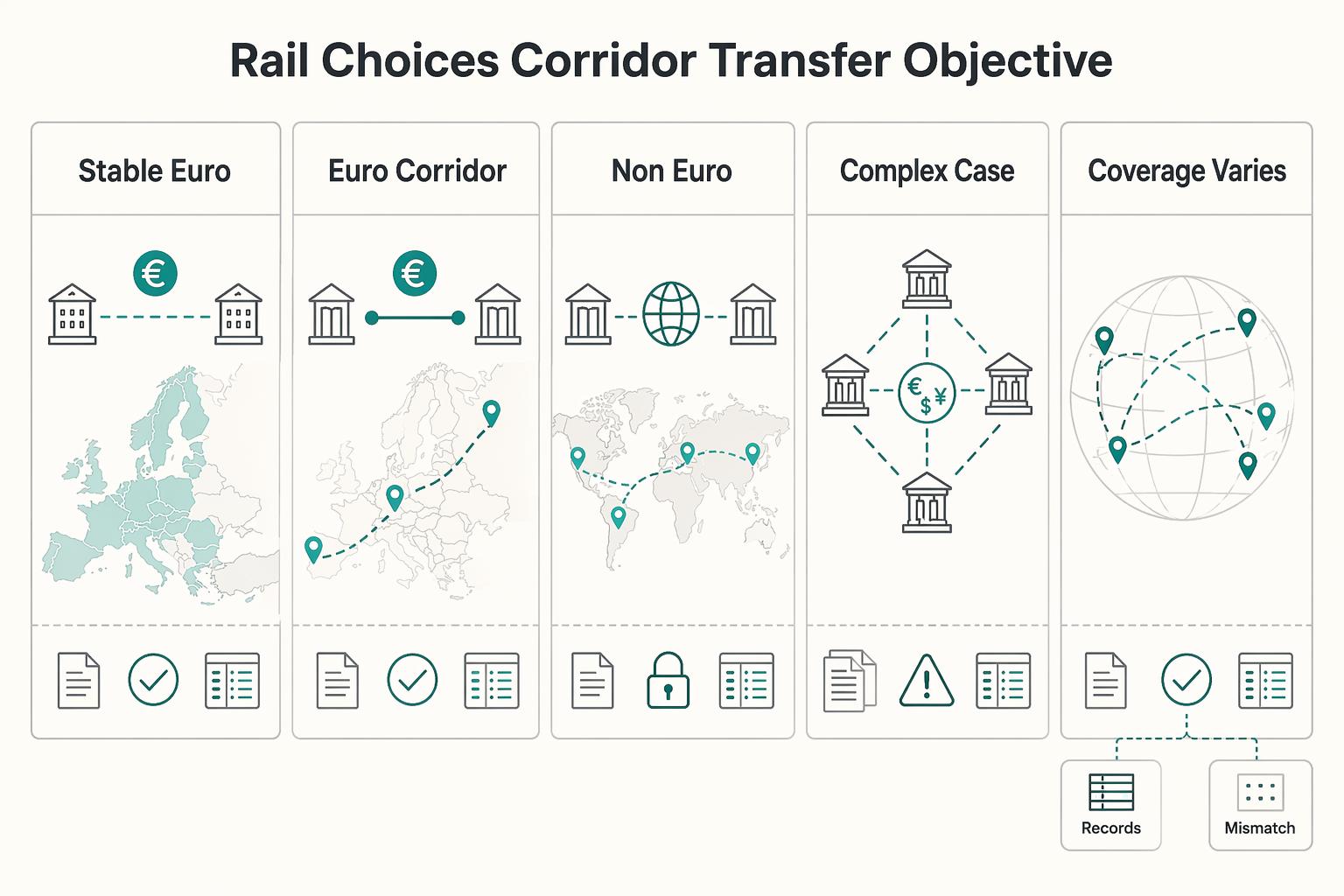
Choose a rail by supported currencies and accounts, expected usable-cash timing, total cost and recovery evidence. SEPA is a EUR candidate within supported schemes; local cross-border providers or correspondent routes can serve other flows. Compare the actual route rather than naming SWIFT as a mandatory default for every non-euro transfer.
The tradeoff is not just price. Keep cost, speed, access, and transparency in view together. Correspondent banking remains central to cross-border coverage, but those frictions still show up in practice.
| Corridor type | Rail candidates | FX approach | Expected failure modes | Reconciliation burden |
|---|---|---|---|---|
| Stable euro corridor, liquidity balancing between entities | SEPA | No FX if both sides hold EUR; if conversion is needed, convert before transfer and send EUR end to end | PSP not formally participating in SCT, payment details issues, non-euro payment routed into a euro-only rail | Low when entity pair and amount band are consistent |
| Euro corridor, urgent payout funding where time to funds matters | SEPA (SCT Inst where enabled) | Keep funding in EUR where possible so release is not waiting on conversion | Assuming instant availability when SCT Inst is not enabled, treating "sent" as usable balance too early, institution or program support mismatch | Low to medium, depending on payout-release logic |
| Non-euro or non-SEPA corridor, urgent funding to keep payouts moving | Supported local cross-border route or correspondent-bank route | Lock FX decision close to execution and store quote or rate reference with the transfer record | Slower funds availability, intermediary handling, and weak transparency if you only track dispatch | Medium to high |
| Mixed-currency month-end entity rebalancing with close-cycle deadlines | Supported conversion plus local/correspondent settlement | Prioritize auditable FX over lowest spread; store approval, rate source, value date, and resulting journals together | Timing mismatches across entities and incomplete FX audit trails | High |
| Coverage varies by market or program, even with broad provider reach | Verified supported route; separately tested fallback | Treat FX setup as provider- and market-specific until confirmed for receiving institution and region | Assuming availability from generic coverage claims, then finding the receiving institution or program is not enabled | Medium to high |
| Corridor where a stablecoin-like option may exist only if separately enabled and approved | Supported bank route or separately assessed alternative | Use standard bank-rail FX unless the alternative path is explicitly enabled, legally cleared, and documented | Compliance gating not met, jurisdiction restrictions, missing authorization checks, added review from illicit-finance risk controls | High until fully approved and documented |
For each shortlisted route, record the expected source debit and destination credit, fee payer, currency conversion point, cutoff and evidence of usable funds. Apply these checks before depending on it for payouts:
- For euro liquidity balancing, verify the payment is in EUR and both PSPs formally participate in SCT.
- For urgent euro funding, verify SCT Inst is actually enabled for the relevant institutions and program if you are relying on near-immediate availability.
- For non-euro or mixed-currency corridors, optimize for a clean audit trail, not just the lowest conversion fee.
- Confirm the receiving institution and actual program support. A fallback must be tested and available; neither a SWIFT label nor a coverage page guarantees it.
- For stablecoin-like alternatives, treat them as conditional rails requiring explicit enablement and compliance sign-off.
The minimum compliance and documentation pack before go-live#
Use a transaction-specific document pack. The purpose is to explain the legal funding position and the accounting at both entities, while retaining the information needed by the banks and applicable tax rules.
| Control pack | Before launch, confirm | Key detail |
|---|---|---|
| Funding agreement and pricing rationale | Match loan, equity, service settlement, reimbursement or pooling purpose to its terms | Loan principal, interest and service consideration can have different tax and accounting treatments |
| Entity/jurisdiction map | Local lending, capital, currency-control, withholding and filing requirements | Use the rules applying to this entity pair; OECD documentation frameworks do not create one global filing duty |
| Bank/provider and release controls | Entity onboarding, signing authority, screening responsibilities and escalation owner | Apply the program’s actual checks without borrowing bank-specific filing duties |
| Tax records and close support | Payment-specific withholding/status evidence, invoices and paired journals | Retain rate, currency, value date, fees and any applicable documentation effective dates |
1. Intercompany agreement and pricing rationale#
Start with an intercompany agreement that matches the transfer flow you are automating, then attach a transfer-pricing method note. The tax anchor is the arm's length principle for pricing between associated enterprises.
Before launch, confirm each live entity pair has:
- A retrievable agreement reference
- A retrievable pricing-method reference
- Clear internal terms for transfer purpose, settlement currency, pricing logic, and true-up handling
The IRS documentation FAQ discusses US penalty-protection documentation: with exceptions, it must exist when the return is filed and be supplied within 30 days of an examination request. Those conditions are not a universal legal deadline before executing any group transfer. Preparing the relevant rationale before execution is a practical control; adequate records do not automatically guarantee penalty protection.
2. Jurisdiction map for tax regimes#
List the rules triggered by the actual transaction and entity pair. OECD Action 13 provides a documentation framework, but local adoption, thresholds and exemptions determine duties. For UK scope, the HMRC overview distinguishes general records from specified Master File and Local File obligations for relevant entities within the CbCR threshold.
Keep a tax owner and review date for each classification. A loan may require interest and withholding analysis; a service settlement may require invoice and VAT treatment; equity has capital formalities. Do not attach individual freelance forms or a country-by-country report to every transfer simply because funds cross a border.
3. KYC, KYB, and AML release gates#
If your operating workflow includes internal funding and downstream payout release, set operational gates so release does not happen before legal-entity checks are complete and escalation ownership is clear.
Banks and providers impose onboarding, signing-authority and customer-due-diligence requirements for the actual program. Identify what your platform must supply and what the covered institution owns. Avoid importing a bank’s legal reporting duties into an ordinary group treasury process without establishing that they apply.
Your control record should show:
- KYB/CDD status for each legal entity
- Beneficial-owner identification and verification status
- Named owner for manual escalation when review is pending
4. Tax forms and downstream reporting dependencies#
Document form and reporting dependencies only where they apply, and record them before the first transfer rather than during close.
For each payment type, retain the tax-status or treaty documents actually required, their effective dates and owner. Use foreign-entity documentation for an entity when appropriate, and assess interest, royalty or service withholding separately from principal. Validate VAT status only where relevant to the taxable supply. Personal earned-income exclusions and unrelated information-return thresholds do not determine how a platform funds its subsidiary.
Build controls so retries are safe and audits are easy#
Operational failures often show up as duplicate execution and weak evidence trails. That makes retry safety and traceability practical release blockers for payment transfers.
1. Idempotency first#
Create one durable funding intent and reserve approved source liquidity. Bind retries to that intent, its entity pair, amount, currencies and purpose. A changed amount or new replenishment needs a separate approved operation. After a timeout, reconcile the original result before allowing another initiation.
Document each provider’s key scope, expiry and recovery API. Persist intent-to-transfer mapping longer than the provider’s request-cache lifetime. Enforce uniqueness locally as well; a short cache window cannot be the sole protection against duplicate funding after a delayed retry.
2. One traceability chain across the full payment journey#
You need one continuous chain from request to reconciliation export: request ID -> provider reference -> ledger posting -> payout or settlement report. Without that chain, close can turn into manual matching across systems.
Persist the core links together in one record: internal request ID, provider transfer reference, webhook event ID, journal or posting ID, and reconciliation export row key. This makes "what happened?" answerable quickly during audits and month-end reviews.
3. Let the ledger win over balance views#
Use a transaction ledger for operational funding and reservations, with a documented feed and reconciliation to entity GLs. Product balance views can lag. Authorize funding and payout reservations against the authoritative available balance rather than a stale display or a month-end GL snapshot.
Record source debit, cash in transit, destination booking and intercompany position according to the approved accounting policy and evidence at each stage. A journal posting must not invent bank settlement. On separate systems, recover partial posting explicitly; do not claim two entity GL writes and provider execution are one atomic transaction.
4. Webhooks need duplicate handling and late-outcome rules#
Assume asynchronous outcomes and build for delay, retries, and reordering. Final status may arrive long after the initial request response.
Authenticate and durably retain incoming notifications before trusted processing. Deduplicate delivery IDs separately from the underlying financial operation: several lifecycle notifications can describe one transfer. Commit posting and processing completion safely, or recover an external-ledger timeout with the same operation key. A delayed earlier status must not undo a confirmed return; use provider ordering rules or retrieve current state.
Failure scenarios and what to do in the first hour#
In the first hour, contain downstream impact, investigate from the provider reference outward, and avoid workarounds that assume an uncertain transfer is settled.
1. Transfer delayed in transit#
Treat delay as a status problem first, not an automatic retry signal. Consider pausing dependent payouts or internal releases, publish an internal status update, and escalate by corridor and rail.
Check the provider’s transaction status and any available bank tracking reference, such as a SWIFT UETR. Use the appropriate scheme reason code for a rejection or return. A payment-status message does not necessarily prove beneficiary cash availability. Keep the original intent active while the outcome is uncertain; do not send a replacement solely because a balance screen is stale.
2. Transfer returned or unmatched#
Separate a confirmed return from a destination attribution problem. For a return, record the actual source/destination cash effects, fees and linked reversal or correction under the entity policy. For confirmed cash with an unmatched internal reference, retain it in the correct suspense treatment until attribution is resolved instead of forcing an amount-only match.
A return request or recall is not a confirmed return. Use the scheme/provider outcome and bank evidence to establish the financial effect, and preserve the original movement link. If the destination already used the funds, reconcile the resulting funding shortfall and any recovery obligation explicitly.
3. Compliance hold triggered#
If a compliance hold is triggered, treat it as a stop condition under your AML/KYC process until review clears it. Do not bypass the hold with manual overrides.
Escalate to the designated legal/compliance owner with transfer intent, approvals, screening evidence, provider messages and timestamps. Determine which institution or entity owns any reporting duty and its actual deadline. Do not infer a platform’s SAR threshold or filing duty from rules applicable to a bank, and do not route around the hold through another provider.
4. Reconciliation mismatch at close#
Investigate mismatches before close sign-off: transaction currency/amount, reporting cutoff, cash in transit, fees, FX rates, source and destination journals, and any return. Do not book a balancing adjustment merely to make two unexplained totals match.
Continue the loan example: the EUR-functional subsidiary still owes USD100,000. At an assumed closing rate of EUR0.92 per USD, its payable is EUR92,000 rather than EUR90,000. Under the illustrative ordinary monetary-loan treatment, it debits FX loss EUR2,000 and credits the payable EUR2,000. The parent’s USD principal stays USD100,000. Compare both sides first in the contractual USD amount, then apply the group’s translation and consolidation policy. Eliminate the intragroup principal; retain the external USD25 fee and applicable exchange effects. Net-investment and other special treatments need separate assessment, not an automatic “eliminate all FX” rule.
A 30-day implementation sequence finance and engineering can actually execute#
A four-week sequence can be enough to expose the real issues. Decide the model and corridor scope first, harden policy and retry behavior second, run narrow live pilots third, and expand only after close and compliance sign-off in week four.
Week 1 decide the model and corridor inventory#
Week 1 is for decisions, not code. Pick the first live model, centralized, local pre-funding, or hybrid, and approve one shared scorecard across finance and engineering.
Build a concrete corridor inventory for every in-scope flow: origin entity, destination entity, funding purpose, currency pair, expected rail, approval owner, and accounting destination. If a route is eligible for SEPA Credit Transfer, keep the boundary explicit: SCT is for euro payments between accounts in SEPA and spans 41 SEPA scheme countries. Routes outside that footprint should be marked for non-SEPA routing, with SWIFT as a common candidate in correspondent-banking flows.
Define measurable service indicators per corridor, with safety and efficiency both covered, for example, approval time, execution handoff time, exception response time, and reconciliation completion.
Week 2 harden policy gates, retries, and accounting outputs#
Week 2 is where you remove duplicate-payment and invisible-hold risk. Configure policy gates for AML/KYC review, approval thresholds, release ownership, and evidence retention before any live pilot.
On the API layer, make transfer creation replay-safe with Idempotency-Key handling for retryable POST behavior. Validate by replaying the same request with the same key and confirming one transfer state and reference, not two movements of funds.
Implement webhooks in the same week so asynchronous outcomes update correctly, including events that can arrive late or out of sequence. Validate that request ID, provider reference, and journal outcome still reconcile under event reordering.
Map entity-level chart accounts, transaction and functional currencies, cutoffs and export/import fields. Test the actual accounting edition and interface used by finance. Reconcile the operational ledger feed to each GL rather than making a product wallet view the accounting authority.
Week 3 pilot real corridors and force the ugly edge cases#
Week 3 should be live but narrow. Pilot one or two corridors with enough activity to expose real behavior while limiting close-period blast radius.
Pilot the supported rail with the actual entity accounts and payout deadline. Exercise quote expiry without automatically repeating a possibly executed conversion. Use your provider’s documented quote acceptance and recovery behavior; unscoped one-hour or twenty-four-hour examples are not a universal contract.
Force stale-quote retry tests on purpose, verify failure behavior, then confirm recovery does not create duplicate transfers. For each pilot transfer, retain the rail-selection reason, original request ID, approval record, provider reference, and resulting journal entry.
Week 4 simulate close, sign compliance artifacts, then expand#
Week 4 determines production readiness. Run a close simulation using the same month-end evidence pack: transfer intent, approvals, screening outputs, provider status or return evidence, journal entries, and reconciliation rows that tie them together.
Review the pilot’s actual funding classifications, pricing support, local documentation requirements and signing authority. Confirm fees, withholding, FX and in-transit treatment in the entity and consolidation outputs. Resolve document gaps for the applicable transaction rather than attaching every available tax form.
Expand corridor coverage only after the close simulation passes and the document pack is complete. If you cannot quickly produce request ID, provider reference, ledger posting, and transfer-pricing or tax support for pilot corridors, keep scope fixed until you can.
If you are turning this 30-day plan into build tickets, use the Gruv docs to map APIs, webhooks, and payout status handling to your rollout.
Choose the model that reduces failures you can measure#
Once your minimum controls are in place, evaluate failure recovery and close reliability alongside headline fees. A lower-cost route can still become expensive if it creates unreconciled balances, legal-entity cash-flow delays, or quarterly tax-provision timing issues.
Score the model on recoverability, not just price#
In cross-border payments, performance is multi-objective: cost, speed, transparency, and access. Judge each model by whether you can trace transfers end to end, retry safely, and close without manual reconstruction. If your team cannot explain a transfer from request through settlement output, any fee advantage may be a false economy.
Prove corridor behavior end to end before expanding#
Prove one meaningful corridor first: approved intent, single execution, confirmed source/destination evidence, paired accounting and close reconciliation. Include an ambiguous timeout, a delayed notification, a return and an FX remeasurement. A successful API response or an exported report alone is not proof that the entity positions reconcile.
Validate exact corridor, entity, and reporting fit before rollout#
For each entity pair, verify legal funding permission, supported currencies/accounts, confirmed-availability evidence, failure recovery and finance outputs. If a route cannot meet the payout deadline, evaluate pre-funding or another tested route. Expand when the pilot evidence supports the decision, not when a general coverage page lists the country.
Frequently Asked Questions
What counts as an intercompany cross-border internal transfer in a multi-entity platform?
It is a funding or settlement movement between separate legal entities under common control in different jurisdictions. Loan principal, equity contributions, service payments and cash-pool transfers can all be intercompany, but require different legal and accounting treatment. A transfer between accounts of the same legal entity is not a new intercompany position. An unrelated supplier payment or external MoR settlement is an external flow.
How is an intercompany transfer different from a vendor payout or a customer refund?
The counterparty and transaction purpose determine the classification. A group loan or settlement creates or clears an intragroup position; a vendor payout or customer refund settles an external obligation. In consolidation, relevant intragroup balances and transactions are eliminated under the reporting framework, while external bank fees and applicable FX effects can remain.
Should we centralize treasury first or pre-fund local entities first?
Centralize ownership when fragmented approvals and investigations are costly. Pre-fund locally when confirmed local cash is needed before a deadline and the liquidity cost is acceptable. The choices can coexist: central treasury can forecast and authorize local balances. Compare legal restrictions, accessible liquidity, timing and recovery evidence before selecting the model.
What is the minimum control set before sending internal cross-border transfers?
Document the legal entities and transaction classification, terms and pricing support, applicable local rules, approval authority, source liquidity and provider recovery behavior. Keep the chain from funding intent through provider movement, cash evidence and entity journals. Release dependent payouts only against confirmed destination availability and the required controls.
How should we handle delayed, returned, or unmatched internal transfers operationally?
Investigate the existing movement by intent, provider reference and bank tracking evidence before initiating a replacement. Distinguish an uncertain delay, a confirmed return and an attribution problem. Record confirmed cash and corrections under the entity policy, preserve the original link, and reconcile principal, fees, currencies and cutoffs across both entities.
Which documents should finance prepare for transfer-pricing and tax reviews before go-live?
Keep the applicable funding agreement, transaction classification, pricing rationale, local tax assessment and paired accounting evidence. A loan needs repayment and interest/pricing support; a service settlement needs the relevant invoice and tax treatment. Master File and Local File duties depend on local scope, thresholds and exemptions. Tax-status or treaty forms apply to the relevant payment; foreign entities ordinarily use entity forms rather than individual W-8BEN documentation.
Try a related tool
Researched and edited by the Gruv editorial team. Gruv builds cross-border billing, payouts, and finance-operations software for global businesses.
Sources
Includes 4 external sources outside the trusted-domain allowlist.
- ecb.europa.eu/paym/retail/sepa/html/index.en.htmltrusted
- irs.gov/businesses/international-businesses/transfer...trusted
- irs.gov/forms-pubs/about-form-w-8-ben-etrusted
- oecd.org/en/publications/transfer-pricing-guidance-on...trusted
- europeanpaymentscouncil.eu/news-insights/news/publication-2025-epc-paym...external
- gov.uk/hmrc-internal-manuals/international-manual/i...external
- ifrs.org/news-and-events/updates/ifric/2026/ifric-upd...external
- ifrs.org/issued-standards/list-of-standards/ifrs-10-c...external
Educational content only. Not legal, tax, or financial advice.
Related Posts
How Platforms Choose International EFT Payments Across Borders
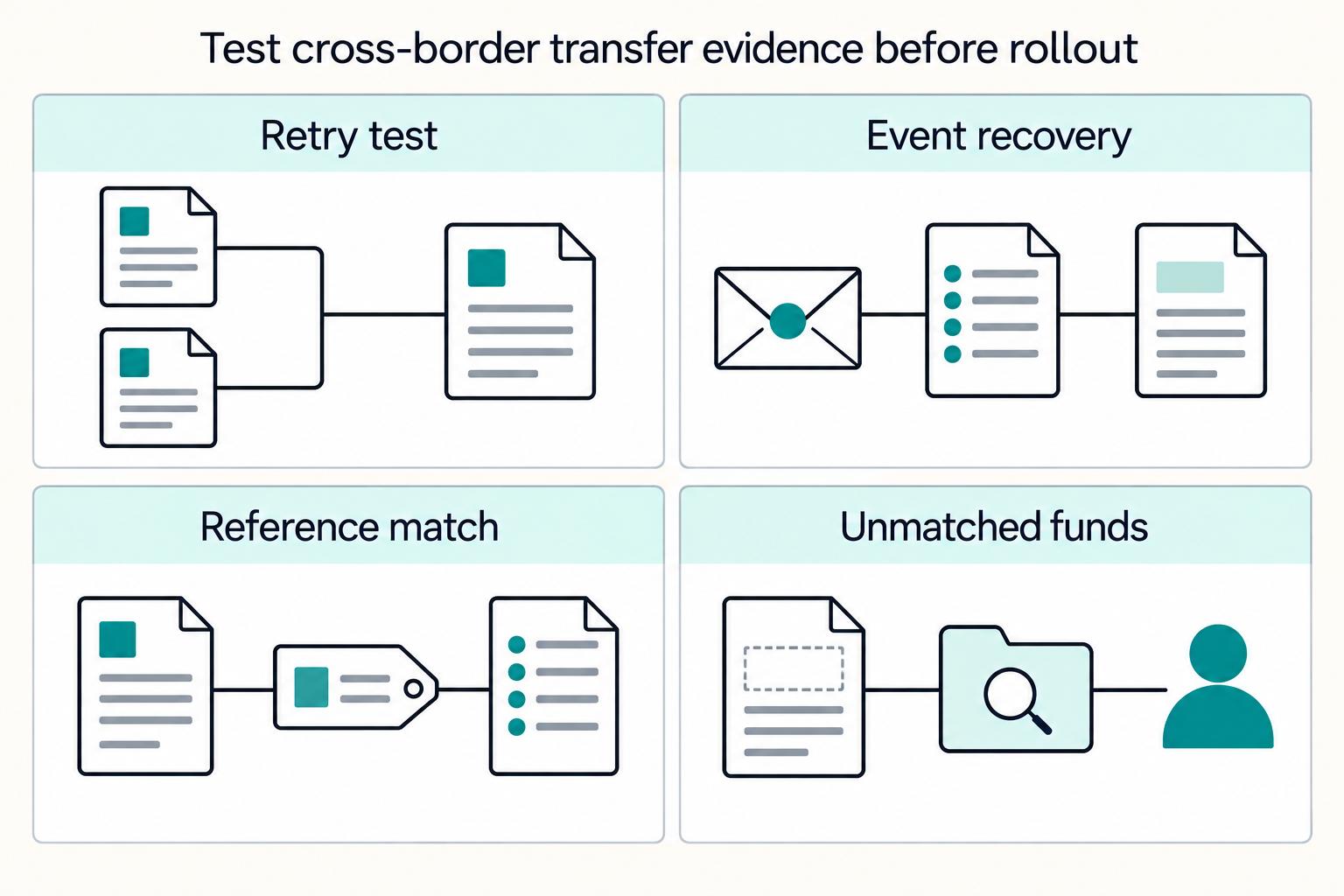
If you are choosing a provider for cross-border EFT, start with route evidence, not country-count slides. Cross-border payments are more complex than domestic ones: they are often slower, less transparent, and more expensive. Broad coverage on paper may not reflect performance in your real corridors or exception paths.
Adaptive Payments for Platforms: How to Split a Single Transaction Across Multiple Payees
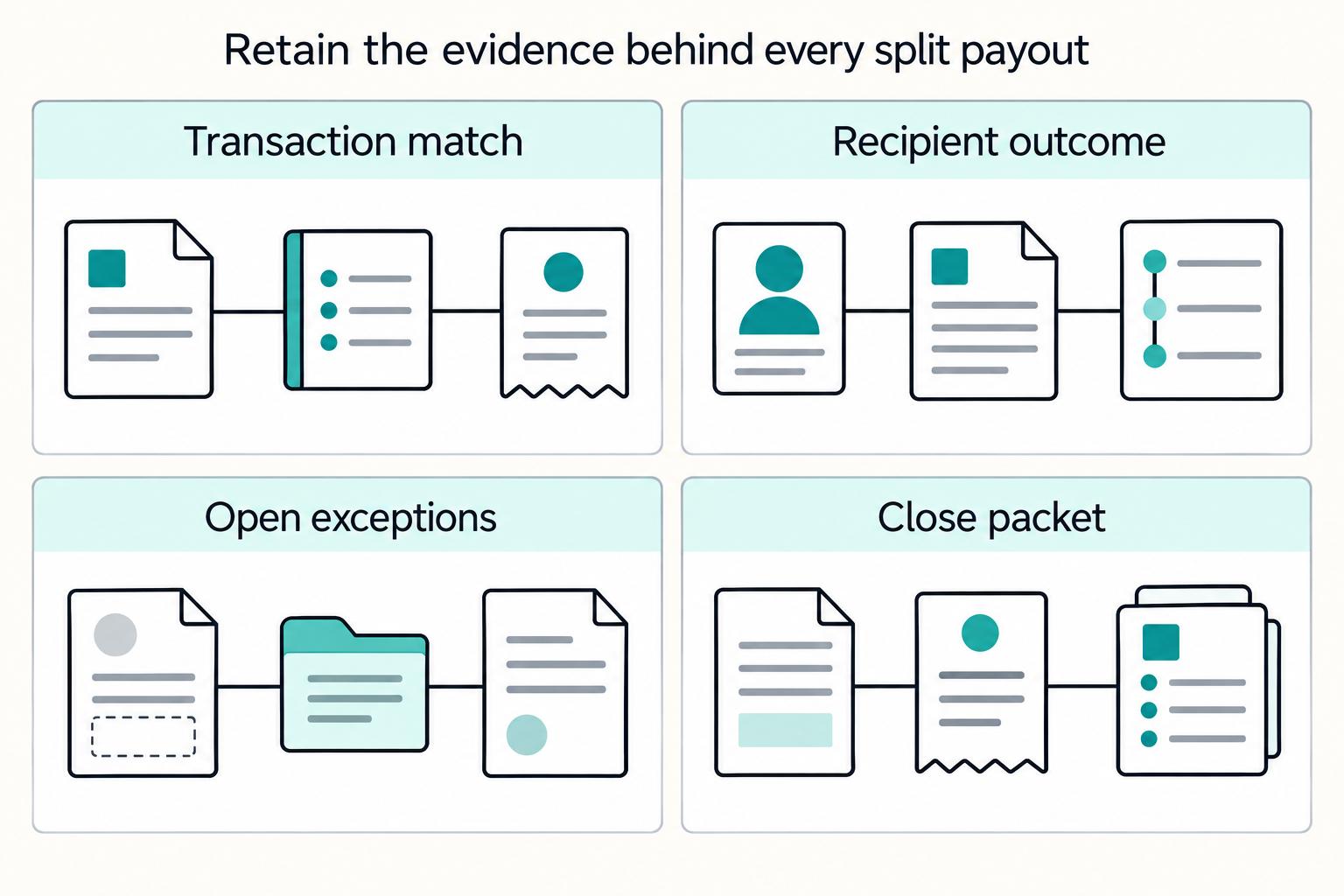
The first decision is easy to state and easy to get wrong. Does one buyer checkout need to fund multiple recipients under explicit rules for platform fees, partner payouts, and failed or blocked money movement? If you cannot explain that money path on one page, pause before you code.

The Freelance Payment Penalty: A Modeled Audit of Platform Fees, FX Spreads, and Payout Delays
The money rarely disappears through a single, easy-to-spot fee. The real loss is stacked. A marketplace takes its commission, a processor adds a charge for international cards, a bank or payment company converts the currency at a spread, a platform holds the funds before release, and a wire sheds a little to intermediaries on the way in. Each layer looks defensible on its own, but the worker feels the combined result as a smaller deposit and a later payday.