
Quick Answer
Build one documented process that screens for PEP and RCA risk at onboarding, routes unresolved matches to EDD, and keeps monitoring active after account approval. For politically exposed persons screening platforms pep lists monitoring, the article’s core rule is ownership clarity: name who reviews alerts, who can pause or release payouts, and how suspicious activity handoffs are handled. Use the simplest model that still produces auditable case files with match basis, analyst reasoning, approvals, and final action.
Politically Exposed Persons screening for platforms that need defensible decisions, not vendor promises#
If your platform moves money across borders, treat PEP screening as a decision discipline, not a vendor checkbox. You should be able to show how an alert became a documented action under your AML and CTF controls without leaning on vague vendor claims. That matters most in five places:
- Cross-border payout exposure
A PEP is an individual who holds a prominent public position, and that can bring higher bribery and corruption risk. For platforms paying contractors, sellers, or creators over time, the risk is not limited to onboarding. The real issue is ongoing exposure. A marketplace with recurring payouts needs screening tied to account activity, not a one-time name check.
- EDD and monitoring obligations
In practice, the job is not just finding a possible match. It is deciding when EDD starts and how monitoring continues after onboarding. Most jurisdictions require EDD and ongoing monitoring for PEPs, and scope may also include close associates. If a potential true match stays unresolved, define a clear escalation path, a named reviewer, and a record of why payouts continued, paused, or were restricted.
- Evidence that can survive review
A defensible program leaves a case file behind, not just a screening result. At minimum, consider keeping the alert snapshot, the matched name or identifier reviewed, analyst notes, the disposition, the approval trail, and the final action. The test is simple: can another reviewer reconstruct the decision from the file alone, including whether EDD was triggered and what follow-up monitoring was required?
- Coverage beyond simple name matching
PEP screening relies on PEP lists, and scope may include close associates. Many jurisdictions also expect ongoing monitoring rather than one-time checks. Build your process so potential matches can be reviewed and revisited over time, not treated as a one-and-done task.
- A realistic view of data sources and vendors
Public-source-only collection can be time consuming and inaccurate, so it is risky to assume manual web checks will scale or stay current. At the same time, no single vendor dataset proves AML or CTF compliance on its own. Before you buy, confirm how lists are updated, what evidence can be exported, whether customer lists can be re-screened on a daily basis if your risk profile requires it, and how false positives are documented rather than quietly dismissed.
That is the thread for the rest of this guide. Choose the simplest approach that still gives you explainable decisions, usable evidence, and monitoring you can actually run.
For a refresher on PEP definitions and risk tiers, see What is a Politically Exposed Person (PEP)? A Compliance Guide.
Choose your screening model before you buy tools#
Choose the operating model first, then the tool. If you cannot show how a PEP or sanctions alert becomes an owned decision under AML and CTF controls, do not roll out yet.
| Situation | Guidance |
|---|---|
| live KYC or KYB obligation | Use this model when elevated PEP risk must be handled inside your KYC or KYB process and tied to real case decisions |
| one-off onboarding checks with no ongoing monitoring and no internal EDD owner | Set ownership before procurement: who triages, who handles EDD escalation, and where final actions are recorded |
| tool scoring | Compare PEP and RCA coverage depth, beneficial ownership support for KYB, false-positive handling, and evidence export quality |
| before rollout | If you cannot explain the path from alert to disposition, stop |
- Buy only if you have a live KYC or KYB obligation
Use this model when elevated PEP risk must be handled inside your KYC or KYB process and tied to real case decisions. In many jurisdictions, PEP cases are expected to include EDD and ongoing monitoring, so your setup needs to support both.
- Do not overbuy for one-time checks with no owner
If you only run one-off onboarding checks, with no ongoing monitoring and no internal EDD owner, a full stack usually creates alert noise without a stronger control. Set ownership before procurement: who triages, who handles EDD escalation, and where final actions are recorded.
- Score options on criteria that change decisions
Compare tools on decision quality, not feature count: PEP and RCA coverage depth, beneficial ownership support for KYB, false-positive handling, and evidence export quality. Include sanctions checks in the design, and test with sample alerts to confirm you can export the alert snapshot, matched fields, analyst notes, disposition reason, and approval trail.
- Use one hard stop before rollout
If you cannot explain the path from alert to disposition, stop. A defensible file should show what matched, who reviewed it, whether EDD was triggered, whether activity continued or paused, and how unresolved risk moved into your suspicious activity review process.
Use the lightest model that still supports KYC/KYB screening, sanctions checks, EDD ownership, and audit-ready exports.
For a step-by-step walkthrough, see Best Merch Platforms for Creators Who Want Control and Compliance.
Compare the four screening setups that actually work for platforms#
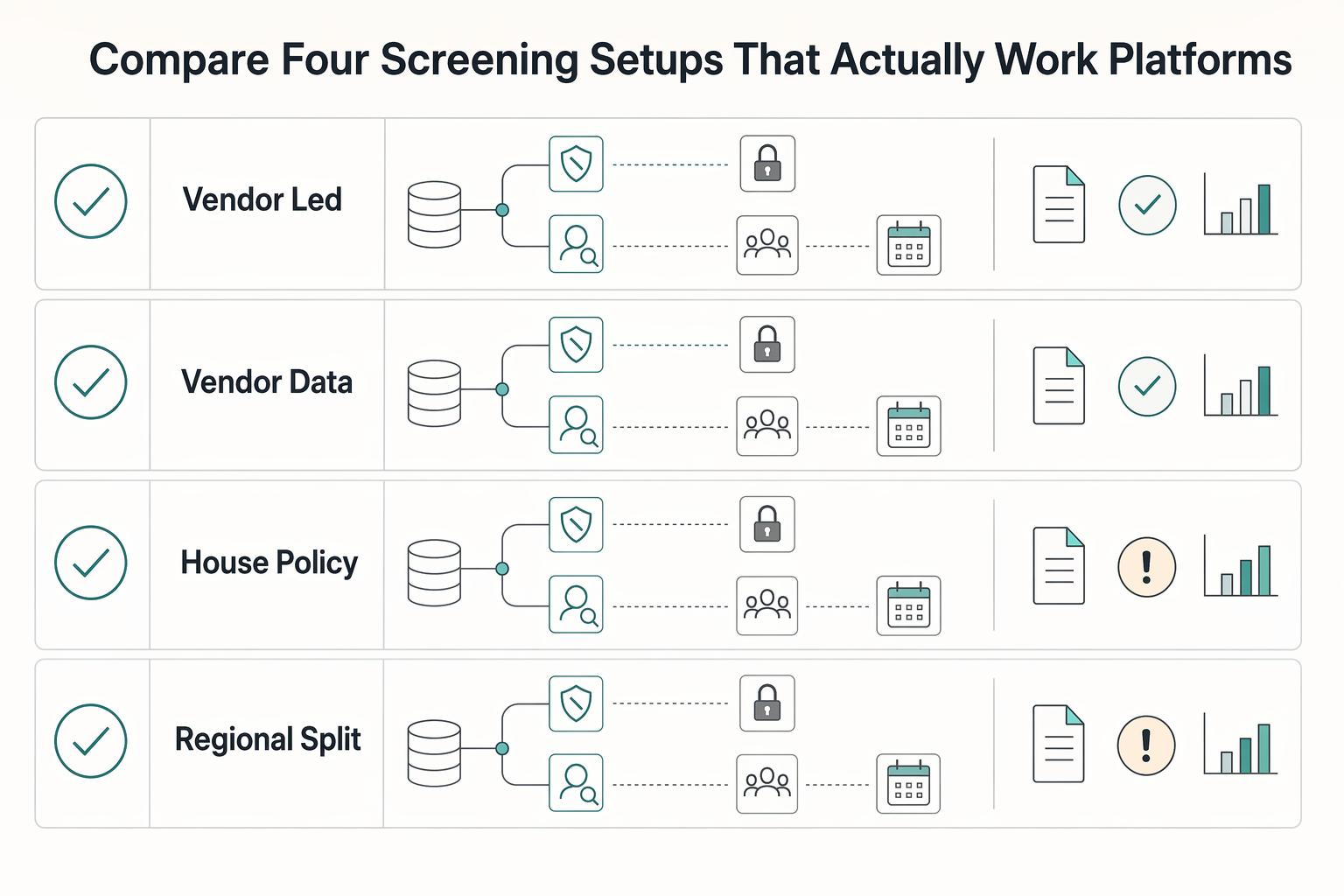
If you need a default, start with Option 2: it keeps vendor data speed while keeping CDD/EDD judgment and escalation ownership inside your team.
Use one workflow that handles both sanctions and PEP screening, but do not treat them as the same outcome. In practice, sanctions handling is often a block decision, while PEP handling is typically scrutinize, review, and monitor. The wrong setup mixes those paths or splits them across disconnected queues.
| Option | Best fit | Main strength | Main risk |
|---|---|---|---|
| 1. Vendor-led screening only | Early-stage teams with tight engineering capacity | Fastest route to live screening | Your CDD/EDD logic can drift toward tool defaults instead of policy |
| 2. Vendor data plus in-house triage layer | Most scaling platforms | Decision control stays with your team | Requires clear ownership of triage, queues, and evidence |
| 3. In-house policy engine with external list providers | Mature AML/CTF programs | Tight control of routing and treatment logic | Higher build and maintenance burden |
| 4. Regional split model by jurisdiction | Platforms with uneven market risk across jurisdictions | More relevant local tuning | Fragmented operations and evidence handling |
- Option 1: Vendor-led screening only
Best for low-complexity launches and early marketplace onboarding. You gain speed and lighter engineering, but policy ownership can weaken if analysts rely on vendor defaults rather than your internal CDD/EDD standards.
- Option 2: Vendor data plus in-house triage layer
Best for scaling teams and growing alert volume. You keep external list coverage while controlling how sanctions, PEP, and RCA cases are escalated, which makes suspicious activity handoffs clearer and more defensible.
- Option 3: In-house policy engine with external list providers
Best for mature teams with strict governance needs. You get tighter AML/CTF policy control and custom RCA logic, but only if you can sustain rule maintenance, versioning, and operational ownership.
- Option 4: Regional split model by jurisdiction
Best when market risk and supervisory expectations vary by region. Localized KYC/KYB tuning can improve relevance, but operational consistency gets harder across training, reviews, and case records.
Most platforms should begin with Option 2 and move to Option 3 only when investigation volume and jurisdictional complexity justify the extra operating burden. Keep the test simple: can you show a clear, auditable path from alert to decision for both block and scrutinize outcomes?
Set minimum onboarding scope for PEP, RCA, and ownership checks#
Set onboarding scope as a control decision, not a form-design afterthought. If identity and ownership context are thin, PEP and RCA alerts get noisier, and loosening AML logic later usually masks risk instead of resolving it.
- Collect enough identity and ownership context to support decisions
Treat KYC and KYB data points needed for reliable matching as required for your flow, including ownership context where relevant to how the account will be used. In the UK context, the 2017 regulations (as amended) are tied to identifying PEPs, applying EDD, and monitoring relationships on a risk-sensitive basis.
- Run CDD at onboarding and define when cases move to EDD
Make CDD your default onboarding path, then route to EDD when your internal risk criteria are met, such as match confidence, role sensitivity, or both. The key is a reviewable handoff: each case should show why it stayed in CDD or escalated to EDD, who approved it, and what evidence was kept.
- For business-account payouts, check relevant connected persons, not just the entity
When payout flows involve business accounts, include connected-person screening where relevant to control or beneficial ownership. FINTRAC guidance requires determining whether someone is a PEP, a head of an international organization, or a related/closely associated person, and it separates account-based and non-account-based reporting sectors.
Use a clear decision rule for hits and payout gating#
Use one written rule that maps each PEP or RCA alert to an owner, a documented rationale, and a current payout state. The goal is consistency: a reviewer should be able to see what was checked, what is still uncertain, and why the team allowed, limited, or paused account actions.
This guide does not set a specific disposition count, payout-threshold formula, Four Eyes requirement, or SAR trigger. Put those details in your own AML/CTF policy with legal and compliance sign-off, then apply them the same way every time.
For each alert file, capture at least:
- case owner and review timestamps
- match basis and mismatch basis
- open questions and required follow-ups
- current due-diligence status
- payout/account-control status
- reviewer/approver names
- final action and why it was taken
Keep the decision tree as a durable artifact, not team memory. If someone can reconstruct the decision path from the record alone, your process is easier to defend and easier to improve.
If you are also deciding who owns onboarding and compliance responsibilities, see Merchant of Record for Platforms and the Ownership Decisions That Matter.
Build monitoring cadence that matches risk, not marketing claims#
Once payout gating is set, use one rule for cadence: make ongoing screening the baseline, then adjust based on risk, transaction behavior, and what your Suspicious Activity Monitoring is showing.
- Start with continuous screening as the default
Treat screening for PEPs, sanctions, and adverse media as ongoing, not just part of onboarding. Set your cadence by customer risk and account activity, and make sure each live account record shows when it was last screened, which inputs were checked, and whether alerts are still open.
- Use event-driven checks alongside scheduled rescans
Scheduled rescans alone are not enough when risk changes between cycles. Trigger ad hoc checks when meaningful profile or account changes occur, or when behavior flags align with money-laundering indicators already used in your monitoring program. Use both ad hoc and batch approaches as part of one monitoring system.
- Document exactly which screening inputs drive alerts
A defensible file should identify the input types behind the result: PEP watchlists, sanctions lists, and adverse media feeds. Keep that source inventory visible in policy and case records so reviewers can trace why a case was cleared, escalated, or kept under monitoring.
- Match monitoring intensity to exposure speed
The same AML policy can still require different operating loops across products. Where payouts move quickly and at high volume, tighter monitoring and faster escalation are usually needed than in slower, lower-frequency flows. If you need a sanctions-focused companion control, see OFAC Sanctions Screening for Global Businesses.
Keep an audit file reviewers can follow without guesswork#
Make each alert reviewable end to end in one record so a reviewer can see the alert, the reasoning, and the final action without reconstructing the case from memory.
- Keep one case file with the core decision trail
For each alert, keep a single record with the screening alert, analyst notes, disposition reason, approval trail, and final action. Tie it to the customer's KYC profile and record whether the relationship was handled under standard review, CDD, or EDD when the decision was made. For PEP work, state clearly whether the hit was treated as a likely false positive, a potential true match, or a confirmed match.
- Retain evidence that links monitoring events to actions
Store the decision chain, not just the alert: what event triggered review, what evidence was used, and what followed (restriction, escalation to EDD, continued monitoring, or SAR consideration). Identifying PEPs is part of AML/CTF compliance, and most jurisdictions require EDD and ongoing monitoring for PEP relationships. If close associates or entity connections were part of the review, keep that relationship evidence in the same file.
- Keep governance artifacts alongside case files
Maintain periodic QA sample results, unresolved backlog logs, and policy exception records so reviewers can test whether the process works in practice. These records help show where manual reviews, fragmented data, or disconnected systems are putting pressure on the control flow. If QA repeatedly finds missing approvals or backlog logs show aging alerts, treat that as a control gap before scaling screening further. Related: A Guide to Enhanced Due Diligence (EDD) in FinTech.
Execute in 30 days with clear owners across compliance, ops, and engineering#
A 30-day rollout is workable when ownership is explicit from day one: compliance owns policy, ops owns account actions, and engineering owns queue and record mechanics.
| Week | Focus | Checkpoint |
|---|---|---|
| Week 1 | lock policy scope and decision ownership | for any PEP or RCA hit, the policy version and decision owner are immediately clear |
| Week 2 | build screening flows and case queues, then test both paths | correct queueing, visible source records, and retained second-review approval where required |
| Week 3 | connect monitoring outputs to operational action | Every production decision should be traceable from input record to final action with retained evidence |
| Week 4 | run a controlled pilot and tune for ownership and geography | Do not scale globally until recurring ownership-data or verification issues are resolved |
- Week 1: lock policy scope and decision ownership
Set the minimum scope for PEP and RCA checks across KYC and KYB, then assign who can clear likely false positives, escalate to EDD, and pause or release payouts when risk is unresolved. Capture this in one approved artifact. Your checkpoint is simple: for any PEP or RCA hit, the policy version and decision owner are immediately clear.
- Week 2: build screening flows and case queues, then test both paths
Implement intake, screening, and case routing, and use automation where it improves accuracy and reduces human error. Keep an auditable analyst step where policy or jurisdiction expects a Four Eyes-style review. Test one clear false positive and one likely true match. Success is not alert volume alone; it is correct queueing, visible source records, and retained second-review approval where required.
- Week 3: connect monitoring outputs to operational action
Monitoring should drive action, not just generate alerts. Route outcomes into payout holds, account review states, or handoff into Suspicious Activity Monitoring under your internal criteria, and confirm audit exports preserve the input record, match details, analyst notes, approvals, and final action. Every production decision should be traceable from input record to final action with retained evidence.
- Week 4: run a controlled pilot and tune for ownership and geography
Run a limited pilot first (for example, one corridor, one segment, or one KYB path), then review exceptions with a focus on beneficial ownership and jurisdiction-specific risk. This is where a risk-based approach becomes practical, because rules need to match the markets you actually operate in. Do not treat regions like LATAM as a single compliance jurisdiction, and do not scale globally until recurring ownership-data or verification issues are resolved.
The practical takeaway for platform risk teams#
The strongest control model is usually the least flashy: clear ownership, defensible AML/CTF decision rules, and evidence you can produce on demand. If your team cannot explain why a PEP or RCA alert moved to routine monitoring, EDD, or SAR review, more screening features will not solve the core risk.
-
Start with a right-sized scope your team can run every day. Use onboarding and ongoing monitoring as your baseline, and apply PEP risk within your KYC/KYB process. The practical test is simple: another reviewer should be able to follow one closed case from customer data to alert to disposition without asking the original analyst to fill in gaps.
-
Hard-code escalation logic for PEP/RCA hits before alert volume grows. A PEP is an individual in a prominent public position, and most jurisdictions require EDD plus ongoing monitoring for PEPs. Define clear paths (for example: likely false positive, potential true match, confirmed PEP/RCA), assign owners, and route unresolved risk into EDD; if suspicious activity is also present, hand off to SAR review under your AML/CTF criteria.
-
Treat auditability as a daily operating requirement, not a cleanup task. Keep the source record, triggering list/profile, analyst notes, disposition rationale, approvals, and final CDD/EDD action for material alerts. PEP and sanctions screening is a foundational AML/CTF control, so your records should show what matched, what decision was made, and who approved it.
If coverage varies by market or program, document those limits explicitly and confirm jurisdiction-specific obligations with specialist counsel before scaling.
Frequently Asked Questions
What is the minimum required scope for a PEP monitoring program on a cross-border platform?
At minimum, screen at initial engagement and include both PEP checks and sanctions checks. Your scope should also cover Relatives and Close Associates, because RCA is part of proper PEP screening rather than an optional add-on. If your program spans different customer types, apply that scope consistently to the relevant natural persons in each case.
How often should platforms re-screen PEP watchlists and sanctions lists?
There is no single global interval you can rely on as universally required, so do not hard-code "monthly" or "daily" as if that settles the issue everywhere. A defensible minimum is screening at onboarding, then ongoing monitoring with periodic review and re-screening when a triggering event requires a CDD review. The key is to define and consistently act on the triggering events that reopen CDD.
When does a PEP alert require EDD instead of routine monitoring?
Most jurisdictions require PEPs to be subject to enhanced due diligence and ongoing monitoring, so a potential true match should move into EDD unless you can clearly document it as a false positive. The decision point is not "did an alert fire" but "can we verify this is not the person, or is the risk still unresolved?" Avoid leaving unresolved PEP hits in routine monitoring without a clear rationale.
When should a potential PEP case be escalated for SAR review?
A PEP alert by itself does not mean a SAR should be filed, and you should avoid treating every hit that way. Escalate for SAR review when additional facts meet your internal AML or CTF escalation criteria. If your team needs a tighter handoff model, map it directly into your Suspicious Activity Monitoring process rather than relying on ad hoc judgment.
What documentation should be retained to satisfy audit or exam requests?
The baseline here does not define specific legal retention periods or a universal checklist of required case-file fields. Keep enough documentation for another reviewer to reconstruct the decision from alert to outcome, including how CDD or EDD status was determined. A practical checkpoint is that both the disposition rationale and underlying match detail are clear.
How should platforms handle RCA and beneficial ownership checks in KYB flows?
The baseline confirms RCA should be included in PEP screening, but it does not set a single universal KYB ownership-screening rule. In KYB flows, apply your policy to the relevant connected natural persons behind the entity and include RCA checks where that policy requires them. If ownership or control data is incomplete, resolve that CDD gap before finalizing the case.
Try a related tool
Researched and edited by the Gruv editorial team. Gruv builds cross-border billing, payouts, and finance-operations software for global businesses.
Sources
Includes 3 external sources outside the trusted-domain allowlist.
- bhsoac.ca.gov/sites/default/files/documents/2018-05/Commis...trusted
- congress.gov/congressional-record/volume-163/issue-76/hou...trusted
- dol.gov/sites/dolgov/files/ebsa/laws-and-regulations...trusted
- energy.gov/sites/prod/files/2014/03/f13/FY06PAR.pdftrusted
- ncua.gov/foia/request-logstrusted
- fintrac-canafe.canada.ca/guidance-directives/client-clientele/pep/pep...external
- sanctionscanner.com/blog/sanctions-screening-vs-pep-screening-wh...external
- smartsearch.com/en-us/resources/help-center/glossary/pep-lis...external
Educational content only. Not legal, tax, or financial advice.
Related Posts

What Is a Politically Exposed Person and How to Decide Next Steps
Use this guide to make one clear onboarding call each time: proceed with standard checks or escalate before funds move. The goal is simple: cleaner onboarding, fewer payout surprises, and AML records you can defend later.
Choosing a Defensible SAR Filing Model for Payment Platforms
For platforms moving contractor, seller, or creator funds, when SAR filing applies, the goal is an operating approach your team can run consistently, not a system that tries to catch everything. You need alerts that get reviewed, cases backed by evidence, and filings you can defend. FFIEC describes suspicious activity reporting as the cornerstone of BSA reporting and emphasizes that SAR content quality is critical to the effectiveness of that system.
Enhanced Due Diligence in FinTech That Holds Up Under Real Case Volume
For a lean team, practical Enhanced Due Diligence (EDD) is what tends to survive weekly volume. The goal is not bigger files. The goal is repeatable judgment that the next analyst can read and defend without guessing what happened.