
Quick Answer
Treat enhanced due diligence as an ongoing fintech workflow. Use a written trigger matrix, a fixed pass/escalate/reject path, and a case checklist that logs evidence, owner, and follow-up. Keep customer EDD separate from partner due diligence, then sequence controls from CDD/KYC intake through ongoing monitoring. If uncertainty remains material after targeted follow-up, do not progress the case as cleared.
You need EDD that is practical, not performative#
For a lean team, practical Enhanced Due Diligence (EDD) is what tends to survive weekly volume. The goal is not bigger files. The goal is repeatable judgment that the next analyst can read and defend without guessing what happened.
Weak execution creates friction fast. You may see delayed onboarding, repeated document requests, and blocked transactions. Good controls still matter, but they need to work under queue pressure. EDD should reduce uncertainty, not add noise.
Treat EDD as an ongoing AML control, not a one-time checkpoint. A case that passed earlier can still need a fresh look when its risk profile changes. If reopening criteria are unclear, teams can rely on stale assumptions.
Use three practical tools together so outcomes stay consistent:
- A trigger matrix that separates standard due diligence from EDD.
- A pass, escalate, reject path with named ownership.
- An audit-ready checklist that records trigger, evidence, judgment, and follow-up.
These tools are intentionally simple. Simple controls survive shift handoffs and staffing changes better than complicated logic hidden in personal judgment. If one analyst can explain the decision and another can replay it later, the process is working.
Before you increase case volume, pressure-test those three tools on real files from different risk tiers. If teams can apply the same logic under light and heavy queues, you are ready to scale. If decisions drift when volume rises, tighten language now. Drift is cheaper to fix in templates than in reopened cases.
Your exact obligations depend on the jurisdiction, regulated entity, and partner program. Map those requirements before applying this workflow.
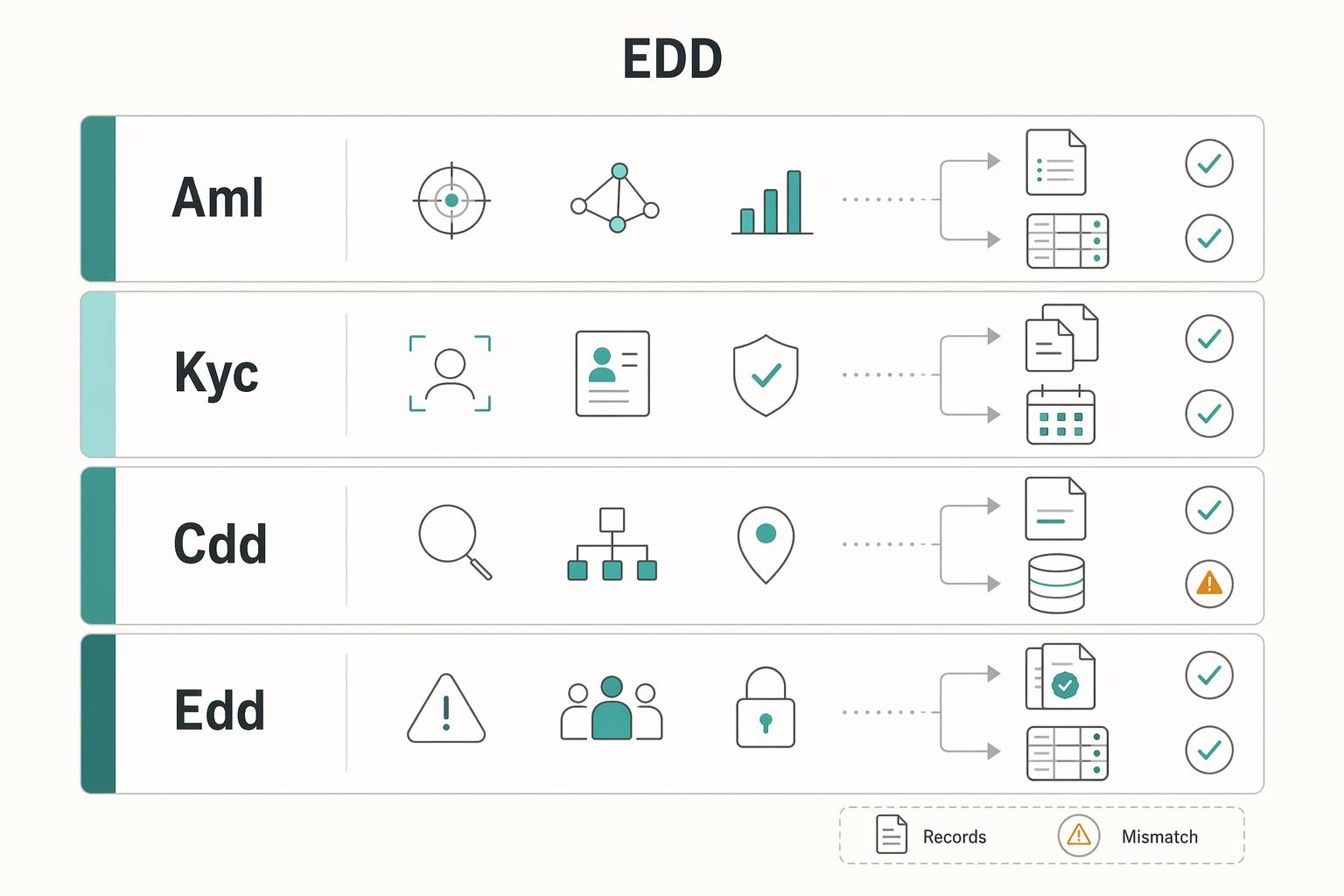
EDD, CDD, KYC, and AML are not the same thing#
Teams lose consistency when these terms blur. Keep the definitions stable so escalation quality and audit trace stay strong.
| Term | Meaning |
|---|---|
| AML | Broader legal, regulatory, and process framework for preventing illicit funds from being laundered |
| KYC | Identity verification and related checks inside AML |
| CDD | Baseline customer due diligence review |
| EDD | Deeper review when baseline checks do not resolve elevated risk |
Daily decisions improve when labels stay clear. If KYC is treated as done forever at onboarding, later transaction monitoring and screening signals can be missed. If CDD and EDD are mixed, one analyst escalates while another passes the same fact pattern because they are using different standards.
Regulatory expectations can shift over time and by market. FATF standards, EU AMLD frameworks, and FinCEN rules all shape AML requirements. That means internal language has to stay precise even as external expectations move.
Use one closure test for every file: can a reviewer explain in plain language why the case stayed at CDD or moved to EDD. If the answer is unclear, the process is too vague.
Require a short decision note that states:
- The risk signal that drove the path.
- The added checks completed.
- Why the final outcome matches the evidence.
Good notes also support calibration. When two analysts see similar facts and choose different paths, compare their notes first. If wording is vague, tighten the template. If wording is clear but outcomes still differ, align decision criteria before more files move through the queue.
Build a trigger matrix before you review a single file#
Starting case by case without a written trigger matrix invites inconsistency. A matrix gives analysts the same entry point and can reduce ad hoc escalation driven by personality or queue pressure. A clearly defined, risk-based approach also aligns with regulator expectations.
Begin with categories that different reviewers can score the same way:
- Jurisdiction exposure that raises risk.
- Unusual transaction behavior against the stated profile.
- Identity or onboarding evidence gaps.
- Complex or unclear ownership structure.
- Delivery-channel risk that raises uncertainty.
For each trigger, define two boundaries: what confirms concern and what resolves concern. Those boundaries help prevent open-ended document collection and keep requests tied to a decision question.
A useful trigger note can be short but specific:
- Trigger category.
- Observed signal.
- Why baseline checks are not enough.
- Evidence requested to resolve the issue.
- Case owner and next review point.
Set an internal stacking rule for moderate signals so multiple smaller concerns are handled consistently. Keep that rule in policy, review it against outcomes, and keep it distinct from any legal thresholds your program applies.
Write trigger language so it can be applied by a new analyst on a busy day. Avoid labels that sound clear but mean different things to different people. If a trigger says unusual activity, define unusual against the declared profile and the available transaction context. If a trigger says ownership complexity, define what evidence resolves that complexity in this program.
Before full review begins, require the trigger note in the case record. This checkpoint can improve handoffs because the next reviewer can see the original concern, the requested proof, and the expected resolution path without rebuilding context from scratch.
Separate customer EDD from partner due diligence#
Customer EDD and partner due diligence answer different questions. Mixing them can create unclear ownership and weaker decisions.
| Risk question | Correct lane | What you are testing |
|---|---|---|
| Is the customer identity, ownership, and activity profile coherent? | Customer due diligence or enhanced due diligence | Whether customer claims hold up under review |
| Can an external provider support your product safely and legally? | Partner due diligence under third-party risk management | Strategic fit, financial fit, and implementation risk |
Use customer EDD when uncertainty is about who the customer is or what the customer is doing. Use partner due diligence when uncertainty is about a payment processor, sponsor bank, or another provider enabling delivery.
For U.S. bank-related programs, anchor partner review in Interagency Guidance on Third-Party Relationships: Risk Management dated 06/09/2023. The interagency guidance is from the Federal Reserve System, the FDIC, and the OCC.
Add one verification checkpoint before approval:
- Mark the risk object in the case header as
customerorpartner. - If marked
partner, state whether the relationship supports strategic and financial goals and can be implemented in a safe and sound manner consistent with applicable legal and regulatory requirements. - If using a diligence guide, record which one was used and why review depth matched the risk and circumstances.
When both customer and partner risks are elevated, run both lanes in parallel with separate sign-off. Keep evidence and decision notes distinct even if one team handles both files. This helps avoid cross-contamination where a customer concern is treated as a vendor concern, or a partner concern is treated as a customer issue.
Do not merge approvals at the end for convenience. If customer risk clears and partner risk does not, outcomes should differ. Clear separation makes that possible and keeps accountability visible in audit review.
A lane check at intake can prevent rework later. If the file type is wrong, fix it early rather than after documents are collected under the wrong standard.
Use a pass, escalate, reject path that analysts can defend#
A three-outcome path can keep case handling clear: pass with controls, escalate for deeper review, or reject with rationale. Limiting outcomes can make monitoring and audit review more straightforward.
| Outcome | Use when | Required control |
|---|---|---|
| Pass with controls | Core facts are coherent and residual risk is understood | Set monitoring controls and a follow-up date before release |
| Escalate | Evidence conflicts or unresolved alerts remain | Move the file into investigation with named ownership |
| Reject | Core facts remain unverifiable after follow-up under your policy | Record rationale, evidence gaps, decision owner, and closure detail |
Escalate when declared activity conflicts with suspicious activity signals, especially when alerts cannot be resolved as false positives. Reject based on your policy when core facts remain unverifiable after follow-up.
For higher-risk escalations, consider adding a second reviewer as an internal control. The second review should check reasoning quality, not only confirm that documents exist.
Keep one audit note template for every outcome. At minimum capture:
- Trigger that opened review.
- Evidence reviewed, including what is missing or inconsistent.
- Decision owner and second reviewer when used.
- Final outcome, control conditions, and follow-up date.
When you escalate, write the exact blocking question in one sentence. Then tie each requested document to that question. This prevents escalation files from turning into broad document hunts and helps reviewers close the case faster once the right evidence appears.
Transaction monitoring is continuous, so closure is conditional. Reopen files when new suspicious activity appears or when prior assumptions no longer match observed behavior. A clear reopen rule keeps pass decisions from becoming permanent by inertia.
Define the evidence pack for every EDD case#
Start with a minimum evidence-pack template for your EDD program, then add depth as risk rises. Consistency here is what makes later decisions defensible.
| Evidence block | Minimum contents | Decision question |
|---|---|---|
| Identity | Customer information and verification output (KYC/CDD records) | Is identity credible enough to proceed? |
| Ownership | Beneficial ownership documents and control details | Do we know who in the end owns or controls the relationship? |
| Financial activity | Financial activity details and funds narrative | Does the activity narrative fit the profile? |
| Relationship context | Business summary, intended purpose/nature of the relationship, and expected transaction profile | Do declared intentions match likely behavior? |
CDD is baseline for most customers. EDD is the risk-based extension when customer, transaction, or geography risk is elevated. The objective is coherent, defensible evidence, not maximum document volume.
Add a verification checkpoint before risk-scoring sign-off. Confirm consistency across identity, ownership, business purpose, and financial activity. Keep material conflicts escalated until they are resolved, or reject under your policy with a documented rationale.
Handle sensitive case data under applicable legal and internal governance requirements, and preserve a clear audit trail of what was collected, reviewed, and decided.
Complex files need an uncertainty note. Record:
- What remains unknown.
- Why it could not be resolved now.
- How the uncertainty changed the decision.
- When the case will be reviewed again.
Request evidence in the order that resolves the highest-impact contradiction first. If identity is uncertain, close that gap before expanding context collection. If ownership is uncertain, resolve ownership before debating profile fit. Sequencing requests this way keeps case handling focused and defensible.
Zero uncertainty is not the target. The target is reduced, justified uncertainty with a documented control plan. If unknowns are material and unresolved, the case should not move forward as if fully cleared.
Sequence your controls from onboarding to ongoing monitoring#
Use one sequence from intake to monitoring so risk context survives every handoff.
| Stage | Primary owner | Required output before handoff |
|---|---|---|
| CDD and KYC intake | Analyst | Identity and baseline profile in a written record |
| Trigger review | Analyst | Clear reason to stay at baseline or open EDD |
| EDD evidence collection | Analyst | Coherent file with open risks flagged |
| Decision and sign-off | Reviewer | Pass, escalate, or reject with rationale and controls |
| Ongoing monitoring | Operations | Active follow-up queue tied to risk changes and material events |
For U.S. institutions covered by the FinCEN CDD rule, keep onboarding controls aligned with current requirements and applicable exceptions. FinCEN lists FIN-2026-R001 as exceptive relief from identifying and verifying beneficial owners at each account opening. Check that ruling before changing account-opening controls.
After decisioning, avoid calendar-only reviews. Monitoring depth should track changing risk context and reopen when relevant customer or activity risk factors change.
Keep ownership explicit at each checkpoint:
- Analyst prepares the file, logs unresolved gaps, and proposes the path.
- Reviewer approves or rejects the path and sets conditions.
- Operations tracks remediation deadlines, monitoring flags, and reopen events.
Use the same case record from intake through monitoring. Without a single record, teams spend time reconstructing context, and that delay can hide unresolved risk. Strong onboarding with weak follow-through can become a failure mode, and clear sequencing helps close that gap.
At handoff, require the receiving owner to restate the open risks and next action in the record. That simple restatement helps confirm shared understanding and catch missing context before the case moves forward. It also makes reopen decisions easier because the prior state is clear.
Reduce onboarding friction without weakening compliance#
Lowering onboarding drop-off and keeping AML quality high are compatible if requests are phased by risk. Ask for baseline KYC evidence first, then request deeper EDD documents only when triggers appear.
| Phase | Used for | Focus |
|---|---|---|
| Phase 1 | All applicants | Core identity evidence, baseline profile, initial screening outputs |
| Phase 2 | Triggered cases | Deeper EDD evidence for high-risk profile, complex ownership, transaction behavior, or jurisdiction exposure |
| Phase 3 | Decisioning | Test coherence across identity, activity, ownership, and profile; record pass, escalate, or reject with conditions |
Long verification flows add friction. Give each document request a defined risk purpose, and explain how it helps resolve the case before adding another request.
Explain every request in plain language. Applicants and internal teams should understand why a document is needed and what decision question it resolves. Clear explanations can reduce repetitive back-and-forth and help shorten cycle time while maintaining standards.
Keep requests cumulative and visible. If a document already answered a decision question, do not ask for it again under a different label. Repeated requests add friction, increase drop-off risk, and may not improve risk judgment.
Keep a visible record of trigger, requested evidence, decision owner, and reopen condition. The tradeoff is direct: faster onboarding is acceptable only when remaining uncertainty is explicit and monitored. If uncertainty cannot be justified, pause progression until missing evidence is resolved.
Common EDD mistakes that create avoidable risk#
Most breakdowns are execution failures. Written policies can look complete while day-to-day case handling drifts under volume pressure.
Common mistakes include:
- Treating AML controls as documentation only, not daily decision discipline.
- Letting queue pressure prioritize speed over review quality.
- Relying on rules-based engine outputs without timely human judgment.
- Treating document completion as case completion when key risk questions remain unresolved.
- Leaving weak decision rationale, which can slow later reviews.
- Delaying suspicious activity reporting when alert handling falls behind.
Escalation drift can emerge under sustained queue pressure. A file is escalated, but ownership and blocking questions are not explicit, so the case can stall or reopen. A practical control is one owner, one blocking question, one due date, and one closure note tied to evidence.
Add one closure guardrail: require a short case note with trigger, evidence reviewed, contradictions, decision owner, and follow-up date. If contradictions remain open, keep the file escalated. This single standard can reduce premature closure and help protect review quality when volume spikes.
Make EDD auditable in your fintech stack#
Controls fail in practice when decisions cannot be replayed end to end. Any reviewer should be able to see what happened, who approved it, what remained unresolved, and why the outcome was accepted.
Use one structured case log so teams can reconcile reviews with payouts, holds, and exceptions without rebuilding context:
case_id, product line, jurisdiction, and current risk tier.- EDD trigger and evidence reviewed.
- Outcome (
pass,escalate,reject) with approver and timestamp. - Open contradictions, remediation owner, and due date.
- Downstream action (
release,hold,exception) and reopening condition.
Treat event handling and state transitions as compliance controls. Idempotent handling and explicit state rules can reduce duplicate escalations, stale updates, and skipped approval checkpoints during retries.
Where payout release is part of the flow, require reviewer visibility before funds move. If critical KYC evidence remains unresolved, keep release blocked until a named reviewer clears it.
For financial entities within its scope, DORA has applied since January 17, 2025. Its ICT risk-management and third-party oversight requirements complement this workflow; they do not replace customer AML review.
When policy language changes, keep a dated policy snapshot in the case record for decisions made under that version. That reduces confusion during later review and helps explain why an older case used different wording from a newer case.
Weak traceability can leave a team unable to explain earlier decisions. In July 2025, the FCA fined Monzo £21,091,300 for inadequate anti-financial-crime systems and controls between October 2018 and August 2020. Keep the evidence and decision record accessible after onboarding.
Rules vary by country and program, so confirm safely#
Apply jurisdiction-specific rules rather than one global threshold before escalating or approving EDD decisions. Map each control to the correct country, program, and legal entity so outcomes stay defensible.
When referencing U.S. banking guidance, label it as U.S.-specific context. Use FATF concepts to orient risk, then map those concepts to local law, partner requirements, and regulator expectations in each market.
That mapping should govern how CDD and EDD are applied across the lifecycle. CDD is not limited to onboarding and can recur over time. EDD is deeper review, commonly triggered by insufficient CDD, unusual transactions, or links to high-risk jurisdictions. Triggered files usually need deeper identity, beneficial ownership, and source-of-funds review.
Keep one country-program matrix so teams apply the same logic consistently. Include:
- Jurisdiction, legal entity, and program variant.
- Escalation triggers.
- Required evidence depth for identity, ownership, and source of funds.
- Decision authority and rules for unresolved evidence.
- Retention expectations and policy review timing.
For bank-linked offerings, use the final 2023 interagency guidance, rather than an earlier proposal, when mapping third-party risk practices. Confirm which requirements apply to your legal entity and partner arrangement before changing controls.
Set a review cadence and enforce ownership. Record what changed, why it changed, and who approved the update. That record limits policy drift and gives reviewers a clear line from legal scope to operational behavior.
When local interpretation is still being confirmed, use temporary internal guidance that is clearly marked as pending confirmation. That avoids silent drift while legal and partner compliance align on final wording.
Turn this into action in the next 30 days#
Use the next 30 days to make decisions consistent, evidence-backed, and auditable under real workload. The goal is simple: similar facts should produce similar outcomes, even when queue pressure rises.
| Days | Focus | Key actions |
|---|---|---|
| Days 1 to 7 | Trigger matrix and decision path | Define when a case stays in CDD and when it moves to EDD; keep one fixed outcome set: pass, escalate, or reject; end the week with a single trigger note template |
| Days 8 to 14 | Minimum evidence pack and reviewer sign-off | Require a complete record from alert creation to final decision; confirm key customer and transaction details are checked for internal consistency before sign-off; watch alert-noise overload closely |
| Days 15 to 21 | Separate customer EDD from partner due diligence | Keep the lanes distinct; customer EDD should test customer evidence and account behavior; partner due diligence should test whether providers or sponsor-bank arrangements can support compliance and control expectations; add a required case-header field for customer or partner |
| Days 22 to 30 | Monitoring tied to risk movement and new signals | Set recurring checkpoints for triage quality and reopened-case quality; record what changed, what evidence was requested, and when the next decision is due; sample recent pass decisions to confirm agreed risk conditions were monitored |
- Days 1 to 7: lock your trigger matrix and decision path.
Define working criteria for when a case stays in CDD and when it moves to EDD. Keep one fixed outcome set: pass, escalate, or reject, with named approvers. Review recent files and map each one to the trigger categories so wording is grounded in actual case patterns. End the week with a single trigger note template that all analysts use.
- Days 8 to 14: enforce a minimum evidence pack and reviewer sign-off.
Treat transaction monitoring alerts as the beginning of investigation, not the end of screening. Require a complete record from alert creation to final decision (for example, SAR filing or case closure), including contradictions and rationale. Confirm that key customer and transaction details are checked for internal consistency before sign-off. Watch alert-noise overload closely, because volume can hide weak triage and delayed escalation.
- Days 15 to 21: separate customer EDD from partner due diligence.
Keep the lanes distinct so obligations and approval logic do not blur. Customer EDD should test customer evidence and account behavior. Partner due diligence should test whether providers or sponsor-bank arrangements can support your compliance and control expectations. Add a required case-header field for customer or partner and block approvals if that field is missing.
- Days 22 to 30: tie monitoring to risk movement and new signals.
Set recurring checkpoints for triage quality and reopened-case quality. For each reopened case, record what changed, what evidence was requested, and when the next decision is due. If quality drops as volume rises, retune triage and reviewer capacity before scaling intake. Close the month by sampling recent pass decisions to confirm agreed risk conditions were actually monitored.
Finish the month by reconciling policy language, product controls, and audit records side by side. If they do not reflect the same triggers, evidence standards, and outcomes, fix the gap before pushing growth. For the U.S. baseline, keep the FinCEN customer due diligence rule in the reviewer pack before you freeze trigger language.
Frequently Asked Questions
What is enhanced due diligence in fintech in one sentence?
Enhanced due diligence in fintech is a heightened, risk-based review for customers or relationships that present higher risk than standard checks. It goes beyond baseline due diligence with deeper evidence review and clearer documented judgment before approval. In practice, teams may move from basic identity and profile confirmation to deeper checks on ownership and activity coherence. The outcome is a decision that can be defended later.
How is EDD different from CDD in day-to-day operations?
CDD is the baseline due diligence framework. EDD is the deeper path used when risk indicators appear or when baseline checks do not resolve uncertainty. The difference in daily operations is depth and control intensity: CDD confirms expected facts, while EDD tests conflicting or incomplete facts with extra evidence and tighter sign-off. Teams should start at CDD, move to EDD when triggers are met, and document why the transition happened.
When is EDD required instead of standard onboarding checks?
Use EDD when standard onboarding checks are not enough to explain or mitigate risk. Common triggers include insufficient CDD, unusual transactions, and links to high-risk jurisdictions. The key signal is unresolved material uncertainty after baseline review. Once that happens, move the case out of routine onboarding, define the concern, request targeted evidence, and assign clear ownership for decisioning.
Which EDD triggers matter most for small fintech teams?
Small teams should prioritize triggers that can be applied consistently: weak baseline checks, unusual activity, and jurisdiction-linked risk. Consistency matters more than long trigger lists that analysts interpret differently. Define each trigger in plain language, and state what confirms concern and what resolves concern. When a trigger is met, document what evidence is missing, unclear, or inconsistent, then set a next review point.
What documents are usually needed for source of funds and beneficial ownership checks?
There is no universal document list in this guidance. Collect enough documentation to identify and verify beneficial owners of legal entity customers and to assess whether the funds explanation is credible for the risk level. Requirements can vary by jurisdiction, institution type, and partner program terms. In U.S. covered-institution contexts, check current FinCEN orders and guidance before assuming one account-opening requirement applies in every case. For the control checklist, align the evidence request with the FFIEC BSA/AML examination manual and your current risk-rating logic instead of copying a generic onboarding packet.
How should a team decide between pass, escalate, and reject?
The guidance here does not provide universal pass/escalate/reject thresholds, so use written internal criteria tied to triggers, evidence depth, and legal scope. Pass when material risk questions are resolved and residual risk is explicit with monitoring conditions. Escalate when evidence is incomplete or conflicting, and reject when core facts remain unverifiable after follow-up. Keep one decision template across outcomes so rationale stays comparable across reviewers.
Is EDD only for banks, or does it apply to non-bank fintech companies too?
EDD is not only for banks. Fintechs and other organizations also apply heightened review when higher-risk customers or relationships appear. In U.S. context, CDD requirements name covered institutions such as banks, mutual funds, and brokers or dealers in securities, so scope should always be confirmed before assuming one rule applies to every entity. Non-bank teams still need clear trigger rules, evidence standards, and documented outcomes when risk signals exceed baseline checks. Where EU-facing products or partners are in scope, map your trigger logic against the EBA AML and CFT guidance hub before you standardize reviewer playbooks.
Watch
Enhanced Due Diligence in FinTech: EDD Guide
Try a related tool
Researched and edited by the Gruv editorial team. Gruv builds cross-border billing, payouts, and finance-operations software for global businesses.
Sources
- bsaaml.ffiec.gov/manualtrusted
- eba.europa.eu/regulation-and-policy/anti-money-laundering-...trusted
- esma.europa.eu/esmas-activities/digital-finance-and-innovat...trusted
- fdic.gov/sites/default/files/2024-03/pr21075a.pdftrusted
- federalregister.gov/documents/2023/06/09/2023-12340/interagency-...trusted
- federalreserve.gov/newsevents/pressreleases/files/bcreg20210713...trusted
- federalreserve.gov/supervisionreg/srletters/SR2304.htmtrusted
- fincen.gov/resources/statutes-and-regulations/cdd-final...trusted
Educational content only. Not legal, tax, or financial advice.
Related Posts

The Freelance Payment Penalty: A Modeled Audit of Platform Fees, FX Spreads, and Payout Delays
The money rarely disappears through a single, easy-to-spot fee. The real loss is stacked. A marketplace takes its commission, a processor adds a charge for international cards, a bank or payment company converts the currency at a spread, a platform holds the funds before release, and a wire sheds a little to intermediaries on the way in. Each layer looks defensible on its own, but the worker feels the combined result as a smaller deposit and a later payday.

How to Respond to a Subpoena for Business Records
Move fast, but do not produce records on instinct. If you need to **respond to a subpoena for business records**, your immediate job is to control deadlines, preserve records, and make any later production defensible.
A US Expat's Guide to Investing in UCITS ETFs to Avoid PFIC Issues
The real problem is a two-system conflict. U.S. tax treatment can punish the wrong fund choice, while local product-access constraints can block the funds you want to buy in the first place. For **us expat ucits etfs**, the practical question is not "Which product is best?" It is "What can I access, report, and keep doing every year without guessing?" Use this four-part filter before any trade: