
Quick Answer
Use split payments when one checkout allocates funds to multiple recipients under explicit fee, payout, and failure rules. Treat Parallel and Chained Payments as legacy PayPal flow labels. For new integrations, select current provider primitives and document charge ownership, merchant-of-record configuration, release controls, reversals, and reconciliation for each leg.
Start Here With the Decision You Actually Need to Make#
The first decision is easy to state and easy to get wrong. Does one buyer checkout need to fund multiple recipients under explicit rules for platform fees, partner payouts, and failed or blocked money movement? If you cannot explain that money path on one page, pause before you code.
Confirm this is really a multiparty payments problem#
You have a multiparty payments problem when one checkout moves money among multiple parties, not just one buyer and one merchant. That often means marketplaces and similar platform models where one payment is split across a seller, the platform, and sometimes another partner.
Map the transaction from left to right: buyer, primary recipient, platform, and any additional payee. Then mark who receives funds, who pays fees, and who owns the issue if a transfer fails or is held. Teams usually find the first real misalignment in that last item.
Define fees in provider terms before you discuss architecture#
Define your fee model in provider terms before discussing architecture. Stripe Connect can use application fees for supported charge models; with separate charges and transfers, the platform commonly retains the difference between the charge and transfers instead. PayPal Multiparty uses partner fees, whose currency must match the transaction currency.
Treat your Platform Take Rate as policy, not as spreadsheet habit. Document when it applies, what amount it is calculated from, and who can approve exceptions. If finance cannot explain each fee line, disputes and reconciliation get harder later.
Validate the PSP and program before implementation#
Validate the PSP and program before implementation. Pricing and regional availability are not uniform, and availability can vary by country and enabled features. Stripe lists 2.9% + 30¢ for domestic cards, while Adyen shows a $0.13 processing fee plus payment-method-specific fees. Use those as context, not as a direct comparison.
Ask each PSP in writing:
- Which countries and regions support your exact split pattern for onboarding, payment acceptance, and payouts?
- Which object controls automatic split logic? (Adyen uses a split configuration profile, and each profile contains at least one rule.)
- What happens when split instructions are missing or invalid? (On Adyen, funds and fees can be booked to the platform's liable balance account when split instructions are not provided.)
- How are platform or partner fees settled, and on what timeline? (PayPal Multiparty consolidates partner-fee settlement once daily and settles the next day.)
Settlement timing affects both cash visibility and month-end reconciliation, so get this clear before you build.
Lock a short decision record before engineering starts#
Lock a short decision record before engineering starts: your target markets, your recipient types, your fee policy, your split owner, your blocked-payout fallback, your compliance assumptions, and your provider objects. If your team still uses older PayPal language, confirm whether they mean the legacy Adaptive Platform API or a current multiparty product. PayPal describes Adaptive Platform API as legacy and still supported.
Also, do not assume provider verification tooling satisfies all legal duties. Stripe explicitly says not to rely on its verification for independent legal KYC or verification requirements. If your plan assumes the PSP covers all compliance, fix that assumption first.
You might also find this useful: How MoR Platforms Split Payments Between Platform and Contractor.
Confirm Adaptive Payments Fit Your Business Model#
Use this model when one buyer payment must be routed to multiple recipients under defined rules, without staff recreating allocations manually. If your checkout only pays one merchant, validate a standard payment flow before you add split logic.
Start with recipients, not APIs#
Start with recipients, not APIs. You likely need adaptive or split payments when one transaction must fund a seller or service provider, your platform fee, and sometimes another partner. Stripe Connect is designed for platforms that move money between multiple parties, including flows where a customer payment is collected and a portion is paid out automatically.
Checkpoint: can your team list every recipient, explain who gets paid automatically, and identify where manual allocation is still required? If not, pause architecture decisions until that is clear.
Pressure-test the simpler flow first#
Pressure-test whether you really have a single-merchant checkout. Standard payment acceptance already covers a lot of use cases, so if you have one merchant of record and no platform-managed downstream payout, a simpler flow may fit better. Do not add split capability just to future-proof. It introduces routing and ownership decisions you may not need yet.
Confirm payout controls and ownership early#
For marketplace, gig, or sharing-style models, confirm payout controls and recipient visibility early. If you need to control payout timing or operations, verify that the provider supports the payout model you plan to run. Also verify what account status and balance visibility your operations team will have in provider tooling.
Before you build, set ownership explicitly: who owns split logic, and who owns provider-side split configuration. On Adyen, API split instructions override split-configuration-profile rules, and if no split instructions exist, the full amount and fees can post to the liable balance account. Treat that as an operating decision, not as an edge case.
Related: Machine-to-Machine Payments: How Platforms Will Process Autonomous Agent Transactions.
Gather Prerequisites Before You Touch Split Logic#
Lock prerequisites before you design split rules: recipient verification data, commercial policy, provider constraints, and ownership boundaries. Split logic usually breaks because one of those inputs was never made explicit.
Build a complete recipient inventory#
Start with a complete recipient inventory, not just account IDs. For each payee, capture legal-entity details, business representative details where required, payout method, and onboarding status for KYC (Know Your Customer) and KYB (Know Your Business). If your PSP requires your platform to collect and submit this information, treat it as launch-critical.
| Recipient field | What to capture | Grounded note |
|---|---|---|
| Legal-entity details | Legal-entity details for each payee | Treat required PSP collection and submission as launch-critical where applicable. |
| Business representative details | Business representative details where required | Capture this as part of the complete recipient inventory. |
| Payout destination | Bank account or debit card | Confirm payout destinations up front before split behavior is implemented. |
| Payout rail | Configured payout rail for each recipient | The team should be able to state the configured payout rail for each recipient. |
| Onboarding status | Current onboarding status | Track onboarding status for KYC and KYB. |
| Legal payee | The legal payee for each recipient | The team should be able to state the legal payee for each recipient. |
| Verification status | Current verification status | The team should be able to state the current verification status for each recipient. |
Confirm payout destinations up front. Payout accounts can be bank accounts or debit cards, so your launch cohort should have this set for each recipient before you implement split behavior. Checkpoint: your team should be able to state, for each recipient, the legal payee, configured payout rail, and current verification status.
Define the commercial rules in plain language#
Define commercial rules in plain language before you encode them in API fields. Document fees, commissions, refund handling, and your application-fee (platform take rate) policy. Be explicit about the basis for fee calculations, because that changes reconciliation outcomes.
Also define which transaction types require split instructions. Adyen supports split instructions for payments, refunds, and chargebacks, so do not leave reversal allocation undefined. Checkpoint: product and finance should be able to explain one sample payment and one sample refund line by line using the same numbers.
Validate PSP constraints before promising payout behavior#
Validate PSP (Payment Service Provider) constraints before you promise payout behavior. Payment-method availability can depend on onboarding configuration, and webhook delivery is asynchronous, so both affect real operations.
Set expectations from provider docs, not from status-page headlines. Adyen expects webhook acknowledgment within 10 seconds. If acknowledgment fails, notifications can be queued and retried at 2 minutes, 5 minutes, 10 minutes, 15 minutes, 30 minutes, 1 hour, 2 hours, and 4 hours. Plan your reconciliation timing around that behavior, and keep public uptime metrics separate from contractual Service Level Agreement (SLA) terms.
Assign owners before engineering wires event flows#
Assign owners before engineering wires event flows, and document which responsibilities sit with your platform, your PSP, and connected accounts.
Engineering checkpoint: money-moving API actions need idempotency so retries do not duplicate operations. Finance checkpoint: define the default when split instructions are missing. On Adyen, the full transaction amount and fees can be booked to the liable balance account.
For a step-by-step walkthrough, see Transaction Monitoring for Platforms: How to Detect Fraud Without Blocking Legitimate Payments.
Choose Parallel Payments or Chained Payments With Clear Tradeoffs#
Use the legacy labels Parallel Payments and Chained Payments to describe direct multi-recipient and primary-receiver-first intent. For a new integration, choose a currently supported provider flow that fits your liability, release, and checkout requirements; these PayPal Adaptive labels are not current cross-provider product options.
Pick the funds flow first#
Start with the funds flow, because it defines everything downstream. In legacy PayPal terms, Parallel Payments let a sender pay multiple receivers in one payment request, up to six receivers in the cited model. Chained Payments route funds to a primary receiver first, then to secondary receivers.
Use this rule:
- If your promise is "the buyer paid multiple parties in one checkout," prefer Parallel Payments.
- If your promise is "the platform receives first, then remits by policy," prefer Chained Payments.
Checkpoint: support should be able to explain, in one sentence, who was paid first and how the first money-missing complaint is triaged.
Compare the operational tradeoffs, not just the diagrams#
The real tradeoffs show up in operations, not in the diagrams.
| Model | Checkout clarity | Dispute handling | Settlement control | Reconciliation effort |
|---|---|---|---|---|
| Parallel Payments | High when multiple receivers are part of the checkout story | Depends on how each receiver relationship is presented and supported | Less centralized after initiation because funds are directed to multiple receivers | Can require mapping one checkout to multiple recipient outcomes |
| Chained Payments | Clear when the platform is the primary commercial counterparty | Often follows the primary-receiver-first flow | Can provide more centralized control because funds move to the primary receiver before secondary disbursement | Requires internal ledger rules for downstream remittance decisions |
| Modern API-first split architecture | Usually platform-led checkout, with split visibility handled in ledger, transfers, and reporting | Tied to provider charge model and liability setup | Strong control when charges and transfers are decoupled or split rules are centrally configured | Requires upfront design of ledger, transfer, and reporting rules |
Two control and liability checks matter here:
- On Stripe separate charges and transfers, the charge is decoupled from transfers, and the platform balance is debited for fees, refunds, and chargebacks. Confirm the merchant of record from the commercial arrangement and charge configuration: Stripe’s
on_behalf_ofsetting can identify a connected account as MoR for an indirect charge. Funds routing alone does not decide tax or legal responsibility. - On Adyen, you can use automatic split configuration and override it per API request. If split instructions are missing, the full transaction amount and fees are booked to the liable balance account.
Preserve business intent when migrating legacy flows#
If you are migrating from legacy PayPal Adaptive Payments, preserve business intent, not API shape. PayPal classifies Adaptive Platform as legacy and directs new integrations to newer tools.
- List each legacy flow intent: direct multi-receiver distribution, primary-receiver-first disbursement, or hybrid support behavior.
- Map intent to current primitives, for example Stripe separate charges and transfers for platform-controlled multi-recipient settlement, or destination charges when funds are transferred immediately to connected accounts.
- Rebuild split behavior in ledger and transfer logic, not in legacy checkout semantics.
- Test one payment, one refund, and one chargeback path before launch to confirm which balance is hit first and how support traces the flow.
If you want a deeper dive, read How to Handle Multi-Party Payments: Splitting a Single Transaction Across Multiple Recipients.
Decide Who Gets Paid First and When Funds Move#
Set payout order before launch. If you leave it vague, disputes, compliance holds, support, and reconciliation get harder to run. Document the sequence in terms finance and support can verify from real transaction states.
Map the full money path, not just checkout#
Map the full money path from authorization to settlement to payout, not just checkout.
In legacy PayPal terms, Parallel Payments send one payment request to multiple receivers, while Chained Payments send funds to a primary receiver first, then to secondary receivers. That first receiver can become the first stop for missing-funds, refund, and support ownership questions.
In modern flows, the practical choice is often immediate recipient movement versus platform-controlled release:
- Destination charges transfer the captured funds to the connected account’s Stripe balance; availability and payout to its bank follow separate timing rules.
- Separate charges and transfers decouple the platform charge from downstream transfers.
Use your product promise as a design rule, then validate the sequence against provider and program terms. Depending on setup, this may resemble direct-to-recipient sequencing or platform-first sequencing.
Verification point: for any test transaction, your team should be able to answer three questions from provider objects and logs: who got funds first, when funds became available, and which balance is hit first if a payout later fails or reverses.
Tie release to policy checks, not charge success#
If your risk posture is strict, route funds through a controlled balance and release only after policy checks.
Stripe's separate charges and transfers supports decoupled release, and Stripe also documents a protected holding-state option (funds segregation, private preview). That gives operations time to run payout gating before money leaves to end payees.
Tie release to concrete compliance checks, especially KYC status for connected accounts. Stripe states connected accounts must meet KYC requirements before accepting payments and sending payouts. It also says payouts can be disabled if required information is not provided by the current_deadline.
Do not treat this as universal law. AML and KYC do not always require platform-first custody, and the feasible flow depends on provider and program setup. The practical rule is simpler: do not auto-release only because a charge succeeded.
If you use manual capture, confirm that the payment method supports it and inspect the authorization’s capture deadline. Capture a PaymentIntent only while it is requires_capture and before the applicable authorization expires. Card network, payment method, and extended-authorization eligibility can change the window; do not use one default duration for every flow.
Normalize provider timing states into one internal model#
Define internal timing states - pending, available, held, returned - and map each provider label to them.
Provider vocabularies are not interchangeable. Stripe documents balance states like pending and available. PayPal also uses labels like Pending, Held, and Returned. Build one internal model and keep provider mappings explicit.
| Internal state | Product meaning | Grounded provider note | SLA implication |
|---|---|---|---|
| Pending | Funds are authorized or captured but not yet usable for payout | Stripe: funds move through pending before available | Do not promise payout release yet |
| Available | Funds are usable and eligible for payout rules | Stripe: available balance can be used for payout decisions | Schedule payout, but do not promise receipt time |
| Held | Funds are blocked by policy or review | PayPal uses held or on-hold style statuses; labels vary by provider | Explain hold reason and next review point |
| Returned | A payment or payout leg came back after initiation | Stripe: returned payouts are sent back in a separate transaction; PayPal also uses returned | Treat as exception handling, not as completion |
Set SLA language by object and state. For example, Stripe Global Payouts uses posted, which does not guarantee recipient availability. Connect balance, transfer, and payout objects have different lifecycles. Keep “payout sent” separate from “cash received.”
Also account for async reliability windows. Stripe can retry undelivered webhooks for up to three days, and Adyen requires 2xx acknowledgment plus stored, later processing. Your SLA for state convergence needs replay and out-of-order tolerance.
Set one default payout sequence per scenario#
For split funding, set one default sequence per scenario, then document exceptions. Confirm each default against provider and program terms for that exact flow.
| Scenario | Validate first | Why | Red flag |
|---|---|---|---|
| Marketplace goods | Whether your setup supports direct movement, platform-controlled release, or both | Sequence affects fulfillment exceptions, refunds, and support ownership | Treating one sequence as universal without checking provider/program terms |
| Contractor payouts | Verification and payout-capability requirements for connected accounts | Payout capability can depend on KYC status | Treating work completion alone as payout-ready when verification is incomplete |
| Creator rev share | Contract timing plus provider handling for adjustments and returns | Reporting and reversals can change release timing | No written rule for late adjustments, clawbacks, or returned payouts |
Choose one default payout sequence per product line. Then record exceptions with evidence such as verification status, balance-state history, provider events, and the policy reason for hold, release, or return. If you cannot do this for a single test payment, payout order is not yet operationally reliable.
Design Split Rules That Hold Up Under Real-World Edge Cases#
Split-rule failures often come from inconsistent math, not just payment execution. Keep your logic simple enough that finance, engineering, and support can explain every line item for partial captures, discounts, and refunds. If they cannot, simplify before launch.
Set one internal calculation order#
Set one internal calculation order and treat it as a product contract. A practical internal sequence is: gross amount, taxes and processing fees, platform take rate, partner shares, rounding, then net payout.
This is not a provider standard. It is your internal rule for consistent calculation and supportability. Document it once, include worked examples, and define rounding in the smallest currency unit so teams land on the same result. Run a verification check on test charges so every component maps to ledger amounts without hand-waving.
Lock edge-case behavior before go-live#
Lock edge-case behavior before you go live, especially for partial capture and refunds.
| Edge case | Rule to lock | Grounded operator detail |
|---|---|---|
| Partial capture | Define splits on captured funds, not just authorized funds | Adyen split-at-capture requires a method supporting separate captures. Stripe multicapture requires an eligible integration and payment; confirm support and limits before promising multiple captures. |
| Discounts | Use one allocation method and keep it fixed | The approved sources here do not define one universal discount allocation method. |
| Refunds | Reuse original split references and refund-owner logic | Adyen requires matching original reference values, and refunds can only be deducted from balance accounts that received the original credit. |
Refund ownership should follow charge type. Stripe states direct charges debit the connected account for refunds, while destination or separate charge-and-transfer flows debit the platform. Transfer reversal is the documented way to recover funds from connected accounts, fully or partially.
Validate the instruction path, not just the formula#
Validate the instruction path, not just the formula. In Adyen, transaction-level split instructions override automatic split configuration profiles, and if split instructions are omitted, the full transaction amount and fees book to the liable balance account.
Also, format validation is not enough. Adyen notes validation can pass even when referenced balance accounts are invalid or closed. Preflight checks should confirm account usability, required reference matching, and that all components reconcile to the captured or refunded amount after rounding.
Version split-rule changes like cash-impacting changes#
Version split-rule changes as cash-impacting changes. Store the rule version, approval record, effective timestamp, before-and-after examples, and provider object IDs for first-use transactions.
This matters most when provider-side and app-side logic both exist. Adyen allows rule updates by API, and per-transaction instructions can override saved profiles. If payouts change after deployment, your team should be able to answer three questions quickly: which rule version applied, who approved it, and whether execution used profile logic or explicit transaction instructions.
If your team still uses Parallel Payments or Chained Payments terminology from legacy PayPal Adaptive patterns, keep those labels for internal clarity, but manage the split math as a versioned rule set.
Related reading: How to Embed Payments Into Your Gig Platform Without Rebuilding Your Stack.
Before go-live, align your split-rule logic with payout statuses and retry handling in the Gruv Payouts module.
Add Compliance Gates Before Any Payout Leaves the System#
Clean split math is not enough. Gate payout eligibility on verification status before funds move, and make those checks fail closed.
Treat verification as a payout condition#
Treat KYC (Know Your Customer), KYB (Know Your Business), and AML (Anti-Money Laundering) controls as payout conditions, not as onboarding extras. If a recipient is not cleared for the payout capability your PSP (Payment Service Provider) requires, keep the payout in held.
Provider guidance is explicit here. Connected accounts must meet KYC requirements before they can accept payments and send payouts, and required information must be collected and verified for charges and payouts. Include KYB for business recipients where your program requires it, and do not assume PSP verification alone covers your separate legal obligations.
Run this as an event-driven control, not as a manual checklist. Listen for account status changes, map them to payout eligibility, and persist the decision on the recipient record your payout service reads.
Define hold and release triggers before launch#
Define hold and release triggers before launch. Block payouts when the provider disables the payout capability or your approved policy requires a hold. Newly requested information can have a future deadline, so track remediation separately from actual eligibility instead of treating every new requirement as an immediate provider block.
Apply the same fail-closed posture when bank details change mid-cycle. If a payout destination changes, flag that destination for review and apply your PSP/program hold rules until validation completes. If a payout fails and the account enters an errored state, keep payouts stopped until details are updated.
| Trigger | Required action | Evidence to keep |
|---|---|---|
| Verification requirement blocks payout capability or your policy requires a hold | Move recipient to held; block payout creation | Account status-change event, decision timestamp, missing requirement code |
| Bank account details change | Flag the destination for review; apply PSP/program hold rules until re-check completes | External account change record, initiator, related payout IDs |
| Payout fails to recipient bank | Isolate that payout leg; continue other eligible legs where supported | Failed payout reference, bank account status, remediation notes |
For Split Payments, isolate the affected leg where your architecture permits it instead of freezing every payee.
Keep evidence minimal and decision trails centralized#
Store only the identity evidence you need, and keep payout decision trails centralized. Personal data should be limited to what is necessary, so prefer provider-hosted collection flows for bank and identity inputs when available.
Your audit record should answer four questions without ticket archaeology: recipient status at decision time, what changed, why payout was held or released, and which provider objects support that decision. Keep payout-account-change audit details tied to the payout decision record so finance can investigate quickly.
Lock market variance early#
Lock market variance early. Verification and payout-program constraints vary by country, legal-entity type, requested capability, account, and charge model. Test representative recipients against the provider’s current requirements for each launch market instead of copying another country’s checklist.
Do not build one universal checklist. Define requirements by market, PSP program, and recipient type where supported, and version those requirements the same way you version split rules. If provider coverage expands later, treat it as a fresh compliance review.
Build Reconciliation and Audit Evidence From Day One#
Your reconciliation design should start on day one. Use your internal ledger as the system of record, and use PSP (Payment Service Provider) data to prove each movement.
Use your ledger to anchor every split leg#
Record immutable ledger entries for material money movements: charge or capture, platform fee, recipient allocation, payout, refund, or reversal. Keep verification decisions, bank-detail changes, and hold/release transitions in linked control logs; those events do not automatically create accounting postings. Retain charge, transfer, payout, and provider balance-movement references for each relevant record.
Stripe balance transactions record activity affecting the account balance. Transaction-to-payout attribution is available for automatic payouts; manual payouts require your own reconciliation, and instant payouts require your own underlying-transaction attribution. Keep transfers to connected balances separate from payouts to external accounts. Adyen’s Settlement details report provides transaction-level settlement identifiers, which must be mapped to your internal split legs.
Verification point: for one completed payout, confirm you can show from your own records which buyer transactions funded it, which recipients were included, and which rule set produced each amount.
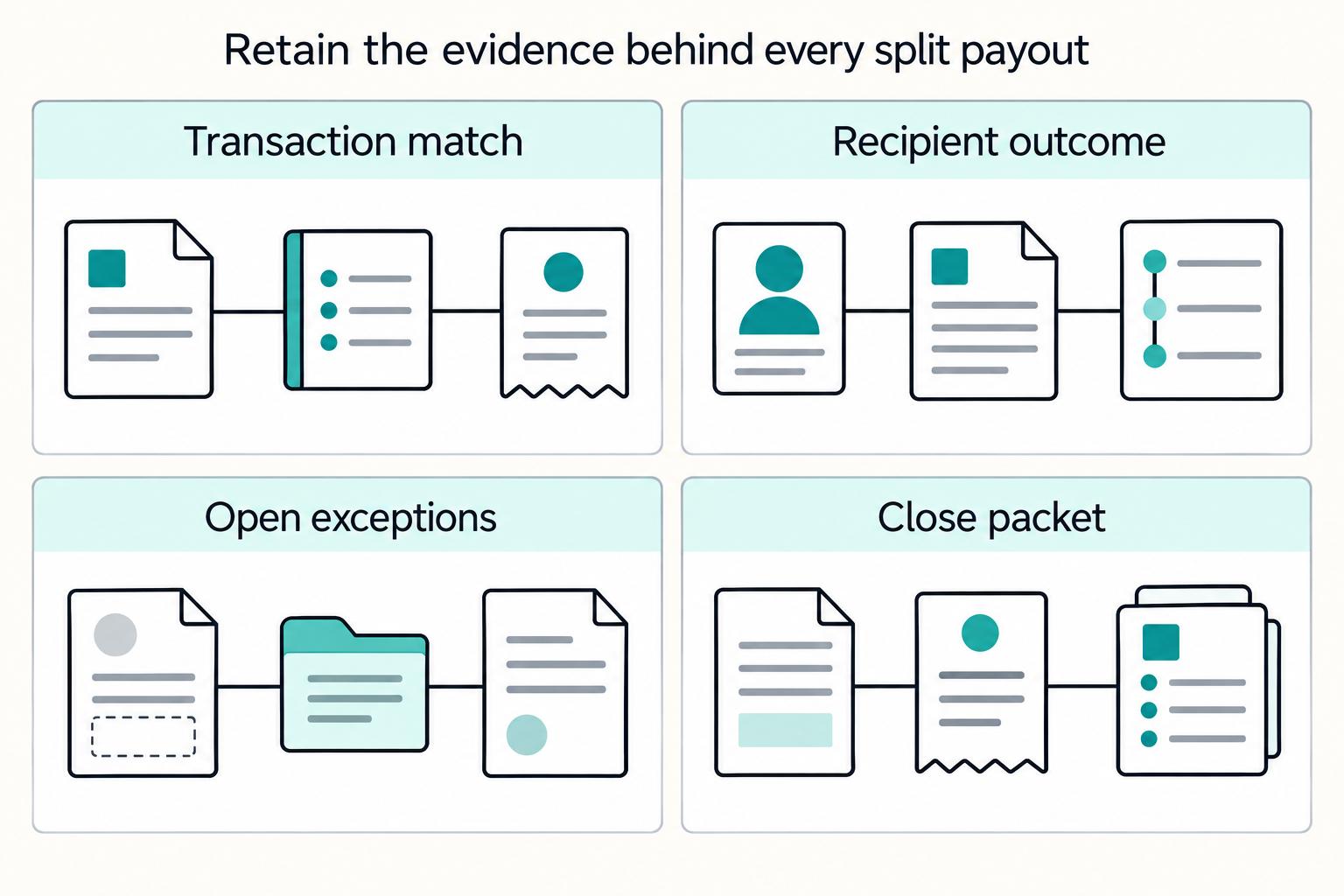
Reconcile in passes before marking a payout clean#
Use a repeatable pass structure so breaks are visible early. One practical sequence is transaction math first, then recipient-level outcomes, then unresolved exceptions.
- Transaction pass: confirm gross charge, fees, platform share, and recipient legs net to expected postings.
- Recipient pass: confirm what each payee earned, what stayed held, what became available, and what was actually paid out.
- Exception pass: queue unmatched items, for example a settlement record without an internal leg, or an internal payout leg still missing a provider reference, until resolved with a reason code.
Manual payouts increase reconciliation responsibility. Stripe is explicit that if you create manual payouts, reconciliation is your responsibility. Automatic payouts generally preserve cleaner transaction-to-payout linkage.
Define a monthly evidence pack before finance asks#
Set a monthly evidence pack format early so finance can close and explain exceptions without ticket archaeology. Include payout status history, hold and release decision logs, including KYC-related status changes, and provider artifacts that support each decision, such as payout IDs, BalanceTransaction references, and settlement batch identifiers.
For banks subject to U.S. CIP requirements, 31 CFR 1020.220 distinguishes identity information retained for five years after account closure from verification-method and result records retained for five years after the record is made. Do not apply that bank rule automatically to a platform. Determine your entity’s applicable retention duties and keep the payout decision trail under a documented policy.
For a sampled payout, reconstruct the recipient balance, allocation rule, and external outcome from ledger records and provider references. If the team must manually guess which transactions funded the payment, reconciliation is not complete.
Implement API and Webhook Flows With Idempotent Retries#
Treat retries as a normal path, not as an exception. If create, capture, or payout calls are retried without an Idempotency key, duplicate money movement is still possible.
Enforce idempotency on every POST that can move funds#
Use one unique provider key per request operation, not per HTTP attempt, and keep a durable internal business-intent ID. Retry the same request with unchanged parameters and the same key within provider retention rules. A new authorized financial replacement after confirmed non-payment can need a separate attempt ID and key. Investigate uncertain outcomes before sending it. Stripe returns the first saved result for a key; Adyen and supported PayPal endpoints have their own retention and retry semantics.
| Provider | Header or key | Grounded detail |
|---|---|---|
| Stripe | Idempotency key | Stores the first status code and response body for a key so retries return the same outcome; keys can be up to 255 characters. |
| Adyen | idempotency-key | Supports timeout-safe retries when the same key is reused; keys can be up to 64. |
| PayPal | PayPal-Request-Id | Used for REST POST calls on endpoints that support it. |
Operational details matter. Stripe keys can be up to 255 characters, and Adyen keys up to 64. In multi-PSP setups, keep one internal operation ID and map it to each provider header format instead of generating unrelated keys per connector.
Verification point: force a client timeout on a capture or payout request, retry with the same key, and confirm you get one provider object and one ledger action.
Process webhooks asynchronously and track explicit states#
For Adyen webhooks, authenticate and durably persist or enqueue the message, then return a successful acknowledgment within the provider’s window. Process business logic asynchronously; acknowledging before durable receipt can lose the event after a crash.
For both Parallel Payments and Chained Payments, make state changes explicit in your records: received, accepted, applied, ignored as duplicate, or rejected for manual review. This keeps behavior predictable when providers retry events. Stripe automatically resends undelivered events for up to three days, and already-processed events can still be retried, so handlers should return success for duplicates.
Match replay windows to provider behavior#
Do not assume one retry pattern across providers. Adyen retries failed webhook delivery three times immediately, then can continue retries from a queue for up to 30 days. Braintree treats responses longer than 30 seconds as timeouts and retries every hour for up to 24 hours in production.
| Provider | Retry pattern | Window |
|---|---|---|
| Stripe | Automatically resends undelivered events | Up to three days. |
| Adyen | Retries failed webhook delivery three times immediately, then can continue retries from a queue | Up to 30 days. |
| Braintree | Treats responses longer than 30 seconds as timeouts and retries every hour in production | Up to 24 hours. |
The practical rule is to keep dedupe records and event-processing history long enough to cover the longest replay tail you support.
Verify ordering assumptions before trusting orchestration#
Arrival order is not a contract. Braintree documents that notifications may arrive out of sequence. For Payment Orchestration, retain provider timestamps as evidence, but use supported object versions, current provider state, and idempotent transition guards to resolve ordering. Sorting timestamps alone does not establish the authoritative payout state.
Red flag: if payout release logic depends on "webhook B always comes after webhook A," the design is not reliable yet.
Handle Failures, Refunds, and Recovery Without Manual Fire Drills#
Define failure handling up front so support and finance do not have to invent policy during incidents. Under Split Payments, use explicit failure classes, quarantine only the affected leg in decoupled multi-recipient flows, and document refund and dispute precedence for legacy Chained Payments, or your equivalent platform-first flow.
Classify failures before support has to guess#
Use four separate classes because each one needs a different response:
| Failure class | What it means | Operator action |
|---|---|---|
| Failed payee transfer | The transfer or payout leg to one recipient did not complete | Stop that leg and queue recovery |
| Delayed settlement | Funds are not yet available to release | Wait on settlement state; do not treat as payout failure |
| Returned payout | The payout was sent but did not arrive and is sent back | Re-credit balance, confirm destination details, retry after review |
| Disputed charge | Funds are withdrawn after a buyer dispute | Debit the liable balance per provider rules and start recovery if allowed |
Do not treat delayed settlement as a failed payout. Adyen settlement runs on a 24-hour sales day and can include configured delays. On Stripe Global Payouts, posted does not guarantee recipient availability, and returned payouts are typically returned within 2-3 business days, with timing that can vary by recipient country.
Quarantine only the broken leg in Parallel Payments#
If one recipient payout fails after partial success, quarantine that recipient leg first. In decoupled multi-recipient flows, unrelated recipients can continue on their normal path.
Stripe Connect's separate charges and transfers model supports this operating pattern: the platform charge is decoupled from downstream transfers, and funds can be transferred to multiple connected accounts. Verification point: simulate a one-recipient failure after partial success and confirm your ledger shows one quarantined leg, unchanged settled legs, and intact provider references for each transfer and payout object.
Document refund precedence for Chained Payments#
Write down refund and dispute ownership by provider and charge type. There is no universal default. In Stripe Connect, refund debits vary by charge type: direct charges debit the connected account, while destination charges or separate charges and transfers debit the platform. For Stripe indirect-charge marketplace flows, Stripe debits the platform balance first, then recovery can be attempted via transfer reversals, including partial reversals.
For Adyen split refunds, you can choose who is liable, and the outcome arrives asynchronously via a REFUND webhook. If you still run legacy PayPal Adaptive Payments patterns like Chained Payments, explicitly define the primary liable balance, the recovery method, and the event that marks the case resolved.
Launch in Weeks Not Quarters#
You can shorten time to launch if you lock five decisions before go-live, though timeline still depends on integration scope and provider approval.
Copy/paste launch checklist
- Chosen model documented: Separate charges and transfers (or your selected flow) with tradeoffs
- Split math approved: fees, surcharges, Platform Take Rate, refund order
- Compliance gates active: KYC (Know Your Customer), KYB (Know Your Business), and program-appropriate AML (Anti-Money Laundering)
- Reliability controls live: Idempotency, webhook replay handling, exception queue
- Reconciliation pack defined: ledger mapping, provider refs, and a signoff cadence with your PSP (Payment Service Provider)
Document the model before you optimize it#
Decide and document your launch flow first, then optimize. Write down which split-payment model you are using, for example separate charges and transfers, why, and what that choice means for support, disputes, and reconciliation. If you are using separate charges and transfers, treat it as a one-to-many option with added integration complexity.
Your verification point is simple: product, finance, and engineering should describe the same money path from charge to payout without contradiction.
Freeze split math and refund order in one spec#
Approve one split-and-refund spec before launch, not scattered logic in code and tickets. Define the order for gross amount, fees, surcharges, Platform Take Rate, partner shares, rounding, and refunds across authorization, capture, and refund events.
Be explicit about fallback and reversals. If split instructions are missing, funds and fees can default to the platform's liable account in some setups. Also define refund ownership clearly, because refunding a platform charge does not automatically reverse associated transfers.
Turn on fail-closed compliance gates#
Block payouts until required verification is complete. Gate eligibility on KYC, KYB, and the right AML posture for your program, with requirements varying by provider, market, and entity type.
Before requesting live launch, test account creation, identity verification, and payouts end to end in sandbox. The checkpoint is whether representative users can reach payout-eligible status with the evidence your PSP requires.
Make retries boring before real money moves#
Put Idempotency on money-moving API requests so retries do not duplicate money movement. Since keys can be removed after at least 24 hours, do not assume old keys remain reusable.
Handle webhooks with replay in mind: return fast success responses, process downstream work asynchronously, and route non-deterministic failures to an exception queue. Your operating guide should cover replay windows like Stripe resends for up to three days and Adyen retries for up to 30 days.
Prove reconciliation on a small cohort, then scale#
Define the reconciliation pack before launch, then prove it on real settlements. Map internal ledger entries to provider object IDs, payout IDs, and provider-side identifiers such as a PSP reference. On Stripe, the balance transaction source field links back to the related object, and the Payout reconciliation report supports payout-to-activity matching.
Start with a limited-scope cohort, validate tie-outs and exception handling, then scale traffic gradually. When your launch checklist is complete, validate market coverage and compliance gates for your flow with Gruv's team.
Frequently Asked Questions
What is adaptive payment splitting for platforms?
Adaptive payment splitting is one buyer checkout that allocates funds to multiple recipients using explicit split rules. In legacy PayPal terms, Parallel Payments means one sender pays multiple receivers in one request, while Chained Payments routes funds through a primary receiver before secondary receivers. For new designs, treat this naming as a flow concept, not as a default product choice, because PayPal classifies Adaptive Platform as legacy.
How do I choose between Parallel Payments and Chained Payments?
Start with the mechanics: Parallel Payments sends one payment to multiple receivers in one request, while Chained Payments routes funds through a primary receiver before secondary receivers. There is no universal winner, so choose based on your liability model, support burden, and the visibility you want across recipients.
Who should receive funds first, the platform or end payees?
There is no single rule. It depends on your charge model and PSP (Payment Service Provider) configuration. In Stripe destination-charge flows, the charge is created on the platform account, while direct-charge flows place the charge on the connected account. If you need to separate collection from disbursement, separate charges and transfers decouples the platform charge from transfers to one or multiple connected accounts.
What minimum data do we need before go-live?
At minimum, collect the required recipient identity and business verification information and provide it to your PSP. Do not assume a single onboarding form works for every recipient, because required verification data varies by country, business type, and requested capabilities. Before launch, test representative recipient profiles across your target countries and business types to confirm onboarding and verification can complete as expected.
What controls prevent duplicate or inconsistent payouts?
Use Idempotency on money-movement requests, and keep state transitions deterministic so retries cannot create duplicate movement. Stripe documents idempotency keys up to 255 characters and notes keys can be pruned after 24 hours, so old keys should not be treated as safely reusable beyond that window. For webhooks, return a fast 2xx response before heavy logic and design for replay, since undelivered events can be retried for up to three days.
What should we validate with providers before signing?
Validate the exact split patterns supported in your target markets, how refunds and disputes debit balances, and whether regional constraints block your planned setup. Stripe states charge type changes fund distribution between the platform, connected account, and processor, and some separate-charges-and-transfers scenarios require the platform and connected account to be in the same region. Also get written confirmation of webhook retry behavior and legacy-product availability, because PayPal labels Adaptive Platform as legacy and availability for new activations can differ by provider.
Researched and edited by the Gruv editorial team. Gruv builds cross-border billing, payouts, and finance-operations software for global businesses.
Sources
Includes 2 external sources outside the trusted-domain allowlist.
- developer.paypal.com/api/nvp-soap/adaptive-platformtrusted
- developer.paypal.com/docs/multipartytrusted
- docs.stripe.com/api/idempotent_requeststrusted
- docs.stripe.com/connect/separate-charges-and-transferstrusted
- ecfr.gov/current/title-31/subtitle-B/chapter-X/part-1...trusted
- ecfr.gov/current/title-31/subtitle-B/chapter-X/part-1...trusted
- adyen.com/pricingexternal
- docs.adyen.com/platforms/online-payments/split-transactionsexternal
Educational content only. Not legal, tax, or financial advice.
Related Posts

The Freelance Payment Penalty: A Modeled Audit of Platform Fees, FX Spreads, and Payout Delays
The money rarely disappears through a single, easy-to-spot fee. The real loss is stacked. A marketplace takes its commission, a processor adds a charge for international cards, a bank or payment company converts the currency at a spread, a platform holds the funds before release, and a wire sheds a little to intermediaries on the way in. Each layer looks defensible on its own, but the worker feels the combined result as a smaller deposit and a later payday.

How to Respond to a Subpoena for Business Records
Move fast, but do not produce records on instinct. If you need to **respond to a subpoena for business records**, your immediate job is to control deadlines, preserve records, and make any later production defensible.

A US Expat's Guide to Investing in UCITS ETFs to Avoid PFIC Issues
The real problem is a two-system conflict. U.S. tax treatment can punish the wrong fund choice, while local product-access constraints can block the funds you want to buy in the first place. For **us expat ucits etfs**, the practical question is not "Which product is best?" It is "What can I access, report, and keep doing every year without guessing?" Use this four-part filter before any trade: