
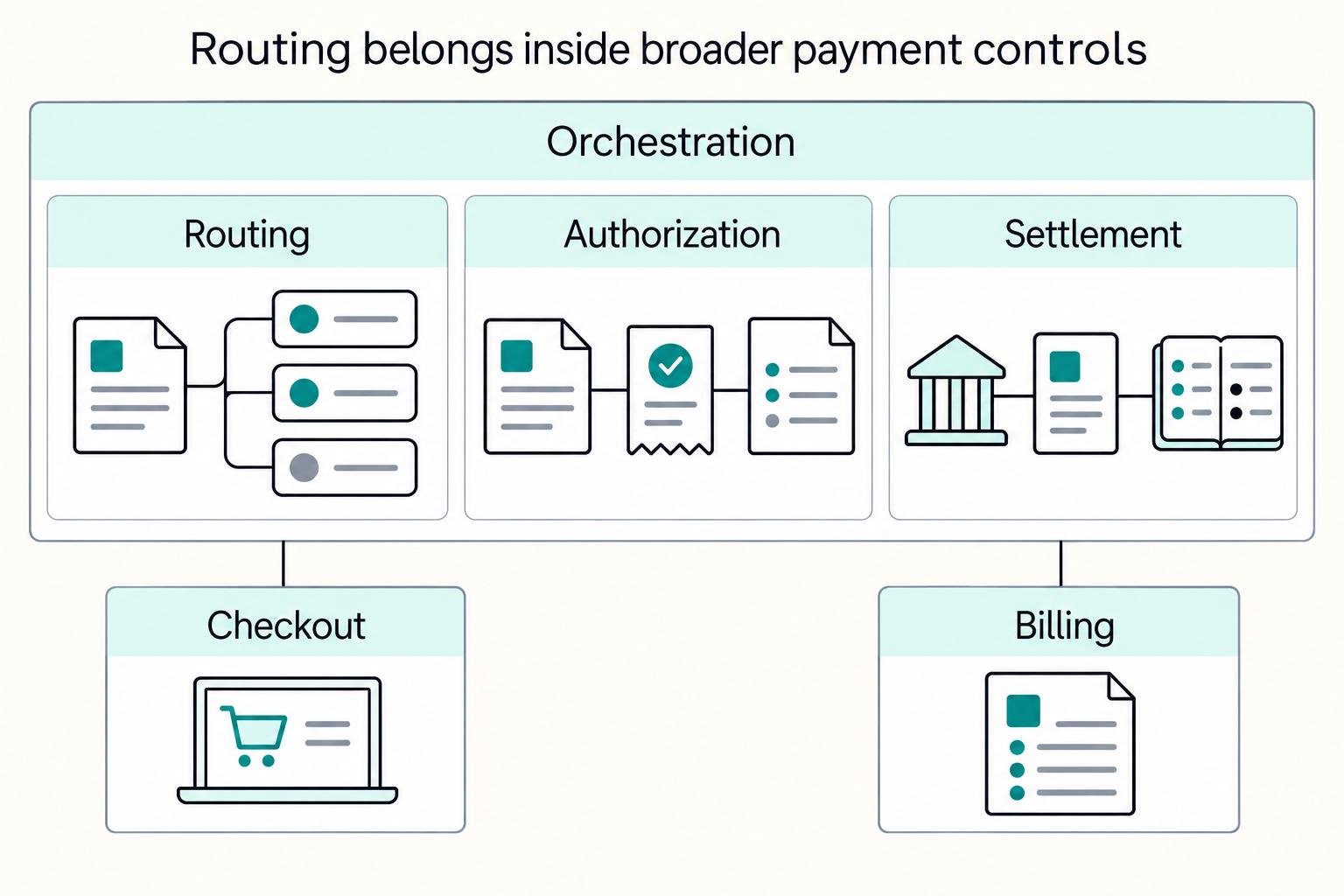
Quick Answer
Routing chooses a PSP for a new eligible payment attempt. Orchestration also records policy, attempts, recovery and merchant reporting. Keep unknown submitted attempts with their original provider until resolved; cross-provider switching is not protected by a provider-specific idempotency key.
Know when payment orchestration starts to matter#
Payment orchestration coordinates payment providers, routing decisions, attempt history and operational reporting through a shared control layer. It becomes useful when checkout traffic needs more than one PSP and separate integrations make outcomes harder to explain. One integration can simplify access; it does not automatically settle funds or reconcile every connector.
Most teams feel this as an operations problem before they label it a platform problem. Payment results start to vary by region, customer preference, or provider path, and you need routing and failover that can adapt. Consolidation is a real benefit here. One integration can connect multiple PSPs and payment methods instead of separate provider-by-provider builds. That only helps if the platform gives you usable control over routing, retries, and reporting.
Who this guide is for This guide is for teams that own both uptime and money movement in a multi-PSP setup. That usually means founders, product leads, payments ops, engineering owners, and finance teams. If you are involved when a provider degrades, settlements do not line up, or ticket volume spikes after a routing change, this guide is for you.
This guide focuses on merchant payment acceptance and its authorization, capture and settlement records. Contractor payouts need a separate obligation and funding model. An orchestrator is not automatically the acquirer, merchant of record or legal holder of funds.
What to protect while choosing a path The goal is not to connect more providers for their own sake. It is to choose a multi-PSP orchestration path that keeps authorization performance, fallback logic, reconciliation, and compliance controls intact. Routing is only part of that job. The platform still needs to manage processing from authorization through routing and settlement, with reconciliation built into the flow rather than left for manual cleanup.
Before adding a backup provider, separate a confirmed decline from an unknown response. A timeout after submission may hide an approved authorization or completed capture. Switching providers at that point can create a second payment. Recovery must preserve the original attempt until its outcome is known.
Related reading: What Is an Audit Trail? How Payment Platforms Build Tamper-Proof Transaction Logs for Compliance.
How to use this list and who it is for#
Use this list when multi-provider complexity is already shaping day-to-day decisions and you need to compare platforms on operational control, not connector count. The question is simple: can this platform help your team steer production payments when performance shifts or a provider degrades?
- Use it when your stack is getting harder to steer
This list is most useful if you run, or are about to run, a multi-PSP setup across regions with changing providers or payment-method mix. In that situation, a payment orchestration platform should let you manage providers from one place instead of maintaining provider-by-provider flows. If your team is asking questions like "why did auth rate drop 3% last week?", this list is relevant.
- Use it as a cross-functional evaluation tool
Engineering needs explainable routing and attempt recovery. Finance needs the same transaction references linked to captures, fees, refunds, disputes and merchant bank settlement. Evaluate that chain together before adding another PSP.
- Skip it for now if one PSP still fits cleanly
If one PSP meets your payment-method, region and operating needs, keep the setup simple. Add orchestration when the measured acceptance, cost or control benefit exceeds the extra implementation and recurring operations work.
- Score options on four production-critical criteria
Score each option on routing control, integration depth, reporting depth, and fit with your operating model, for example pure connectivity and routing versus more bundled infrastructure. Ask for proof that routing is configurable by region, payment method, risk profile, and provider performance. Then test for thin pass-through integrations that look broad but break down when you need failover, data access, or usable reconciliation.
If you want a deeper dive, read Gateway Routing for Platforms: How to Use Multiple Payment Gateways to Maximize Approval Rates.
What orchestration does that basic routing does not#
Routing selects a provider for an eligible new attempt. Orchestration also maintains the policy version, request history, recovery decisions and reporting around that attempt. The distinction matters most when the first response is lost or a later refund changes the financial outcome.
| Area | Routing or switching only | Orchestration |
|---|---|---|
| Transaction control | Predefined rules send a transaction down an effective path | Centralizes routing, authorization, and settlement between checkout and billing |
| Provider failure | Redirect new unsubmitted traffic when a path is unavailable | Resolve submitted attempts before deciding whether a backup create is safe. |
| One integration | Access to multiple providers through one integration is useful | Does not automatically fix reconciliation work or one-off dashboards by itself |
| Incident operations | Teams can still rely on fragmented provider-by-provider workflows | Rollout quality affects how well routing, authorization, and settlement stay coordinated during incidents |
- Routing is one policy; orchestration is the control layer.
Smart routing uses predefined rules to send a transaction down an effective path. Orchestration sits between checkout and billing and centralizes how payments are routed, authorized, and settled, so routing is only one part of the job.
- Failover is not just a traffic switch.
Failover can redirect future traffic away from an unavailable provider. For an attempt already submitted, first determine whether authorization or capture occurred. A provider error label alone is not a cross-provider duplicate-prevention guarantee.
- One integration helps, but it does not solve operations by itself.
Access to multiple providers through one integration is useful, but that alone does not automatically fix reconciliation work. Without orchestration, teams can still end up stitching together one-off dashboards and integrations, with brittle flows and reconciliation bottlenecks.
- This is where implementation tradeoffs show up.
Orchestration platforms are not plug-and-play, so rollout quality affects how well routing, authorization, and settlement stay coordinated during incidents. If your team still needs fragmented provider-by-provider workflows to understand what happened, routing is carrying too much of the load.
When multi-PSP is worth it and when it is not#
Multi-PSP is worth it when it solves a measured problem and your team can operate it. If not, it can add complexity faster than resilience.
| Situation | Suggested path | Why |
|---|---|---|
| Approval outcomes differ by geography, card type, amount, or historical performance | Add a second PSP | You can route based on measured performance variance |
| Retries and failover are hard to test, observe, or reconcile end to end | Stay single-PSP for now | Adding providers can multiply operational confusion |
| Single-provider dependency and reporting risk are emerging | Assess orchestration readiness early | Do not rush expansion by default |
| Operations are fragmenting across multiple PSP relationships at high volume | Strengthen orchestration first | Control is the safer sequence before adding more PSPs |
- Add a second PSP when performance variance is clear and practical.
Multi-PSP is most useful when approval outcomes differ by factors like geography, card type, amount, or historical performance, and you can route based on that variance. Keep the checkpoint practical: compare PSP performance in one place across authorization, fees, and speed before you expand further.
- Stay single-PSP if failover and post-failure control are still weak.
If retries and failover, for example from PSP A to PSP B, are still hard to test, observe, or reconcile end to end, adding providers can multiply operational confusion. Fix visibility and failure handling first.
- Assess concentration and reporting risk early, but do not rush expansion by default.
Single-provider dependency can be a risk, but adding PSPs too early can create fragmented operations and reporting. Treat that as a signal to assess orchestration readiness earlier, not a blanket rule to add more PSPs immediately.
- Prioritize control before connector count when operations are fragmenting.
Adding PSPs without a control layer often leads to fragmented data and more complex oversight. If you already run multiple PSP relationships at high volume, strengthening orchestration first is usually the safer sequence. If one provider is stable and the need for fallback is still unproven, keep the setup simple.
Platform comparison table for multiple PSP operations#
The five products below expose different control surfaces. Compare their documented features with your own payment flow rather than treating every one as an identical full-lifecycle orchestrator. Public documentation establishes capabilities; your connector test establishes whether the needed behavior works for your merchant account.
Some platforms are positioned as pure connectivity or routing layers, while others bundle orchestration with broader infrastructure. Neither model is universally better. Choose based on your actual bottleneck.
| Product | Documented control surface | What the choice leaves you to prove |
|---|---|---|
| Corefy | Routing tree, actions, provider-account routes and cascading strategies | Which result triggers another route and how an uncertain submitted attempt is recovered. |
| Primer | Workflow-based provider routing and fallback configuration | Payment-method and connector-specific decisions, customer authentication and settlement joins. |
| IXOPAY | Connector configuration plus reconciliation/settlement fetchers | Coverage of the actual adapters and reports, and provider-reference continuity during exceptions. |
| ProcessOut | Custom routing rules, performance-based routing and normalized Payout reconciliation objects | Report compatibility for each PSP; Payout here represents merchant settlement, not contractor disbursement. |
| Basis Theory | Processor-agnostic payment vault and routing/proxy tools | Where your routing and money-lifecycle state live; vault access alone does not supply every settlement or accounting workflow. |
Use the same scenario for each candidate: an order whose provider response is lost after authorization, followed by an asynchronous status update. Compare how the product recovers that attempt, prevents another charge and exposes the outcome to finance. Do not rank a vendor on a generic connector count.
- Portability: Identify the vault and token type, permissions, receiving-provider compatibility and contractual export process.
- Recovery: Test confirmed decline, unknown submission, authentication required and later reversal separately.
A practical vendor evidence pack should include routing rule version history, degraded-provider failover evidence, retry behavior, and reconciliation outputs tying payment attempts to settlement records.
Related: Adaptive Payments for Platforms: How to Split a Single Transaction Across Multiple Payees.
Corefy: routing trees and cascading strategies#
Corefy’s rule-engine documentation describes routing trees, conditions, actions and cascading. Its strategy guide distinguishes direct, optimal, balance-based and termination behavior. That supports evaluating it for configurable provider-account routes. Test the trigger result at the connector boundary; “unavailable” must not be silently treated as proof that an already submitted authorization did nothing.
Primer: workflow-based routing#
Primer describes provider fallback in its cascading-payment workflow. Evaluate it when payment-method selection and provider decisions need to be visible in one workflow. Follow an actual authentication-required or declined payment through the selected connector, then compare its records with the PSP. An editable workflow does not make every decline eligible for another authorization.
IXOPAY: connector and post-processing configuration#
IXOPAY’s connector manual covers payment credentials, routing and connector-level reconciliation/settlement fetchers. Evaluate the configured adapters together with finance: which provider reports are fetched, how fees and returns appear, and which references survive a recovery. An advertised reconciliation feature still needs the reports used by your own merchant accounts.
ProcessOut: routing plus merchant-settlement normalization#
ProcessOut documents custom routing rules and a Payout reconciliation object that maps merchant bank transfers to underlying transactions where provider reports allow it. Its documentation notes that full report compatibility is not always possible. Test your PSP reports and refund/chargeback entries. This Payout object is not an API promise to pay unrelated contractors.
Basis Theory: payment credentials and routing ownership#
Basis Theory positions its payment vault around processor-independent credentials, collection and proxy access. It also offers routing tools. Evaluate it when credential ownership and provider choice matter, then locate the authorization, capture, refund and settlement state in your wider stack. Vaulting can reduce sensitive-data exposure; your integration and applicable PCI responsibilities still need their own assessment.
Use an acceptance experiment the team can explain#
Suppose two comparable cohorts each contain 1,000 eligible checkout orders. Route A completes 900 and Route B completes 920: a two-percentage-point difference. Compare traffic mix, payment method, authentication and total fees before treating that as a routing benefit. Count unique orders successfully paid, not successful attempts divided by all retries. These are illustrative numbers, not vendor uplift claims.
Make the failure decision explicit#
For each order, store the chosen provider/account, operation, parameters, policy version, idempotency key and provider reference with a distinct attempt ID. A request key is scoped to the provider’s contract and retention window; it cannot protect a create request at another PSP. Do not mint a new attempt merely because the response or key has aged.
| Observed result | Next action |
|---|---|
| Not submitted; primary route unavailable | Select another eligible route under the current policy. |
| Confirmed decline | Use the provider/network retry guidance and customer context; some outcomes need authentication or new details, while restrictions require stopping. |
| Timeout or indeterminate server error after submission | Keep the original attempt unknown; retrieve its state or obtain provider confirmation before a replacement. |
| Authorized or captured | Continue or recover that original transaction; do not cascade another create for the same order. |
| Confirmed cancellation or reversal | Check the actual final state, any remaining holds and retry eligibility before a separately recorded new attempt. |
Stripe’s low-level error guidance distinguishes an indeterminate server result from a definite failure. Its decline guidance also separates authentication-required and do-not-retry outcomes. Apply the corresponding contract for the selected PSP; do not bypass authentication, fraud or legal restrictions by choosing another provider.
Authenticate callbacks and persist recoverable work before acknowledging them. Make local ledger effects unique and retryable, then recover missing outcomes from provider records. Record captures, refunds, disputes and actual bank movement even when a routing approval failed; retain the control exception separately. A new event ID is not necessarily a new financial effect.
30 60 90 day implementation checkpoints#
Treat the first 90 days as a planning frame for a controlled proof of one production route, not a broad rollout across multiple providers. Use these checkpoints as practical prompts, not fixed day-by-day requirements.
| Phase | Focus | Key checks |
|---|---|---|
| Days 1 to 30 | Ownership and evaluation criteria | Make ownership explicit across product, engineering, payments ops, and finance; set criteria for routing rules, failover, data access, reporting, reconciliation, and fee transparency |
| Days 31 to 60 | One live route with guardrails | Explain why traffic is sent one way, what happens when a provider path is unavailable, and validate outcomes in reporting and reconciliation |
| Days 61 to 90 | Expand only after one route is stable | Add provider paths only after the first route is explainable in routine operations and incident handling |
| Before scaling further | Evidence pack | Keep routing policy history, failover and failure-test results, finance reconciliation sign-off, and compliance gate mapping |
Days 1 to 30#
Make ownership explicit across product, engineering, payments ops, and finance so routing decisions, escalation paths, and reconciliation acceptance are clear.
Set your PSP and acquirer evaluation criteria early. Use questions that reveal real control and operability. Can your team define granular routing rules? Do integrations expose real failover and data access? Are reporting, reconciliation, and fee transparency usable for finance and operations teams?
Days 31 to 60#
Run a permitted live route only after merchant account access, authentication and recovery controls are ready. Use sandbox or controlled mock scenarios for outages and lost responses; do not replay a paid production order to test resilience.
Follow one order and its attempts into authorization, capture and merchant settlement records. Confirm an unknown response stays attached to its original attempt and a later refund remains a distinct financial entry.
Days 61 to 90#
Consider expanding provider paths only after the first route shows stable, explainable behavior in both routine operations and incident handling. If the route is hard to explain, hard to trace, or hard to review across teams, adding more PSP paths can increase complexity without clear resilience gains.
Evidence pack before you scale further#
Before widening the route map, keep a lightweight evidence pack with clear provenance and ownership so review and audit work does not depend on scattered tickets, spreadsheets, or email threads. A practical pack can include:
- routing policy history
- failover and failure-test results
- finance reconciliation sign-off for the live route
- compliance gate mapping for routing changes
The decision rule is straightforward: if you can quickly assemble audit-ready artifacts and cross-team evidence for one route, scaling is safer. If you cannot, fix that first.
Need the full breakdown? Read What Is a Balance Sheet? How Payment Platforms Account for Held Funds Reserves and Liabilities.
If your 30-60-90 plan needs concrete API and webhook patterns for retries, status handling, and reconciliation, review the Gruv docs.
Conclusion and next step#
Choose the option that fixes your current bottleneck now, and hold off on extra PSP complexity until your control layer can handle failures cleanly. In these decisions, the expensive mistake is buying for a future state you do not operate yet.
1. Pick for the bottleneck, not the brochure#
Start with the pain you can name clearly. If your team keeps asking why authorization dropped 3% last week, prioritize route control and visibility. If reconciliation still takes 6 days, prioritize unified data and reporting before you add more routing logic.
Orchestration is broader than traffic switching. It can consolidate gateways, processors, and related services behind a single API instead of separate integrations. Running multiple PSPs independently often creates fragmented data, heavier risk oversight, and inefficient reporting. Build versus buy is not the point by itself. The right choice is the one that fits your setup and bottleneck right now.
2. Count gains only if they survive failure#
Treat authorization gains as provisional until they hold when a provider fails. If a fallback path looks good on a dashboard but weakens reporting, reconciliation, or retry clarity, you have shifted cleanup cost instead of reducing risk.
Make the first checkpoint an unknown-response recovery. The team should be able to show whether the original authorization occurred and why any later attempt was permitted. Merchant settlement records should preserve that history.
3. Shortlist only after one real proof point#
If you are evaluating vendors now, build the comparison table before demos. Include your current bottleneck, integration model, backup-path behavior, and reporting depth that matter to finance and operations.
Review the confirmed-decline and unknown-response scenarios together. A backup route is useful only when the customer outcome and financial history remain coherent. Use the same evidence to choose the next provider path.
When your team is ready to pressure-test multi-PSP rollout assumptions against compliance gates and operational controls, talk with Gruv.
Frequently Asked Questions
What is the difference between payment orchestration and payment routing?
Payment orchestration is broader than routing. It manages multiple PSP and gateway relationships in one system, with routing as one part of that control layer. If you only handle routing, you can still end up managing integrations and reporting provider by provider.
Why do multiple PSPs increase complexity without an orchestration layer?
Without orchestration, teams often run integrations, reporting, and workflows separately for each PSP. That can create operational inefficiency and added cost. Orchestration addresses this by unifying multiple providers into a single operational system.
How many PSPs should a platform start with?
There is no universal right number for every platform. Start with the smallest provider setup that solves a real acceptance or cost tradeoff you need to manage. Expand only when reporting and integrations stay clear as complexity increases.
What are the first routing and fallback rules to implement?
Start with eligibility and a primary provider for new attempts. Redirect unsubmitted traffic if that path is unavailable. For submitted traffic, distinguish confirmed declines from unknown results and recover the original outcome before replacement. Apply provider/network retry and authentication rules.
Which metrics show that orchestration is working beyond uptime?
Track unique-order completion, first-attempt approvals, cost per completed order, unresolved-attempt age, duplicates, refund/dispute outcomes and settlement exceptions. Compare like-for-like traffic cohorts; additional attempts should not make apparent acceptance improve simply by changing the denominator.
How do we reduce vendor lock-in when choosing a payment orchestration platform?
Review token ownership and type, receiving-provider compatibility, consent and permissions, export timing and contract costs. Also export routing rules, attempt history and finance mappings. A credential migration is separate from moving subscriptions or operational state; test the receiving system rather than assuming every token is portable.
Researched and edited by the Gruv editorial team. Gruv builds cross-border billing, payouts, and finance-operations software for global businesses.
Sources
Includes 6 external sources outside the trusted-domain allowlist.
- docs.stripe.com/error-low-leveltrusted
- docs.stripe.com/declines/codestrusted
- basistheory.com/solution/data-consolidationexternal
- docs.corefy.com/docs/rule-engineexternal
- docs.corefy.com/docs/employ-routing-actions-cascadingexternal
- docs.processout.com/docs/defining-custom-routing-rules-1external
- docs.processout.com/reference/payoutexternal
- documentation.ixopay.com/manual/docs/connectorexternal
Educational content only. Not legal, tax, or financial advice.
Related Posts

The Freelance Payment Penalty: A Modeled Audit of Platform Fees, FX Spreads, and Payout Delays
The money rarely disappears through a single, easy-to-spot fee. The real loss is stacked. A marketplace takes its commission, a processor adds a charge for international cards, a bank or payment company converts the currency at a spread, a platform holds the funds before release, and a wire sheds a little to intermediaries on the way in. Each layer looks defensible on its own, but the worker feels the combined result as a smaller deposit and a later payday.

How to Respond to a Subpoena for Business Records
Move fast, but do not produce records on instinct. If you need to **respond to a subpoena for business records**, your immediate job is to control deadlines, preserve records, and make any later production defensible.
A US Expat's Guide to Investing in UCITS ETFs to Avoid PFIC Issues
The real problem is a two-system conflict. U.S. tax treatment can punish the wrong fund choice, while local product-access constraints can block the funds you want to buy in the first place. For **us expat ucits etfs**, the practical question is not "Which product is best?" It is "What can I access, report, and keep doing every year without guessing?" Use this four-part filter before any trade: