
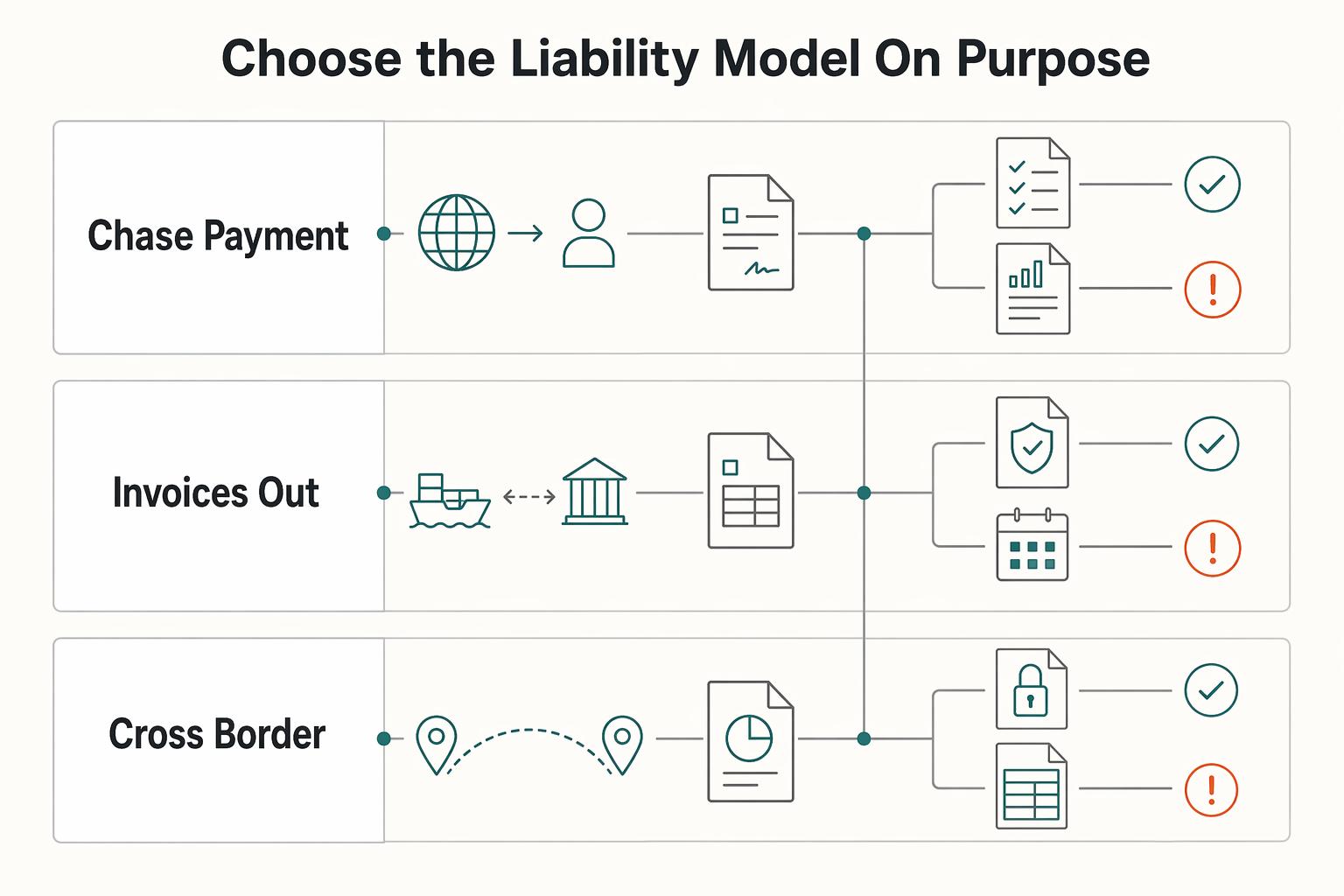
Quick Answer
Agree the legal client, deliverables, revisions, fee, currency and billing triggers before kickoff. Use shorter funded milestones for long projects, send invoices through the confirmed AP route and retain the evidence required by each trigger. Reconcile gross receipts and fees before marking paid, and choose a provider that accepts your actual design service.
Where cross-border design payments get delayed#
Traditional payment protection is often too reactive for cross-border independent work. The real risk is usually operational: late or missing payment, invoice-validity issues, payment-rail friction, and fees that reduce your margin after settlement.
A designer can deliver on time and still wait for payment because the client disputes scope, AP rejects the invoice, or a transfer remains unresolved. Contract and invoice controls reduce those avoidable gaps. Legal late-payment remedies are a separate step: for an eligible UK B2B debt, GOV.UK describes statutory interest of 8% plus the Bank of England base rate, subject to the contract’s interest provision. Do not apply that formula automatically to every foreign client.
| Question | Legacy protection approach | Revenue security operations |
|---|---|---|
| Main trigger | Reacts after loss or non-payment | Reduces risk before work starts and at each billing point |
| Coverage gap | May not address invoice-quality failures, rail delays, or fee stack | Depends on your process discipline and payment design |
| What you can control | Limited once the problem appears | Contract execution, invoice quality, payment rail choice, and fee-aware pricing |
If you run a multi-client pipeline, you can deliver on time and still be paid late. Delays can stem from invoice handling, processing constraints, or cross-border friction around cost, speed, access, and transparency. In EU B2B workflows, invoices are generally required for VAT purposes, and invoice quality affects tax treatment, so this is a control point, not just admin polish.
Fee drag is another operational risk. Card and processor pricing can include base fees plus international and currency-conversion add-ons, so headline project price is not the same as settled net. Treat payment protection as a three-layer approach you control, not a fallback product you reach for after the damage is done.
Layer 1: Agree the scope and payment triggers#
Start at signature stage: make required documents and payment terms explicit before work starts.
1. Get commitment before kickoff#
Agree kickoff conditions with the client before reserving production time: the governing terms, SOW, authorized approver and any start payment. A requested document is an internal gate only if it is part of the agreed conditions; unrelated government-contract requirements do not govern ordinary design work.
Use plain language such as: "Work begins only after the signed agreement is returned and all required start conditions are met, including any agreed start payment."
Set the start payment against the work you will commit before the next billable milestone. State its amount, due date and treatment if the project is canceled; do not assume that calling it a deposit makes it non-refundable.
Before you schedule production, confirm you have:
- signed agreement
- named SOW version
- proof that any contract-required start condition was met
2. Define scope so billing triggers are unambiguous#
A vague SOW creates vague billing rights. Write it like an execution record, not a promo summary.
Name the governing terms, SOW and relevant versions, and state which document controls if they conflict. Define how authorized changes can be agreed, including email where your terms permit it. Do not assume that a later email is ineffective simply because it is outside a signed PDF.
At minimum, specify:
- deliverables by name and format
- approval points tied to deliverables
- how contract terms are incorporated (document name/version)
- how updates are documented when terms change
Name the actual billing event: an agreed start date, delivery of a specified presentation, written approval against stated criteria, or final delivery. If client feedback is needed, define its deadline and the next step if it is late. A vague promise to invoice when the client is happy leaves the trigger unresolved.
| Weak contract language | Protective contract language |
|---|---|
| "Website design project." | "Deliverables are those listed in SOW v3 dated [date], incorporated into this agreement." |
| "Payment due during the project." | "Invoice events occur only at the written triggers defined in the incorporated SOW." |
| "Extra terms are in email." | "Changes are agreed through [authorized people and channel] and recorded with the affected SOW version, fee and date." |
| "We can adjust scope later." | "Scope changes require a written change record before related work starts." |
3. Control change orders before work expands#
For an out-of-scope request, record the added deliverable, revision allowance, fee, billing event and schedule effect. Have the authorized client approve the change through the agreed channel before starting that extra work. Keep unrelated, already-authorized work and payment obligations separate.
Keep a single audit-trail folder with:
- signed agreement
- current SOW version
- approved change records
- delivery records
- approval messages
If a requested change conflicts with the agreement or its authorization is unclear, resolve it in writing before the affected work starts. Preserve the earlier terms and the accepted change together rather than replacing the original record.
4. Run a pre-sign check#
Before kickoff, confirm the actual project conditions below. The purpose is to make scope, billing and approval executable without inventing additional sign-off gates after work is done.
| Check | What to confirm |
|---|---|
| Client legal name and billing contact | Correct client legal name and billing contact |
| SOW title and version date | Attached SOW title and version date |
| Start conditions | Explicit start conditions |
| Invoice triggers | Invoice triggers that can be verified |
| Approval points and approver | Approval points and approver |
| Method for documenting scope changes | Written method for documenting scope changes |
Use the table above as your pre-sign checklist. If any item is unclear, fix it before work starts. This layer helps reduce preventable disputes by making required terms explicit and verifiable. Next, make sure your invoice reflects these terms exactly.
Layer 2: Build Invoicing That AP Can Process and Pay#
A clear contract does not save an invoice that AP cannot process. Your invoice should execute the deal you already protected in the contract.
1. Start with compliance checks#
For cross-border B2B work, build one master template. Then verify legal and tax details before each send instead of filling them from memory.
| Invoice item | Verify before send |
|---|---|
| Your legal business name and address | Your legal business name and address |
| Client legal entity name and billing address | Client legal entity name and billing address |
| Unique invoice number and invoice date | Unique invoice number and invoice date |
| Service period or delivery date | Service period or delivery date |
| Deliverable reference that matches the signed SOW version | Deliverable reference that matches the signed SOW version |
| PO number, vendor number, or internal billing code | If required |
| Tax treatment and supplier/customer registration IDs | Determine which IDs, rate, exemption or reverse-charge basis actually apply to this supply. |
| Price, currency, due date and applicable invoice format | Use the agreed amounts and due date; verify local tax fields and structured-format obligations. |
| Payment method details | Exactly as the client must use them |
| Billing contact and AP submission route or portal | Billing contact and AP submission route or portal |
Start from the applicable invoice rules for the supplier, customer and service. The European Commission lists basic VAT invoice fields, but national rules and the tax treatment still matter. A PO or portal route is an AP requirement, not a substitute for legal invoice fields. Check any required structured format separately; a PDF alone may not meet a domestic e-invoicing mandate.
2. Tie each invoice to proof#
Match the invoice to its agreed trigger and evidence. A start-payment invoice may precede delivery; a delivery-triggered milestone may not require a new acceptance signature. Attach the relevant SOW reference and the record that proves the specific event, rather than requiring every invoice to have the same approval bundle.
Use this structure:
- Illustrative $5,000 branding project: $1,500 start payment due after the agreement and SOW are accepted, before production starts.
- $2,000 due on written approval of the named concept presentation against agreed criteria, including two defined revision rounds. Save the presentation version and approval message.
- $1,500 due at the agreed final-handoff trigger. State whether final source files or usage rights transfer only after cleared payment, and apply that condition only if it was agreed. The amounts total $5,000; they are sample commercial terms, not a standard deposit schedule.
| Common invoice rejection reason | Preventive fix you control |
|---|---|
| Client name does not match legal entity or vendor record | Copy legal entity details from signed agreement or vendor onboarding record |
| Missing PO number, vendor code, or AP route | Confirm AP submission instructions before kickoff and store them with project docs |
| Description is too vague | Reference exact SOW version, deliverable name, and service period |
| Tax text or registration detail is incomplete | Confirm the actual tax treatment and required IDs/wording before issuing; use a linked correction where needed. |
| Payment details are unclear or outdated | Verify changed beneficiary details through a previously known contact channel before issuing or paying. |
Reconcile partial payments and currency fees#
Suppose the $2,000 milestone receives a $1,000 client payment and the processor deducts a $25 fee that you agreed to bear. The bank receives $975, but the client paid $1,000 and still owes $1,000. Record the gross receipt and fee separately. If you instead apply $975 as the payment, your ledger wrongly shows $1,025 due. Keep the invoice, payment and settlement references together.
For a full $2,000 payment, assume a hypothetical 2.5% fee and then conversion at €0.90 per remaining dollar. The fee is $50 and the €1,755 bank receipt equals $1,950 × €0.90. The invoice is paid in full if your terms put those fees on you; do not chase the client for the conversion difference. Use the actual provider quote and settlement report, and confirm who bears intermediary bank charges or any legally required withholding before billing.
3. Run a receivables cadence#
Set a collection cadence around the agreed due date. For example, confirm AP receipt three working days before due, send a due-date reminder if unpaid, ask for a specific payment date five working days later, then escalate a missed promise to the billing contact and decision-maker. These are suggested operating checkpoints, not legal notice deadlines. Before suspending further work, follow the agreement’s notice and cure requirements; do not revoke rights or withhold already-delivered material without an agreed basis.
Assign one owner to each stage. Handoff gaps are a common failure point, and poor coordination can turn into month-end blame instead of mid-week fixes.
Keep invoice, client, expected currency, amount, due date, credited amount, gross receipts, fees and remaining balance in one receivables log. Track whether an exception is an AP rejection, a disputed milestone, a partial payment, or a transfer awaiting trace; each needs a different next action.
4. Do a final readiness check#
Before sending, confirm:
- invoice matches the governing SOW and the actual billing trigger
- client entity, relevant PO details and AP route are correct
- required tax fields and invoice format are complete
- currency, amount, due date and verified payment instructions are correct
- evidence needed for this trigger is saved, without adding a new approval condition
Correct missing legal fields or a genuine unresolved billing trigger before sending. Resolve AP routing issues promptly, but do not silently postpone an already-due invoice while waiting for an internal approval that the agreement did not require. Record the issue, original billing event and next action.
Layer 3: Limit the cashflow exposure#
A solid invoice gets one payment through. This layer helps keep one late payer, one tax cycle, or one dispute from destabilizing your business. Run three controls in parallel: client concentration limits, cash-account rules, and a clear liability model for transactions.
1. Set a client concentration policy#
Set a concentration alert that fits your expenses, available cash and ability to replace work. Review it monthly rather than adopting a public-company disclosure percentage as your operating limit.
- Client share: calculate each client’s share of trailing 12-month revenue and separately its share of receivables. For example, $60,000 from one client out of $120,000 total is 50%; that is an exposure measure, not a universal breach.
- Early warning: identify how a delayed payment would affect the next payroll, software or supplier bill, and set a cash-based alert before that point.
- Action: reduce additional unfunded commitments where the contract permits, negotiate shorter milestones for new work, and build a replacement pipeline. Do not assume a new policy changes existing payment terms.
Track both trailing 12-month revenue and committed next 90 days. Concentration risk can spike when one client expands while smaller projects roll off.
2. Separate cash and automate the first move#
Cash discipline works best when the first move is automatic, not ad hoc.
Use this implementation sequence:
- Keep business and personal accounts separate.
- Maintain at least one business operating account plus a separate tax-reserve account; add owner-pay and reserve or profit accounts if useful.
- Allocate only confirmed available cash under your reviewed tax, operating and owner-pay plan; reserved funds and pending transfers are not automatically spendable.
- Review on a fixed cadence: weekly transfer reconciliation and monthly balance check against real obligations.
If US individual estimated-tax rules apply, use the current Form 1040-ES calendar: the ordinary 2026 installments are April 15, June 15, September 15 and January 15, 2027, with relevant exceptions and relief. Expected tax of $1,000 or more is a general trigger, but withholding, credits and applicable safe harbors affect the calculation. A reserve transfer is not a tax payment. For US insured deposits, FDIC’s standard limit is $250,000 per depositor, per insured bank, per ownership category; separate account labels at the same bank do not each create new coverage.
As an illustrative liquidity check, $12,000 in available bank cash includes a $4,000 tax reserve that your plan keeps protected. That leaves $8,000 for operations. At $2,000 weekly operating outflow, you have four weeks of operating cover before other receipts. An unpaid $10,000 invoice does not extend that cover until it clears. Review committed payments and any provider reserve before starting another unfunded milestone.
3. Choose who owns transaction liability#
Separate who sells the design service from who processes payment. Using a processor normally does not make it the contracting seller. A reseller or Merchant of Record arrangement can change transaction responsibilities, but the contract still determines payout deductions, reserves and any costs passed back to you. This is not a guarantee that every client invoice will be collected.
| Model | Tax handling | Liability ownership | Dispute risk | Operational overhead |
|---|---|---|---|---|
| Direct invoicing | You determine applicable transaction tax and invoicing rules | You remain the design supplier | You manage commercial disputes and any refund obligations; bank payments do not have card-chargeback procedures | You own AP follow-up and reconciliation |
| Processor or invoicing platform | Payment processing and any separately configured tax service are distinct | You normally remain the seller unless the actual structure changes it | Card disputes can debit your balance under the provider agreement | Easier collection mechanics; reconciliation and collection decisions remain |
| Reseller or MoR arrangement | Handles taxes on its own covered customer sale under the agreement | Identify the customer-facing seller and your separate supply to that entity | Provider manages customer-facing disputes, but refund/chargeback costs, reserves or indemnities may still affect your payout | Provider dependence, eligibility, payout schedule and residual obligations must fit |
Check whether the provider accepts bespoke human design services before changing your billing route. For example, Paddle says its software-focused service is not a fit when the primary offering is human design or consulting services. For an eligible arrangement, confirm who invoices the buyer, who owes you payment, reserve and deduction rules, dispute evidence deadlines and what happens on provider termination. Merchant status and who ultimately bears a cost are related but separate questions.
Monthly cashflow check#
| Monthly check | Confirm |
|---|---|
| Client share is within your policy cap | Trigger breaches have written actions |
| Cleared payments were allocated by rule | No undocumented tax-reserve reversals |
| Estimated-tax deadlines | Scheduled and funded if applicable |
| Current model (DIY, processor, or MoR) | Matches your actual contract terms on tax, refunds, chargebacks, and legal responsibility |
Use the table above as your monthly review.
Put the controls into the next project#
If you want more control over when you get paid, treat this as a three-part operating decision: tighten your contract, tighten your invoicing process, and choose your cross-border compliance route on purpose. In practice, this is less about one tool and more about reducing ambiguity, reducing payment friction, and checking responsibilities early, especially when requirements vary by jurisdiction.
Tighten the contract before work starts#
Write contracts that remove guesswork before work starts. Name the client entity, define the deliverable or milestone in plain language, state the invoice trigger, and include a pause-of-work right if approvals or payments stall. Use this checkpoint: a neutral third party should be able to read the signed agreement and identify when you can invoice, what counts as approval, and who can authorize changes.
Make invoicing easy to process and defend#
Match each invoice to its agreed billing event and retain the relevant SOW, changes and delivery or approval record. Verify the price, currency, due date, tax fields and receiving details before send. Track gross receipts, fees, partial balances and unresolved transfers separately until reconciliation is complete.
Choose the liability model on purpose#
Choose the payment-liability model for the work you do, not just the fastest setup. Direct invoicing can give you more control while often leaving more operational burden with you. A processor may make collections smoother, but contract and tax responsibility can still remain with you depending on terms and jurisdiction. A Merchant of Record may reduce transaction-handling work, but responsibilities are not automatic or universal, so verify contract boundaries, payout timing, refunds, disputes, and any remaining obligations.
| Reactive workflow (before) | Controlled workflow (after) |
|---|---|
| You chase payment after confusion appears | You set triggers, approvals, and escalation points before kickoff |
| Invoices go out when work "feels done" | Invoices map to documented milestones or acceptance events |
| Cross-border responsibility is assumed | Seller, refund/dispute handling, and jurisdiction-specific requirements are checked up front because requirements vary by jurisdiction |
Your next move should be small and concrete:
- Update contract terms so payment triggers, approvals, and pause-of-work rights are explicit.
- Match each invoice to its actual billing trigger and relevant delivery or approval evidence; reconcile receipts and fees separately.
- Choose your cross-border route now: direct invoicing, platform, or Merchant of Record, then verify which liabilities remain with you.
Frequently Asked Questions
How do you lower non-payment risk before work starts?
Confirm the legal client, billing contact, authorized approver, any required PO and start-payment trigger before reserving production time. Define deliverables, revisions, due dates and how late feedback affects the schedule. Complete applicable tax and invoice checks, and agree any suspension or rights-transfer terms in advance.
Which billing route should you choose for a cross-border project?
Direct invoicing often fits custom work for a known business client; a processor can add payment methods without changing seller identity. Use a reseller or MoR only if it accepts your actual design service and its payout, tax and dispute terms fit. Neither a convenient checkout nor a merchant label guarantees that refund or chargeback costs cannot be deducted from your earnings.
What contract terms matter most if your goal is simply getting paid on time?
Specify the fee and currency, start and milestone triggers, feedback and revision limits, due dates, termination payment and any suspension or rights-transfer conditions. Retain the governing agreement, authorized changes, invoices and the delivery or approval evidence relevant to each trigger. Review a redline that changes these rights before accepting it.
How do you handle scope creep without turning it into an argument?
Classify each request as included, deferred, or billable, and confirm it in writing before you start the extra work. Define deliverables, revision limits, approval authority, and a short change-order path that updates price and timeline. Include jurisdiction-specific tax wording only after scope changes, tax treatment, and invoice obligations are confirmed, and escalate when changes affect usage rights, sublicensing, reseller treatment, or the client disputes a conflicting SOW.
Should you use milestone billing or one final invoice?
Use milestones when delivery spans multiple cycles, depends on approvals, or carries revision risk, so you do not hold all timing risk to the end. Define each milestone by a visible output or approval event, set invoice timing to that event, and state what happens if the client goes silent after delivery. For a concrete structure, see How to De-Risk a Fixed-Price Project with a Phased Payment Schedule. Escalate if acceptance criteria are subjective, retroactive, or dependent on third parties outside your control.
What should you do when the client says payment was sent?
Ask for the payment date, amount, currency, beneficiary and bank or provider reference. Match it to the actual receipt and invoice before marking paid. If it is missing or pending, ask the payer’s bank or provider to trace it and keep one case reference. Do not request a replacement transfer until the original outcome is understood, or you may collect twice. For a partial receipt, state the remaining balance and distinguish a processing fee you agreed to bear from an actual client shortfall.
Try a related tool
Researched and edited by the Gruv editorial team. Gruv builds cross-border billing, payouts, and finance-operations software for global businesses.
Sources
Includes 2 external sources outside the trusted-domain allowlist.
- docs.stripe.com/connect/merchant-of-recordtrusted
- fdic.gov/resources/deposit-insurance/understanding-de...trusted
- fdic.gov/resources/deposit-insurance/faqtrusted
- irs.gov/businesses/small-businesses-self-employed/es...trusted
- irs.gov/pub/irs-pdf/f1040es.pdftrusted
- taxation-customs.ec.europa.eu/taxation/vat/vat-businesses/invoicing_entrusted
- gov.uk/late-commercial-payments-interest-debt-recov...external
- paddle.com/help/start/intro-to-paddle/what-am-i-not-all...external
Educational content only. Not legal, tax, or financial advice.
Related Posts

How to De-Risk a Fixed-Price Project with a Phased Payment Schedule
Phased payments let you keep one fixed project price while tying payment timing to verified progress. That can help protect cash flow without giving up the budget certainty your client wants.

The Freelance Payment Penalty: A Modeled Audit of Platform Fees, FX Spreads, and Payout Delays
The money rarely disappears through a single, easy-to-spot fee. The real loss is stacked. A marketplace takes its commission, a processor adds a charge for international cards, a bank or payment company converts the currency at a spread, a platform holds the funds before release, and a wire sheds a little to intermediaries on the way in. Each layer looks defensible on its own, but the worker feels the combined result as a smaller deposit and a later payday.

How to Respond to a Subpoena for Business Records
Move fast, but do not produce records on instinct. If you need to **respond to a subpoena for business records**, your immediate job is to control deadlines, preserve records, and make any later production defensible.