
Quick Answer
Use Pix for a provider-supported local BRL contractor payout. Validate the beneficiary, persist a durable instruction, and mark paid only on confirmed settlement. TED can be a controlled alternative after definitive non-settlement; DOC is retired.
How to pay Brazil contractors with Pix using provider validation, BRL controls, and reconciliation evidence#
For local contractor payments in Brazilian real (BRL), Pix is a practical starting rail when your provider supports the recipient and funding path. Compare it with TED and an international bank transfer, then define how to confirm settlement and recover failures. DOC was retired in February 2024 and is not a fallback for a new payout.
Before you start#
Read this as an operator, not as a freelancer picking a withdrawal method. If you own payout speed, reconciliation, finance approvals, or the engineering path that creates and tracks disbursements, your job is to choose the right rail and make its behavior predictable. For Brazil, that means using the same discipline you would use for ledger design or a provider migration, not defaulting to "wire funds and see what happens."
Step 1 Choose the rail based on the payout shape#
Pix sits inside Brazil's payment infrastructure and was created by Banco Central do Brasil. It supports transfers in a few seconds at any time, including non-business days, and moves funds between transactional accounts such as demand, savings, and prepaid payment accounts. That often makes it a strong first option when you are paying locally in BRL and funds availability matters.
That judgment changes as soon as the payout stops looking local. If your operating model depends on international bank routing, foreign currency, or provider coverage that is not confirmed for the recipient account type, do not assume Pix is available just because the contractor is in Brazil. Before launch, verify that your provider supports the exact BRL payout path you plan to use, can return a provider reference for each transfer, and exposes status updates you can reconcile later.
Step 2 Separate payment speed from operating reliability#
Pix reduces network transfer time, but provider funding, screening and FX conversion can still delay a payout. Keep recipient validation, duplicate-send prevention and exception ownership in the workflow.
A provider acknowledgment proves receipt of the instruction, not settlement. Show pending until the provider confirms the final transfer outcome and provides a reference that finance can match.
Step 3 Decide what you need from the rest of this guide. Use the rest of the guide to make a short set of decisions, not just collect background knowledge. By the end, you should know when BRL plus Pix is the right default. You should also know what data and controls need to be ready before your first live batch, how to route and recover exceptions, and what records finance and audit will expect when they ask you to prove a payout really happened.
That is the lens for the rest of the article. The question is not whether Pix is popular. It is whether your team can run it with enough control to trust the result. If you want a deeper dive, read Invisible Payouts: How to Remove Payment Friction for Contractors Without Sacrificing Compliance. Want a quick next step? Try the free invoice generator.
Decide whether Pix should be your default rail for Brazil contractors#
Use Pix as your default when the payout is local in BRL and fast availability matters; pause that default when the flow depends on international routing or non-BRL settlement.
Pix has operated since November 2020. Its availability in Brazil does not establish your provider’s coverage: confirm the recipient account type, BRL funding path, limits and status API before launch.
| Contractor type | Currency and routing | Funds urgency | Default decision | What to confirm before go-live |
|---|---|---|---|---|
Autonomo | Local BRL in Brazil | High | Pix | Coverage for this payout path, status tracking, and exception ownership |
Pessoa Juridica (PJ) | Local BRL in Brazil | High | Pix | Same checks; do not assume support matches every account path |
Autonomo or PJ | Local BRL in Brazil | Low to medium | Pix is still the starting point | Whether your team can reconcile outcomes and run fallbacks cleanly |
Autonomo or PJ | Non-BRL or international bank routing required | Any | Evaluate cross-border routing first (IBAN/SWIFT path) | Provider constraints, required routing fields, and return/exception flow |
| Known unknowns | Any | Any | No default until clarified | Provider-specific limits, reversals, and dispute handling |
Compare the actual provider paths using the same funding currency and recipient account. Record expected funding, conversion and transfer times separately; network speed alone is not an end-to-end delivery promise.
Keep a visible "known unknowns" row in your decision record, with owner and resolution deadline, so finance does not assume behavior that has not been confirmed. Related: How to Pay US-Based Contractors from Australia.
Prepare compliance and payout data before your first live transfer#
Before your first live Pix transfer, lock down your payout data and review flow so your team does not release money from incomplete or misclassified records.
| Control area | What to define | Timing or check |
|---|---|---|
Autonomo vs Pessoa Juridica (PJ) intake | Split onboarding early and store contractor profile and identifier class as separate fields | Before payout activation; run a pre-live sample check across both paths |
| Tax and invoice evidence | Document where ISS review or NFS-e (Nota Fiscal de Serviço eletrônica) evidence happens | Onboarding, payout review, or reconciliation |
LGPD (Lei Geral de Protecao de Dados) privacy controls | Define who can view full values, who sees masked values, and how long records are retained | Validate access with real user roles across ops tools, exports, and support workflows |
Step 1 Separate Autonomo and Pessoa Juridica (PJ) intake#
Split onboarding early between Autonomo and Pessoa Juridica (PJ), then define the required fields for each path before payout activation. If your process uses CPF and CNPJ, store the contractor profile and identifier class as separate fields so ops does not have to infer document type from free text.
Run a pre-live sample check across both paths. Finance, ops, and engineering should see the same profile class, payout owner, and recipient details for the same contractor record.
Step 2 Decide where tax and invoice evidence enters your flow#
For contractor services, review the applicable NFS-e service-invoice requirements rather than assuming a goods NF-e is the right document. The national NFS-e portal covers service invoicing; the contractor’s regime, municipality and service determine which requirements apply. Assign a local tax owner to establish invoicing and ISS treatment, including any withholding, before encoding document rules.
Keep the evidence linked to contractor or payout records, not scattered across chat or email. If ownership is still undecided, treat that as a launch blocker.
Step 3 Document payout-data privacy controls under your LGPD (Lei Geral de Protecao de Dados) approach#
Pix can be initiated with a simple key such as a phone number or email, so payout operations can involve sensitive identifiers. Define who can view full values, who sees masked values, and how long those records are retained across ops tools, exports, and support workflows.
A short policy is enough to start if it is explicit and testable. Validate access with real user roles so full identifiers are only visible where approved.
Related: How Australian Agencies Can Pay US Contractors With Lower Risk.
Build the payout flow in the right order so finance and engineering stay aligned#
After intake is clean, the next control is sequence: treat request sent and paid as different states, and run one ordered flow from eligibility to reconciliation.
| Flow stage | Primary control | Operational note |
|---|---|---|
| Eligibility gate | Confirm the contractor is approved, Pix is present and ready, and the amount is confirmed in Brazilian real (BRL) | Block release when required CPF, CNPJ, or NFS-e (Nota Fiscal de Serviço eletrônica) evidence is missing |
| Creation and status intake | Protect payout creation and callback/event handling | Use one internal payout ID per payable item and deduplicate by provider reference or event identity |
| Completion definition | Treat request sent and paid as different states | A payout can be settled and still not be operationally done if it is missing from reconciliation export or cannot be matched cleanly |
| Post-transfer handling | Model delayed acknowledgments, failures, and reconciliation tasks as first-class stages | Keep the flow explicit: eligibility passed, method ready, amount confirmed, execution attempted, status finalized, export reconciled |
Step 1 Gate eligibility before you create any payout#
Use a hard pre-check before payout creation. Confirm the contractor is approved, Pix is present and ready, and the amount is confirmed in Brazilian real (BRL).
If your process requires CPF for Autonomo, CNPJ for Pessoa Juridica (PJ), or NFS-e (Nota Fiscal de Serviço eletrônica) evidence, block release when any required item is missing. It is easier to stop a bad payout in queue than unwind it after execution.
Step 2 Add idempotency at creation and at status intake#
Protect both entry points: payout creation and callback/event handling. If you only protect execution requests, retries and repeated events can still create duplicate outcomes in your internal records.
Persist a durable payout instruction before sending it, with amount, BRL currency, approved recipient and a unique internal ID. Reuse the provider idempotency key only within its documented window. If the response is lost, query the original instruction or escalate to the provider before resending or switching rails. Store each webhook durably and atomically commit its deduplication marker with the internal state and ledger changes; commit downstream outbox intent in that same transaction, then dispatch after commit.
Recipient details can change. Validate the resolved beneficiary name and identifier against the approved contractor before release, and require approval for a destination change.
Step 3 Define what "done" means in your ledger and ops UI#
Make completion explicit across finance, engineering, and support.
| State | Internal meaning | Store at minimum |
|---|---|---|
| Request accepted | Payout request created | Internal payout ID, contractor ID, BRL amount, timestamp |
| Provider reference received | Transfer attempt acknowledged | Provider reference, request timestamp, raw response/event ID |
| Settled or failed | Final payment outcome reached | Final status, final timestamp, failure reason if any |
| Reconciliation export complete | Included in finance matching export | Export batch ID, export timestamp, ledger link |
A payout can be settled and still not be operationally done if it is missing from reconciliation export or cannot be matched cleanly.
Step 4 Treat post-transfer handling as a real stage#
Execution is not the end of the process. Delayed acknowledgments, failures, and reconciliation tasks happen after send, so model them as first-class stages.
For local BRL payouts, keep the flow explicit: eligibility passed, method ready, amount confirmed, execution attempted, status finalized, export reconciled. This gives finance and engineering shared state definitions and gives support a clear answer when contractors ask for payout status.
We covered this in detail in The Best Way to Pay a Team of Contractors in Latin America.
Compare Pix, TED and international bank transfers for real operating scenarios#
Use Pix for a supported local BRL path and TED as a preapproved domestic alternative. FEBRABAN announced that DOC ended on February 29, 2024; remove it from routing configuration and support instructions.
Step 1 Prefer the rail that matches your operating tempo#
Pix is a candidate for local BRL payouts when the recipient path, provider limits and final-status evidence meet your requirements.
TED (Transferência Eletrônica Disponível) remains a domestic option and is described as a same-day settlement rail, especially for larger amounts. Use it when your provider or treasury flow is bank-account-led, but run it with explicit operational controls for processing windows, acknowledgment timing, and exception handling.
A retired DOC route should fail configuration validation. For TED, document the provider’s processing window and final-status evidence before treating it as a usable alternative.
A practical check is to run one test payout per rail after your usual approval batch time and confirm: expected status path, provider reference returned, and one clear final reconciliation state.
Step 2 Separate payout fees from FX and funding effects#
Do not read "no provider payout fee" as "no payout cost." A local BRL payout can still carry cost from funding and conversion effects outside the provider's payout-request fee.
Keep these as separate ledger lines:
- Provider payout fee policy
- Funding currency vs settlement currency effects
- Any conversion reference used before settlement
This prevents a common month-end mismatch where only provider fees are booked and BRL conversion effects are treated as noise.
Step 3 Route cross-border only when local BRL is unavailable#
An overseas funding leg can convert into BRL before a domestic Pix payout. Keep that funding leg separate from the recipient transfer. If the agreed recipient path instead requires an international bank transfer, validate the bank and beneficiary fields specified by your provider before sending.
| Scenario | Recommended primary rail | Fallback rail | Practical routing logic |
|---|---|---|---|
Marketplace payouts in Brazil | Pix | TED | Default to local BRL via Pix; use TED when Pix readiness or coverage is missing. |
| Creator platform cashouts | Pix | TED | Prioritize fast local BRL payout; keep TED for recipients on bank-transfer paths. |
| B2B contractor payouts | Pix for local BRL, TED when AP flow is bank-account-led | International rail with IBAN/SWIFT when local BRL is not possible | Choose rail based on whether domestic BRL payout is feasible first. |
That hierarchy keeps rail logic clear: local BRL first, domestic bank-transfer fallback second, cross-border only when domestic payout is not possible. For a full process view, see How to Pay International Contractors With Fewer Delays and Disputes.
Set up reconciliation and audit evidence before scaling volume#
Set a finance-approved reconciliation schema before increasing volume. Include the instruction, provider and Pix end-to-end references where returned, beneficiary, BRL amount, fees, funding and FX references, status history and ledger entries. A completed transfer with no matching liability reduction remains a reconciliation exception.
Step 1 Standardize one evidence pack for every payout batch#
Define one required evidence schema for each payout and each batch, then apply it across all rails and fallback paths. At minimum, make sure your records let ops, finance, and tax answer the same four questions quickly: what happened, when it happened, who it affected, and how it was posted in the ledger. If a record is missing key trace data, treat it as an open operational defect rather than cleanup work.
Step 2 Reconcile by status class, not by net totals#
Reconcile each instruction by state and amount. Pending or unknown submissions retain an open payable and reserved funding as appropriate; confirmed settlement reduces the payable; confirmed failure releases the reservation. A returned transfer needs its own cash and liability entries. Have finance approve these mappings for your accounting model.
Step 3 Attach tax artifacts and auto-open exceptions#
Link the applicable service-invoice and tax-review records to the payable. A missing NFS-e is a hold only where the established legal or contractual requirements call for it; record the rule, owner and remediation deadline instead of using one blanket artifact requirement.
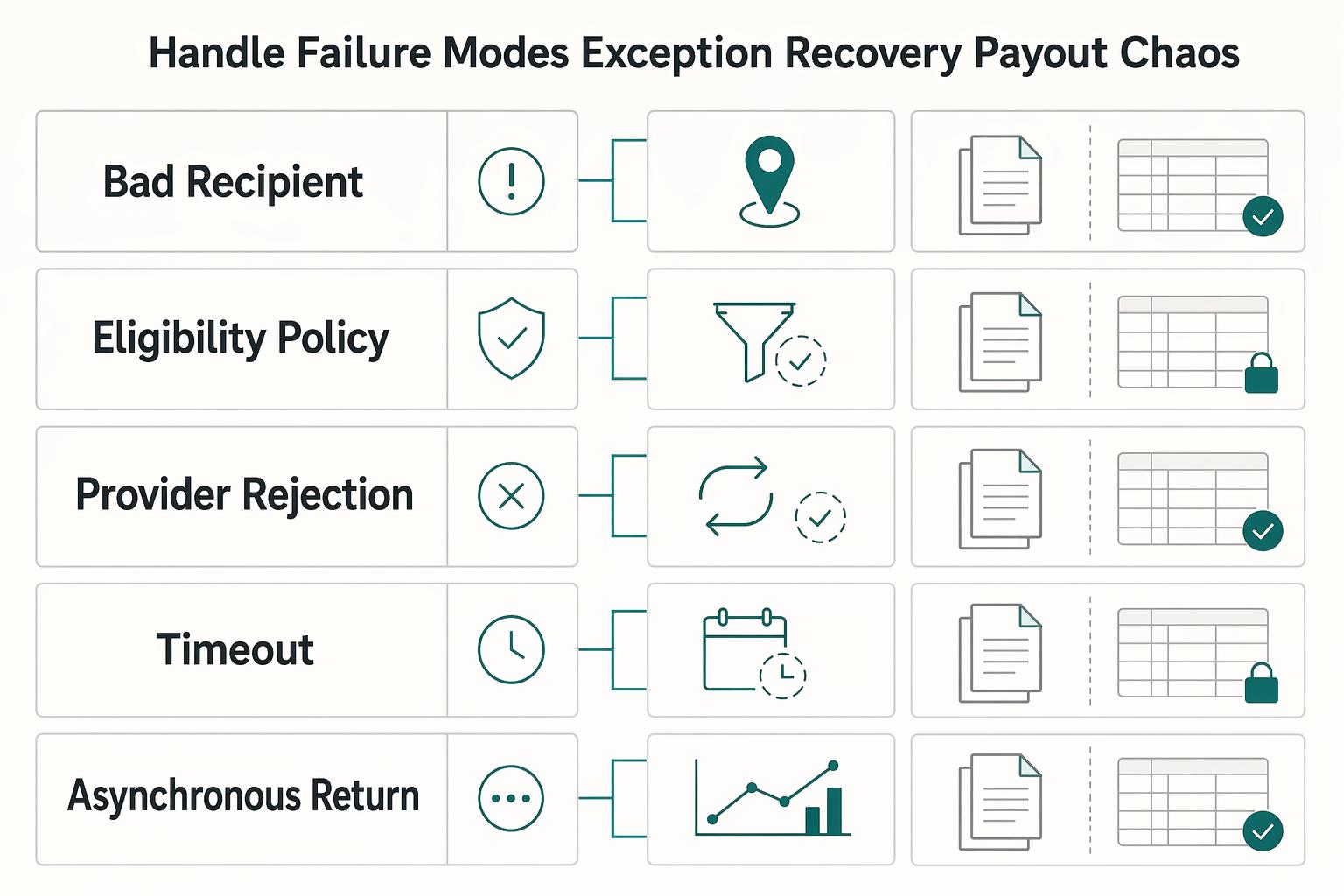
Handle failure modes and exception recovery without payout chaos#
Treat exception recovery as a controlled workflow, not a retry race. On real-time rails, partial failures happen, so the safest path is to classify the issue first, apply a predefined recovery action, and protect auditability and ledger accuracy at each step.
| Exception class | Meaning | Default action |
|---|---|---|
| Bad recipient data | Payee identity or recipient data does not match the intended contractor record (for example CPF/CNPJ path mismatch) | Correct the approved source record; submit again only after confirming the original instruction was unsent or definitively failed. |
| Eligibility or policy block | Your internal rules should stop release (approval, compliance, or documentation hold) | Hold policy/compliance blocks for review |
| Provider rejection | The processor returned a clear rejection | Use an approved TED alternative only after confirming no original transfer settled or remains pending. |
| Timeout | Outcome is unknown at the moment of failure | Resolve status first and avoid blind auto-retries |
| Asynchronous return | A payout looked accepted first, then funds returned later | Run a defined return-funds flow and reopen liability cleanly |
Step 1 Classify the exception before you retry anything#
Require every exception to be tagged before an operator can act:
| Exception class | What it means operationally |
|---|---|
| Bad recipient data | Payee identity or recipient data does not match the intended contractor record (for example CPF/CNPJ path mismatch). |
| Eligibility or policy block | Your internal rules should stop release (approval, compliance, or documentation hold). |
| Provider rejection | The processor returned a clear rejection. |
| Timeout | Outcome is unknown at the moment of failure. |
| Asynchronous return | A payout looked accepted first, then funds returned later. |
Before any replay, confirm the case shows payout ID, provider reference (if available), identifier class, last status timestamp, and current ledger state.
Step 2 Preassign one recovery action to each class#
Do not decide recovery in the middle of an incident. Map each class to one default action:
- Correct recipient data and reapprove it; confirm the original attempt was unsent or definitively failed before a new submission.
- Hold policy/compliance blocks for review.
- Use TED only after definitive non-settlement of the original transfer, with both attempts linked to one payable.
- For timeouts, resolve status first and avoid blind auto-retries.
- For asynchronous returns, run a defined return-funds flow and reopen liability cleanly.
This is a speed-versus-certainty choice: when status is ambiguous, prioritize duplicate-payment prevention over fast replay.
Step 3 Escalate unresolved cases before they hit churn or close#
Escalate unresolved status to payments ops for provider reconciliation and contractor communication. Do not switch rails or release a replacement while the original transfer outcome remains unknown. Near close, send finance the full instruction, provider and ledger evidence so the open item is accounted for.
A practical ownership split is: ambiguous status to payments ops, identity/compliance mismatches to compliance or onboarding, and returned-funds cases to finance until ledger correction is complete. For the full breakdown, read A Guide to Using Wise for Payroll for International Contractors.
Run a controlled launch and monitor the first month#
Launch in a controlled cohort first, not across all Brazil contractors at once, so you can validate your real payout behavior before scale.
Step 1 Start with a split cohort#
Use a limited live cohort with separately reviewed Autônomo and Pessoa Jurídica (PJ) intake requirements. Apply the same execution safeguards while preserving any differences in tax evidence and contractor documentation.
Verification point: each payout record should expose contractor type, identifier class, internal payout ID, provider reference (when available), and last status timestamp for reconciliation.
Step 2 Track daily outcome metrics#
Monitor success rate, time from approved instruction to confirmed settlement, unresolved submissions, exception reasons and confirmed transitions from Pix to TED. Track the funding and provider delays separately from network transfer time.
Pix is built for transfers in seconds and is available 24 hours a day, 7 days a week, including weekends and holidays. If delays or manual interventions trend up, treat that as an early warning even when total completed payouts still look acceptable.
Step 3 Hold a weekly cross-functional review#
Run a weekly finance-and-engineering review and close repeated issues with a named owner and a rule change. Tighten onboarding checks when input quality is the root cause, and update routing logic when execution behavior is the issue.
By the end of month one, you should have fewer manual touches, clearer fallback rules, and cleaner audit evidence.
Conclusion#
A fast domestic rail still needs a controlled funding and payout workflow. Launch Pix only when beneficiary validation, final-status evidence and recovery rules are tested on the provider path you will use.
Copy/paste launch checklist#
Step 1. Confirm the contractor path before you confirm the payment method. Lock one onboarding path per payee and make sure the contractor profile, payout instruction, and reconciliation export all use the same core record details. If those records disagree, stop release and fix the source record first.
Step 2. Decide the rail before sending. Test the supported Pix path and any TED alternative with your provider. A replacement requires proof that the original instruction was unsent or definitively failed; an unknown outcome stays in investigation. Keep both attempts tied to the same payable.
Step 3. Separate funding from cost. Confirm where BRL comes from and who can explain the full payout cost. Finance should be able to see provider payout fees separately from FX or exchange impact, or you will get false "low cost" assumptions in reporting. A useful verification point is whether one payout batch can be tied back to both a funding source and a fee view without manual thread chasing.
Step 4. Write down ownership for tax and privacy artifacts. Do not leave tax and data-handling responsibilities implied between ops, finance, and legal. Even when the exact obligation depends on your model, you want named owners, retention rules, and a clear answer on who reviews missing or inconsistent artifacts. If nobody owns the exception, it will surface at month end.
Step 5. Make execution duplicate-safe and observable before volume arrives. A fast rail does not protect you from duplicate sends, delayed acknowledgments, or stale status screens. You want controlled retry behavior, provider reference capture, and a defined escalation point when provider status and your internal records do not line up. If you cannot show request accepted, provider reference received, and final status posted, do not call the payout done.
Step 6. Require a reconciliation pack for every batch. At minimum, keep the internal payout ID, contractor record key, amount and currency, payout method used, provider reference when available, status timeline, and posting record. That pack is what turns a quick payment rail into an auditable operation. If any "completed" payout cannot be traced across those records, treat it as an exception, not a rounding error.
Related reading: Brazil's CNPJ for Foreign-Owned Businesses: When It Is Needed and What It Does.
Frequently Asked Questions
Can you pay contractors in Brazil with `Pix` if your platform is global?
Yes, if your payout setup can execute a local Brazilian real (BRL) transfer in Brazil or your provider offers a cross-border Pix product. The key check is provider coverage and operating model, not whether your platform serves multiple countries. A global product does not automatically mean local Pix reach.
Is `Pix` always instant for contractor payouts, or does provider workflow still add delay?
Pix supports transfers in seconds around the clock. Provider funding, FX, compliance review and recipient validation can add delay before the domestic transfer starts. Measure the full provider workflow separately from the Pix network step.
When should you choose `Pix` instead of `TED`?
Use Pix when the provider supports the approved BRL recipient path and its limits. TED can be an alternative for a known unsent or definitively failed instruction. Resolve an unknown Pix outcome before switching rails so the same payable is not paid twice. DOC is retired.
What is usually included in payout cost for `Pix` in `Brazilian real (BRL)` versus non-`BRL` flows?
For local BRL payouts, record the provider transfer fee and any separate funding cost. For cross-border funding, also record the conversion rate, FX charge and net BRL amount. Compare the total cost of the supported provider paths using the same amount and recipient; no single fee applies to every Pix provider.
What contractor data is typically needed for payout readiness, including `CPF` and `CNPJ`?
A Pix key may be a CPF/CNPJ, phone number, email address or random key. It is an alias for the recipient account, not proof that you selected the intended contractor. Use the provider’s lookup or validation flow, compare the resolved beneficiary with the approved payee, and protect any personal data returned. Follow the provider’s required account fields for a transfer without a key.
How do `IBAN` and `SWIFT` matter if a contractor cannot be paid locally via `Pix`?
IBAN identifies an account where used; SWIFT/BIC identifies a bank. Neither guarantees acceptance. Use the provider’s Brazil-specific beneficiary and bank-field requirements and confirm the supported currency and account path before switching from local settlement.
What are the minimum reconciliation records finance should require for audit-ready Brazil payouts?
Keep internal instruction and contractor IDs, amount and currency, recipient-validation evidence, provider and Pix end-to-end references where available, status timestamps, fees, funding/FX records and ledger links. Resolve unmatched or unknown outcomes individually; a matching batch total can hide one missed payment and one duplicate.
Try a related tool
Researched and edited by the Gruv editorial team. Gruv builds cross-border billing, payouts, and finance-operations software for global businesses.
Sources
Includes 2 external sources outside the trusted-domain allowlist.
Educational content only. Not legal, tax, or financial advice.
Related Posts

Hiring Contractors in Brazil: CPF, CNPJ, Invoices and Pix
Hiring a Brazilian contractor creates three separate decisions: whether the work is genuinely independent, which person or business supplies it, and how the agreed amount reaches that supplier. A CNPJ, a service invoice and a successful Pix payment do not settle the employment question. Equally, receiving foreign client payments does not automatically require the contractor to become your employee.
Invisible Payouts: How to Remove Payment Friction for Contractors Without Sacrificing Compliance
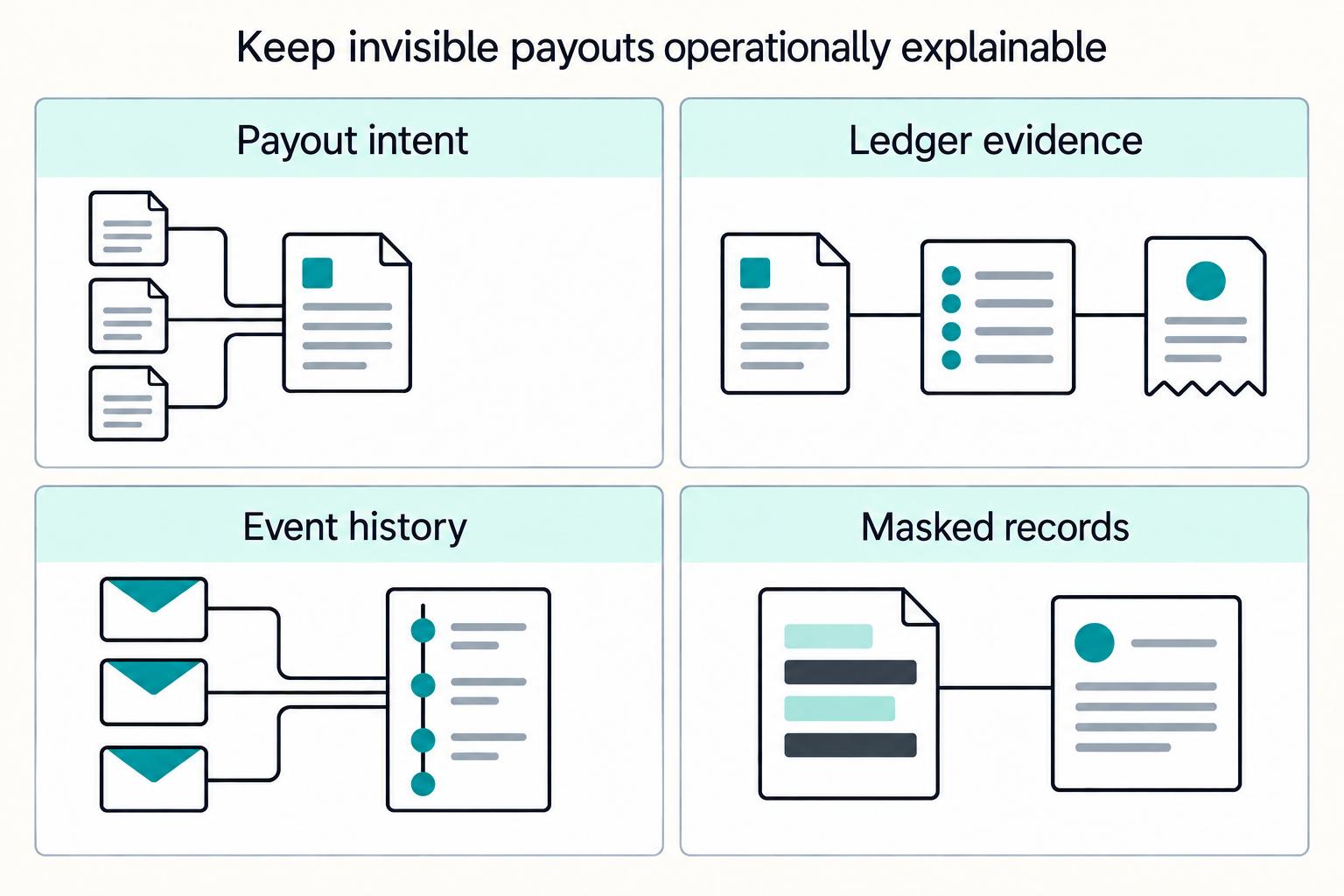
Invisible payouts should make life easier for contractors without hiding the controls your team needs. Contractors should get a predictable, low-friction flow, while internal teams can still enforce and document payout decisions when needed. If you run contractor payouts at scale, you need both outcomes at once. We recommend treating every easy payout as a controlled release path your team can replay later.

IBAN vs SWIFT for International Contractor Payouts on Platforms
If you are scaling international contractor payouts, treat code choice as a release control, not a glossary question. The practical rule is simple: collect the right bank identifiers up front, validate them before approval, and keep enough evidence to explain every submitted, rejected, returned, or retried payout later.