
Quick Answer
A foreign-owned business may need a CNPJ when the company must be recognized in Brazilian records for banking, contracting, invoicing, opening a business, or investing. CNPJ is Brazil's legal-entity tax identifier, not full operating clearance, so the right route, local representation, and any incorporation or local registrations should be confirmed before funds move.
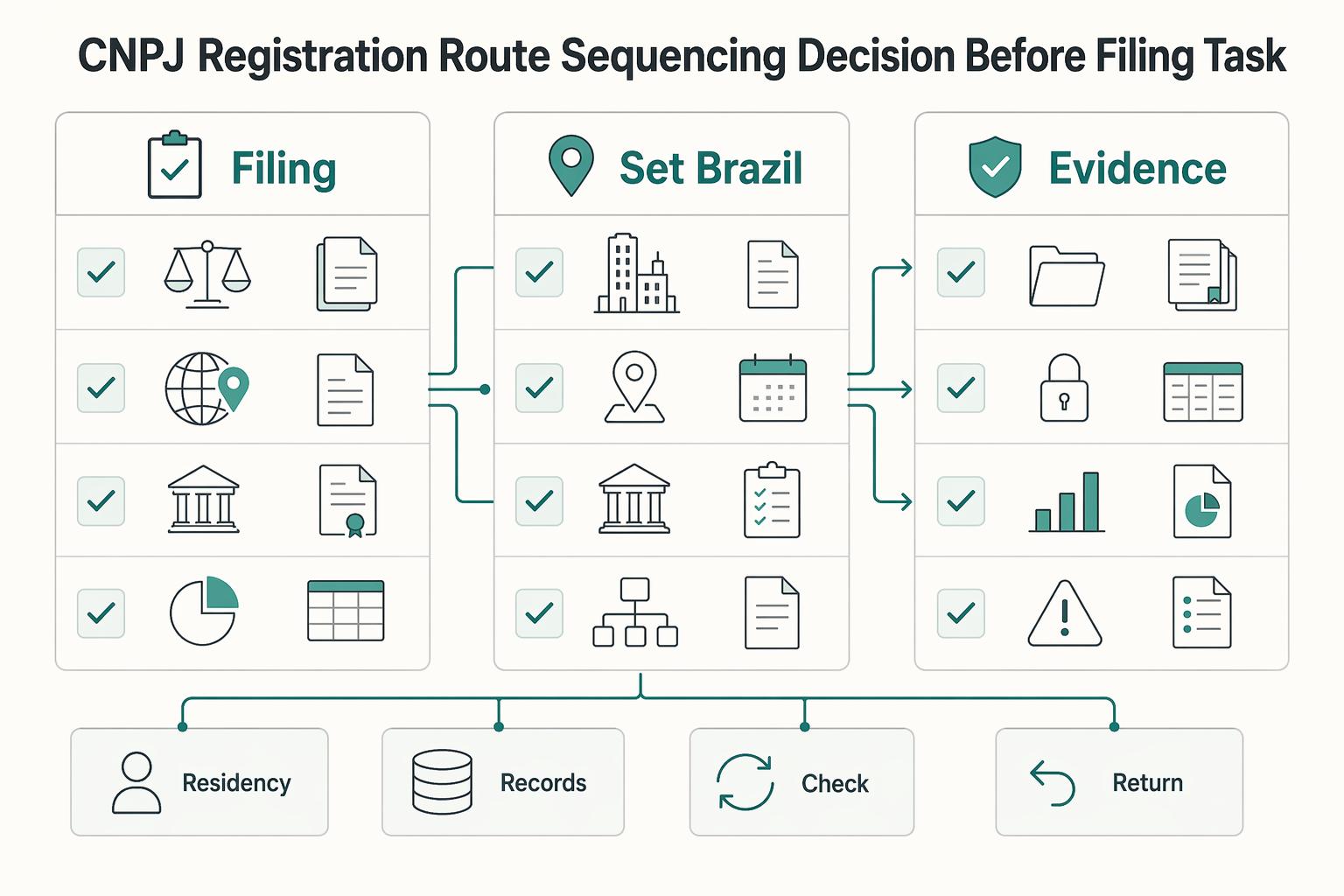
Why CNPJ registration is a route and sequencing decision before it is a filing task#
For many foreign founders, the first decision is not how fast to file. It is whether your current activity requires a CNPJ now, later, or not yet.
CNPJ (Cadastro Nacional da Pessoa Jurídica) is a legal-entity taxpayer identifier. It is different from CPF (Cadastro de Pessoas Físicas), which is for individuals, and it does not, by itself, mean you are ready to operate. Depending on your route, you may still need incorporation filings, local registrations, or post-registration tax steps.
For foreign entities, historical rule text says CNPJ registration applies when the entity has assets or rights in Brazil that must be publicly registered. Examples include equity holdings in Brazilian companies, bank accounts, and financial or capital market investments. The same source also says this duty did not apply to holders of industrial property rights such as trademarks and patents. Because those rule discussions are historical, treat them as a starting point and confirm current Receita Federal practice before you act.
Approach this as a route and sequencing decision. If your path points to CNPJ registration as a foreign entity, an early gate is appointing a Brazil-resident attorney-in-fact in good standing with federal tax authorities. If your path is local incorporation, corporate documents filed with the Junta Comercial must be in Portuguese, and CNPJ issuance may still be followed by other tax registration steps, including a municipal tax ID.
Use this guide as a working checklist for four things:
- choose your route before filing
- set up the Brazil-resident representative correctly
- prepare the required documents for that route
- verify key identifiers and filings before money starts moving
The goal is to avoid two common mistakes: registering the wrong structure and treating tax ID issuance as the finish line.
What CNPJ is and what it does not do#
CNPJ is the legal-entity tax identifier in Brazil, not proof that your operation is fully ready. It is the registration number for legal entities in the Cadastro Nacional da Pessoa Jurídica, assigned in the Receita Federal do Brasil (RFB) registry.
Keep the distinction clear:
- CPF is for individuals and has 11 digits.
- CNPJ is for legal entities and has 14 digits, commonly shown as XX.XXX.XXX/XXXX-XX.
They are not interchangeable. A founder's CPF does not replace the entity's CNPJ.
For foreign operators, the requirement is case-specific. A non-resident may need CPF or CNPJ when owning certain assets in Brazil, including participation in a company, bank accounts, or investments. That does not mean every foreign business needs a CNPJ immediately, and it does not mean CNPJ alone satisfies every authority. Requirements can also vary by entity type and by state or municipality.
In practice, CNPJ is commonly requested for supplier onboarding, invoicing, bank account opening, and status checks. The document usually requested as proof is the Comprovante de Inscrição e de Situação Cadastral, often called the Cartão CNPJ.
Treat it as one compliance layer. You may still need local registrations or other approvals before banking and invoicing work in practice. Before onboarding or payment setup, verify the exact number against official records and the Cartão CNPJ. One mistyped digit is enough to invalidate it.
You might also find this useful: How to Get a CPF Number in Brazil as a Foreigner.
When a foreign business is required to register#
If your foreign entity plans to open a business, sign contracts as a company, issue invoices, or invest through a legal entity in Brazil, start from a presumption that CNPJ registration is likely. Then confirm the exact requirement directly with Receita Federal do Brasil (RFB). This is a practical rule, not a universal legal test for every case.
In practice, the trigger depends on the activity, the entity profile, and how state or municipal interpretation is applied.
Practical trigger table#
| Activity or position in Brazil | Why this puts CNPJ on the table | Likely operating posture | What to verify directly with RFB | Known unknowns |
|---|---|---|---|---|
| Opening a business in Brazil as a legal entity | Opening a business is a practical trigger to assess CNPJ requirements | Assume registration is likely early in setup | Whether the foreign legal entity must be registered now and which entity documents are required | Requirements can vary by entity type and by state or municipality |
| Opening or maintaining a Brazil-linked bank account in the company name | CNPJ is widely used as a business identifier for account onboarding and status checks | Expect CNPJ-related evidence requests | Whether the account setup requires prior CNPJ and whether the Cartão CNPJ, or Comprovante de Inscrição e de Situação Cadastral, is required | Institutional and local practice can vary |
| Investing through the foreign legal entity in Brazil | Investing through a legal entity is a practical trigger to assess CNPJ requirements | Treat as high likelihood for early registration review | Whether the chosen investment path requires foreign-entity registration first | Investment structures can follow different operational paths |
| Signing contracts in Brazil as the foreign company | Signing contracts as a company is a practical trigger to assess CNPJ requirements | Commercially, CNPJ may be needed before deal execution | Whether your contract flow can proceed without a Brazilian entity ID | State, municipal, and counterparty practice can differ |
| Issuing invoices or running day-to-day company operations in Brazil | Operational processes often depend on CNPJ and can involve more than tax ID alone | Assume CNPJ may be necessary but not sufficient | Whether you need only tax ID or also incorporation and local registrations | CNPJ issuance alone does not settle every operating requirement |
Operator rule for faster decisions#
Use a practical default: if the foreign company must be recognized as a legal entity in Brazilian records for opening a business, banking, contracting, invoicing, or investing, start with a presumption that CNPJ is likely. Then validate early with RFB instead of relying on blanket statements like "always required" or "never required."
Ask early whether the planned transaction requires proof of entity registration status, and whether the expected document is the Cartão CNPJ or Comprovante. That answer often tells you whether registration has to happen before commercial onboarding can move forward.
After registration, remember the next compliance step. CNPJ-registered companies, including foreign ones, must file a UBO existence or non-existence declaration within 30 days. Ownership and control analysis includes cases where a natural person holds more than 25% of share capital or otherwise controls the company or group.
Even if you get the trigger decision right, setup can still slow down because of document translation, legalization, and local representative setup across multiple regulatory layers. Related: Hungary's White Card for Digital Nomads: A Complete Guide.
Choose the right setup path before filing anything#
Choose your path based on where your day-to-day operations will live. In practice, teams often use a foreign-entity CNPJ route when they mainly need the foreign company recognized, and local incorporation when they need stronger in-country operating autonomy.
A CNPJ is a legal-entity tax registration number. A local entity or branch setup is an incorporation path, not just an identifier step. If your plan includes recurring local contracts and ongoing invoicing in Brazil, evaluate local formation early instead of stretching a foreign-only structure beyond its purpose.
The split that matters#
Keep the authority roles separate. Receita Federal do Brasil (RFB) is tied to obtaining CNPJ. Junta Comercial is tied to corporate incorporation.
It is easy to blur the line. Tax registration and incorporation solve different problems, and local formation can span federal, state, and municipal layers.
| Path | What you are setting up | Main authority focus | Who this path fits | Main watchout |
|---|---|---|---|---|
| Foreign entity with CNPJ registration | Recognition of an existing foreign company for tax or registry purposes | RFB | Teams that mainly need the foreign company recognized in Brazil for defined activities | Easy to mistake for full operating readiness |
| Local company such as LTDA | A Brazilian legal entity formed locally | Board of Trade for incorporation, with CNPJ as part of the process | Founders planning recurring local operations, ongoing invoicing, and a clear Brazil operating footprint | More bureaucracy and ongoing maintenance |
| Brazilian branch | A branch route considered instead of a local subsidiary | Incorporation and tax-registration steps | Cases evaluating branch versus subsidiary structures | Many foreign businesses choose a local subsidiary or limited-liability company instead |
How to choose by operating intent#
Use a simple filter: where will the business activity actually happen? If the foreign company remains the contracting center and only needs Brazil recognition for a defined purpose, the foreign-entity route with RFB may be the first path to evaluate.
If operations need to run inside Brazil with local autonomy, start with local formation analysis such as LTDA or branch, depending on your case. Do not treat foreign-only registration as a substitute for incorporation when the operating model is local.
Checkpoints that save rework#
If you are pursuing an incorporation path, expect formal document checks at the Board of Trade. One concrete checkpoint is submitting core formation documents there, such as a Certificate of Incorporation and Memorandum and Articles of Association.
Plan for setup effort, not just filing steps. One guide describes Board of Trade registration as typically 60 to 90 days. The same guide gives setup estimates ranging from less than $500 in self-managed cases to $3,000 to upwards of $10,000 depending on execution model. These are variable planning estimates, not fixed national fees.
Also plan for ongoing compliance after registration. An unfit CNPJ status is described as resulting from failures in ancillary tax obligations and can block invoicing, tender participation, and bank-account access. Intent first, filings second. Choose the structure you can operate and maintain.
If you want a deeper dive, read Sole Proprietorship vs. LLC: The Definitive Guide for Global Freelancers.
Ownership and representation rules that change your risk#
After route selection, representation is often the sharper risk than ownership percentage. If you cannot appoint a reliable Brazil-domiciled legal representative with clear authority and a replacement path, pause filing and fix governance first.
Ownership percentage does not reduce the compliance burden tied to CNPJ/MF records. Ownership defines control and economics. Representation defines who can act in Brazil in ways tax authorities, banks, and other third parties will recognize.
Ownership does not replace operational validity#
A cap table alone does not make operations valid. For foreign-shareholder companies, a Brazil-domiciled legal representative is described as structural to regular operations before third parties, not just an administrative formality.
That shows up in day-to-day registration reality. The representative role is described as a prerequisite for tax-registration regularity, bank-account maintenance, and regulatory interaction. So do not treat CNPJ/MF issuance alone as proof that your representation risk is solved.
Why the Attorney-in-fact role is not a formality#
An Attorney-in-fact is part of how a company is formally represented in corporate acts. A weak appointment, unclear scope, or poor record hygiene can create operating problems, not just paperwork issues.
Before filing, verify that:
- representative identity and scope of authority match corporate documents and registration materials
- company and representative data stay aligned across tax, banking, and Central Bank-linked contexts
- there is an explicit owner for updates when representative details change
Grounded failure modes include operational blocks, registration refusals, suspension of foreign-exchange transactions, and regulatory inquiries. Improper replacement is also described as a source of nullities, personal liability, and broader governance failures.
Make the handoffs explicit#
Define the split between founder, counsel, and tax or accounting teams before you file.
| Role | What this party should own | What to verify before go-ahead |
|---|---|---|
| Founder or foreign parent | Business intent, ownership map, approval chain, signatory logic | The Attorney-in-fact has real authority, a reporting cadence, and a backup path |
| Local legal counsel | Appointment documents, scope of powers, representation design, filing consistency | Names, entity data, and authority language match the corporate and registration record |
| Tax or accounting support | Tax-registration follow-through, maintenance tasks, ongoing data consistency | Records used with the Brazilian Federal Revenue Service and banking partners reflect the same representative and company details |
Use one practical rule: the founder sets risk appetite, counsel defines authority, and tax or accounting keeps records current. Do not file until you can name the representative, show the authority document, and state who updates what when details change.
Related reading: A Guide to Tax Residency in Brazil for Digital Nomads.
Build your document pack before talking to counsel#
Build a lean evidence pack before legal review so counsel can focus on filing instead of reconstructing your records. For CNPJ work, a practical starting point is documentation that helps confirm entity identity and ownership, especially when a foreign company is investing or holding assets in Brazil.
What to prepare first and what is often requested later#
| Category | Prepare early | Often requested later |
|---|---|---|
| Entity identity | Core entity details and identifiers used in filing drafts | Refreshed extracts if timing stretches |
| Ownership structure | Current ownership map for the investing legal entity | Deeper shareholder detail for bank compliance review |
| Representation | Current details for the person representing the company in Brazil, if applicable | Updated evidence if representation changes |
| Local entity route | If forming a Brazilian company, draft or near-final Articles of Association and other incorporation documents for the Board of Trade | Additional registration items tied to later incorporation steps |
| Banking readiness | Basic file that can identify individual shareholders behind the investing legal entity | Full bank KYC and questionnaire packs after CNPJ issuance |
Use a simple filter: collect it now if it helps you choose the route or complete the CNPJ application with Receita Federal (RFB). Defer items that are mainly for downstream bank onboarding unless counsel asks for them earlier.
This split avoids wasted effort. For foreign-group subsidiaries, document preparation can take several weeks and sometimes several months, so stale versions and duplicate files can create avoidable delay.
Verification checks that prevent rework#
Before you send anything to the RFB or, where relevant, the incorporation authority, run a consistency check across your documents:
- key entity details are consistent across records and filing drafts
- if a CNPJ already exists, all 14 digits match exactly in every file
- if banking is part of launch, ownership records can identify the individual shareholders behind the investing legal entity
Final checkpoint: keep your expectations realistic. CNPJ issuance is not the end of setup, and opening a bank account can still take time because compliance review is commonly slow. Clean, consistent documents reduce rework at both stages.
For a step-by-step walkthrough, see Can I Use a US-Based P.O. Box for My Foreign-Owned LLC?.
Execute in the right order so you do not rework filings#
Once your document pack is clean, use a clear sequence. Decide the route, confirm representation, pre-validate with counsel, submit the CNPJ registration step, then run incorporation steps only if your route requires local formation.
This is not a claim that one legal order applies to every case. It is a practical sequence that reduces avoidable reversals when multiple advisers, banks, and counterparties are involved.
Start with the route, not the registration form#
One common failure mode is filing for CNPJ before deciding the structure. Are you using a foreign-entity route for a specific Brazil touchpoint, or setting up a local operating entity? If that decision is wrong, later filings, authority documents, bank onboarding, and contract drafts can all point to the wrong vehicle. Treating registration and incorporation as interchangeable can create rework.
| Stage | Go only if | Stop if |
|---|---|---|
| Path decision | You can state clearly whether you will act through a foreign entity or a local Brazilian entity | Anyone is still saying "we'll decide after CNPJ" |
| Representative setup | The acting person is identified and authority documents match the chosen route | Authority is generic, unsigned, or tied to the wrong entity |
| Counsel pre-validation | Counsel confirms route fit and document consistency | You are relying on copied precedent or old memo language |
| CNPJ submission | Name, powers, notarization, and legalization checks are aligned | There are still mismatches across core records and filing drafts |
| Incorporation steps, if needed | Local incorporation is confirmed as required | You are using incorporation steps to patch an unresolved route decision |
Confirm representation before final legal check#
Do not assume old appointment papers still fit your selected path. A representation setup prepared for one route may not work for another. Before final counsel review, confirm consistency across legal name, authority documents, and filing drafts, and verify notarization and legalization status where applicable. If the representative, powers, and core identity details do not match cleanly, pause before filing or banking.
Use counsel to prevent rejection, not explain it later#
Pre-validation should answer two questions before submission: is this the right route, and do the supporting documents match that route from end to end? This includes name consistency, powers, notarization or legalization, and whether later licensing or municipal steps depend on premises and activity-code choices.
Escalate when references conflict. If advice depends on older instruction history without a clear tie to current practice, get a current-law view from specialist counsel before filing. Older guides and forward-looking commentary should not be treated as settled current practice.
Treat CNPJ as a registration step, not full readiness#
After route, representation, and pre-validation are settled, the CNPJ submission is cleaner. But CNPJ alone is not full operating readiness. Incorporation or registry status can still leave follow-on measures before the business is fully qualified to operate.
Final stop/go: do not move to banking, live contracts, or launch messaging while registration ambiguity is unresolved. If local incorporation is part of the chosen route, complete those steps on that basis, not as a speculative parallel track.
This pairs well with our guide on A Guide to Spain's 'Ley de Startups' (Startup Law) for Foreign Entrepreneurs.
If your route is still ambiguous after mapping stop/go checkpoints, pressure-test your launch plan before submitting filings: Talk to Gruv about Brazil rollout readiness.
Mistakes that create delays, rejections, or cleanup costs#
Many avoidable delays come from four operational errors: mixing personal and entity identifiers, treating informal advice as final, skipping cross-record identifier checks, and assuming CNPJ issuance alone means no further validation is needed.
| Mistake | Why it causes trouble | What to verify before moving |
|---|---|---|
| Treating CPF and CNPJ as interchangeable | They are used in different contexts: CPF is personal, while CNPJ is the corporate taxpayer identifier in entity filings | Label each record as individual or entity, then confirm the identifier matches that role |
| Using informal advice as if it were current authority | Requirements can change, and informal guidance may not reflect current requirements | Validate key points against official sources and Brazil-qualified counsel |
| Skipping cross-record identifier checks | Brazilian corporate filings can present multiple identifiers together (for example CNPJ, NIRE, and CVM code), so mismatches can surface later | Reconcile legal name and identifiers across the filing and related records before moving |
| Assuming tax ID issuance means full operational readiness | Tax registration can be one milestone, but filings may still need consistency across identifiers | Confirm identifier consistency across relevant filing and registry records before proceeding |
Keep CPF and CNPJ in their own lanes#
Do not let a personal ID stand in for an entity record. A CPF can be a practical prerequisite in some personal onboarding steps, while CNPJ is the corporate identifier used in company filings. A common risk is reusing whichever identifier is already on hand, then finding mismatches later across forms or account setup.
Use informal sources to build questions, not decisions#
Community posts can help you spot issues, but they are not final authority. Since requirements can shift, treat any unverified claim as provisional until it is confirmed through official channels and current counsel.
Define cross-record checks before friction starts#
If identifier checks are vague, problems often appear in follow-up steps, not at first submission. Set a clear checkpoint up front: reconcile names and identifiers across the records you rely on before proceeding.
Treat CNPJ as one milestone, not the finish line#
CNPJ issuance matters, but it is not a universal green light. Brazilian corporate records may carry multiple identifiers together, for example CNPJ with NIRE and CVM code. Use that as a reminder to run cross-record checks before you move forward.
Banking, capital, and payment operations after CNPJ#
A CNPJ is a key milestone, but it does not by itself mean your banking and payment setup is ready to use. After registration, make sure your records, representative authority, and compliance steps are consistent enough for banks, payment providers, and counterparties to move funds.
For foreign businesses in Brazil, authority is split. RFB issues the CNPJ, incorporation can also involve the state Junta Comercial, and setup guidance can include foreign-capital declarations. Treat those capital-related items as a separate validation track rather than assuming CNPJ issuance covered everything.
Registered is not the same as usable#
"Registered" means the identifier and core registration steps are in place. "Operationally usable" means you can receive funds, make payments, issue invoices as needed, and support those flows if reviewed.
A common risk is record misalignment. Friction is more likely when legal name, representative details, or supporting documents do not match across registration records and onboarding forms, including translated or legalized documents when used.
Before first funds movement, run one cross-check: legal name, CNPJ, representative information, and key company details across RFB records, corporate files, and bank or provider onboarding forms. Reconcile mismatches first.
Where foreign investment context shows up#
For some foreign-owned structures, CNPJ is only one part of the compliance picture. Setup guidance also flags foreign-capital declarations, so capital-related obligations may sit outside the tax-ID step.
If foreign-capital filings may apply to your model, confirm with Brazil-qualified counsel and your banking partner what is required, who owns each filing, and when updates may be needed.
Controls worth having from day one#
Use simple controls from day one so payment operations stay explainable:
| Control | What to keep |
|---|---|
| Onboarding decisions | Which entity path was used, why, and who approved it |
| Representative authority records | Appointment scope and supporting documents used in onboarding |
| Payout approvals | Approver, payee, and supporting invoice or contract |
| Reconciliation artifacts | Statements, provider exports, and internal ledger tie-outs used for period close |
| Payout access and compliance gates | Confirm coverage and requirements up front because they vary by market and program |
Verification checkpoints before first invoice or payout#
Before your first invoice or payout, run a final go/no-go check on registration status, route-specific requirements, and evidence quality.
| Checkpoint | What to confirm |
|---|---|
| Identity consistency | Keep one clean trail across the CNPJ record and core company documents |
| Incorporation layer | If local company formation steps apply, confirm the incorporation layer is complete before first commercial activity |
| DUIMP entity status | For DUIMP filing, the named entity needs both a Brazilian CNPJ and active RADAR habilitação |
| Foreign company without a Brazilian subsidiary | Cannot obtain RADAR, file the declaration, or clear goods |
| DUIMP Product Catalog | Confirm it is pre-populated before attempting to register a declaration |
| Customs document consistency | Check Invoice, Packing List, and Bill of Lading, including exact 8-digit NCM codes |
Start with identity consistency. Keep one clean trail across your CNPJ record and core company documents so a reviewer can follow the same entity details from start to finish.
If your setup depends on local company formation steps, confirm the incorporation layer is complete before first commercial activity. That layer is described as the first registration step before federal tax identification, and it is decentralized across 27 states plus the Federal District, so state-level status can affect readiness.
If your first activity includes commercial imports, verify import-specific readiness separately from CNPJ issuance. For DUIMP filing, the named entity needs both a Brazilian CNPJ and active RADAR habilitação. Without a Brazilian subsidiary, a foreign company cannot obtain RADAR, file the declaration, or clear goods. Also confirm the DUIMP Product Catalog is pre-populated before attempting to register a declaration.
Finally, make your document checks review-ready before launch. Where customs documents are involved, check consistency across Invoice, Packing List, and Bill of Lading, including exact 8-digit NCM codes. If your facts are unusual, get specialized Brazilian advice before the first transaction.
We covered this in detail in A Guide to Mexico's RFC Number for Foreign Freelancers.
Your 30-day action checklist#
Use this as a sequencing template, not a legal deadline or fixed timeline. If your route is still unclear, pause filing until the path is consistent.
Week 1. Decide your route first, then validate it#
Decide your route first, then validate it. Choose between a branch-style foreign registration route and a local Brazilian entity, and pressure-test the choice with Brazil-qualified counsel. Keep the authority split clear from day one: Receita Federal do Brasil (RFB) handles CNPJ, while Junta Comercial handles incorporation registration. If your operating plan points to a local company, assess a Sociedade Limitada (LTDA) early, since foreign businesses often use a subsidiary or LLC path instead of a branch.
Week 2. Set representation and documents before any submission#
Set representation and documents before any submission. Appoint a local representative if your route requires one, and define responsibilities clearly. Finalize your RFB document pack so company and representative information is consistent across documents. Handle translation and legalization early, and quality-check apostille status and power-of-attorney wording, because documented rejection loops can send resubmissions back to the end of the queue.
Week 3. Submit only the steps your route actually needs#
Submit only the steps your route actually needs, then track them closely. Start CNPJ-related actions with RFB, and begin incorporation steps with Junta Comercial only if your path requires them. Before moving forward, confirm your documents and representative appointment form one consistent chain into the RFB filing. If anything conflicts, fix it before creating new records.
Week 4. Run a pre-launch readiness check before your first transaction#
Run a pre-launch readiness check before your first live transaction. Confirm banking or payment onboarding readiness, recordkeeping setup, and clear ownership of compliance tasks as they apply to your route. Treat registration as necessary but not sufficient for operational readiness. Assign one internal compliance owner, one Brazil escalation contact, and one evidence folder for approvals, onboarding records, and route-specific documents.
Conclusion#
The right move is not to get a CNPJ fast. It is to choose the right path first, then file in the right order.
If your Brazil plans involve banking, invoicing, or local operations, treat CNPJ and authority sequencing as one coordinated decision. In practice, that means aligning federal tax authority steps and, when incorporation is part of your route, Junta Comercial filings.
Before filing, settle the route. A foreign-investor registration path is different from incorporating a Brazilian company. For foreign investors, CPF/CNPJ registration should be in place before moving forward with incorporation.
If you are incorporating a Brazilian entity, documents filed with the Junta Comercial must be in Portuguese. If officers or directors are non-resident, a Brazil-resident attorney-in-fact is required. Where foreign ownership applies, be ready to support ultimate beneficial owner reporting to federal tax authorities.
Keep one distinction clear: CNPJ is the legal-entity identifier, often described as a 14-digit registration, not full operating clearance by itself. After CNPJ issuance, a Brazilian entity is also required to obtain a municipal tax ID. So "registered" and "ready to operate" are related, but they are not the same.
Use this final check before submission:
- Path confirmed: foreign registration versus Brazilian entity formation is decided.
- Authority order confirmed: tax authority steps are sequenced, with incorporation filings where required.
- Sequence checkpoint confirmed: for foreign investors, CPF/CNPJ registration is completed before incorporation.
- Representation confirmed: attorney-in-fact coverage is in place when non-resident officers or directors are involved.
- Records aligned: legal name, ownership chain, and representative details match across filing materials.
- Post-CNPJ steps mapped: municipal registration and banking requirements are identified.
Ask this question first: what are you actually trying to do in Brazil, and which filing sequence supports it cleanly? That is what reduces rework and lowers compliance risk as you grow.
When your registration path is finalized and controls are defined, move to operational money movement with visibility and policy gating where supported: Explore Gruv Payouts.
Frequently Asked Questions
Can a foreign company get a CNPJ in Brazil?
Yes. A foreign company may obtain a CNPJ depending on the chosen structure, and CNPJ issuance is handled by Receita Federal do Brasil. Registering a foreign entity is different from forming a Brazilian company that receives its own CNPJ, so confirm the right route before filing.
When is CNPJ mandatory for a foreign-domiciled entity?
It depends on the activity and how the company must be recognized in Brazilian records. The article treats CNPJ registration as likely when the foreign company will open a business, sign contracts as a company, issue invoices, bank in the company name, or invest through a legal entity in Brazil. Confirm the exact requirement directly with RFB and Brazil-qualified counsel before documents are executed or funds move.
Do I need a Brazilian partner or shareholder to operate legally?
Usually, no. The article states local partners are generally not required for incorporation, though regulated activities can be exceptions. Foreign investors do, however, need a Brazil-resident attorney-in-fact, so ownership and representation should be treated separately.
Is CNPJ alone enough to start operating and invoicing in Brazil?
No. CNPJ is the legal-entity tax identifier, not full operating clearance. Depending on your route, you may still need incorporation steps, local registrations, banking onboarding, or other approvals, and your legal name, ownership, and representative details should match across records before invoicing.
What is the difference between registering a foreign entity and opening a Brazilian company?
Registering a foreign entity is a recognition route for an existing foreign company, while opening a Brazilian company creates a local legal entity, often an LTDA. The first is tied to RFB registration needs, and the second also involves corporate incorporation with the Junta Comercial. If the business will run recurring local operations and invoicing in Brazil, the article says local formation should be evaluated early.
What details are still unknown before filing, and how should I verify them safely?
The main unknowns are the exact registration trigger, the best-fit entity path, and whether the activity is regulated or has extra requirements. Structure rules also need verification, because the material notes conflicting references on LTDA shareholder requirements. The safest approach is to have Brazil-qualified counsel confirm the current route, then check name consistency, translation and legalization status, and the powers granted to the attorney-in-fact before submission.
Researched and edited by the Gruv editorial team. Gruv builds cross-border billing, payouts, and finance-operations software for global businesses.
Sources
Includes 2 external sources outside the trusted-domain allowlist.
- documents1.worldbank.org/curated/en/149941636370484994/pdf/Comparing-...trusted
- oecd.org/content/dam/oecd/en/topics/policy-issue-focu...trusted
- oecd.org/content/dam/oecd/en/publications/reports/201...trusted
- sec.gov/Archives/edgar/data/1110649/0001104659110033...trusted
- sec.gov/Archives/edgar/data/1884095/0001292814210039...trusted
- state.gov/report/custom/c848c9b08dtrusted
- alvesjacob.com/open-a-company-in-brazil-legal-setup-for-for...external
- bpc-partners.com/brazilian-taxes-what-you-need-to-know/busine...external
Educational content only. Not legal, tax, or financial advice.
Related Posts

Sole Proprietorship vs LLC for Global Freelancers in 2026
For most freelancers in 2026, the practical default is still simple: use the simplest structure you can run cleanly, then formalize when risk actually rises. If your work is still in validation mode and the downside is contained, a sole proprietorship is often the practical starting point. When contract exposure, delivery stakes, or dispute risk starts climbing, forming an LLC deserves earlier attention.

Hungary White Card Guide for Digital Nomads: Eligibility, Documents, Fees, and Timeline
Treat this like an audit, not a hope-and-pray submission. Your job is to decide whether your real-world setup fits the permit logic, pick the right filing route, then build one evidence pack that stays coherent even if someone reviews it line by line.

How to Get a CPF Number in Brazil as a Foreigner
Foreigners can get a Cadastro de Pessoas Físicas (CPF), Brazil’s personal taxpayer registration. For a first application from abroad, start with the consular post responsible for your residence. In Brazil, start with the [official Receita service](https://www.gov.br/pt-br/servicos/inscrever-no-cpf), then apply the channel rules for your identity documents.