

Quick Answer
IBAN identifies the beneficiary account; BIC identifies an institution. Choose required fields by destination, currency, rail, and provider. Covered EU euro payments do not require a user-supplied BIC, and local non-IBAN routes can use domestic routing without one. Validate the selected route’s fields before release and preserve attempt references to investigate delays or returns.
International contractor payouts fail on details, not intent#
If you are scaling international contractor payouts, treat code choice as a release control, not a glossary question. The practical rule is simple: collect the right bank identifiers up front, validate them before approval, and keep enough evidence to explain every submitted, rejected, returned, or retried payout later.
The distinction matters because it drives routing and validation. An International Bank Account Number, or IBAN, is the standardized identifier for the beneficiary account. A SWIFT code, also called a BIC code, identifies the receiving bank for an international transfer.
In operations, teams get into trouble when a contractor record is missing a required field, when a digit is mistyped, or when ops releases a batch before data and compliance checks are complete.
That pattern is common: incorrect beneficiary details can send a payment into limbo, and delays can come from compliance holds, sanctions screening, currency restrictions, or issues at correspondent banks, not just technical outages. For a platform, that means payout design has to cover more than speed. Your intake model, approval states, audit trail, and exception path matter as much as the transfer rail itself.
Two checkpoints usually pay for themselves quickly. First, validate the beneficiary payload before a payout is eligible for release: destination country, account identifier such as IBAN where applicable, and SWIFT code or other bank-routing detail where required. Second, preserve request-level and provider-level evidence after submission. Request logs for successful and failed API calls help engineering trace integration problems, while provider responses and payment references help finance reconcile outcomes and explain retries.
At scale, the friction is not one payment. It is batch behavior. One bad record can create queue holds, manual review work, or finance exceptions when a contractor was marked paid internally but rejected externally. If you operate in European corridors, standardized exception labels such as SEPA reason codes can also improve triage because they distinguish rejected, returned, and stopped payments instead of leaving ops with a generic failure bucket.
So the useful comparison is not just IBAN versus SWIFT, but definitions versus controls. The better operating choice is to build documented checks that tie contractor records, invoices, and payout execution together, then make release conditional on passing those checks. The rest of this guide turns that into concrete decision rules: when to require IBAN, when SWIFT is enough, when you need both, and what finance, ops, and engineering should verify before money moves. Related: Xero + Global Payouts: How to Sync International Contractor Payments into Your Accounting System.
IBAN vs SWIFT at a glance for platform payout decisions#
For payout decisions, treat IBAN and SWIFT/BIC as complementary controls, not interchangeable fields: IBAN identifies the beneficiary account, and SWIFT/BIC identifies the beneficiary bank or branch.
| Decision point | IBAN | SWIFT / BIC | What your product should do |
|---|---|---|---|
| Purpose | Identifies the beneficiary account | Identifies the receiving bank or bank branch | Keep separate fields and separate validation rules |
| Scope | Account-level identifier | Bank-level or branch-level identifier | Do not let one substitute for the other |
| Required fields | IBAN, plus beneficiary legal name and destination-country context | SWIFT/BIC, plus beneficiary legal name and destination-country context | Collect both when the destination route or provider requires both |
| Commonly used | Common in IBAN-based markets, including many European flows | Common in cross-border bank routing globally | Make field requirements conditional by destination and provider |
| Typical failure mode | Invalid format/control digits, or missing IBAN where required | Wrong or missing bank/branch identifier where required | Block before release instead of discovering errors after submission |
| Who owns validation in-product | Product defines required-field logic; engineering enforces checks; ops/finance handle exceptions | Product defines required-field logic; engineering enforces checks; ops/finance handle exceptions | Keep ownership explicit, not hidden in manual review |
| Can this be optional | Sometimes, where destination rails and provider do not require it | Sometimes, where destination rails and provider do not require it | If the destination rail requires IBAN and you only collected SWIFT, hold payout before submission |
| Evidence to store | Beneficiary account details, destination-country context, validation result | Provider response, submitted bank identifier, payment reference and other audit-ready reconciliation references | Preserve evidence for submitted, rejected, returned, and retried payouts |
The rule is straightforward: required fields should be driven by destination and provider requirements, then enforced before release. A single "bank details" field is not enough for cross-border contractor payouts.
For euro payments covered by Regulation (EU) No 260/2012, Article 5(7) removes the requirement for payment service users to supply a BIC. Do not turn IBAN collection into a universal dual-identifier requirement. Outside that scope, use the selected route’s current instructions.
Verification should happen pre-send, not after a failure: validate IBAN format and control digits, and where both fields are required, verify BIC together with IBAN as part of one release gate.
What each code actually controls in routing#
IBAN and SWIFT/BIC control different routing layers, so they are not substitutes. IBAN identifies the beneficiary account, while SWIFT is a secure financial messaging network and BIC is the institution identifier used in that messaging context.
| Routing job | IBAN | SWIFT / BIC |
|---|---|---|
| What it identifies | The customer account at a financial institution | The beneficiary institution (and, in some flows, other institutions in the route) |
| Where it matters | Account-level destination accuracy | Institution-level message delivery and routing |
| What to verify before release | Format and control digits | Presence and structure of the BIC (8 or 11 characters) |
An IBAN contains country-specific bank and account components, but its valid format does not establish account ownership, reachability, or acceptance by the selected provider. Cross-border wire instructions may also need intermediary and beneficiary-bank details. A BIC alone never supplies the account to credit.
Treat account identification and bank routing separately. Some wire routes need both account details and a BIC; covered EU euro payments follow the IBAN-only user requirement. Use the route contract rather than a general “European payment” label.
One limit to keep in mind: do not assume corridor-level differences in settlement speed, fee impact, or country-specific exceptions apply. Use destination and provider requirements as your release gate, not assumptions about timing or cost.
When to use IBAN, SWIFT, or both in real payout scenarios#
Select the route using destination, payout currency, rail, and provider. Collect its required banking fields before releasing the payout.
| Payout scenario | Collect before payout approval | Why this is the right minimum | Operator checkpoint and likely failure |
|---|---|---|---|
| Covered EU euro payment | IBAN and beneficiary details required by the route | The user need not supply a BIC under Article 5(7) | Validate account format and beneficiary information; do not impose a universal BIC field |
| Non-IBAN account | Account number and routing fields required by the selected rail | A local route may use domestic routing without BIC; an international wire may require BIC | Validate the provider’s account and bank identifiers for the currency and rail |
| Mixed global contractor base | Intake switches fields by destination, currency, rail, and provider | One static bank form creates avoidable failures across IBAN and non-IBAN markets | Capture destination and select the route before bank fields; do not ask for IBAN on non-IBAN routes. |
| Marketplace with frequent new payees | Destination-specific required set plus pre-send validation before payout eligibility | New payees usually create the most data-entry mistakes | Do not treat "bank details saved" as "ready to pay." Hold first payout until account identifier, bank identifier/details, and country-specific routing fields pass validation. |
Decision rules that hold up in production#
For an IBAN-based route, require a valid IBAN. Collect BIC only when the selected route requires it; do not default to requiring it from users of covered EU euro payments.
| Destination case | Minimum fields | Release rule |
|---|---|---|
| IBAN-based destination | IBAN plus any fields required for the selected route | Do not require user-supplied BIC for covered EU euro payments |
| Non-IBAN account | Local account/routing details; BIC only if the rail requires it | Validate the selected provider’s currency and rail requirements before batching |
| Mexican peso payments | You may need the beneficiary's 18 digit CLABE | SWIFT plus free-text account details alone may still be incomplete |
For a non-IBAN account, collect its account number and the routing identifiers required by the selected rail. A domestic transfer can use local routing without BIC. An international wire may need BIC and intermediary instructions as well.
Match the field set to the destination before money moves. For Mexican peso payments, for example, you may need the beneficiary's 18 digit CLABE; SWIFT plus free-text account details alone may still be incomplete.
The tradeoff is worth being explicit about#
Stricter upfront capture adds onboarding friction, but missing or incorrect beneficiary or bank data can delay international wires. For operators, that usually means exception handling and manual follow-up after payout initiation.
Capture destination country and choose the payout currency, rail, and provider before rendering the required bank fields. Mark payees payout-ready only after those fields and applicable verification checks pass.
Collect contractor banking data once and validate it in order#
Use a destination-first intake flow, then gate payout eligibility on validation evidence. Capture a baseline payload for each payee: beneficiary account name, beneficiary account identifier, destination country or region, and SWIFT/BIC when that route requires it.
| Field | When it belongs in the baseline | Route note |
|---|---|---|
| Beneficiary account name | Baseline payload | Pre-send checks commonly cover recipient name |
| Beneficiary account identifier | Baseline payload | Show IBAN where used, or local account details where IBAN is not used |
| Destination country or region | Baseline payload | Collect destination first because required payout fields vary by recipient bank country or region |
| SWIFT/BIC | When that route requires it | Pre-send checks commonly cover SWIFT/BIC |
That baseline is a starting point, not a universal field set for every corridor. Required payout fields vary by recipient bank country or region, so collect destination first, then show the right account identifier for that market: IBAN where used, or local account details where IBAN is not used.
Keep the validation sequence strict:
- Collect required fields.
- Validate format and country fit.
- Run beneficiary checks before marking a payee as payout-eligible.
Pre-send checks commonly cover recipient name, address, account number, and SWIFT/BIC. For some IBAN payments, name-check controls compare the recipient name with account-holder details. In product terms, "bank details saved" should never equal "ready to pay."
Mask banking details in the UI and protect usable account data at rest with appropriate encryption or tokenization and access controls. Retain validation outcomes, timestamps, overrides, and payout references. Truncation is suitable for display or secondary records, not the only copy needed to execute a payout.
| Condition | Default action | Why |
|---|---|---|
| Destination country or region missing | Block payout creation | You cannot determine required fields without corridor context. |
| Required beneficiary account identifier missing or invalid for that destination | Block payout creation | This is a core routing field, whether IBAN or local account number. |
| Required SWIFT/BIC missing for the selected route | Block payout creation | The beneficiary bank cannot be identified correctly for routes that require it. |
| Name-check or beneficiary check returns a mismatch | Warn and route to manual review | Strong error/fraud signal, but not universal across all routes and can produce mismatches. |
| Non-critical field discrepancy that the route does not require | Warn | Escalate only if your provider later flags it as required. |
Block missing routing essentials and send reviewable mismatches to the appropriate owner. A valid IBAN checksum confirms structure, not that the intended contractor owns the account; keep those checks separate.
Put compliance and release gates before payout batches#
Validated bank details are necessary, but they are not enough to release a payout batch. Before submission, check each payee's live verification and risk state and decide item by item whether funds can move.
Apply the provider’s verification requirements to the payee and transaction, including business verification where relevant and applicable sanctions and AML controls. Check current restrictions before submission. This is a risk and capability decision, not a universal requirement to repeat every onboarding check on every batch.
| Gate | Status | Batch action | What ops should see |
|---|---|---|---|
| KYC or KYB | Complete | Eligible to submit | No action needed |
| KYC or KYB | Pending | Hold item from batch | Exact missing information or verification step still due |
| KYC or KYB | Failed or restricted | Block item | Reason code, affected capability, owner, and next remediation step |
| AML or sanctions screening | Clear | Eligible to submit | Screening timestamp or clear status |
| AML or sanctions screening | Pending review | Hold item from batch | Case status and who must review |
| AML or sanctions screening | Match, failed, or restricted | Block item | Escalation path and compliance contact |
Hold items whose applicable verification or risk requirements are unresolved and show the exact next step. Match restrictions to the affected capability; a screening alert needs adjudication and does not by itself prove a prohibited payee.
Keep a durable identity and provider attempt reference for each logical payout. Use the provider’s supported idempotency contract for same-intent retries. If a response is lost or the payment remains pending, reconcile the original attempt before any replacement; cache expiry or a new key is not evidence of non-completion.
Reduce payout failures with a clear exception path#
The fastest way to reduce payout failures is to triage exceptions in order: keep the raw provider signal, classify it as invalid data or delay/transient, then route it to the right owner.
Common failure modes should stay visible as codes, not flattened into a generic "failed" label. Hard data errors include invalid IBAN format, invalid or incorrect account identifiers, and incorrect bank identifier/BIC format. You may also see beneficiary-bank rejections, which require code-level review before choosing the next step. Separate those from non-final delay signals like pending credit, where processing continues but credit may not happen the same day.
Triage in order#
| Step | What to capture or classify | Operational result |
|---|---|---|
| Capture the raw signal first | Provider status, reason code, timestamp, payout reference, and any return code shown in the reference field; for SCT Inst failures, the specific R-transaction reason code | Keep the provider-native signal intact |
| Classify into an action bucket | Invalid routing data, confirmed rejection/return, or pending/uncertain processing | Correct data after reviewing a final failure; investigate pending attempts without sending a replacement |
| Route by owner | Finance, engineering, or compliance | Finance handles rejected vs returned outcomes and reconciliation; engineering handles validation defects, retry logic, and provider/transient issues; compliance handles KYC, KYB, AML, or sanctions blocks |
For each exception, retain the masked beneficiary details, submitted SWIFT/BIC values, exact provider response, and internal decision. This prevents guesswork later when "rejected" and "returned" require different reconciliation actions.
Statuses that survive handoffs#
| Internal status | What it means | Typical next action |
|---|---|---|
| Pending review | Non-final warning, delay, or unclear provider response | Wait for propagation or review with provider trace |
| Blocked by compliance | KYC, KYB, AML, or sanctions state prevents movement | Resolve compliance requirement before resubmission |
| Submitted | Accepted by provider and in process | Monitor for completion, rejection, or return |
| Rejected | Payment was not accepted or was rejected before completion | Confirm final rejection and non-completion, inspect the code, then correct data and use a controlled resubmission |
| Returned | Funds came back after submission | Reconcile return, inspect return code, recollect details if required |
| Reconciled | Ledger and payout outcome agree | Close exception with audit trail intact |
Keep two fields per payout item: the provider-native code and your normalized class. Finance gets a stable operating model, while engineering and ops keep the exact signal needed to decide whether to update data, retry, or reconcile a return.
Tie payout execution to accounting records#
Use your payout ledger as the single source of truth for payout state and evidence. Finance can still reconcile in Xero where they use it, but ops and engineering need one record that survives status changes, returns, and year-end tax review.
If finance uses Xero, match imported statement lines to the corresponding accounting transactions and investigate balance differences. Keep provider completion and accounting reconciliation as separate states: a missing bank-feed line can leave reconciliation pending without making an otherwise confirmed payout unpaid.
Make the code choice a release decision, not a glossary fact#
Treat IBAN vs SWIFT as a release control: choose the identifier set by destination, then enforce it before batch submission.
Incorrect beneficiary details can cause returns, but so can compliance restrictions, closed accounts, or other bank decisions. Preserve the reason code before deciding whether data correction is appropriate.
| Release decision | Use when | What must be valid before release | Block condition |
|---|---|---|---|
| IBAN-led | The destination requirement says IBAN is needed | Beneficiary account captured as an IBAN, format checks passed, destination country matches the route | Required IBAN missing or invalid |
| SWIFT-led | The destination does not use IBAN but the route requires a SWIFT code | SWIFT code plus the local bank or account details required for that market, all complete and validated | SWIFT code missing, malformed, or paired with incomplete local banking details |
| IBAN + BIC/SWIFT | The destination or payment context expects both identifiers | IBAN, BIC or SWIFT code, and verification status all clear before approval | Either identifier missing, mismatched, or the payee is still pending verification |
Separate IBAN-only intake for covered EU euro payments from wire routes requiring BIC and additional account details. Route selection should determine the form fields and validation rules.
Field capture alone is not enough. Apply release gates so payouts or payments stay disabled until required checks pass. Your pre-flight should confirm both: the destination has the right identifier set, and the account is still eligible for release. If verification is pending or failed, hold before submission.
Store the rule that approved release, not just raw bank fields. Keep destination country, whether release used an IBAN-led, SWIFT-led, or dual-identifier rule, and verification state at approval time. When a payout is returned, finance and engineering can investigate from evidence instead of debating whether the record looked complete.
If you are entering new corridors, build the destination rule matrix before scaling volume. Clear routing rules, strict intake validation, and release holds prevent more operational pain than another glossary walkthrough.
Frequently Asked Questions
Do I need IBAN or SWIFT for international contractor payments?
Not always the same one. IBAN identifies the beneficiary account, while a SWIFT code identifies the receiving bank. Depending on the country and bank context, you may need one or both. If the destination route is IBAN-based, do not release the payout with only a SWIFT code on file.
Can a transfer be sent with a SWIFT code but no IBAN?
Yes, for a non-IBAN account a wire can use BIC plus the beneficiary account number and required local routing details. BIC alone cannot identify the account. For an IBAN-based route, provide the IBAN; confirm any additional routing fields with the selected provider.
When should a platform require both IBAN and BIC code at onboarding?
Require both only for a selected route whose instructions need both account and institution identifiers. Do not use “EU cross-border” as the trigger: covered euro payments under Regulation (EU) No 260/2012 do not require users to supply a BIC.
What fields should we validate before releasing payout batches?
At minimum, validate the recipient's bank account number or IBAN, plus the recipient's SWIFT or BIC code where applicable. Check format, completeness, and whether the combination matches the destination you are trying to pay into. If either required field is missing, the batch item should stay blocked, not move to submitted.
What happens operationally when IBAN or SWIFT details are wrong?
Bad destination details commonly lead to returned payouts. When that happens, do not overwrite the original payout as if nothing happened; capture the provider's return reason, move the item into an exception state, and send it through a contractor update flow or manual review. Blind retrying with the same bad data can lead to repeated failures.
How do verification checks change payout timing?
Verification state can directly delay release because providers can pause payouts when required information is missing or unverified. Treat pending or failed verification as a hold condition before submission, not as a problem to clean up after the fact. That keeps you from mixing compliance exceptions with ordinary payout failures.
What should we store for audit-ready proof of each payout decision?
Keep the beneficiary details used for the payout, whether the account identifier was an IBAN or account number, the SWIFT or BIC captured, the provider reference, timestamps, and every status change from hold to submit to complete or returned. If a payout is sent back, store the return reason from the provider record. That evidence pack is what lets finance, ops, and engineering agree on why a payout was released, blocked, or reversed.
Where Gruv fits
Researched and edited by the Gruv editorial team. Gruv builds cross-border billing, payouts, and finance-operations software for global businesses.
Sources
Includes 2 external sources outside the trusted-domain allowlist.
Educational content only. Not legal, tax, or financial advice.
Related Posts
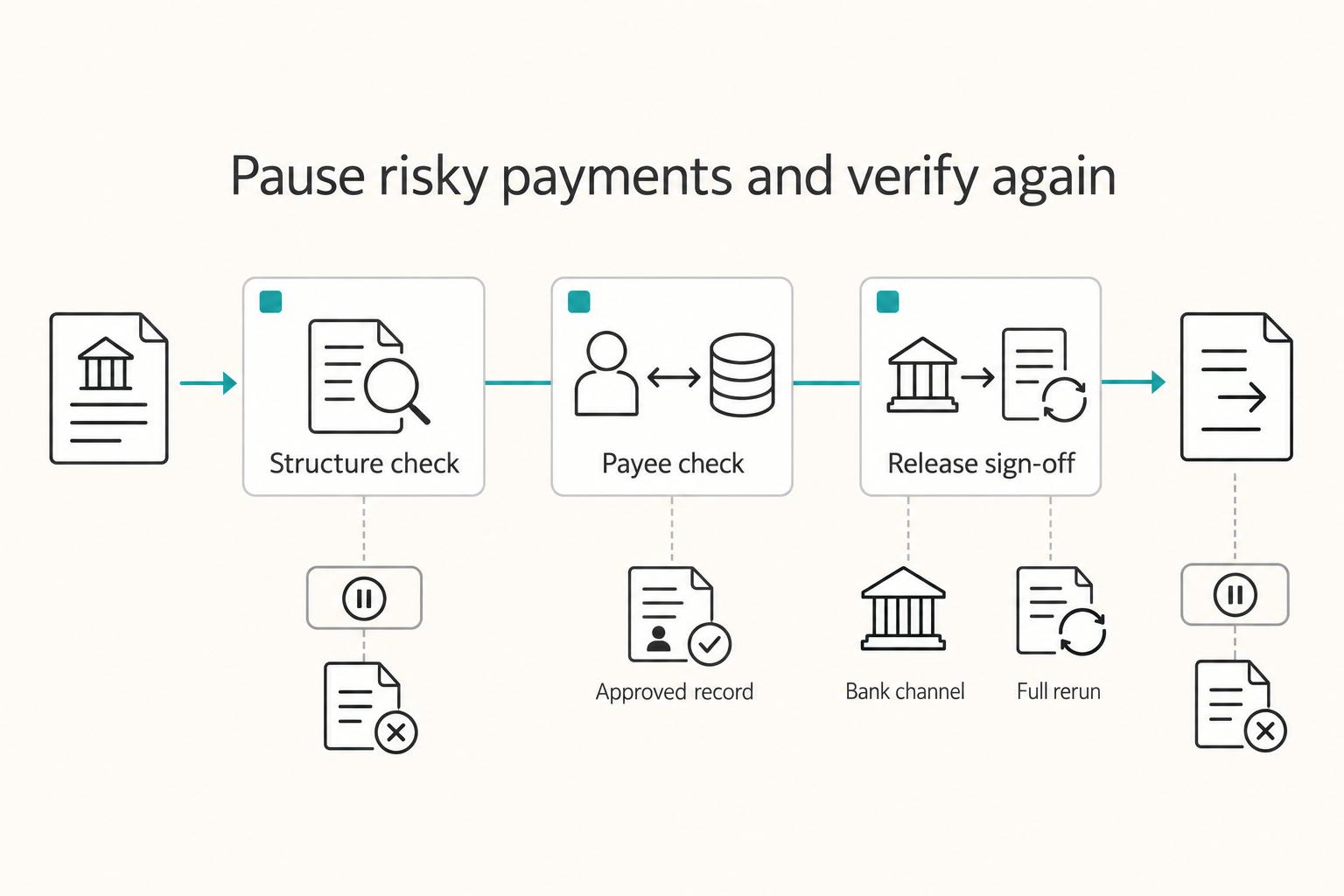
What is an IBAN and How is it Different from a SWIFT Code?
For people handling high-stakes international payments, uncertainty is expensive. Not knowing whether a wire will arrive on time, or at all, pulls attention away from the work and adds avoidable risk. The fix is not another generic template. It is a repeatable process that tells you which details matter, where to get them, and how to check them before money moves.
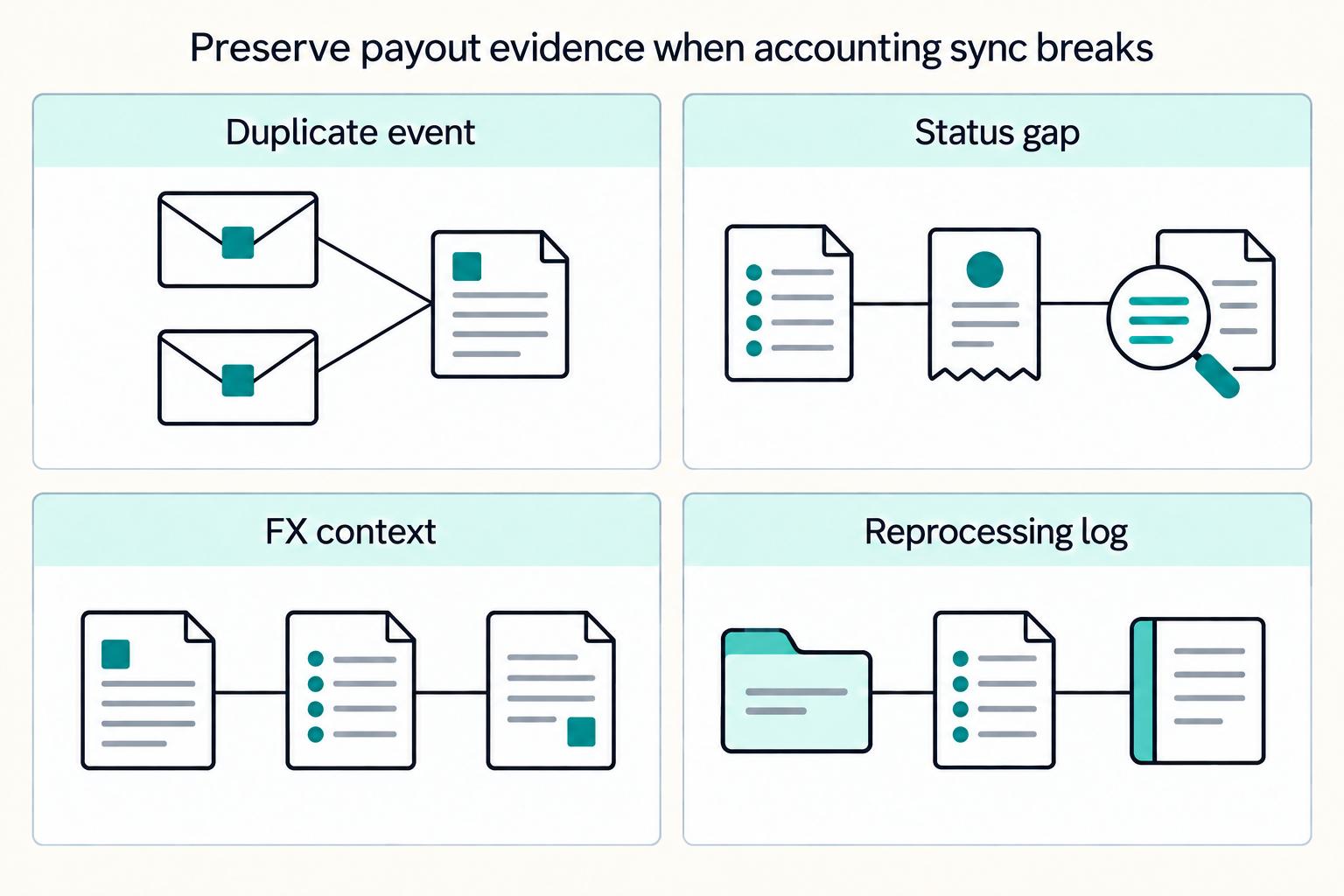
Xero + Global Payouts: How to Sync International Contractor Payments into Your Accounting System
Treat this as a disbursement-sync problem, not a receivables setup task. Xero has clear ways to help customers pay invoices and, in some cases, to pay certain supplier bills. That is not the same as running outbound contractor payouts across countries, currencies, and payout methods end to end.

What Is a SWIFT Code (BIC)? Bank Details for International Payouts
A contractor sends an IBAN and a SWIFT code. Your payout provider also asks for a currency, beneficiary name and sometimes an intermediary bank. Those fields serve different purposes. Copying a plausible bank code into every routing field can turn correct account details into an instruction the receiving bank cannot use.