
Quick Answer
To terminate an international contractor safely, follow the contract, document the reason and deliverable status, send provable written notice, handle approved and disputed payments separately, and immediately secure access, IP, and records. The article recommends a three-stage process: set exit terms early, execute the separation cleanly, then confirm handover, ownership control, and account lockdown.
Terminating a Contractor Feels Personal and Risky. Here's How to Make it a Professional, Secure Process.#
When you terminate an international contractor, treat it as a controlled legal and operational event, not a one-off conversation. A messy exit can trigger five risks at once:
- contract breach exposure
- IP or work-product control disputes
- access and security gaps
- payment and non-performance disputes
- reputation damage
The legal risk runs both ways. A breach is a failure to perform contractual obligations, and in cross-border contracts that can include late or defective performance, not just total failure. If you ignore your own termination terms or delay final payment when it is due, you can create damages exposure and a dispute over what was owed and delivered.
The operational risk is just as practical. Paying for contractor output does not automatically mean you own it in every scenario, and work-made-for-hire treatment is limited. Before you end access, make sure your contract file is complete. That means clear IP assignment terms, the current statement of work, acceptance records, and documented handover of files and credentials.
Security risk can increase during separation. Authorized users can still create insider risk, so account management should be tied to termination events. Use a verifiable access checklist across email, cloud storage, repos, design tools, password vaults, project boards, and shared drives. Also remember that removing access may not address data that was already copied or forwarded.
Payment and enforcement need the same discipline. Late payment can itself be non-performance, and statutory late-payment consequences can apply in some jurisdictions. If your contract uses arbitration, foreign awards are handled under the New York Convention framework, so poor offboarding decisions can have cross-border enforcement consequences.
Whether you have a legal department or not, you need a repeatable process because you are making legal, finance, and operations decisions yourself. The next three stages follow the same logic you will use in practice: set the exit terms early, execute the separation cleanly, then lock down assets and records. You might also find this useful: How to Pay International Contractors With Fewer Delays and Disputes.
Stage 1: Pre-emptive Safeguards - Building the Exit Ramp from Day One#
The easiest termination is the one your documents already anticipated. In cross-border contractor relationships, your contract should already cover three things: how termination works, who owns the work product, and what records count as performance evidence.
Cross-border risk is often predictable. First ownership of IP is not harmonized, and some drafting choices can increase classification risk. Your goal in Stage 1 is practical, not theoretical. You want terms you can operate, document, and enforce without improvising later.
Write the termination section like you expect to use it#
A usable termination clause reads like an operating procedure, not a single sentence. State how either party can terminate, what written notice must include, whether a cure process exists for breach, and how accepted and in-progress work are handled at termination. Keep no-fault termination separate from breach termination:
- For convenience (without cause): either party can exit for any reason with written notice.
- For cause: tie termination to your contract's breach terms, with cure wording only after jurisdiction review.
| Design choice | What to define now | Why it matters later |
|---|---|---|
| For convenience vs. for cause | Define both routes separately and confirm each party can use them | Helps avoid arguments about what qualifies as breach |
| Notice window language | Use a specific written notice period (typical convenience range: 14 to 30 days) | Specific language lowers dispute risk; vague language increases it |
| Cure-period handling | State whether cure is allowed, when cure starts, and what counts as cure. Add jurisdiction-specific wording after legal review. | Helps reduce disputes about whether the breaching party had a fair opportunity to fix the issue |
| Payment on termination | Define treatment of accepted work, work in progress, and reimbursable expenses in the contract | Helps reduce end-of-engagement payment disputes caused by missing terms |
Before kickoff, verify that the signed contract answers four questions in plain language: who can terminate, how notice is sent, whether cure applies, and how final amounts are handled.
Lock down ownership with assignment, not assumptions#
Do not assume you own contractor-created work unless the contract says so. In the UK, Germany, China, and the U.S., contractor-created IP is generally owned by the contractor unless rights are assigned.
Use clear assignment language for new project output. If the contractor keeps pre-existing materials, define that license scope so reuse and modification rights are explicit.
For U.S. commissioned works, work-made-for-hire is limited and requires a signed commissioning agreement. Do not rely on that language alone for contractor ownership. Also account for classification risk. In some U.S. states, using work-made-for-hire language with independent contractors can have employment-related consequences, including statutory-employee risk.
If ownership steps are not handled, businesses can face IP leakage, value loss, operational risk, and disputes.
Spell out handover obligations at termination too. Cover delivery of source files, drafts, code, and project credentials, plus a brief handoff record of what was delivered and where it is stored. If you plan to include moral-rights waiver or consent language, add jurisdiction-specific wording only after legal review.
Define performance proof before there is a performance problem#
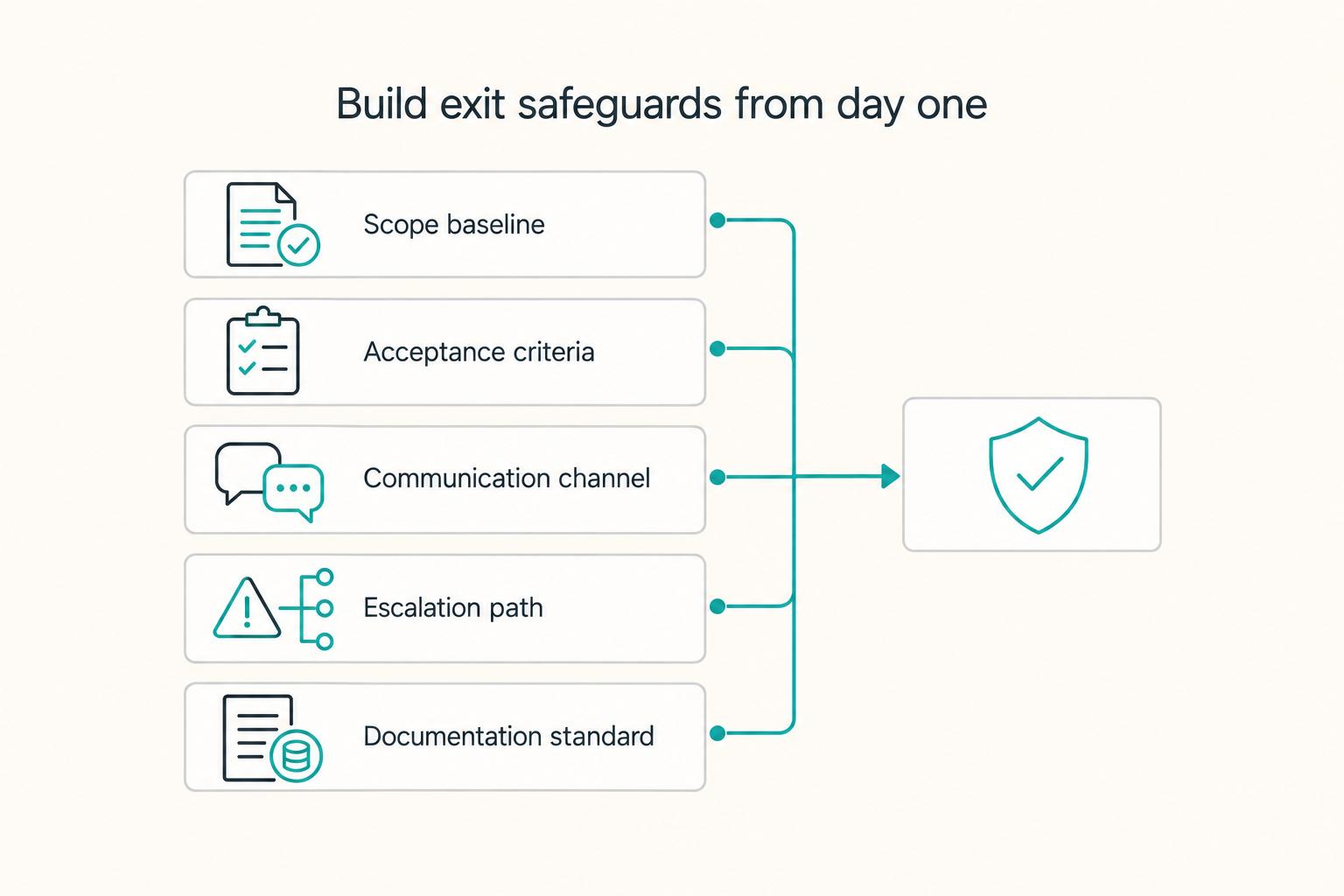
If your evidence is weak, Stage 2 can become harder than it needs to be. Put performance governance in the contract or SOW so any dispute maps back to agreed standards, not memory. Use this checklist:
| Element | What to define |
|---|---|
| Scope baseline | Current SOW, named deliverables, milestones, and version date |
| Acceptance criteria | Objective definition of "done" |
| Communication channel | Where instructions, approvals, and changes are valid |
| Escalation path | What happens when deadlines slip or quality concerns appear |
| Documentation standard | How updates, feedback, and acceptance decisions are recorded |
Checkpoint: an outside reviewer should be able to identify the latest scope, the acceptance standard, accepted versus rejected work, and prior warnings from your file alone. If that record is incomplete, fix it before kickoff.
With those pieces in place, the actual termination becomes an execution exercise instead of an argument about what the deal was. Related: Deel vs. Remote: A Comparison from the Freelancer's Perspective. Before your next engagement starts, turn your checklist into stronger contract language with a freelance contract generator.
Stage 2: The Execution Protocol - A Step-by-Step Guide to Professional Separation#
Once you decide to end the engagement, speed matters less than control. Run this sequence in order where appropriate: dossier, written notice, live conversation, then payment and records.
Build the dossier#
Build the file before you send anything. Your dossier should let a third party understand the decision from documents alone. Collect and organize:
| Dossier item | Collect and organize |
|---|---|
| Contract file | Signed contract and current SOW or milestone version |
| Evaluation standard | Acceptance criteria used to evaluate work |
| Performance record | Dated performance feedback and prior warnings |
| Written communications | Relevant written communications |
| Deliverables status | Approved deliverables, rejected deliverables, and pending items |
| Billing and handover | Invoice status and any handover obligations |
Use an evidence standard for every entry:
| Label | What it is | Example |
|---|---|---|
| Fact | Verifiable event tied to contract terms, scope, or dates | "Milestone 3 due 4 March, not delivered as of 12 March." |
| Opinion | Context or judgment that is not independently verifiable | "Communication felt slow." |
Anchor each fact to the clause or expectation it relates to. If you are using a for-cause path, map each issue to a specific contractual failure, such as delivery, progress, or another provision. Avoid framing minor issues as material breach. Also check governing-law and mandatory local-rule constraints before relying on notice, cure, or breach language.
Draft and send the notice#
The notice should be written before the call, and sent in a way you can prove was received. Include these core elements:
- Contractor legal name and address
- Contract identifier (title, number, or date) and clause invoked
- Termination route and effective date
- Scope impact (full or partial termination, with exact scope)
- Brief factual basis (if for cause)
- Cure language, if applicable, aligned with the contract and governing law
- Handover instructions (files, credentials, work in progress)
- Final payment process, including separate handling for disputed items
Use the route that matches your contract:
| Route | Use when | Notice emphasis | Timing |
|---|---|---|---|
| For convenience | You are ending the relationship without alleging breach | Clause invoked, effective date, scope ending | Follow contract notice terms |
| For cause | You are alleging material or fundamental non-performance | Breached provision, supporting facts, prior warnings, cure status | Follow the contract's cure and notice process, and check mandatory local rules |
Keep the story consistent. Your notice, your file, and your later payment record should all line up.
Hold a live conversation (if appropriate)#
Keep the call short and procedural. The goal is clarity, not persuasion.
- Opening: confirm time, and confirm notice receipt (or immediate delivery)
- Decision statement: state termination decision, route, and effective date
- Logistics: cover handover steps, access return, and payment process
- Close: confirm written follow-up and end the call
Use a few guardrails to keep the call from expanding into a dispute:
- Do not relitigate the full history on the call
- Do not add new reasons beyond the written notice
- If the call turns argumentative, repeat that next steps are controlled by the written notice and request written responses
- Keep language contract-focused, especially where worker-status issues may be sensitive
Close payment and confirmation records#
Do not mix approved work and disputed work into one fight. Settle approved work under the contract terms, and move disputed items onto a separate track. Run this closeout checklist:
- Pay approved and accepted items on the agreed path
- Split disputed items into a separate line-item track
- Require support for disputed amounts that maps to milestones, hours, or deliverables
- Move unresolved disputes into the contract's dispute process
- Send a written confirmation record with notice date, effective date, approved amount paid, disputed balance, and outstanding handover items
This protects defensibility and keeps the offboarding process moving even when one part of the account is still contested. Once notice and payment are under control, the last job is protecting the business from loose access, missing assets, and fuzzy records. If you want a deeper dive, read Germany Freelance Visa: A Step-by-Step Application Guide.
Stage 3: The Post-Termination Lockdown - Securing Your Assets and Reputation#
At separation, move immediately into lockdown. This is where you confirm that the business, not the departing contractor, controls the digital assets and records that matter.
Revoke access by role, not by app#
App-by-app shutdowns can miss things. Use a role-based checklist so handover and access changes stay coordinated.
| Checklist area | What it covers | Verify before changes |
|---|---|---|
| Access inventory | Accounts, credentials, and tools tied to the work | Your business controls admin and recovery paths |
| Work product and records | Files, decisions, and project history needed for continuity | Materials are accessible without contractor credentials |
| Ownership control | Confirm business ownership and primary admin control where applicable | Ownership status is documented |
| Open-risk review | Unresolved items, shared access, or dependencies | Each item has an owner and next step |
- Access inventory: accounts, credentials, and tools tied to the work.
Verify before changes: your business controls admin and recovery paths.
- Work product and records: files, decisions, and project history needed for continuity.
Verify before changes: materials are accessible without contractor credentials.
- Ownership control: confirm business ownership and primary admin control where applicable.
Verify before changes: ownership status is documented.
- Open-risk review: unresolved items, shared access, or dependencies.
Verify before changes: each item has an owner and next step.
If ownership transfer is not verified, do not assume that removing access solved the risk.
Use the right access-removal method for each system#
The right method depends on control and continuity. Choose the least risky option for each system, then verify access from your side after every change.
| Method | Use when | Benefit | Tradeoff |
|---|---|---|---|
| Disable account | Account is business-owned and temporary recovery may be needed | Fast containment with a rollback path | Can interrupt pending handover tasks |
| Remove permissions | Access should be reduced without fully disabling an account | Targeted and less disruptive | Secondary or inherited access can be missed |
| Rotate credentials | Shared credentials were used | Cuts off reused access paths | Can break integrations if dependencies are unclear |
Checkpoint: if your team cannot independently access or administer the system, handover is not complete.
Confirm handover with an acceptance record#
Do not rely on an informal "got it" message. Use a short acceptance record so a third party can see what was delivered, what changed hands, and what is still open. Include:
- Contract-defined deliverables received and accessible
- Ownership or admin transfer status
- Any contract-required return or deletion confirmations
- Unresolved-items log (item, owner, next action, target date)
Where termination for convenience applies, the written notice period is often in the 14 to 30 days range. After that window, track incomplete handover as exception-log items.
Close with a short digital handshake#
Send one final closure note after access review and handover confirmation. Record the effective end date, what was delivered, what access changed, what payment was completed, and any unresolved items that remain in the log.
Keep the message neutral and final. Do not introduce new allegations or renegotiate scope. A clean close can help protect your reputation if a future reference request or dispute appears. For related context, see When to Use an Employer of Record for International Hiring.
End a Contractor Relationship With the Same Disciplined Closeout#
You do not need perfect certainty to end a contractor relationship well. You need a disciplined closeout. Use the same three-stage approach every time so the decision stays professional and defensible: contract basis first, then documented communication and payment closure, then access and IP handover.
Follow the signed agreement, not your frustration#
Start with the agreement in your file and terminate on its terms or by mutual agreement. Make sure your notice letter, delivery proof, and final instructions match the agreement title and date, notice method, and end date. Do not treat the contract label as proof of worker status. If the facts are mixed, document the control and independence factors you weighed.
Close payment and records cleanly#
Close payment against completed contractual work, confirm accepted deliverables, and store invoices, payment confirmations, and any holdback rationale together. Keep those records as long as needed to support tax positions and deductions. Use applicable timing rules instead of assumptions. Under EU late-payment rules for business-to-business dealings, businesses generally must pay invoices within 60 days unless the contract expressly sets different terms, and in the UK, payment is late after 30 days if no payment date was agreed. If U.S. worker status is disputed, Form SS-8 is the formal determination path.
Lock down access and confirm IP handover#
Offboarding is not complete until accounts are disabled, assets are transferred, and your team can independently control what matters. Keep one evidence pack with the signed agreement, handover record, repository or file-transfer confirmations, and any return or deletion confirmations. IP outcomes depend on contract wording, and in U.S. copyright law, work-made-for-hire treatment requires explicit written agreement language.
If cross-border classification, tax treatment, governing law, or enforceability is unclear, pause and get local legal or tax review before finalizing. Then run your checklist: confirm notice, payment closure, access shutdown, IP handover, and a complete documentation trail. For a step-by-step walkthrough, see How to Classify a Worker as an Employee vs. an Independent Contractor in the US. If this termination process spans countries, payout rails, or compliance handoffs, you can contact Gruv to review your workflow fit.
Frequently Asked Questions
What should be in a contractor termination letter?
A contractor termination letter should follow the signed agreement and be sent in a verifiable way. Include the contractor or business legal name, agreement title and date, effective end date, the contract basis for termination, handover steps, and final invoice instructions. Before sending, confirm the notice method and contract details against the signed version and check current local requirements if they could affect form or timing.
How do you end the relationship for poor performance without creating a bigger dispute?
End the relationship based on documented contract gaps, not general frustration. Tie missed deadlines, rejected deliverables, or quality issues to the scope, SOW, or acceptance criteria, and keep written feedback plus any cure opportunity your contract supports. Avoid vague statements if your file does not show what was missed, when it was raised, and how the contractor responded.
Do you still have to pay if you are unhappy with the work?
You may still need to pay for completed work under the contract, then handle quality disputes through the contract process instead of refusing payment outright. Separate approved work from disputed items, require support that maps to milestones, hours, or deliverables, and move unresolved disputes into the contract's dispute process. For non-U.S. contractors, W-8BEN can document foreign status, and 1099 filing is generally not required for contractors working outside the U.S.
How do you protect your IP during termination?
Protect your IP by relying on clear contract language and a documented handover. Confirm what files, code, drafts, credentials, and other deliverables were transferred, where they are stored, and whether any return or deletion steps were completed. Do not assume payment alone gives you ownership if the agreement does not say so.
What is the difference between breach of contract and wrongful termination here?
In contractor disputes, the main issue is usually breach of contract: whether either side failed on notice, scope, payment, or handover obligations in the agreement. Employee-style wrongful termination concepts may not apply the same way across countries. The safer approach is to follow the contract and verify current local requirements before finalizing the separation.
What should you watch for if termination could expose misclassification risk?
Termination can expose misclassification risk if the relationship looked employment-like rather than independent. Warning signs include heavy supervision, required training, and intern-like dependence on guidance. Before sending final notice, review the file and contract for control-heavy terms and keep supporting records such as the contract, scope changes, invoices, payment records, feedback trail, and relevant tax documents like W-8BEN.
Try a related tool
Researched and edited by the Gruv editorial team. Gruv builds cross-border billing, payouts, and finance-operations software for global businesses.
Sources
- acquisition.gov/far/49.601-2trusted
- acquisition.gov/far/52.249-8trusted
- cisa.gov/topics/physical-security/insider-threat-miti...trusted
- copyright.gov/circs/circ30.pdftrusted
- copyright.gov/register/se-hire.htmltrusted
- dodcio.defense.gov/Portals/0/Documents/CMMC/AG_Level2_MasterV2....trusted
- dol.gov/agencies/whd/fact-sheets/13-flsa-employment-...trusted
- dot.ca.gov/-/media/dot-media/programs/local-assistance/...trusted
Educational content only. Not legal, tax, or financial advice.
Related Posts

Germany Freelance Visa Application Path for Freiberufler and Gewerbe
Choose your track before you collect documents. That first decision determines what your file needs to prove and which label should appear everywhere: `Freiberufler` for liberal-profession services, or `Selbständiger/Gewerbetreibender` for business and trade activity.
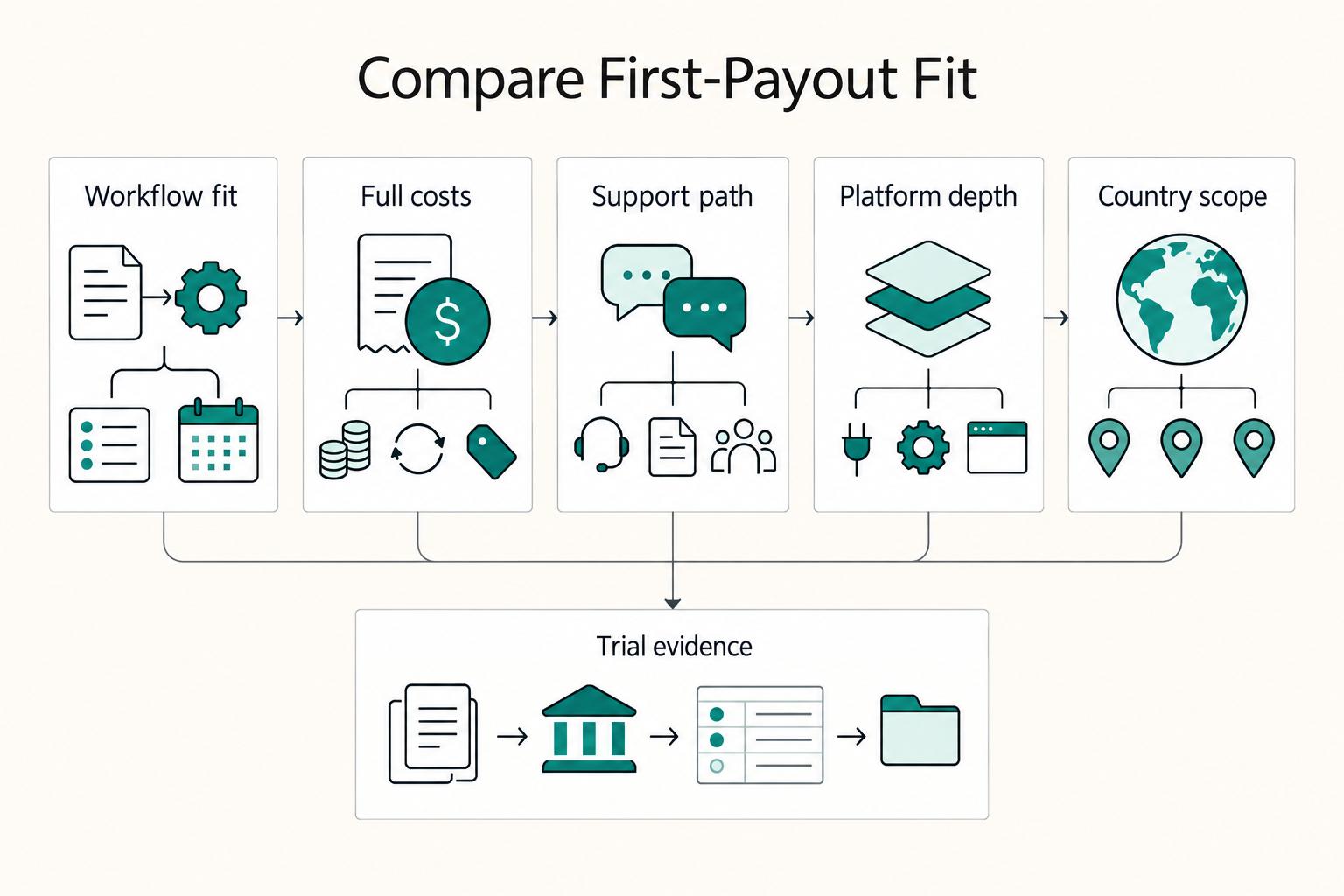
Deel vs Remote for Freelancers Who Need a Clear First-Payout Decision
Choose the platform that makes your first payout cycle predictable and your contracts easier to defend. This is an operating decision, not a brand contest.

The Freelance Payment Penalty: A Modeled Audit of Platform Fees, FX Spreads, and Payout Delays
The money rarely disappears through a single, easy-to-spot fee. The real loss is stacked. A marketplace takes its commission, a processor adds a charge for international cards, a bank or payment company converts the currency at a spread, a platform holds the funds before release, and a wire sheds a little to intermediaries on the way in. Each layer looks defensible on its own, but the worker feels the combined result as a smaller deposit and a later payday.