
Quick Answer
Use both identifiers for many cross-border wires: SWIFT/BIC routes funds to the right bank, and the IBAN points to the exact account. In an iban vs swift code choice, it is often “and” for Europe and many Middle East transfers, not “or.” For US payments, split local transfers (account plus ABA routing) from incoming cross-border wires (account plus SWIFT/BIC), then complete structure and payee checks before submission.
For people handling high-stakes international payments, uncertainty is expensive. Not knowing whether a wire will arrive on time, or at all, pulls attention away from the work and adds avoidable risk. The fix is not another generic template. It is a repeatable process that tells you which details matter, where to get them, and how to check them before money moves.
That process starts with a clear view of how payment details actually route funds. Think of it as a global postal system for your money: you need the building's street address and the recipient's mailbox number. Get either one wrong and you invite delays, fees, and misrouting.
The two core components work together like this:
- SWIFT/BIC Code: The Bank's Global Address. A SWIFT (Society for Worldwide Interbank Financial Telecommunication) code, also called a BIC (Bank Identifier Code), is an 8 or 11-character code that identifies a specific bank within the global financial network. Its job is to route money to the correct financial institution, wherever it is.
- IBAN: The Specific Account's Mailbox. An International Bank Account Number (IBAN) is a longer, country-specific code of up to 34 characters that identifies an individual account within that bank. Originally developed to simplify transfers within Europe, it has been adopted by 89 countries. Its structure includes check digits, which let banks verify the number before processing and help catch typos.
The distinction is simple: one identifies the bank, and the other identifies the account.
| Code Type | Primary Function | Structure | Geographic Use |
|---|---|---|---|
| SWIFT/BIC | Identifies a specific financial institution globally. | 8-11 alphanumeric characters (Bank, Country, Location, Branch). | Universal; used in over 200 countries. |
| IBAN | Identifies a specific, individual bank account. | Up to 34 alphanumeric characters (Country, Check Digits, Account Details). | Mandatory in most of Europe and used by 89 countries worldwide. |
That gives you the rule to apply from here:
The "And, Not Or" Rule: For most international transfers, especially to Europe and the Middle East, you need both the SWIFT code and the IBAN. The SWIFT code handles primary routing to the correct bank. The IBAN provides the final instruction to credit the correct account. Omitting either one is a common cause of failed payments.
Step 1: The Diagnostic - Tailor Your Payment Instructions#
Your first decision is the payment route, not whether IBAN or SWIFT matters more. Start with the destination country and payment rail, then request only the fields that route needs. That cuts down on common return causes like wrong account details and missing country-specific information.
A generic request like "send your bank details" creates avoidable rework. Cross-border payments are processed by route, and the required fields change with the destination and payment context.
Diagnose the route first#
Start with the route, then build the payment instructions around it. If the payer bank form asks for intermediary institution or creditor-agent details, pause and confirm before you finalize the invoice.
- Identify the destination country and the currency the payer will actually send.
- Match it to the route: IBAN-based Europe/SEPA, US domestic wire, US inbound international wire, or another bank-defined country route.
- Request only the exact fields for that route.
- If the payer bank form asks for intermediary institution or creditor-agent details, pause and confirm before finalizing the invoice.
For foreign-currency legs, extra routing fields can be required. If those fields appear, do not guess from an old template.
| Destination market | Required recipient identifiers | Bank-routing identifiers | Common failure point |
|---|---|---|---|
| Europe / SEPA / IBAN-country route | Full IBAN (for routes that require it) | SWIFT/BIC if the payer bank requests it | Missing or truncated IBAN, or assuming one BIC rule applies to every Europe-bound payment |
| United States domestic wire | Account number | ABA routing number | Using the wrong account/routing number |
| United States inbound international wire | Account number | SWIFT/BIC, plus any intermediary or creditor-agent details required by the payer bank | Providing only domestic routing details for a cross-border wire |
| Other country routes | The exact account identifier provided by the receiving bank for that route | Bank-issued international routing details for that route | Reusing an old template without checking current receiving instructions |
Europe has an important nuance. Within SEPA, BIC requirements are reduced in many cross-border cases, but some bank forms still ask for BIC for international payments. The practical rule is to always provide the full IBAN for IBAN-country routes. Include BIC when your bank provides it or the payer bank asks for it.
For US wires, split domestic and international every time. Domestic uses account number plus routing number. Inbound international uses account number plus SWIFT/BIC. If routing details are unclear, verify before sending instructions.
Copyable invoice field blocks#
Use one block per route, not one universal footer. The table below helps you scan the fields quickly; the blocks that follow are the ones you actually paste into invoices.
| Payment block | Field |
|---|---|
| Europe-style payment block | IBAN (for IBAN-country routes) |
| Europe-style payment block | SWIFT/BIC (if provided by your bank or requested by payer bank) |
| Europe-style payment block | Any additional incoming-payment fields exactly as provided by your account-servicing bank |
| US-style payment block | Account number |
| US-style payment block | SWIFT/BIC (for inbound international wire) |
| US-style payment block | ABA routing number (for US domestic wire) |
| US-style payment block | Intermediary institution or creditor-agent details (if requested by the payer bank) |
Europe-style payment block
- IBAN (for IBAN-country routes)
- SWIFT/BIC (if provided by your bank or requested by payer bank)
- Any additional incoming-payment fields exactly as provided by your account-servicing bank
US-style payment block
- Account number
- SWIFT/BIC (for inbound international wire)
- ABA routing number (for US domestic wire)
- Intermediary institution or creditor-agent details (if requested by the payer bank)
Know when to confirm and when to hand off#
Certain situations deserve a pause before you send instructions.
Confirm with the payer's bank before invoicing when:
- They will send in a foreign currency
- Their form asks for intermediary institution or creditor-agent details
- The payer is outside the receiving account's country
If you are working from screenshots, old invoices, or memory, stop and move to Step 2. Your account-servicing bank is the source of truth for IBAN and BIC, and the right place to confirm route-specific incoming wire instructions. Step 2 is where you lock those details into a controlled template.
If you want a deeper dive, read Separating Business and Personal Finances: An Important Step for LLCs.
Step 2: The Acquisition - Your SOP for Securing Information#
Once you know the route, the next control is source quality. This step helps prevent avoidable setup errors by making sure payment details are validated against bank-provided receiving instructions, live in one approved record, and have a clear owner. That helps stop missing beneficiary details, wrong IBANs, unclear references, and outdated instructions from spreading.
Run this SOP every time#
Do the setup the same way every time so you are not rebuilding it from scattered emails or old documents.
| Step | Action | Control |
|---|---|---|
| 1 | Collect payment details through a standard intake and validate once against bank-provided receiving instructions | Validate once against bank-provided receiving instructions |
| 2 | Store approved details in one master record for that receiving account | One master record for that receiving account |
| 3 | Assign one record owner for updates and exception handling | Record owner for updates and exception handling |
| 4 | Publish only approved fields to invoicing/AP from that record | Approved fields only from that record |
| 5 | If anything is unclear or conflicting, pause setup and confirm with the account-holding bank | Pause setup and confirm with the account-holding bank |
Keep one controlled record#
Use one Payment Instructions Master per receiving account, with at least:
- beneficiary name
- recipient country
- route/corridor type
- approved payment fields for that route
- last verified date
- verification note
- record owner
- version note (example:
v3, verified 2026-03-24)
This keeps stale details from old invoices, PDFs, or email threads out of active payment instructions.
| Source input | Intake handling | How to use it |
|---|---|---|
| Bank portal or official bank app | Capture and verify | Record the receiving instructions used for setup |
| Recent official bank statement | Capture and compare | Use as supporting detail and escalate mismatches |
| Bank support reply (documented) | Capture for exceptions | Save written confirmation in the master record |
| Counterparty email | Intake only | Do not finalize setup until details are validated |
| Third-party lookup / IBAN generator | Format hint only | Do not use alone to create or complete payment details |
If any required field is incomplete, unclear, or inconsistent across sources, stop and confirm with the account-holding bank before payment setup proceeds.
Use a corridor-aware intake checklist#
Ask only for the route-specific fields you actually need. That keeps the request clean and reduces the odds of someone filling in the wrong field from habit.
- For IBAN/SWIFT-style routes, generally collect beneficiary name, recipient country, full IBAN, and bank SWIFT/BIC.
- For domestic-format routes, collect beneficiary name, recipient country, and the exact account/routing identifiers shown in the bank's own receiving instructions.
Escalate before finalizing when foreign-currency legs or intermediary-bank details appear.
Control handoff to invoicing and AP#
Once the approved record exists, the handoff should be mechanical, not interpretive. Publish approved field labels exactly as stored (Beneficiary name, Recipient country, IBAN, SWIFT/BIC, plus route-specific domestic labels). Require copy and paste from the master record only, with no retyping and no reuse of legacy templates.
In practice, this is the core risk control. Common failures start when unverified or outdated details leak through templates and email chains, leading to returned payments and AP rework.
Related: Correspondent Banking Explained: Why Your International Wire is So Slow and Expensive.
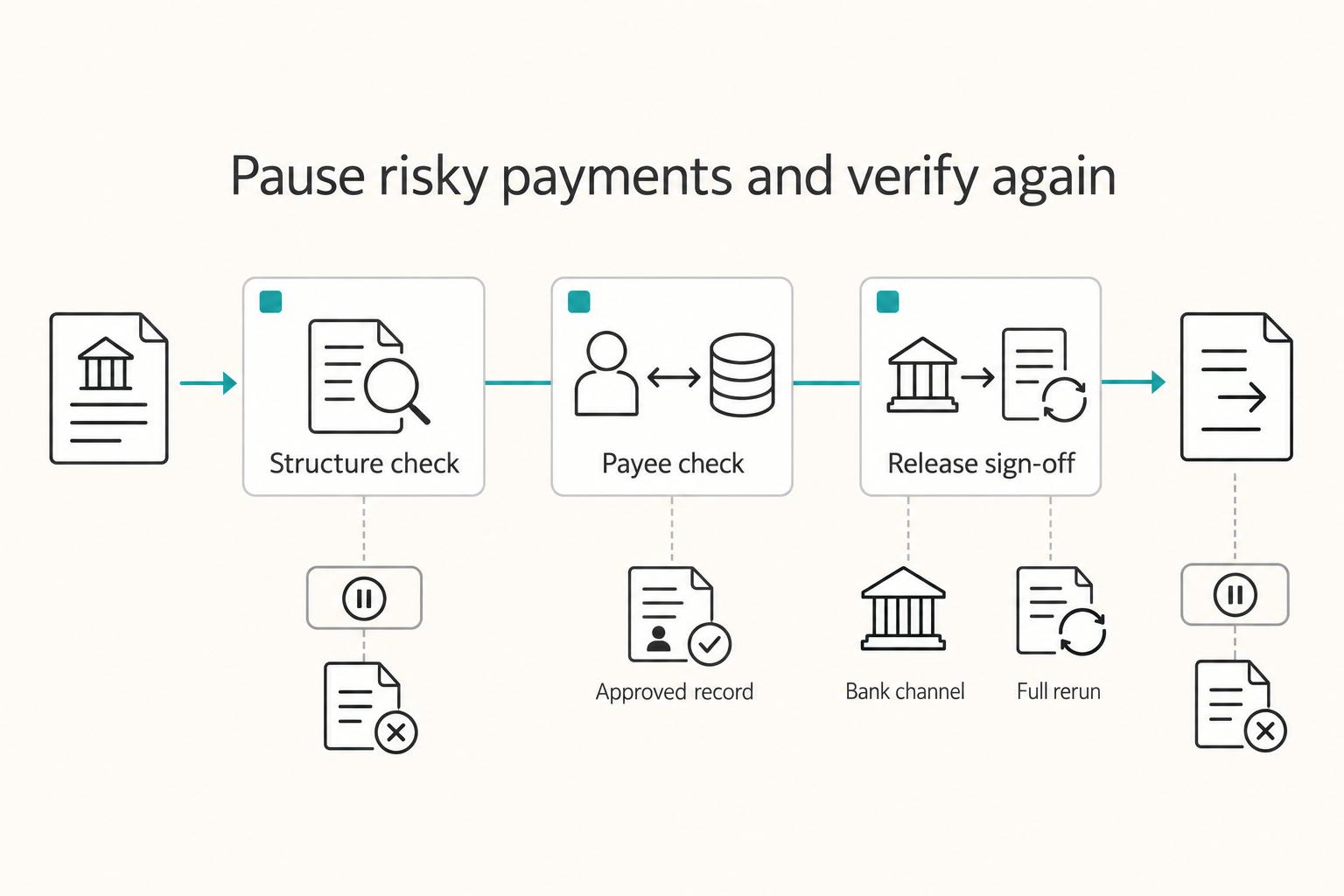
Step 3: The Verification - The Pre-Flight Check to Eliminate Errors#
Before you release any transfer, run the same checks in the same order: structure, payee, sign-off. The sequence is the control. In many payment flows, if a transfer is executed using the unique identifier you submitted, it may be treated as correctly executed even when the destination is not what you intended.
Step 2 gave you an approved record. Step 3 makes sure today's transfer still matches that record and that the intended beneficiary is the one tied to the payment details.
Run this checklist before every release#
- Pull details from the approved record only. Use the approved Payment Instructions Master. Do not pull from old emails, invoices, or PDFs.
- Validate IBAN structure. Use a reputable IBAN validator for country-format checks (IBANs can be up to 34 characters).
- Validate the bank identifier separately. If the route requires SWIFT/BIC, confirm it against the approved record. BIC identifies the payment service provider, and sometimes the branch, not the account.
- Confirm beneficiary identity through official channels. Structural validation is not ownership validation. If your provider offers Verification of Payee, run it before authorization.
- Run two-party confirmation. Sender recaps destination details, recipient confirms in writing, approver signs off before submission.
- Store evidence. Keep the validation note or result, recipient confirmation, and approval record with the payment file.
Know the validator's scope#
Use an IBAN validator for structure checks only. It helps catch format issues, but it does not prove account ownership, account status, or beneficiary-name match.
| Item | IBAN validator | Needed separate step |
|---|---|---|
| Structure checks | Use an IBAN validator for structure checks only | Then run a separate ownership or beneficiary confirmation step through the account-holding PSP or your provider's payee-verification process |
| Account ownership | Does not prove account ownership | Confirm through the account-holding PSP or your provider's payee-verification process |
| Account status | Does not prove account status | Confirm through the account-holding PSP or your provider's payee-verification process |
| Beneficiary-name match | Does not prove beneficiary-name match | Confirm through the account-holding PSP or your provider's payee-verification process |
| Calculator-style tools | Can still output wrong IBANs if the input data is wrong | Do not rely on the tool alone |
Then run a separate ownership or beneficiary confirmation step through the account-holding PSP or your provider's payee-verification process. Treat close-match or non-match outcomes as stop signals. Also remember: calculator-style tools can still output wrong IBANs if the input data is wrong.
Standardize read-back as a formal confirmation workflow#
A short read-back can catch mistakes that slip past format validation. Use it when the name on the invoice, the trading name, and the registered account-holder name are not identical.
- Sender recap: beneficiary name, recipient country, last few IBAN characters, and SWIFT/BIC when used.
- Recipient confirmation: written confirmation from the same official contact channel used during setup, or reconfirmation via the bank's receiving instructions.
- Explicit sign-off: release only after approved confirmation is on record.
Compare failure modes before approval#
| Failure mode | Detection point | Possible operational outcome | Recovery path |
|---|---|---|---|
| Invalid IBAN format | IBAN validator before submission | Transfer may be blocked or rejected | Correct details, revalidate, and resubmit |
| Incorrect SWIFT/BIC for route | Pre-flight check vs approved record and bank instructions | Transfer may fail routing checks, be rejected, or require manual investigation | Re-source from official instructions, correct, and resend if not released |
| Structurally valid but wrong IBAN | Payee verification or recipient confirmation before authorization | Payment may be treated as correctly executed against the provided unique identifier, even if it is not the intended destination | Contact provider immediately; providers must make reasonable efforts to recover funds, but do not assume reversal |
| Payee name and IBAN mismatch | Verification of Payee before authorization | Non-match or close-match warning | Pause, confirm registered account-holder name via official bank channel, and rerun checks before release |
Escalation path for mismatches or high-risk payments#
If you see a mismatch, close match, missing field, or route ambiguity, pause the payment. Re-source details from the approved record and official bank channel. Then rerun full verification before release.
Apply the same pause rule for higher-risk transfers, such as a first-time payment, urgent payment, unusually large amount, or changed beneficiary account. Where available, use Verification of Payee as a pre-authorization control, but do not assume it exists in every corridor.
Use structure checks to catch bad data, payee verification to catch a bad destination, and explicit sign-off to control release.
You might also find this useful: What is a SWIFT MT103 and How to Use It to Trace a Wire Transfer.
If you want fewer manual bank-detail errors on repeat international payments, use a dedicated receiving-details setup as your fallback process: Explore Virtual Accounts.
Conclusion: Diagnose the Route, Acquire Details, Verify Before Release#
Confidence comes from sequence, not familiarity. Cross-border transfers still carry practical risk, so on every invoice and every transfer, use the same order: diagnose the route, acquire details from trusted instructions, and verify before release. Used consistently, this can help reduce avoidable errors, back-and-forth clarification, and payment-review friction.
-
Diagnose the route before data entry. Match your transfer form to the recipient's current incoming-payment instructions instead of reusing fields from an older payment. Apply this today by adding a hard stop to your checklist. If portal fields and instructions do not align, pause and confirm before sending.
-
Acquire details only from controlled, trusted sources. Use official recipient instructions and a licensed, regulated provider, not forwarded screenshots or memory. Apply this today by keeping one approved instruction record per payee, enabling two-factor authentication on the sending account, and treating urgency or unknown recipients as fraud red flags.
-
Verify like a release check, not a quick glance. Triple-check recipient details, review total cost as transfer fee plus exchange-rate markup, and keep confirmation records with invoice approvals. Apply this today by doing a final character-by-character check against the original instructions just before submission.
If you're comparing iban vs swift code, keep the practical rule in mind: treat each requested banking field as distinct and follow the receiving bank's current instructions on exactly which identifiers to provide for that transfer.
Before your next payment, turn these three checks into a reusable SOP or one-page checklist so execution stays calm, consistent, and low-risk.
For a step-by-step walkthrough, see How to Pay US-Based Contractors from Australia.
When you are ready to run invoicing, collection, and payouts in one operational flow, review the freelancer path and confirm market coverage before rollout. Merchant of Record for Freelancers.
Frequently Asked Questions
Is an IBAN the same as a SWIFT/BIC code?
No. An IBAN identifies the specific bank account, while a SWIFT/BIC identifies the financial institution, and sometimes the branch. Treat them as separate fields. An IBAN can be up to 34 characters, and a SWIFT/BIC is 8 to 11 characters, so copy each one from bank-issued instructions.
Do you always need both for an international payment?
No. Depending on the countries and banks involved, you may need IBAN, SWIFT/BIC, or both. Use the receiving bank’s official payment instructions for that specific transfer, then run your pre-flight checks before release.
When are both codes required versus local routing details?
Use both when the receiving instructions ask for both account identification (IBAN) and bank identification (SWIFT/BIC). Requirements can vary by the countries and banks involved. If field mapping is unclear, pause and confirm with the bank.
What if the form asks for local routing details instead of an IBAN?
That can be normal. Depending on the countries and banks involved, payment forms may request different fields. If SWIFT/BIC is requested, use it to identify the bank. If the portal fields do not match the bank-issued instructions, stop and verify before sending.
Does an IBAN replace your regular account number?
No. It is an additional international identifier, not a replacement for your regular account number. If your bank provides both, keep both in your approved payment record and label them clearly to prevent entry errors.
Can an IBAN validator confirm the right beneficiary?
No. A validator checks structure and check digits, which helps catch typos and transposed characters, but it does not confirm account ownership or beneficiary-name match. Use validation first, then confirm beneficiary details through bank-issued instructions or your payee-verification process, and keep that evidence in the payment file.
What is the biggest practical risk?
Relying on format checks alone is a major risk. An IBAN can pass structure and check-digit validation and still be wrong for the intended beneficiary, which can still lead to payment failures. If details changed, a close match appears, or anything conflicts with your approved record, pause the payment, re-source the details, and rerun full verification.
Try a related tool
Researched and edited by the Gruv editorial team. Gruv builds cross-border billing, payouts, and finance-operations software for global businesses.
Sources
Includes 4 external sources outside the trusted-domain allowlist.
- comptroller.war.gov/portals/45/documents/fmr/Volume_11a.pdftrusted
- ecb.europa.eu/paym/target/target-professional-use-document...trusted
- eur-lex.europa.eu/legal-content/EN/TXT/PDFtrusted
- legislation.gov.uk/uksi/2017/752/regulation/90/madetrusted
- chase.com/digital/wire-transfer/faqsexternal
- dfas.mil/Portals/98/Documents/Contractors-Vendors/lef...external
- ecbs.org/iban.htmexternal
- frbservices.org/binaries/content/assets/crsocms/resources/re...external
Educational content only. Not legal, tax, or financial advice.
Related Posts

How LLC Owners Separate Business and Personal Finances
For an LLC, separating business and personal money is best treated as a weekly habit, not a one-time bank setup. It keeps records cleaner, cuts month-end cleanup, and creates clearer boundaries as the company grows.
Why Your International Wire Arrives Late and Costs More
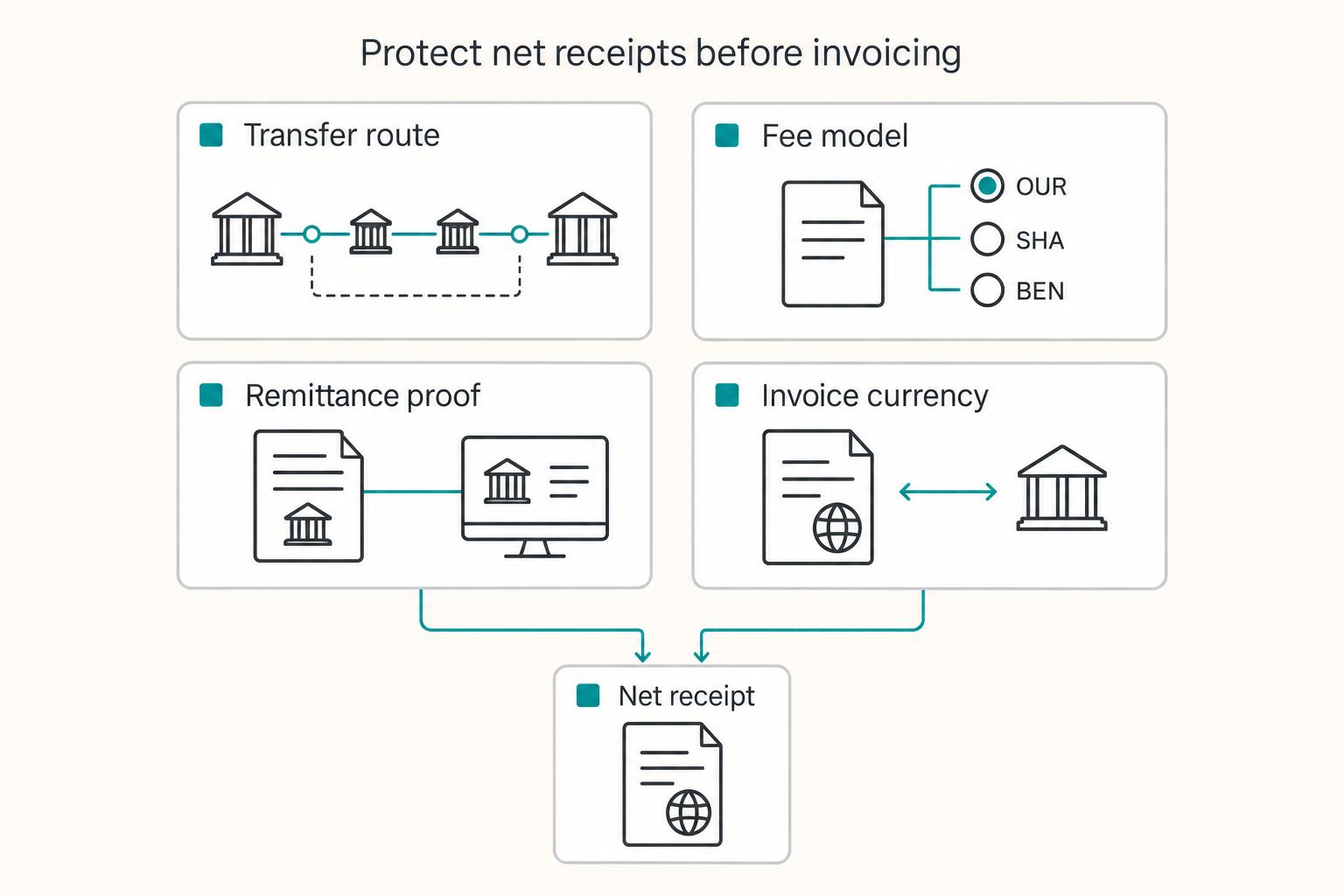
When a client says they paid but your money arrives late, lands short, or is hard to trace, that is a cash-flow risk, not a minor inconvenience. If the amount and timing are uncertain, planning your next moves gets harder.

The Freelance Payment Penalty: A Modeled Audit of Platform Fees, FX Spreads, and Payout Delays
The money rarely disappears through a single, easy-to-spot fee. The real loss is stacked. A marketplace takes its commission, a processor adds a charge for international cards, a bank or payment company converts the currency at a spread, a platform holds the funds before release, and a wire sheds a little to intermediaries on the way in. Each layer looks defensible on its own, but the worker feels the combined result as a smaller deposit and a later payday.