
Quick Answer
Start with a narrow cohort and a defensible claim. Use the primary keyword intent by tying speed promises to visible states contractors already see, such as pending, held, completed, failed, or returned. Launch receive-only when exception handling is still uneven, and move to send-enabled only after support, product, and finance give the same explanation for disputed payouts. Keep fee disclosure before confirmation with gross, fee, and net shown together, then expand only after your evidence trail is complete.
How to Frame Instant Payouts for Contractors#
Instant payouts are not a headline feature first. They are a promise about what your payout operation can actually deliver, explain, and recover when something goes wrong. If that promise is vague, any growth upside can be short-lived, and cleanup can land in support, finance, and contractor trust.
That framing matters more than any broad market claim you could drop into a launch deck. Contractors may care less about whether faster payouts are trendy and more about whether your product language matches the real path from approved earnings to money received, including awkward cases where something is delayed, reviewed, or sent back. A claim that survives exceptions is usually more credible than a louder claim that breaks on first contact with reality.
Before you start#
Start by checking the quality of the evidence behind your message. A common failure is leaning on material that sounds official but does not actually support a current payout promise.
For example, consider the Office of Advocacy progress report, a document published in December 2018 that covers the first 16 months of Regional Regulatory Reform Roundtables from June 2017 through September 2018. That may be useful for showing source limits and recency issues. It is not evidence for how a 2026 instant payout offer behaves. Another case in point is simply a college course catalog, which is an even clearer relevance miss.
That is the practical context for this guide. The problem is not a lack of claims to borrow. It is that payout claims are often built from weak inputs, stale inputs, or inputs that have nothing to do with money movement at all. If you want to pitch instant payouts credibly, use evidence tied to your own operation, your own payout paths, and the contractor experience you can actually support.
A simple readiness test helps. Do not promote what your team cannot explain in plain language. Before you put "instant" anywhere public, make sure you can answer three questions without hand-waving:
- What status labels does the contractor actually see from request to completion, including exceptions?
- What evidence can support see when a payout is delayed, held, failed, or returned?
- What exact path will you use to prove what happened if the contractor says, "You told me this would be instant"?
The verification point is straightforward: ask someone outside payments, often support or ops, to walk through two real or staged payout cases using only the contractor-visible timeline and the internal evidence trail. They should be able to identify the current state, the last meaningful event, and the next action without pulling in a specialist. If they cannot, your message is ahead of your operation.
The failure mode is just as clear. Marketing writes "get paid instantly," but support can only say "please wait while we check with the payment team," and the product shows a generic pending state with no reason or next step. That gap can make the offer feel opaque even if many payouts are fast. In practice, credibility breaks often come from missing evidence paths, not from the existence of exceptions themselves.
So the right opening move is narrower and more useful than a campaign. Align the facts first. Confirm the payout states, the support-visible records, and the exceptions you are willing to explain publicly. If you need the operations side tightened before you write copy, read Invisible Payouts: How to Remove Payment Friction for Contractors Without Sacrificing Compliance. From there, the sequence is simple: get the facts straight, decide where speed actually changes behavior, and only then roll out the message.
Related: Gig Platform Regulatory Radar 2026: 10 Laws That Will Impact How You Pay Contractors.
Prepare the inputs before you pitch anything#
Do not pitch instant payouts until your team can prove what happens, where exceptions appear, and who owns each decision. Use one shared readiness check across product, support, compliance, and finance ops so your message reflects current operations, not assumptions.
| Step | Operator check | Primary owner | Evidence source | Ready signal | Not ready signal |
|---|---|---|---|---|---|
| Step 1 | Build a shared baseline before writing copy | Product or payments ops | Real payout timelines, exception logs, support themes, payout-method mix | Teams align on normal flow, common interruptions, and message constraints (promise, qualify, avoid) | Teams describe the same flow differently or cannot show evidence behind claims |
| Step 2 | Standardize gate language across teams | Compliance with support and product | Review queues, document requests, internal decision reasons, contractor-visible copy | Each gate has one meaning, one owner, and one plain-language outcome contractors will see | Internal shorthand differs by team, so support has to interpret or guess |
| Step 3 | Map market and route eligibility with fallback behavior | Payments ops or engineering | Production route config, country or corridor eligibility matrix, fallback rules, QA screenshots | Public copy matches routes live in production now, plus the fallback when preferred routing is unavailable | Copy reflects roadmap notes, contracts, or test environments instead of live behavior |
| Step 4 | Set a go/no-go evidence pack tied to observable events | Finance ops with engineering | Request event, status updates, settlement confirmation, ledger trace, support macros | For disputed payouts, the team can trace request to final accounting record | Team can show initiation, but not the next state or final ledger outcome |
Step 1: Build the shared baseline. Start with observed payout timelines, repeated exception patterns, and recurring support themes. The output is not a slogan. It is message constraints: what you can promise, what needs qualification, and what should stay out of campaign copy.
Run a quick verification pass: have support and product explain the same five payout cases in contractor-facing language. If the explanations do not match, hold launch messaging.
Step 2: Standardize gate language. Keep gate logic, but remove language drift. If a gate can slow, pause, reroute, or stop payout, align three artifacts before launch copy: contractor-facing text, support macro, and internal reason code.
If those three items do not map cleanly, your message will fragment as volume grows.
Step 3: Map route and market eligibility. A credible pitch needs current supportability, not broad intent. Limit copy to routes and cohorts that are live now, and state fallback behavior when a preferred route is unavailable.
For cross-border readiness context before expanding claims, review Gig Worker Tax Compliance at Scale: How Platforms Handle 1099s W-8s and DAC7 for 50000+ Contractors.
Step 4: Set the go or no-go evidence pack. Launch only when key events are observable end to end: request received, status updated, settlement confirmed, and ledger trace completed. If any point is missing, your team cannot reliably defend payout messaging in a dispute.
For a related implementation pattern, see Virtual Card Issuance for Platform Contractors: How to Give Vendors Instant Spending Power.
Decide where instant payouts actually matter#
Do not roll out instant payouts as a platform-wide default. Prioritize the segments where payout timing is most likely to affect contractor stability, and keep batch as the baseline elsewhere until your own data supports expansion.
In platform work, vulnerability is not evenly distributed. The cited evidence shows many workers rely on this work as a main income source (31% of current or recent workers in the referenced US findings), and platform systems can be opaque or error-prone, so faster access and clearer status handling matter most in specific moments, not all moments.
Step 1: Rank moments by income dependence and vulnerability, not by marketing appeal.
| Segment | Why this can matter first | Signal to verify internally |
|---|---|---|
| Contractors who rely on platform income most heavily | Delays can create higher day-to-day strain when this is a primary income stream | Repeated payout-timing complaints, payout-related support volume, repeat contacts on status clarity |
| Delivery and ride-heavy cohorts | These are common platform work types in the cited market, so exposure can be high | Concentration of timing complaints and payout exceptions by work type |
| Error-recovery cases (for example, correction after a platform-side issue) | Opaque or error-prone system decisions increase trust risk if resolution is slow | Time to resolve payout corrections, reopened cases, repeat follow-up after resolution |
Step 2: Use one decision rule. Expand instant payouts only where your own payout and support data show a clear, repeatable problem tied to payout timing or payout-status uncertainty. If that pattern is not clear, keep batch as default for that segment.
Step 3: Choose default vs paid option by exposure.
- Use instant as default only where the operational flow is stable and you can consistently explain outcomes.
- Use instant as a paid option where urgency exists but demand, risk, or margin impact is still uneven.
- Keep batch as default where impact is weak or exception handling is still inconsistent.
Step 4: Tie messaging to what you can prove. Before launch copy, define one observable outcome per target segment and confirm you can track it reliably. Do not promise exact delivery times, adoption lift, or retention impact you cannot substantiate from your own data.
For a step-by-step walkthrough, see Cash Pickup Payouts for Unbanked Contractors in Cash-Preferred Markets.
Choose your rollout path receive-only first or send-enabled#
Start with the mode you can explain end to end today, then widen access only when your evidence and exception handling stay clear under load. If your team cannot consistently answer "what happened" and "what happens next," start receive-only and treat send-enabled as a later gate.
| Decision | Trigger | Signals reviewed |
|---|---|---|
| Expand | All four stay stable and explainable across multiple reviews | Risk events, completion reliability, support load, and reconciliation quality |
| Hold | One signal worsens but the cause is known and contained | Risk events, completion reliability, support load, and reconciliation quality |
| Roll back | Status changes are unexplained, support cannot reconstruct the timeline, or reconciliation mismatches require repeated manual cleanup | Risk events, completion reliability, support load, and reconciliation quality |
Step 1: Choose the entry mode by explainability. Start receive-only when contractors can see clear payout states, but your team cannot yet support contractor-initiated send actions with the same traceability. Move to send-enabled only when support can follow a payout from request to final outcome, exceptions are visible in one place, and the same explanation appears across product, ops notes, and support responses. If you need a sharper filter for where speed is worth added complexity, use Real-Time Payment Use Cases for Gig Platforms: When Instant Actually Matters.
Step 2: Define the expand/hold/rollback gate before launch. Use one fixed review cadence and the same four signals every time: risk events, completion reliability, support load, and reconciliation quality. Expand only when all four stay stable and explainable across multiple reviews. Hold when one signal worsens but the cause is known and contained. Roll back when status changes are unexplained, support cannot reconstruct the timeline, or reconciliation mismatches require repeated manual cleanup.
Step 3: Lock exception ownership before wider access. Document who owns reversals, held funds, duplicate attempts, and delayed updates before you promote broadly. For each path, define the internal owner, system of record, contractor-facing message, and the handoff point from automation to human review. When exception handling is vague, rollout confidence drops and trust erodes faster than adoption grows. For scale implications tied to these controls, see How to Scale a Gig Platform From 100 to 10000 Contractors: The Payments Infrastructure Checklist.
Price instant payouts so adoption and margin can coexist#
Price instant payouts as a trust policy, not a late finance toggle. Decide who pays for speed in a way you can explain before confirmation, defend in support, and apply consistently when payouts hit exceptions.
Digital labor platforms run through apps and websites, and workers often have to trust decisions that can feel opaque. When fee language changes across screens or appears at the wrong moment, contractors read it as unfairness. That risk is higher when platform income is central to someone's finances.
Step 1 Choose a pricing model by cohort, behavior change, and margin guardrail#
Start with one cohort where faster access is most likely to change behavior, then expand only if results hold. Food delivery is a practical early test cohort because it is a common form of digital labor in the US.
| Model | Best use case | Ownership decision | Main failure risk |
|---|---|---|---|
| Platform-funded benefit | You want faster access to drive retention or activation for a defined cohort | Product and finance jointly own eligibility and budget limits | Usage expands beyond the intended cohort and compresses margin |
| Contractor-paid fee | Faster payout is optional and the contractor choosing speed covers added cost | Product owns disclosure, finance owns fee accounting, support owns explanation | The fee feels hidden, unavoidable, or inconsistent across screens |
| Tiered subscription | A repeat-use cohort values frequent access enough to pay regularly | Growth owns packaging, product owns feature gating, finance owns recognition rules | Value feels weak if eligibility, timing, or route coverage varies too much |
Write the expected behavior change in one line before launch. Then set one margin guardrail; the current threshold must be verified from finance records before use. Keep expansion tied to planned evaluation and observed results, not assumptions.
Step 2 Make the amount story identical everywhere the contractor sees it#
Your fee story should match in onboarding, payout confirmation, and support macros. If those versions differ, trust drops quickly.
- In onboarding, say faster payout access may include a fee and standard payout remains available.
- In confirmation, show gross amount, fee, and net payout together before the contractor confirms.
- In support macros, use the same labels shown in product.
- In your evidence pack, retain the pre-confirmation screen, final receipt, ledger entry, and macro used for that payout.
Use spot checks on completed payouts before broader promotion. If gross amount, fee, or net payout language does not match across artifacts, hold expansion until it does. For a UX pattern that reduces friction without hiding key details, see Invisible Payouts: How to Remove Payment Friction for Contractors Without Sacrificing Compliance.
Step 3 Write exception rules before marketing the headline price#
Define exception policy before you scale promotion. Most trust damage happens in retries, holds, and cross-border or Merchant of Record scenarios.
- Retries and timeouts: charge once for one intended payout action, and prevent duplicate fee collection on replay or manual retry.
- Holds and reviews: if funds are held, do not treat the speed fee as earned while faster access is not delivered.
- Cross-border or Merchant of Record scenarios: keep separate eligibility and pricing language when coverage, timing, or setup differs from domestic flow.
If support cannot explain these cases without escalating, delay broad promotion. Recheck economics with the same discipline you used for rollout scope in How Platforms Can Offer Instant Payouts as a Premium Feature Without Margin Surprises.
You might also find this useful: Offer Instant Payouts Without Taking on Float Risk.
Write messaging that sells speed and sets real expectations#
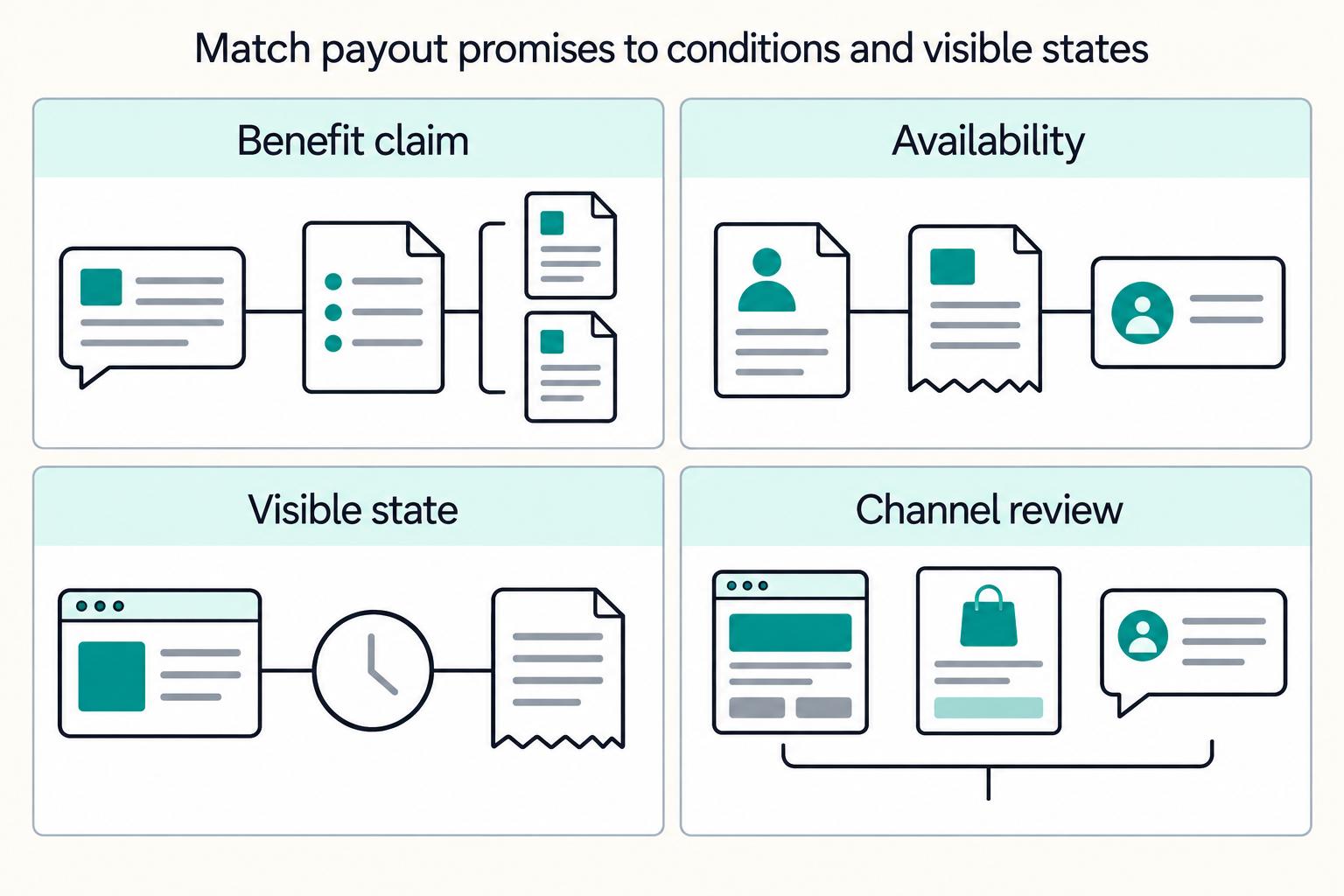
Once pricing is clear, your messaging should do one thing: present the speed benefit without promising outcomes your flow cannot always deliver. The most reliable pattern is claim + qualifying condition + user-visible state in every channel.
Step 1 Build each pillar as claim plus condition plus state#
Keep the same four pillars, but force each one into the same structure before it goes live.
| Message pillar | Benefit claim | Qualifying condition | User-visible state |
|---|---|---|---|
| Faster access to funds | "Get funds faster" | "when faster payout is enabled and available for your account" | Eligible, in review, or unavailable |
| Clearer status language | "Track what's happening" | "based on the status shown in your payout flow" | Pending, held, failed, completed |
| Predictable eligibility | "Know if you can use it" | "based on account and program eligibility" | Eligible or not eligible |
| Fewer payout surprises | "See what to expect before confirming" | "when your current status and availability are shown clearly" | Pre-confirmation status and post-confirmation status |
Example: "Get funds faster when faster payout is enabled on your account" is defensible. "Get paid instantly" is not.
Step 2 Apply claim guardrails before publishing#
Use this mini-framework in copy review:
- Allowed language: faster access, when enabled, where supported, availability varies by program, pending, held, failed, completed
- Required qualifiers: account eligibility, route/program availability, and the exact status label shown in product
- Prohibited unless internal evidence threshold is met: Confirm the current evidence threshold from internal source records before using claims such as instant for everyone, always available, no delays, guaranteed every time
If a line sounds too good to be true, tighten it.
Step 3 Keep tiered wording consistent across touchpoints#
Tiered communication works only if each cohort sees consistent wording across landing copy, product UI, and support replies.
| Channel | Cohort-aware requirement | Launch check |
|---|---|---|
| Landing copy | Promise speed with qualifiers that match each offer tier | Headline and subhead match real eligibility rules |
| In-product text | Show current state in plain language for that user's tier | Status labels in UI match actual flow states |
| Support macros | Explain exceptions with the same terms used in product | Macro wording matches current screenshots and UI labels |
Review these artifacts side by side for one eligible user and one in-review or non-eligible user. For more on trust-preserving language, see Invisible Payouts: How to Remove Payment Friction for Contractors Without Sacrificing Compliance.
Step 4 Rewrite broad promises into defensible value#
- Before: "Cash out instantly anytime."
- After: "Choose faster payout when available. You'll see your payout status in app before and after confirmation."
The second version still sells speed, but it sets expectations your product can actually support.
Need the full breakdown? Read Scheduled, Same-Day, and On-Demand Instant Contractor Payouts: Economics, Rails, and Rollout.
Put controls in place before scaling promotion#
Before you scale promotion, confirm your controls can clearly explain eligibility decisions and exceptions; if that is unclear, scale will magnify trust and operations risk.
| Control | What to verify | Grounded reason |
|---|---|---|
| Eligibility and classification review | You can explain why a contractor is in or out of the offer, and who reviews edge cases | Questions about who is inside the labor-law framework are treated as critical and fundamental, and newer work models have increased disputes over employee definitions |
| Algorithmic decision checks | Automated decisions are visible, reviewable, and not treated as unquestionable | Platform algorithmic management is described as potentially opaque, error-prone, and discriminatory |
| Messaging controls | Frontline teams use clear talking points, not improvised or rigid scripts | A sales script is a conversation guide with clear talking points, and mechanized pitching is a known trust failure mode |
| Scale discipline | Expansion is staged, with controls proven before wider promotion | Digital labor platforms expanded quickly (142 in 2010 to over 777 in 2021), so weak controls can compound fast |
- Make eligibility decisions explainable before you market them.
If your team cannot explain why someone qualifies, narrow the rollout until it can. Keep a clear review path for borderline cases so decisions are not just "system said no."
- Treat automation as assistive, not final.
Where rules or models affect access, require a visible rationale and exception handling. Opaque decisions are exactly where trust breaks first.
- Lock message discipline across product, support, and campaigns.
Use shared talking points so the promise stays consistent everywhere a contractor sees it. Keep language natural and specific, not robotic.
- Scale only after controls hold under real volume.
Platform growth can happen quickly, so promotion should follow proven control behavior, not lead it.
With these controls live, early rollout becomes a measured expansion instead of a messaging gamble.
Run the first 30 days with hard checkpoints#
Use the first 30 days as a controlled learning cycle, not a scale-up sprint.
| Checkpoint | What to review | Notes |
|---|---|---|
| Recurring review cycle | Run regular 360 feedback with the people involved in delivery | Keep the cadence consistent so issues and wins surface early |
| Challenge/success depth | Ask detailed questions about both challenges and successes | Focus on what happened and the path that led there |
| Escalation readiness | Confirm your team can respond quickly to unexpected financial situations | Keep escalation ownership clear before widening promotion |
| Human guardrails | Check where automation may remove human connection | Keep an easy path to a real human when contractors need help |
-
Run the same review rhythm every week. Treat checkpoint meetings as a fixed operating ritual, not an ad hoc status update.
-
Review challenges and successes together. Ask detailed questions on both sides so you can see what is working, what is breaking, and why.
-
Pressure-test escalation response. Make sure unexpected financial situations have a clear, fast response path before you expand.
-
Protect the human layer as you automate. Keep support reachable, and avoid automating touchpoints that depend on human trust or motivation.
Conclusion and copy-paste launch checklist#
The close is simple: promise less, prove more. If you cannot explain eligibility, status changes, and exception handling from request through final outcome, do not widen the offer yet.
That matters even more on digital labor platforms, where payment decisions can already feel opaque or error-prone. Faster access to earnings may build trust, but only when the contractor sees the same boundaries in your marketing, product, and support replies.
Step 1. Pick the segment before you pitch the benefit. Start with one contractor moment where timing clearly matters, not your full base. A good first check is whether the cohort is tied to an observable event in your records, such as first successful payout, off-cycle correction, or another case your team can identify without guesswork. If the segment definition depends on broad intent language instead of a real event or flag, tighten it before launch.
Step 2. Lock the policy boundary and get sign-off. Write one short launch note that names who is eligible, who is excluded, which payout paths are in scope, and what users may see if a payout is pending, held, or returned. Add jurisdiction notes only after the current requirement is verified from legal or policy records. Your verification cue is joint internal sign-off from legal and operations to reduce drift into unsupported country, tax, or rail claims. If your memo cites FederalRegister.gov during review, treat it as informational: the site states it is not the official legal edition, and its XML rendition does not provide legal or judicial notice. Verify against the official Federal Register edition or the linked official PDF on govinfo.gov before approval.
Step 3. Match the message to the real experience. Your landing page, in-app copy, and support macros should use the same status names and the same qualifiers, including "when eligible" or "where supported" when those limits are real. A quick review against your product states usually exposes the gap: if marketing says instant but your UI can show pending, held, or returned, the copy is too clean. If you need help tightening the experience without hiding controls, see Invisible Payouts: How to Remove Payment Friction for Contractors Without Sacrificing Compliance.
Step 4. Prove traceability before promotion grows. One payout should be explainable end to end in your own records: request timestamp, eligibility result, visible status changes, final outcome, and any hold or return reason shown to the contractor. That evidence pack is your verification cue. Missing timestamps, conflicting statuses between ledger and UI, or support notes that use different reasons than the product are not cleanup items after launch. They are launch blockers.
Step 5. Expand only after the first cohort stays explainable. Review usage, exceptions, and support contacts together, not as separate dashboards. If usage rises but exception handling, trust complaints, or manual reviews rise with it, hold the rollout and fix the boundary or message first. Expansion is earned when your team can still answer "Where is my money?" with one consistent explanation across finance, product, and support. If the next question is reporting or contractor documentation, read Gig Worker Tax Compliance at Scale: How Platforms Handle 1099s W-8s and DAC7 for 50000+ Contractors.
Copy-paste launch checklist#
- Step 1: Name one target contractor segment tied to a real payout event or flag.
- Step 1 verification: Confirm the cohort can be pulled from your records without manual interpretation.
- Step 2: Document eligibility, exclusions, supported payout paths, visible status states, and any jurisdiction-specific requirement once verified from legal or policy records.
- Step 2 verification: Get legal and operations sign-off on the same launch note; if FederalRegister.gov is cited, verify against the official edition or official PDF on govinfo.gov.
- Step 3: Align landing page, in-app copy, and support macros to the exact status language shown in product.
- Step 3 verification: Check that no channel promises a cleaner outcome than the real flow.
- Step 4: Assemble one payout evidence pack with timestamps, status transitions, and exception reasons.
- Step 4 verification: Confirm ledger, UI, and support notes tell the same story.
- Step 5: Hold, expand, or rollback based on early usage plus exception and support signals.
- Step 5 verification: Make sure every team can answer "Where is my money?" the same way before widening access.
Need the controls side? Read the compliance piece above. Need the tax and reporting side? Use the compliance-at-scale guide before you expand.
Related reading: SEPA Instant Credit Transfer for Euro Payouts.
Frequently Asked Questions
How do I pitch instant payouts without sounding generic?
Lead with the contractor outcome, then state the limit in the same sentence: faster access to earnings, clear status updates, and visible eligibility where supported. If your copy says "instant" but users often see pending, held, or returned states, tighten the promise before you promote it. That matters because workers on digital labor platforms can already face decisions that feel opaque or error-prone, so vague speed claims can reduce trust instead of building it.
What messaging usually improves adoption first?
Speed-only copy may not be enough. The message is often stronger when you pair faster access with what the contractor will actually see next, such as eligibility before confirmation and a plain status trail after submission. If you are still deciding where to lead with this offer, start with the segments outlined in our guide to when instant actually matters, not your broadest audience.
When should we launch receive-only first?
Use a narrower launch when your team cannot yet explain eligibility, timing, hold states, and exception paths in one clean answer. A good checkpoint is simple: ask support, product, and finance to answer "Where is my money?" using the exact same status names shown in the UI. If those answers drift, keep the offer narrow.
What must be ready before enabling faster outbound payouts?
You need traceability before scale. One payout should be explainable from request to final outcome in your ledger, product states, and support replies without contradictory timestamps or missing notes. If you want the experience to feel smoother without hiding controls, this piece on removing payment friction without sacrificing compliance is a useful next read.
How should we frame cross-border contractor payouts if compliance readiness is still uneven?
Do not market cross-border speed as universal. First confirm that you can explain which jurisdictions you currently support, what documentation your process already requires, and what the contractor will see if a payout is held, reviewed, or returned. Keep an evidence pack for exceptions with the contractor's jurisdiction, chosen payout method, timestamped status changes, and the hold or return reason shown to the user.
Should instant payouts be free or paid?
Either model can work if the price and baseline are obvious before confirmation. Trust can break when marketing implies universal free access but the fee, limit, or eligibility rule appears later in the flow. Review your landing page, in-app copy, and support macros side by side whenever pricing changes.
How do we avoid overpromising in marketing copy?
Use explicit qualifiers, publish eligibility clearly, and mirror operational states exactly as they appear in product. A practical check is to compare campaign copy, payout screens, and support templates in one review. If any one of them promises a cleaner experience than your real payout flow can deliver, fix the message before you scale.
Try a related tool
Researched and edited by the Gruv editorial team. Gruv builds cross-border billing, payouts, and finance-operations software for global businesses.
Sources
- acquisition.gov/sites/default/files/page_file_uploads/far-co...trusted
- advocacy.sba.gov/wp-content/uploads/2018/12/What-Small-Busine...trusted
- clackamas.edu/docs/default-source/catalog/current-catalog/...trusted
- congress.gov/crs-product/R47642trusted
- facilities.unt.edu/images/2025_07_unt_design_and_construction_s...trusted
- federalregister.gov/documents/2026/01/21/2026-01009/united-state...trusted
- ftc.gov/news-events/events/2000/12/mobile-wireless-w...trusted
- ftc.gov/system/files/ftc_gov/pdf/compendium-ftc-poli...trusted
Educational content only. Not legal, tax, or financial advice.
Related Posts
Invisible Payouts: How to Remove Payment Friction for Contractors Without Sacrificing Compliance
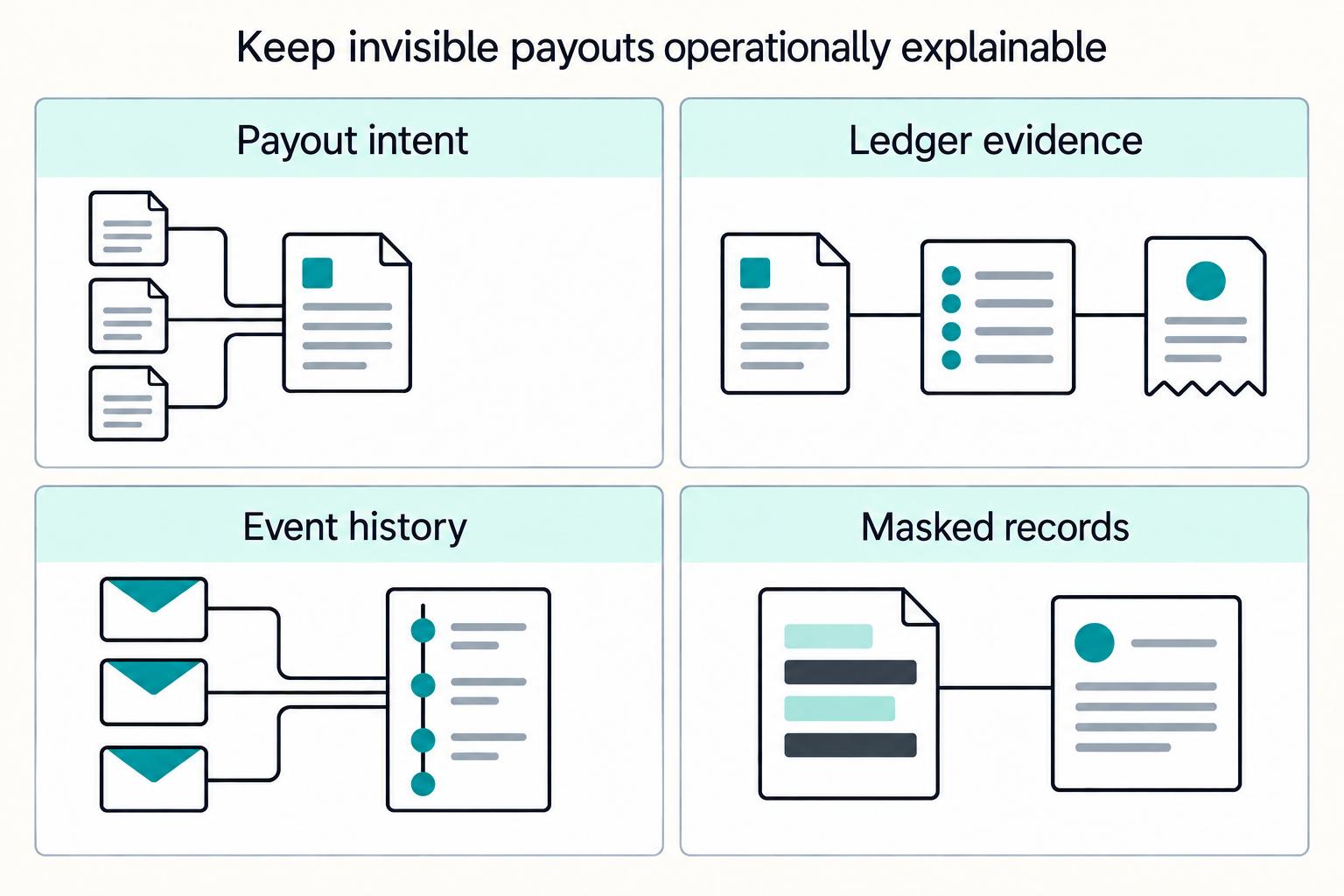
Invisible payouts should make life easier for contractors without hiding the controls your team needs. Contractors should get a predictable, low-friction flow, while internal teams can still enforce and document payout decisions when needed. If you run contractor payouts at scale, you need both outcomes at once. We recommend treating every easy payout as a controlled release path your team can replay later.
When Instant Payout Matters for Gig Platform Payments
Instant payout is a tool, not the goal. The real operating decision is where instant timing creates measurable value, where batch timing is enough, and where both should run side by side.

Gig Worker Tax Compliance at Scale: How Platforms Handle 1099s W-8s and DAC7 for 50000+ Contractors
At scale, the hard part is not the acronyms. It is deciding sequence, ownership, and evidence when Form 1099-K, Form 1099-NEC, Form W-8BEN/W-8BEN-E, and DAC7 do not line up cleanly. If you run a high-volume marketplace, put controls in the right order and define clear stop points where legal or tax takes over.