
Quick Answer
Choose SCT Inst before submission when urgency and confirmed eligibility justify it. Resolve any submitted instruction’s unknown outcome before retry or standard-SCT fallback; the original can report late success even after balance restoration. Keep provider keys scoped and beneficiary availability separate from local posting.
When SEPA Instant Credit Transfer Fits Euro Payout Operations#
SEPA Instant Credit Transfer is real, fast, and operationally useful, but it is not an automatic yes for every euro payout program. The practical question is this: where does instant speed create enough product value to justify the extra validation work before launch?
SCT Inst is the instant euro credit-transfer scheme. Its maximum ten-second execution clock starts at the PSP’s time of receipt, generally authorization, rather than creation of a platform payout request. Standard SCT timing depends on valid receipt and cutoffs; applicable PSD2 rules generally require credit to the receiving PSP by the following business day.
The instant service is available around the clock, with short foreseeable maintenance periods notified in advance. Your platform’s approval, funding and internal reconciliation may add time outside the scheme execution clock.
If your product promise depends on someone receiving euro funds tonight or on a weekend, instant can materially improve the user experience. If it does not, regular SEPA Credit Transfer may still be the cleaner choice.
SEPA coverage is broader than live instant reachability for your account and recipient IBAN. Use scheme participation and provider-specific eligibility together; geography alone does not establish a working route.
Build the right mental model of SEPA Instant for payouts#
SEPA Instant Credit Transfer is an instant euro payout rail, not a complete payout operating model. The EPC scheme defines the rail and rules for instant euro credit transfers in the Single Euro Payments Area, but it does not define your provider routing, exception handling, or reconciliation behavior.
As checked on3 October2026, the current2025 SCT Inst rulebook is version1.2, which replaced1.1 on30 September2026. It delays the unstructured-address sunset without changing the other operational rules. Confirm the active rulebook and implementation guidance for your provider rather than relying on a fixed future expiry.
Your go-live risk sits with your Payment Service Providers. Before promising instant payouts, confirm whether your PSP supports your entity and use case, what happens when instant is unavailable, and how exceptions and final outcomes are reported back to your team.
The common mistake is assuming scheme adherence means identical provider behavior. It does not: implementation can still be uneven, and practical 24/7 back-office support remains a real operational constraint. If fallback, exception handling, and reporting are unclear, treat SCT Inst as an instant-capable rail, not a finished instant payout product. For related background, see SEPA Payments for Platforms: Direct Debit Instant Transfer and Recurring Billing.
Map eligibility and coverage before promising instant payouts#
Do not promise instant until you have verified reachability for your exact payout stack and recipient corridor.
Keep EU legal applicability and actual SEPA reachability in separate columns. The scheme spans41 SEPA countries, including non-EU countries; adherence is not proof of current per-IBAN eligibility for your provider.
The EU regulation’s deadlines depend on PSP category and Member State location. The table below distinguishes bank-type deadlines from PI/EMI extensions. Confirm which regulated entity provides the transfer rather than assigning a single date to every layer in your stack.
Use written checks before go-live:
- Confirm who is actually sending in your stack (bank PSP, sponsored PI, or EMI) for each corridor.
- Verify participant certainty in the EPC Register of Participants, not only in provider marketing.
- Get written fallback behavior, final status signaling, and downgrade handling to SEPA Credit Transfer.
| Stack participant | Confirm for SCT Inst | Confirm for SEPA Credit Transfer | Red flag |
|---|---|---|---|
| Bank PSP | Can originate instant for your entity and target corridors; participant status is verified | Standard euro transfer support and reporting | "Instant-capable" claim without written program-level confirmation |
| Sponsored PI | Whether the PI is the actual sending entity and dependency ownership is clear | Standard SCT path when instant is unavailable | Routing ownership is unclear across dependencies |
| EMI layer | Whether the EMI can receive/originate as required in your model, with documented limits | Settlement and reporting path for non-instant payouts | Supports internal wallet movement but not external payout origination |
Choose standard SCT before submission when instant reachability is unconfirmed, if allowed by your terms. After an instant instruction has been submitted, an uncertain outcome requires resolution before another transfer.
Choose SCT Inst or SEPA Credit Transfer by payout scenario#
Use SCT Inst when payout timing is business-critical and recipient reachability is confirmed; use SEPA Credit Transfer when predictability and batch control matter more than speed.
Compare urgency against confirmed reachability and support. Measure the PSP execution clock separately from approval, funding, API acknowledgement and your own posting latency.
Pick based on urgency, not on scheme availability alone#
SCT Inst fits payouts where delay directly weakens the outcome: creator earnings released after a live event, contractor milestones tied to continued work, or seller disbursements near a cutoff. Central-bank guidance also points to urgent and immediate-settlement use cases.
SEPA Credit Transfer fits low-urgency flows like weekly seller runs, scheduled affiliate payouts, and finance-led batch disbursements. Instant-charge parity under the Instant Payments Regulation helps on pricing, but it does not remove the operational requirement for stronger reachability checks, clearer status handling, and explicit fallback.
Confirm the sending entity and exact recipient path before instruction. Route to standard SCT at that decision point when needed; after submission, resolve the original outcome before any fallback.
| Scenario | Urgency | Recipient expectation | Failure tolerance | Recommended path | Fallback path |
|---|---|---|---|---|---|
| Creator earnings released after event completion | High | Funds should arrive now, including outside business hours | Low tolerance for delay | SCT Inst | Standard SCT only after confirmed original non-execution, with ETA notice. |
| Contractor milestone payout approved same day | High | Fast access may affect willingness to continue work | Medium tolerance if communicated | SCT Inst | Standard SCT if reachability is unconfirmed |
| Marketplace seller weekly batch in a B2B2C model | Low to medium | Predictable settlement window is acceptable | Higher tolerance for next business day | SEPA Credit Transfer | Keep as SCT unless seller opted into instant and is confirmed reachable |
| Affiliate or referral batch payout | Low | Scheduled payment is expected | High tolerance | SEPA Credit Transfer | Resolve original outcome before any batch retry. |
| Urgent treasury-style intercompany transfer | High | Immediate funds positioning matters | Low tolerance | SCT Inst | Standard SCT only if urgency can no longer be met |
Mixed coverage is where policy matters most#
For marketplace payouts across multiple SEPA countries, do not force one rail across all recipients when instant reachability is mixed. Route sellers with confirmed instant reachability and business-critical timing to SCT Inst, and route the rest to SEPA Credit Transfer in the same run.
This is often the practical design because instant coverage is still not available to the same degree in all SEPA jurisdictions. The key risk is a product-level "instant payouts" promise when your evidence only supports part of the recipient base.
Document each payout class with four items: recipient segment, PSP confirmation, fallback behavior, and customer-facing ETA text. If payout timing is business-critical and coverage is confirmed, prefer SCT Inst; if predictability and operational control dominate, prefer SEPA Credit Transfer. We covered this in detail in Instant Payouts: The Economics Behind Same-Day Contractor Payments.
Design the payout flow so retries are safe and auditable#
Design the flow so a retry cannot create a second payout, and a payout is never shown as final until it maps to one internal record plus provider evidence.
Use this order of operations:
- Create one business payout record and atomically reserve initiation.
- Complete required verification of payee before authorization; retain its result.
- Submit one identified attempt and retain the provider reference.
- Resolve authoritative beneficiary availability or final rejection; keep unknown outcomes unresolved.
- Record internal accounting/reconciliation independently; show completed only with beneficiary-funds evidence.
The main failure mode is posting too early. If your product shows "paid" before you have a provider reference and matching confirmation, reconciliation becomes ambiguous.
Use identifiers that survive every handoff#
Treat payout evidence as a pack, not a single field. Store these together for every payout:
- internal payout ID
- request-level identifier or idempotency key used at submission
- provider reference returned after submission
- end-to-end transaction identifier where supported
Keep one business payout record with separate submission attempts. Provider keys apply within a particular account, operation, unchanged payload and retention window; changing rail or provider needs a separate attempt identity after the original outcome is safely resolved. Durable local initiation controls prevent concurrent duplicate attempts.
Keep your message strategy aligned to ISO 20022 and PAIN#
For file initiation, distinguish customer-to-PSP messages from inter-PSP settlement messages. Confirm the exact ISO20022 message versions, required fields and status meanings your provider supports under the active SCT Inst guidance; standard-SCT examples are not universal instant specifications.
Do not assume every PSP uses identical versions or field behavior. Confirm, in writing, the PAIN version, optional fields, and status mappings your provider supports for your program.
Define states and owners before production#
Define states and ownership before go-live so unresolved payouts cannot stall silently.
Track requested, submitted, beneficiary-confirmed, internally posted, rejected and unresolved states separately. Also retain later returns and recall requests/recovery; a recall request is not guaranteed recovery.
- Engineering owns idempotent request handling, PSP submission logic, and event ingestion.
- Payments ops owns exception handling and reconciliation for payouts stuck in
submittedorexception.
Make unresolved payouts age into a visible queue. Your audit trail should show who submitted the payout, which message or file carried it, which provider reference came back, and which reconciliation data was captured. For a deeper format-level breakdown, see Batch Payout File Formats: NACHA ACH ISO 20022 PAIN and SEPA Credit Transfer Explained.
Plan for failure modes before they hit production#
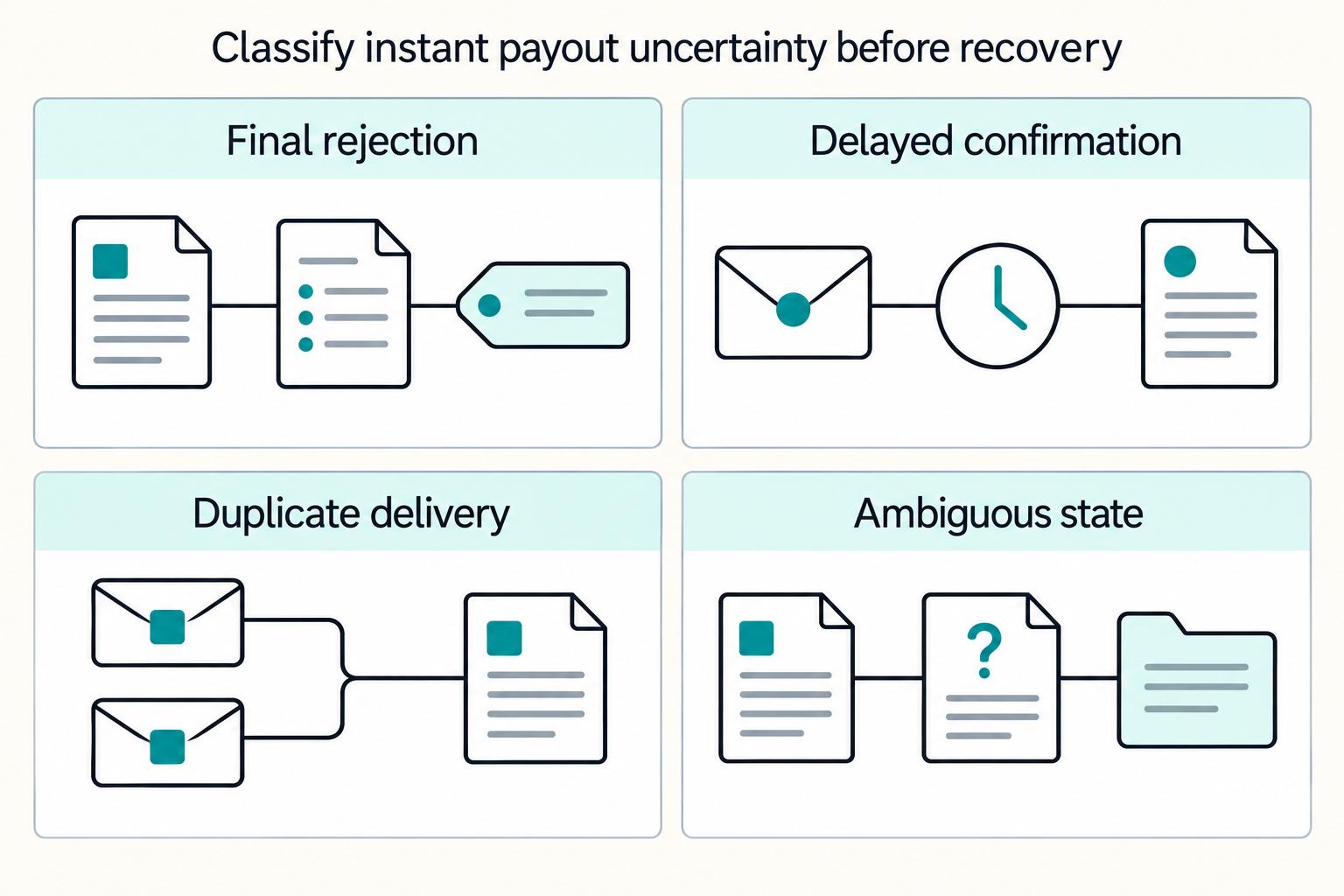
Plan for ambiguity first: for instant euro payouts, the biggest production risk is not a clean reject, but a payout that is neither clearly successful nor clearly failed. If that path is undefined before launch, timeouts, duplicate events, and delayed confirmations become manual cleanup and double-pay risk.
Given the 10 seconds SCT Inst timing context, treat failures as separate classes, not one generic error bucket:
- rejected payout with a final provider status
- delayed confirmation in an asynchronous event flow
- duplicate event delivery during webhook ingestion
- ambiguous final state after submission when the response is missing or timed out
Define retries by state, not by error string#
A submission timeout is an unknown outcome. Query the PSP, preserve the original attempt and use a same-key replay only when the provider contract makes it safe. A changed key or rail must not create another transfer while the first can still execute.
- Before submission, choose an eligible rail and reserve one initiation.
- For submitted or timeout outcomes, query or safely replay the same provider operation; do not start another transfer.
- For beneficiary-confirmed outcomes, repair only internal processing; do not resend payment.
- For final non-execution, permit an approved new attempt after checking the original cannot later settle.
- Keep returns and recall requests as subsequent states with separate recovery evidence.
Deduplicate event receipts by stable event identity and apply the business state change atomically. Read authoritative state/version for out-of-order notifications; the same transfer reference can carry legitimate later return or recall events.
Make fallback explicit, not implied#
Use pre-submission reachability checks to choose a route, subject to your terms. After submission, fallback requires authoritative confirmation that the original instruction was not executed and cannot later settle; timeout or restored balance alone is insufficient.
Illustrative case: a€500 instant payout has no confirmation at the deadline and the payer’s balance is restored. Keep the payout unresolved and query the PSP: the EPC allows a belated positive notification. If success arrives, reconcile the original payment and send no SCT. Create a standard-SCT attempt only after final non-execution is established; retain separate route references under the same business payout and communicate the revised ETA.
Give finance ops daily visibility#
Set a daily exception queue review cadence, define unresolved-item handling before launch, and split reconciliation by provider rather than only total volume. That makes it easier to isolate whether problems are concentrated in rejection rates, delayed confirmations, or event replay noise from one provider.
Also track rejected transactions and ambiguous-state backlog as separate signals, not one blended failure metric. If either rises for a provider, pause volume expansion until you confirm whether the issue is reachability, status mapping, or replay handling.
Align legal and compliance checkpoints with launch gating#
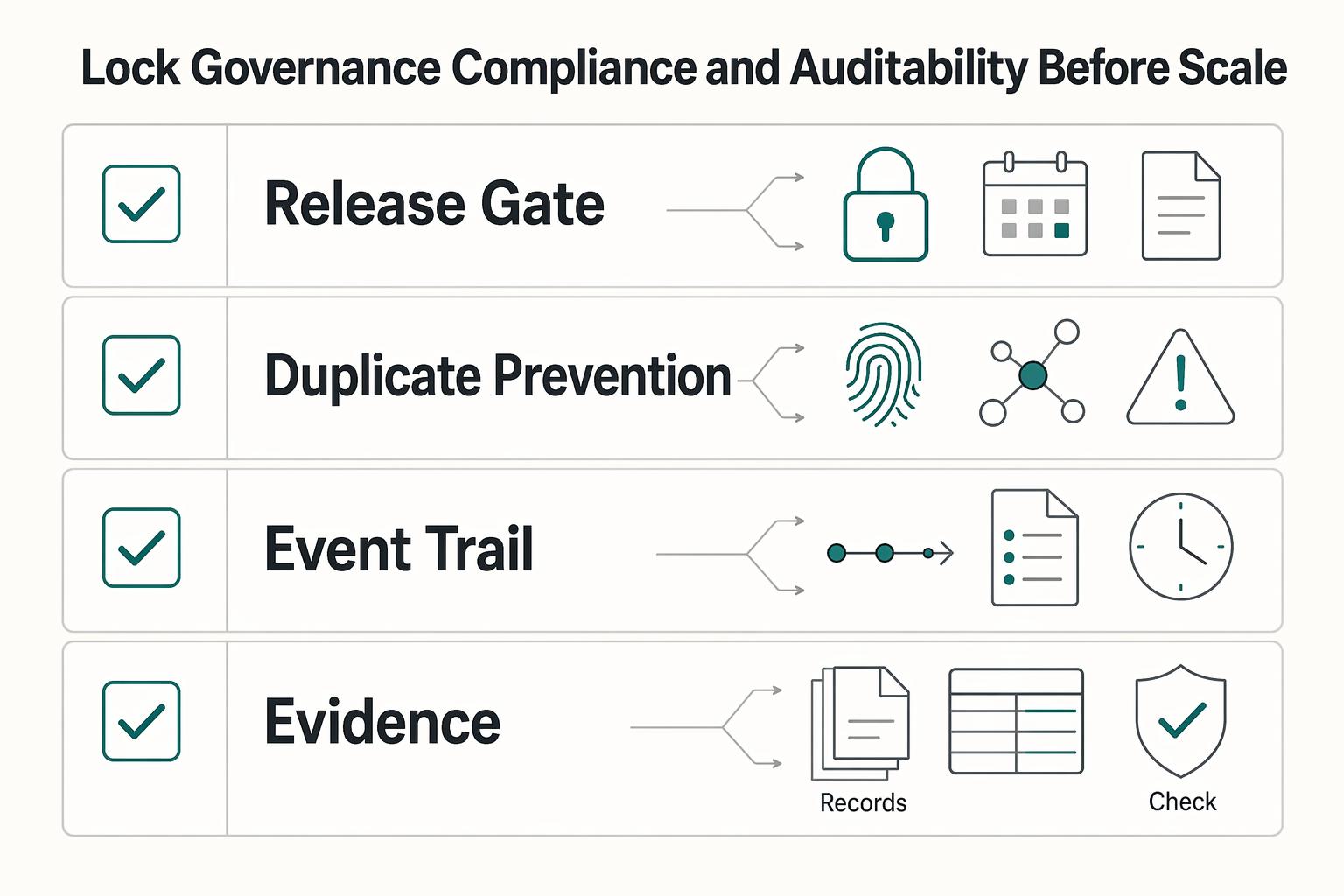
Before scaling, treat legal and compliance sign-off as a launch gate tied to your payout design. Anchor your interpretation in Regulation (EU) 2024/886 (Instant Payments Regulation) together with SEPA Regulation (EU) No 260/2012, because the instant framework amends SEPA rather than operating as a separate ruleset.
Map the applicable obligations to the actual PSP and your own entity. Contracts can allocate operations but do not erase statutory responsibility.
Grounded obligations to map explicitly:
- Map instant-transfer availability and applicable deadlines to the actual PSP.
- Corresponding PSP instant-transfer charges cannot exceed non-instant charges; this is not a universal total-cost promise.
- Apply targeted financial-restriction user checks at least daily and on relevant list changes; other AML/fraud duties remain.
- Verification of payee applies before authorization to both standard and instant credit transfers under the applicable timetable.
For verification of payee, handle match, close match, no match and unavailable results before the payer authorizes. Review a close match or discrepancy under a clear decision policy and show the result; verification checks name/account correspondence, not payment purpose, beneficiary honesty or guaranteed fraud prevention.
Separate EU legal scope from EEA coverage language#
Keep legal applicability and operational coverage in separate columns. Teams often use "EEA coverage" as shorthand for reach, but legal timelines are not a single EEA-wide date.
The European Economic Area includes the 27 EU Member States plus Iceland, Liechtenstein and Norway.
| Scope | Receiving deadline | Sending deadline | Note |
|---|---|---|---|
| Euro-area bank-type PSPs | 9 January2025 | 9 October2025 | Confirm actual scope. |
| Non-euro-area bank-type PSPs | 9 January2027 | 9 July2027 | Confirm actual scope. |
| Euro-area PIs/EMIs | 9 April2027 | 9 April2027 | Category extension. |
| Non-euro-area PIs/EMIs | 9 April2027 | 9 July2027 | Sending deadline differs. |
Confirm location/category applicability and operational readiness separately; a regulatory deadline is not a test result for your program.
Check contracts for gaps, not just compliance labels#
Provider participation in instant schemes does not, by itself, confirm your exact program scope, entity setup, or country coverage on the terms you need. Review executed terms for:
- product and country coverage
- pricing parity treatment
- sanctions-screening responsibility split
- fallback and exclusions for specific payout flows
For launch sign-off, keep an evidence pack with:
- a Eurozone vs non-euro-area coverage matrix
- a legal memo referencing Regulation (EU) 2024/886 and SEPA Regulation (EU) No 260/2012
- executed contract terms or addenda assigning screening, pricing, and service obligations
Run a controlled pilot and score go or no-go#
Run a narrow pilot and treat it as a launch decision, not a soft rehearsal. Keep scope tight: one provider setup, a limited recipient cohort, and success criteria you can review daily.
Measure beneficiary-funds availability from PSP receipt separately from your overall platform latency. Review rejects, uncertain outcomes and notified maintenance alongside speed; a run exceeding ten seconds from internal request creation alone does not establish scheme noncompliance.
- payout completion reliability
- exception rate
- reconciliation effort
- ops workload
If transfer speed looks fine but your team is still manually resolving references or ambiguous statuses, treat the pilot as not passing.
Before each expansion step, confirm a short launch gate:
- coverage certainty for the exact corridor and payout program, not just broad SEPA participation
- SEPA Credit Transfer fallback tested in production-like conditions
- compliance approval aligned with your Instant Payments Regulation interpretation
- production monitoring live for submission, confirmation, rejection, and exception queues
Make exception quality a hard checkpoint. Reason-code discipline in SCT Inst operations means failed or disputed payouts should include the provider reference, your internal payout ID, and the returned R-transaction reason code. If you cannot classify rejects, recalls, or requests for recall quickly, you do not have a scalable operating model.
Set stop conditions before first live traffic. Pause when unresolved exceptions outpace ops clearance, status ambiguity repeats on the same path, or reconciliation breaks exceed your agreed tolerance. Then close with a one-page go/no-go memo signed by product, finance ops, and engineering, with the pilot evidence attached.
Conclusion#
Pilot confirmed reachability, verification-of-payee results, a clean reject and a timeout with late success. Expand only when your team can reconcile the original attempt and prevent a second payment during recovery.
Related reading: Offer Instant Payouts Without Taking on Float Risk.
Frequently Asked Questions
What is SEPA Instant Credit Transfer for euro payouts?
SCT Inst enables instant euro credit transfers. The ten-second execution clock starts at the PSP’s time of receipt, generally authorization. Platform approval, funding and posting are separate stages; a provider acknowledgement alone does not establish beneficiary receipt.
How is SCT Inst different from SEPA Credit Transfer for platform payout operations?
The practical difference is timing. Standard SEPA Credit Transfer can take up to one business day, while the instant rail is built for funds availability in seconds. If payout speed changes user value, use instant where coverage is confirmed. If cost control, batching, or simpler operations matter more, standard SCT is often the better default.
Are SCT Inst payouts available for both domestic and cross-border euro recipients?
Yes, where the actual sending and receiving route supports it. SEPA spans41 countries, but scheme participation and geography alone do not prove current instant eligibility for a particular IBAN and payout program.
Is SEPA Instant effectively 24/7 for payout programs, including weekends and holidays?
At scheme level, yes: instant services are intended to be available 24 hours a day, 365 days a year, including weekends and holidays. That does not remove the need to check your provider's operational windows, maintenance approach, and incident process. If your payout promise depends on overnight or weekend release, verify that behavior in production-like tests, not just sales documentation.
What should we verify first with Payment Service Providers before enabling SCT Inst?
Confirm the originating entity, scheme participation and live recipient eligibility, then obtain provider status definitions and verification-of-payee handling. Agree how unknown outcomes are resolved and when a confirmed non-executed attempt can use another route.
What are the most common operational risks when launching instant euro payouts?
Uncertain outcomes, duplicate initiation and mismapped status can cause double payment. Query the original attempt before retry or fallback, and require beneficiary-funds evidence before showing completed. A local posting or balance restoration alone is insufficient.
When should a platform default to SEPA Credit Transfer instead of SCT Inst?
Choose standard SCT before submission when instant reachability is unconfirmed, urgency is low or your terms call for batching. If an instant transfer has already been submitted, resolve its outcome and establish non-execution before creating the standard transfer.
Try a related tool
Researched and edited by the Gruv editorial team. Gruv builds cross-border billing, payouts, and finance-operations software for global businesses.
Sources
Includes 1 external source outside the trusted-domain allowlist.
- docs.stripe.com/api/idempotent_requeststrusted
- docs.stripe.com/webhookstrusted
- eba.europa.eu/regulation-and-policy/single-rulebook/intera...trusted
- ecb.europa.eu/paym/retail/instant_payments/html/instant_pa...trusted
- ecb.europa.eu/paym/retail/instant_payments/html/index.en.htmltrusted
- eur-lex.europa.eu/eli/dir/2015/2366/2015-12-23/engtrusted
- legislation.gov.uk/eudr/2009/110/article/2trusted
- clearbank.github.io/eu/docs/eur-payments/sepa-credit-transferexternal
Educational content only. Not legal, tax, or financial advice.
Related Posts
Batch Payout File Formats for NACHA ACH, ISO 20022 PAIN, and SEPA Credit Transfer
A workable batch payout strategy starts with one blunt fact. Saying a provider "supports ISO 20022" is often not enough to build against. You need to separate the message standard from the payment scheme, then confirm exactly what your bank or processor will accept in production.
Choosing SEPA Payment Rails for Platform Compliance and Recurring Billing
A platform collecting a monthly service fee needs a different payment instruction from a platform paying a contractor. SEPA Direct Debit pulls a permitted collection from the payer’s account under a mandate. SEPA Credit Transfer and SEPA Instant Credit Transfer are payer-initiated transfers. A recurring schedule does not by itself make a payment a direct debit: a customer can also pay regularly by standing order or another authorized transfer.
How to Send an FFC Wire Transfer With Fewer Errors
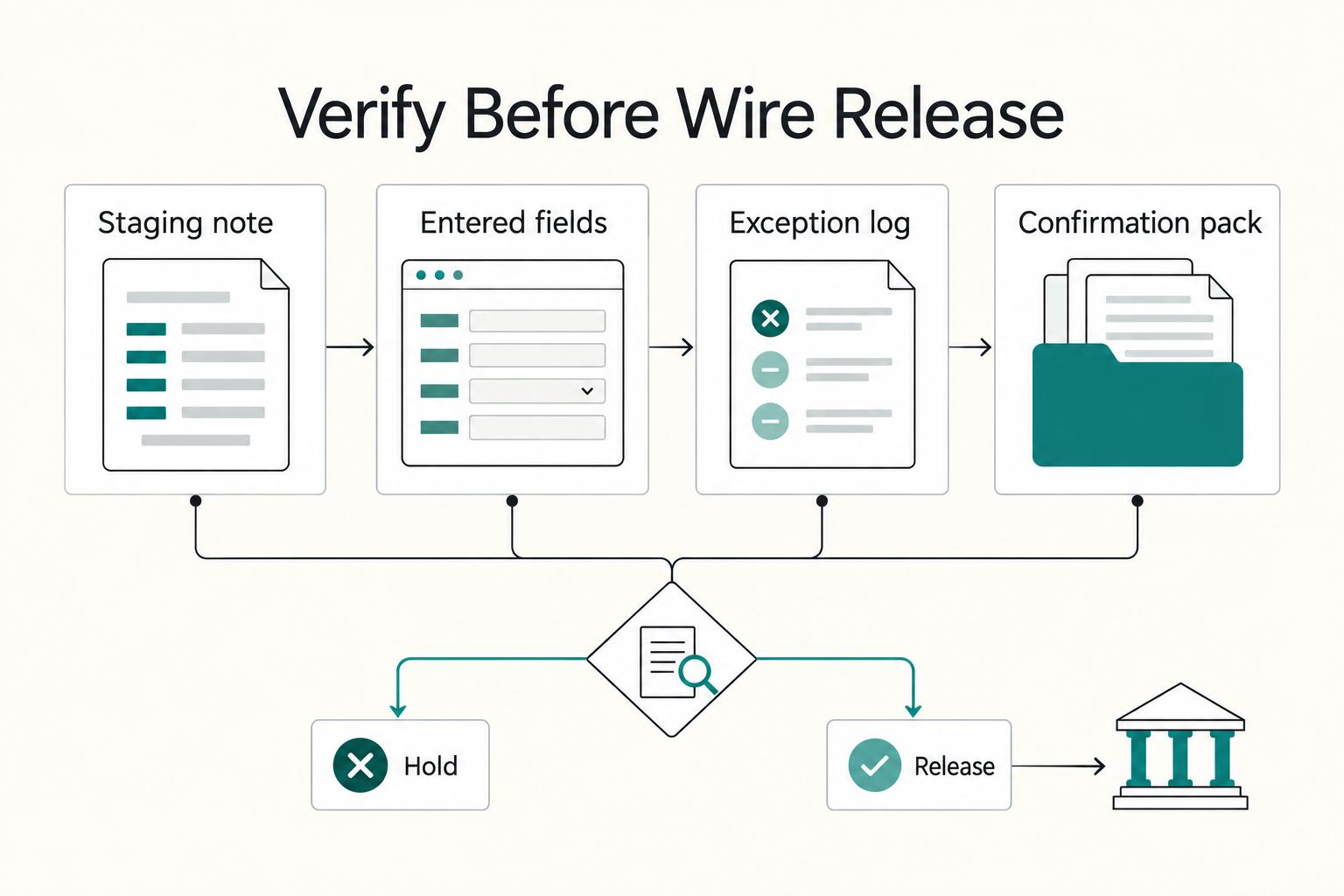
When a client asks for an **FFC transfer**, treat it as an accuracy-sensitive request, not a speed task. The request itself does not prove payment reliability, so your safest move is to confirm one current instruction source before you enter anything.