
Quick Answer
Use your bank-approved native ACH file or ISO 20022 initiation format; pain.001 is not a universal requirement for ACH. Confirm the message version, SEC code and remittance fields, then test acknowledgments, settlement, returns and Notifications of Change. That inbound path may use pain.002, camt messages or a provider feed.
Where These Batch Payout Formats Differ#
A workable batch payout strategy starts with one blunt fact. Saying a provider "supports ISO 20022" is often not enough to build against. You need to separate the message standard from the payment scheme, then confirm exactly what your bank or processor will accept in production.
The practical recommendation is simple: choose your initiation format and your exception path together, or you risk reconciliation debt that is expensive to unwind later.
Nacha maintains U.S. ACH rules and native ACH file formats. ISO 20022 is a message standard that can carry payment instructions to a bank and reporting back to a business. A bank may translate between them, but native ACH records do not become SEPA instructions merely because the input is XML.
Start with the receiving bank’s implementation guide, supported message version and accepted sample files. Then obtain examples of acknowledgments, settlement reporting and item-level exceptions. Those samples tell engineering what to serialize and finance how to match the result.
If those items are vague, treat that as a delivery risk, not a documentation gap you can clean up later.
Keep ACH and SEPA rules separate even when they share an ISO message family. The scheme defines eligible payments and processing rules; the bank defines its supported interface and validation requirements.
For example, your internal payout record can hold the obligation ID, recipient, amount, currency and remittance reference. One serializer can produce native ACH records and another an approved pain.001 version. Preserve the obligation ID through both paths so reports reconcile to the same original payment.
This pairs well with our guide on FedNow vs RTP vs ACH for U.S. Platform Payout Routing.
Start with the terms that drive architecture#
Start by separating layers: ISO 20022 is a messaging standard, while ACH and SEPA are payment schemes.
If a provider says it "supports ISO 20022," that still does not confirm what it accepts in production.
In this U.S. mapping context, anchor on Nacha's ISO 20022 Credit Transaction Guide to Mapping U.S. ACH File Formats (August 2023, Version 4.01). The scope is explicit: mapping U.S. ACH formats such as CCD, CTX, PPD, and Outbound IAT. It also explicitly covers "Payment Initiation (pain.001) Credit Transfer File Structure and Content." Treat that as your starting point for outbound batch payout initiation.
Before field mapping, get three concrete artifacts from your bank or processor:
- The exact implementation guide they use
- The message version they expect
- A sample file they accept in production
Keep message families separate. pain.008 initiates direct debits, pain.002 reports payment status, and camt.053 carries bank statements. Request the actual output your bank uses for returns and Notifications of Change; these events need stable references back to the original ACH entry.
For a step-by-step walkthrough, see ACH vs Wire Transfer for Contractor Payouts When Platform Teams Should Use Each.
Choose the right file family before you build your payout pipeline#
Choose the bank’s accepted initiation format and test the inbound status and reconciliation path at the same time.
That prevents a common launch gap: leaving returns and Notifications of Change too late.
| File family | Purpose | Useful mapping | Bank-specific check |
|---|---|---|---|
pain.001 | Credit transfer initiation | Nacha's August 2023 Version 4.01 guide covers "Payment Initiation (pain.001) Credit Transfer File Structure and Content" and maps CCD, CTX, PPD, and Outbound IAT | Exact bank implementation guide, expected message version, corridor-specific required fields, and a sample accepted file |
pain.008 | Debit collection context | Customer direct debit initiation; it collects funds rather than sending a credit payout | Whether your provider supports it, which version they support, and which debit-specific validations they apply |
camt.053 | Post-settlement statements, returns, and change handling | Nacha's August 2023 Version 2.01 guide covers "Bank to Customer Statement (camt.053) File Structure and Content for Returns," including Return Reason Codes and Change Codes | How complete provider statement enrichment is, where return and NOC events appear, and whether references are enough for automated matching |
pain.001 carries credit instructions; it does not prove the payout settled. Use status reports such as pain.002 for acceptance or rejection and statement or notification feeds for later movements. Nacha provides a camt.053 mapping for ACH returns and NOCs, but your bank may deliver those events through another interface.
Before you build transforms, lock down your provider document set. For U.S. ACH mapping, confirm whether they align to Nacha pain.001 Version 4.01 and camt.053 Version 2.01, and request one accepted example plus one returned example. For returns, confirm exactly where Return Reason Codes and Change Codes appear in provider output.
Do not use the Nacha guide’s pain.001.001.03 recommendation as the current SEPA baseline. The EPC 2025 customer-to-PSP guidelines specify pain.001.001.09. Document each bank’s accepted version and scheme rules before sharing serializers between ACH and SEPA.
If provider docs are thin, especially on pain.008 and camt.053 statement enrichment, mark that as open scope now. Otherwise you risk shipping a pipeline that can send funds but cannot reliably explain or recover post-submission outcomes. If you want a deeper dive, read SEPA Instant Credit Transfer for Euro Payouts.
Pick ACH SEC codes based on remittance and operational burden#
Pick your ACH Standard Entry Class (SEC) code only after bank/provider validation, not team memory.
Treat
CCD,CTX,PPD, andOutbound IATselection as an implementation decision that must be confirmed in writing.
| SEC code | Payment context | Confirm before build |
|---|---|---|
| CCD | Corporate ACH credit or debit, with limited addenda | Confirm provider production support, accepted remittance fields, release approvals, and failure/change output |
| CTX | Corporate ACH entry supporting richer remittance addenda | Confirm operational burden, source data quality, field validation, and downstream reconciliation output |
| PPD | Consumer ACH credit or debit | Confirm provider production support, accepted remittance fields, release approvals, and failure/change output |
| Outbound IAT | International ACH transaction with additional party and bank information | Confirm whether ISO Country Codes and additional review gates apply, and who owns those checks |
Use this short pre-build checklist:
- Which SEC options your provider supports in production for your payout use case
- What remittance fields they accept at submission and preserve downstream
- What approval and review steps they require before release
- What statement/export output you get when items fail or are changed
If you are leaning toward CTX for richer remittance, verify the operational burden before build. Confirm your source data quality, field validation, and downstream reconciliation output so added detail does not become added manual cleanup.
For cross-border-sensitive flows, escalate Outbound IAT design early. Explicitly confirm whether ISO Country Codes and additional review gates apply in your corridors, and who owns those checks.
Use Same Day ACH when the bank’s submission cutoff, funding and approvals fit the deadline. Nacha currently lists a $1 million per-payment limit; IAT entries are not eligible. Confirm the bank’s earlier customer cutoff and exception process before promising same-day arrival. Related: payout methods compared.
Implement in the right order so finance ops and engineering stay aligned#
Run outbound file creation, submission controls, and inbound statement handling as one track from day one.
Payment formats handle both payment instructions and the statement data you need for reporting and reconciliation, so an outbound-only build creates avoidable finance-ops risk.
| Checkpoint | What to lock down first | Verify before moving on |
|---|---|---|
| 1. Canonical payout model | One internal payout record and bank-approved native ACH or pain.001 serialization | Your team can generate accepted sample files from real scenarios |
| 2. Pre-submit controls | File-format checks, duplicate prevention, and approval gates tied to the exact batch payload | A retry does not create a second logical submission |
| 3. Status and statement ingestion | Asynchronous payment acknowledgments and statement-data mapping (including camt.053 where applicable) | Returned events can be matched back to the original payout record |
| 4. Evidence pack | Immutable batch artifacts for audit and reconciliation | You can reconstruct one batch from source payload to final outcome without manual stitching |
Start by agreeing on the canonical payout record before debating transport details. For pain.001, that means defining one authoritative field map for your implementation and validating against accepted bank/provider samples, rather than relying on memory or ad hoc exports across teams.
Before enabling live submission, prove controls under failure conditions. Your pre-submit layer should confirm format validity for the accepted file type, prevent duplicate logical batches during retries, and enforce approvals that finance ops and engineering can both trace to the exact payload that was sent.
Then finish the return loop and evidence generation before scaling volume. Treat statement/acknowledgment ingestion as core implementation work, not cleanup: if you cannot quickly map inbound events to original payouts, reconciliation slows and exceptions become manual.
Schedule bank testing before launch, including an accepted file, an item rejection, a return and an NOC. The time required depends on the bank interface and approval process; those tests expose missing identifiers while the batch is still small.
Design returns and NOC handling as a first-class operating system#
Treat returns and Notification of Change (NOC) handling as a core operating workflow, with named owners and clear release authority for corrected re-submissions.
If ownership stays ambiguous, one ACH item can be triaged three different ways by finance, ops, and engineering, with no single decision path.
Assign owners before the first exception spike#
Set decision rights before exception volume rises.
| Exception type | First owner | Decision | Required attachment |
|---|---|---|---|
| Return Reason Codes | Payments ops or finance ops | Confirm true return vs duplicate vs posting issue | Original batch ID, entry ID, camt.053 reference, reason code, SEC code |
Change Codes from Notification of Change (NOC) | Ops with data stewardship support | Identify source-record corrections needed | Original value, corrected value, date received, affected future batches |
| Corrected retry after a reject or return | Finance or treasury release owner | Confirm the original obligation remains unpaid before releasing a new instruction | Original status, correction, linked attempt and approval record |
Keep one evidence chain per item: original payout record, provider reference, SEC code and received status or statement events. An NOC asks you to correct future instructions and does not by itself mean the payment failed. Record the data change separately from any decision to retry an unpaid obligation.
Use one shared exception record across teams#
Map the bank’s actual status and statement feeds into a shared record, with the original payout ID attached.
Banks can translate native ACH information into ISO 20022 reporting for corporate clients. Confirm which messages your bank delivers instead of assuming every institution provides camt.053 for each event.
Track submitted, accepted, settled, rejected and returned states separately from an NOC data-correction task. Nacha’s camt.053 mapping covers returns and NOCs, not a complete bank statement. Match each event to its original entry before updating balances or future recipient instructions.
Pause rollout when the pattern is still unclear#
Set an internal threshold for unresolved returns, and pause new corridor rollout when that threshold is exceeded until open items are categorized by SEC code.
This prevents broad "ACH failure" labels and forces root-cause separation.
| Case | Action or impact |
|---|---|
| Unresolved returns exceed an internal threshold | Pause new corridor rollout until open items are categorized by SEC code |
| Transport timeout or lost response | Check submission status before retrying; reuse the bank-supported duplicate-control identifier |
| Semantic rejects tied to account data, format content, or field completeness | Do not auto-replay |
Mandatory (M) field omitted | Causes rejection at the ODFI |
Required (R) field omitted | May be rejected at the RDFI |
A timeout can leave submission status unknown. Query the bank or provider before retrying, and reuse its supported duplicate-control identifier rather than assuming a local idempotency key prevents a second bank payment. Correct semantic rejects before resubmission. Nacha distinguishes Mandatory fields, whose omission causes ODFI rejection, from Required fields, which may be rejected by the RDFI.
Compare ACH mapping and SEPA expectations without false equivalence#
A shared ISO 20022 surface helps with interoperability, but it does not create shared acceptance rules.
Use
pain.001to reduce formatting drift, then validateACHandSEPA Credit Transferagainst their own scheme and bank requirements before release.
On the U.S. side, the grounded scope is specific: Nacha's August 2023, Version 4.01 credit transaction guide maps U.S. ACH formats, with dedicated sections for CCD, CTX, PPD, and Outbound IAT, plus mapping detail for file header, company/batch header, and entry detail records. Treat that as mapping guidance, not a cross-scheme rulebook.
| Area | ACH + Nacha mapping focus | SEPA Credit Transfer expectations under EPC guidance |
|---|---|---|
| Primary use | Map U.S. ACH structures into pain.001 credit transfer content | Use pain.001-based initiation, but confirm acceptance behavior with your bank/provider |
| Rule control | Nacha manages ACH Network development, administration, and rules in the U.S. | Local scheme and bank implementation rules control acceptance and rejects |
| Practical implementation | Strong record-level mapping coverage, including separate Outbound IAT treatment | Re-check local usage rules before reusing U.S.-centric assumptions |
| Interoperability | Shared message structure can reduce translation overhead | Shared structure does not guarantee corridor-level pass rates |
Where pain.001.001.03 helps and where it does not#
A shared initiation version can simplify serializers only when every receiving bank supports it for the selected scheme. Keep the old ACH mapping recommendation distinct from the current EPC SEPA version, and test each bank profile separately.
That is an interoperability benefit, not a rule-equivalence guarantee.
Acceptance still depends on local scheme and bank validation. A structurally valid XML file can still fail for content, enrichment, or mandatory-field reasons in a specific corridor.
Constraints teams miss in practice#
Remittance Information is explicitly a named subsection in the Nacha mapping structure, but this section does not establish SEPA-wide limits. Treat remittance length and format behavior as provider-confirmed, corridor-specific configuration.
Do the same for XML character handling. Validate edge-case names and remittance text in your target bank/provider flow, then confirm what is preserved, normalized, or rejected in downstream outputs.
Keep a versioned profile for each bank: scheme, initiation message, status feed, remittance rules and required identifiers. That lets a serializer change without silently changing another corridor’s reporting assumptions.
Test accented names, XML-sensitive characters and long remittance references with bank fixtures. Confirm what arrives in the recipient and statement output, rather than checking only whether the XML parses.
If you are moving from ACH flows into euro payouts, make provider confirmation a release gate. Related reading: PIX vs. SEPA vs. ACH vs. SWIFT: Choosing the Right Payout Rail for Each Market.
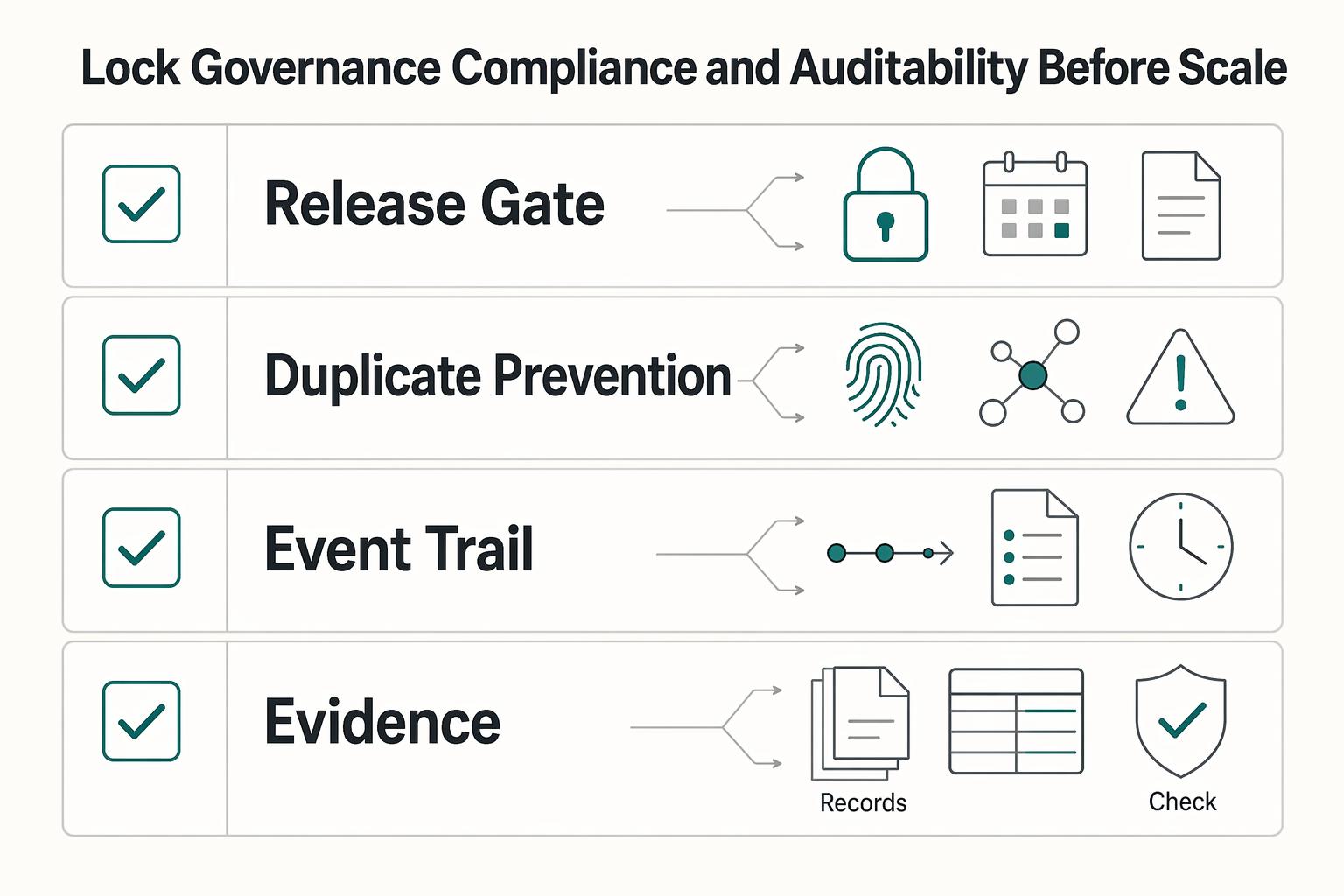
Lock governance, compliance, and auditability before scale#
Before you scale batch payouts, lock your internal control standard and validate it by market. Nacha has served as trustee of the ACH Network since 1974 and says it manages the network's development, administration, and rules, but that does not define your internal approval, duplicate-prevention, or audit model.
| Control area | What to define |
|---|---|
| Approval | Who approves each outbound pain.001, and when |
| Duplicate prevention | How you prevent duplicate submission, for example stable idempotency handling |
| Event trail | What event trail you retain from approval through downstream status artifacts, including camt.053 only if it is part of your reporting flow |
| Evidence export | How finance can export batch evidence without engineering intervention |
| Program-specific gates | Whether KYC, KYB, AML review, sanctions screening, or hold/release controls are pre-submit conditions |
Treat compliance gates the same way: make them explicit and program-specific. If your sponsor bank, program, or jurisdiction requires KYC, KYB, AML review, sanctions screening, or hold/release controls, make those pre-submit conditions, not post-submit cleanup.
Keep one market-level check before launch. Nacha's white paper states its views may not reflect every participating entity, so bank/provider confirmation should be a release gate for each corridor. We covered this in detail in Same-Day ACH for Platforms: How to Speed Up Contractor Payments Without Wire Transfer Fees.
Conclusion#
Use the bank-approved native ACH or ISO initiation format, choose the SEC code for the payment and recipient type, and test the inbound outcome feed before launch. A valid XML document alone does not establish scheme eligibility, acceptance or settlement.
That is the main lesson from the Nacha material. Nacha describes its guides as guidance on applying ISO 20022 to U.S. ACH formats, not as legal advice, and it explicitly says knowledge of both XML and Nacha rules and formats is needed to interpret the mappings correctly. If you remember one operator rule from this article, make it this: bank acceptance and scheme rules should beat your internal assumptions.
A shared operating model across product, engineering, and finance ops matters because the handoff points are where most rework starts. Product decides what payout experiences and remittance data the business wants. Engineering turns that into pain.001 serialization and submission controls. Finance ops owns the day-two truth: whether the batch was accepted and whether beneficiary data needs correction. When those three groups use different labels for the same batch or do not agree on the relevant SEC code, you create reconciliation debt before volume even arrives.
Your next move should be a corridor-by-corridor readiness check. Keep it simple and evidence-based:
- Record both the document revision and XML message version: Nacha’s August 2023 guide is Version 4.01 and recommends pain.001.001.03; the EPC 2025 SCT guidelines use pain.001.001.09. Confirm the receiving bank’s supported interface.
- Decide the SEC code before file generation, not during exception triage.
CCD,CTX,PPD, andOutbound IATare explicitly named in Nacha's mapping guidance, so they should exist in your payout data model as first-class choices. - Record what you verified. A dated copy of the bank implementation guide, the accepted message version, and the corridor owner will save time when a file is rejected and nobody remembers which rule set was approved.
If you want a clean decision rule for launch, use this one: do not go live until you can prove which initiation format you are sending, which SEC code each batch uses, and which current bank requirement you validated for that corridor. That is what turns payout format selection from a documentation exercise into a predictable operating capability.
Frequently Asked Questions
What is the practical difference between `pain.001`, `pain.008`, and `camt.053` for a payout team?
pain.001 initiates credit transfers; pain.008 initiates direct debits. camt.053 is a bank-to-customer statement. For payouts, pair the accepted initiation format with the bank’s status and statement feeds, including whatever it uses for ACH returns and Notifications of Change.
Is `pain.001.001.03` mandatory for `ACH`, `SEPA Credit Transfer`, or only certain bank implementations?
No. Nacha’s August 2023 ACH mapping guide recommends pain.001.001.03, while the EPC 2025 SEPA Credit Transfer customer-to-PSP guidelines use pain.001.001.09. Native ACH files are another possible bank interface. Use the version approved for your bank and scheme; the guide’s Version 4.01 is a document revision, not an XML message version.
How do `CCD`, `CTX`, `PPD`, and `Outbound IAT` change payout file design and reconciliation effort?
They are not just labels for reporting. Nacha's pain.001 credit mapping guide is explicitly about mapping U.S. ACH formats for CCD, CTX, PPD, and Outbound IAT, so your file generation and validation rules should branch by SEC code instead of assuming one generic ACH payout shape. A good checkpoint is to make the SEC code part of batch metadata before serialization, then test reconciliation outputs separately for each code.
Where do `Return Reason Codes` and `Change Codes` appear, and how should ops teams act on them?
Nacha maps ACH return and NOC codes into camt.053, but your bank may supply them through another feed. Match the event to the original entry. A return needs investigation before another attempt; an NOC generally requires a correction to future instructions and is not evidence that the original payment failed.
Can we launch with `pain.001` first and add `camt.053` later without creating reconciliation risk?
You can launch without camt.053 if another tested feed covers the outcomes you need. Keep original batch and entry IDs, the transmitted file fingerprint, provider references and settlement or exception events together. Outbound initiation alone cannot establish whether recipients were paid.
When should we enable `Same Day ACH`, and what has to be true operationally before doing it?
Use Same Day ACH when the payment is eligible and your funding and approval process can meet the bank’s cutoff. Nacha currently lists a $1 million limit and excludes IAT entries. Test returns and NOCs before increasing speed, and confirm customer cutoffs and fees with the bank.
Try a related tool
Where Gruv fits
Researched and edited by the Gruv editorial team. Gruv builds cross-border billing, payouts, and finance-operations software for global businesses.
Sources
Includes 8 external sources outside the trusted-domain allowlist.
- docs.oracle.com/cd/F52784_01/psft/pdf/fscm92fgat-b022022.pdfexternal
- docs.oracle.com/cd/E27605_01/fscm91pbr2/eng/psbooks/fgat/htm...external
- documentation.sepamail.org/images/e/ea/ISO20022_usage_guide_V3.pdfexternal
- europeanpaymentscouncil.eu/document-library/implementation-guidelines/s...external
- iso20022.org/sites/default/files/2020-03/ISOInitiatives_J...external
- kansascityfed.org/Payments%20Conferences/documents/4068/2012-c...external
- kyriba.com/resource/what-are-bank-reporting-and-payment...external
- nacha.org/system/files/2023-08/NACHA_ISO20022_Guide_pa...external
Educational content only. Not legal, tax, or financial advice.
Related Posts
SEPA Instant Credit Transfer for Euro Payouts
SEPA Instant Credit Transfer is real, fast, and operationally useful, but it is not an automatic yes for every euro payout program. The practical question is this: where does instant speed create enough product value to justify the extra validation work before launch?
Payout Method Comparison Tool for Platform Operators Across ACH, SEPA, PIX, and UPI
Use this comparison matrix as a decision worksheet for ACH, bank wires, SEPA, Pix and UPI. Swift messaging may support a bank wire; it is not itself the settlement rail. Choose a corridor/currency and eligible recipient first, then compare timing, total cost and operational fit.
PIX vs. SEPA vs. ACH vs. SWIFT for Platform Payout Decisions by Market
If you own payouts, you do not need another glossary. You need a fast way to choose the rail that fits the job, then avoid the failures that show up after launch. This payout rail comparison is for finance, ops, and engineering teams that care less about labels and more about whether money lands on time, statuses reconcile cleanly, and exceptions stay out of inboxes.