
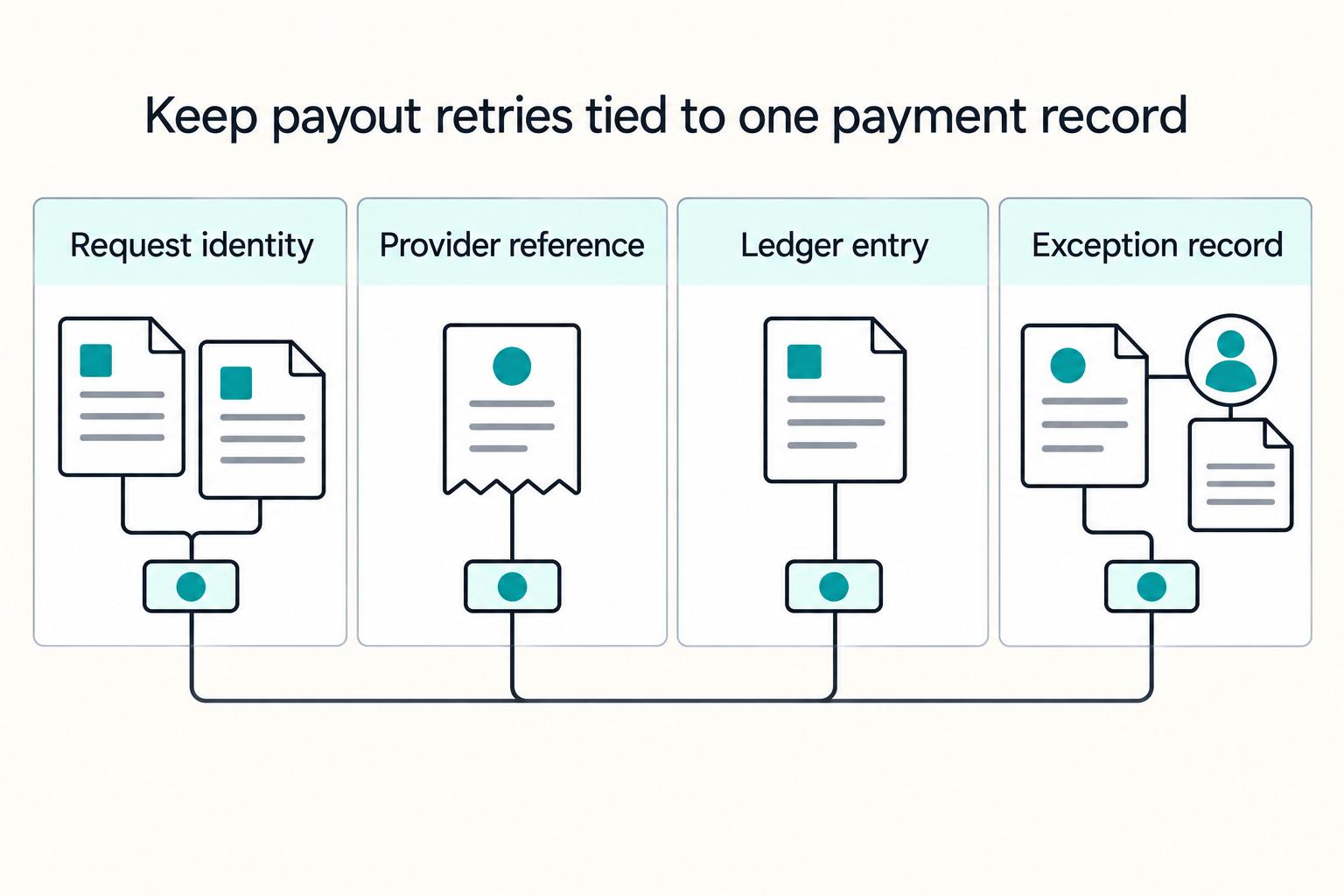
Quick Answer
Choose a mixed routing policy: keep predictable contractor cycles on ACH and route only time-critical payouts to RTP or FedNow. The decision hinges on finality and control timing, since instant rails settle quickly and are treated as irrevocable after processing. Confirm bank-level send and receive readiness plus contingency behavior before launch promises, because network availability does not guarantee your exact flow is live. Use the rail timelines as context: RTP launched in 2017, while FedNow launched on July 20, 2023.
How FedNow, RTP, and ACH differ for payout routing#
For many U.S. platforms, the right move is not picking a single winner between ACH, RTP, and FedNow. It is routing each payout to the rail that fits the job. Use ACH for predictable, non-urgent flows, and instant rails when speed changes the outcome and you are ready for tighter controls.
That is the lens for this FedNow vs. RTP vs. ACH comparison for platform operators. If you pay contractors, creators, sellers, or marketplace participants, the practical question is which rail fits a given payout after you account for settlement speed, finality, fraud exposure, treasury impact, and what your partners can actually support today.
ACH supports scheduled credit and debit entries. RTP, operated by The Clearing House, and FedNow, operated by the Federal Reserve, support instant credit transfers. A weekly contractor run and an urgent seller disbursement can therefore need different routes.
RTP and FedNow settle individual payments continuously, with final settlement. Approvals and fraud checks must precede release. A request to return funds is a separate recovery process, not a unilateral cancellation of the settled payment.
Funding also changes. Instant settlement removes float time many businesses use between sending and receiving funds. That can put more pressure on funding, reconciliation, and exception handling. Keep two decisions separate: users wanting faster payouts, and your team being ready to fund and control that speed safely.
Verify the bank’s live send capability, recipient reach, limits and fallback behavior for your program. Network participation alone does not establish that every customer can originate every supported message.
For a step-by-step walkthrough, see Real-Time Ledger vs Batch Settlement for Platform Volume Decisions.
At a glance comparison for platform operators#
Use a mixed-rail design when payout needs span different urgency levels. In practice, partner readiness and control design can matter as much as rail branding.
| Criteria | Automated Clearing House (ACH) Network | Real-Time Payments (RTP) Network | FedNow Service | What this means operationally |
|---|---|---|---|---|
| Settlement | Batch settlement on banking days; Same Day ACH has defined windows | Individual instant credit transfers, 24/7 | Individual instant credit transfers, 24/7 | Separate network settlement from provider review and customer ETA |
| Direction | Credits and debits | Credit push; optional Request for Payment messaging | Credit push; optional Request for Payment messaging | A payment request does not pull funds |
| Recovery | Limited rule-based returns and erroneous-entry reversals | Final settlement; separate return/request processes | Final settlement; separate return/request processes | Do not promise unilateral cancellation or recovery |
| Funding | Bank-program funding and cutoff rules | Participant prefunding in a joint Federal Reserve account | Participant master account or correspondent settlement | Obtain your bank’s own platform funding requirements |
| Access and cost | Bank/provider-specific | Bank/provider-specific | Bank/provider-specific | Verify send service, recipient reach, limits and comparable fee units |
These are network characteristics. Your platform’s access, fees, funding deadlines, recipient reach and lower transaction limits depend on the bank or provider agreement. Compare quotes for the same payout population and service level.
For more on when instant payout is actually worth using, see Real-Time Payment Use Cases for Gig Platforms: When Instant Actually Matters.
Start with payout jobs before you pick a rail#
Start with the payout job, not the rail branding. Use instant rails when delay creates a real operational problem, and keep scheduled work in a scheduled, non-instant lane.
| Payout job | First rail to evaluate | Why it fits | Check before launch |
|---|---|---|---|
| Recurring scheduled runs | ACH or another scheduled non-instant rail | Useful when the job is scheduled and does not require immediate funds | Confirm bank process, internal SLA, and reconciliation workflow before making it your default route |
| Urgent one-off disbursements | RTP or FedNow | Both are instant payment systems with immediate funds availability 24/7 | Confirm current network ceiling and any lower bank or program limit. |
| Customer refunds | RTP or FedNow | An eligible refund may be originated as a separate credit transfer. | Confirm recipient reach and refund policy; a Request for Payment message is not required. |
| Exception recoveries | Case by case | Instant payments are irrevocable and confirmed within seconds | Require stronger pre-release approvals, duplicate checks, and a fallback path before using an instant rail |
For urgent payouts, evaluate both instant networks against actual recipient reach and the bank’s send service. Request for Payment is an optional message requesting a payment; it is neither a debit nor a prerequisite for issuing a refund.
For a deeper operational view, see End-to-End Payments Visibility: How CFOs at Platform Companies Track Every Dollar in Real Time.
When ACH should stay your default lane#
Keep ACH as your default when payouts are recurring, predictable, and not time-critical. Use RTP or FedNow as conditional lanes for urgent exceptions, not as the baseline for routine volume.
Understand the limits of ACH recovery#
ACH payout credits are not freely reversible. Nacha permits reversals for specified erroneous entries, generally within five banking days of settlement. Other recovery requests depend on the applicable rules and receiving bank; do not promise that funds will be recovered.
An unauthorized consumer ACH debit has different return protections from an outbound payout credit. Do not use the consumer-debit return window as the recovery policy for contractor payouts. Instant-network returns likewise do not undo the finality of the original settlement.
Set cutovers before urgency decisions happen ad hoc#
Define your ACH-to-instant cutover rules in advance, then enforce them in routing logic.
| Decision point | Keep on ACH | Route to RTP or FedNow |
|---|---|---|
| Urgency | Scheduled timing is acceptable | Delay creates an immediate operational problem |
| Recovery model | Limited rule-based returns; no general cancellation guarantee | Final settlement with separate recovery requests |
| Payout pattern | High-volume routine runs | Urgent one-offs and priority exceptions |
| Controls | Required identity, recipient and fraud checks | Same required checks, completed before instant release |
Related: What Are Payment Rails? ACH Wire SEPA and Real-Time Networks Compared.
When FedNow is the better fit#
FedNow can be a better fit when ACH timing is creating real user or merchant friction and your bank partner can support your exact real-time flow in production. If either condition is missing, keep ACH as the primary lane and use FedNow selectively for urgent cases.
FedNow and RTP support domestic instant credit transfers around the clock. Network settlement speed is distinct from your provider’s initiation, risk-review and confirmation latency; measure the end-to-end customer experience before publishing an ETA.
The use cases where FedNow earns its complexity#
Use FedNow where immediate availability is part of the product promise and waiting for the next ACH window would create operational issues. If a payout can wait without operational damage, keep it on scheduled ACH.
Enable a new route only for the payout jobs and recipient population that passed testing, then expand from observed results.
What to verify with your bank before you commit#
Before launch, confirm how settlement will actually post for your program. The guidance reviewed here states that settlement can occur through a financial institution's Fed master account or through a correspondent-bank path, and that difference affects operations.
| Question to verify | Why it matters | What a weak answer looks like |
|---|---|---|
| Will settlement post through a Fed master account or a correspondent-bank path? | Changes who handles funds movement and where exceptions may surface | "We support FedNow" with no settlement-route detail |
| What send and receive capabilities are live today for our specific program? | "On the network" does not always mean production-ready for your use case | Roadmap language with no concrete go-live scope |
| Who owns ongoing operations and exception handling for this rail? | You need clear ownership before real-time volume goes live | No named owner or no documented operating procedure |
The practical constraint most teams hit#
A common risk is not speed alone. It is readiness for your specific use case. Treat "available in principle" and "ready for your production flow" as separate checks.
Also plan for the operating tradeoff. Instant settlement removes float time that many teams rely on for cash planning and reporting, and real-time payments are irrevocable after processing. If your controls still depend on post-send cleanup, tighten pre-send approvals and fraud checks before you expand FedNow usage.
For a closer look at how the two real-time rails differ in practice, see FedNow vs. RTP: What Real-Time Payment Rails Mean for Gig Platforms and Contractor Payouts.
When RTP is the better fit#
RTP is a better fit for urgent push disbursements when your bank can reliably send over The Clearing House RTP network for your program. It also needs to be a flow where funds truly need to move and settle immediately. If not, keep ACH as the default lane and use real-time rails selectively.
The Real-Time Payments (RTP) network from The Clearing House has been live since 2017 and is built for true real-time clearing and settlement. It is most useful when timing is part of the product promise, not just a convenience.
Where RTP pulls ahead#
Use RTP when you need all three at once: immediate settlement, 24/7 availability, and finality after processing.
| Payout scenario | RTP fit | Why |
|---|---|---|
| Urgent one-off disbursement | Strong | Real-time movement and settlement reduce delay in high-urgency cases |
| Scheduled recurring payout | Weak to moderate | ACH is often the default when seconds do not matter |
| Exception payout outside batch windows | Strong | RTP runs 24/7, so you are not waiting for the next ACH window |
Select RTP for an urgent payout when your bank can originate it and the recipient institution is reachable. An unsupported recipient needs an explicitly agreed alternative and customer message.
Design for finality before launch#
RTP's main product constraint is finality. Once processed, payments are not handled with standard ACH-style reversals. That means approval and fraud controls have to happen before release, not after posting. If your current process depends on post-send cleanup, tighten pre-send decision points before you expand RTP volume.
Treasury checks to settle early#
Instant settlement also changes cash timing by removing float time, which can affect cash planning and reporting. Before launch, align treasury and operations on your bank's live RTP send capability, exception ownership, and cash-planning implications for your program. If those details are still vague, keep RTP narrow until they are clear.
Why irreversibility changes your risk and compliance design#
If you add FedNow or RTP, your strongest risk control is the decision point right before release, not what happens after send. Compared with many legacy payment workflows, instant rails are less forgiving once funds move.
Final settlement makes mistaken-recipient and fraud losses harder to recover. Validate recipient details, unusual changes and authorization before release; a successful network response does not prove the underlying instruction was legitimate.
The control timing is different by rail#
FedNow and RTP are closer to each other than many non-instant legacy rails for fraud and compliance design. FedNow is the Federal Reserve's instant rail, and RTP is privately owned by The Clearing House, but both push teams toward prevention-first release gates.
| Criteria | Legacy non-instant flows | RTP | FedNow |
|---|---|---|---|
| Typical operating pattern | ACH recovery depends on entry type and rule, not a blanket cleanup window | Pre-release decision quality is critical | Pre-release decision quality is critical |
| If checks run too late | A bad instruction may still settle; recovery is limited | Late intervention is less useful after send | Late intervention is less useful after send |
| Practical control focus | Strengthen pre-release checks where possible | Run fraud and compliance checks at release time | Run fraud and compliance checks at release time |
| Escalation tempo | Can be less time-critical in some flows | Must work in real time | Must work in real time |
Apply the required identity and risk controls at release#
Assign AML, KYC and KYB responsibilities according to the regulated entity, customer relationship and partner contract. For your program, check required identity status and current fraud decisions before release. A rail choice alone does not impose the same legal obligations on every platform.
This does not require re-running every check from scratch each time. It means the release step can verify current identity or business status and current risk decisions before payment is sent.
Real-time escalation has to be real#
Define escalation so action can happen during the release window, not through later ticket triage. If risk signals fire during release, product, ops, and compliance owners need a clear handoff that can immediately stop or hold payment.
| Outcome | When it applies |
|---|---|
| Release | Checks are clean |
| Hold for review | Signals conflict or confidence is low |
| Block | Fraud or account-integrity signals fail |
Capture decision evidence before funds move#
For instant rails, assume you may need to defend the release decision using records captured at send time. Keep the decision inputs tied to each payout: who initiated it, which checks ran, pass or fail outcomes, timing, and who or what approved release.
Test the hold and escalation path under production-like timing. A detection rule is useful only if it can stop the instruction before submission, with an owner available to resolve the case.
Funding, liquidity, and treasury mechanics teams often underestimate#
Choose the rail and the liquidity operating model as two separate decisions. RTP and FedNow are true real-time rails with immediate clearing and settlement. ACH is not, so treasury timing and cash readiness do not work the same way across all three.
Instant release can shorten the time between initiation and availability, but it does not necessarily reduce prefunding. RTP participants fund a joint Federal Reserve account; FedNow settles through a participant’s master account or correspondent. Your bank may separately require a prefunded platform balance on either route.
| Rail | Liquidity timing pattern | What to confirm before launch | Common risk |
|---|---|---|---|
| ACH | Funding deadline follows the bank’s program and processing windows | How far ahead payout cycles need cash and how delays affect daily position | Reusing ACH-era timing assumptions for urgent flows |
| RTP | Network participant prefunding; platform funding terms set by bank | Funding setup and monitoring approach with your bank partner | Enabling instant payouts before treasury monitoring is ready |
| FedNow | Master-account/correspondent settlement; platform funding terms set by bank | Operational process and monitoring approach with your bank partner | Treating network access as full operational readiness |
Model liquidity mechanics before go-live#
Start with how each rail actually behaves, then design partner decisions around that reality. Payment options become operationally complex quickly when teams are not aligned on those mechanics, especially once instant release is in scope.
Run intraday treasury controls, not just start-of-day checks#
If you use real-time rails, monitor expected release demand through the day, not only morning balances. Tie liquidity checks to planned release timing so finance ops and engineering can act before constraints affect payouts.
For more on adjacent infrastructure choices, see Payment Infrastructure Trends 2026: How Marketplace Operators Should Prioritize Real-Time Rails, Stablecoins, BNPL, and Embedded Checkout.
Integration checkpoints that prevent month-two failures#
Connectivity is not enough on its own. Use one internal payment model that each rail maps into, with clear retry, trace, status, and reconciliation rules.
Build one request identity to reduce duplicate payouts from retries#
Assign one durable internal payout identity. Use a provider idempotency key only within its documented scope and retention period, with unchanged parameters. A timeout leaves the original outcome unresolved: query and reconcile it before another send or alternate rail. Reserve the payout atomically in your own system so workers cannot initiate it concurrently.
| Retry path | Identifier rule | System response |
|---|---|---|
| Transport retry | Same internal identity; unchanged request and documented provider-key scope | Query an unknown result before retrying |
| Queue replay | Atomic local reservation and durable attempt record | Suppress a duplicate initiation without losing later status events |
| Operator recovery | Resolve the original attempt first | Use a new linked correction only when the original outcome and recovery policy permit |
Request for Payment messages and the eventual credit transfer have distinct identities and outcomes. Link them internally without treating delivery of a request as payment authorization or settlement. The payer can decline or never respond.
Trace every payment from API call to ledger posting#
Make traceability explicit from initiation to provider reference to ledger result, and keep records searchable for finance and support while limiting sensitive account and personal data in operator-facing views.
| Checkpoint | What to capture |
|---|---|
| Initiation | Internal payment ID, request identifier, created-at timestamp |
| Provider reference | External reference, rail, status timestamp |
| Ledger posting | Ledger entry ID, posted amount, account impact |
| Exception handling | Recovery action, owner, resolution note |
Define one internal lifecycle and map each partner event to it#
Map partner events into explicit internal states. Store durable receipts and apply their local effects atomically, deduplicating deliveries while allowing legitimate later returns. Use provider sequencing or an authoritative status query to prevent older events from overwriting newer outcomes.
| State | Definition |
|---|---|
| Accepted | Provider received instruction; settlement not yet proven |
| Pending/unknown | Await authoritative outcome; do not send a fallback |
| Completed | Settlement confirmed and required local posting reconciled |
| Rejected/failed | Instruction did not settle; determine safe retry from authoritative evidence |
| Returned | Separate return of a previously settled payment; preserve original settlement and link the recovery |
Reconcile before period close, not after tickets arrive#
Run reconciliation checkpoints that tie rail events to ledger balances and payout reporting before each close. At minimum, you should be able to prove which payments were initiated, which provider references exist, and which ledger entries posted.
For instant-rail operations, this matters continuously because settlement can occur 24/7/365. Where available, use richer RTP or FedNow messaging data and RFP request details to keep authorization, payment, and ledger impact linked in one record.
Questions to settle with bank and rail partners before launch#
Do not launch until your bank and rail partners confirm institution-level support, pricing approach, operations coverage, and compliance ownership in writing.
Confirm actual send and receive scope for the transaction type and customer segment. Both instant networks support Request for Payment at network level, but your bank may offer only selected capabilities. A payout does not require Request for Payment.
| What to confirm | ACH | RTP | FedNow |
|---|---|---|---|
| Institution support | Current support for your use case, customer segment, and direction | Current send and receive support for your use case | Current send and receive support for your use case |
| Timing and operations | Batch-based processing and cutoff or exception handling | Immediate funds flow with 24/7 operations and escalation expectations | Immediate funds flow with 24/7 operations and escalation expectations |
| Limits and features | Bank/program limits and processing windows | Current network ceiling, lower bank limits and offered messages | Current network ceiling, lower bank limits and offered messages |
| Cost comparison | Quote in the same unit format as RTP and FedNow | Quote in the same unit format as ACH and FedNow | Quote in the same unit format as ACH and RTP |
Ask finance to normalize every quote into the same unit format before approval. If one rail is quoted per payment and another is bundled, you do not have a true cost-to-serve comparison. Ask partners to break out applicable charges in comparable terms.
Settle exception handling before go-live. Because ACH is batch-based and RTP and FedNow run continuously, confirm after-hours escalation paths, support windows, and the operator tooling available for payment status and exception resolution.
Record which entity owns each required compliance check and which evidence it must retain. Keep fraud controls and bank-contract obligations explicit without implying every platform is itself a regulated financial institution.
A practical decision checklist for product, ops, and engineering#
If your payout mix includes both scheduled runs and time-sensitive disbursements, consider a mixed-rail plan. If one payout job clearly dominates, a single primary rail can work, but define fallback behavior explicitly instead of treating ACH, RTP, and FedNow as interchangeable.
| Team | Decide now | Verify before launch | Red flag |
|---|---|---|---|
| Product | Define payout speed tiers (for example: scheduled, expedited, instant-eligible) | For each tier, define primary rail, fallback rail, and user-facing message when the preferred route is unavailable | "Instant" appears in the UI, but no rule exists for unsupported routes or failed initiations |
| Finance ops | Approve liquidity plan, reconciliation controls, and exception ownership | Confirm provider and banking-partner contact paths, reporting cadence, and the records needed to resolve breaks | Treasury, reconciliation, and support each assume another team owns exceptions |
| Engineering | Gate instant-rail traffic behind reliability controls | Validate idempotent initiation, provider reference capture, webhook retry handling, ledger traceability, and alerting | Without safeguards, timeouts or webhook replays may create duplicate payout attempts or unclear payment state |
| Leadership | Set rail scope from payout-job mix, not marketing claims | Review partner-confirmed use-case coverage and operational readiness before go-live | A single-rail decision is locked before fallback and support coverage are proven |
The routing matrix must distinguish an unreachable recipient before send from an unknown outcome after send. Only the former permits immediate selection of another route; resolve the latter before risking a duplicate payment.
For finance ops, approval should include reconciliation and exception workflows, not just pricing. You need a documented path that links payout requests, provider references, and ledger outcomes, plus a clear owner and contact process for exceptions.
For engineering, treat instant traffic as production-critical from day one. Idempotency, durable webhook processing, audit trails, and monitoring should be live before launch.
Related reading: ACH vs Wire Transfer for Contractor Payouts When Platform Teams Should Use Each.
If this checklist exposed gaps in retries, status visibility, or fallback routing, review how Gruv handles compliance-gated payout operations with audit-ready tracking in Payouts.
Frequently Asked Questions
Is FedNow the same thing as RTP?
No. RTP is operated by The Clearing House and FedNow is operated by the Federal Reserve, so they are different rails. Both are used for true real-time payments with immediate clearing and settlement, but they run under different operating frameworks.
When should a platform use ACH instead of FedNow or RTP?
Use ACH for recurring or scheduled payouts that are not time-critical. It remains a practical fit for non-urgent flows. Keep real-time rails for payouts where timing is operationally important.
Are FedNow and RTP reversible the way ACH can be?
ACH payout credits have limited rule-based reversal and return processes, rather than a general cancellation right. The consumer unauthorized-debit window does not apply to a contractor payout credit. RTP and FedNow settlement is final; recovery may involve a separate return or request to the receiving institution and is not guaranteed.
What is the most important operational difference between FedNow and RTP?
Ownership, settlement funding and your bank’s offered service differ. RTP uses the private network’s prefunded joint-account arrangement; FedNow settles through Federal Reserve master accounts or correspondents. Both support Request for Payment messages, subject to participant capability. Recipient reach and bank service determine the usable route.
Do most platforms need one rail or a mix of ACH plus real-time rails?
Platforms with both scheduled and urgent payout jobs often use a mix. ACH usually fits the scheduled lane, while FedNow or RTP fits instant-eligible disbursements. The right mix depends on the payout job and partner capabilities.
What should we verify first with banking partners before committing to a rail mix?
Start with institution-level confirmation for your exact use case. Verify which rails are supported, current institution-specific limits, and whether features differ by rail, including Request for Payment support. If you use FedNow, align legal and operations teams on Regulation J (Subpart C), Operating Circular No. 8, and the FedNow Service Operating Procedures. Also confirm cross-rail handling, because FedNow and RTP operate with different standards and processing frameworks.
Try a related tool
Researched and edited by the Gruv editorial team. Gruv builds cross-border billing, payouts, and finance-operations software for global businesses.
Sources
- brookings.edu/wp-content/uploads/2023/01/20230109_CRM_Klei...trusted
- brookings.edu/wp-content/uploads/2020/09/PCB.pdftrusted
- congress.gov/116/chrg/CHRG-116shrg38550/CHRG-116shrg38550...trusted
- federalreserve.gov/paymentsystems/fednow-additional-questions-a...trusted
- federalreserve.gov/SECRS/2019/November/20191118/OP-1670/OP-1670...trusted
- govinfo.gov/content/pkg/CHRG-116shrg38550/html/CHRG-116s...trusted
- hks.harvard.edu/sites/default/files/centers/mrcbg/Final_AWP_...trusted
- home.treasury.gov/system/files/136/Assessing-the-Impact-of-New...trusted
Educational content only. Not legal, tax, or financial advice.
Related Posts

FedNow vs RTP for Gig Platform Contractor Payouts
You are not choosing a payments theory memo. You are choosing the institution-backed rail path your bank and provider can actually run for contractor payouts now: FedNow, RTP, or one first and the other after validation.
What Are Payment Rails? ACH Wire SEPA and Real-Time Networks Compared
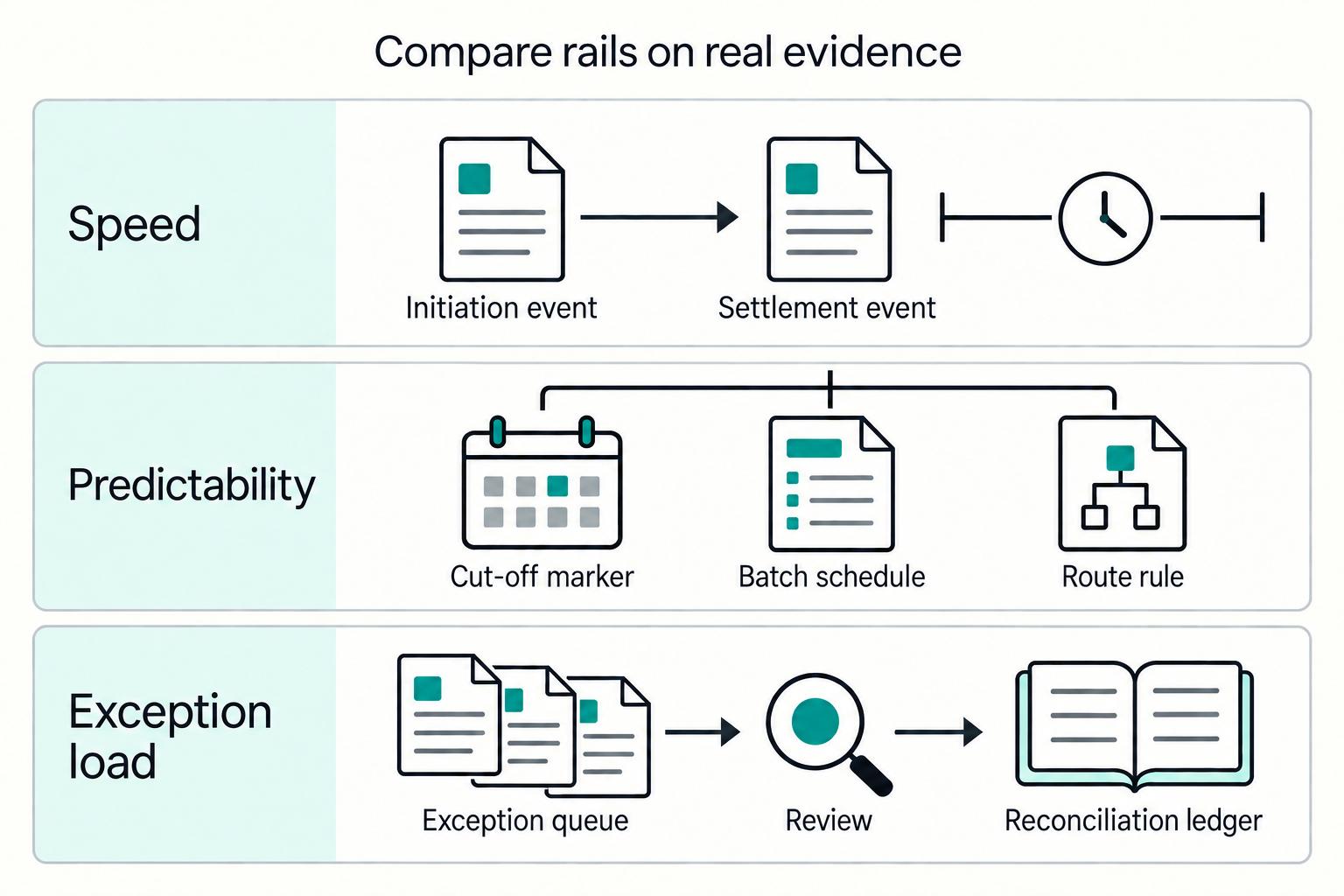
For platform operators, rail choice is an operating decision, not just a glossary term. It affects payout speed, exception handling, and how much cleanup your support and finance teams inherit.
When Instant Payout Matters for Gig Platform Payments
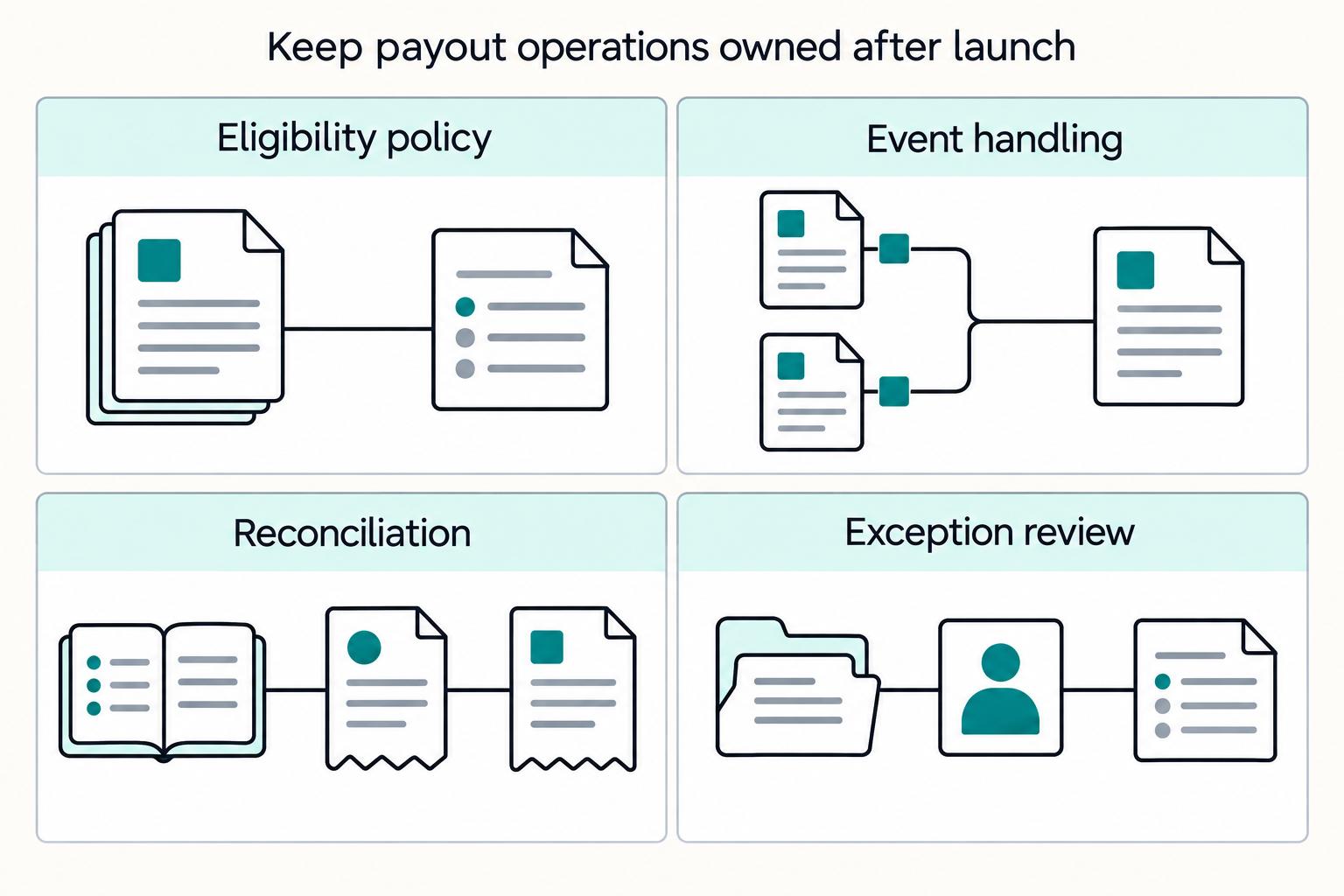
Instant payout is a tool, not the goal. The real operating decision is where instant timing creates measurable value, where batch timing is enough, and where both should run side by side.