
Quick Answer
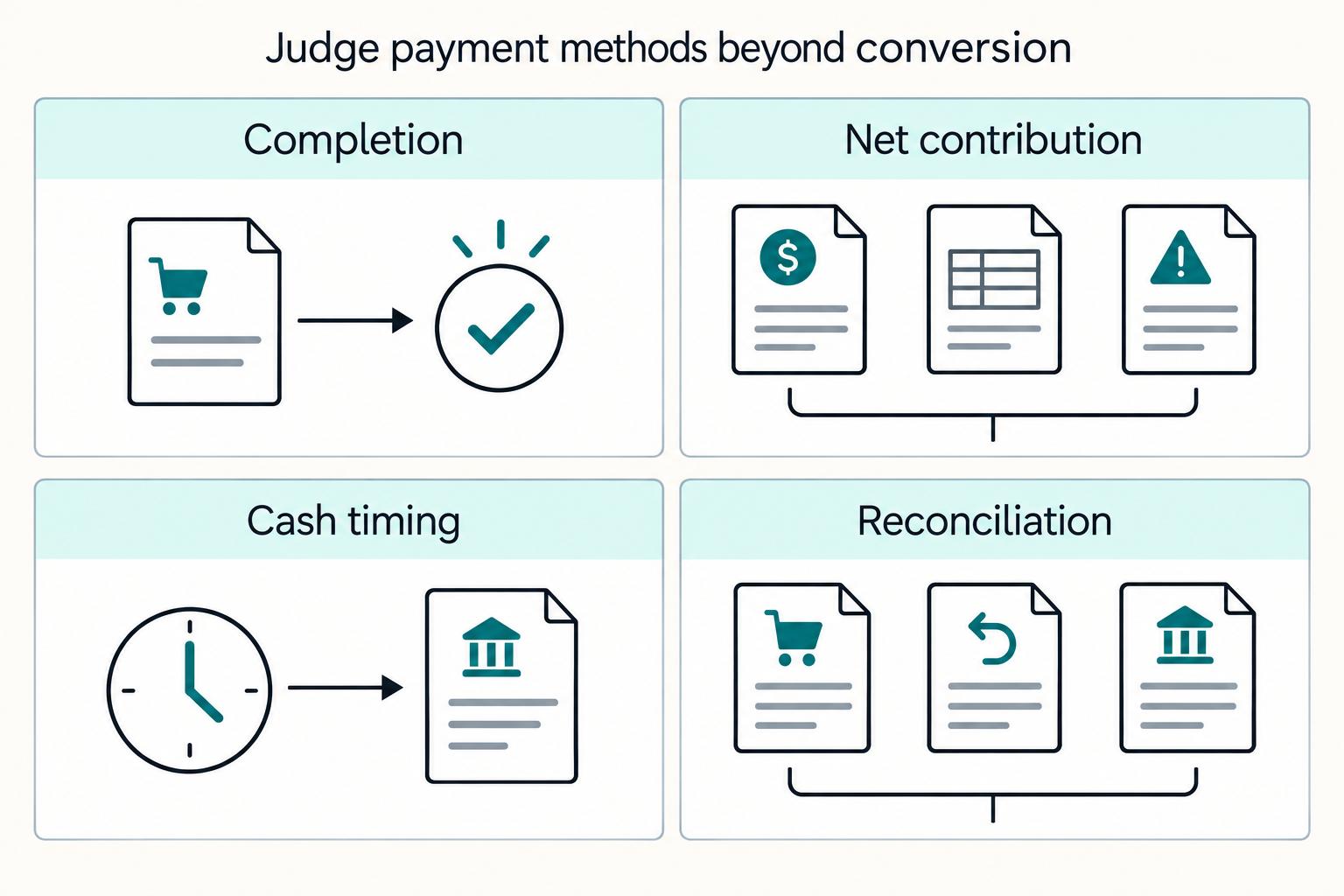
Start with a country baseline and a concurrent randomized holdback for one new method. Stripe’s 2025 experiment reported an average 7.4% relative conversion lift and 12% revenue lift from surfacing an additional relevant method; those are vendor study results, not forecasts for your checkout. Measure completion per eligible session, net contribution, and settlement outcomes before expanding.
Match local payment preference to checkout economics#
Adding payment methods can lift checkout completion when the method matches how buyers prefer to pay in that country and still fits your fee and operating model. The real decision is not whether to add more methods, but which method to add in which country, and on what economics.
This is a cross-functional call. Revenue and product teams care about completion lift, while finance and payments ops need to validate fee layering and payout operations. If conversion improves but cost structure or cash operations get worse, it is not a clear win.
Stripe’s April 2025 holdback experiment within its Optimized Checkout Suite reported average relative increases of 7.4% in conversion and 12% in revenue when at least one additional relevant method beyond cards was dynamically shown. Reported country-method examples included Alipay in China (91%), BLIK in Poland (46%), and iDEAL in the Netherlands (39%). These are increases relative to the study’s comparison checkout, not absolute completion rates or percentage-point gains, and they do not forecast your own results.
Compare any lift with your actual fee schedule. For a U.S. Stripe Standard online-card example, pricing is 2.9% + 30¢ for domestic cards, with additional fees where international cards or currency conversion apply. Managed Payments is a separate merchant-of-record product; its additional fee applies only if you use that product, not simply because you add local payment methods.
This guide uses a country-by-country decision sequence with clear evidence weighting. Holdback results are stronger evidence, while broader market coverage is directional context. Usage share and checkout lift are not the same signal.
You should leave with:
- a country-method priority table
- a controlled rollout test plan
- a go or no-go launch checklist anchored to conversion, margin, and operational load
Define the metrics before choosing methods#
Define the metrics first, then choose methods by country. If your team mixes up usage share, checkout completion, and revenue impact, you will choose methods for the wrong reason.
Define the denominator before comparing results. Method completion is completed payments divided by attempts using that method. Overall checkout completion is completed purchases divided by eligible checkout sessions. Usage share is the mix of methods used. A method’s selected-user completion rate cannot by itself show the incremental effect of offering it.
Define the payment methods included in your experiment and who is eligible to see them. Stripe’s holdback compared dynamically showing an additional relevant method beyond cards with the comparison checkout. Counting available options alone does not measure their effect.
Use one scorecard with three separate outcome layers:
- method-level checkout completion by country
- revenue impact
- checkout complexity and abandonment-risk signals
Set your country-level data cut before you call winners. Do not pool China, Poland, and the Netherlands into one global average and call it insight. The holdback results were segmented by country and industry, and that is the pattern to follow. Rushing decisions from thin country data, or adding too many methods at once, can add checkout complexity and increase abandonment risk.
Related: Alternative Payment Methods for Subscriptions: Which APMs Boost Conversion in Each Market.
Separate strong evidence from directional signals#
Rank your evidence before you rank methods by country. Stripe is the strongest operator signal available. Other market reports are directional context unless you can review country cuts, methodology, and test design.
It is the most practical input here because it ties method choice to execution and cost mechanics. Its pricing copy says local methods can help optimize checkout conversion and increase acceptance rates. Its support docs also provide a concrete country-method table: Payment method | Supported buyer geos | Variable pricing | Fixed fees. Use that as implementation input, not as published causal proof.
Use an evidence ladder#
| Evidence tier | What counts | How to treat it |
|---|---|---|
| Controlled outcome evidence | A concurrent holdback experiment with a defined population and completion denominator | Evidence of incremental effect within that experiment; validate applicability locally |
| Directional market signal | market reports for hypothesis generation | directional context |
| Not decision-ready | claims where values are hidden, details are paywalled, or methodology is not visible | not decision-ready |
Treat country-method pairs as test priorities, not universal truths. Usage or market presence is a starting signal, not proof that your checkout completion will rise.
Before rollout, confirm pricing for your merchant country and contract, including the selected method and any separate products you use. Save the dated fee schedule alongside the experiment definition. Managed Payments pricing belongs in the model only when that merchant-of-record product is part of your flow.
For a step-by-step walkthrough, see Churn Rate Benchmarks by Industry for Payment Platforms.
Build a country and method baseline that teams can act on#
Build one shared baseline table now, and mark uncertainty explicitly so product, payments ops, and finance can work from the same sheet.
| Market | Seed method candidate (unverified) | Current checkout share | Completion rate | Refund or failure rate | Operational burden | Confidence |
|---|---|---|---|---|---|---|
| China | Alipay (seed; verify with your data) | Pull from your checkout logs | Measure by offered method | Measure | Review reconciliation, refunds, and transaction scope | Insufficient evidence |
| Poland | BLIK (seed; verify with your data) | Pull from your checkout logs | Measure by offered method | Measure | Review support volume and exception handling | Insufficient evidence |
| Netherlands | iDEAL (seed; verify with your data) | Pull from your checkout logs | Measure by offered method | Measure | Review settlement mapping and refund handling | Insufficient evidence |
| Japan | Konbini (seed; verify with your data) | Pull from your checkout logs | Measure by offered method | Measure | Review delayed-payment handling and support burden | Insufficient evidence |
| Germany | PayPal (seed; verify with your data) | Pull from your checkout logs | Measure by offered method | Measure | Check domestic vs international treatment and market mapping | Insufficient evidence |
| United States | Cash App (seed; verify with your data) | Pull from your checkout logs | Measure by offered method | Measure | Compare added ops load vs current card flow | Insufficient evidence |
| APAC | Country-specific wallet and local rail candidates; evaluate PhonePe only where your own demand supports it | Split by country, not region average | Measure per country | Measure per country | High risk if copied across countries | Insufficient evidence |
| LATAM | Country-specific wallet and local rail candidates; evaluate Mercado Pago or Nubank only where your own demand supports it | Split by country, not region average | Measure per country | Measure per country | High risk if regional averages hide country differences | Insufficient evidence |
| MEA | Country-specific wallet and bank-transfer candidates | Split by country, not region average | Measure per country | Measure per country | High risk if local settlement and support steps are unclear | Insufficient evidence |
Use external signals only to seed candidate methods, and keep performance columns grounded in your own checkout events and outcomes. Before rollout, add one economics checkpoint to each row:
- For PayPal rows, confirm whether flows are domestic or international, and account for grouped markets when international rates are calculated. Keep market mapping consistent with the Market Code Table.
- Do not generalize one PayPal fee page across countries. Page rates are scoped to listed resident markets and regions.
- For Stripe rows, flag that custom pricing can be country-specific. Use published fee layers as comparison context:
2.9% + 30¢domestic cards,+1.5%international cards, and+1%when currency conversion applies.
Keep confidence labels strict:
Causal evidence: your own controlled test with visible method-level outcomesDirectional evidence: external research with a visible country cut and methodologyInsufficient evidence: listed method without outcome proof for your checkout
With this evidence pack, keep seed rows at Insufficient evidence for conversion lift until you attach method-level proof from your data.
If you want a deeper dive, read How CRO and Payments Can Make or Break Your Affiliate Network.
Pick the first methods per country with explicit decision rules#
Use explicit operating rules to keep country rollouts measurable: as an internal governance rule, launch up to three methods per country, then pause expansion until outcomes are cleanly measured and reconciled.
Start with the strongest country signal, not the longest method list#
Start with your clearest country hypothesis. If one local method stands out in your own baseline, test it first before you add long-tail wallets.
This gives you a cleaner read on completion impact and limits choice clutter while confidence is still Insufficient evidence. A common failure mode is launching too many plausible methods at once, then losing method-level attribution.
Use country research to identify promising methods and explain buyer preference. Keep rollout decisions tied to checkout outcomes from your own eligible customers; accepted-method surveys do not establish conversion lift.
Go wallet first only when your funnel shows card friction#
A wallet-first path makes sense only when your own funnel supports it. If mobile traffic is high and you also see clear mobile card-entry drop-off, test a wallet-first path such as PayPal before adding another bank rail.
Mobile share alone is not enough. Check where users fail by device: form start, form completion, and payment approval completion. Also check overlap before adding separate wallet projects. PayPal Expanded Checkout includes cards, Apple Pay, Google Pay, and more, so validate whether that already covers the wallet demand you planned to build separately.
Use a simple launch order and hold the line#
If you use a simple internal launch template, keep it disciplined:
- Strongest local method hypothesis for that country
- Broadly trusted backup with operational coverage you already understand
- Market- or segment-specific method only when traffic mix or demand supports it
Treat the three-method cap as a governance rule, not a market truth. Before adding a fourth method, complete at least one full review cycle where each live method is tied to checkout attempts, completed payments, refunds, settlements, and support exceptions.
PayPal fee schedules distinguish domestic and international transactions and are scoped to particular merchant markets and products. Save the applicable dated schedule with the test so later margin changes can be traced to the terms you used.
You might also find this useful: Payment Method Coverage by Country for Launch-Ready Global Platforms.
Before adding a third or fourth method, run your expected fee and margin scenarios side by side with this payment fee comparison tool.
Tie conversion lift to margin and cashflow reality#
A payment method is only a win if it improves completion and still holds up on margin, cash timing, and reconciliation.
Once you have a short list of candidate methods, run each one through a finance-grade scorecard before you scale traffic. Keep cards and local methods in the same frame so gross conversion lift is never reviewed in isolation.
Build one scorecard finance can use#
Use the same fields for every method-country pair:
| Method | Experiment outcome and method diagnostics | Fees and money-movement costs to record | Risk and exception exposure to record | Settlement and payout check | Support and reconciliation check |
|---|---|---|---|---|---|
| Cards baseline | Control-group completed purchases per eligible checkout session; card-attempt completion and retry recovery as separate diagnostics | Processor fees, FX costs where applicable, gateway add-ons | Chargebacks, declines that become support contacts, manual review volume | Time from successful payment to payout and bank arrival | Deposit match rate, refund matching, ticket volume |
| Local method candidate | Treatment-versus-control change in completed purchases per eligible checkout session; selected-method completion as a separate diagnostic | Provider fee terms, FX path, conversion or treasury costs | Failed or abandoned payments requiring follow-up | Approval timestamp versus payout date and bank posting date | Order-level matching for payouts, fees, and refunds |
Completion can rise while contribution falls#
This is the core risk: form completion improves, but net contribution gets worse after fees, exceptions, and handling cost.
Common failure modes:
- Hidden ops load: more payment-state ambiguity, refund chasing, or unmatched deposits can erase apparent conversion gains.
- Cash timing drag: intermediary banks, cutoffs, or local payout processing can delay usable cash even after payment approval.
- FX leakage: a double-conversion trap can reduce value between checkout and reporting currency.
The reverse can also happen. Providers using localized liquidity pools may enable instant domestic transfers in destination countries, which can improve cash timing in some markets even when headline processing fees are not the lowest.
Put finance checkpoints before full rollout#
Before meaningful traffic allocation in each country, require three sign-offs:
- Payout timing: compare payment success time, payout date, and bank-arrival date on the same order cohort.
- Refund and return behavior: verify how refunds appear in reports, when cash actually leaves, and whether entries match cleanly.
- Reconciliation complexity: confirm finance can tie orders, payouts, fees, and refunds without manual patchwork.
If any checkpoint fails, keep exposure limited and treat results as incomplete.
Use settled cash as the truth layer#
Conflicting dashboards are common, and last-click attribution can over-credit the final touchpoint. That can push budget toward channels or methods that look good in-platform but hurt real performance.
Use a single chain of truth: checkout attempt -> approved payment -> payout received -> reconciled cash. For the measurement pattern, use How to Track Payment Conversion Rates on Your Platform: From Invoice to Settled Cash.
Compare settled cash and net contribution per eligible checkout session across test groups. A new method may raise completed orders while also increasing processing fees, refunds, or support work. Those effects belong in the same rollout decision.
We covered this in detail in How to Build a Payment Platform Pricing Page: Conversion-Optimized Design Patterns.
Design experiments that product and finance both trust#
If you use a country-level holdback and fixed sequence, treat that as an internal operating choice, not external proof. Avoid global rollouts that can blur local effects, and treat each method-country pair as its own decision.
The provider's public pricing context is useful for setup, not proof of uplift. It positions local methods as a conversion and acceptance lever, and exposes method-level pricing per successful transaction. That gives you a concrete way to track economics without assuming any method will lift completion in every market.
Keep the test sequence fixed#
Use a concurrent randomized holdback to distinguish method impact from changes in traffic or seasonality. A historical baseline helps plan the test, but a before-and-after comparison alone cannot isolate the new method’s effect.
| Step | Action |
|---|---|
| Baseline and eligibility | Record the existing path, eligible population, completion denominator, test duration, and decision criteria before launch. |
| Randomized concurrent exposure | Assign eligible sessions to a control retaining the existing checkout or a treatment adding the new method; keep other major conditions stable. |
| Group and method tracking | Record assignment, method shown and selected, completed purchase, fallback, refund, and settlement reference; compare completion per eligible session. |
| Post-test review | Review both completion and downstream cash outcomes before making a rollout call. |
| Decision memo | Document launch, extend, or rollback with the exact reason so future country tests start from evidence, not memory. |
Lock economics before day one#
Freeze the applicable fee assumptions before the test. As a U.S. Stripe Standard online-card example checked on October 2, 2026, domestic cards cost 2.9% + 30¢, with +1.5% for international cards and +1% when currency conversion is required. Other merchant countries, methods, contracts, and optional products can have different fees. Recheck your own schedule when making the rollout decision.
| Pricing element | U.S. Stripe Standard online-card example |
|---|---|
| Domestic cards | 2.9% + 30¢ per successful domestic card transaction |
| International cards | +1.5% |
| Currency conversion | +1% when currency conversion is required |
| Setup, monthly, or hidden fees | none |
| Pricing changes | confirm pricing again before and after the test window |
Verify the payment chain, not just checkout completion#
Do not stop at checkout completion. Treat these as internal checks, not source-validated benchmarks:
- Method-level completion: verify results by method, not only blended checkout totals.
- Authorization-to-settlement continuity: where your data allows, verify approved payments map to payouts and bank arrival.
- Device-segment variance: if sample size supports it, compare outcomes by device segment so one channel is not masking another.
If any checkpoint fails or remains inconclusive, keep the conclusion local and reversible instead of averaging it into a broad rollout decision.
Roll out by region without overgeneralizing#
A country-level win is not regional proof. Keep rollout decisions local, and use regions to decide what to test next.
A regional expansion plan still needs a country decision. Buyer preference, method eligibility, settlement arrangements, and local requirements can differ across neighboring markets. Carry the test design to the next country, then collect fresh outcome data.
Use regions for sequencing, not for proof#
Use regions to set hypotheses, not to auto-approve methods.
A region can be a priority area to test checkout behavior and local method fit. But a pattern in one country is not rollout proof for another country. A method that works in one market still needs fresh evidence in each target market.
Apply the same logic to globally available methods. Strong results in one market can justify testing in another, but they do not prove those methods will outperform local rails, local wallets, or bank methods elsewhere.
Make stack expansion earn its way#
Do not copy a method stack from country to country without local checkout and failure evidence. Before expanding, confirm two checkpoints:
- Local checkout behavior
Validate method shown, method selected, approval or decline, and fallback completion in the target country.
- Local failure pattern
Review failure signals and completion outcomes in that same country.
This is where overgeneralizing gets expensive. Cross-border expansion adds payment processing and regulatory-compliance complexity, and unsupported localized methods can hurt checkout outcomes in specific contexts.
Add governance that forces a local decision#
Treat a documented governance checkpoint as an operating control for each country launch. Keep the approval pack lightweight but explicit:
- structured launch report with country, enabled methods, expected economics, and known risks
- early method-level checkout and failure data
- short dissemination plan with owners, review timing, and rollback triggers
This keeps regional narratives from replacing local evidence. If you cannot show clean country-level proof, keep the rollout reversible and keep claims narrow.
Instrument the money lifecycle so gains are auditable#
A country launch is only credible when you can trace money from checkout to settled cash. If a method looks strong in checkout but breaks in reconciliation or payouts, treat it as a reporting gap, not a conversion win. This is the control that makes country-level rollout decisions believable after launch.
Follow one chain from payment state to payout#
Track each transaction across three linked layers: customer-facing payment outcome, internal ledger posting, and final payout or settlement outcome. Keep one shared vocabulary across product, payments ops, and finance so terms like paid, returned, failed, and settled mean the same thing in every report.
A practical check is to sample recent successful checkouts in one country and confirm all three records exist. If checkout shows complete but the ledger entry or payout trace is missing, keep the market change open until the gap is explained.
If you use Stripe, artifacts like Financial reporting, Consolidated reports, and Payout management can support this review. They are evidence inputs, not proof on their own.
Make retries harmless to your metrics#
Method-level reporting can become unreliable when retries create duplicate records. Set a hard rule: one real payment outcome should be counted once, even when upstream systems retry.
Use deduplicated event records and retry controls so transient failures do not inflate approvals or duplicate ledger postings. Otherwise, a country-method test can look better because of instrumentation error, not buyer behavior.
A simple checkpoint is to reprocess a recent event batch in a test environment and verify totals by method and country do not change.
Review exceptions every week#
Checkout completion alone is not enough. Review exceptions weekly by method and country, with a close look at unmatched deposits, returns, and payout failures to see where operating burden is rising.
Rising unmatched deposits, returns, or payout failures can reveal a gap between the new method and your operating process. Review the specific failure reasons by market before expanding; exception volume alone does not identify the cause.
Keep a decision pack ready#
For each market change, keep a lightweight evidence pack so product, payments ops, and finance can make auditable decisions quickly:
- Method scorecard with checkout completion, exception counts, and current status by country
- Reconciliation extract tying payment records to ledger postings and payout outcomes
- Approval log showing approvers, approval date, and rollback trigger
If you need a deeper event map, How to Track Payment Conversion Rates on Your Platform: From Invoice to Settled Cash is the companion piece.
This pairs well with our guide on Payment Decline Rate Benchmarks for Platform Operations.
Catch failure modes that fake success#
Do not call a method rollout a win until the checkout lift survives margin, market, and measurement checks. In country-level method work, approvals can rise while net revenue quality gets worse.
Review effective processing cost, refunds, dispute exposure, and settled cash per completed order for each method. PayPal’s U.S. fees vary by product and transaction type, so use the applicable business fee schedule for your integration instead of applying one headline rate to every wallet or card flow.
Keep country decisions local. PayPal fee schedules are market-scoped, so treat outside benchmarks as hypotheses, then validate with each country's own baseline, controlled rollout, and post-launch reconciliation sample before expanding the method mix. For cross-border methods, include sanctions checks since OFAC can prohibit certain financial transactions, including in some non-U.S. person cases.
Assume instrumentation can fake both wins and misses. If retries, missing ledger links, or payout mismatches remain, performance comparisons are not reliable yet. Before judging method fit, confirm that one completed checkout has all three records: payment event, ledger posting, and settlement or payout trace.
Avoid method sprawl during testing. Adding many methods at once can blur attribution, which makes any uplift harder to trust.
Related reading: Withholding Tax Rate Lookup for Treaty Decisions Across 100+ Country Pairs.
Conclusion#
Choose payment methods by country based on tested checkout impact in that market, not a generic global list. Local fit matters only when you can prove it in your own checkout and defend it in finance review.
Treat options like Alipay, BLIK, iDEAL, or Konbini as hypotheses until your data clears them. Preferred-method gaps can drive abandonment, unfamiliar options can reduce confidence, and usage share alone does not prove incremental conversion lift without controlled testing. The real decision question is simple: which method improves purchase completion in this country, in this flow, at an acceptable cost?
Pair local method fit with finance-grade measurement so you can evaluate reconciliation and margin impact. Keep transaction currency in scope. If customers are charged in home currency abroad, costs can rise through unfavorable exchange rates and extra conversion fees. Make "which currency is the customer charged in?" a required launch checkpoint.
- Build a country-method baseline table this week for priority markets: country, methods shown, completion rate, transaction currency shown, fee notes, and confidence level (
tested,directional,unknown). - Run one controlled test in one priority market before broad rollout, with a narrow change you can attribute clearly.
- Make a documented go or no-go decision before expansion: what changed, what did not, and whether to keep, revise, or remove the method.
Use vendor-reported uplifts as test hypotheses. Keep the rollout you can explain with your own comparison groups: how completion changed, what happened to net contribution, and whether payment and cash records reconciled.
If you want to operationalize this with event-level tracking, payout statuses, and reconciliation-ready flows, review the implementation paths in Gruv docs.
Frequently Asked Questions
Does adding local payment methods increase conversion by country?
It can, but treat it as a country-by-country test, not a universal rule. The material here signals that local payment methods can improve checkout conversion and acceptance, but it does not quantify lift for every country. Your launch decision still needs local validation against fees, reconciliation, and operating load.
Which country-method pairs have the clearest quantified lift in current evidence?
Stripe’s 2025 holdback reported relative conversion increases for Alipay in China (91%), BLIK in Poland (46%), and iDEAL in the Netherlands (39%). Those are results for the study’s eligible checkouts, not absolute conversion rates or guaranteed gains for your business. Use them to prioritize local tests.
How many methods should we launch first in a new country?
Start with a narrow set you can measure and operate cleanly. Expand only after you can clearly compare method-level checkout outcomes and confirm payouts reconcile as expected. If attribution or reconciliation gets unclear, the rollout is too broad for this stage.
Are digital wallets always the best choice?
No. Compare the method’s incremental completed purchases with its actual processing costs, refund behavior, and support load. A U.S. Stripe Standard online-card baseline is 2.9% + 30¢, plus 1.5% for international cards and 1% if conversion is required. Those are scoped card-fee examples; local methods and other merchant markets need their own schedules. Include Managed Payments fees only if you use that separate product.
What is the difference between payment method market share and conversion impact?
Market share shows what buyers commonly use in a market. Conversion impact shows whether adding that method increases completed checkouts versus your current setup. You need both, because broad usage alone does not prove incremental performance in your flow.
What data is still missing before we commit budget?
You still need country-level proof from your own checkout on method-specific conversion lift. You also need your market-level economics and current provider pricing rechecked before launch, since country pricing pages can override summary tables and fees can change. Finally, confirm that your internal measurement can tie checkout outcomes to payout reconciliation before scaling spend.
Try a related tool
Researched and edited by the Gruv editorial team. Gruv builds cross-border billing, payouts, and finance-operations software for global businesses.
Sources
Educational content only. Not legal, tax, or financial advice.
Related Posts

The Freelance Payment Penalty: A Modeled Audit of Platform Fees, FX Spreads, and Payout Delays
The money rarely disappears through a single, easy-to-spot fee. The real loss is stacked. A marketplace takes its commission, a processor adds a charge for international cards, a bank or payment company converts the currency at a spread, a platform holds the funds before release, and a wire sheds a little to intermediaries on the way in. Each layer looks defensible on its own, but the worker feels the combined result as a smaller deposit and a later payday.

How to Respond to a Subpoena for Business Records
Move fast, but do not produce records on instinct. If you need to **respond to a subpoena for business records**, your immediate job is to control deadlines, preserve records, and make any later production defensible.

A US Expat's Guide to Investing in UCITS ETFs to Avoid PFIC Issues
The real problem is a two-system conflict. U.S. tax treatment can punish the wrong fund choice, while local product-access constraints can block the funds you want to buy in the first place. For **us expat ucits etfs**, the practical question is not "Which product is best?" It is "What can I access, report, and keep doing every year without guessing?" Use this four-part filter before any trade: