
Quick Answer
Start with one six-stage model: invoice issued, delivered/viewed, payment initiated, payment received, cash applied, and cash settled/available. Then measure three separate views: stage movement, end-to-end progression, and lag between events. Use a ledger-backed weekly table with conversion %, median lag, exception rate, owner, and a confidence flag, so paid status is not treated as usable cash by default. Prioritize fixes where absolute cash at risk is largest, then validate with sampled transactions before changing policy.
Why Invoice-to-Cash Conversion Rates Matter#
Track the full invoice-to-cash chain, not payment success alone. If you want to track payment conversion from platform invoice to settled cash, measure from invoice creation through payment collection, reconciliation, reporting, and settlement confirmation. Do not rely only on a processor status that says "paid."
Payment conversion rate, in the narrow sense, is the share of payment attempts that succeed in a defined period. That metric is useful, but AR decisions usually depend on the broader invoice-to-cash cycle. A payment can succeed at the payer step and still create operational risk if matching is delayed, reporting is unclear, or settlement is not yet confirmed.
A practical rule is simple. If one team reports "payment received" while another still cannot reconcile or use the cash, those are different stages. This article uses that distinction to lay out stage definitions and checkpoints that finance, ops, and product can use together.
Measure the chain, not the moment. The decision value sits in the full chain, not just a single status update. Failed payments are one conversion loss. Transactions that clear but arrive with delayed confirmation, weak visibility, or messy reconciliation can still slow collections and reporting.
Use a simple check. Sample invoices and confirm you can trace each one through invoice creation, payment activity, and settlement confirmation with timestamped records, not just dashboard snapshots. Real-time payment tracking and notifications are a useful checkpoint.
Expect cross-border to distort the picture first. Cross-border business payments can expose measurement gaps early, because organizations in different countries are transacting across currencies. In these flows, settlement speed, transaction cost, and accessibility can change timing and outcomes before finance sees clean cash.
Currency handling adds another layer. Presentment currency is what the customer pays in. Settlement currency is what the business receives. That gap affects customer experience, reconciliation quality, and the amount kept after fees. One warning sign is strong payment completion paired with harder downstream reconciliation when paid amounts or received currency do not line up with AR records.
If you own AR, reconciliation, or settlements across currencies, this lens can keep reporting closer to how cash actually arrives.
For pre-payment workflows, Proforma Invoice Controls for Contractor Platform Pre-Payment Workflows goes deeper on the control layer.
Define your invoice-to-settled-cash funnel and formulas#
Pick one internal stage model before you analyze rails or dashboards. Treat it as your reporting language for the invoice-to-settlement lifecycle, not a universal standard. One practical internal model is: invoice issued, delivered or viewed, payment initiated, payment received, cash applied, and cash settled or available. Whatever labels you use, give each stage a clear entry event, exit event, and owner.
| Metric view | Tracks |
|---|---|
| Stage movement view | How items move from one named stage to the next |
| End-to-end view | How issued invoices progress to cash settled or available |
| Stage timing view | Elapsed time between stage events |
Lock one canonical stage model. Document stage definitions in a metric dictionary and reuse them across AR, ops, and finance reviews. Validate it with sampled invoices. Each invoice should map to one current stage from timestamped records, not only dashboard rollups. If one invoice can be counted as both "payment received" and "cash settled," your boundaries are unclear.
Define three metric views separately. Keep funnel metrics separate instead of blending them into one KPI. This split makes diagnosis cleaner. Completed and failed transactions both matter for improvement, and denominator changes between stages can distort interpretation.
- Stage movement view: track how items move from one named stage to the next.
- End-to-end view: track how issued invoices progress to cash settled or available.
- Stage timing view: track elapsed time between stage events.
Keep matching quality distinct from cash outcome. If you track Cash Application Hit Rate, treat it as an internal matching-quality metric in your operating view, and keep end-to-end Invoice-to-Cash progression separate as a cash-outcome view. Keeping them separate makes it easier to see whether friction sits with payer behavior, reconciliation, or settlement timing.
Tie ops metrics to board context. Use stage movement and timing trends for operational diagnosis, then roll that trend context into management and board reporting. That keeps leadership reporting aligned while preserving a stage-level view of where cash movement slows.
If you want a deeper dive, read What Is Invoice Factoring? How Platforms Can Offer Early Payment to Contractors in Cash Flow Crunch.
Set scope before you measure anything#
Lock scope before you build dashboards, or your conversion rates will drift with every edge case. Start by defining the payment endpoint you will measure, then freeze segmentation and ownership so exceptions stay visible instead of disappearing into averages.
Define the payment endpoint in your invoicing flow. In invoicing and ERP flows, receivables context may sit in your system while the actual payment step happens elsewhere. In many invoicing flows, the primary payment channel is an invoice email link, not a storefront checkout. Do not use one vague settlement label across all payment methods you support. For each method, define the exact event you count as complete in reporting, and validate it with sampled invoices so you can trace the funnel endpoint back to a real paid and posted state.
Freeze segmentation rules up front. Set your reporting cuts before analysis, such as currency, region, payment method, customer type, and invoice size. This prevents unlike cases from collapsing into one line. A £50 invoice and a £500,000 invoice can involve very different payment method mix, risk handling, and follow-up effort. For international invoicing, keep multi-currency support in scope, and treat customer-mandated PSP requirements as explicit segments so the constraint is measurable.
Assign owners to failure types by segment. Scope only becomes operational when each segment has a clear owner for each failure mode. Assign ownership for matching and partial-payment handling so exceptions have a direct path to action. Reconciliation coverage should explicitly include matching payments to invoices, marking paid status, ledger updates, and partials handling. Include a clear path for weak remittance or reference quality, since that can create manual matching work.
If definitions are disputed, decide using reconciliation evidence. Compare candidate definitions against real invoices and where stage counts diverge. Then choose one source of truth and retire the other. Prefer the definition that holds up under reconciliation, especially where weak remittance or reference quality creates manual matching work.
You might also find this useful: Embedded Working Capital for Platforms: Invoice Financing Factoring and Cash Advance Compared.
Instrument events and ledger checkpoints in order#
Only use stages you can trace back to internal accounting records and external statements from banks, card providers, or payment processors. If a stage cannot be reconciled to those records, treat it as directional rather than a hard decision point in your conversion metric.
Define one reconciliation chain and keep it consistent. If you use stage-based reporting, keep the sequence for each transaction type stable across reporting periods, and standardize the documentation used at each checkpoint.
Join operational events to ERP and provider records. Link operational records to the accounting and payment records used for reconciliation in systems like SAP or NetSuite, and connected accounting stacks such as QuickBooks or Xero.
Where applicable, keep purchase-order and receipt references with invoice records. In B2B flows, reconciliation can require three-way matching across PO, invoice, and receipt, and missing references can increase manual cleanup.
Standardize documentation for review. Set one documentation standard so teams review the same artifacts needed to compare internal records with external statements.
That supports a clear audit trail and makes control checks easier, including separation of duties in reconciliation review.
Plan for scale before publishing metrics. In high-volume transaction environments, a solid reconciliation process is non-negotiable, and manual reconciliation can become a bottleneck. Use automation where possible to reduce data-entry errors and free finance time from chasing discrepancies.
Build a weekly operator scorecard#
Keep the weekly review small and tied to decisions: one stage table, a focused KPI set, typically 5 to 10 metrics, and clear ownership for each break. Once definitions and joins are stable, this becomes the operating view the team can actually use.
Build one stage table and use it every week. Use the same ordered stages each week, and review each stage with the same operating measures.
| Stage | Conversion % | Median lag | Exception rate | Owner |
|---|---|---|---|---|
| Invoice issued to delivered/viewed | Not measured yet | Not measured yet | Not measured yet | Not assigned yet |
| Delivered/viewed to payment initiated | Not measured yet | Not measured yet | Not measured yet | Not assigned yet |
| Payment initiated to payment received | Not measured yet | Not measured yet | Not measured yet | Not assigned yet |
| Payment received to cash applied | Not measured yet | Not measured yet | Not measured yet | Not assigned yet |
| Cash applied to cash settled/available | Not measured yet | Not measured yet | Not measured yet | Not assigned yet |
Add a confidence flag beside each metric so decision quality is visible, not implied. Define that flag with checks your team can verify consistently from the underlying data.
Recut the same table by segments that change behavior. Keep the table structure fixed and rerun it by segments that matter for your business, for example cross-border vs domestic flows, currency group, payment method, and key customer cohorts. Mixed payment types and remittance formats can create different matching and timing patterns, so blended results can hide where conversion is actually breaking.
Track AR matching quality on a separate health line. Track matching quality separately from funnel conversion. Consider adding a Cash Application Hit Rate line using your internal definition, and include Digital Lockbox coverage where relevant. This catches a common failure mode: cash is received but not applied, so paid invoices still look outstanding and unapplied cash can distort revenue expectations.
Set the tie-breaker before teams disagree. If teams report different numbers, decide upfront which view is primary for weekly operations; one practical option is a ledger-linked scorecard while mismatches are resolved. The scorecard should win only when the number can be reconstructed from transaction evidence and settlement records.
For a step-by-step walkthrough, see How to Build a Payment Reconciliation Dashboard for Your Subscription Platform.
When your weekly table is defined, map each metric to a concrete event and status field so owners can act on the same data model across finance and ops. Read the implementation docs.
Diagnose where conversion breaks and what to fix first#
Use the weekly scorecard to pick the break with the biggest drop-off impact, then verify it with stage-level evidence before assigning fixes. A noisy stage is not always the stage doing the most cash damage.
Rank breaks by impact, then confirm traceability. Start by ranking stages by where invoices stop moving before reaching settled cash, not by alert volume alone. Then confirm the signal is real by tracing a small sample end to end from invoice issuance to settlement. If that path is not reconstructable, fix instrumentation and data joins first.
Triage required compliance steps vs avoidable friction as a working rule. Use a simple first-pass split. If drop-off appears around required compliance or payment-review steps, simplify wording, sequencing, and expectations. If it appears around optional or premature requests, remove or delay them. Treat this as a triage shortcut, not a universal rule, and adjust once you review sample evidence.
Separate speed failures from visibility failures. Do not treat every low-conversion stage as the same problem. Long lag with steady progression can indicate a speed problem. Breaks caused by unclear amount, method, or status visibility often point to a visibility problem. Keep those lanes separate in review so you do not optimize the wrong issue.
Use scenario contrasts to choose the intervention. Compare two patterns side by side: invoices that reach settled cash quickly and invoices that stall before settlement. They need different actions. Before assigning owners, define one measurable inflection point tied to real cash movement, then validate the suspected break on a small sample so decisions rest on evidence, not dashboard shape.
For the payment side of the funnel, Revenue Leakage from Payment Failures: How Much Are Failed Transactions Really Costing Your Platform? shows how failed transactions reduce cash collection.
Reduce cross-border and FX-driven conversion loss#
Treat FX as an operations control issue as soon as breaks appear around payment initiation or settlement. Make currency choice explicit, track quote freshness, and route stale-quote or amount-mismatch cases into a dedicated exception lane so they do not distort reconciliation and settlement reporting.
Isolate FX-driven failure patterns. Start by confirming this is FX friction, not a general collections delay. Focus on three patterns together: mismatched invoice and received amounts, delayed initiation where value shifts between initiation and settlement, and reconciliation slowdowns tied to unmanaged FX exposure.
Use one hard checkpoint first. Compare the payer-facing displayed amount with the later debited or received amount. A documented failure mode is this exact mismatch, for example about £38.40 shown at checkout and £39.60 posted two days later (£1.20 higher). If you cannot reconstruct displayed amount, currency, quote timestamp, received amount, and settled amount for a sample, pause diagnosis and fix traceability first.
Set a currency policy by segment. Do not assume USD is always better, and do not assume local currency is always better. Set policy by segment using currency, region, transaction value, and processing speed requirements, then apply it consistently.
Your policy should answer two decisions: when to invoice in USD versus local currency, and when to lock versus refresh rates before settlement. Where exposure windows are material, rate-locking can reduce movement risk. Depending on your operating model, this can include forward contracts, limit orders, or multi-currency accounts. Choose based on observed mismatch patterns and volume, not a universal currency preference.
Create an exception lane for stale quotes and mismatches. Stale-quote and amount-mismatch cases need a separate owner flow, not the standard reconciliation queue. Unmanaged FX exposure slows settlement and makes reconciliation harder, so this lane should have clear ownership, service levels, and decision rules.
Trigger the lane when quotes are stale under your policy window or when debited or received amounts do not match expected invoice amounts after allowed tolerance. Require a compact evidence pack before action: invoice ID, invoice currency, payer-facing shown amount, quote timestamp, expected amount, received amount, settlement amount, and exception code. Close each case with one of two outcomes only: write off within approved internal threshold or escalate for outreach, re-invoicing, or manual settlement review.
Use regional views only when they support action. If volume is thin, segment first by currency pair or payment method, then split regionally when data is meaningful.
The test is simple. Does the regional cut change what action your team takes? If not, keep the broader segment until evidence justifies a separate regional response.
Tighten cash application and reconciliation without slowing close#
If you want reliable tracking from invoice to settled cash, tighten cash application first. Normalize payer references and remittance details before posting, then route exceptions into visible owner queues.
Normalize payer references before posting. Treat reference cleanup as core cash application work, not after-the-fact cleanup. Cash application involves matching payments to invoices while handling remittances and exceptions, and inconsistent invoice numbers, payer IDs, and references make matching harder.
Create one normalized record before AR posting with:
- invoice ID or invoice number
- payer name and customer ID
- payment amount received
- remittance details
- payment date and method
- any PDF invoice, receipt, or PO artifact used in matching
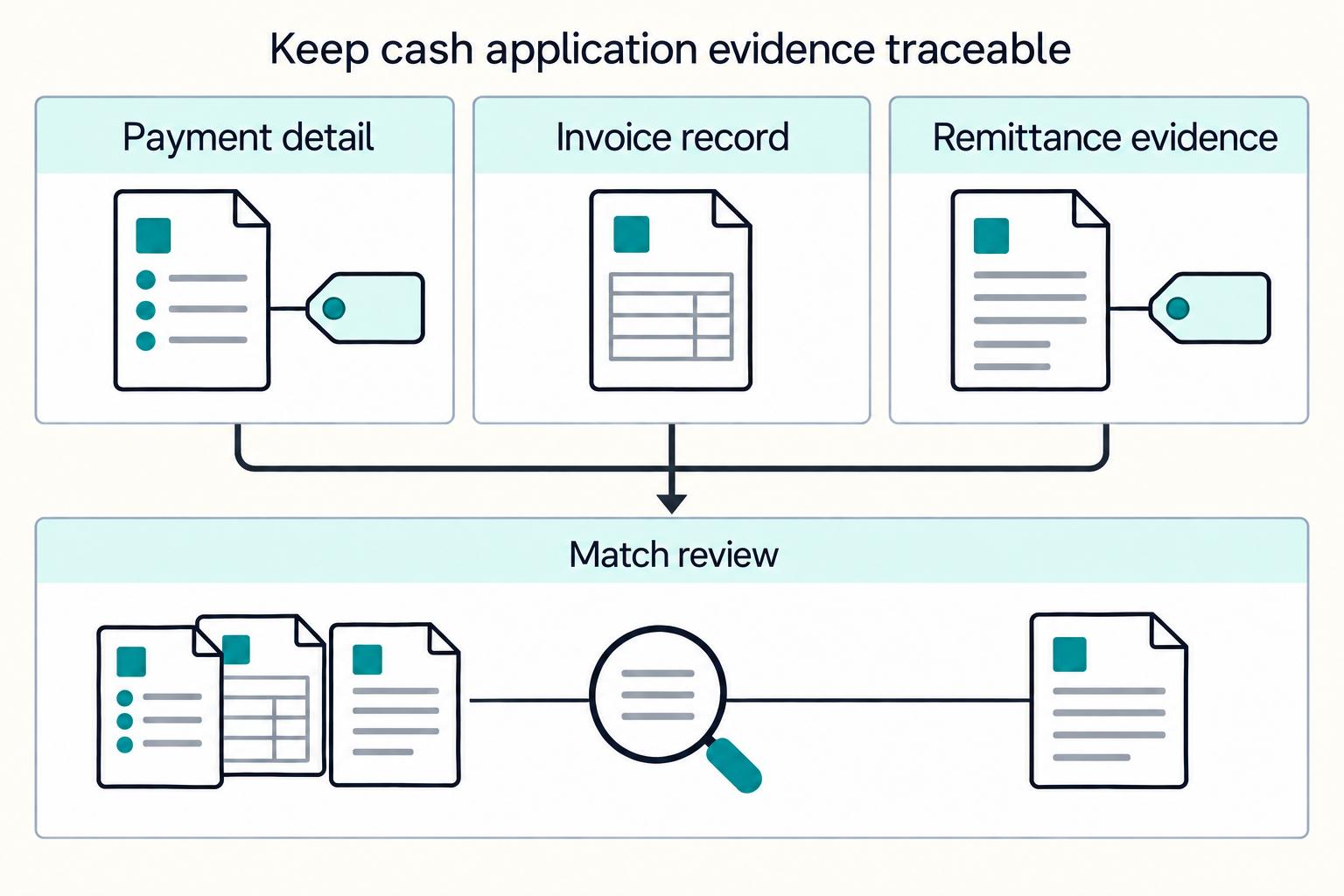
Use one control check. For sampled matched receipts, confirm the normalized record traces back to the original payment detail and remittance artifact.
Automate capture, but keep anomaly review. Use automation where remittance details arrive separately from payment movement, since that separation can delay posting. Manual handling across files and systems also creates bottlenecks and matching mistakes.
OCR is useful when payment context is in uploaded invoices or related documents, because it can read and extract that data into a central record. If you test newer AI capture tools, use them as assistive matching support and send ambiguous cases to review instead of auto-posting.
Separate exception items from straight-through matches. Keep non-standard reconciliation items out of the main reconciliation stream. Put them in a dedicated queue with aging views and named owner actions so unresolved items stay visible and practical.
The exact bucket design can follow your current finance process. Each item just needs an owner, current age, and next action.
Link exception status to close execution. Do not stop at match metrics alone. Keep unresolved reconciliation exceptions visible during close execution so operations and accounting work from the same open-item view.
Before close signoff, reconcile open exception counts and aging with what remains unresolved in AR posting. If exceptions remain, each one should have a task, owner, and status.
Balance settlement speed with fraud and control risk#
Faster settlement helps only if control quality stays intact after you change rails. Treat Real-Time Payments (RTP) as a segment-level routing choice, not a blanket upgrade across all payouts and collections.
Evaluate faster rails against enforceable controls. Start with a segment review. Real-time payments can make final funds available in real time or near real time, often on a near-24/7 basis, but coverage can vary by scheme and provider.
A route that works for domestic volume may not behave the same way for cross-border payouts. Currencies, regulations, payment networks, and broader global risk can add failure points.
Before you move live volume, confirm three control checks for each segment:
- You can validate recipient account details before release.
- You have clear, detailed reporting on payment status and outcomes.
- You can apply fraud signals that stop or slow release before funds move.
If account validation is not consistently documented, do not move that segment first.
Route by risk band, not by speed alone. After a segment is technically eligible, apply policy gates. Let lower-risk transactions auto-progress only when required checks pass, and send higher-risk items to approval or hold where your controls allow it.
Risk should reflect control signals, not just amount. Weak account-validation outcomes or conflicting fraud signals are enough to require review. Your reporting should clearly show why a transaction auto-progressed or was held, who approved it when review was required, and the final outcome.
Roll back segments when exceptions rise. Measure success by both speed and exception pressure. If settlement time improves but exceptions rise in a segment, roll that segment back and strengthen pre-settlement checks before re-testing.
Operator rule: if speed improves but exceptions increase, reverse the routing change first, then diagnose. The target is not the fastest timestamp. It is settled cash you can trust, with fewer unresolved exceptions.
Common mistakes and how to recover quickly#
Many recovery delays come from measurement confusion and partial fixes. You can recover faster by separating what each metric means, reviewing performance by segment before rolling up, and fixing payment flow issues as one connected chain.
| Mistake | What it hides | Recovery |
|---|---|---|
| Reporting acceptance as conversion | Acceptance-style metrics can hide failed attempts by counting only the final successful outcome | If acceptance improves while attempt-level conversion does not, treat that as a partial win, not a full conversion gain |
| Using one retry pattern for all declines | A blanket reattempt 24 hours later can miss local differences in issuer behavior and regional banking conditions | Soft declines can be retried automatically, while hard declines require customer intervention |
| Aggregating before segmenting | A single global benchmark can hide real loss points | Compare like with like before you roll results up and prioritize the failing segment first |
| Fixing initiation only | Front-end gains count as success only when downstream exceptions also decline | Address payment friction, payment-option fit, and transaction errors together |
Separate acceptance from attempt-level conversion. Do not report payment acceptance rate as payment conversion rate. Conversion and acceptance terms are often used interchangeably, and acceptance-style metrics can hide failed attempts by counting only the final successful outcome. If acceptance improves while attempt-level conversion does not, treat that as a partial win, not a full conversion gain.
Classify declines before retrying. Soft declines (for example, insufficient funds) can be retried automatically, while hard declines (for example, stolen card) require customer intervention. A fixed retry pattern, such as a blanket reattempt 24 hours later, can miss local differences in issuer behavior and regional banking conditions.
Segment first, then aggregate. A single global benchmark can hide real loss points. Recovery and conversion behavior can vary by local conditions such as time zones, issuer behavior, and regional banking nuances, so compare like with like before you roll results up. If your global average looks healthy while one segment keeps failing, prioritize that segment first.
Fix the full flow, not just initiation. Improving initiation alone is usually not enough. Performance improves more reliably when you address payment friction, payment-option fit, and transaction errors together.
Track downstream failure modes, including failed authorizations, incorrectly applied funds, and delayed transactions, so front-end gains count as success only when downstream exceptions also decline.
Related: Gateway Routing for Platforms: How to Use Multiple Payment Gateways to Maximize Approval Rates.
Your 30-day checklist to launch and run this weekly#
Use this as a practical 30-day operating template to establish one weekly, ledger-linked review that finance, ops, and product can trust for decisions.
| Week | Focus | Verification check |
|---|---|---|
| Week 1 | Lock definitions and publish one dictionary | Give three recent transactions to finance, ops, and product; if classification differs, the dictionary is not ready |
| Week 2 | Connect events to ledger checkpoints and set a minimum evidence pack | Trace 10 recent transactions from invoice record to ledger entry without jumping across disconnected tools |
| Week 3 | Ship one weekly scorecard with clear ownership | When reports conflict, use the ledger-linked scorecard as the operating source |
| Week 4 | Run one improvement cycle and document tradeoffs | If reported conversion rises while manual AR work increases, treat it as downstream rework, not a clean improvement |
Week 1. Lock definitions and publish one dictionary. Define stages once and keep them stable for the month. Write down your settlement definition and segment taxonomy: payment method, currency, region, customer type, and invoice size band. Include fields that change operations, such as multi-currency support and customer-level PSP mandates. Verification check: give three recent transactions to finance, ops, and product. If classification differs, the dictionary is not ready.
Week 2. Connect events to ledger checkpoints and set a minimum evidence pack. Do not rely on dashboard snapshots alone. If receivables sit in ERP but payment happens elsewhere, tracking is most reliable when operational events and ledger records are joined end to end across invoice generation, payment capture, and reconciliation status.
For each transaction, keep: invoice ID, method or rail, expected vs received amount, payer or remittance reference, provider reference, settlement timestamp, and exception code, if present. Verification check: trace 10 recent transactions from invoice record to ledger entry without jumping across disconnected tools.
Week 3. Ship one weekly scorecard with clear ownership. Publish one standing table with your stage conversion, lag, exception rate, owner, and a data-completeness confidence flag. Segment inside the same review by factors that change behavior, for example currency, payment method, key customer cohorts, and PSP-mandated accounts. Keep reporting aligned to invoicing reality, including email payment-link flows where applicable.
Keep cash-application quality separate from end-to-end conversion so matching issues are not confused with payment-movement issues. Verification check: when reports conflict, use the ledger-linked scorecard as the operating source.
Week 4. Run one improvement cycle and document tradeoffs. Prioritize the issue with the highest cash at risk. If breakdowns happen before payer action, tighten invoice clarity, payment-link placement, or method communication. If breakdowns happen after receipt, fix matching and reconciliation first.
Document before and after using the same Week 1 definitions: what changed, what improved, and what remains unresolved. If reported conversion rises while manual AR work increases, treat it as downstream rework, not a clean improvement.
Keep going weekly. Run the same review every week, re-rank by cash at risk, and tighten controls only where your payment program and market coverage support it. Report mandated-PSP segments separately instead of blending them away. If data completeness drops or a join breaks, mark the metric untrusted until fixed.
Related reading: How to Maximize Your Xero Investment as a Payment Platform: Integrations and Automation Tips.
If you want to pressure-test this 30-day workflow against your rails, controls, and reconciliation requirements, align on an operating design before rollout. Talk with Gruv.
Frequently Asked Questions
What is payment conversion rate from invoice to settled cash?
Use it as an end-to-end view of the invoice-to-cash cycle: invoice generation, payment collection, reconciliation, and reporting. There is no universal conversion formula, so use one shared internal settlement definition and keep stage definitions consistent across finance and ops.
How is cash application hit rate different from invoice-to-settlement conversion?
Confirm the definition of cash application hit rate with your finance team or a qualified adviser. Treat hit rate as an internal metric only if you maintain your own documented definition, and keep it separate from end-to-end invoice-to-settlement reporting.
Which metrics matter most besides payment success rate?
Look at stage-level movement and timing across invoice generation, collection, reconciliation, and reporting. Real-time payment tracking and notifications help isolate where delays are happening in that chain. That gives you a clearer operating view than a single success outcome.
What data fields are required to measure invoice-to-settled-cash conversion reliably?
There is no single required field list to standardize on. At minimum, keep your currency and payment-method choices explicit, including billing currency, accepted currencies, and preferred or required payment method for international invoices. Make sure records stay traceable through your ERP or accounting integration so the flow can be followed without guesswork.
Why do cross-border invoices convert slower even when payment methods are available?
Cross-border business payments move across countries, currencies, and jurisdictions, which can add delay. Settlement-time and transaction-cost friction have historically been common, especially in less liquid currencies. FX risk can also change effective cost between invoice issuance and payment processing, so unclear currency and payment-method choices can add avoidable hesitation.
How should we segment conversion reporting by rail, currency, and customer type?
Start with factors supported here: payment method, currency, region, transaction value, and speed requirements. This matches how international payment-system choices are made in practice. If you add rail-level or customer-type cuts, treat them as internal extensions rather than source-backed requirements.
When should we prioritize faster settlement rails over stricter risk controls?
There are no fixed risk-control thresholds to apply. Prioritize faster options when segment needs (currency, region, transaction value, and speed requirements) support it and reconciliation/reporting remain dependable. Do not assume universal same-day settlement; some networks are described as up to 4 days faster than traditional wires.
Try a related tool
Researched and edited by the Gruv editorial team. Gruv builds cross-border billing, payouts, and finance-operations software for global businesses.
Sources
Includes 4 external sources outside the trusted-domain allowlist.
- comptroller.tn.gov/content/dam/cot/la/advanced-search/2026/educ...trusted
- federalregister.gov/documents/2025/01/16/2025-00592/securing-the...trusted
- occ.gov/publications-and-resources/publications/comp...trusted
- stripe.com/resources/more/presentment-currency-and-sett...trusted
- barnraisersllc.com/2026/03/06/cross-border-payment-toolsexternal
- bill.com/blog/how-to-use-payment-analyticsexternal
- billtrust.com/resources/blog/ai-finance-toolsexternal
- breakingac.com/news/2026/mar/31/why-your-platform-needs-a-h...external
Educational content only. Not legal, tax, or financial advice.
Related Posts

The Freelance Payment Penalty: A Modeled Audit of Platform Fees, FX Spreads, and Payout Delays
The money rarely disappears through a single, easy-to-spot fee. The real loss is stacked. A marketplace takes its commission, a processor adds a charge for international cards, a bank or payment company converts the currency at a spread, a platform holds the funds before release, and a wire sheds a little to intermediaries on the way in. Each layer looks defensible on its own, but the worker feels the combined result as a smaller deposit and a later payday.

How to Respond to a Subpoena for Business Records
Move fast, but do not produce records on instinct. If you need to **respond to a subpoena for business records**, your immediate job is to control deadlines, preserve records, and make any later production defensible.

A US Expat's Guide to Investing in UCITS ETFs to Avoid PFIC Issues
The real problem is a two-system conflict. U.S. tax treatment can punish the wrong fund choice, while local product-access constraints can block the funds you want to buy in the first place. For **us expat ucits etfs**, the practical question is not "Which product is best?" It is "What can I access, report, and keep doing every year without guessing?" Use this four-part filter before any trade: