
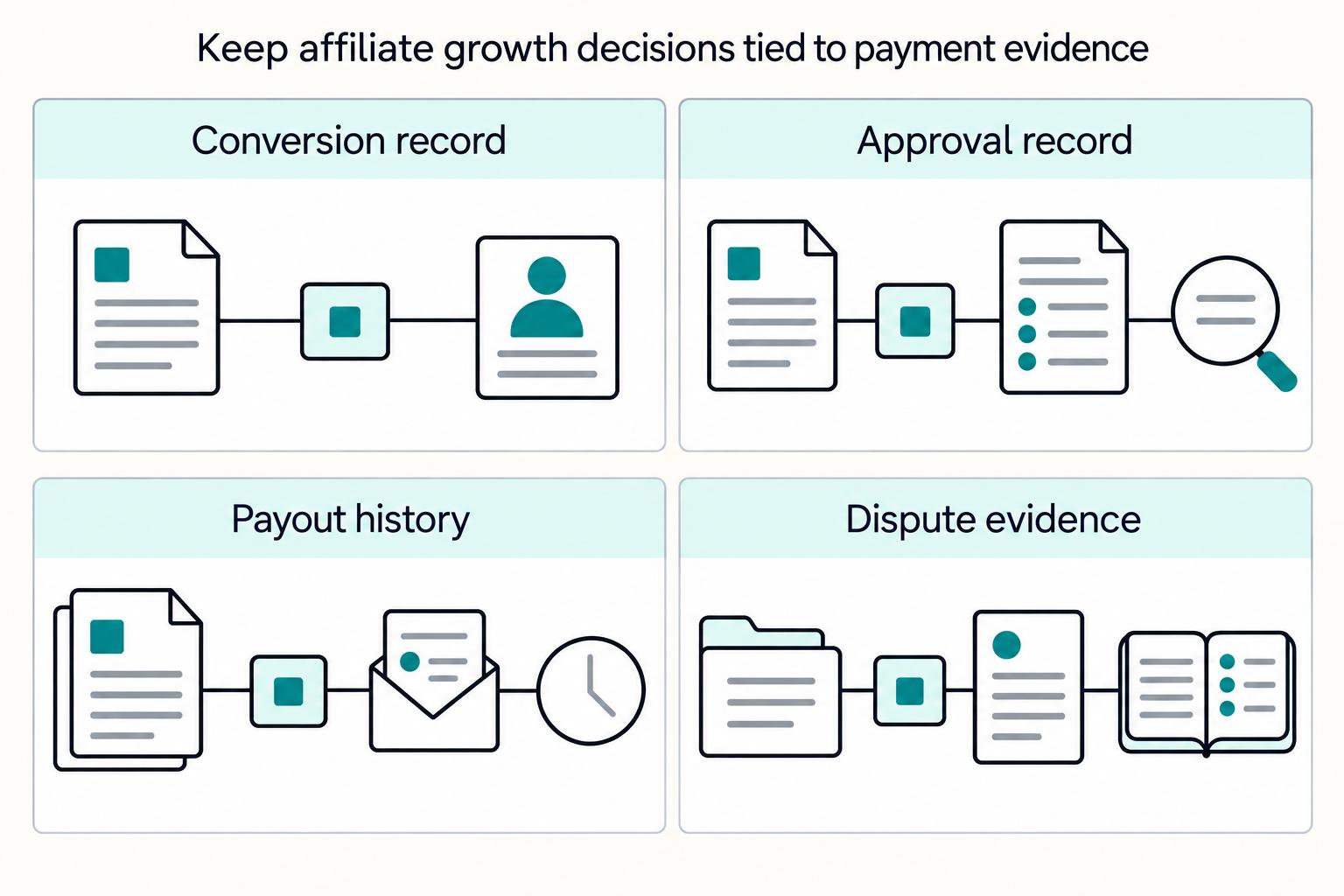
Quick Answer
Diagnose the leak before scaling: separate Sales Funnel drop-off from payout friction and assign one owner, KPI, and evidence source to each issue. Use cohort-level signals instead of blended affiliate totals, then verify whether complaints map to specific payout batches or cutoff timing. If payment confidence is the blocker, stabilize cadence, status visibility, and exception handling first; programs like Awin run on the 1st and 15th with minimum payout thresholds, so eligibility and timing rules must be explicit.
Why CRO and Payments Matter in Affiliate Networks#
An affiliate network can scale more reliably when you run Conversion Rate Optimization (CRO) and payouts as one revenue system, not as separate growth and finance tracks. CRO improves the share of visitors who complete a desired action, and in a commission-based model, that affects partner earnings.
The catch is execution. A conversion only matters to partners once it clears approval and becomes withdrawable commission. You can post strong top-line growth while partner trust and retention weaken if payout steps feel slow, inconsistent, or unclear.
In practice, actions move through checks before commissions are payable. Some programs also use an action locking period where actions can be modified or reversed under contract rules. One documented flow cites an invoicing period of about 2 to 3 weeks before payout scheduling, while Awin processes publisher payments twice monthly on the 1st and 15th. These are examples, not a universal timeline, but they point to the same reality: partner experience depends on the full path from action to payout.
Before you push harder on partner recruitment or front-end conversion tests, confirm the full earnings journey with evidence:
- Funnel conversion performance
- Approval timing and reversals
- Payout cadence and payment-status clarity
- Support volume tied to payout confidence
There is a finance tradeoff to manage. Research on delayed payments in other commercial relationships shows that short-term cash benefits can come with relationship and financial downside. Affiliate programs are not the same as supplier models, but the warning still applies: cash-timing decisions can limit the upside from CRO gains.
This guide follows that logic step by step. It shows how to separate funnel leaks from payout leaks, what evidence to gather before you change anything, where growth and control tradeoffs sit, how to recover from delays or reversals, and a copy-and-paste checklist to keep growth, product, and finance working from the same facts.
Why CRO and payouts must share one operating model#
Run Conversion Rate Optimization (CRO) and payouts as one operating model because partners often judge your program on the full path from conversion to paid earnings. Better conversion can raise commissionable volume, but payout quality still depends on accurate, timely, reliable execution. If funnel metrics improve while payout reliability slips, the program can look healthier in reports than it feels to partners.
Step 1 Tie conversion gains to payable earnings#
CRO is not just a site KPI here. It changes how many users complete actions that can become affiliate commissions, and payout operations determine whether those earnings feel dependable. Track both sides together for the same partner cohort:
- approval-to-payout timing
- reversal or exception rate
- support tickets about payment status or missing funds
If payout signals worsen after a conversion win, treat that as a warning, not as proof the program is improving.
Step 2 Recognize the downside path early#
Partners experience one earnings journey, not separate growth and finance processes. In payout operations, late or failed payouts are linked with higher support volume, churn, and internal cost. Payments research also shows that payment-method mismatch can hurt conversion, which reinforces the same point: money-movement friction can reduce performance even when acquisition is working.
A converting sales funnel alone is not enough. Publishers have alternatives, including options like Google AdSense. When payouts are late or fail, support demand can rise and partner churn risk can increase.
Step 3 Use one decision rule#
If partner complaints point to payment confidence, treat payouts as a growth blocker before you add new acquisition spend. Confirm the pattern in ticket tags, payout-status logs, and partner-manager notes, then fix reliability first. This is a cross-functional execution issue, because growth, finance, and payment ops all influence the same ROI outcome. For related testing discipline, see A Freelancer's Guide to A/B Testing Your Website and Emails.
What to prepare before you optimize anything#
Build one shared evidence pack before you change CRO or payout settings. If growth, product, and finance are working from different snapshots, you can optimize the wrong constraint.
Step 1 Build one evidence pack for the same partner journey#
Put the evidence for your affiliate network in one place, tied to the same partner cohorts, time window, and conversion path. Include funnel-stage drop-off, payout timing, payment-status support tickets, and documented payout-delay reasons.
For funnel performance, use funnel exploration or custom funnel views to see where users drop off step by step. For payouts, map the full path from action to payout: approval checks, action lock, payment scheduling period, and release. Commissions pass through multiple checks before withdrawal, so your prep should reflect the full sequence, not just the approval point.
Include a payout reconciliation report, or an equivalent export, so you can trace which transactions were included in each payout. If you cannot map a complaint to a specific payout batch, transaction set, or overdue reason, your prep is not complete.
Step 2 Segment partner cohorts before reading performance#
Do not treat affiliates as one blended source. Split results into the cohorts that matter for your goals, such as your internal "Relevant Affiliates" cohort, coupon affiliates, and browser extension affiliates.
| Cohort | Why separate | Article note |
|---|---|---|
| Relevant Affiliates | Not a universal category | Define it internally and document the rule |
| Coupon affiliates | Partner type selection should follow business goals, not just traffic volume | Keep coupon-focused partners separate |
| Browser extension affiliates | Disclosure and attribution handling can differ | Some networks require extension publishers to disclose |
Define "Relevant Affiliates" internally and document the rule, since it is not a universal category. Keep browser extension affiliates separate because disclosure and attribution handling can differ, and some networks require extension publishers to disclose. Keep coupon-focused partners separate because partner type selection should follow business goals, not just traffic volume.
Step 3 Gather experiment and payout incident logs#
Bring in your current A/B testing log and payout incident log from your payout operations stack. For experiments, prioritize randomized variant tests with statistical analysis over simple before-and-after changes.
For payout incidents, capture run date, affected partners, root cause, resolution time, and partner visibility. Document your live payout baseline exactly. Cadence differs by program: some runs are on the 1st and 15th, some invoicing periods stretch over 2 to 3 weeks, and some setups use holding periods from 1 to 90 days.
Step 4 Assign ownership before tradeoffs appear#
Set ownership before conflicts show up: a CRO owner, a payouts owner, and one DRI for cross-team decisions. A simple RACI chart is enough if it makes accountability explicit.
Use one checkpoint: every issue in the evidence pack maps to one owner and one next action. If a conversion win increases payout exceptions or payment-support load, the DRI decides whether to pause, proceed, or redesign.
Step 1 Diagnose where growth is leaking first#
Diagnose the leak in two separate lanes first: Sales Funnel or Automated Payments Experience. When those signals get mixed into one backlog, teams can end up fixing the louder problem instead of the actual constraint.
The evidence pack from the previous step is your guardrail. If a suspected leak is not tied to the same cohort, time window, and partner journey, treat it as unverified.
Build a two lane diagnostic table#
Use one shared view so growth and finance are reading the same signals.
| Check | Lane A Sales Funnel leakage | Lane B Automated Payments Experience friction |
|---|---|---|
| Typical symptom | Affiliate clicks arrive, but conversion stays flat or users drop at a required step | Conversions hold, but payment-status tickets or payout complaints increase |
| Best evidence | GA4 funnel exploration, landing/checkout drop-off, prior A/B testing logs | Payout reconciliation report, payout incident log, payment-support tickets, and any churn reasons tied to payment timing or confidence |
| Core KPI | Step completion rate, checkout completion rate, approved action-to-conversion rate | On-time payout rate, overdue payout count, payment-status ticket volume, churn signals tied to payout issues |
| Likely owner | CRO owner | Payouts owner |
In Lane A, funnel exploration helps you locate where journeys become inefficient or abandoned. If users miss a required step, they fall out of the funnel there, so sharp drop-offs are measurable path breaks, not just soft demand.
In Lane B, payment reliability is a growth signal, not just a finance signal. Timely publisher payments are treated as foundational to affiliate operations, and payment speed has been publicly tied to publisher growth outcomes.
Apply a first triage rule before opening work#
Use this as a first pass, then verify it. Strong traffic quality with flat conversion can indicate funnel friction. Stable conversion with rising payout complaints can indicate payout friction.
Inside the payout lane, check timing friction against your real schedule and thresholds. Awin publishes twice-monthly processing, cutoff points on the 15th or last day of the month, and minimum thresholds of £20/€20/$20. CJ states closing occurs around the 13th and 22nd. If complaints cluster around cutoffs, below-threshold balances, or delayed runs, you have a concrete investigation path. If you cannot map a complaint to a payout batch or overdue reason, the diagnosis is not ready.
Read the same signals by affiliate cohort#
Do not rely on blended affiliate totals. Publisher types differ, and discount-code publishers and browser-extension-style affiliates should be read as separate cohorts rather than averaged together.
If you use an internally defined Relevant Affiliates cohort, prioritize it explicitly and weight severity by cohort importance, not just raw complaint volume.
Verify each leak before anyone starts fixing it#
Before work begins, require four checks for each suspected leak:
- Write the leak as an observable problem, not a theory.
- Attach one KPI and one evidence source.
- Assign one owner.
- Set the next review point to confirm or reject the diagnosis.
A KPI without an owner becomes debate, and an owner without a KPI becomes opinion. Once each leak has both, deciding where to start gets faster and clearer.
Step 2 Remove conversion blockers that hurt affiliate earnings#
If Step 1 confirms funnel leakage, fix the eCommerce journey before you buy more affiliate traffic. Sending more clicks into a weak landing page or clumsy checkout can scale waste across your affiliate network. This is especially true on mobile, where a 1-second delay can impact conversions by up to 20%.
1 Fix the biggest break in the journey#
Start with the sharpest drop in your Sales Funnel, not the page with the most opinions. GA4 funnel exploration helps you see where users complete or abandon a task, so you can separate a true path break from low intent.
Use a simple priority rule: fix required-step friction first. If affiliate traffic reaches product pages but stalls at cart, shipping, account creation, or payment, prioritize that before broad redesign work. Checkout friction still matters here: Baymard reports average cart abandonment at 70.19%, and 18% of US shoppers report abandoning because checkout felt too long or complicated. At the same time, 43% report abandoning because they were just browsing or not ready to buy, so not all abandonment is a UX defect.
Keep validation cohort-specific. Check the same affiliate cohort, device, landing page, and time window from Step 1. If the drop-off only appears in blended traffic, treat the diagnosis as unproven.
2 Run narrow A/B tests, not broad redesign bets#
Use A/B Testing to answer one question per test. The strongest tests isolate one element, so avoid changing headline, layout, checkout fields, trust copy, and offer framing in the same experiment.
Read results beyond top-line conversion rate. Conversion rate is conversions per interaction, but your decision should also include business outcomes, not just order count. Use one readout format for every test:
- Affiliate cohort or traffic source tested
- Exact funnel step targeted
- Conversion result for that step and completed checkout
- Revenue, cost, or margin movement
- Business-value impact, not clicks alone
If your analytics setup can compare A/B paths inside the funnel, use it to confirm the variant improved the journey rather than just moving abandonment downstream.
3 Hold back wins that weaken unit economics#
Set this rule before rollout: if a variant lifts conversion but weakens margin, do not scale it until unit economics are rebalanced.
CRO decisions need finance discipline. Define the monetary metric in advance, then require sign-off before you expand beyond the test cohort.
4 Borrow adjacent channel learning carefully#
Use App Store Optimization (ASO) testing discipline where it fits, especially for message and creative handoffs. Google Play store listing experiments support A/B testing and recommend running tests for at least a week to capture weekday and weekend patterns. Apple product page optimization allows testing up to 3 alternate product page versions against the original.
Do not treat app-store outcomes as one-to-one predictors for web checkout. The transferable lesson is methodological. Test one conversion-oriented creative or message variable at a time, then verify that top-of-funnel promises still match the landing page and checkout experience.
For a step-by-step walkthrough, see Affiliate Program Management for Platforms Running a High-Performing Publisher Network.
Step 3 Redesign payout operations as a partner trust product#
Payout operations are a partner trust product. If earnings are late, unclear, or unresolved, conversion gains can still leak out through partner churn.
1 Choose the payout model you can actually operate#
Pick the model your team can run reliably under real exception load, not the model that looks most efficient on paper.
| Payout design | Control | Speed expectation | Exception burden |
|---|---|---|---|
| Manual ops | Highest trigger control; you choose when to release funds, but country timing obligations still apply. | Team-dependent and provider-dependent; manual Stripe payouts typically arrive in 1-4 business days after initiation. | Highest: manual run initiation, failure monitoring, reconciliation, and partner inquiry handling. |
| Payables Automation | Less per-run control, with cadence options (daily, weekly, monthly, or manual). | Cadence-based, but still rail- and provider-dependent. | Medium: fewer manual release steps, but pending, failed, returned, and mismatch cases still need handling. |
| Global Payables Automation Solution | Centralized operations across markets with cross-border and local-currency support where supported. | Route- and provider-dependent; some flows are near-instant, others take business days. | Medium to high: less routine release effort, more route validation, market support checks, and policy gating. |
If you run multi-country or multi-currency affiliate payouts, manual-only operations can become fragile as volume and exceptions rise. Cross-border and local-currency support is provider- and market-specific, so validate routes and coverage up front.
2 Set the trust requirements partners actually feel#
Partners judge payouts by reliability and visibility, so define those requirements explicitly.
First, run on the promised cadence. If your schedule is twice monthly, keep it consistent. Clear cadence expectations matter. For example, Awin processes on the 1st and 15th.
Second, verify payout accuracy before release. Confirm approved commissions, holds, account details, and payable currency. Include a freeze control for risky changes. Some setups apply a 48-hour hold after bank detail updates.
Third, support the right route and currency where supported. If cross-border local-currency payout is available, use it, but pre-check transfer routes for new recipients to reduce bank or regulatory failure risk.
Fourth, expose payout status in the Automated Payments Experience. At minimum, make states visible to partners and support, for example: initiated, pending, failed, credited, returned.
3 Run every payout in the same order every time#
Run every payout in the same order every time. Standardize this sequence for every run:
- Pre-checks
Confirm approved earnings, payout method, recipient details, and transfer route for new or changed recipients.
- Compliance gates
Hold or review based on transaction and geographic risk context.
- Release funds
Create the payout batch and store the provider reference. If a provider returns payout_batch_id, persist it. On transient HTTP 5xx create errors, retry with the same sender_batch_id to avoid duplicates.
- Reconcile
Match your approved-commission ledger against provider payout reports to catch partial releases, mismatches, and missing recipients.
- Partner-visible confirmation
Show real status outcomes, not just submission. Mark completion only when provider state confirms it, for example, credited or returned.
Your support team should be able to answer "what happened to this payout?" from one internal ledger line and one provider reference.
4 Define failure handling before you scale volume#
Delayed responses, mismatches, and returned payouts are normal payout conditions, so define the handling before volume increases.
| Failure class | Handling rule | Article note |
|---|---|---|
| Delayed responses | Define pending-time review points and partner notification timing | Set an SLA per failure class and assign escalation ownership |
| Mismatches | Pause the next release until the ledger-to-provider difference is explained | Set an SLA per failure class and assign escalation ownership |
| Failed payouts | Split retryable cases from those that need partner action | Set an SLA per failure class and assign escalation ownership |
| Returned payouts | Detect returned funds and reopen payable balances cleanly | Some providers return unclaimed payouts after 30 days |
Set an SLA per failure class and assign escalation ownership. For delayed responses, define pending-time review points and partner notification timing. For mismatches, pause the next release until the ledger-to-provider difference is explained. For failed or returned payouts, split retryable cases from those that need partner action. Some providers return unclaimed payouts after 30 days, so detect returned funds and reopen payable balances cleanly.
If a partner asks where funds are and your team cannot provide status, timestamp, and next action, payouts are still a trust risk.
Need the full breakdown? Read Platform Take Rate Optimization: How to Set Marketplace Fees Without Losing Liquidity.
Step 4 Choose affiliate mix based on incremental value#
Once payout reliability is stable, rank partners by incremental value first, not raw volume. Bias budget and commission toward affiliates that drive revenue that would not have happened otherwise, not just affiliates that appear late and claim the conversion.
Step 1 Score partners by contribution, not clicks#
Make incremental revenue the highest-weight signal in your partner score, and keep raw click volume low-weight. Partner roles differ across the journey: some support discovery and research, while others are more conversion-focused at purchase, so one scoring lens is usually misleading.
Use a compact scorecard with four inputs:
- Incremental revenue contribution by partner type or cohort
- Cohort ROI after commission and payout cost
- Retention outcome from that partner's traffic over time
- Exception drag, including rising Transaction Query volume or attribution conflicts
Promote affiliates when they show measurable lift beyond conversion capture. Evaluate end-of-journey partner types with incrementality checks when impact appears concentrated at the end of the journey.
Verification point: only move a partner into a higher commission tier when cohort ROI or measured incrementality improves, not just tracked conversion count.
Step 2 Configure commission logic around quality signals#
Use commission logic to reward measured quality, not one flat rate across your Affiliate Network. Awin's commission flexibility allows customized rules from tracking conditions, including different rates by partner category.
For browser extension partners, apply Soft Click status where appropriate. It prevents certain software or extension publishers from overwriting existing post-click attribution from other affiliates, which helps protect earlier contributors. Avoid paying purchase-stage and discovery-stage partners the same rate without checking who is actually moving demand.
Step 3 Cap exposure when your own data shows weak value#
Cap exposure when a partner cohort shows weak ROI, repeated attribution issues, or a growing share of disputes. Use a lower rate, tighter approval rules, or a temporary pause while you review tracking and award logic.
Treat dispute volume as an operating signal. A Transaction Query is a publisher-raised dispute when commission appears untracked or incorrectly awarded. Awin notes these are most common among customer-facing publishers, including cashback and loyalty partners. On Awin, Transaction Queries auto-validate within 75 days, so unresolved cases need active handling before that window closes.
Step 4 Recheck ROI by cohort every month#
Run a monthly cohort review to keep partner mix aligned with real performance. GA4 supports daily, weekly, or monthly cohort grouping, and monthly is often a practical cadence for partner-budget decisions. Review each month:
- ROI by partner cohort
- Commission paid versus measured incremental value
- Transaction Query count and aging
- Retention or repeat-value signal by cohort
If a cohort wins on conversion volume but loses on ROI after payouts, disputes, and retention, reallocate budget toward cohorts with stronger incremental value and margin performance.
Step 5 Align product design and finance controls#
As you shift budget toward higher-value partners, product and finance need one auditable payout timeline, not separate views. Treat each conversion, approval, payout release, provider event, and dispute as one control chain so Payables Automation does not hide errors until partners escalate them.
Step 1 Build one event timeline for conversion and payout#
Link the commercial event to the money event in one record set. At minimum, connect each affiliate conversion to approval status, payout amount, payout attempt, provider status update, and any later dispute or reversal. That way, product and finance can review the same facts.
Use a simple test: trace one paid commission from start to finish without switching tools or requesting a spreadsheet. If you cannot see conversion time, approval time, payout release time, provider callback, and final settlement state together, the timeline is not yet audit-ready for Affiliate Marketing decisions.
Affiliate commissions often pass through multiple checks before funds are withdrawable, so stopping your internal view at "approved" creates blind spots between recorded liability and actual partner cash timing.
Step 2 Define policy gates before exceptions scale#
Set named control gates before volume makes exceptions hard to manage. Build explicit verifications, reconciliations, authorizations, and approvals into the payout flow instead of relying on silent automation.
A workable policy set usually includes:
- Approval gate: when a conversion becomes payable, including who can override holds and why
- Exception gate: mismatched amounts, failed beneficiary checks, or disputed commissions
- Reconciliation gate: before close, matching payout statuses and fees to transaction records and invoice items
If teams cannot clearly see whether a payment is pending approval, sent, failed, disputed, or reconciled, your Automated Payments Experience is too opaque.
Step 3 Add retry and status checkpoints that fail safely#
Design retries so they cannot create duplicate payouts. Use idempotency on payout-creating requests where supported. If you use Stripe idempotency keys, keep them within the documented limit of 255 characters.
| Control | Requirement | Article detail |
|---|---|---|
| Idempotency | Use idempotency on payout-creating requests where supported | If you use Stripe idempotency keys, keep them within 255 characters |
| Webhook deduplication | Deduplicate repeated provider events | Handle provider events as asynchronous and potentially duplicated |
| Listener acknowledgments | Return 2xx acknowledgments when required | In implementations like PayPal, non-2xx responses can trigger redelivery up to 25 times over 3 days |
Handle provider events as asynchronous and potentially duplicated. Webhook consumers should deduplicate repeated events, and listeners should return 2xx acknowledgments when required. In implementations like PayPal, non-2xx responses can trigger redelivery up to 25 times over 3 days.
Verification point: simulate one failed callback and one duplicate callback in staging. You should see one final business action, a visible retry trail, and no second payout created.
Step 4 Bring leadership an evidence pack, not a narrative#
Leadership should review control performance, not just growth volume. Bring shared evidence that product and finance can both audit: payout accuracy logs, exception aging, dispute counts, and cohort-level Affiliate Retention trends.
For reconciliation, use provider reporting that ties lifecycle events and fees to transaction records and invoice items. Dispute-reason reporting also makes dispute counts operationally useful, not just directional.
If your cohort data shows retention drops while payout failures or unresolved disputes rise, treat it as a cross-functional operating issue and make one decision from one evidence set.
Related reading: Partial Payments and Milestone Billing: How to Implement Flexible Invoice Terms on Your Platform.
Common mistakes that stall affiliate growth and how to recover#
Once your event timeline and control gates are visible, failures usually follow a pattern. A common one is front-end optimization continuing while payout friction, weak partner segmentation, and conversion-only test decisions stay unresolved.
1. Pause expansion when payout trust is the real blocker.
If partners are still chasing payouts, scaling traffic can scale the problem. Payment experience is a relationship touchpoint, and late-payment practices can materially harm payees. One payments survey also found that 68% of companies view long-term payee retention as critically important. That reinforces payout reliability as a growth input, not just a finance task.
A practical recovery move is to pause net-new recruitment or budget expansion while payout reliability is stabilized. This is not a permanent freeze. It is a sequencing decision: avoid scaling a lane you cannot pay accurately and predictably.
Check operations directly: review payout tickets, failed runs, delayed statuses, and partner complaints, then compare that list with your high-value affiliate cohort. If the same partners appear in both, payouts are likely the active growth constraint. Also verify beyond internal approval timestamps, because release, provider confirmation, and settlement can still lag.
2. Split actions by partner type instead of managing one blended channel.
Use a partner-mix strategy, not one blanket playbook. Recovery starts by separating Relevant Affiliates, Coupon Affiliates, and Browser Extension Affiliates in reporting and actions.
Relevant Affiliates should be managed for landing-page fit, approval clarity, and payout transparency. Coupon Affiliates should be reviewed for incrementality, since coupon partners may complete purchases rather than create net-new demand. Browser Extension Affiliates need tighter attribution review because extension behavior is a recurring issue in last-click debates.
If all three groups stay blended, channel quality gets harder to read and optimization decisions get noisier. Your review should show conversion rate, approved commission, disputes, and repeat value by cohort, not just as one affiliate total.
3. Judge every test on value, not conversion count.
CRO improves the share of visitors who complete an action, but conversion lift alone is not enough. A test that raises conversions while weakening margin quality or partner retention is not a true win.
Use a Target ROAS-style readout so decisions include conversion value, such as revenue or profit margin, not just action volume. Require statistical significance before naming a winner. If orders increase through lower-value paths, ROI can fall even when top-line conversion rises.
Keep every readout decision-ready: conversion delta, margin impact, cohort-mix shift, and changes in payout disputes or partner retention. If one is missing, the test result is incomplete.
4. Require incident readiness before choosing payout tooling.
Automation can improve scale, but exceptions determine whether it works in production. NIST incident-response guidance supports the same principle: preparation reduces incident count and impact.
Before rollout, require written playbooks for:
- failed or partially completed payout runs
- duplicate or delayed provider events
- beneficiary or amount mismatches
- reversals, disputes, and partner-facing status corrections
Run a tabletop incident before go-live. You should be able to identify the owner, reconciliation report, partner communication path, and manual release-or-hold rule. If exception handling is still improvised, tooling selection is not complete.
30-day execution sequence with weekly checkpoints#
Use the first 30 days to get a decision-ready baseline before you scale. The goal is one clear read on growth leaks, tighter payout controls, and a Week 4 choice: scale, iterate, or roll back.
1. Build the diagnostic and ownership map.
Week 1 is strongest when every leak has an owner and next action. Map the Sales Funnel and payout lane side by side, then use a RACI chart so accountability is explicit for each issue.
Set one checkpoint: each suspected leak must have a measurable KPI, a named owner, and a next action. Pull evidence from funnel drop-off, affiliate complaints, failed or delayed payout statuses, and retention-risk signals in the affiliate network. If high-value partners appear in both payout tickets and retention-risk notes, treat payout reliability as a likely blocker to resolve before you expand.
2. Run focused tests and lock payout controls.
Week 2 is about disciplined testing and payout control, not test volume. Run only the highest-confidence CRO tests, pre-define the readout rule, and avoid early winner calls.
In standard frequentist setups, read results only after planned sample size or design duration is reached, using your chosen threshold, for example, a 95% confidence interval. In parallel, lock payout controls: monitor payout states (processing, posted, failed, returned, canceled) and review a payout reconciliation report for each automatic batch. Do not treat internal approval as completion when returns can appear 2 to 3 business days later.
3. Change cohorts and recalibrate commissions.
Week 3 is when you apply cohort-based commission changes. Separate partner cohorts, and recalibrate rates with Commission Groups, or equivalent controls, using criteria you can defend, such as customer type or product category.
Review performance by cohort, not just channel totals. If a change lifts conversions but raises disputes or low-margin orders, reverse it quickly.
4. Review retention and make the scale call.
Week 4 should combine conversion, payout accuracy, and affiliate retention in one decision. Use a retention report or cohort view to confirm behavior is improving over time, not just in a single week.
For payout reliability, review at least the last 2 payment runs, about 30 days, before deciding. Keep the rule simple. Scale when conversion improves and payout accuracy holds. Iterate when conversion rises but failed, returned, or canceled payouts increase. Roll back commission changes when the target cohorts do not improve and retention risk remains.
Copy and paste checklist for operators#
Use this checklist to lock the decision record before your next review cycle. If any item is still vague, pause and close that gap before you scale further.
- Confirm leak diagnosis and owner
- We diagnosed funnel leaks and payout leaks separately, and each issue has a named owner, KPI, and next action. - For funnel checks, we used GA4 Funnel exploration to identify where users dropped out. If users skipped a required step, we treated it as a real break because they fall out of later funnel counts. - For payout checks, we logged issue type, affected partner cohort, and evidence source, including support tickets, failed payout records, or reconciliation notes.
- Segment Commission-Based Affiliate Partners by incrementality
- We segmented Commission-Based Affiliate Partners by quality, customer-journey role, and incremental value, not just raw conversion volume. - We used an incrementality lens: value that would not have happened without that partner. Where tested, we compared test-versus-control conversion-rate differences instead of assuming every assisted conversion was incremental. - Red flag: if a partner is strong on conversions but weak on incremental value or margin, do not expand commission exposure yet.
- Validate payout reliability, accuracy, and currency experience
- We validated whether the Automated Payments Experience is reliable, accurate, and clear for partners, including status visibility and exception handling. - We reviewed failed payouts directly: a failed payout means the receiving bank could not accept the funds. Because incorrect bank details are a common failure mode, bank-detail verification remains in the checklist. - If you support international charge flows, we verified the currency experience deliberately. Stripe notes support for processing charges in 135+ currencies, and local presentment can improve conversion and authorization rates.
- Tie every change to ROI and retention
- We tied each CRO or payout change to expected and actual Return on Investment (ROI), using ROI to measure whether the investment made or lost money. - We also logged Affiliate Retention impact. A conversion lift is not a win if payout confidence drops and churn risk rises.
- Document exceptions, escalation paths, and next priorities
- We documented exceptions, third-party dependencies, and escalation paths with explicit ownership at each step. - We recorded escalation triggers, retry and reversal approvers, and what must be rechecked in the next review cycle. If a payout pause appeared related to tax-form or bank-detail issues, we verified resolution before treating it as closed.
We covered this in detail in Affiliate Marketing Management for Platform Operators Running a Partner Network.
If your checklist flags payout reliability as the growth constraint, pressure-test your operating requirements against Gruv Payouts before you scale partner spend.
Conclusion#
Profitable, durable affiliate growth can break when CRO and partner payouts are managed as separate problems. Run them as one system: CRO increases the share of traffic that converts, and on-time, reliable payouts help keep partners confident enough to keep sending that traffic.
Diagnose the leak type first, then fix the highest-risk constraint before you scale spend or recruit more partners. If conversion is the bottleneck, prioritize funnel fixes. If payout trust is the bottleneck, stabilize payment timing, rules, and status visibility first.
If you want to validate payout operations, compliance gating, and market coverage for your model, talk to Gruv.
Frequently Asked Questions
How do Conversion Rate Optimization (CRO) and affiliate payouts influence each other in practice?
They shape the same partner economics from opposite sides. Better conversion performance increases earnings from the same traffic base. But if payouts are late, unclear, or blocked by validation issues, that added earning power does not feel reliable to partners, which can hurt retention and effort.
What are the top drivers of Affiliate Retention beyond commission percentage?
Reliability and relationship quality are major drivers beyond the commission rate. On-time payments, predictable schedules, clear validation, and responsive partner management all influence whether affiliates stay active. A practical check is whether partners can quickly understand when they get paid, what balance they need, and why a payment is delayed.
What payout factors matter most to partners in a global Affiliate Network?
Partners care most about predictability, eligibility rules, payout-method availability, and country-specific constraints. Awin’s published thresholds are £20, €20, and $20, with processing twice per month and cutoff timing on the 15th or last day of the month. It is also important not to assume uniform options, since payment methods vary by country and network setup, and payment requirements must be completed before payout.
Should we fix conversion issues or payout reliability first when growth stalls?
Fix the first hard blocker, but prioritize payout reliability when partner feedback points to payment confidence. Timely publisher payments are treated as foundational in industry guidance, so payout friction can stall growth even with decent conversion performance. If conversion is the clear bottleneck, work CRO first. If churn and payment tickets are rising, stabilize payouts before expanding traffic.
Why can Relevant Affiliates outperform Coupon Affiliates and Browser Extension Affiliates on long-term value?
Relevant affiliates often deliver stronger incrementality, meaning more true lift instead of conversions you may have captured anyway. That is why partner selection should emphasize net-new customer contribution over last-step proximity. Coupon impact is context-dependent, so compare cohorts by net-new contribution, margin, and retention rather than attributed volume alone.
What does a strong partner payout experience look like when using Payables Automation?
A strong payout experience is predictable, transparent, and low-friction for partners. It includes a clear schedule, completed tax and payment setup, prompt validation, visible status, and clear handling for declined transactions or exceptions. A common failure mode is incomplete tax or payment details, which can interrupt payouts and add avoidable friction.
Try a related tool
Researched and edited by the Gruv editorial team. Gruv builds cross-border billing, payouts, and finance-operations software for global businesses.
Sources
Includes 1 external source outside the trusted-domain allowlist.
- bsaaml.ffiec.gov/manual/OfficeOfForeignAssetsControl/01trusted
- csrc.nist.gov/pubs/sp/800/61/r3/finaltrusted
- csrc.nist.gov/projects/incident-response/preparation-resou...trusted
- docs.stripe.com/payouts/reconciliationtrusted
- guides.gaoinnovations.gov/greenbook/2025/principle-10-design-control-a...trusted
- neeley.tcu.edu/News/Insights/Rodriguez-Swink-Researchtrusted
- occ.gov/publications-and-resources/publications/comp...trusted
- aeaweb.org/conference/2016/retrieve.phpexternal
Educational content only. Not legal, tax, or financial advice.
Related Posts
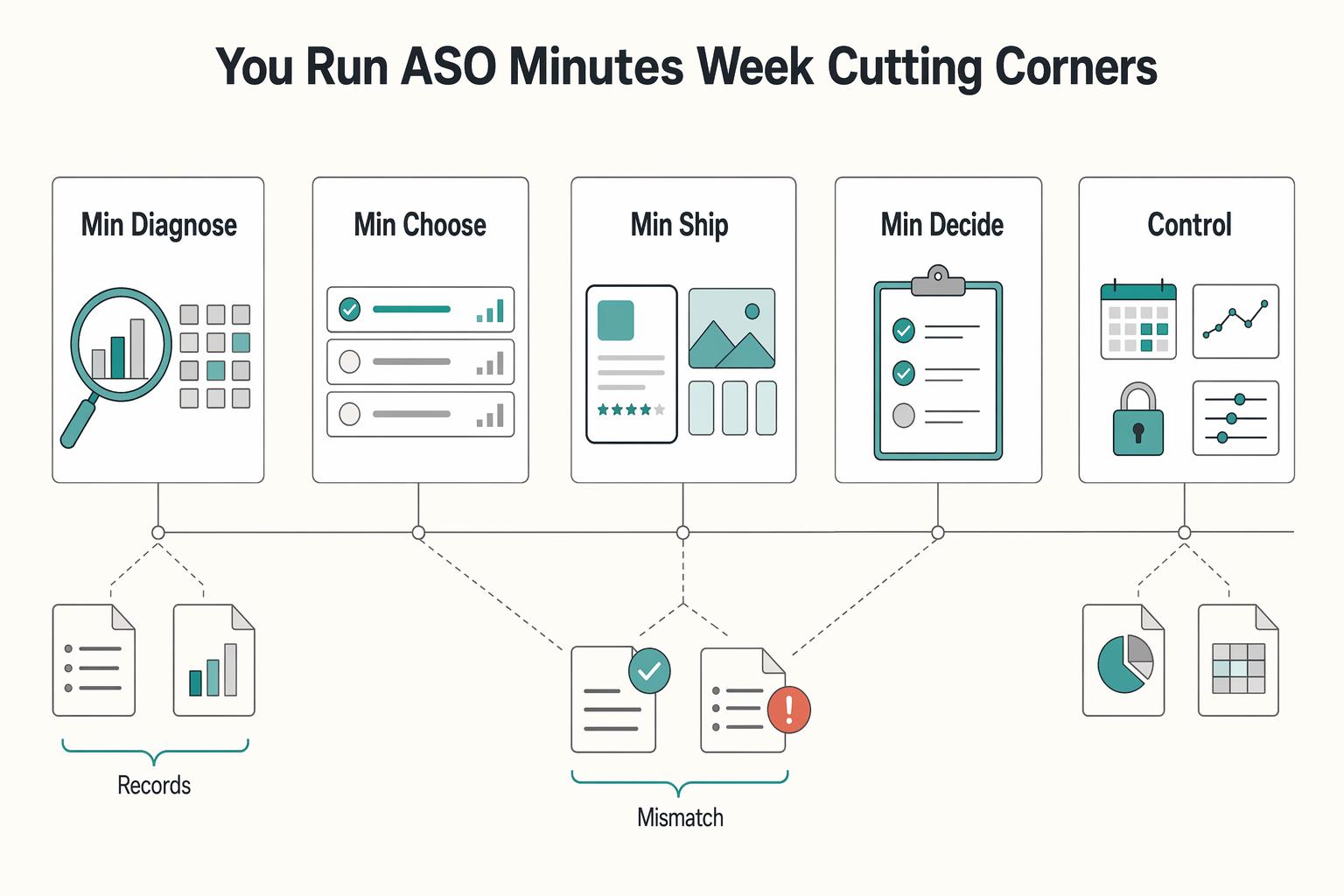
Run App Store Optimization Like an Operator for Mobile Apps
ASO works when you treat it like a recurring operating practice, not a burst of edits when installs dip. If you are working solo or with one helper, keep it to four controls you can actually manage: metadata, creative, experimentation, and risk. Think of this as a practical four-part ASO stack with a simple report card for execution.
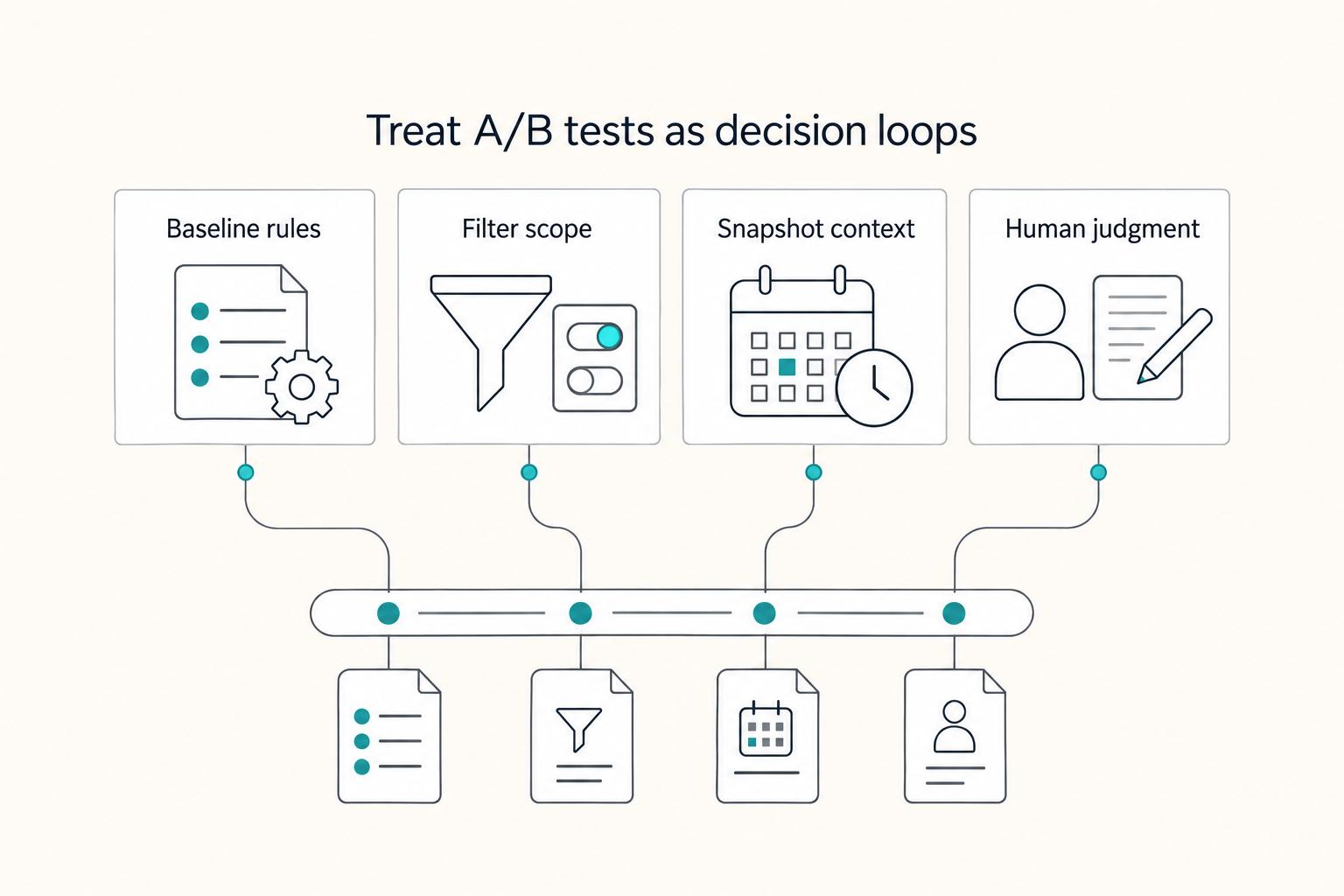
A Freelancer's Guide to A/B Testing Your Website and Emails
**A/B testing can help only when your process is explicit.** If **a/b testing for freelancers** is going to help your business, it needs boring rules. The useful version is not "test more ideas." It is knowing when to launch, when to pause, and when to close a test so you can make one clean decision.

Build a Freelance Sales Funnel You Can Run in One Hour a Week
Start smaller than you want. Your freelance sales funnel should survive a normal delivery week, not a rare week when you happen to have extra energy. If you cannot maintain it without pushing client work aside, it is not usable yet.