
Quick Answer
Run a/b testing for freelancers as a controlled loop, not a stream of edits. Define one change, verify event tracking, set a review point, and prewrite your closeout labels before launch. Keep the run narrow enough to protect interpretation, then end with a documented decision instead of leaving results open-ended. A simple log with hypothesis, metric, contamination check, and final disposition is what makes the process reusable.
You don't need "growth hacker" vibes - you need a repeatable A/B testing operating system#
A/B testing can help only when your process is explicit. If a/b testing for freelancers is going to help your business, it needs boring rules. The useful version is not "test more ideas." It is knowing when to launch, when to pause, and when to close a test so you can make one clean decision.
Freelancer-specific A/B benchmarks, uplift percentages, sample-size minimums, significance rules, and fixed test-duration guidance are not established. Use your own documented thresholds instead of assuming universal ones.
What is the five-step loop to use every time?#
- Choose one asset and name it exactly.
Pass if you can point to one page URL, one form, one email, or one step in a sequence. Fail if you are mixing a page rewrite, offer change, and email change into one effort.
- Write one hypothesis and one primary metric.
Pass if the sentence is plain enough to read a week later: "Changing the headline from X to Y will increase consult bookings." Name one main metric only. If you have not verified the current baseline yet, mark the baseline as unresolved in your test notes instead of inventing a number. Fail if you are trying to "improve engagement" without saying how you will measure it.
- Change one meaningful variable and freeze the rest.
Pass if the variant changes one thing that could reasonably affect behavior, like headline, CTA text, form copy, subject line, or preview text. Fail if you also plan to change audience, pricing, page layout, send time, or traffic source during the run.
- Verify tracking and set review rules before launch.
Pass if you have checked that the variant renders correctly, the primary event fires, and the review date is on your calendar. If tracking is broken or the asset displays incorrectly, pause.
- Close the test in writing.
Pass if you end with one of three labels: roll out, roll back, or inconclusive follow-up. If the evidence is too thin, close it as inconclusive and note the next narrower question. Do not leave a test open forever while waiting for a threshold you never defined.
Which setup gives you a readable answer without extra overhead?#
| Test element | Control | Variant | Primary metric | Decision window |
|---|---|---|---|---|
| Homepage CTA | Book a call | Start project brief | CTA click-through rate | 14 days |
| Proposal subject line | Project proposal for [client] | Scope and timeline proposal for [client] | Open rate | 10 business days |
| Case-study block order | Problem -> process -> outcome | Outcome -> process -> proof | Scroll depth to proof block | 2 weeks |
This does not validate website-vs-email A/B setup rankings, tool scorecards, or reliability tables for freelancers. It does support a few operational habits from automation work: use current inputs instead of stale feeds, use an explicit scoring step instead of memory, and condense long inputs into decision-ready summaries.
One lesson carries over from that automation evidence. Current inputs beat stale ones, and an explicit scoring step beats memory. That does not give you an A/B benchmark, but it does support the habit that matters here. Use current data, write down the decision rule, and do not rely on recall.
Triage the bottleneck before you touch copy#
When a test process breaks, the fix depends on where it went sideways.
If you cannot launch, the fix is scope. Pick one asset and one change. Do not rewrite the offer, adjust pricing, or redesign the page at the same time.
If the test drifts, the fix is a freeze list written before launch. State what will not change during the run: audience, traffic source, form fields, send time, CTA destination. Do not swap the primary metric after you have looked at early numbers.
If the result is unreadable, the fix is a contamination check. Ask whether anything outside the variant changed, whether the event fired correctly, and whether the segment stayed stable. If your email segmentation is still messy, clean that first or revisit How to Build an Email List for Your Freelance Business before testing against the whole list.
Keep a short run log for every test. Your mini template should include Hypothesis, Primary metric, Segmentation note, Contamination check, and Final disposition. Add one evidence-pack item too: a screenshot of the variant or the exact event name you verified. That document is what turns "I think version B did better" into a decision you can defend later.
If you want another process-heavy Gruv guide, read How to Find a Doctor or Dentist Abroad.
The freelancer mental model: A/B testing is a controlled decision loop (not a tool)#
A/B testing is a decision loop, not a tool purchase. The tool support is practical: filtering opportunities, hiding listings without budget, and sending instant notifications when new jobs are posted. You still own the decision rules: what you are testing, what would invalidate the run, and when to review results.
A run is ready when your target project type and filters are written down and match the tool settings. One concrete setup checkpoint shown in the UI is whether to hide projects without budget. The same page also says free signup gives access to filter attributes and instant alerts, so it helps to log exactly which filters and alerts you turned on.
Keep interpretation modest. The page shows a snapshot of 814 projects published for past 72 hours for the shown query, plus example budgets such as $5 - $8 / hr. Treat those as query-time signals, not the full freelance market. Decision thresholds for website or email A/B tests are not established.
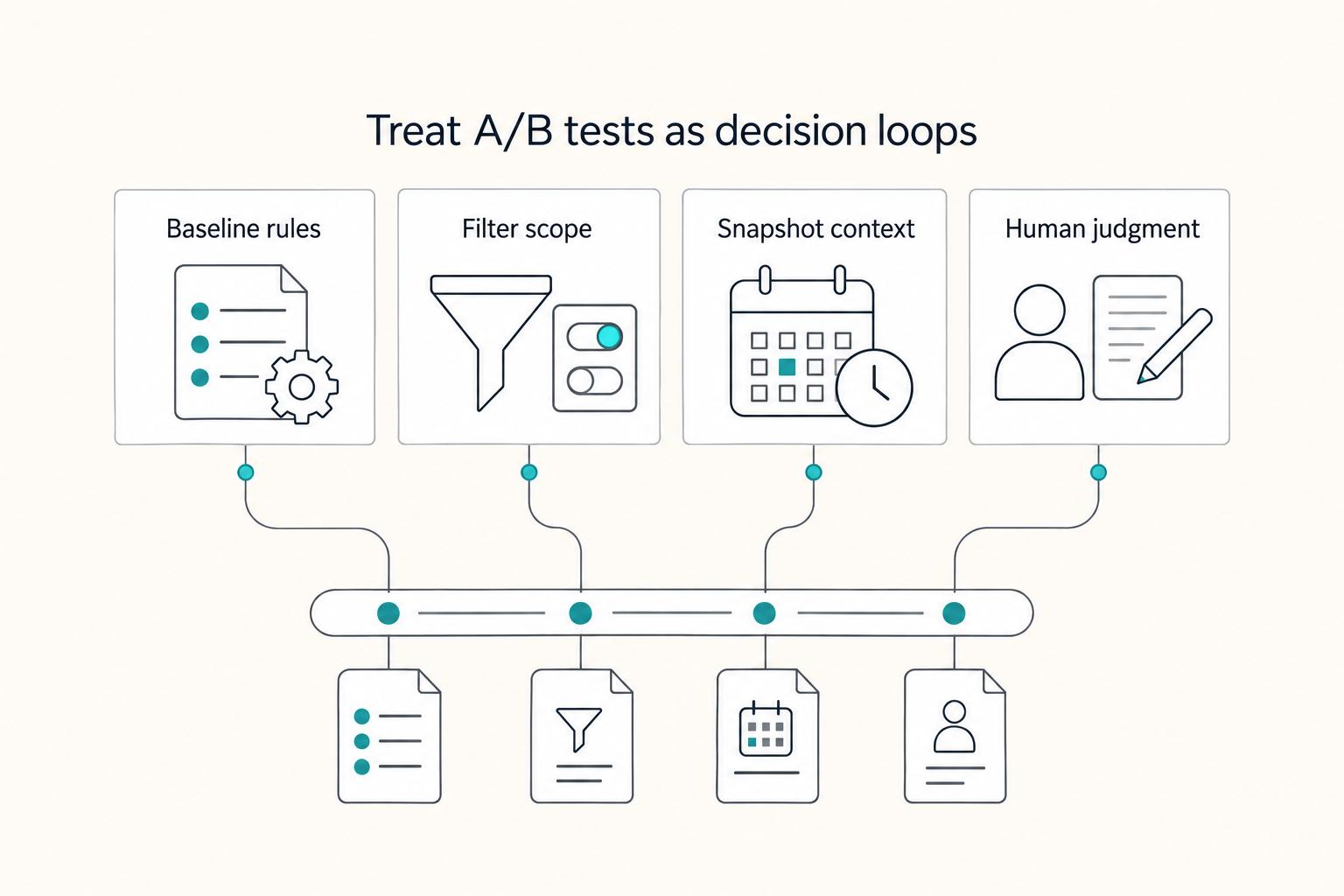
| Owner check | Website test | Email test | Distortion risk if unchecked |
|---|---|---|---|
| Baseline rules | Not specified in this evidence | Not specified in this evidence | You compare moving targets |
| Filter scope | Set filters explicitly (including whether to hide no-budget projects) | Set filters explicitly (including whether to hide no-budget projects) | Noise crowds out useful opportunities |
| Snapshot context | Record the query and review window (for example, a 72-hour snapshot) | Record the query and review window (for example, a 72-hour snapshot) | Counts and budgets get overgeneralized |
| Human judgment | Keep fundamentals first; AI is an accelerator, not a substitute | Keep fundamentals first; AI is an accelerator, not a substitute | Tool output gets treated as final truth |
Closeout should stay explicit. Keep a pattern when it fits your goals and constraints, drop it when it clearly misses, and mark it inconclusive when the signal is mixed. Define specific roll-out, roll-back, or follow-up thresholds before you act.
“Inconclusive” is not failure. It is the right label when the loop stayed controlled but did not earn a decision from the evidence you collected.
| Weekly sessions | Baseline conversion | Minimum detectable lift | Approx. runtime | Recommended cadence |
|---|---|---|---|---|
| 300 | 2.0% | +30% | 4-6 weeks | One test at a time |
| 800 | 3.0% | +20% | 3-4 weeks | One core test per month |
| 1500 | 4.0% | +15% | 2-3 weeks | Two sequential tests per month |
You might also find this useful: The Best Email Marketing Platforms for Freelancers.
The 90-day freelancer A/B testing framework you can run monthly (without burning your calendar)#
A 90-day cycle is easier to keep than constant tinkering. For a/b testing for freelancers, treat it as three decision gates. Month 1 prepares one test. Month 2 runs it cleanly. Month 3 closes it and queues the next question only if the evidence is usable.
That cadence fits evidence that self-employed schedules can vary week to week and may not follow a standard 40-hour plan. Even full-time employed people averaged 8.1 hours on days worked in 2024, so you should not build a testing plan around the idea that spare attention will just appear.
If you want a planning baseline, use your own verified benchmark instead of guessing.
| Phase | Website test | Email test | Exit gate |
|---|---|---|---|
| Month 1 setup | Start only when variants can run concurrently with random assignment, the same conversion path is intact, and the primary event fires on both versions. Produce a one-page brief, variant URLs, screenshots, and a QA note from your own click-through on desktop and mobile. Main contamination risk: launching on staggered dates or changing allocation/distribution during the run. | Start only when one segment, one variable, and one winner metric are fixed. Produce the send brief, segment rules, exclusions, seed-send proof, and a note confirming links, tags, and automations. Main contamination risk: resend logic or segment changes after launch. | Launch or delay. If comparability is not intact, do not start. |
| Month 2 live run | Keep running only if traffic split matches the configured ratio closely enough to trust assignment. If counts look off, treat possible Sample Ratio Mismatch as an integrity gate before analysis. Do not edit the experiment or alter traffic distribution mid-run. | Keep running only if the audience stays fixed and follow-up automation does not muddy the outcome. For content tests, judge winner by click rate, not open rate. | Continue, pause as compromised, or stop for review after at least seven days. |
| Month 3 closeout | Close only when the run stayed clean long enough to cover at least one business cycle and the result still fits business logic. | Close only when the send conditions stayed stable and the winning metric matches the action you care about. | Roll out, roll back, or queue a narrower follow-up. |
One operator check is worth doing every time. Complete the full path yourself before launch. On web tests, submit the form or click the CTA on both variants and confirm the same thank-you step and reporting event fire. On email tests, send to a seed list and confirm every tracked link lands on the intended page.
If you need a plain-English reference for the SRM check, Microsoft's Sample Ratio Mismatch explainer is worth bookmarking.
How to choose one idea when five are competing#
When too many ideas compete, score them instead of debating them. Score each idea from 1 to 5 on four factors.
| Handoff field | Example value | Why it matters |
|---|---|---|
| Hypothesis ID | Q2-CTA-01 | Prevents duplicate test launches |
| Stop rule | 95% confidence or 28 days | Avoids premature decisions |
| Guardrail metric | Lead quality score >= baseline | Protects downstream quality |
| Final decision | Ship variant B | Creates a durable learning log |
Impact means likely movement on the primary metric you actually review. Effort means total build, QA, launch, and write-up time. Confidence means you have a reason to expect a change, such as repeated client objections or weak click performance in past sends. Control means you own the asset, audience, and timing end to end.
Highest total wins. If two ideas tie, choose the one with higher control first, then lower effort, then the one closer to revenue. If acquisition is too unstable to trust comparisons, fix that first with A Freelancer's Guide to LinkedIn Marketing.
What belongs in your contamination protocol and monthly handoff?#
When a run gets dirty, pause fast. Mid-run edits and changed traffic allocation are clear integrity risks. Audience drift, broken events, or altered send timing can also compromise interpretation. Label the run compromised or inconclusive and decide whether to restart or narrow the question.
Use a short handoff note each month:
- Asset and audience or source
- Primary metric, launch date, and review date
- Run integrity status: clean, compromised, or inconclusive
- Decision rationale in one sentence
- Next test trigger: what must be true before you queue the next experiment
Related: A/B Testing for UX Designers Who Need Defensible Client Decisions.
Frequently Asked Questions
What is the same five-step loop you should use every time?
Use the same loop every time. Each run should answer one question about either a website asset or an email asset: Before launch, do a quick validation pass on measurement. Click through both variants yourself and confirm they follow the same conversion path, fire the same success event at the same step, and land in the same thank-you flow. If one version sends visitors to a different path or tracks a different completion action, the comparison is compromised before it starts. Run your normal analytics QA checks before traffic goes live.
How do you diagnose the bottleneck before you test?
Start with the real bottleneck, not the easiest line of copy to rewrite. A lot of freelancers default to headline tests when the actual issue is further down the path. A simple decision tree helps: That order matters. A cleaner headline will not solve form friction, and a shorter form will not fix a bad-fit offer. If two possible issues show up at once, start with the earliest bottleneck in the path.
How do you keep scope under control when the run gets messy?
Treat comparability as the gate. Before launch, confirm both versions record the same primary conversion at the same step in your setup; if tracking or paths differ, fix that first. If one version hits a different form path or thank-you page, you do not have a clean test yet. During the run, use this framework rule: if contamination appears and you cannot verify comparable conditions, close the run as compromised instead of forcing a winner. Do not quietly keep the data and call it "directional" if you already know the conditions broke. Log the cause, then restart later or narrow the next test. Typical contamination signals are traffic-mix shifts, segment drift, mid-run edits, or offer changes. If acquisition inputs are unstable, stabilize that first with a channel plan like A Freelancer's Guide to LinkedIn Marketing.
Which fields belong in the monthly handoff?
Keep only the fields that drive the next decision. You do not need a long document; you need a handoff you will actually reuse next month: If you had to revisit the run in 30 days, those fields should tell you what changed, what stayed fixed, what broke, and what you decided. You should be able to answer three questions fast: What did we test? Can we trust the run? What do we do next?
Try a related tool
Researched and edited by the Gruv editorial team. Gruv builds cross-border billing, payouts, and finance-operations software for global businesses.
Sources
Includes 5 external sources outside the trusted-domain allowlist.
Educational content only. Not legal, tax, or financial advice.
Related Posts

LinkedIn for Freelancers Who Want a Predictable Client Pipeline
Treat LinkedIn as two jobs you run at the same time: a credibility check and a conversation engine. If you only chase attention, you can get noise. If you only send messages, prospects may click through to a thin profile and hesitate.
How to Build an Email List for Your Freelance Business
As the CEO of your business-of-one, you need a repeatable system you can actually run.

How to Find a Doctor or Dentist Abroad
**To find a doctor abroad under pressure, run a simple system with clear decision gates, clean documentation, and backup paths.** You are not hunting random listings. You are running a repeatable process you can use for routine care, travel disruptions, and true emergencies.