
Quick Answer
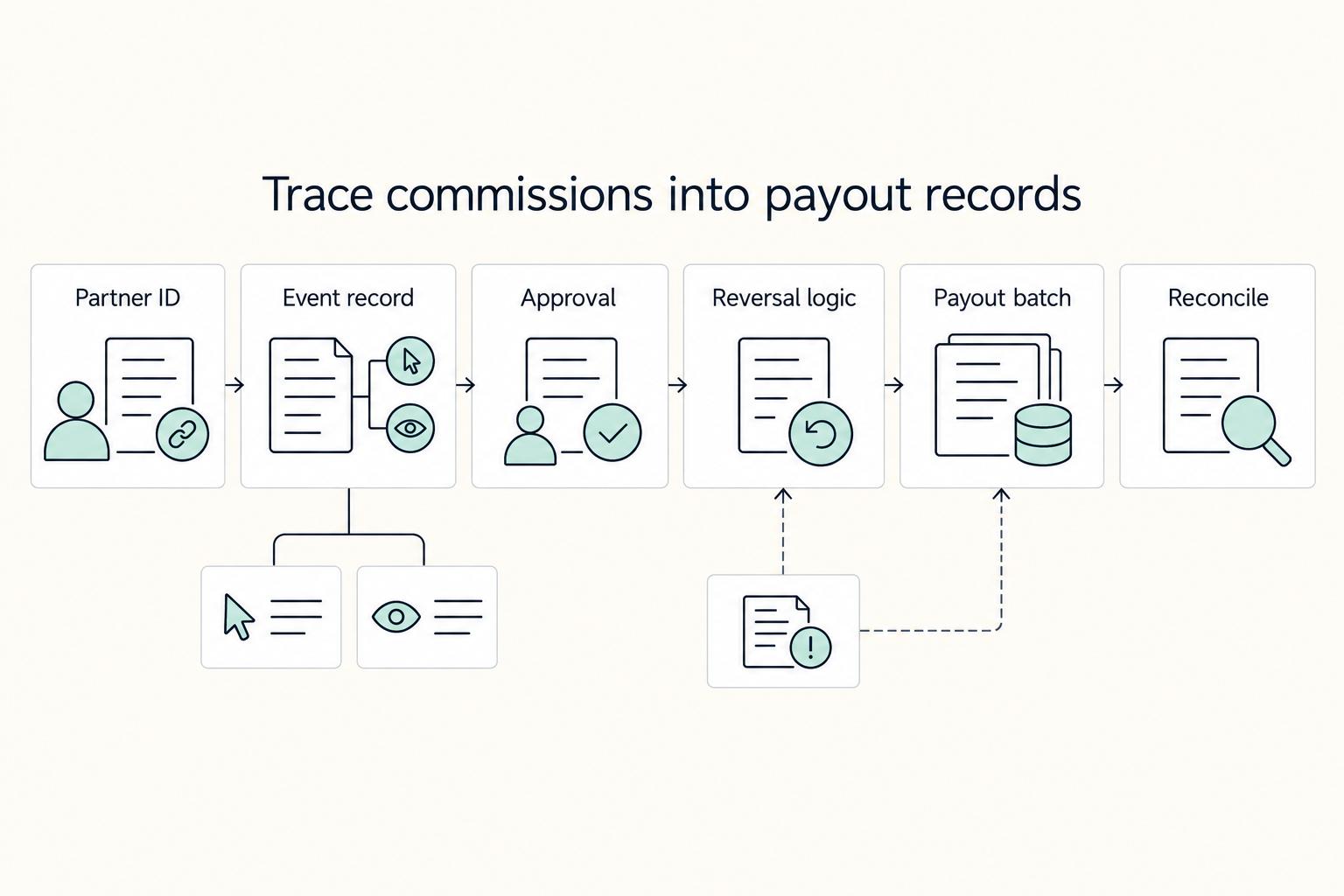
Choose a provider by the work you need it to own: publisher discovery, direct partner management or B2B enablement. Test attribution, commission rules, exports and contractual data rights before deciding whether to stay or switch. Then define approval, reversal and dispute rules, and trace each payable line from referral to final payment.
What affiliate marketing management looks like for platform operators#
Partner revenue can be a clean growth engine, or it can turn into an expensive mess of unclear attribution, manual payouts, and commission disputes. The difference is usually not partner enthusiasm. It is the operating model you choose, and whether that model matches the control your team actually needs.
At its core, affiliate marketing is simple. Your company works with external partners who help market your product or service, and you reward them when a defined goal is met. In the classic three-player setup, you handle the product and fulfillment, partners promote to their audiences, and customers complete purchases through tracked links that trigger commission. It sounds straightforward until the real operating decisions show up. Who owns partner recruitment? Who sets the commission logic? How do disputes get resolved? Can finance verify what was earned before money leaves the business?
Before setting a rate, define the commission base: collected sale value, a qualified lead, a valid click or another agreed event. State whether taxes, refunds, shipping and discounts are excluded. Then trace one attributed event through its calculation and payment; a headline commission percentage cannot explain the amount owed by itself.
This guide compares three operating models: an affiliate network, a partner marketing platform and partner relationship management (PRM). Choose by the partner motion, records you need and work your team can own.
Scope matters here. This article is for operators running affiliate and referral-style partner programs. These motions can look similar from a revenue dashboard, but they can behave differently in practice. The goal is to make your onboarding, tracking, payout evidence, and exception handling clear before complexity compounds.
For payout operations, see Affiliate Network Payouts: How to Pay Publishers and Partners Automatically at Scale.
What affiliate marketing management means for a platform operator#
For a platform operator, affiliate marketing management starts with picking the right operating model, because these terms are related but not interchangeable.
| Model | Definition | Focus |
|---|---|---|
| Affiliate network | Intermediary model | Matches advertisers with publishers or affiliates |
| Partner marketing platform | SaaS model | Lets your company run and manage its own partner program |
| PRM (Partner Relationship Management) | Built for broader B2B partnerships | More focus on partner lifecycle and enablement |
The control boundary follows that model choice. A network can provide tracking, attribution, reporting, commission management, and payout handling, but operator responsibility does not disappear. Even when you use Awin, PartnerStack, or a similar vendor, you still need clear ownership of acquisition, attribution rules, commission logic, payout execution, and compliance decisions.
That is why you should separate channel growth from program management. Channel growth is about traffic, referred conversions, and revenue. Program management is about policy, economics, and auditability, especially when you need to investigate partner-level outcomes or payout exceptions.
Network services can reduce recruitment and payment work, but data access and customization depend on the contract and product. A self-run system also needs usable exports and clear partner rights; its category alone does not guarantee more control.
Choose the right model for your stage and control needs#
If publisher discovery is the immediate need, evaluate network services. If attribution or commission control is the gap, compare the current provider with alternatives that demonstrate the missing capability. A platform or another network may satisfy it; verify the product and agreement before switching.
A network can combine publisher access with tracking and payment services. A program-management platform can support direct relationships and configurable rules. These functions overlap, so test the actual product and agreement rather than treating the labels as a fixed ranking.
| Operating model | Useful when | Evidence to request | Work your team still owns |
|---|---|---|---|
| Affiliate network | You need publisher discovery and intermediary services | Partner-level transactions, validation rules, payment reports and export rights | Offer economics, brand requirements and review of disputed transactions |
| Partner marketing platform | You manage direct partners or several partner types | Rule version history, attribution records, reversal links and payout integration | Recruitment, commercial terms and operational decisions not delegated by contract |
| PRM | Co-sell, reseller enablement or referral deal registration drives the program | Deal ownership, lead acceptance, partner access and reporting exports | Enablement and the separate commission/payment process where required |
Read the tradeoff correctly#
Check current availability before putting a vendor on your shortlist. Awin announced that ShareASale closed on 6 October 2025. Treat a legacy ShareASale integration as a migration question, not as a new standalone launch option.
More direct management can bring more operational responsibility, but control depends on the actual permissions, exports and contract. Better tooling also cannot resolve unclear commercial terms; document the commission rules with partners first.
Use simple decision rules#
Choose the option that can demonstrate the required partner access, attribution rules and finance exports within your staffing capacity. Do not change categories solely to obtain a presumed increase in control.
Before you commit, ask each vendor to show you in the product:
- partner-level conversion records
- the payout record tied to those conversions
- the export/report finance will reconcile
Know when to reassess before scaling#
Reassess model fit when payout exceptions, tracking disputes, or commission exceptions stop fitting your normal payout cycle without side spreadsheets, ad hoc approvals, or repeated escalations.
Use workload evidence rather than an affiliate-count threshold. If approved commissions or payment exceptions cannot be reconciled within your promised cycle, limit new spend while fixing the cause. Continue honoring existing payment obligations under the partner terms.
For a step-by-step walkthrough, see Affiliate Marketing for Creators Who Need Predictable Payouts.
Design partner mix by job, not by hype#
Design your partner mix around measurable partner jobs, then qualify each partner against that job with data, incentives, and review standards. In practice, affiliate program management is not about adding more partners; it is about managing the right partners with aligned incentives and usable performance data.
Use a simple operating lens for each partner segment:
- Define the job you expect that segment to perform in your program.
- Set qualification checks before approval (partner quality, brand fit, operational support load, and payout/compliance readiness).
- Decide the evidence you will require to approve attribution and payouts later.
- Keep segment reporting separate so you can evaluate incrementality without mixing unlike partner motions.
Influencers can belong to an affiliate program, but their promotional content needs review as well as attribution. In U.S. contexts, FTC guidance calls for clear disclosure of material connections where required. Give partners disclosure instructions, check a sample of live promotions and correct missing disclosures; a tracked link alone does not explain the relationship to viewers.
Build economics and payout logic before partner recruitment#
Set the money rules before you recruit anyone. If a commission plan cannot be reconciled from the attribution event to the payout record, do not launch it.
That rule prevents predictable scale problems: payout disputes, exception queues, and margin arguments caused by vague event definitions. Before launch, make sure each payable line can be traced to a partner ID, event timestamp, event type, order or lead ID where relevant, approval status, reversal reason, and final payout batch record.
Set model economics before rate cards#
Treat CPC, CPM, and conversion-based payouts as different operating models, each with its own controls.
| Model | Gross margin impact | Commission basis | Clawback policy | Payout timing | Fraud reserve assumption |
|---|---|---|---|---|---|
| CPC (Cost Per Click) | Cost is incurred before revenue is confirmed | Pay on validated clicks under your traffic and source rules | Define reversals for invalid, duplicate, or non-compliant clicks | Pay only after click-validation checks close | Any reserve or hold must have an agreed basis, amount, review owner and release terms |
| CPM (cost per thousand impressions) | Cost is tied to delivery of impressions | Pay on verified impressions under your counting rules | Define reversals for invalid traffic, reporting conflicts, or placement violations | Pay after impression reconciliation | Any reserve or hold must have an agreed basis, amount, review owner and release terms |
| Conversion based | Cost is tied to approved business outcomes | Pay on approved sales, qualified leads, or defined subscription events | Define reversals for refunds, cancellations, duplicate attribution, or failed qualification | Pay after approval/return/qualification windows close | Any reserve or hold must have an agreed basis, amount, review owner and release terms |
Use CPC or CPM when the purchased outcome is validated traffic or reach. Conversion-based payment is useful when the agreed outcome is a sale or qualified lead. In every model, define invalid activity, attribution priority, eligibility and the approval window before partners start work.
Illustrative commission: Partner P7 refers order O42 for USD 500. The agreed rate is 10% of collected merchandise value, excluding tax and shipping, so the pending commission is USD 50. A USD 100 merchandise refund within the agreed validation window reduces eligible value to USD 400 and commission to USD 40. Link the USD 10 adjustment to O42 and its rule version; a replayed order event must not create a second USD 50 commission. After validation closes, approve and pay USD 40. A later reversal of an already-paid commission requires the recovery process permitted by the partner agreement.
Keep automation on a short leash#
If you automate traffic routing, retain the approved offers, markets, sources and partner rules with each decision. Review invalid-traffic signals and downstream outcomes so routing volume cannot hide low-quality or disallowed traffic.
A practical checkpoint is to review top-earning sources against downstream outcomes (approved conversions, rejection reasons, and refunds). If a source drives volume but weak approved outcomes, treat it as a control issue, not a scaling win.
Choose payout rails with documents, not assumptions#
Choose payout rails by documentation quality and reconciliation readiness, not convenience. For each rail, confirm what you can document about fees, payout timing commitments, and exception handling before you promise partner terms.
For a PayPal payout path, use the market-specific business fee documentation and product terms. Consumer wallet transfer fees do not establish the price or eligibility of an operator’s payout program.
Keep the effective date and currency of the fee terms used in your budget. Record payout attempts with stable business IDs and durable pending states; resolve an unknown provider result before switching rails or submitting another payment. Reconcile item-level outcomes, not merely batch acceptance, before marking partners paid.
Wire transfer and other digital wallet rails can still fit, but validate their market-specific documentation before launch, including required beneficiary data and failed-payment handling. If that documentation is incomplete, the payout rail is not ready yet.
Put minimum controls in place before scaling spend#
Do not scale spend until your minimum controls are written, owned, and repeatable. If your process still depends on memory, Slack threads, or one operator, keep partner onboarding and budget expansion tight.
Set the non-negotiables first#
Keep the checklist short, but make each control explicit:
| Control | What to define |
|---|---|
| Tracking QA | Run live test events for each payable action, and confirm partner ID, event timestamp, event type, order or lead ID, approval status, and reversal reason are all visible for later reconciliation. |
| Partner approval policy | Define who can join, allowed traffic types and geos, and clear pause or removal triggers. |
| Dispute path | Assign an owner, response window, required evidence, and the rule while a dispute is open. |
| Payout approval thresholds | Define when payouts can be auto-approved and when finance review is required. |
| Fraud monitoring cadence | Assign owners and a recurring review rhythm, not only complaint-driven checks. |
| Promotion and tracking requirements | Check required endorsement disclosures and applicable consent/privacy requirements; review promotional samples and tracking behavior before expansion |
impact.com describes automation for partner discovery, contracts, tracking and payments. Decide which decisions can be automated under your terms and which need review; the presence of a workflow does not prove that your commission rule is correct.
Treat compliance as market- and program-specific#
Confirm the advertising, privacy, tax and payment requirements for the actual market and partner role. Record which party owns each requirement and the evidence it needs; do not treat financial-institution onboarding rules as universal affiliate-program rules.
Before adding a new country or partner type, confirm with legal and finance what applies for KYC, KYB, AML, tax collection, and reporting. Do not assume another program's setup is enough for yours.
Review evidence, not just dashboard totals#
Use fixed verification checkpoints with your revenue and finance owners:
- Monthly attribution audit: trace a sample of payable events back to raw tracking and payout records.
- Payout reconciliation sample: confirm paid lines match approved and documented events.
- Exception log review: review disputes, reversals, and payment exceptions together, then close owners and deadlines.
Run your first 90 days with clear owners and checkpoints#
A 30/60/90-day schedule is one planning option. Advance when attribution, validation and payout evidence are ready, rather than because a calendar phase has ended.
Sequence the first 90 days#
| Timing | Phase focus | Key detail |
|---|---|---|
| Days 1-30 | Lock the operating model and documents | Set commission logic, approval rules, dispute handling, payout timing, partner terms, and tracking definitions; do not advance until live test events are clean enough to follow from partner ID through approval and reversal handling. |
| Days 31-60 | Onboard in a controlled way | Keep partner mix and traffic types narrow so performance changes are still diagnosable; a phased path that starts with affiliates before widening helps avoid false signals. |
| Days 61-90 | Stabilize payout and attribution | Aim for a dependable line from conversion event to approved payout, with records finance and product can both explain without guesswork. |
Assign owners and enforce gates#
Set explicit ownership across partner mix, tracking integrity, and payout reconciliation/controls, then document it. Expansion should pause when dispute volume spikes, payout failures rise, or tracking confidence drops.
Your monthly evidence pack should stay short and decision-ready:
- Partner cohort performance by join month and partner type
- Exception root causes with counts and owners
- Payout accuracy snapshot from reconciliation samples
- Margin by channel, including channels where reversals can lag apparent performance
Know when to switch models and avoid lock-in#
Switch models when the same issues repeat in your monthly evidence pack. If reporting blind spots, commission exceptions, or partner-type workarounds keep recurring, you are likely seeing a model mismatch, not just a staffing gap.
A practical trigger: if your records still cannot show which partner drove an event, how commission was calculated, whether it was approved or reversed, and when it became payable, pause expansion. If that logic is rebuilt by hand each month, treat it as a red flag. The same is true when you are forcing new partner motions into tooling built for one merchant and one program, while your operating needs now look closer to network software that supports multiple advertisers, affiliates, offers, reporting, and automated payouts.
Pick the direction that matches the gap#
Name the unmet requirement before planning a switch. Test whether the current network can address it, and compare alternative networks and program platforms against the same example and export requirements. Move only when the replacement’s product and contract supply the needed capability and migration cost is justified.
Move from PRM (Partner Relationship Management) first to a hybrid stack when co-sell or referral workflows work, but performance offers need tighter event tracking. If you are evaluating Everflow, PartnerStack, or similar tools, keep the checks practical: can you export event-level data, support new commission logic without manual overrides, and audit reversals cleanly?
Keep the records portable#
Avoid lock-in by keeping core rules outside vendor UI. Store partner terms, attribution definitions, payout rules, and rate tables in portable files with version history and effective dates.
An affiliate agreement template can help set expectations early, but treat template language as informational, not legal advice. Before any migration, verify contract fee lines, especially transaction fees that can affect margins. A common failure is not day-one tracking loss, but migrating without prior exception logic and discovering payout disputes after the first batch closes.
Conclusion#
If you take one thing from this guide, make it this: choose the model your team can actually operate with discipline. Pick the Affiliate network, Partner marketing platform, or PRM (Partner Relationship Management) option that matches your current staffing, control needs, and tolerance for exceptions, not the one with the loudest marketplace pitch.
A sensible next step is a time-bound pilot with explicit checkpoints and named owners. Treat it as a proof period, not a soft launch you hope will sort itself out. At minimum, your pilot should produce evidence on three fronts:
- Attribution confidence: test tracking end to end, review attribution quality regularly, and confirm the rules are still explainable after reversals or disputed conversions.
- Payout control: run a payout reconciliation sample against actual partner terms and check that approval thresholds, compliance handling, and exception records line up.
- Margin quality: review partner cohort performance against the commission basis you chose, especially in models that can hide low-intent traffic.
Related: Affiliate Network Payout Structures: Performance-Based Commission Models for Publisher Partners.
Frequently Asked Questions
What is affiliate marketing management for a platform operator in practical terms?
In practice, it is not just partner recruitment or traffic growth. It is the day-to-day control of tracking, attribution, commission setup, payout handling, and reporting records needed to explain each one later. If you cannot trace an event from referral to payable amount, you are managing activity, not the program.
How do I choose between an affiliate network, a partner marketing platform, and PRM first?
Evaluate network services when you need intermediary discovery or payment support, program-management platforms when you manage direct relationships, and PRM when enablement or deal registration is central. Capabilities overlap. Select only after verifying the required rules, records and contractual rights; the model label does not promise greater control.
Who owns partner data and attribution logic in each operating model?
Data ownership, export rights and attribution configuration depend on the provider agreement and product, not just the operating-model label. Keep partner terms, rate tables and attribution definitions under your own control with versions and effective dates, and test whether transaction and payment records can be exported.
What can I realistically customize in tracking and commissions before complexity hurts execution?
If the model offers only minimal customization of tracking or commission logic, do not design a plan that depends on exceptions every month. A good limit is this: if finance cannot reconcile the rule from event record to payout record without manual interpretation, the design is already too complex. A common failure mode is higher dispute volume after payout cycles begin.
When is CPC a poor fit versus CPM or conversion based payouts?
CPC is a poor fit when your goal is qualified sales but you cannot validate traffic quality or tolerate paying for clicks that do not convert. CPM purchases impression delivery, while conversion-based payment purchases an agreed sale or lead outcome. Choose the measurable outcome and document validation and reversal rules before launch.
What are the first risks to control before scaling partner spend?
Control tracking QA, partner approval rules, payout approval thresholds, and a clear dispute path before you add budget. Then review a monthly attribution audit, a payout reconciliation sample, and an exception log with revenue and finance owners. If those three checks are messy at low volume, scale will magnify the mess.
How do I verify compliance and payout setup when rules vary by country or program?
Treat compliance and payout setup as program-specific, confirm requirements with legal and finance before expansion, then document the approved rule set by country or program. A useful checkpoint is to test one payout batch end to end and confirm the supporting records match the configured terms before onboarding more partners.
Try a related tool
Researched and edited by the Gruv editorial team. Gruv builds cross-border billing, payouts, and finance-operations software for global businesses.
Sources
Includes 2 external sources outside the trusted-domain allowlist.
Educational content only. Not legal, tax, or financial advice.
Related Posts
Affiliate Program Management for Platforms Running a High-Performing Publisher Network
If a partner setup does not improve contribution margin after commissions, payout costs, compliance overhead, and internal operating load, it is the wrong choice, no matter how polished the marketplace pitch sounds. This guide is for founders, revenue leaders, product teams, and finance operators who need an answer that holds up in a planning meeting and in the monthly close.
Affiliate Network Payout Structures for Publisher Commissions
Commission design is an operating decision, not a pricing footnote. The structure you choose affects what behavior you reward and the economics of the program. It is easy to announce rates. It is much harder to define a model that still holds up once reversals, edge cases, and partner questions start showing up.
Automating Affiliate Network Payouts for Publishers and Partners at Scale
Automating affiliate payouts is worth doing, but only after you decide what has to stay controlled. As programs grow, payouts become a real operational burden, and payout reliability affects whether partners stay engaged. If you automate the payment motion before you clean up approvals, tax data, and reconciliation, you usually do not remove work. You just move it into exceptions that are harder to unwind.