
Quick Answer
Start with control gates, then automate the payout path in order. Verify tax readiness (including Form W-9 and correct TIN handling for U.S. payees), lock approval ownership, and map source data before you speed up disbursements. Then automate ingestion, commission calculation, approval states, payout release, and reconciliation. Keep a batch evidence pack with approval record, disbursement result, payout ID, and accounting export so you can isolate a bad record instead of stopping every partner payout.
Why affiliate payout automation matters at scale#
Automating affiliate payouts is worth doing, but only after you decide what has to stay controlled. As programs grow, payouts become a real operational burden, and payout reliability affects whether partners stay engaged. If you automate the payment motion before you clean up approvals, tax data, and reconciliation, you usually do not remove work. You just move it into exceptions that are harder to unwind.
Start with the basic unit of work: an affiliate payout is the transfer of earned commission from a program owner to a partner. At small volume, teams can patch that together with exports, spreadsheets, and manual checks. At higher volume, that approach can break down because every payout depends on several moving parts being right at the same time.
The earning has to be approved, the partner record current, the payment details usable, and finance able to prove the amount against internal records and external statements. That last point matters more than teams expect. Account reconciliation is the comparison of internal records with external statements to confirm accuracy. It is what keeps "we paid someone" from turning into "we cannot explain what happened."
This guide is for teams responsible for commission calculations, release approvals and payment execution. Make the agreed qualification window explicit: a conversion may be provisional until the refund or validation period ends. An approved commission, a payable balance and a completed disbursement are separate records.
Before you speed up payouts#
The first hard gate is tax and payee data quality. For U.S. information return reporting, Form W-9 is used to collect the correct Taxpayer Identification Number, and if a payee fails to provide a correct TIN, backup withholding can apply. The current IRS backup withholding rate is 24 percent. That means a missing or bad tax form is not just a profile completion issue. It can change what you are legally required to withhold, so you should verify tax form status before first payout, not after a batch fails.
Before expanding automation, trace a batch from approved commissions to its disbursement results and reconciliation. Resolve tax exceptions through the applicable withholding and reporting process; use a full-payment hold only when contract or law permits it.
That is the through-line here. Automate in stages, keep control of approvals where risk is still high, and only increase volume when your checks are strong enough to catch bad data before partners feel it.
For a step-by-step walkthrough, see Affiliate Program Management for Platforms Running a High-Performing Publisher Network. Want a quick next step on automating payouts for publishers and partners? Try the free invoice generator.
What to prepare before you automate payouts#
Before you automate payouts, lock down ownership, policy inputs, data scope, and batch evidence so you can trace errors to the right cause instead of guessing.
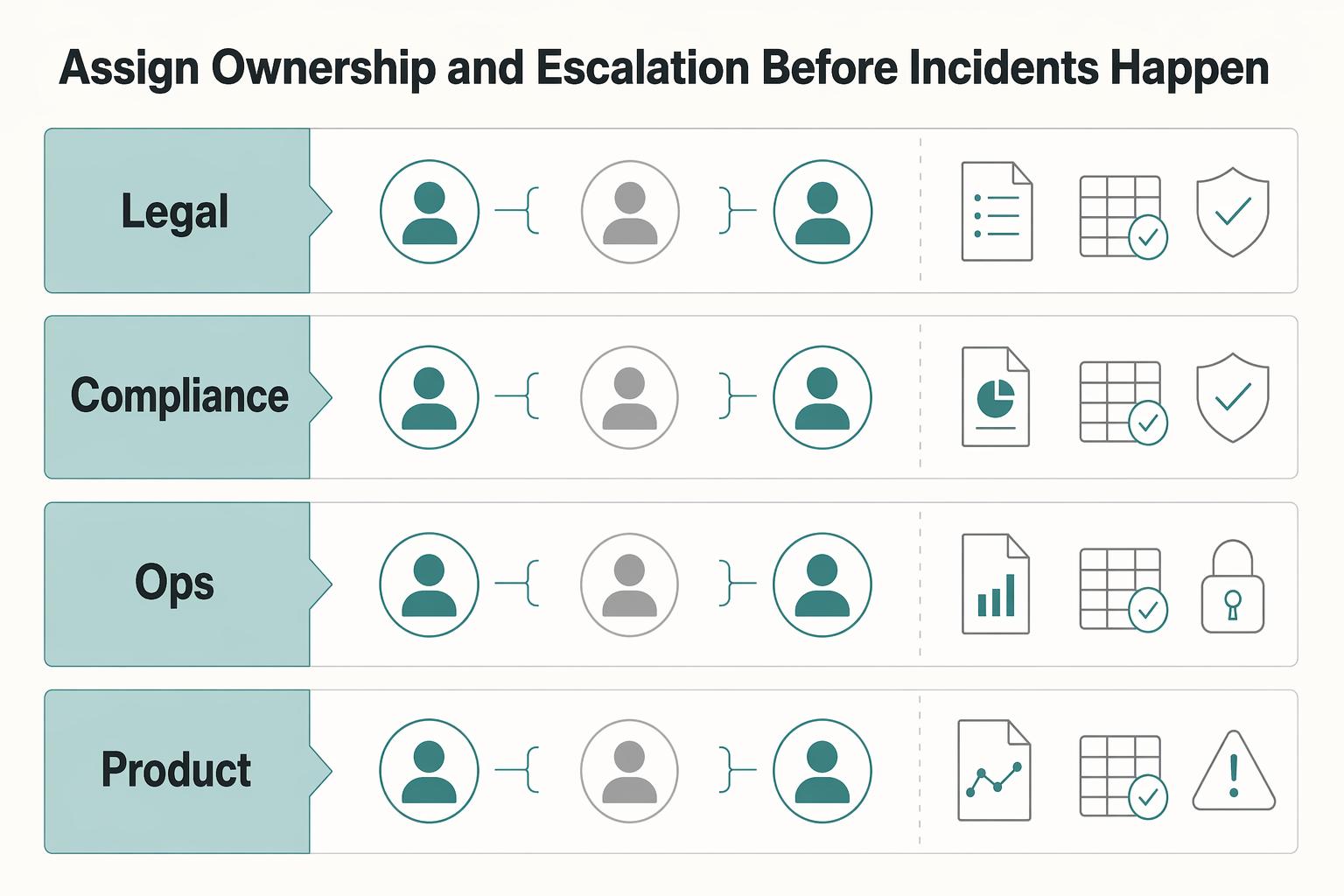
Step 1: Assign owners by control boundary. Use a written role-assignment plan, not a verbal understanding. A practical split is finance for approval flow and reporting, engineering for retry-safe execution, and payments ops for payout schedules and exception queues. This follows the internal-control principle of separating authority, custody, and accounting activities. Set one named owner for each handoff and one escalation path when a batch is held.
Step 2: Version policy inputs for the launch window. Record commission rules, qualification periods, payment cadence and tax treatment. Keep the first cycle comparable, but apply required legal changes rather than freezing an obsolete withholding rule.
Step 3: Identify the authoritative commission source. Use the affiliate tracking or advertiser-approved conversion record to establish earnings. Ad-spend and campaign-performance reports can help explain attribution, but do not themselves prove the publisher is owed a commission. Map conversion ID, partner, approved amount, currency and qualification status before automation.
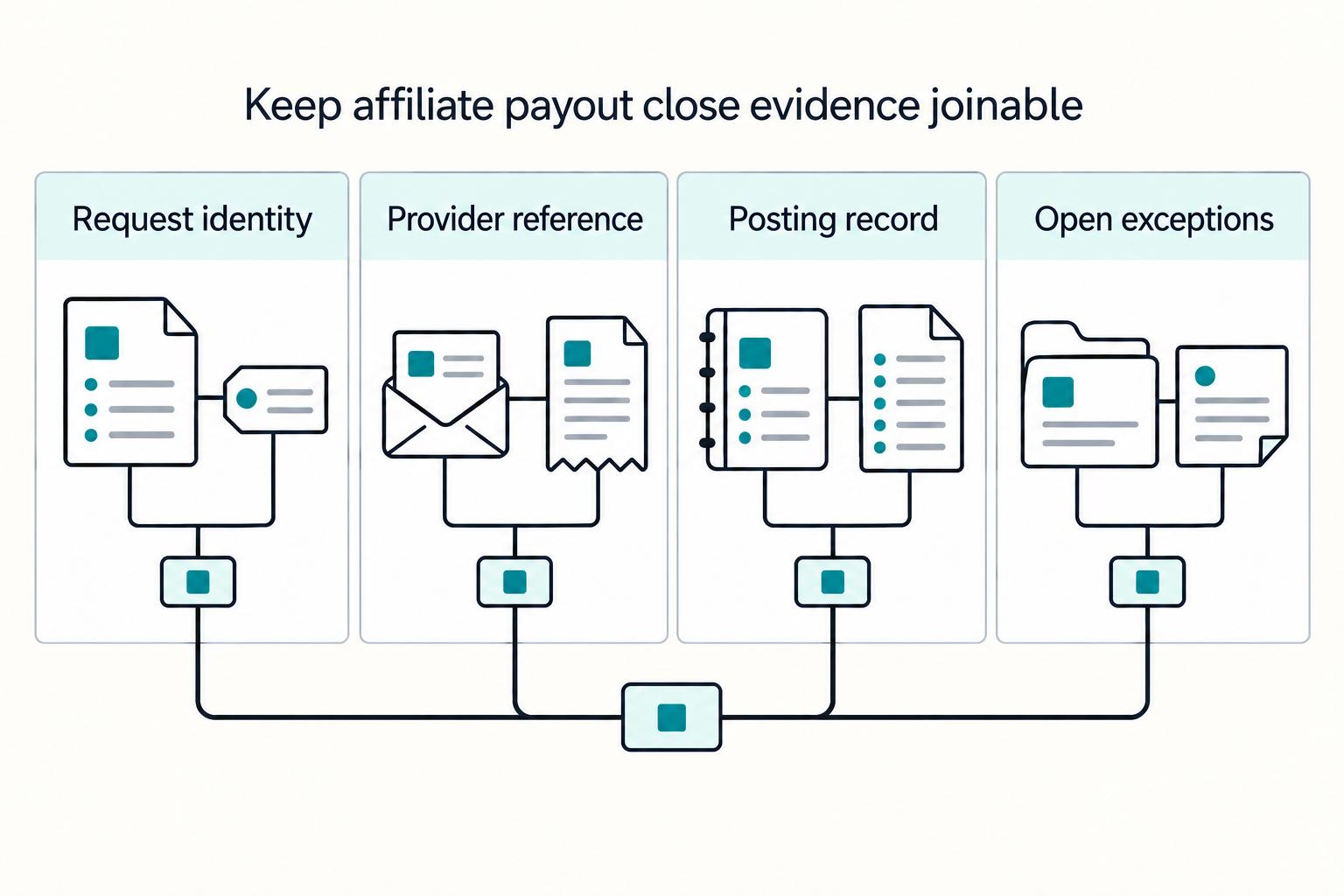
Step 4: Create a minimum evidence pack for every batch. Keep the partner record, tax-form status, approval record, disbursement status, and accounting-sync export under the batch ID. If your accounting tool generates a reconciliation report for that session, attach it. This evidence pack lets you prove payout decisions, isolate failures, and hold only affected partners instead of questioning the full batch.
For a deeper look at mass payouts across publishers, partners, and creators, see Mass Payouts for Affiliate Networks: How to Pay Publishers Partners and Creators at Scale.
Pick the payout operating model that matches your risk tolerance#
Pick your model based on control reliability first, then payout speed. If partner data quality or tax form completion is inconsistent, keep approvals human-reviewed before you shorten payment cycles. The table is an editorial comparison of operating tradeoffs, not measured vendor performance; verify contract fit and recovery behavior for your implementation.
| Operating model | Best fit | Tradeoff | Implementation complexity | Reporting depth | Failure recovery speed | Contract fit to verify |
|---|---|---|---|---|---|---|
| Manual approvals + automated execution | You still expect exceptions in tax setup, partner records, or source imports | Strong control and reconciliation, slower payout experience | Medium | High | Medium | High |
| Fully automated for low-risk tiers | Data quality, approval logic, and reconciliation are already stable | Faster payout experience, but weaker controls can raise exception, rework, and audit risk | Low to medium | Medium | Fast when scoped correctly | Medium |
| Hybrid by partner tier | Mixed-risk network with both stable and noisy cohorts | Balances speed for clean cohorts with tighter review for higher-risk partners | Medium to high | High | Fast for low-risk tiers, controlled for high-risk tiers | High |
Use one default path plus documented exceptions by partner tier, and apply the rule consistently so audits and partner disputes are easy to reconcile later. Before accelerating payout timing, confirm you can hold one payout without freezing the whole batch. The practical goal is to reduce exceptions, rework, and control failures.
Build the data and control architecture before touching payout frequency#
Before you speed up payouts, enforce one canonical path from earnings ingestion to reconciliation and accounting sync. If each connector follows different logic, you will scale reconciliation errors, not reliability.
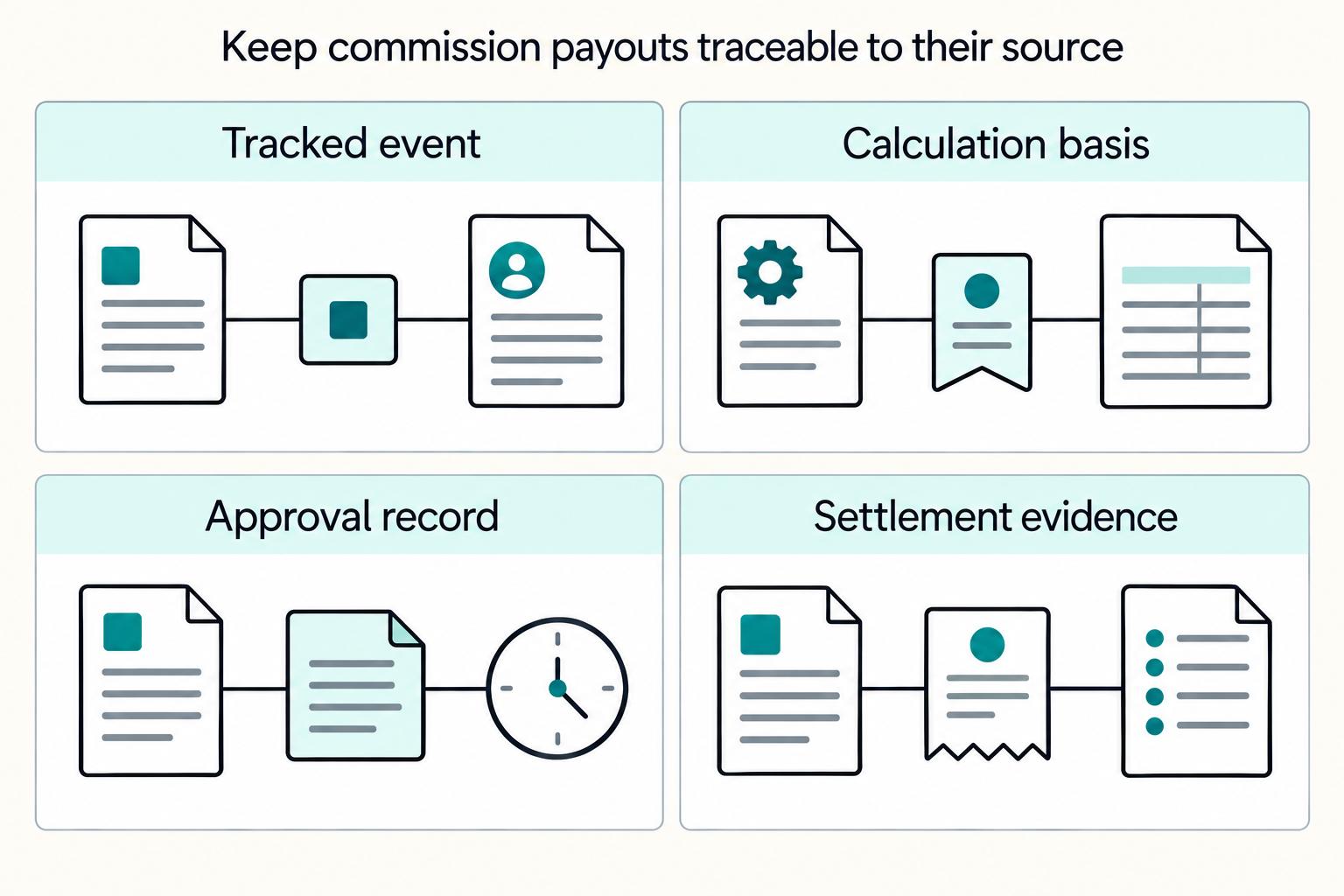
Step 1: Define one earnings-to-cash path. Keep source conversions, calculated commission, approval, payable balance, disbursement and accounting entries linked. For example, a $500 approved commission reduced by a documented $50 reversal leaves $450 payable before applicable withholding. Preserve both the original and adjustment; do not replace their history with a single net number.
Use a minimum required record for each payable line:
| Input source | Import pattern | Internal fields required before payout posting |
|---|---|---|
| Affiliate tracking conversion API | Import event and approval history | partner ID, conversion ID, qualification status, earning period, amount, currency, batch ID |
| Advertiser-approved commission export | Versioned approved file | partner ID, commission/reversal reference, approved amount, currency, batch ID |
| Ad-spend/performance feed | Separate supporting dataset | campaign reference and metric definition; not a payable without an explicit commission rule |
If a connector cannot populate these fields consistently, do not allow it to create live commission payouts.
Step 2: Version source mappings. Map each authoritative tracking export or API into a documented ledger shape. Import campaign metrics separately unless an approved commission rule explicitly uses them. A connector’s availability does not make its data an earnings source.
For each source, validate a sample import before approval: row count, total amount, currency, and external references should match the source report.
Step 3: Add owned control checkpoints between stages. Define checkpoints your team owns: import validation, approval flow lock, disbursement trigger, post-payout reporting, and reconciliation signoff. The lock can be an internal status that prevents changes to earnings or partner data after approval.
For outgoing partner payments, reconcile the approved payable amount to the provider disbursement record, funding debit and destination outcome available for that rail. Link each result to partner and batch IDs. A report of collections paid into your own bank is not a substitute for this outgoing-payment evidence.
Step 4: Make mutating steps retry-safe. Use a durable internal operation ID, an atomic claim and a stored request payload for each payment. Reuse the key and identical parameters only while the endpoint’s idempotency protection remains valid. Stripe, for example, can prune keys after at least 24 hours; reuse afterward can create a new request.
After a timeout or unknown response, reconcile the provider reference and local operation record before another send. Outside the provider’s key-retention window, do not blindly retry. A ledger write and remote payment are different side effects, so track pending, completed and unresolved attempts separately.
For more on the compliance side of performance marketing payouts, see Performance Marketing Payouts: How to Pay Affiliates Influencers and Publishers Compliantly.
Set onboarding, tax, and payout rules as hard gates#
Collect required partner and tax information before activating new payout arrangements wherever possible. For earned amounts already due, determine the applicable withholding, reporting and payment deadline. Missing documentation is not a universal legal basis to retain the entire payment.
| Gate | Required before payout | Constraint |
|---|---|---|
| Onboarding | Verified partner profile and linked payout account | Make onboarding a payout prerequisite, not a parallel workflow |
| Tax setup | Applicable documentation or exception procedure and withholding determination | Missing form does not automatically authorize a full-payment hold |
| Partner-specific payout rules | Use only where contract or risk differences justify it | Label rules as where supported and document market and program scope explicitly |
Make onboarding a prerequisite#
Make onboarding a payout prerequisite, not a parallel workflow. Before payout activation, require a verified partner profile and a linked payout account in your payout system, then enforce that gate in the same data path your payout engine reads.
Before first release, check the approved partner, verified destination and recorded tax treatment. Keep collection, validation, withholding and any lawful hold as separate states; a missing certificate must route to a tax owner rather than imply payment is always forbidden.
Require tax setup before first payout#
Choose documentation from payee status and payment source/character. U.S. persons commonly provide W-9; foreign individuals or entities may use W-8BEN or W-8BEN-E where applicable, and other payment contexts can require different forms. Record the withholding decision before relying on an exemption.
Keep document-requested, received, validated and withholding-configured states separate. Apply backup withholding when the current payment-year conditions require it; an invalid TIN and an IRS mismatch notice can have different procedures. Use the actual provider’s validation status rather than a universal 48-hour assumption.
Separate payout rules only where risk justifies it#
Use partner-specific payout rules only where contract or risk differences justify it. Some affiliate tooling supports partner-level payout structures, so you can apply deeper controls to higher-risk programs and lighter paths where appropriate.
Record the enabled currency, country and bank rail for each destination. Restrictions vary by provider and account, so validate the actual combination before a partner relies on the schedule.
Related: Affiliate Network Payout Structures: Performance-Based Commission Models for Publisher Partners.
Implement automation in the right order#
Use the payout record flow as your default automation sequence: earnings ingestion and validation, then commission calculation, then approvals and disbursement, then reconciliation and reporting. This order is a practical control pattern, not a universal mandate.
| Step | Stage | Verification checkpoint | Rollback path |
|---|---|---|---|
| 1 | Earnings ingestion and validation | Confirm source totals, record counts, and key IDs reconcile to the imported batch | Retain the prior import method for one cycle and log which batches used which path |
| 2 | Commission payout calculation | Compare calculated outcomes against known manual outcomes and track calculation exceptions | Revert to the prior calculator behavior for that cycle without deleting imported earnings |
| 3 | Approvals and disbursement | Check approval flow exception rate first, then payment cycle completion after release | Stop unsent work; preserve sent/unknown outcomes and reconcile before restart |
| 4 | Reconciliation and reporting | Confirm accounting sync accuracy across batch IDs, payout IDs, disbursement status, and ledger totals before close | Revert process behavior at this stage while preserving full audit history |
Step 1: Automate earnings ingestion and validation. Start where approved conversions or earnings events enter your ledger, normalize once, and write to a canonical dataset for downstream jobs. Verification checkpoint: confirm data match rate before payout logic runs so source totals, record counts, and key IDs reconcile to the imported batch. Keep a rollback path by retaining the prior import method for one cycle and logging which batches used which path.
Step 2: Automate commission payout calculation. Turn on calculation only after earnings inputs are stable. Version the commission rule set and store calculated results separately from source earnings so disputes and reruns have a clean trail. Verification checkpoint: compare calculated outcomes against known manual outcomes and track calculation exceptions. Rollback path: revert to the prior calculator behavior for that cycle without deleting imported earnings.
Step 3: Automate approvals and disbursement. Release only the immutable approved payable records, with funding checks and one durable operation per payment. Reconcile unknown outcomes before retrying. A rollback can stop unsubmitted work or restore review controls; it cannot erase a payment already sent.
Step 4: Automate reconciliation and reporting. Match outgoing partner disbursements and their funding debits to approved payable records, withholding and any returned amounts. Replaying an accounting export must not resend payment. If evidence lags beyond the close window, pause schedule expansion and resolve the gap while preserving existing payment outcomes.
Handle failures without breaking partner trust#
Handle payout incidents by isolating the affected record or account first, then communicating clearly. Do not freeze a full payment cycle unless the break is truly batch-wide.
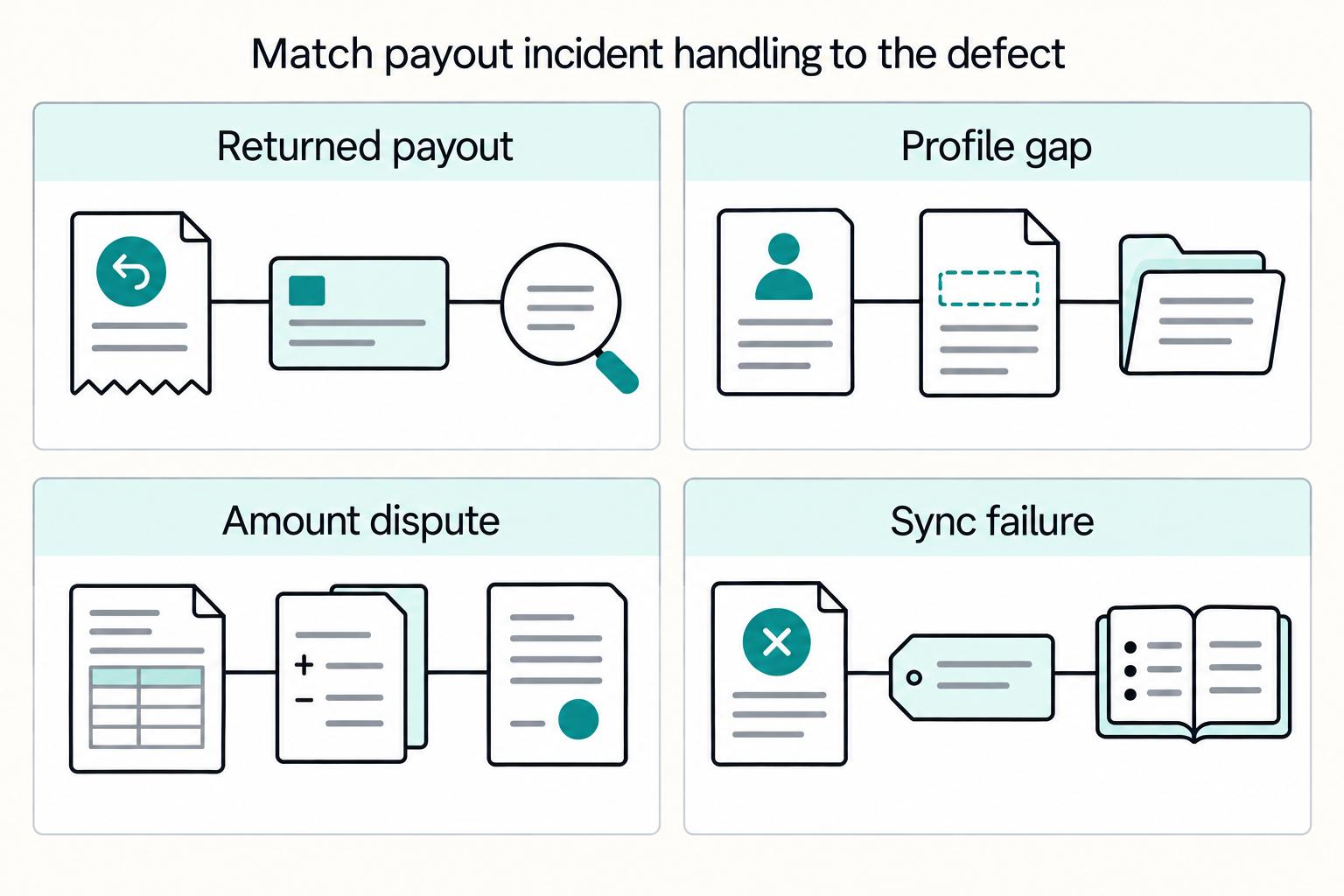
Step 1. Classify the failure before retrying. Use payout statuses as distinct signals, not one generic failure bucket. If your monitor separates processing, posted, failed, returned, or canceled, you can route the issue correctly and avoid broad, unnecessary holds.
| Failure mode | First isolation move | Primary recovery owner | Verification detail |
|---|---|---|---|
| Returned payout | Pause the affected external account only, where supported | Ops | Confirm status is returned and bank/profile details were updated |
| Stale partner data or invalid tax/profile | Isolate record; apply withholding or a lawful hold as appropriate | Ops | Actual validation result, tax owner decision and payment deadline |
| Disputed commission payout amount | Hold that partner's release or adjustment, not the whole batch | Finance | Compare imported earnings, calculation version, and approval record before changes |
| Broken accounting sync job | Stop unsafe export replay; determine if unsent payment controls are also affected | Engineering first, finance verifies | Re-run export against existing batch or payout IDs and confirm ledger totals tie out |
Step 2. Assign recovery by defect type. A practical split is: engineering fixes retry or idempotency defects, finance resolves approval-flow exceptions, and ops resolves onboarding or profile gaps. Include a small handoff pack each time: payout ID, batch ID, partner record, payout status, tax or profile state, approval record, and sync error output. Use idempotent retry so repeating a request does not create duplicate side effects.
Step 3: Isolate the affected obligation. A bad destination may require a permitted hold; a tax exception may require withholding instead of retaining the full payment. Keep unaffected records moving only when shared controls remain sound. For a return, confirm the original money movement and funding availability before approving a linked replacement payment.
Step 4. Reuse partner-facing incident language. Keep one approved set of delayed-cycle updates so partner and advertiser teams stay consistent.
- Payment delayed while profile details are updated
"We need to review the bank or tax information for this payment. We will confirm the applicable next step and expected update time. Other unaffected payments are continuing."
- Payout returned by receiving bank
"Your payout was returned by the receiving bank. We have paused payouts to that payment destination until updated details are confirmed."
- Reporting delay after payment release
"Your payment has been released, but reporting and accounting records are delayed. This does not mean a second payout will be sent."
For a broader operator view of running a partner network, see Affiliate Marketing Management for Platform Operators Running a Partner Network.
Run go-live and weekly controls your team can actually execute#
Your controls only work at scale if they run as a repeatable rhythm, not as tribal memory.
| Control | Timing | What to review |
|---|---|---|
| Go-live readiness | Before release | Dry-run outgoing disbursements, approved payables, withholding, funding debits and returned amounts; match the accounting export to the same records |
| Exception review | Weekly across the previous 7 days | Withheld payouts, aging reconciliation items, failed disbursements, returned payouts, and partner support escalations |
| Cycle checkpoint | Monthly for the previous calendar month | Match outgoing payment and funding records to bank/provider evidence and approved payables, including returns |
| Operating log | For each batch | Payout batch ID, reporting artifacts, reconciliation decisions, and any retry or hold notes |
Step 1. Prove readiness before release. Validate connector imports, partner/destination checks, immutable approvals and recovery in a controlled test. Reconcile each approved payable to the outgoing disbursement result, withholding, funding debit and any returned amount; verify the accounting export uses the same operation and batch IDs.
Step 2. Run one weekly exception review across the previous 7 days. Use a scheduled report or queue where available, then triage withheld payouts, aging reconciliation items, failed disbursements, returned payouts, and partner support escalations in one pass. Use payout statuses like processing, posted, failed, returned, and canceled to separate items that need action from items still in flight.
Step 3. Use a monthly checkpoint to correct recurring cycle issues. Review the previous calendar month, match payout records to monthly bank statements, and validate against reconciliation output. If delays keep repeating because of profile gaps, approval bottlenecks, or returns, adjust commission payout rules or approval depth before speeding up the cycle.
Step 4. Keep a single operating log in a central location. For each batch, record the payout batch ID, reporting artifacts, reconciliation decisions, and any retry or hold notes. This is the fastest way for finance, ops, and engineering to explain why a batch was released, held, retried, or adjusted.
Related reading: Best Affiliate Marketing Networks for Beginners Who Need Reliable Payouts.
Conclusion#
You do not make payout automation safer by adding more features. You make it safer by locking down ownership, sequencing control activities before speed, and treating tax readiness as a real release gate.
- Map owners before you raise payout volume.
Give each stage one named owner: finance for approval criteria and release evidence, engineering for execution and idempotent retries, and ops for exception handling and partner data cleanup. That is not just tidy org design. It matches the core control idea that management assigns responsibility and delegated authority to key roles. Use a simple verification test: pick one recent batch and see whether your team can pull the approver, payout batch ID, reconciliation output, and accounting export without rebuilding the story from chat threads. If nobody clearly owns a failed retry or a held payout, scale can turn that ambiguity into risk of duplicate payments, delayed closes, or both.
- Sequence verification, reconciliation, authorization, and approval before shortening the payment cycle.
The control activities that matter most are the unglamorous ones: verifications, reconciliations, authorizations, and approvals. Automate in that order of confidence. First prove your earnings imports tie back to source records, then prove your calculations post correctly, then automate disbursement execution, and only then decide how much approval can be removed for lower-risk cohorts. Your checkpoint is whether procedures define timing and corrective follow up, not just whether the job ran. If reconciliation lag starts spilling past your close window, stop expanding payout frequency and fix the reporting gap first. Faster release on top of weak tie-outs is just faster rework.
- Enforce onboarding and tax gates at the record level.
For each payable record, retain the approved commission, partner/destination data, tax treatment, disbursement outcome and any exception decision. A withholding issue is not the same as authority to hold the whole payment. Correct the applicable condition, preserve deadlines and isolate the record without discarding prior payment history.
The GAO Green Book is a federal-agency internal-control standard; its 2025 revision became effective in fiscal year 2026. Private networks can use its control concepts as a reference, rather than treating it as an affiliate-payout legal mandate.
Frequently Asked Questions
What should an affiliate network automate first: calculations, approvals, or disbursements?
A common starting point is earnings ingestion and calculation, because bad inputs pushed downstream only create faster mistakes. Once your imported data ties back to source records and your reconciliation report matches the batch, many teams automate disbursement execution before removing human approval. If tax form status, partner onboarding data, or exception volume is still noisy, keep approvals manual a bit longer.
Which controls are required before increasing payout volume for publishers and partners?
Do not scale on speed metrics alone. A baseline control set should include verifications, reconciliations, authorizations, approvals, and segregation of duties, because higher volume amplifies both error and fraud risk. A practical checkpoint is whether each batch has an approval record, reconciliation output, payout batch ID, and accounting export you can trace without rebuilding the story from Slack and email.
How do we combine tax form collection and withholding with a faster payout schedule?
Collect tax information early and configure the applicable withholding before accelerating a schedule. A missing form is not a universal full-payment hold: apply the current payment-year rules, notice procedures and contractual deadlines. Isolate the affected records, and escalate any shared configuration defect.
How do we combine multiple affiliate and advertiser commission sources without reconciliation drift?
Map approved conversion and commission records into one versioned ledger shape. Keep spend/performance feeds separate unless the commission rule explicitly uses them. Reconcile partner IDs, conversion references, qualification status, amounts and currency before approval; connector success alone does not prove earnings.
What should trigger a payout hold versus a full batch stop?
Isolate a defective destination, disputed amount or tax exception and determine its permitted treatment. Stop the batch if a shared mapping or approval defect affects all unsent work. Preserve already-submitted payments and resolve unknown outcomes before deciding whether replacements or retries are safe.
How can finance and engineering split approval flow ownership without slowing payment cycles?
Finance owns commission rules, approvals and release evidence; engineering owns durable operation records, execution and recovery. The approved artifact is the only input execution may submit. Preserve identical retry parameters within the endpoint’s key-retention window; reconcile unknown or older attempts before sending again.
Try a related tool
Researched and edited by the Gruv editorial team. Gruv builds cross-border billing, payouts, and finance-operations software for global businesses.
Sources
Educational content only. Not legal, tax, or financial advice.
Related Posts
Mass Payouts for Affiliate Networks Paying Publishers, Partners, and Creators at Scale
Treat affiliate payouts as infrastructure, not as a payment feature. Once you are paying publishers, partners, and creators in volume, the hard part is often not the send button. It is everything around it: commission calculation, recipient onboarding, approval controls, rail selection, status handling, reconciliation, and close.
Affiliate Network Payout Structures for Publisher Commissions
Commission design is an operating decision, not a pricing footnote. The structure you choose affects what behavior you reward and the economics of the program. It is easy to announce rates. It is much harder to define a model that still holds up once reversals, edge cases, and partner questions start showing up.
Performance Marketing Payouts for Affiliates, Influencers, and Publishers Without Compliance Debt
The first decision is not where you can grow fastest. It is which vertical and country pair you can launch now without creating payout compliance debt. Get that wrong, and early volume can hide messy approvals, weak records, and payout disputes that slow you down later.