

Quick Answer
Define one benchmark cohort, then separate first attempts, failed retries, and pre-authorization blocks before comparing rates. Track Authorization Rate and Checkout Completion Rate side by side, and segment by processor path, issuing country, and payment method so owners can act on the right failure class. Keep any improvement only after it still reconciles through settlement files and payout records.
How to Benchmark Payment Decline Rates#
A useful decline-rate benchmark is not a headline percentage. It is a repeatable view of your own traffic that clearly defines the cohort, the processor path, and what happened after authorization through settlement and payout reconciliation.
Payment decline rate is easy to quote and hard to compare over time. If your denominator mixes raw attempts with repeated retries, the number can look better or worse without any real operating change. The first check is simple: are you measuring unique outcomes, or retry noise?
Why headline rates fail in operations#
Headline rates fall apart fast when processor traffic is blended together. If your stack runs across more than one processor path, one aggregate decline number can hide route-specific issues. The transaction path matters, and acquirer-to-processor connectivity is not unlimited. Processor-scoped analysis is usually a baseline requirement for meaningful comparisons.
Who this article is for#
This article is for finance, ops, and product owners who need metrics that hold up beyond the checkout result. If you own ledgers, reconciliation, settlement reporting, or payout execution, you need to confirm that front-end outcomes reconcile to transaction history, settled records, and funding or payout records.
That validation matters because acceptance movement alone is not an operations win. Where payout timing is manually controlled, payout reconciliation still has to match transaction history. Settlement confidence also depends on transaction-level records that confirm payments were settled and paid out, not just authorized.
What a benchmark needs before you trust it#
A benchmark becomes decision-ready when you can answer:
- Is the rate first-attempt, all-attempt, or final purchase outcome, and which attempts are grouped?
- Is the view scoped to one processor path?
- What geography, payment-method mix, and time window are included?
- Can the result be validated against settlement and payout records?
If those answers are missing, treat the number as context, not a target. Methodology notes can change over time, and cross-region comparisons can break under country-specific network rules. Timing matters too. Analytics windows and reconciliation files can run on different daily schedules, so mismatched windows can create apparent incidents.
The rest of this article focuses on building a benchmark process you can run weekly, audit at month end, and improve without losing the link between authorization, settlement, and cash movement.
Start with clean definitions before you compare anything#
If your definitions move, your benchmark is noise. Before you compare trends or external references, lock one shared metric dictionary with each metric's stage, numerator, denominator, included payment methods, and retry treatment.
| Metric | How it's framed | Operational note |
|---|---|---|
| First-attempt issuer decline rate | First issuer-declined requests / first requests actually submitted for authorization | Exclude pre-issuer abandonment/blocks. Keep known submitted requests with unresolved outcomes in the denominator, report them separately, and mark the rate provisional |
| All-attempt authorization rate | Approved authorization requests / all submitted authorization requests, including retries | Not a purchase conversion rate; approvals can still fail capture |
| Final purchase recovery | Distinct purchase obligations authorized by the chosen cutoff / distinct obligations attempted | Retain first-attempt result, retry count and recovery window alongside it |
| Checkout Completion Rate | Completed checkout journeys / started journeys under your event definition | Publish journey/session grouping; not an issuer metric |
| Provider Payment Success Rate | Use the provider’s actual numerator, denominator and retry filters | Do not assume it is 1 minus your issuer decline rate |
Define the purchase identity as an order, invoice, or payment obligation and store separate attempt IDs beneath it. A card can pay for several valid orders; a fingerprint alone is not a purchase identity. Document how missing IDs, changed amounts, and later recovery are treated.
Hypothetical example: 100 purchases make a first issuer authorization attempt; 80 approve and 20 decline. The first-attempt decline rate is 20/100 = 20%. Ten declined purchases are retried, producing five approvals and five declines. All-attempt authorization is 85/110 = 77.3%, while final purchase recovery at that cutoff is 85/100 = 85%. None of those means the first-attempt decline rate improved.
Split out failures that never reached issuer authorization. Some payments are blocked before an issuer is asked, so labeling every failed payment as an issuer decline misstates root cause and pushes teams toward the wrong fix.
Keep card authorization metrics separate from asynchronous bank-debit or other method outcomes. Define success at the stage you actually observe—authorization, capture, or a later confirmed state—and retain subsequent returns and disputes. A mixed-method rate needs a disclosed method mix and consistent maturity window.
Check whether a benchmark claim is trustworthy before you use it#
Use a benchmark as an operating target only after you can match its scope to your own traffic. If sample scope or transaction mix is missing, treat it as directional context, not a target.
Headline rates are not enough for decisions because they can hide differences in processor path, market mix, and checkout inputs. In practice, a headline number alone will not tell you enough.
Before you copy a benchmark into planning docs, use this comparison table and start with two checks:
- Timeframe alignment. Match the transaction cohort dates, timezone, and observation cutoff; record analytics refresh time separately.
- Transaction context alignment. Payment context and fields like MCC can change what a reported authorization or decline rate actually represents across categories, countries, and acquiring setups.
| Source | Cohort definition | Payment Gateway or processor scope | Geography | Payment method mix | Timeframe | Public methodology gaps |
|---|---|---|---|---|---|---|
| Stripe Acceptance analytics | Own-account attempts; raw and deduplicated filters have different grouping | Processor filters can cover multiple processors, but network authorization rate is unavailable for non-Stripe processors | Country and card/input-method filters | Describe the actual filtered mix, not a cross-merchant benchmark | Selected transaction period in UTC; daily processing runs noon–23:59 UTC | Refresh processing times do not define the transaction cohort; estimated optimization impacts are not guarantees |
| Cybersource analytics | Historical transaction analysis across authentication, authorization, capture and settlement | Record the available processor dimension and filters used | Record selected countries | Record payment type and currency mix | Product page describes previous six months | An analytics product description is not an external industry decline-rate dataset |
| Survey or vendor research | Record whether responses describe merchant opinions or actual transactions | Record providers/acquirers represented or mark unknown | Record countries and population | Require transaction-method mix for transaction-rate comparison | Record fieldwork and transaction dates separately | A consumer/merchant survey cannot establish an issuer decline benchmark simply because its sample size is large |
| Internal processor comparison | Same purchase definition, eligibility, observation window and attempt grouping | Keep initial and retry routes identifiable | Match merchant and issuer markets | Compare like methods, interaction types and amounts | Use equally mature periods or a controlled experiment | Route selection can bias results; disclose allocation and exceptions |
Keep a short evidence pack for each external benchmark: source link, metric definition, sample type, field dates, sponsorship, and comparability judgment. A survey disclosure is useful for understanding that survey; it does not turn shopping opinions into authorization-event data. See Platform Payment Disputes for the later dispute stage.
Segment benchmarks by the paths that actually fail#
Use segmented benchmarks, not one blended decline rate. For decisions, split by the payment path components that can fail independently: Payment Method, region, Issuing Bank country, Acquirer or processor path, and first-attempt vs retry routing.
A blended Payment Decline Rate can hide opposite realities, such as healthy domestic authorization and weak cross-border corridors, or flat first-attempt performance masked by retry recovery. If you want a benchmark you can act on, segment by failure-path ownership.
Start broad, then cut toward the failure path#
Start with a wide view, then go deeper only when the upper layer shows concentration. Stripe acceptance analytics supports cuts like card brand, country, and input method, and Adyen troubleshooting highlights acquirer-supplied payment context, including payment instrument and shopper interaction.
| Segment level | What to split by | What it helps you answer | When to stop here |
|---|---|---|---|
| Global view | Payment Method, overall region, processor scope | Is Payment Success Rate or Authorization Rate actually moving? | Executive rollups or very low-volume programs |
| Corridor view | Merchant region to Issuing Bank country, domestic vs cross-border path | Is decline concentration corridor-specific? | When issuer/acquirer detail is too sparse to stay stable |
| Issuer/acquirer view | BIN, Issuing Bank country, Acquirer or processor, transaction type (ecommerce/POS) | Is one bank, BIN cluster, or acquiring path driving change? | Main operating layer when volume supports it |
| Checkout step view | Input method, shopper interaction, first attempt vs retry path | Is loss pattern tied to interaction type or retry behavior? | After upper layers isolate a clear problem |
This is an investigation order, not a universal industry standard.
Split first attempts from retries every time#
Keep first attempts, retry attempts, and final purchase outcomes separate. Excluding retries from one view and counting them in another is legitimate only when the labels say so. A deduplicated final-outcome rate is not the same as a first-attempt rate.
Record the initial processor and every retry route under the same purchase identity. Routing can change which issuer populations each processor sees, so a blended before/after lift may reflect traffic selection rather than better processing.
Use low-volume caution, not false precision#
Low-volume micro-segments can swing sharply from week to week, so false precision is a real risk. If a segment is thin, roll up one level and watch trend stability before you assign hard targets.
If declines concentrate in one bank or BIN range, show both its rate and absolute count. Hypothetically, one decline among five requests is 20%, while 200 among 1,000 is also 20%; the percentages match but support very different confidence and business-impact judgments. Roll up sparse segments or extend the observation period.
Keep SaaS Subscription Billing renewals separate#
Separate first on-session checkout from later recurring collections, including customer-initiated and merchant-initiated traffic where correctly classified. Keep invoices that are still awaiting authentication or retry recovery out of final-outcome claims until their observation window closes.
For eligible card collections, Stripe Billing’s Smart Retries currently recommends eight tries within two weeks. This is a configurable recommendation, not a network entitlement or a rule for every payment method. Measure scheduled attempts separately from executed requests: a hard-declined invoice can have scheduled retries without a new charge.
Map decline causes to technical owners across the payment stack#
After you segment declines by corridor, attempt type, and payment path, assign ownership by failure class so the right team acts first. Do not route one blended decline bucket to every team.
Build the taxonomy around where the failure happened#
Build the taxonomy around the point of failure, not the headline symptom. Use four owner lanes.
| Decline class | What it usually looks like | Primary owner | First action |
|---|---|---|---|
| Customer input or checkout abandonment | Shopper drops before completion, cancels, or fails a checkout step | Product / checkout team | Check Checkout Completion Rate, step-level drop-off, and whether the event happened before authorization |
| Payment Gateway, acquirer, or integration issue | Invalid API input, known gateway/acquirer failure, or issuer-reachability error; record unknown responses separately | Payments engineering | Review provider request logs and refusal fields, then isolate by processor or acquiring path |
| Issuing Bank response | Authorization reached the issuer, but the issuer declined | Payments ops / issuer-acquirer owner | Split hard vs potentially recoverable responses, then test retry timing or routing only where retry is appropriate |
| Fraud Detection Systems decision | Merchant-side block or risk refusal before issuer approval | Risk / fraud team | Review risk rules, score thresholds, and false-positive candidates before changing routing |
This lines up with provider behavior: Stripe separates issuer declines, blocked payments, and invalid API calls, and Adyen exposes resultCode, refusalReason, and refusalReasonCode for classification. So 16 Shopper Cancelled is not an issuer issue, 4 Acquirer Error is not a fraud issue, and 20 FRAUD should go to risk review before routing changes.
For each decline cluster, first confirm whether authorization reached the issuer. If it did not, do not record it as issuer performance.
Use response families to decide if retry is eligible#
Retry only where responses indicate recoverability. Treating all declines as retryable adds noise and can distort performance. Checkout.com response families are practical for triage:
| Response signal | Meaning | Retry note |
|---|---|---|
| Checkout.com 20xxx | Soft-decline family | Read the exact code and issuer advice; possible recovery is not permission for unlimited retries |
| Checkout.com 30xxx | Hard-decline family | Usually needs issuer/cardholder remediation; follow exact non-retry instructions |
| Checkout.com 40xxx | Risk-response family | Inspect status and risk settings rather than treating every code as an issuer decline |
| Issuer/scheme Do Not Try Again instruction | Explicit non-retry advice | Suppress automated retries and cross-processor bypasses for that obligation |
| Transport timeout or missing response | Unknown outcome, not a confirmed decline | Query/reconcile the original reference before a replacement or alternate route |
Preserve the raw issuer or scheme advice alongside the provider’s mapped decline. Code values are provider- and field-specific: a response code, refusal code, and merchant advice code are not interchangeable. Follow the documented retry prohibition for the actual field and route.
For subscription cards, use the configured Billing retry schedule only for eligible responses. Authentication-required and revoked-authority cases need the appropriate customer action; a timer cannot fix missing consent or authentication.
Spend effort where evidence points#
Once a cluster is confirmed issuer-side, test issuer-path variables such as retry timing and, where relevant, routing path on eligible decline families. When a cluster is risk-side, review and tune Fraud Detection Systems first.
For confirmed merchant-risk blocks, investigate the matching rule and legitimate-client evidence before changing controls. Keep allow exceptions narrow and reviewed. Changing a rule does not retroactively process a blocked request, and routing around a risk block is not a valid substitute for risk approval.
Also keep acquirer and issuer-availability incidents separate. Adyen distinguishes 4 Acquirer Error from 9 Issuer Unavailable; they require different owners and different actions. Predefined escalation lanes can make spike response faster and cleaner early in an incident.
Define escalation lanes before incidents#
- Finance or payments ops opens the incident, confirms cohort scope, and attaches Request ID or RID, transaction logs, processor, country, and response-family counts.
- Product owns shopper-cancelled and pre-authorization checkout failures tied to Checkout Completion Rate and step instrumentation.
- Payments engineering owns invalid API calls, gateway errors, acquirer errors, and issuer-reachability issues.
- Risk owns blocked payments and fraud-coded refusals first, including rule and allow-list review.
Attach the provider request/reference IDs, timestamp, environment, mapped and raw response, route, and relevant webhook events. Keep sensitive credentials and card data out of the incident notes. The provider’s support interface may differ, but those references let its team find the exact attempt.
The objective is simple: get the right owner the right evidence fast enough to improve Payment Success Rate without adding unnecessary retry traffic or extra risk. Related: SaaS Subscription Billing Benchmarks: Churn MRR Expansion and Payment Decline Rates.
Decide when to optimize routing and when to tighten controls#
If issuer-linked declines rise while risk blocks are stable, inspect response reasons, authentication, card details, outages, and eligible routing options. Test routing only when evidence points to a path-specific issue; insufficient funds or revoked authority does not become retryable just because another processor exists.
That split matters because these failures come from different decision systems. Issuer declines are decided on the issuer or payment-provider authorization side, while blocked payments are risk-side and may never reach issuer authorization. If blocked-payment share is flat but issuer declines are climbing, extra checkout friction alone is unlikely to fix the root cause.
Use a hard split before you change anything#
Before changing controls, confirm whether authorization reached the issuer. If it did not, classify checkout/authentication failures, merchant-risk blocks, and gateway/acquirer/integration errors separately. Keep unresolved transport outcomes unknown and reconcile the original attempt before retrying. For confirmed issuer declines, review the response family, processor/acquirer logs, and any Merchant Advice Code or equivalent guidance before testing an eligible remedy.
Network retry limits and fees are distinct from the best recovery schedule. Adyen’s current scheme-fee guidance describes fees from the 16th retry in a rolling 30-day period for specified Visa categories. Confirm the current category, region, and acquirer rules before configuring limits; never use a fee threshold as an operating target.
Apply the counter-rule too. If approvals improve but abuse signals or false-positive complaints worsen, pause routing expansion and recalibrate Fraud Detection Systems.
Compare the interventions before you spend effort#
| Intervention | Best fit signal | How to validate | Main tradeoff |
|---|---|---|---|
| Transaction Routing across processor, Acquiring Bank, or network path | Issuer-linked declines up, blocked-payment share stable | Match eligible cohorts by issuer, method, amount, and interaction; use controlled allocation and adequate sample/maturity, not a fixed calendar guarantee | Can improve approvals, but adds payment-path reporting and reconciliation complexity. |
| Fraud Detection Systems recalibration | Blocked payments rising, false positives visible, abuse signals changing | Compare blocked-payment rate, approval rate, and abuse outcomes on the same cohort before and after rule changes. | Looser rules can raise abuse exposure; tighter rules can suppress legitimate payments before issuer contact. |
| Checkout UX or extra friction | Checkout Completion Rate falling before authorization, or customer input failures dominate | Verify step-level drop-off and confirm auth was never attempted. | Can cut conversion without changing issuer-side declines. |
Change one lever at a time. Routing, fraud controls, and checkout friction can all move conversion through different mechanisms, so changing them together makes attribution and rollback harder.
Write the tradeoff in language leadership can act on#
Treat vendor-reported uplifts as directional, not guaranteed outcomes, until your own traffic validates them. Use a plain-English decision note:
- Expected gain: higher authorization or payment success on issuer-side traffic.
- Risk cost: more abuse exposure or more false positives if controls are mis-set.
- Operational cost: more route-level monitoring, exception handling, and reconciliation overhead when adding processor or acquirer paths.
Use issuer evidence to choose an eligible remediation—customer action, authentication, timing, or a tested route. For a merchant-risk decision, resolve risk policy first. For unknown outcomes, reconcile the original attempt before either path.
Before changing routing or risk thresholds, align your runbook with idempotent retries, status tracking, and webhook handling in the Gruv docs.
Run a seven-day incident sequence for sudden decline spikes#
Use this seven-day outline as a suggested investigation cadence, not a reason to wait during an outage. Triage immediately, protect customers and duplicate-send controls, and advance diagnosis and mitigation as soon as evidence supports them. Larger samples or settlement/dispute maturation may require longer validation.
Day 1 and 2 triage#
Rebuild the view from raw events using purchase IDs and separate attempt IDs. Check duplicate event delivery, timezone, refresh lag, and unresolved responses. Card fingerprints can help link attempts but must not collapse separate orders by the same customer or card.
Then separate failures into issuer declines, blocked payments, and invalid API calls so the right owners work the right problem. After that split, segment the spike by processor, issuing country, issuing bank, and BIN to find concentration. Also note the reporting window for the dataset you are using, since delayed processing can mislead same-day decisions.
Day 3 and 4 diagnosis#
Once the metric is stable, test concentration directly. Is the spike tied to one transaction-routing path, one payment method, or one checkout step?
Review processor-level and decline-code-level cuts together. If one route or acquirer path is the issue, decline codes and issuer or scheme response detail should cluster there. If you use Adyen, inspect resultCode, refusalReason, and refusalReasonCode, and review raw acquirer response detail where available.
Day 5 action#
Ship a scoped fix as soon as the failure is understood; day 5 is a planning marker, not a mandatory wait. Eligible changes include a targeted route adjustment, authentication/checkout repair, or correction of invalid API inputs. Set rollback conditions before release.
Define proceed or stop gates before release, for example:
- no clear recovery in the affected cohort after the next stable reporting cycle
- a worse mix of decline families after the change
- downstream capture or settlement issues even if authorization improves
Authorization recovery alone is not enough if funds do not capture cleanly.
Day 6 and 7 validation#
Validate recovery in the same segments where the spike appeared, not only in blended totals. Recheck authorization outcomes by processor, route, payment method, issuer segment, and checkout step.
Check authentication, authorization, capture and settlement in the same affected cohort. Keep later disputes and unresolved settlement items under observation after the first week. If capture or settlement quality degrades, the change needs further investigation even when authorization improves.
Tie benchmark improvements to ledger, reconciliation, and payout reliability#
A benchmark improvement is only real if it also holds up in accounting and cash movement. If Authorization Rate or Payment Success Rate improves but ledger traceability, settlement consistency, or payout reconciliation gets worse, treat the change as incomplete.
Use this section after incident triage to confirm downstream reliability, not just front-end acceptance. Acceptance analytics and back-office controls are different checks on the same payment flow.
Check the ledger before you celebrate#
Before you call a change a win, review Payment Success Rate and network Authorization Rate separately, then validate ledger linkage for the changed cohort. For Stripe, balance transactions are ledger-style records, and each includes a source field that links the balance entry to the related Stripe object.
Checkpoint: confirm you can trace each sampled payment from your internal record to the provider reference and the related ledger event in balance transactions. If that chain is inconsistent, month-end close risk can increase even when approval metrics improve.
Control for settlement timing before comparing periods#
Use transaction-level settlement records rather than assume every authorization settles when a batch closes. Adyen’s Settlement details report identifies journal entries, fees and merchant payouts; batch closure/report generation follows account payout frequency and does not mean every authorized transaction was captured or bank-credited.
| Check | What to compare | Why it matters |
|---|---|---|
| Batch consistency | Credits, debits, and transaction counts by settlement batch | Detects timing-window drift |
| Transaction traceability | Payment records to transaction-level settlement detail | Confirms settled records align with approved payments |
| Cost visibility | Transaction-level costs before and after the change | Highlights cost shifts alongside approval changes |
Watch payout friction as a downstream signal#
Review holds, reserves, refunds, disputes, payout exceptions, and bank-deposit matches for the changed cohort. A merchant bank payout can aggregate many transactions and adjustments. Its amount and date therefore need reconciliation rather than a one-payment-to-one-deposit assumption.
Stripe can associate transactions with automatic payouts through its payout reconciliation flow. For manual payouts, it says the operator must reconcile payout amount and timing against transaction history. In either case, verify bank arrival separately; the provider payout record is not your bank statement.
Keep the audit trail provider-specific but complete: internal payment record, provider reference, ledger or settlement event, payout identifier, and bank-deposit match. That chain helps finance defend month-end close.
Build the evidence pack your team can audit and reuse#
Standardize one monthly evidence pack and use it every month. That is how benchmark gains stay auditable, reusable, and defensible instead of turning into one-off wins.
At minimum, the pack should answer the same four questions in the same order each cycle: what was measured, which segments moved, what changed in production, and what happened before versus after. Keep definitions explicit. Track Payment Decline Rate, Payment Success Rate, and network Authorization Rate separately, and state whether authorization uses unique declines with failed retries excluded.
What belongs in the monthly pack#
Use one fixed structure so finance, ops, and product review the same evidence every time.
| Pack element | What to include |
|---|---|
| Metric definitions | Numerator, denominator, retry treatment, and reporting window |
| Segment tables | Global total plus the cuts most likely to explain movement, including region or country, payment type, decline code, issuer BIN, retry strategy, and any gateway or acquirer dimensions your data can reliably attribute |
| Intervention log | Date, owner, change ticket, hypothesis, affected traffic share, and rollback trigger for each gateway, routing, fraud, or checkout change |
| Before/after outcomes | Same cohort rules, same reporting window, and exact delta for declines and authorization |
For trend stability, include a trailing view alongside the current month. Cybersource describes the previous six months as a useful window across authentication, authorization, capture, and settlement stages.
Score outside sources before they become targets#
Use external benchmarks only after you record credibility notes.
| Source | What it can support | What to record before using it |
|---|---|---|
| Provider analytics docs | Metric definition, supported filters and grouping | Record the exact rate definition, filters, refresh lag, exclusions and version/date |
| Provider transaction and settlement reports | Attempt classification and downstream accounting evidence | Record references, journal types, fees, report timezone and payout mapping |
| Published transaction dataset | Possible external comparison when methodology matches | Record population, methods, issuers, geographies, sample, dates and retry rules |
| Survey or vendor marketing | Questions or directional context | Distinguish self-reported opinion from transaction observations; record sponsor |
| Educational article or social post | Investigation ideas | Do not treat an unsupported percentage as a target or audited standard |
If sample scope, payment-method mix, geography, or timeframe is missing, keep the source as directional context only.
Add checkpoints and keep a decision register#
Require three controls before sign-off: data freshness, cohort lock, and named owner approval. Record extract timestamp and provider report date, lock cohort rules before review, especially retry treatment, and attach sign-off for each gateway or acquirer change.
Keep a decision register next to the pack with one row per pattern: segment, suspected cause, action taken, result, owner, and next review date. That register is what lets the team resolve repeat decline patterns faster in later quarters.
For a step-by-step walkthrough, see How to Build a Deterministic Ledger for a Payment Platform.
Avoid the benchmarking mistakes that waste quarters#
The evidence pack matters only if it prevents bad decisions, not just bad math. The biggest misses are usually the same four.
- Using one global target without segment context
A single target across all payment networks and payment methods can hide the real issue. Review results by card brand, country, input method, and other payment dimensions before setting or reporting targets, and normalize scheme-specific refusal text because raw acquirer responses differ across schemes and can change.
- Treating every decline as fraud
Not every decline is a fraud problem. Payment failures include issuer declines, blocked payments, and invalid API calls, so classify the failure type first, then tune the right lever. Otherwise you can add friction while the real issue remains in issuer behavior or integration.
- Claiming success-rate lift without downstream validation
Payment success rate or network authorization rate improvement is not enough on its own. Authorized payments may not be captured, and settlement timing varies by location and payment method, so validate gains with transaction-level reconciliation against settled and paid-out records before calling it a clean win.
- Copying external benchmarks into internal targets
External benchmarks are directional until methodology and sample scope are clear. Use them as targets only when field period, sample, geography, cohort definition, and payment-method mix are disclosed.
Account for country and program variation before setting targets#
Set targets by market, method, and program state when volume supports them. A blended target across US, EEA, and other cross-border traffic can conceal differences in authentication, issuer behavior, and acquiring setup.
Record whether SCA applies to the actual transaction and whether an exemption or out-of-scope treatment was used. A recurring label alone does not establish exemption; proper initial authorization, consent, and transaction flags matter. If authentication handling changed mid-quarter, segment that change before attributing performance.
Do not assume authentication performance carries between regions. Measure issuer response, authentication completion, abandonment and fraud in each eligible cohort. Preserve required authentication; an approval target is not a reason to bypass it.
Before you publish targets, lock a country-level matrix with:
- issuing country
- merchant or acquirer country
- SCA enabled state
- exemption usage
- payment gateway or processor route
- active risk-policy version
Use “Europe” carefully. PSD2/SCA scope depends on the payment providers, transaction type and applicable rules, not a continent label. The EBA’s one-leg/two-leg Q&A is a starting point for scope analysis; record the applicable market interpretation instead of labeling all European traffic identically.
For cross-border programs, review payment networks and acquiring configuration before you attribute movement to team performance. Merchant and cardholder country mismatch can change network treatment, and local acquiring can improve issuer familiarity. If Payment Success Rate moved after an acquirer-country or routing change, call it out directly so setup effects are not misread as team execution changes.
For more on authentication-related declines, see Strong Customer Authentication (SCA) for Subscription Platforms: Reducing Decline Rates.
Conclusion#
A useful benchmark is not a headline percentage. It is a segmented, auditable operating view that separates authorization rate from conversion and payment success, then helps trace movement to likely failure points: gateway path, issuer response, or downstream settlement and payout.
Start with definition control. Authorization rate is the share of attempted payments that are approved, and authorization is not the same as conversion. If first attempts and retries are blended, teams can fix the wrong layer, so lock cohort rules and period comparisons before you set targets.
Keep raw response and advice fields so you can distinguish issuer decline, merchant risk, technical failure, and unknown outcome. Follow current provider/scheme retry guidance for the exact code and field. Missing advice is not blanket permission to retry, and an unresolved timeout must be reconciled before a new route is attempted.
Treat improvements as provisional until finance can reconcile them. One provider's acceptance analytics supports segmented analysis, including payment success plus network authorization with pivots, but impact methodology can change. Validate with your own before-and-after evidence. Confirm operational quality through payout and settlement reconciliation, including payout-to-batch matching, line-level payment, refund, and chargeback visibility, and provider-to-internal record mapping.
If you do one thing next, publish the same monthly evidence pack every cycle:
- Metric definitions and cohort lock rules
- Segment tables by auditable dimensions such as gateway path, issuer country or bank, payment method, currency, and first-attempt vs retry
- Intervention log with date, owner, and expected impact
- Reconciliation proof, including payout-batch matching, settlement lines, and provider or merchant reference mapping
If a number does not hold up under segmentation, retry scrutiny, and reconciliation, it is not a benchmark yet. If your benchmark program now needs tighter payout controls and audit trails, review how Gruv Payouts fits your operating model.
Frequently Asked Questions
What is Payment Decline Rate in one line, and how is it different from Payment Success Rate?
For an issuer-only first-attempt view, divide first requests declined by the issuer by first requests actually submitted for authorization. Count risk blocks, authentication failures, abandonment, and unknown outcomes separately. Provider Payment Success Rate can use a broader denominator, so it is not automatically the complement of your decline rate.
What benchmark range is reasonable to reference, and what caveats make that range unreliable?
No universal decline-rate range fits all platforms. Compare the same stage, purchase/attempt grouping, methods, markets, issuer mix, and maturity window. An internal matched cohort is more actionable than a vendor headline with an undisclosed denominator.
Are high declines usually a fraud problem or a data and infrastructure problem?
High declines can come from either fraud-related pressure or operational issues, so treat both as active hypotheses. Provider docs note declines can indicate fraud or integration issues, and Checkout.com also includes temporary issuer, acquirer, and network outages as causes. Diagnose before you add friction.
Which segmentation dimensions should we prioritize first for platform operations?
Start with issuing country, issuing bank, and issuing BIN, since those are primary filters for investigating authorization failures. Then segment by decline code, processor, and currency to isolate likely root causes. Also separate unique first-attempt declines from retry noise when measuring performance.
What should a team do in the first seven days after a decline-rate spike?
Triage immediately; use the seven-day outline as a suggested follow-through cadence. Validate event freshness and purchase/attempt grouping, localize the failure, and test a scoped remedy with rollback conditions. Continue capture, settlement and dispute checks beyond the week where outcomes have not matured.
What minimum methodology details must exist before we trust an external benchmark?
At minimum, you need clear metric definitions and comparability rules: what is being measured, whether that means acceptance, authorization, or capture, and how retries are handled. You also need sample context and timing, not just a headline number. A disclosed survey sample can be useful context, but it still does not make rates automatically comparable to your program.
How do we confirm that decline-rate improvements did not break reconciliation or settlement quality?
Do not treat authorization lift alone as proof of success. Provider docs note authorized payments may still fail to capture, and Checkout.com separates capture rate from authorization performance. Confirm improvements with downstream checks, including settlement and chargeback monitoring, before calling the change operationally clean.
Try a related tool
Researched and edited by the Gruv editorial team. Gruv builds cross-border billing, payouts, and finance-operations software for global businesses.
Sources
Includes 5 external sources outside the trusted-domain allowlist.
- docs.stripe.com/payments/analytics/acceptancetrusted
- docs.stripe.com/declinestrusted
- eba.europa.eu/single-rule-book-qa/qna/view/publicId/2018_4233trusted
- cybersource.com/en/solutions/payment-acceptance/analytics.htmlexternal
- docs.adyen.com/development-resources/refusal-reasonsexternal
- docs.adyen.com/development-resources/raw-acquirer-responsesexternal
- help.adyen.com/en_US/knowledge/finance/invoices/what-are-no...external
- support.checkout.com/hc/en-us/articles/14327088369170-Understand-...external
Educational content only. Not legal, tax, or financial advice.
Related Posts

Churn Benchmarks by Industry: Metrics, Cohorts and Targets
A payment platform can lose a merchant account, a paying software subscriber or recurring transaction revenue. Those are different outcomes. Before comparing churn by industry, define which relationship can churn and what event ends it. A merchant with no transactions this month is not necessarily a canceled subscriber; a failed renewal attempt is not necessarily a lost customer.
How to Compare SaaS Billing Benchmarks Before Expansion
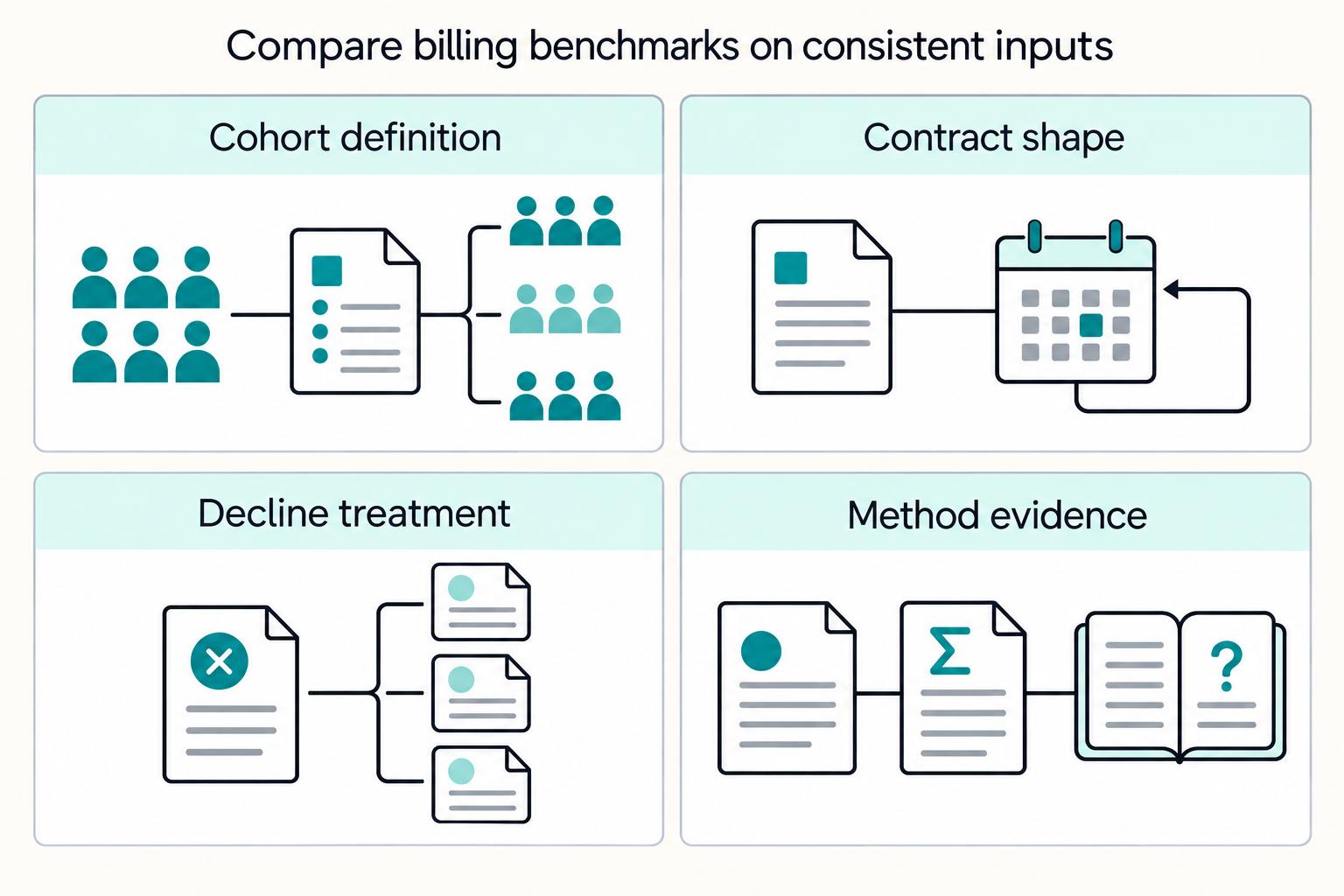
For expansion decisions, treat payment decline rate, churn, and expansion as one system, not three separate metrics. That gives product, finance, and GTM a view they can defend before rollout resources are committed. If you own the budget call, you need that view before your team starts treating one good month as a trend.

Strong Customer Authentication (SCA) for Subscription Platforms: Reducing Decline Rates
If you want fewer surprises, treat SCA as a scope and sequencing decision, not a feature hunt. This ranked list is for teams running recurring collections across markets that want to reduce avoidable decline risk under PSD2 without adding unnecessary checkout friction.