
Quick Answer
Payment links can support PCI-compliant collection when the implementation meets applicable requirements. Hosted pages can reduce direct card-data handling while merchant duties, provider oversight and validation still apply. Confirm the integration and assessment path, then test link authenticity, expiry, intended reuse and authoritative payment status.
Payment-link security starts with the data flow and its owners#
Payment links can support PCI-compliant card collection when the integration meets the applicable requirements. Start with where card data travels and which controls your team and provider operate. The link also needs fraud and reconciliation controls: PCI compliance alone does not prove a payment request is legitimate.
Speed still matters. Even when payment links are used to speed launch, PCI DSS scope is broad. It applies to entities that store, process, or transmit cardholder data or sensitive authentication data, and to entities that could affect the security of the cardholder data environment.
PCI DSS is the baseline technical and operational standard for protecting payment account data. Payment account data includes cardholder data and/or sensitive authentication data, so scoping does not stop at the card-entry screen. Systems around the payment flow, and the way you operate them, can still affect security ownership. Use the current PCI DSS standard documentation as the baseline control source.
For platform teams, the practical goal is to move quickly without losing defensibility. Product, engineering, finance, and ops should align on data boundaries, control points, and incident ownership before anyone treats the setup as done.
Use one checkpoint early: map the flow from link creation through payment completion, then mark every place your team can view, change, resend, log, or export payment-related information. Any unclear control point is an ownership gap you should close first.
Treat provider models as shared responsibility, not transferred responsibility. PCI guidance is explicit that merchants should work with their TPSPs and confirm compliance-validation expectations with acquirers and payment brands, because those program expectations can vary.
Also be careful with the word "hosted." PCI SSC guidance distinguishes full redirects and fully outsourced email-link payment flows from embedded-page patterns. SAQ A v4.0.1 eligibility updates took effect on 1 April 2025. If a provider presents these as equivalent, ask for the exact implementation boundary in writing.
Before you compare vendors, lock three things: your data boundary, your incident owner, and your evidence set. If those are unclear, the risk is not theoretical. It becomes a production ownership problem. For a related operational issue, see Understanding Payment Platform Float Between Collection and Payout.
Start with the terms teams confuse in procurement calls#
These terms get blurred in procurement calls, but they are not interchangeable. Each one changes your responsibility boundary.
| Term | Article note |
|---|---|
| PCI DSS | Baseline standard for entities that store, process, or transmit cardholder data |
| PCI SSC | Develops and manages PCI Security Standards; a vendor claim does not define your scope for you |
| TPSPs | Using them does not transfer ownership; you still need to oversee those relationships, monitor PCI DSS status, and map which requirements are theirs versus yours |
| Embedded iframes and SAQ A eligibility | For SAQ A-style outsourced eligibility, all payment-page elements must originate from the compliant provider via the embedded iframe; if merchant-provided elements are involved in card-data collection or processing, SAQ A eligibility is lost |
| P2PE | Protects account data from card acceptance to secure decryption and can reduce applicable PCI DSS requirements, but it does not eliminate PCI DSS obligations |
Use one procurement rule: for every term a provider uses, ask what merchant responsibilities remain, what document proves that split, and what implementation choice would change it.
Are payment links PCI compliant for your platform#
Payment links can fit a PCI-compliant setup, but the link itself does not determine compliance. Your scope is set by implementation boundaries: who creates, displays, transmits, or stores payment account data, and what parts of your environment could affect cardholder data security.
Provider-hosted collection can keep card numbers and security codes away from your systems. Document whether your platform acts as a merchant, a service provider or both: merchant SAQs do not automatically cover services you operate for other merchants. Confirm the applicable validation path with your acquirer or payment-brand compliance program.
Use one scoping test first#
If your UI, backend, logs, or support tooling touches cardholder data, treat scope as broader until proven otherwise. At minimum, cardholder data includes the full PAN, and account data includes cardholder data and/or sensitive authentication data.
Map where payment account data is created, displayed, transmitted, and stored. Check this across:
- your hosted payment page or iframe implementation
- your product UI and any wrapper page around the payment experience
- backend services, logs, analytics, and error reporting
- support tools, exports, recordings, and admin views
This avoids a common mistake: assuming an embedded payment flow always keeps you out of scope. For SAQ A eligibility in iframe scenarios, PCI SSC states all payment-card capture fields and elements must stay inside the iframe. If payment-card collection or processing elements are on your site, SAQ A eligibility is lost.
Where teams widen scope by accident#
Scope can widen when a custom card field posts through your backend, a proxy terminates card-data traffic, or monitoring captures sensitive values. Review changes to payment-data access before deploying them. A logo, heading or other merchant content unrelated to card-data capture outside the iframe does not by itself disqualify SAQ A.
Use a simple checkpoint: confirm payment-card capture elements remain inside the iframe. Then confirm logs and support surfaces do not expose PAN or other payment account data. If that is not clear from implementation evidence, treat scope as unresolved.
What vendor pages usually do not tell you#
Vendor pages may say "secure" or "PCI compliant" without mapping requirements to your exact integration. They may also not spell out, in one place, the provider-versus-merchant split, the expected SAQ path, and what changes if you customize later.
Request the responsibility matrix, validation evidence for the exact service, secure integration instructions and expected merchant validation path. Record which changes alter eligibility. Confirm submission and annual validation expectations with the compliance-accepting entity; distinguish those from the separate requirement to monitor provider compliance status at least every 12 months.
So, are payment links PCI compliant for your platform? They can be, if your implementation keeps the data boundary clean, documented, and still true after product changes.
If you want a deeper dive, read Webhook Payment Automation for Platforms: Production-Safe Vendor Criteria.
Choose your architecture before you choose a vendor#
Architecture fit matters more than vendor familiarity. If you need speed and lower direct card-data handling risk, start with provider-hosted collection. If you need deep on-site checkout control, plan for a higher PCI DSS ownership burden from day one.
Use the same boundary test from the previous section. Choose the pattern that keeps payment-account-data boundaries clear now and after future product changes.
| Pattern | Implementation speed | UX control | Blast radius if misconfigured | Expected PCI DSS ownership burden |
|---|---|---|---|---|
| Fully hosted payment links | Fast. Provider-hosted page plus link distribution is often a short path to launch. | Lowest. Less control over on-site checkout experience. | Lowest of the three if card entry stays fully on the provider page, though implementation choices can still widen scope. | Potentially eligible for merchant SAQ A if all criteria are met; confirm the actual flow with the compliance-accepting entity. |
| Embedded payment iFrames | Moderate. Faster than full custom, slower than pure redirect. | Medium to high. Better in-product continuity than redirect. | Medium. Small boundary mistakes can change your validation path. | Reduced scope only when boundaries are clean. PCI SSC says all payment-page elements in the cardholder browser must originate only and directly from a PCI DSS validated third-party provider for SAQ A iframe eligibility. |
| Custom payment pages with direct card handling | Slowest. More engineering, security review, and evidence work. | Highest. Full control of fields, layout, and flow. | Highest. Your application and operational systems can enter scope. | Direct card handling brings relevant application, storage, network and operating controls into scope. Confirm the appropriate assessment; an integration label does not establish eligibility. |
Read the table as a decision rule#
For most teams, hosted collection is the practical starting point. PCI SSC's 2025 clarification separates iframe-specific SAQ A criteria from fully outsourced patterns such as emailing a customer a link to a third-party payment site. Map SAQ decisions to the official PCI SSC SAQ document library.
Hosted does not mean hands-off. PCI remains a shared responsibility, and PCI SSC says merchants should work closely with TPSPs on secure implementation.
If you choose embedded iframes, treat boundary validation as launch critical. PCI SSC states SAQ A iframe eligibility is lost if merchant-provided elements are involved in payment data collection or processing. Choose custom direct handling only when the business case is strong enough to justify the added security and audit load.
Use vendor names for discovery, not for the decision#
Evaluate each provider against the same sample flow: issue a fixed-amount invoice link, authenticate where required, process payment, deactivate the link and reconcile the result. Ask which controls are configurable in your contracted product and who can change them. A broader product catalogue does not prove those features are enabled for your account.
Use service-level compliance evidence and the demonstrated integration to choose a provider. PCI SSC guidance explains how embedded-page script protections can be established; the implementation conditions matter alongside the compliance claim.
Pick delivery channels with a risk lens, not only a conversion lens#
Choose the delivery channel as a risk-control decision. The same payment link creates different forwarding, impersonation, support, and auditability risk in email, SMS, or a shareable URL.
| Channel | Interception or impersonation risk | User trust signals | Support burden | Traceability |
|---|---|---|---|---|
| Medium. Links are easy to forward, so recipient control can weaken. | Better when the message appears in an expected customer context. | Moderate, especially for legitimacy checks and resend requests. | Strong if each send is tied to a customer record and payment event. | |
| SMS | Higher. Smishing is a known attack pattern, and recipients cannot reliably verify who originated a text. | Often mixed, especially for unexpected payment requests. | Higher when users question whether the text is legitimate. | Good only if you log who triggered the send, destination, timestamp, and resulting payment event. |
| Shareable URL | High when forwarding and reuse are uncontrolled across recipients and channels. | Can be lower by default when the link appears outside a known authenticated flow. | Can increase when links are reused or paid by the wrong person. | Weaker by default unless issuance and reconciliation data are explicit. |
When you compare channels, use one decision rule: as forwarding or impersonation risk rises, tighten expiry and reuse controls and require stronger verification before accepting payment.
Match controls to the channel#
Your controls should follow the channel. For email and SMS, pair link delivery with risk-based authentication and, where supported, 3D Secure. Use risk signals to trigger step-up checks when needed. Do not assume 3D Secure applies to every transaction or payment method.
Choose an expiry and reuse policy that matches the purchase. Adyen’s Pay by Link documentation gives a provider example: 24-hour default expiry, configurable up to 70 days, early expiry after five unsuccessful attempts and one successful payment by default. Verify your configured behavior. A reusable catalogue link needs different duplicate controls from a single-invoice link.
Make auditability non-negotiable#
Every sent link should map to a clear user action and to downstream payment events. Store issuer identity, target account or invoice, delivery channel, destination, timestamp, expiry and reuse settings, and the payment event that closed the flow. If your provider exposes checkout session events or internal reference fields, use them for reconciliation.
Set one hard boundary in policy: messages can deliver a link to a hosted payment page, but they should not carry raw card data. PCI SSC states unprotected PAN cannot be sent via end-user messaging technologies, and strong cryptography and security protocols are required when cardholder data is sent over open public networks.
Set a minimum control stack before launch day#
Set a written launch gate before the first live payment link. Define where card data can and cannot go, which fraud controls are active, and which failures should pause issuance immediately.
Gate launch on scope boundaries, not just page rendering#
Start by verifying that your real implementation matches your intended PCI scope. PCI DSS is a baseline for protecting payment account data, and using a provider does not remove merchant responsibility. If you rely on hosted pages or iframes to reduce scope, validate the browser path, not only backend diagrams.
For iframe-based collection, SAQ A eligibility depends on payment-page elements in the cardholder browser coming only and directly from a PCI-validated third party. If merchant-hosted elements participate in collecting or processing card data, SAQ A eligibility is lost. This matters because the payment page includes the broader web elements involved in card-data collection or processing, not just the visible card fields.
| Launch gate area | Verify before go-live | Why it matters |
|---|---|---|
| PCI scope boundary | Card data posts directly to the provider, not your servers; provider and merchant responsibilities are documented | PCI is still shared responsibility |
| iFrame or hosted payment page setup | If targeting SAQ A with an iframe, payment-page elements in the browser originate directly from the PCI-validated third party | Merchant-hosted collection elements can break scope reduction |
| Tokenization boundary | Your app, database, and support tools store tokens or provider identifiers instead of sensitive card data | Tokenization reduces exposure by replacing sensitive data with non-sensitive identifiers |
| Logging and storage rules | Logs, analytics, error tools, and support exports do not contain card data; card verification codes are not retained after authorization | PCI SSC prohibits post-authorization storage of card verification codes, and security logging guidance warns against logging credit card data |
A practical go/no-go check is a browser test with developer tools open. For flows intended to keep card data off your systems, confirm card number and CVV are submitted only to provider domains, not your API, CDN, analytics, or session-replay tooling. Keep this evidence in your launch pack for future frontend changes.
Treat 3D Secure and risk-based authentication as coverage decisions#
Use 3D Secure where the scheme, issuer, applicable rules and integration support it. Test frictionless, challenged, failed and unavailable authentication paths. Authentication is separate from authorization, capture and settlement, and does not prevent every phishing or account-takeover scenario. For broader identity and application controls, use the current NIST Digital Identity Guidelines and OWASP ASVS.
Do not assume provider defaults are enough. Keep a short exception register by market and program: where 3DS is enabled, where risk-based authentication is active, and where either is unavailable or intentionally disabled. For uncovered paths, define compensating controls based on your risk profile, such as shorter link expiry, tighter reuse limits, or manual review.
For embedded payment forms, confirm the applicable SAQ A script-attack eligibility condition. PCI SSC describes protective techniques, including those illustrated by requirements 6.4.3 and 11.6.1, or confirmation that the compliant embedded-form provider supplies protection when implemented as instructed. This particular condition does not apply to full redirects or fully outsourced email links; those flows still have other security and eligibility duties.
Test failure paths before customers hit them#
Run negative testing before launch. Replay testing is not defined here as an explicit PCI DSS requirement, but it is still a practical control check. At minimum, test:
- Reuse after successful payment: block a second payment for a single-invoice link; for an intentionally reusable link, verify separate order references and duplicate-order protection.
- Expired links: confirm payment is blocked cleanly.
- URL tampering (amount, invoice reference, customer identifier): confirm changes are rejected or ignored.
- Data leakage checks: confirm logs, analytics, support tickets, and exports do not contain card-number patterns or CVV-like fields.
Block launch when outsourced collection leaks card data into your systems, tampered parameters alter authoritative payment attributes, or a single-invoice link permits unintended duplicate payment. Treat merchant card-capture changes as a scope reassessment trigger. Intentionally reusable links need their documented controls tested rather than an unconditional ban on reuse.
Decide now what pauses issuance#
Pause affected issuance and deactivate risky existing links for card-data leakage, failed required script protection, unauthorized amount or recipient changes, unintended replay of single-use links, or scope drift. Pausing issuance alone does not stop already-issued links from accepting payments. Define rollback criteria and authority before launch.
Contain a non-security operational defect within the affected flow, assign an owner and deadline, and maintain correct customer payment status. Turn the tested launch checklist into an internal runbook available to product, engineering, finance and support.
Assign ownership across product, engineering, finance, and ops#
Assign named owners before launch. If it is unclear who can pause risky hosted payment-link issuance, treat that as a governance gap and resolve it before scaling.
PCI DSS gives you the boundary for that ownership. Requirement 12.8 is where entities using service providers manage those relationships, while 12.9 applies to the service provider itself. So even with a hosted page, your team still needs clear owners for controls, evidence, exceptions, and remediation.
Use a matrix that maps work, not titles#
Map responsibilities to actual work, not job titles. For each control, document who designs it, who maintains evidence, who approves exceptions, and who drives remediation to closure. PCI materials also place completion responsibility on the assessed entity across relevant parties, so "shared ownership" without a final owner is a gap. The team split below is an internal operating model; adapt it to your organization.
| Team | Primary ownership | Evidence they should produce quickly |
|---|---|---|
| Product | Link rules, reuse and expiry policy, customer commitments, exception intake | Current rules, approved exceptions, change rationale |
| Engineering | Data-flow boundaries, technical controls for payment account data, provider integration changes | Current architecture and data-flow documentation, control inventory, change records |
| Finance | Reconciliation and transaction traceability | Reconciliation records tied to payment events |
| Ops/Risk | Policy adherence, incident routing, escalation ownership | Incident contacts, escalation path, exception register |
Keep one shared evidence pack#
Keep one shared evidence pack for hosted payment links so ownership survives team and system changes. As an internal baseline, include current architecture and data-flow documentation, control inventory, incident contacts, and a dated change log.
Use it as a live control, not static documentation. When provider access or link controls change, update the pack and record what was rechecked.
Make exceptions and review cadence explicit#
When controls are not fully available or a change cannot be closed immediately, log the exception owner, reason, compensating control, and remediation target date. This keeps exceptions bounded instead of turning into permanent drift.
For incident readiness, keep contact details current and validate them regularly under 12.10 expectations. Also review service-provider PCI DSS status on a recurring cadence, at least every 12 months, so 12.8 remains an operating control rather than a one-time vendor check.
Pressure-test failure modes before they become incidents#
Before you scale link volume, pressure-test the failure modes most likely to break payment-link operations: spoofed links, stale or over-shared links, duplicate payment attempts, and mismatched payment status.
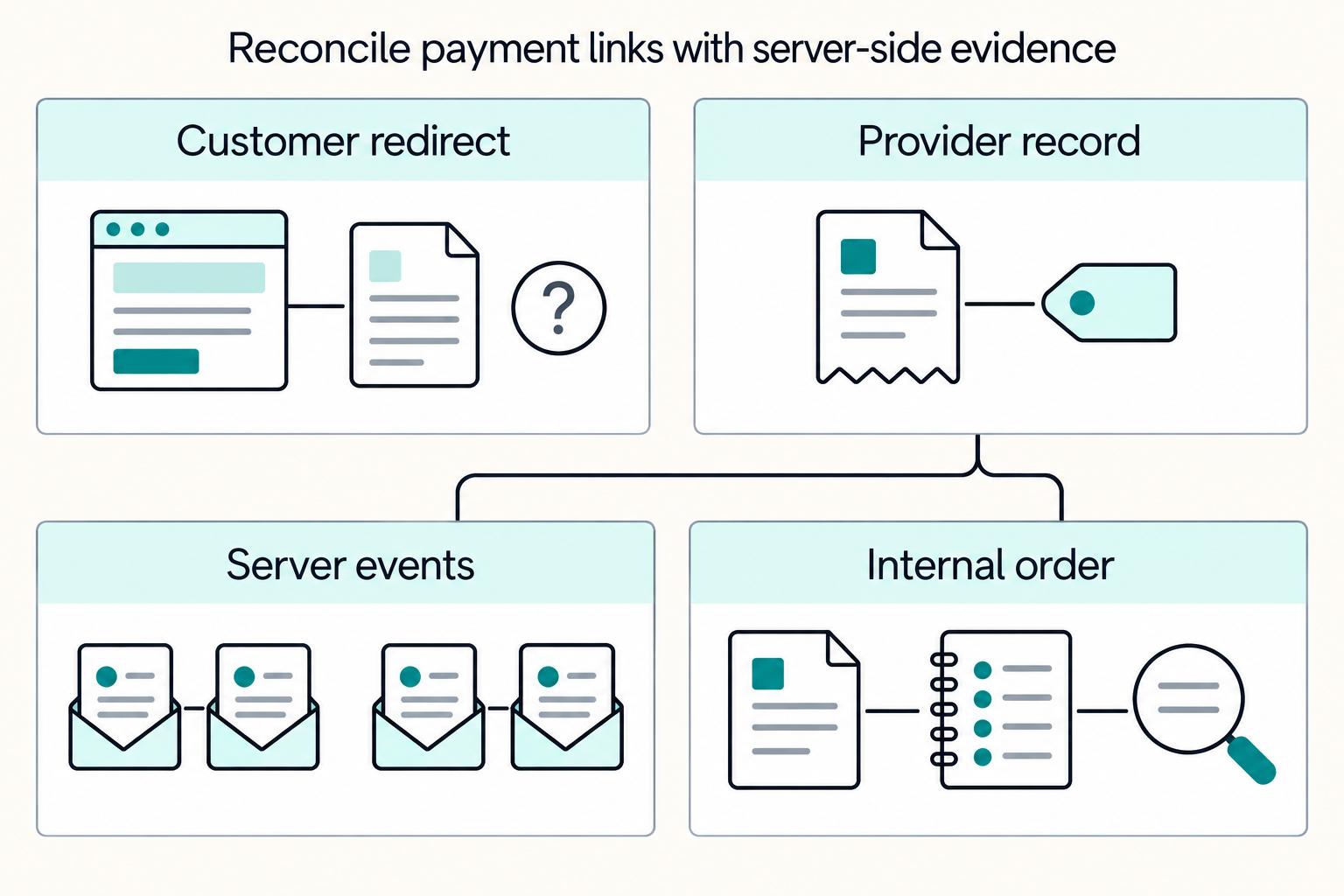
Spoofed links are a trust and fraud risk in email and SMS channels, where attackers can imitate familiar brands. Stale or over-shared links can stay usable beyond the business process they were meant to support unless lifecycle controls are applied. Duplicate attempts happen on retries or repeated submissions. Status mismatches happen when teams treat client redirects as final instead of server-side payment events.
Start with four common cases#
Determine whether a suspicious message points to a genuine provider page or an attacker’s page. Deactivate a genuine link if compromised or misused; deactivating your links cannot disable an attacker’s site. Preserve the message, destination URL, timestamps and reports, warn affected customers through a verified channel, and involve the provider and incident contacts as appropriate.
For stale or reused links, set explicit lifecycle rules and verify deactivation is easy to execute. If the business flow assumes limited use, do not leave link availability to ad hoc manual decisions.
Use stable idempotency keys for the same payment-creation retry and verify webhook signatures before processing events. Deduplicate deliveries and handle out-of-order events; retrieve the provider object when a result is uncertain. A success-page visit is not payment evidence. Stripe retries failed deliveries for up to three days in live mode; that window does not guarantee your handler receives every event. Reconcile separately.
Use one response order every time#
Use the same sequence for fraud signals, integration failures, and internal control breaks. This keeps response execution consistent and supports PCI DSS Requirement 12.10 incident-response readiness expectations.
- Detection: confirm the signal, affected links, and time window.
- Containment: pause risky link issuance, deactivate affected links, and stop fulfillment tied to uncertain status.
- Communications: alert necessary parties quickly with the verified payment path and support channel.
- Transaction reconciliation: align provider records, webhook events, internal order state, and finance records before corrective actions.
- Control updates: fix the failing rule or integration step, and assign owner plus due date.
Write the incident record in PCI terms#
Use PCI Security Standards language in the first incident note so teams align quickly. State whether payment account data impact is suspected and which PCI DSS control area is under review.
Run incident drills and test at least annually. In each drill, verify you can deactivate a live link quickly, reconcile duplicate or delayed webhooks without relying on customer redirect pages, and reach the full incident contact path end to end.
Run vendor due diligence on evidence, not claims#
Treat "secure," "PCI compliant," and "Level 1" as starting claims, not proof. The real decision point is whether the provider can show which PCI DSS controls they perform, which controls stay with you, and the evidence behind that split.
| Evidence | What to request |
|---|---|
| AOC or equivalent validation evidence | Current validation evidence for the specific service in scope |
| Shared-responsibility terms | Data boundaries and where account data may appear |
| Hosted page or iFrame requirements | Implementation requirements for hosted pages or embedded payment iFrames, including any conditions you must meet |
| Incident-notification obligations | Contract or security addendum language |
| 3D Secure documentation | When it is supported and how it is triggered |
PCI DSS Requirement 12.8 is the anchor for TPSP oversight: using a TPSP does not remove your oversight duty, and you still need to monitor TPSP compliance status at least annually. Ask for the current PCI DSS Attestation of Compliance for the specific service you will use. Then map that evidence to your control matrix using the PCI DSS v4.0.1 AOC format references (Aug. 2024). Ask each provider for a compact evidence pack covering those items.
Validate that the AOC covers the contracted service and current scope. Record features handled by another provider and map them to their own evidence and responsibilities. Authentication documentation should show supported markets, triggers and failure behavior for the integration you will deploy.
Do not treat embedded forms and email links as interchangeable. If a provider offers an embedded iframe, require written implementation instructions and confirmation of script-attack protections. If the flow is an email link to the provider site, validate that flow on its own terms instead of assuming embedded-form criteria apply.
Plan your first 30 days with explicit go and no-go checkpoints#
Treat the first month as a gated rollout, not a soft setup period. Each week should answer one decision question: is data scope clear, are controls behaving as expected, and do you have enough evidence to launch staged traffic safely?
| Week | Focus | Checkpoint |
|---|---|---|
| Week 1 | Lock architecture and ownership boundaries | Do not move to week 2 if no one can point to one current diagram showing where payment data is created, displayed, transmitted, and reconciled |
| Week 2 | Implement controls and verify behavior with real test cases | If 3D Secure or risk-based authentication behavior is unclear, hold launch scope until it is |
| Week 3 | Assemble a compact evidence pack and run one incident drill | Simulate a suspicious-link or status-mismatch scenario and confirm detection, containment, notification path, stop-authority decisions, and reconciliation checks |
| Week 4 | Launch with staged traffic and watch failure signals | Pause if no clear owner can stop risky link issuance quickly, 3D Secure or risk-based authentication behavior is still untested or unclear, or webhook failures or reconciliation mismatches remain unexplained |
Week 1. Lock architecture and ownership boundaries#
Lock architecture and ownership boundaries first. Your checkpoint is whether hosted payment links with direct provider collection keep cardholder data out of most of your application and backend surfaces, or whether your implementation pulls you into broader PCI DSS scope.
Write shared PCI responsibility down explicitly across product, engineering, finance, and ops. If no one can point to one current diagram showing where payment data is created, displayed, transmitted, and reconciled, do not move to week 2. Also confirm your actual flow type and how your acquirer/payment-brand program expects compliance validation for that flow. Embedded payment pages, redirects, and fully outsourced payment-link flows are not the same case.
Week 2. Implement controls, then verify behavior with test cases#
Implement controls, then verify behavior with real test cases. If 3D Secure is enabled, test normal and step-up paths, since triggering can depend on regulation, issuer support, and your risk rules.
For risk-based authentication, capture low-risk, high-risk, and failed-authentication examples, then confirm statuses land correctly in payment events and dashboards. If behavior is unclear, hold launch scope until it is.
Week 3. Assemble an evidence pack another operator can review#
Assemble a compact evidence pack another operator can review quickly: current provider compliance documentation for the in-scope service, architecture diagram, responsibility split, incident contacts, change log, and hosted-flow implementation notes.
Run one incident drill before launch. Response testing should happen at least annually, and contact information should be current and validated. For this rollout, simulate a suspicious-link or status-mismatch scenario and confirm detection, containment, notification path, and stop-authority decisions. Finish with reconciliation checks across sent links, provider payment records, and your internal transaction state.
Week 4. Launch with staged traffic and watch failure signals#
Launch with staged traffic, then watch failure signals closely. In webhook-based stacks, track payment success and failure events and reconcile them against dashboard transaction views.
Use a clear go or no-go review based on evidence, not momentum. Pause if any of the following are still true:
- No clear owner can stop risky link issuance quickly.
- 3D Secure or risk-based authentication behavior is still untested or unclear.
- Webhook failures or reconciliation mismatches remain unexplained.
For next steps, align your team on PCI basics, certification context, and handling patterns. Start with What is 'PCI DSS' compliance and do I need it?, Global Payment Compliance Certifications: PCI DSS SOC 2 ISO 27001 for Payment Platforms, and How to create a PCI-compliant workflow for handling credit card data. Related: How to Write a Payments and Compliance Policy for Your Gig Platform.
Account for market and program differences before scaling cross-border#
Do not treat cross-border expansion as copy and paste from your first region. Compliance obligations, authentication expectations, and feature availability can change by jurisdiction, payment method, acquirer, and provider program, even when your cardholder-data handling stays the same.
PCI DSS is still the baseline when you store, process, or transmit cardholder data, but validation obligations can depend on the compliance program governing you, including payment brands or acquirers. In practice, that means PCI standards do not replace market-by-market checks, because legal and operational rules can still differ by launch region.
Authentication is not one global switch#
Set authentication policy for the transaction and market. Strong Customer Authentication is a regulatory outcome; 3D Secure is a card-authentication mechanism that can help deliver it. Exemptions, out-of-scope transactions and issuer decisions affect the path, so distinguish them from a missing or failed control.
FCA guidance explains UK SCA under the Payment Services Regulations and technical standards, including exemptions. The rules began applying in September 2019; the extended e-commerce implementation deadline was 14 March 2022. Test authentication and exemption handling accepted by your acquirer for the specific transactions.
India’s Authentication Mechanisms Directions, 2025 separate domestic and cross-border rules. The general compliance date was 1 April 2026, subject to specified exceptions. By 1 October 2026, Indian card issuers must support validation of non-recurring cross-border card-not-present transactions when the overseas merchant or acquirer requests authentication, and risk-based handling for cross-border CNP transactions. These issuer duties do not apply the domestic framework unchanged to every overseas payment link.
Require a region launch pack#
Before opening a new country or program, require written confirmation for each region on three points:
- Supported controls: confirm whether 3DS, local payment methods, and related controls are available for the relevant country, currency, product, and API path.
- Legal and commercial terms: confirm which entity contracts with you, which rules apply, and whether any payment method includes additional restrictions you must meet.
- Operational escalation paths: confirm who handles incidents, payment disputes, and status mismatches for that market.
This checkpoint is operational, not administrative. Ask for the current country support table, program terms, and market notes showing where availability depends on country or currency. Broad reach claims can still include country-level limits.
Gate expansion when answers are fuzzy#
If any region answer is unclear, pause rollout until you have written confirmation tied to your product setup. Vague sales language is not enough.
One avoidable launch issue is discovering after go-live that a payment method was country-limited or that the assumed authentication path was not enabled on the API product actually in use. Keep customer-facing promises qualified with "where supported" and "when enabled" so you do not overcommit on compliance or security scope as coverage changes.
Use one hard rule: no new market goes live until someone can produce a region-specific note covering PCI DSS scope assumptions, authentication behavior, payment-method availability, and escalation ownership.
Make the choice that keeps ownership clear under pressure#
Choose a model whose data flow, controls and owners you can demonstrate. Hosted collection reduces direct card-data exposure, while applicable merchant or service-provider duties remain. Keep validation expectations tied to your compliance program and review product changes that affect the boundary.
Before launch, make ownership unambiguous and documented:
- where payment account data does and does not flow
- which PCI responsibilities belong to your team versus the provider
- who owns incident response decisions and escalation
- how integration changes are recorded and reviewed
- how you verify sensitive payment data is not captured in surrounding systems
Run one cross-functional working session with product, engineering, finance, and ops to align on the architecture decision and launch checklist, then treat recurring control testing as a separate ongoing requirement. Confirm your exact market and program fit in that session, since payment-method and country support can vary by implementation and account model.
Use the first rollout to produce a reusable transaction trace, responsibility matrix and incident checklist. Before adding another market or method, verify authentication behavior, supported features and escalation contacts for that flow. For Gruv product and coverage questions, contact Gruv with the proposed collection and payout path.
Frequently Asked Questions
Are payment links PCI compliant by default?
No. Hosted collection can reduce direct card-data handling, but your actual implementation must meet applicable PCI DSS requirements. Confirm validation, submission and annual attestation expectations with your acquirer or payment-brand compliance program. Provider compliance evidence does not validate your own integration automatically.
Who is responsible for PCI DSS in a hosted payment-link model?
Responsibility is shared, not transferred. The provider is responsible for the hosted service controls it runs, while you still must oversee the TPSP relationship, maintain appropriate agreements, and document which PCI DSS requirements belong to each party. You should also monitor the provider's PCI status at least annually.
Do PCI-compliant iFrames remove my platform from PCI scope?
No. In an iframe arrangement, fields and elements that collect or process card data must originate from the validated provider, and all other SAQ A criteria must be met. Unrelated merchant content outside the iframe is not automatically disqualifying. Embedded forms also have the script-attack eligibility condition. Confirm the appropriate SAQ rather than assuming every boundary error maps to SAQ A-EP.
What minimum controls should we require before launching payment links?
Require written due diligence, clear agreements, and an explicit requirement split between your team and the provider before launch. Then confirm the implementation boundary so your pages and related components are not handling payment account data when the flow is meant to be fully hosted. If ownership or boundaries are unclear, pause launch.
Should we enable 3D Secure on every payment-link flow?
Set 3DS policy by market, payment type and acquirer requirements, including applicable exemptions. Test supported paths and document unavailable or failed cases. Authentication does not itself prove authorization, capture or settlement, and 3DS does not apply to every payment method.
What remains our responsibility if the provider hosts the payment page?
Maintain applicable merchant controls and validation, provider agreements and responsibility mapping. Monitor provider PCI status at least every 12 months, keep incident contacts current and review integration changes. If your platform provides payment-related services to other merchants, assess that service-provider role separately.
How do we verify a vendor's security claims without full technical transparency?
Treat "secure by default" as a starting claim, not sufficient evidence. Ask for proof that PCI DSS coverage applies to the exact services you will use, plus clear written ownership boundaries. If they cannot map your implementation to the relevant model and responsibility split, treat that as a risk signal.
Try a related tool
Researched and edited by the Gruv editorial team. Gruv builds cross-border billing, payouts, and finance-operations software for global businesses.
Sources
- cisa.gov/news-events/news/avoiding-social-engineering...trusted
- cisa.gov/sites/default/files/2024-08/Federal_Governme...trusted
- consumer.ftc.gov/articles/how-recognize-report-spam-text-mess...trusted
- consumer.ftc.gov/articles/how-recognize-avoid-phishing-scamstrusted
- docs.stripe.com/webhookstrusted
- docs.stripe.com/security/guidetrusted
- nvlpubs.nist.gov/nistpubs/SpecialPublications/NIST.SP.800-61r...trusted
- pages.nist.gov/800-63-4trusted
Educational content only. Not legal, tax, or financial advice.
Related Posts

The Freelance Payment Penalty: A Modeled Audit of Platform Fees, FX Spreads, and Payout Delays
The money rarely disappears through a single, easy-to-spot fee. The real loss is stacked. A marketplace takes its commission, a processor adds a charge for international cards, a bank or payment company converts the currency at a spread, a platform holds the funds before release, and a wire sheds a little to intermediaries on the way in. Each layer looks defensible on its own, but the worker feels the combined result as a smaller deposit and a later payday.

How to Respond to a Subpoena for Business Records
Move fast, but do not produce records on instinct. If you need to **respond to a subpoena for business records**, your immediate job is to control deadlines, preserve records, and make any later production defensible.

A US Expat's Guide to Investing in UCITS ETFs to Avoid PFIC Issues
The real problem is a two-system conflict. U.S. tax treatment can punish the wrong fund choice, while local product-access constraints can block the funds you want to buy in the first place. For **us expat ucits etfs**, the practical question is not "Which product is best?" It is "What can I access, report, and keep doing every year without guessing?" Use this four-part filter before any trade: