
Quick Answer
Goodwill is the acquisition residual after recognized identifiable assets and assumed liabilities. Other intangibles are identifiable nonphysical resources. Their subsequent treatment depends on useful life, framework and policy; book value is not available cash.
Goodwill is the acquisition residual; other intangibles are identifiable assets#
Goodwill and intangible assets are nonphysical asset balances, but they arise differently. Goodwill is the residual recognized when a business is acquired after measuring its identifiable assets and liabilities. Other intangibles can be identified individually: a patent, licence, software asset or acquired customer relationship. Their balance-sheet amounts follow accounting recognition and measurement rules, rather than a company’s estimate of everything its reputation is worth.
For a small business owner reading an acquisition note, the first questions are how the balances arose, what accounting framework applies and how the amounts change after recognition. A large goodwill balance can explain acquisition history without telling you whether the business has cash available to pay this month’s invoices. Keep the accounting explanation separate from the later credit decision.
What makes an intangible asset identifiable?#
IAS 38’s definition focuses on a nonphysical resource that can be separated from the business or arises from contractual/legal rights. A transferable licence is an easy example. Recognizing an asset also requires the applicable benefit and reliable-measurement conditions. Being useful to the business alone is insufficient.
A company may spend heavily on reputation, staff development or advertising without creating a separately recognized asset. Internally generated goodwill and brands are not simply added to the balance sheet under IAS 38. Acquired brands or customer relationships can receive different treatment in a business combination, where the acquisition accounting identifies what the buyer obtained.
This explains why a familiar brand might have no brand-asset line in its own accounts, but an acquired brand appears in the buyer’s consolidated accounts. That difference does not by itself show that one brand is more valuable. It reflects how the asset arose and which recognition requirements apply.
Calculate goodwill from net identifiable assets#
IFRS 3 describes the acquisition method: identify and measure acquired assets and assumed liabilities, then determine the residual goodwill. For a simple purchase of 100% of a business, goodwill equals consideration transferred minus the fair value of net identifiable assets. Net means acquired assets less assumed liabilities, not the assets alone.
Suppose a buyer pays ₹100 lakh for the entire business. Its acquisition-date fair values are ₹30 lakh of tangible/other identifiable assets, ₹20 lakh of acquired customer relationships and ₹10 lakh of a brand. Total identifiable assets are ₹60 lakh. Assumed liabilities are ₹20 lakh, leaving net identifiable assets of ₹40 lakh. Goodwill is ₹100 lakh − ₹40 lakh = ₹60 lakh.
| Acquisition component | Illustrated fair value |
|---|---|
| Tangible/other identifiable assets | ₹30 lakh |
| Customer relationships | ₹20 lakh |
| Brand | ₹10 lakh |
| Total identifiable assets | ₹60 lakh |
| Less assumed liabilities | ₹20 lakh |
| Net identifiable assets | ₹40 lakh |
| Consideration transferred | ₹100 lakh |
| Residual goodwill | ₹60 lakh |
Subtracting only the ₹60 lakh assets would give ₹40 lakh goodwill and miss the assumed liabilities. Conversely, counting the brand or customer relationships again inside goodwill would double count them. The example isolates a 100% acquisition with no previous holding, non-controlling interest, contingent consideration or deferred-tax effects. Real transactions require those additional measurements and the applicable framework.
The ₹60 lakh residual can reflect expected synergies, the assembled workforce or other benefits that are not recognized as separate identifiable assets. It is not a freely saleable ₹60 lakh bank balance or a valuation of one named relationship. If net identifiable assets exceed consideration, IFRS 3 requires the bargain-purchase treatment and measurement reassessment, rather than recording a negative goodwill asset.
Why balance sheets often show goodwill separately#
Goodwill is intangible in the broad sense, yet financial statements and notes commonly distinguish it from other intangible assets because its measurement and subsequent accounting differ. Read both the face of the balance sheet and the supporting acquisition/intangible notes. A combined summary line can conceal several classes and accounting policies.
| Balance | Origin or example | Useful question |
|---|---|---|
| Goodwill | Residual from acquiring a business | Which acquisition and business units generated it? |
| Finite-lived identifiable intangible | A licence with a defined economic life | What useful life and amortisation method apply? |
| Indefinite-lived identifiable intangible | An acquired asset with no foreseeable life limit | Why is the life indefinite, and how is impairment assessed? |
Indefinite does not mean guaranteed to last forever. It means no foreseeable limit has been identified for the relevant economic benefits under the accounting assessment. If that assessment changes, the subsequent treatment changes too. A contractual expiry, replacement technology or changing customer retention may affect the useful-life judgment.
Amortisation allocates a finite-lived asset’s cost#
Under IAS 38, finite-lived intangibles are amortised and remain subject to impairment assessment. Indefinite-lived intangibles are not amortised and require annual impairment testing. Read the asset’s disclosed life and policy; the word “intangible” alone does not tell you which treatment applies.
Take the ₹20 lakh customer-relationship asset from the example. Assume it is ready for use at acquisition, has a five-year useful life, zero residual value and a straight-line pattern that appropriately reflects consumption. Annual amortisation is ₹20 lakh ÷ 5 = ₹4 lakh. After a full year, the carrying amount is ₹16 lakh before any impairment or other change.
That ₹4 lakh is an allocation of previously recognized cost, not an additional ₹4 lakh cash payment to the seller each year. A shorter life would allocate the amount faster; a different consumption pattern could require a different method. The business should support its policy with evidence rather than choose a life merely to improve reported earnings.
Goodwill treatment depends on the reporting framework and policy#
Under full IFRS, acquired goodwill follows an impairment model rather than routine amortisation. IAS 36 requires annual assessment for acquired goodwill and additional assessment when impairment indicators arise. Goodwill is assessed with the cash-generating unit or group of units to which it is allocated, because it does not independently generate cash flows.
The general US GAAP model also does not amortise goodwill and requires at least annual impairment assessment. FASB’s 2017-04 amendments describe the reporting-unit comparison: carrying amount versus fair value, with the recognized goodwill loss capped at the allocated goodwill. A US reporting unit and an IFRS cash-generating unit are framework-specific testing concepts; do not swap their labels or measurement rules.
Eligible US private companies can elect an alternative that amortises goodwill over ten years, or a shorter supported life, with impairment testing when a triggering event occurs. FASB’s 2014-02 amendments describe that election; 2019-06 extends the relevant alternative to not-for-profit entities. Private status alone does not mean the company elected it.
For the ₹60 lakh goodwill example, an eligible company electing a ten-year straight-line alternative would recognize ₹6 lakh annual amortisation, leaving ₹54 lakh after a full year before impairment. Under an impairment-only model, no such scheduled ₹6 lakh reduction occurs. Check the policy note before comparing the companies’ expenses or carrying amounts. These book policies are separate from tax deductions and from other national or SME accounting frameworks.
Impairment is a write-down, with a different question from amortisation#
Amortisation allocates cost as benefits are consumed. Impairment asks whether the carrying amount can still be supported. IAS 36 compares carrying amount with recoverable amount, using the higher of value in use and fair value less disposal costs. Annual testing requirements do not excuse ignoring adverse events between annual dates.
Suppose an IFRS cash-generating unit has a ₹150 lakh carrying amount including ₹60 lakh of goodwill. Its supported recoverable amount is ₹130 lakh. Assume other assets have first been tested as required and there are no other adjustments or allocation complications. The ₹20 lakh impairment is allocated first to goodwill, reducing that balance to ₹40 lakh. The unit then carries ₹130 lakh.
This is an illustrative unit-level calculation, not a comparison of goodwill’s own ₹60 lakh balance with the entire unit’s ₹130 lakh value. Using that incorrect comparison would miss the loss. An impairment reduces reported assets and profit, and generally equity through that profit effect, before any applicable tax effects; it does not itself require paying ₹20 lakh cash on the recognition date.
A write-down may still reveal weaker expected operations or an acquisition that did not perform as expected. Examine the reasons and assumptions, then compare them with cash-flow and financing evidence. Conversely, no impairment charge does not establish immediate liquidity or guarantee a client’s payment. Testing uses estimates and the relevant framework’s unit boundaries.
Read the note and movement schedule together#
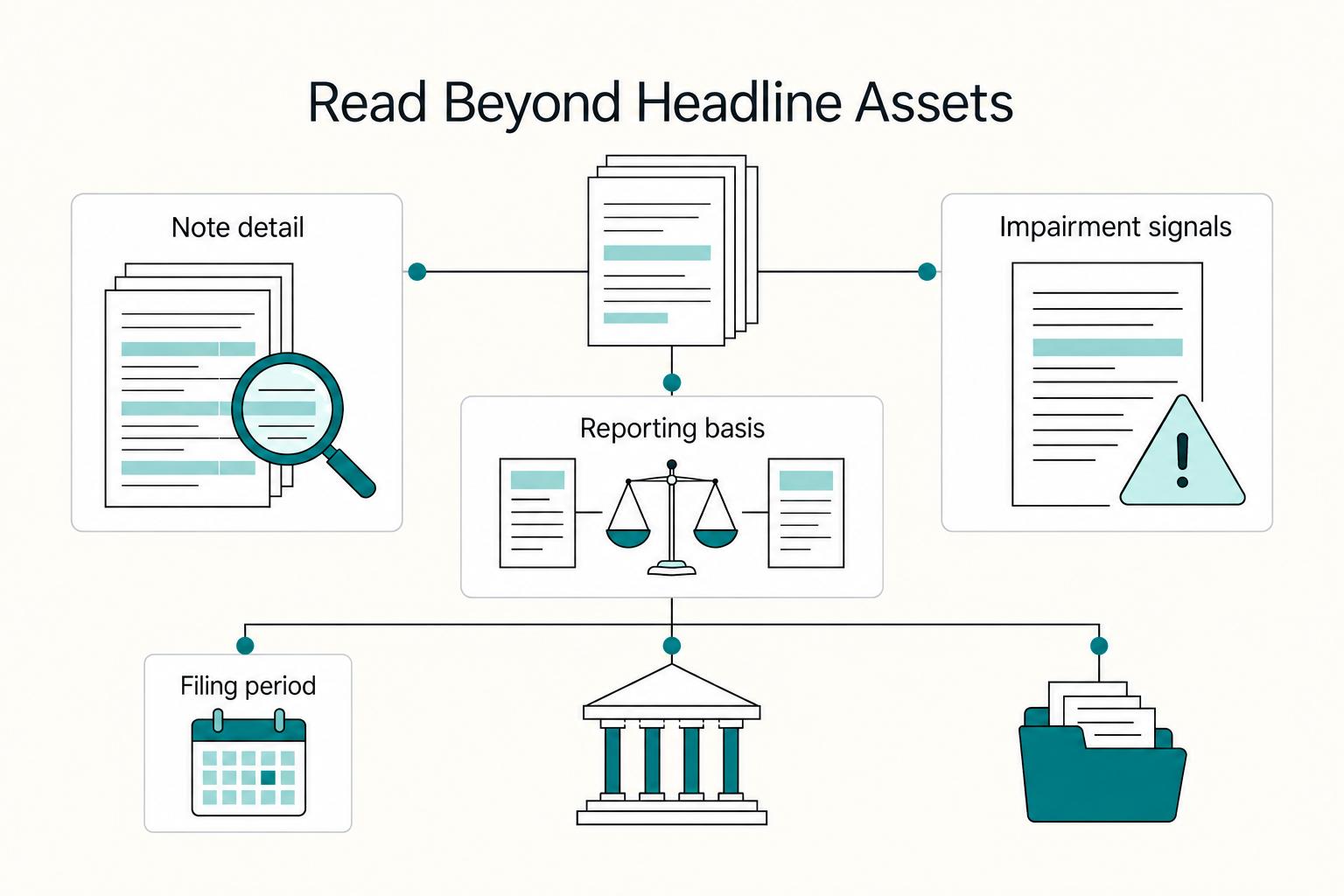
Start with the reporting basis and date. Then identify the acquisition, asset classes, gross carrying amounts, accumulated amortisation and impairment, and useful lives. Reconcile opening to closing balances through additions, amortisation, impairments, disposals and any exchange movements. A change in the total can have several causes, so avoid interpreting every reduction as deteriorating operations.
For example, opening identifiable intangibles of ₹24 lakh, new recognized additions of ₹3 lakh, amortisation of ₹4 lakh and impairment of ₹2 lakh produce a closing ₹21 lakh balance, assuming no disposals or currency movement. The arithmetic is ₹24 + ₹3 − ₹4 − ₹2 = ₹21 lakh. Look for that bridge rather than guessing from the closing line alone.
For goodwill, read its allocation, testing policy, reported charges and sensitivity disclosures. Changed forecasts, discount assumptions or small headroom merit investigation. An accounting proposal or exposure draft is not automatically the entity’s current policy. Confirm the adopted framework and relevant effective dates before interpreting a new rule as already applied.
Use cash evidence for a client-credit decision#
For a freelancer extending credit, goodwill is background acquisition evidence rather than a payment score. Review available cash, operating cash flows, near-term liabilities, financing availability and your own invoice history. Keep the contracting entity distinct from a parent’s consolidated group; the group’s assets do not automatically fund your customer’s invoice.
Suppose two prospective clients each report ₹60 lakh goodwill. One has enough accessible cash for current commitments and has consistently paid your invoices. The other has missed payments and has debt falling due without confirmed funding. Those concrete differences justify different unpaid-work limits. The matching goodwill number alone does not explain the payment decision.
If financial information is unavailable, record that limitation and use commercially appropriate deposits, smaller milestones and a cap on unpaid work. If the client’s cash position or payment behaviour weakens, revisit terms before expanding delivery. Do not treat a clearly named brand asset as proof of liquidity, or tighten terms mechanically after every noncash charge.
Frequently Asked Questions
What are goodwill and intangible assets on a balance sheet?
Goodwill is the residual recognized in acquiring a business after measuring identifiable assets and liabilities. Other intangibles are separately identifiable nonphysical assets, such as acquired licences, brands or customer relationships, recognized under the applicable framework.
How is goodwill calculated in a simple 100% acquisition?
Subtract fair-value net identifiable assets from consideration transferred. If consideration is ₹100 lakh, identifiable assets ₹60 lakh and assumed liabilities ₹20 lakh, net identifiable assets are ₹40 lakh and goodwill is ₹60 lakh.
Are all intangible assets amortised?
No. Under IAS 38, finite-lived intangibles are amortised; indefinite-lived intangibles are not amortised and are tested annually for impairment. Goodwill follows its own framework and policy, including an eligible elected US GAAP alternative.
Can an eligible US private company amortise goodwill?
Yes, if it elects the applicable accounting alternative: straight-line over ten years or a shorter supported life, with impairment testing on triggering events. Do not assume every private company has made that election.
Is impairment a cash payment when it is recognized?
The write-down itself is not a payment on the recognition date. It reduces the asset’s carrying amount and reported results, but its underlying causes can also affect future operations and cash flows.
Does high goodwill show a client cannot pay invoices?
No. Goodwill alone is not a payment predictor. Assess accessible cash, operating cash flows, near-term obligations, funding and actual payment history for the contracting entity.
Researched and edited by the Gruv editorial team. Gruv builds cross-border billing, payouts, and finance-operations software for global businesses.
Sources
Includes 4 external sources outside the trusted-domain allowlist.
Educational content only. Not legal, tax, or financial advice.
Related Posts

The Freelance Payment Penalty: A Modeled Audit of Platform Fees, FX Spreads, and Payout Delays
The money rarely disappears through a single, easy-to-spot fee. The real loss is stacked. A marketplace takes its commission, a processor adds a charge for international cards, a bank or payment company converts the currency at a spread, a platform holds the funds before release, and a wire sheds a little to intermediaries on the way in. Each layer looks defensible on its own, but the worker feels the combined result as a smaller deposit and a later payday.

How to Respond to a Subpoena for Business Records
Move fast, but do not produce records on instinct. If you need to **respond to a subpoena for business records**, your immediate job is to control deadlines, preserve records, and make any later production defensible.
A US Expat's Guide to Investing in UCITS ETFs to Avoid PFIC Issues
The real problem is a two-system conflict. U.S. tax treatment can punish the wrong fund choice, while local product-access constraints can block the funds you want to buy in the first place. For **us expat ucits etfs**, the practical question is not "Which product is best?" It is "What can I access, report, and keep doing every year without guessing?" Use this four-part filter before any trade: