
Quick Answer
Use a control-first ranking: prioritize payment fraud patterns scams freelancers and platforms face by irreversible-loss risk, not headline prevalence. Put pressured overpayment, fake cheque timing traps, beneficiary-change events, and coercive payment threats into strict decision lanes. Apply immediate holds when reversal exposure is still live, move conflicting entitlement evidence to manual review, and escalate threat-led or deception-led cases quickly. Anchor release decisions to provider references, ledger consistency, and documented ownership.
Why Payout Fraud Keeps Hitting Freelancer and Platform Operations#
This is a decision list, not a generic warning-signs article. It helps you decide which pattern in your payout queue needs a payout hold, which belongs in manual review, and which should move straight to fraud escalation because the loss or legal exposure is already too high.
"payment fraud" follows a regulator-backed definition: illegal means used to make or receive payments for personal gain, including scams. In freelancer and platform payouts, that can include scams such as overpayment loops or deceptive transfer requests.
What this top 10 list is actually for#
This list is for compliance, legal, finance, and risk owners running payouts in the gig economy. If you own release decisions, audit trails, or post-incident reporting, you need more than "watch for red flags." You need a repeatable way to map a pattern to an action, assign an owner, and preserve the evidence showing why funds in your workflow were released, delayed, or denied.
Each item is framed around an operational first response:
- Use a payout hold when reversibility risk is still open or payment provenance is unclear.
- Use manual review when key evidence is missing or contradictory but the case may still resolve cleanly.
- Use fraud escalation when suspected deception or compromise creates immediate legal or reputational risk.
Settlement confidence is a practical checkpoint. An instant payment means funds are received immediately, with near real-time interbank settlement. The EBA has reported higher fraud rates for instant payments than traditional credit transfers. Faster payout can still be useful, but speed without controls raises risk.
Where the control line should sit#
The focus here is platform operations, not basic consumer scam prevention. The question is simple for your team: what is the defensible action now, who signs off, and what evidence must sit in the case file before you let money move?
A payout hold is a control tool, not automatically a service failure. In the UK, FCA guidance allows payment service providers to delay payments by up to 4 business days to investigate suspected fraud. That is not a global threshold, but it is a clear example that temporary delay can be a legitimate fraud control.
Evidence limits up front#
Public data supports a strong risk posture, but not a precise freelancer-by-region prevalence ranking. The EBA and ECB reported €4.3bn in 2022 and €2.0bn in the first half of 2023 in EEA payment fraud. Those releases are largely aggregate by payment instrument, value, and volume. Federal Reserve fraud measurement is also aggregate-level.
So this top-10 ranking is based on operational defensibility, reversibility risk, and likely case burden, not a claimed public prevalence table for every US, UK, or cross-border freelancer corridor.
Related reading: How Platforms Detect Free-Trial Abuse and Card Testing in Subscription Fraud.
Who This Top-10 List Is For and How to Size Controls#
With that scope set, size controls to the business you actually run and the corridors you actually support.
- Platform teams with release authority
If your team manages freelancer or contractor payouts across the United States and United Kingdom, and can hold, review, or release funds, this section is for you. UK FCA guidance here is firm-focused and includes payment and e-money institutions within scope, and the US framework imposes program, recordkeeping, and reporting obligations on financial institutions. Practical fit check: for a disputed payout, can you produce the transaction ID, beneficiary details, reviewer name, decision timestamp, and reason code?
- Not a solo-freelancer scam guide
This is not a personal scam-avoidance checklist. It assumes case governance, evidence retention, and escalation ownership because you may need to justify why funds were released, delayed, or denied. In the UK, specified AML records under Regulation 40 have a baseline retention period of 5 years (subject to regulatory exceptions).
- Size controls by business profile and geography
Control depth should match your business's nature, scale, complexity, and geographic spread. A domestic, low-volume flow does not need the same control stack as a cross-border marketplace. The real test is whether you can detect the pattern before settlement and preserve consistent payment information across your flow, which is where cross-border payment-transparency expectations can matter.
- Use four criteria and assign named escalation ownership
Size each pattern with four criteria: financial impact, reversibility, detectability before settlement, and legal/reporting burden. If a pattern can cause hard-to-reverse loss, especially on wire-like rails, or create regulator-facing questions, require pre-payout controls and a named escalation owner before you move funds. Keep accountability explicit: FCA guidance expects senior management responsibility for financial-crime risk. In the United States, suspicious-transaction reporting rules for money services businesses can apply at $2,000 and above when the rule applies to the entity; in UK regulated sectors, SAR duties can arise when suspicious activity is identified.
Related reading: Velocity Checking for Fraud Prevention: How to Detect Suspicious Payment Patterns.
Comparison Table of the 10 Scam Patterns and First Response#
Default to payout hold when funds, funding source, or beneficiary details in your flow may be unauthorized. Use manual review when the payment path looks stable, but entitlement, delivery, or identity evidence is still unclear.
This comparison is conservative. Public reporting is large but not freelancer-only (859,532 complaints and losses exceeding $16 billion in 2024). So the first response is driven by reversibility and evidence quality, not assumed prevalence.
| Scam pattern | Typical entry point | Earliest signal | Immediate action | Escalation owner | Best for | Key pros/cons of control response |
|---|---|---|---|---|---|---|
| Fake check scam | New counterparty sends a check, then asks for early release or money back | Urgent push to release funds before true clearing | payout hold | Payments Risk Lead | High-risk first payouts funded by check | Pro: blocks avoidable loss before return. Con: adds friction for check exceptions |
| Overpayment scam | Counterparty sends more than owed and asks for the excess back | Amount exceeds agreed value plus fast refund pressure | payout hold | Finance Ops Lead | Invoice mismatch and refund-pressure cases | Pro: prevents sending good funds against bad funds. Con: increases support and reconciliation workload |
| Cyber-enabled fraud representation | Internet-based outreach uses false payment or identity representations | Off-process payment request that cannot be verified through trusted channels | fraud escalation | Trust & Safety Lead | High-urgency payment requests with weak verification evidence | Pro: preserves evidence and decision control. Con: can slow legitimate urgent cases |
| Non-payment scam | Goods/services are delivered but payment never arrives | Delivery evidence exists but settlement proof is missing | manual review | Disputes Lead | Post-service disputes and release gating | Pro: reduces wrongful release. Con: can delay payout where proof is incomplete |
| Unauthorized transaction pattern | Funding instrument or transaction appears valid but may be unauthorized | Unknown or unrecognized transaction behavior | payout hold | Payments Operations Lead | Suspicious first-time funding sources | Pro: limits fraud loss exposure. Con: may increase false positives on new users |
| Business Email Compromise (BEC) | Compromised or impersonated email requests fund transfer or account change | Last-minute change request via email only | payout hold | Security Incident Lead | Change-of-bank-detail requests | Pro: enforces out-of-band verification before loss. Con: slows legitimate account updates |
| Authorised push payment (APP) fraud | Victim is tricked into authorizing a bank payment | User confirms payment under social-engineering pressure | manual review | Fraud Operations Manager | Social-engineering transfer cases | Pro: creates a stop point before release. Con: not every case is clearly fraudulent at first contact |
| Invoice/mandate fraud | Impersonation with substituted bank details on an invoice/payment mandate | "Updated bank details" message without trusted confirmation | payout hold | Accounts Payable Control Owner | Supplier payment-detail changes | Pro: strong control for diversion risk. Con: adds verification overhead with vendors |
| Account takeover (ATO) payout redirection | Attacker gains account access and changes payout destination | Login/profile or payout-change behavior inconsistent with normal use | payout hold | Identity & Access Lead | Payout destination changes after account compromise | Pro: directly blocks redirected payouts. Con: can interrupt legitimate urgent payout changes |
| Cross-border fraud variant | Counterparty, instrument, or destination is outside your main operating market | Cross-border exposure; in EEA reporting, card-fraud rates were higher when counterparties were outside the EEA | manual review | Cross-Border Risk Owner | Cross-border first payouts and unfamiliar counterparties | Pro: applies added scrutiny where risk can be higher. Con: creates extra review time for legitimate international payments |
The detailed sections below group several of these patterns where the operator response is similar.
Fake Cheque Scam and Overpayment Scam#
For both patterns, treat visible funds as potentially reversible until settlement is confirmed as irreversible. If a new counterparty pushes for urgent release or refund before that point, freeze your outbound movement and handle it as fraud containment, not routine support.
1. Fake cheque scam#
A fake cheque scam is a pre-clearance trap: an unknown party sends a cheque, then asks for money back or pushes you to release value early. If someone you do not know sends a check and asks for money back, treat that behavior as a scam signal.
The operational risk is timing. Funds can appear within a day or two even when the cheque is not valid, and detection can take weeks. If you send money out before final settlement, that money can be gone while your account is still debited for the bad deposit.
For first-time counterparties requesting urgent release, place a hold until settlement finality is confirmed. Your checkpoint is settlement finality, not balance visibility, so confirm with your provider or bank whether reversal risk is still open. Suspicious activity reports tied to check fraud nearly doubled from 2021 to 2023, so this is an active pattern.
2. Overpayment scam#
An overpayment scam usually starts with payment above the agreed amount, followed by an "accidental overpay" explanation and pressure to refund quickly. Your first control here is reconciliation, not speed.
Before you send any outbound refund, tie the invoice, agreed amount, inbound payment reference, and requested refund path to the same case record in your system. This helps catch refund-pressure loops, especially when the payer asks you to return funds urgently or through a different path.
Use a reconciliation-first response until the original payment is cleared and irreversible. For marketplaces, keep refunds inside approved platform channels in line with platform policy.
Operator sequence#
Use the same sequence for both patterns:
| Step | Action | Key detail |
|---|---|---|
| 1. Verify settlement finality | Do not rely on "available" funds alone | Confirm whether the inbound payment is cleared and irreversible |
| 2. Freeze outbound movement | Stop payout release, refund execution, and linked beneficiary changes | Until review is complete |
| 3. Document counterpart messages | Preserve overpayment claims, urgency language, invoice mismatches, cheque images or deposit records | Any request to move funds through a different rail |
| 4. Route to manual review | Require a human decision | Tied to documented evidence before any payout or refund |
If funds are not irreversibly settled, avoid net-refunding from unrelated balances as a normal workflow. Treat the case as payment-fraud containment until original payment status is confirmed.
Related reading: A Guide to Form 1099-K for Freelancers Using Payment Apps.
Payment Extortion and Payout Dispute Manipulation#
When coercion or contradictory delivery claims appear, move the case out of routine support quickly. Threats, intimidation, or reputational pressure belong in fraud escalation, while disputed completion claims should keep payout blocked until the evidence is reviewed.
3. Payment extortion#
Use this lane when the demand is communications-led, such as "pay or be exposed," "refund now or we post this," or any payment request outside normal invoice or milestone flow. In payments terms, this is manipulation for financial gain, so the message thread is part of the fraud event.
Start with strict triage: move ownership out of routine support, stop ad hoc negotiation, and preserve the original channel. Public UK guidance for threatening-message scams is consistent on the immediate response: do not engage, stop communication, and do not assume payment will stop threats. That guidance is not a universal legal rule for every business dispute, but it is a strong operating rule when the demand is clearly coercive and detached from legitimate billing.
Tighter controls can improve legal and audit defensibility, but case closure may slow while risk, legal, and sometimes communications review the record. Use a simple checkpoint: can you tie the request to a real commercial obligation? If there is no valid invoice, no agreed milestone, or the payment destination changes during the threat, treat it as a red flag.
If money has already moved, the FBI advises immediately notifying all financial institutions involved in the relevant transactions. In the FBI's 2024 reporting, extortion was among the top three cybercrime complaint categories, within 859,532 suspected internet-crime complaints.
4. Payout dispute manipulation#
Use this lane when abuse appears after claimed completion: one side requests payout, the other reverses prior acceptance, or the same party gives incompatible completion stories across channels. The core risk is releasing funds on a record you cannot defend later.
Apply evidence-gated release. Do not release payout because one side in your queue is louder, more urgent, or presents selective screenshots. This prevents decisions based on narrative alone, though it can increase dispute-operations load.
For Visa fraud disputes, Visa CE3.0 sets specific evidence conditions for eligible cases. That includes at least two prior non-disputed transactions on the same payment method, plus at least two matching core data elements, for example User ID, IP address, shipping address, or device ID/fingerprint. Before hard-coding timing rules, verify current network specs. Documentation differs on the lookback window (120 to 365 days in Visa merchant-readiness material vs. 120 to 364 days in Stripe implementation documentation).
If you cannot reconcile timestamps, delivery artifacts, and transaction history, keep payout blocked pending review. For both patterns, keep the same minimum file for post-incident reporting:
- identity snapshot: names, usernames, email addresses, phone numbers, user IDs, and available bank or payment identifiers
- timeline: threat messages, payout requests, delivery claims, and internal decisions in sequence
- contract or invoice artifacts, plus milestone or delivery records where they exist
- complete payment-channel and chat messages, preserved in full rather than summarized
Do not delete messages, images, or payment details. If the case has a U.S. nexus and you are unsure whether it qualifies for external reporting, IC3 says to file even when uncertain.
Related reading: How to Pay US-Based Freelancers from the UK.
Non-Payment Fraud and Service-Delivery Denial Tactics#
For both non-payment fraud and service-denial disputes, base payout decisions on a verifiable audit trail, not chat assurances. The key question is whether work reached a formal, timestamped acceptance point through milestones, submissions, and invoice records.
| Flow | Formal signal | Operator note |
|---|---|---|
| Upwork fixed-price contracts | Review window starts only after formal milestone submission | If files were shared by email or chat but the freelancer did not click Submit, the 14-day review period does not start |
| Freelancer.com | Milestone funds are held until release | Release is treated as acknowledgment that the work was completed satisfactorily |
| Off-platform invoice flows | Keep invoice, delivery, and acceptance evidence in one case file | Need stricter documentation; if card funding is involved, account for chargebacks, including Visa dispute condition 13.1 |
5. Non-payment fraud#
Use this lane when work appears delivered but final settlement is delayed or avoided. In milestone-based marketplaces, rely on formal platform checkpoints rather than side-channel confirmation.
Upwork fixed-price contracts use pre-deposited project funds, and the review window starts only after formal milestone submission. If files were shared by email or chat but the freelancer did not click Submit, the 14-day review period does not start. On Freelancer.com, milestone funds are held until release, and release is treated as acknowledgment that the work was completed satisfactorily.
6. Service-denial variant#
Use this lane when a counterparty claims work was not delivered after earlier acceptance signals. Not every non-delivery claim is fraud, but it is a payout-risk event when the record conflicts.
Treat formal, timestamped acceptance as the decision point. On Upwork, confirm milestone submission and review status. On Freelancer.com, a released Milestone Payment is a strong acceptance signal. If records are incomplete, slow the case down and preserve the full file: invoices, receipts, project history, delivery artifacts, and complete message logs.
Off-platform invoice flows need stricter documentation because moving payments off-platform can remove key platform protections. Keep invoice, delivery, and acceptance evidence in one case file, and if card funding is involved, account for formal reversal routes such as chargebacks, including Visa dispute condition 13.1 (merchandise/services not received). Related reading: AI Fraud Detection for Subscription Platforms Beyond Rules-Based Approaches.
Fraudulent Payment Method Abuse Across Rails#
Once delivery evidence is clean, the next question is whether the inbound funds are dependable enough to support payout. For item 7 and item 8, use one rule in your workflow: if the inbound rail still has a documented live reversal or recall path, route to payout hold. If not, move to evidence-based release review.
Rail choice changes the risk. In EU and EEA reporting, most fraud by value arose from credit transfers and card payments. That is not freelancer-specific prevalence, but it supports rail-specific payout controls instead of a single generic "paid" state.
7. Fraudulent payment method abuse#
Use this lane when the funding instrument may be stolen, unauthorized, or otherwise invalid for the party presenting it. The payer can appear to have paid even though the underlying card or account authority is the real failure point.
Cards make this explicit. Visa describes disputes as issuer-side reversals of transaction value, and US billing-error rules describe unauthorized use as credit not made to the consumer or an authorized user. So a successful card payment event is not final comfort for payout. Fast payout against recent card-funded inflows can still be unwound later.
The key difference from non-payment or service-denial cases is where the dispute starts. There, the dispute is about delivery. Here, the problem starts with the money itself. One failure mode is treating provider "captured" or "paid" status as enough when your ledger cannot tie that event to one settled transaction reference.
8. Reversal-loop abuse#
Use this lane when inbound funds appear valid long enough to trigger payout, then reverse after funds have already left your platform. The loss is timing-driven: payout relied on value that was still reversible.
This can happen across rails, but timing differs. For ACH, reversing entries for an erroneous entry are time-bounded to within 5 banking days following the Settlement Date. Some consumer-side claim paths are longer, including R11 with a 60-day return timeframe after a consumer claim. For non-consumer suspected-fraud returns, cited Nacha risk guidance points to a shorter limit: no later than the opening of business on the second banking day after settlement.
For a SEPA transfer, do not treat bank funding as automatically final. The SEPA Credit Transfer rulebook includes a formal recall route with initiation within 10 Banking Business Days or 13 months, depending on reason. The tradeoff is simple: faster release improves freelancer experience, but some rails keep meaningful reversal or recall exposure open beyond first receipt.
Rail behavior in practice#
| Funding rail | Documented reversal or recall behavior | Higher-confidence checkpoint before release | Practical hold stance |
|---|---|---|---|
| Card-funded | Issuer-side disputes can reverse transaction value; FTC guidance notes credit-card billing errors must be disputed in writing within 60 days in the cited consumer context | Provider reference shows a settled card transaction, not just authorization; no mismatch between provider event and internal balance | Most conservative on fresh inflows, especially first payout or large payout |
| ACH or bank-funded in US | Erroneous-entry reversals within 5 banking days; some suspected-fraud return handling by second banking day; some consumer claim paths longer | Match settlement date, return-code state, account type, and any reversal messages before funds are spendable | Hold while the short return window is open, and extend review if claim facts are unclear |
| SEPA credit transfer | Formal recall path within 10 Banking Business Days or 13 months, depending on reason | Booked transfer plus clean originator reference; where available, retain beneficiary IBAN-name match result | Do not treat as categorically irreversible; apply tighter review on unusual first or high-value payouts |
Checkpoints before payout batching#
Before you run any payout batch, verify three controls in your case file:
- Provider reference match. Internal credit must map one-to-one to provider transaction reference, amount, currency, and settlement date. For an EU or EEA SEPA transfer, keep the beneficiary name and IBAN verification result where exposed, because EU rules include beneficiary IBAN-name verification requirements.
- Ledger-event consistency. Ledger status must match provider event history. If provider events show return, dispute, recall, or reversal activity, available balance should not still be payout-ready.
- Duplicate-attempt detection. Repeated entries with the same amount, reference, or timing should pause release until review. Duplicate entries are a named exception type to investigate and reverse, and they can create a false extra balance.
If any check fails, keep funds on payout hold and move to manual review. If the primary tracked reversal window is closed, references are clean, and ledger events are consistent, allow controlled release with monitoring. Preserve the evidence pack either way so your reviewer can trace the decision: provider transaction IDs, settlement timestamps, dispute or recall notices, IBAN-name check results where relevant, and notes showing how duplicates were ruled out. If you cannot trace that chain in one view, keep the batch paused.
For a step-by-step walkthrough, see Device Fingerprinting Fraud Detection Platforms for Payment Risk Teams.
Onboarding Evasion and Account Takeover Before Payout#
Even after onboarding checks pass, do not treat approval as permanent trust. Re-check at payout when beneficiary details change or transaction behavior no longer matches the approved profile.
9. Onboarding evasion#
Use this lane when an identity passed initial checks but later fails consistency checks tied to payout behavior. The core signal is not one bad document. It is a growing mismatch between the approved identity story and current account activity.
Anchor decisions in ongoing customer due diligence, not onboarding alone. Under 31 CFR 1020.210, controls include building a customer risk profile and ongoing monitoring to identify suspicious transactions and keep customer information current on a risk basis. A clean onboarding result does not close the case if later activity no longer fits the relationship.
Synthetic identity risk reinforces this approach. The Federal Reserve notes synthetic identities can combine real and fictional data and evade standard identity verification and credit screening. You do not need to prove a synthetic identity before acting: if name, business purpose, geography, payout behavior, and profile edits no longer form one coherent story, consider a temporary payout hold and manual review.
10. Account takeover payout redirection#
Use this lane when beneficiary details change suddenly just before payout execution. The risk pattern is timing: a legitimate account at onboarding can still be exposed to unauthorized access or social engineering later.
The FBI describes account takeover as unauthorized access to online financial-related accounts. Since January 2025, IC3 reports more than 5,100 ATO complaints and over $262 million in losses. That is broad complaint data, not freelancer-platform prevalence, but it supports treating payout-destination changes as high-risk events.
Control priority is out-of-band verification. IC3 BEC guidance says to verify account-information changes through a secondary channel or two-factor authentication with the intended recipient. UK cyber guidance also flags requests to pay into a different bank account as a known fraud pattern. Federal Reserve SR 21-14 (August 11, 2021) supports stronger authentication for high-risk transactions, including MFA or equivalent controls.
Order of operations#
Use the same order each time:
- Challenge the change request through a secondary channel, step-up authentication, or both.
- Consider a temporary payout hold before outbound execution until verification is complete.
- Run manual review against the approved profile, original and requested beneficiary details, account-change history, and payout timing.
- Release if verification is clean, or escalate if facts point to takeover or redirection.
If funds already moved, contact the originating financial institution as soon as fraud is recognized to request recall or reversal. Keep a tight evidence pack: approved-profile snapshot, original and requested beneficiary details, challenge outcome, communication history, payout execution status, and decision notes for release, hold, or escalation.
Related reading: Radical Candor for Freelancers: Scope, Feedback, and Payment Conversations.
Cross-Border Blind Spots That Increase Fraud Exposure#
Cross-border fraud exposure can rise when one payout pattern runs through different control regimes in the United States, the United Kingdom, and EU euro credit transfer corridors. If you push payout speed before you normalize those differences, you create gaps in both your decisioning and your audit trail.
| Corridor | What differs | Operational impact |
|---|---|---|
| United States | GAO says financial institutions are generally not required under federal law to reimburse losses from a fraudulently induced payment. | Do not rely on post-loss reimbursement for authorized scam payments; pre-payout controls carry more weight. |
| United Kingdom | APP reimbursement protections apply from 7 October 2024 and apply to UK bank transfers between UK bank accounts. | Case handling and reimbursement exposure are corridor-specific and do not automatically carry to other markets. |
| EU euro credit transfer corridor | The EU Instant Payments Regulation (adopted 13 March 2024) requires Verification of Payee for euro-area member states by 9 October 2025, with outcomes such as match, close match, no match, and other. | Treat this as a structured pre-payment risk signal for release and evidence capture, not a simple pass/fail check. |
The main blind spot is status mapping. BIS notes there is no single complete international standard for cross-border payment service provision, and jurisdictions apply different regulatory and supervisory approaches. In practice, operators can face different labels, review states, and evidence expectations across corridors. If you collapse outcomes like match and close match, or map a UK APP scenario and a US authorized scam payment into one internal state such as "verified," you hide real risk.
As Jennifer Pitt (Senior Fraud Analyst, Javelin Strategy & Research) notes, fraud teams face "gaps in cross-border visibility." That visibility gap can become an audit problem if your records do not preserve the raw provider result, corridor, timestamp, beneficiary data used, manual overrides, and release approver. For firms in scope, FCA SYSC 28.4's record-keeping expectation is a practical baseline for evidence discipline.
Standardize before you speed up#
Before tightening payout SLAs, standardize across markets:
- one shared internal risk-state model
- one minimum evidence pack for payout review
- one rule to preserve original provider statuses instead of overwriting them with generic "pass"
If your mapping cannot reliably separate close match, no match, manual override, and release outcome by corridor, do not optimize for faster payouts yet.
Decision Rules for Payout Hold, Manual Review, and Fraud Escalation#
Use three separate actions, not one generic "risk queue": payout hold, manual review, and fraud escalation. Each action needs a named owner, defined evidence, and a clear close condition so your team neither releases preventable fraud nor traps legitimate freelancers in indefinite review. We recommend giving your reviewers one explicit close condition for each lane.
| Action | Trigger condition | Required evidence | Owner | SLA target | Release / deny criteria |
|---|---|---|---|---|---|
| Payout hold | Suspicious activity is identified before outbound release under predefined risk criteria | Provider result + timestamp, payout/transaction IDs, relevant account identifiers, ledger event history, supporting communications, hold reason code | Payments ops or risk ops | Immediate hold; review starts promptly under an internal SLA | Release only when checks reconcile and no adverse evidence remains. Deny / cancel / reverse when critical verification fails or linked activity remains suspicious. |
| Manual review | Predefined criteria are met but evidence is not yet sufficient for outright denial | Full case file: verification status, timeline, provider references, communication artifacts, reviewer notes | Risk analyst or fraud review team | Queue promptly; explicit decision once evidence is complete (per internal SLA) | End with documented accept or reject. If key evidence is missing or threat signals rise, move to hold or escalation rather than leaving the case open. |
| Fraud escalation | Threat plus payment demand, extortion, suspected criminal coordination, or suspicious activity that may require formal reporting | Preserved threat messages, account identifiers, transaction references, timeline, prior decisions, loss estimate, affected jurisdictions, law-enforcement or compliance contact notes | Fraud lead with legal and compliance | Immediate triage for threat cases; reporting clock starts when facts may require reporting | Release only if escalation concludes there is no continuing threat or blocking suspicious activity. Deny / report when threat, identity deception, or suspicious activity is substantiated; complete post-incident reporting and recovery tracking. |
If X, do Y#
- If coercive threat + payment demand appears, escalate immediately. Preserve the message chain, pause outbound movement, and route outside normal support handling.
- If suspicious activity appears before outbound release, place a payout hold first. Verify critical transaction and verification evidence before release.
- If predefined manual-review criteria are met but evidence is incomplete, route to manual review. Do not auto-release or auto-deny without a documented decision.
- If provider or verification status is ambiguous or needs manual override, do not treat it as verified. Review underlying case evidence before release.
If you use vendor scoring, treat it as a trigger, not a final decision. Stripe Radar defaults (65+ elevated, 75+ high) and rule logic like "Review if elevated" or "Block if highest" are useful entry points, not closure criteria.
Guardrails against false positives#
A defensible risk-based approach means proportionate control, not blanket exclusion and not a zero-failure assumption. Every hold in your queue should carry a named owner, reason code, exact evidence request, and next checkpoint so cases keep moving.
Evidence quality is the second guardrail. Do not deny on vague "felt risky" judgments alone. Denials should rest on preserved artifacts such as provider status, ledger consistency, verification outcomes, or threat evidence. If those do not mature, release with monitoring rather than extending review by habit.
What must be true at closure#
Release only when the case is internally consistent. Provider references should align with recorded transaction events, relevant verification checks should be resolved, and the reviewer should record why the original trigger no longer blocks payout in your workflow.
Reverse, cancel, or deny when the inverse is true: critical verification fails, extortion or identity deception is substantiated, or linked suspicious activity remains unresolved. Record whether funds were reversed, canceled, or never released.
Post-incident closure includes remediation, recovery tracking, and an explicit reporting owner. Where SAR rules apply to your entity type, US bank rules require filing within 30 calendar days from initial detection of facts that may require a SAR. They allow one additional 30-day delay only if no suspect is identified, and cap delay at 60 days total. Urgent cases can require immediate telephone notification to law enforcement. For UK operations, a SAR is not a crime report and does not replace making one.
Related: A Guide to SEPA Transfers for European Freelancers.
Use this table as your implementation checklist, then map each trigger to payout states and evidence fields in your operations flow with Gruv Payouts.
Reporting Pack and Audit-Ready Documentation#
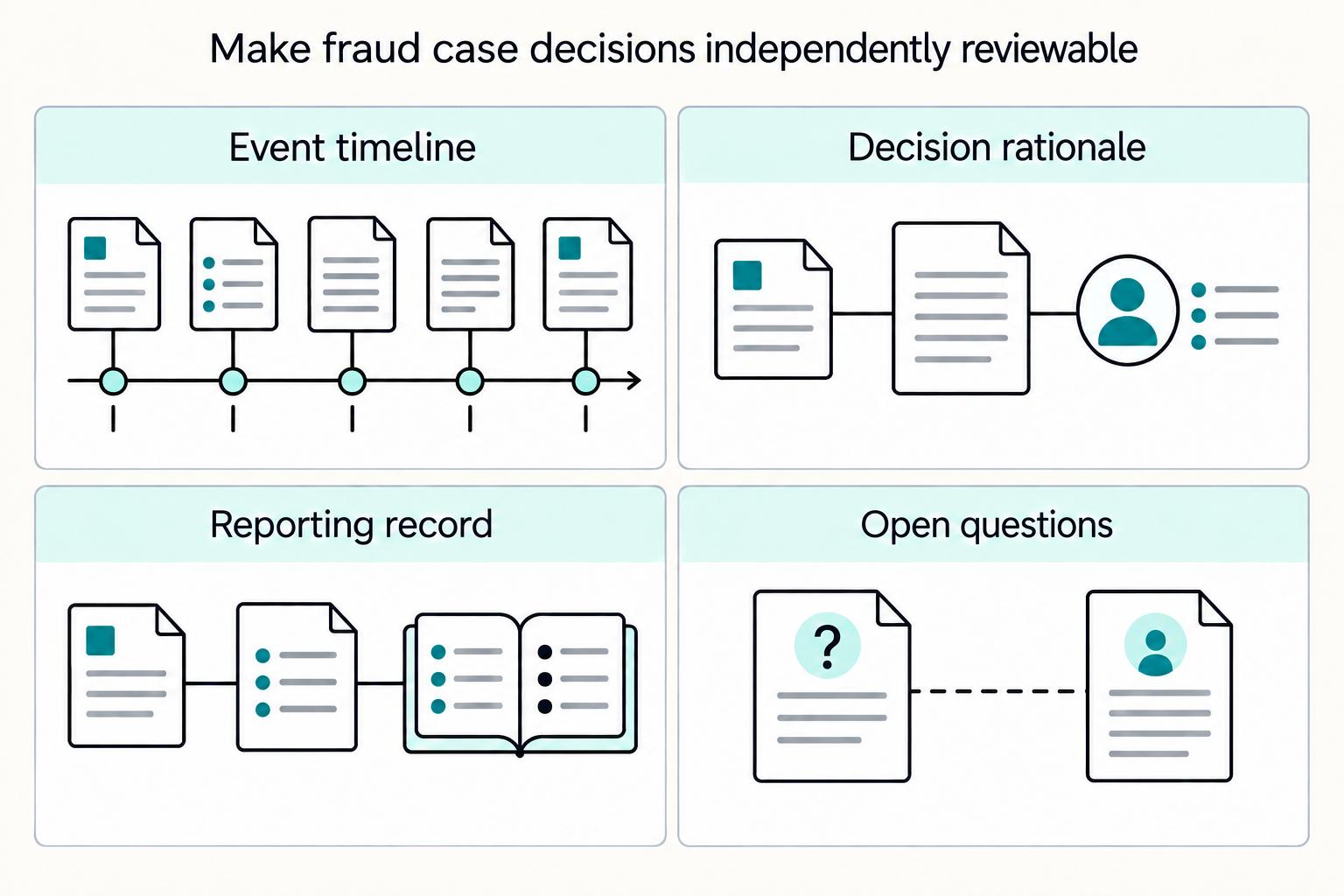
A case is not closed at the payout decision. It is closed when an independent reviewer on your team can reconstruct what happened, why you acted, and what reporting followed.
| Record element | Include | Note |
|---|---|---|
| Minimum case file | Event timeline, transaction identifiers, communication artifacts, decision rationale, and final disposition | Keep one record that stands on its own |
| Decision rationale and non-escalation record | Why you escalated, and why you did not; if no SAR or other report was filed, preserve what was checked, what resolved concern, and why the case was released | Specific enough that another reviewer can follow the decision without restarting the investigation |
| Compliance and legal outputs | Who, what, when, where, why, and how; tag repeat patterns in the case record | Support the 30-calendar-day filing clock, the additional 30-calendar-day delay when no suspect is identified, and the 60-calendar-day maximum delay |
| Post-incident record and unknowns | Filed, not filed, or referred for assessment; ownership for follow-up; what is unverified, what was requested, what explanations were considered, and whether the unresolved point blocked payout | Keep SAR handling distinct from crime-report handling |
- Minimum case file
Keep one record that stands on its own: event timeline, transaction identifiers, communication artifacts, decision rationale, and final disposition. Include the core transaction detail that makes later review possible, such as dates, amounts, accounts, beneficiaries, destinations, related identifiers, and linked evidence. Structure the narrative around who, what, when, where, why, and how. Keep readily available onboarding and due-diligence information with the file, not only incident notes, so your reviewer does not have to reconstruct the basics from scratch. If you hand the file to a second reviewer, they should be able to follow it without another interview.
- Decision rationale and non-escalation record
Document why you escalated, and why you did not. If no SAR or other report was filed, preserve what was checked, what resolved concern, and why the case was released. The rationale should be specific enough that another reviewer on your team can follow the decision without restarting the investigation.
- Compliance and legal outputs
Produce a regime-appropriate summary from the same file, with who, what, when, where, why, and how clearly stated. In UK SAR workflows, guidance includes "Further information" and "report summary" sections. In US bank SAR contexts, your narrative and workflow need to support the 30-calendar-day filing clock, the additional 30-calendar-day delay when no suspect is identified, and the 60-calendar-day maximum delay. Tag repeat patterns in the case record. Multiple reports tied to the same subject can surface broader activity, so those tags can support case closure and downstream review.
- Post-incident reporting, audit trail, and unknowns
Tie each case to a durable post-incident record: filed, not filed, or referred for assessment, plus ownership for follow-up. Keep SAR handling distinct from crime-report handling, and route urgent cases for immediate law-enforcement contact where that rule applies. End with an "unknowns" block when facts remain incomplete: what is unverified, what was requested, what explanations were considered, and whether the unresolved point blocked payout. Recording uncertainty is part of an audit-ready file.
Conclusion#
The real win for your team is not spotting more red flags. It is making consistent payout decisions, for consistent reasons, with evidence that holds up in disputes, audits, and supervisory review. If you cannot explain the decision in one pass, the control still needs work.
Use one operating standard across patterns in your workflow: map each one to a trigger, a named owner, a required action, and a reporting artifact.
- Trigger: the exact event that starts review
- Owner: who makes the next decision
- Action: hold, manual review, escalate, release, or deny
- Reporting artifact: the case record, including transaction identifiers, communications, timeline, decision rationale, and disposition
This is where control quality is won or lost in your operation. In the U.S., suspicious activity reporting is a cornerstone process, and quality matters. Defensible governance also means documenting decisions not to file a SAR, not just filed reports. If your case file cannot show what happened, who reviewed it, what evidence was used, and why funds were released or blocked, the control is weaker than it looks.
The UK lens points the same way: controls should fit the business, and detection will not be perfect. Automated monitoring will produce false alarms, so adding alerts without clear release criteria, escalation ownership, and evidence requirements can increase friction without improving defensibility.
Start with decision tables, then tune thresholds. Build your reviews around verifiable operator facts, make sure every hold has a closure path, and make case notes explicit when release evidence is missing. We recommend reviewing rules and typologies against observed outcomes, then adjusting. We also recommend testing the table against a few recent cases before you tune thresholds. Strong customer authentication helps reduce fraud, but fraud types adapt, so controls need regular review and updates.
Implement the tables first, enforce evidence quality, then tune based on observed outcomes. The strongest teams are not the ones with the most alerts. They are the ones with reviewable, repeatable, case-level payout decisions your team can explain.
If you want to pressure-test your control design across markets before rollout, discuss your workflow and coverage requirements with Gruv.
Frequently Asked Questions
What are the top payment fraud patterns in freelancer ecosystems, and which are most urgent to control first?
Use any "top 10" as a risk framework, not a universal prevalence ranking for freelancer scams. Prioritize the patterns that can create fast, irreversible outbound loss: fake-check and overpayment setups, off-platform payment arrangements, and threat-based payment demands. A practical urgency signal is settlement uncertainty, because a fake check can take weeks to be identified even when funds appear available.
How does a fake cheque scam or overpayment scam usually unfold step by step?
A common flow is a new buyer or client sending a check, sometimes above the agreed amount, then asking for a quick refund of the difference. FTC guidance describes this exact overpayment pattern, including "accidentally" sending too much and requesting money back. The core failure is sending funds out before true settlement finality, so containment starts with pausing outbound movement and not sending money back.
What should trigger an immediate payout hold versus manual review?
Use an immediate hold when release could lock in loss before settlement is confirmed, especially after a pressured refund request tied to overpayment. Use manual review when funds can stay paused while you verify transaction details, communications, beneficiary information, and who actually received the money. There is no universal threshold in these sources, and "funds look available" alone is not a safe release basis.
When should payment threats be treated as fraud escalation instead of customer support?
Treat threats as fraud escalation when messages include coercion or payment demands. FBI guidance states financially motivated sextortion is a crime and advises targets to cut contact and report interactions. More broadly, extortion is a top cybercrime complaint category, so threat-led payment demands should move quickly into incident and reporting workflows.
Why are platform-native fraud checks alone often insufficient for cross-border payouts?
Platform checks weaken when communication or payment moves off-platform, because the marketplace can no longer track or verify the transaction. Cross-border exposure also changes by rail and geography: card fraud rates were reported as ten times higher when the counterpart was outside the EEA, and SCA lowers fraud but does not eliminate it. FATF Recommendation 16 updates also push payment-chain transparency and anti-fraud tooling, which goes beyond platform-side UI checks.
What evidence should be collected before releasing or denying a disputed payout?
Capture core transaction evidence first: account details, transaction date, amount, recipient, and total claimed loss. Preserve all related documents and electronic transmissions, plus the timeline and supporting records tied to the dispute. If the case may enter U.S. bank SAR workflows, retain supporting documentation in a way that can satisfy five-year retention expectations.
Try a related tool
Researched and edited by the Gruv editorial team. Gruv builds cross-border billing, payouts, and finance-operations software for global businesses.
Sources
- bsaaml.ffiec.gov/manual/AssessingComplianceWithBSARegulatoryR...trusted
- consumer.ftc.gov/articles/how-spot-avoid-and-report-fake-chec...trusted
- consumer.ftc.gov/consumer-alerts/2020/02/ftc-bottom-line-fake...trusted
- consumerfinance.gov/enforcement/actions/early-warning-services-l...trusted
- ecfr.gov/current/title-31/subtitle-B/chapter-X/part-1...trusted
- ecfr.gov/current/title-31/subtitle-B/chapter-X/part-1...trusted
- fbi.gov/how-we-can-help-you/scams-and-safety/common-...trusted
- fbi.gov/how-we-can-help-you/scams-and-safety/common-...trusted
Educational content only. Not legal, tax, or financial advice.
Related Posts

The Freelance Payment Penalty: A Modeled Audit of Platform Fees, FX Spreads, and Payout Delays
The money rarely disappears through a single, easy-to-spot fee. The real loss is stacked. A marketplace takes its commission, a processor adds a charge for international cards, a bank or payment company converts the currency at a spread, a platform holds the funds before release, and a wire sheds a little to intermediaries on the way in. Each layer looks defensible on its own, but the worker feels the combined result as a smaller deposit and a later payday.

How to Respond to a Subpoena for Business Records
Move fast, but do not produce records on instinct. If you need to **respond to a subpoena for business records**, your immediate job is to control deadlines, preserve records, and make any later production defensible.
A US Expat's Guide to Investing in UCITS ETFs to Avoid PFIC Issues
The real problem is a two-system conflict. U.S. tax treatment can punish the wrong fund choice, while local product-access constraints can block the funds you want to buy in the first place. For **us expat ucits etfs**, the practical question is not "Which product is best?" It is "What can I access, report, and keep doing every year without guessing?" Use this four-part filter before any trade: