
Quick Answer
Freelancers can use Radical Candor as a business system for client conversations by pairing personal care with direct, documented communication. In practice, that means setting clear scope and payment rules before kickoff, turning vague feedback into observable acceptance criteria during delivery, and handling late payments or offboarding through a consistent written process. This reduces confusion, disputes, and avoidable stress.
Radical Candor is Not a Soft Skill. It's a Business System.#
If you treat Radical Candor as a personality label, you will use it inconsistently. Treat it as an operating choice instead, and you give yourself a clearer way to handle scope, payment conversations, trust, and the record of what was actually said. In practice, that means doing two things at once in client communication: Care Personally and Challenge Directly.
That balance matters because each wrong style creates a predictable business risk. If you soften a hard truth to keep things comfortable, you usually leave out the detail the client needs to act on. Your documentation gets vague with it. If you press the issue without showing care, the client may hear blame instead of guidance. A simple check helps: are you speaking from observable facts rather than assumptions or generalizations, and would that same wording still hold up in your follow-up notes?
| Quadrant | What it looks like with a client | Business risk | What you should do next |
|---|---|---|---|
| Radical Candor | You show care and say the hard thing clearly | Lower risk of confusion and misalignment | Document the decision and next step |
| Ruinous Empathy | You avoid the hard truth to spare feelings | Fuzzy expectations and unclear decisions | Reset expectations with specifics |
| Obnoxious Aggression | You are direct but come off as harsh | Defensive reactions and less open communication | Rephrase with care, then clarify the request |
| Manipulative Insincerity | You stay vague, political, or passive-aggressive | Confusion and weak documentation | Pause and realign in plain language |
This also works in reverse. Start by soliciting feedback, so when a client criticizes your work, your first job is to listen without getting defensive and pull out the observable facts. If the feedback is still vague, ask for examples instead of arguing.
That leads into the three pillars ahead. They are not separate ideas. They are the same discipline applied at three moments: before work starts, while work is moving, and when money is on the line.
For a step-by-step walkthrough, see Important Conversations for Freelancers Who Need Clear Client Boundaries.
Pillar 1: Proactive Candor - Architecting the Engagement#
If you want fewer hard conversations later, make decisions explicit before kickoff. Use this as your pre-project checklist: scope boundaries, money rules, channel rules, and a written approval trail.
Your Statement of Work should define not just what you will do, but where the work stops, what triggers a change, and what requires written confirmation before you proceed. Before signing, ask: "Which line would you interpret differently from me?" That question often surfaces the gap that would later become a dispute.
| Area | Clear clause | Vague clause |
|---|---|---|
| Scope | "Includes the deliverables listed in this document and no additional assets unless added in writing." | "Includes project support as needed." |
| Revision limits | "Includes the number of review rounds stated in the signed agreement for the listed deliverables." | "Reasonable revisions included." |
| Handoff responsibilities | "Client provides source files, access, and consolidated feedback by the agreed dates." | "Client will send materials during the project." |
| Out-of-scope requests | "New requests are scoped separately and start only after written approval of timing and cost." | "Small extras can be handled along the way." |
If a clause sounds polite but cannot be verified later, rewrite it until an outside reader could tell exactly what was agreed.
Set the money rules before the work starts#
Define payment mechanics before any delivery begins, and align them with your current contract language, invoicing setup, and jurisdiction-specific advice.
| Rule | What to define |
|---|---|
| Advance commitment | State what reserves the slot, with the reservation term pending contract review |
| Invoice cadence | State whether billing follows milestones, dates, or delivery events, and name each trigger |
| Late-payment process | Define first, second, and third steps, with timing and consequence terms pending contract review |
| Pause and restart conditions | State when work pauses, what must be paid before restart, and whether timelines are rebooked |
When you write these into the engagement, keep them concrete:
- Advance commitment: spell out what actually reserves the slot, with the reservation term pending contract review.
- Invoice cadence: name whether billing follows milestones, dates, or delivery events, and list each trigger.
- Late-payment process: decide the first, second, and third step now, with timing and consequence terms pending contract review.
- Pause and restart conditions: state what pauses work, what must be paid before restart, and whether timelines are rebooked.
Put approvals where they can be found later#
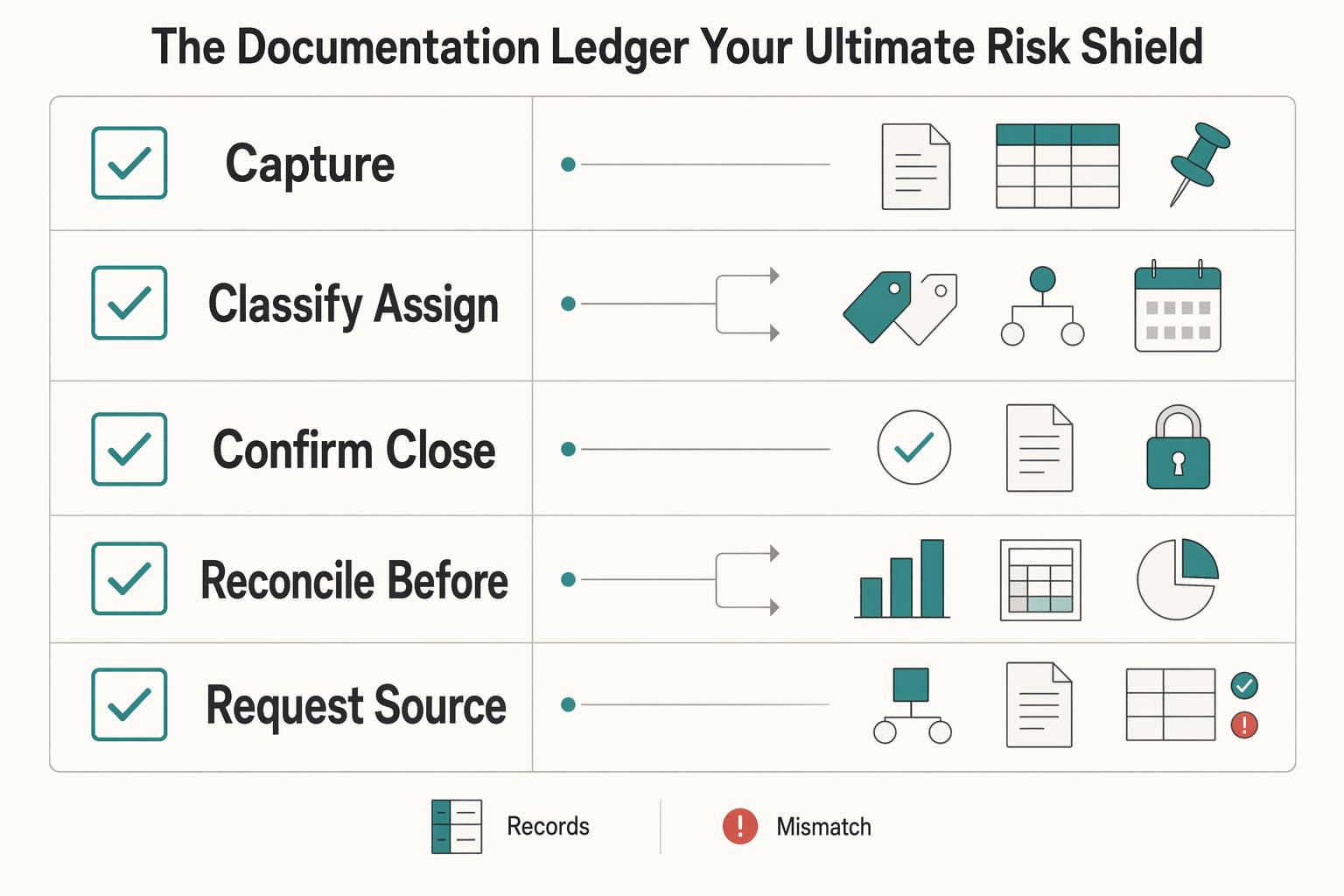
Let discussion happen in normal channels, but keep decisions in one written location. When direction comes through a call, chat, or voice note, summarize it in writing and ask for confirmation there.
Use one standard: any approval that changes scope, timeline, budget, or acceptance criteria belongs in that written record.
Run a short risk pre-mortem#
Before work starts, run two or three "what if" scenarios so expectations are explicit early. Cover likely friction points, like priority changes, stakeholder disagreement, or a first draft that misses the mark.
Then address feedback in both directions: what feedback the client wants from you early, and what feedback you need from them to revise efficiently. This reduces misinterpretation later by making response patterns explicit at the start.
Pillar 2: Operational Candor - Turn Requests and Feedback Into Written Decisions#
Once delivery starts, treat unclear requests as decision points, not casual comments. If a request changes scope, timing, budget, or core assumptions, pause and route it through a written decision.
Use CORE in the moment: Context, Observation, Result, Expected next step. Context anchors to the agreed deliverable, work description, period of performance, or delivery schedule in your Statement of Work. Observation states the request without judgment. Result explains the likely scope, schedule, and cost impact, with effort estimates and revised delivery dates you confirm before committing. Expected next step states the decision you need before work continues.
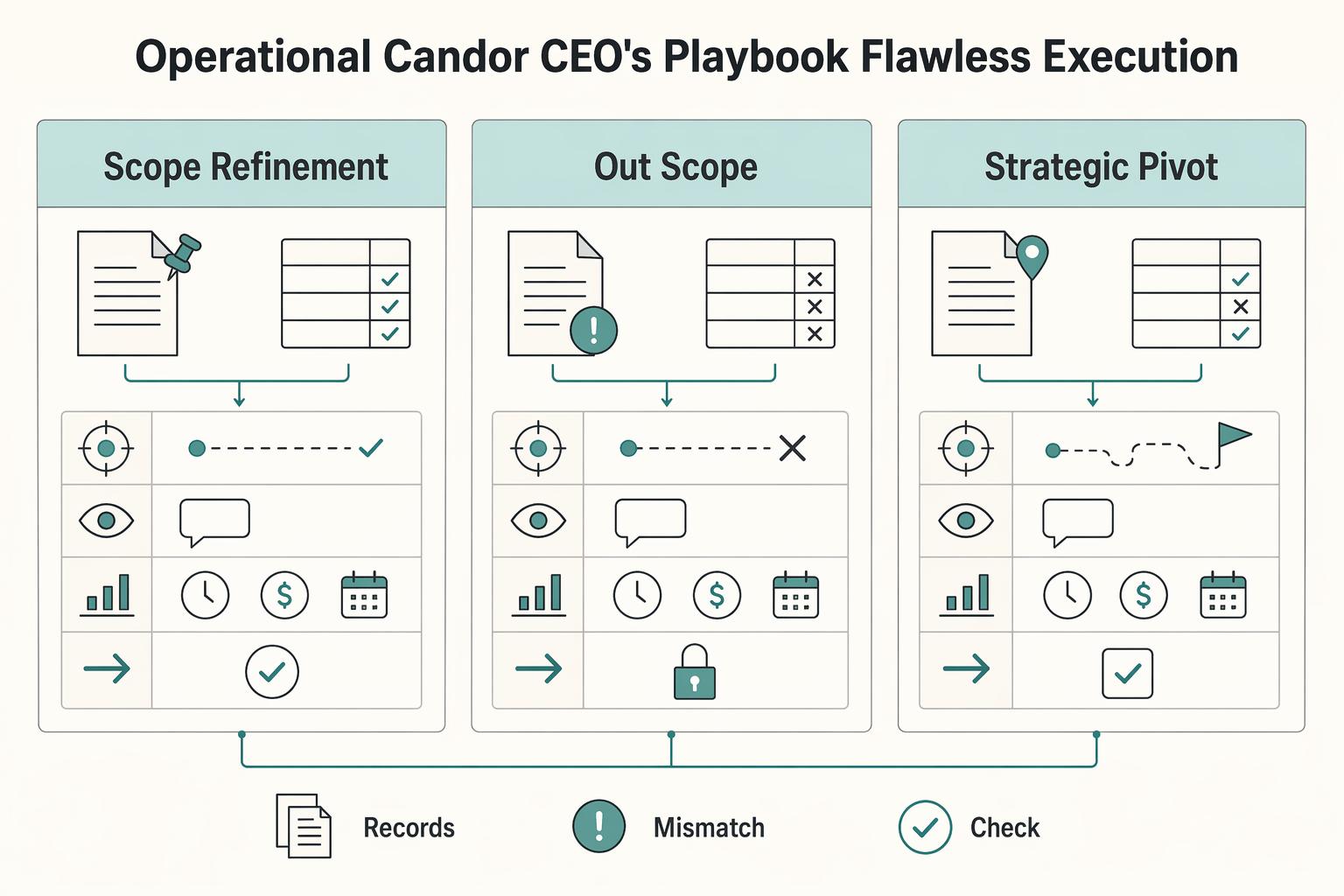
| Request type | How to recognize it | Response path |
|---|---|---|
| In-scope refinement | Clarifies or improves an agreed deliverable without changing the core brief | Confirm the request in writing, restate acceptance criteria, and proceed after client confirmation |
| Out-of-scope change | Adds a new asset, feature, review round, audience, or dependency not covered in the SOW | Send a change request with scope, schedule, and cost impact, then wait for approval before implementation |
| Strategic pivot | Changes the goal, priority, audience, channel, or another core assumption | Stop execution, re-scope against the new objective, and get written approval on the revised plan before restarting |
Operational candor also includes how you receive feedback. Ask for feedback early, then pause before responding. If feedback is vague, do not revise yet; convert it into testable acceptance criteria (the conditions that must be true for the work to be complete).
- Ask for one concrete example: "When you say 'make it more premium,' which part feels off?"
- Translate it into observable criteria: "So approval means cleaner hierarchy, fewer colors, and stronger spacing on the hero section."
- Confirm boundaries: "What must stay unchanged, and who gives final sign-off on this version?"
If you need to challenge weak input, do it privately, and keep praise public.
When a client chooses a direction you advised against, Document the Directive before proceeding. Record the date, exact instruction, your recommendation, the risk discussed, expected impact on scope/schedule/cost, and who approved it. Save that record in the same written system where project decisions already live (email thread, shared project log, or PM ticket), then request explicit acknowledgment there: "Please reply 'approved' so I can proceed under these revised assumptions." This does not remove all risk, but it reduces delivery confusion and later disputes.
Pillar 3: Financial Candor - Payment Issues, Rate Changes, and Client Exits#
Use the same discipline you use for scope control to protect cash flow: clear message, written record, consistent follow-through. When you avoid direct money conversations, you increase the risk of unpaid work, unclear expectations, and avoidable stress.
Financial candor is an operating protocol for payment issues, rate changes, and client exits. In each case, anchor what you say to your agreement and documented project record.
Late payments need an escalation path, not improvisation#
Treat overdue invoices as a repeatable process. Start by confirming the invoice is accurate and sent to the right contact, then escalate in writing using the same record location each time.
Before you send
- Check the contract payment-terms clause.
- Verify invoice number, amount, currency, due date, billing contact, and required references (for example, PO fields).
- Confirm where the written trail lives (for example, invoice email thread plus accounting log).
| Trigger condition | Message goal | Action if no response | Documentation step |
|---|---|---|---|
| Invoice is past due; timing threshold pending contract review | Confirm receipt, assume good intent, and surface processing blockers | Follow up directly with billing contact and original approver | Save reminder in invoice thread and log sent date |
| Invoice remains unpaid after first reminder; timing threshold pending contract review | Request a specific payment date and state business impact clearly | Escalate to the client decision-maker named in the engagement | Record who was contacted, requested date, and any commitment |
| Invoice remains unpaid after second reminder; timing threshold pending contract review | State the contract-based consequence, such as pausing future work | Pause new work only if your agreement supports it, and notify in writing | Store pause notice, contract reference, and outstanding balance with prior decisions |
If your agreement allows a pause for nonpayment, cite that clause directly. If it does not, do not threaten actions you may not be able to enforce.
Rate changes should be evidence-based#
When you raise rates, tie the request to documented changes in the work, not personal pressure. Keep the message simple: what changed, what rate now matches that work, and when it would apply.
| Check | What to verify |
|---|---|
| Contract terms | Check contract pricing, renewal, or change language |
| Rates and date | Verify current rate, proposed rate, and effective date |
| Approval record | Confirm where written approval will be stored |
Before you send
- Review contract pricing, renewal, or change language.
- Verify the current rate, proposed rate, and effective date.
- Confirm where written approval will be stored.
Use evidence you can verify:
- Outcomes delivered.
- Scope complexity added (channels, stakeholders, review cycles, decision overhead).
- Responsiveness expectations added (faster turnaround, more live collaboration, ongoing availability).
If you cannot support the change with clear evidence, wait until you can.
Offboarding is a structured transition workflow#
When a client relationship needs to end, run a documented transition so both sides can continue cleanly. The workflow is: notice, handover package, final billing, and access removal.
| Step | What it covers |
|---|---|
| Notice | State end date and support coverage through that date |
| Handover package | Deliver the agreed assets and status items relevant to the engagement |
| Final billing | Close completed work and approved extras |
| Access removal | Inventory tools/folders/admin roles and remove access after handover confirmation |
Before you send
- Check termination or notice language in the agreement.
- Verify open invoices and any remaining agreed deliverables.
- Confirm where final transition records will be stored.
Run the transition in order:
- Notice: state the end date and what support continues through that date.
- Handover package: deliver the agreed assets and status items relevant to the engagement.
- Final billing: close completed work and approved extras.
- Access removal: inventory tools, folders, and admin roles, and remove access after handover confirmation.
Keep the tone respectful and the record complete. That protects professionalism and reduces avoidable disputes.
Your Mindset Must Shift from Fearing the Conversation to Fearing the Consequences of Not Having It#
If you avoid a hard message, the risk usually gets bigger, not smaller. Your goal is not to sound harsh; your goal is to make the next decision clear while the problem is still recoverable.
This matters most after something slips. What you do next matters more than the mistake itself, and the common misses are ordinary: a missed deadline, a forgotten follow-up, or work that snowballs into something unmanageable. Start with ownership, then move quickly to a rebuild plan and better questions so the same gap does not repeat.
| Conversation avoided | Likely business consequence | First corrective action |
|---|---|---|
| Acknowledging a missed deadline | Work keeps moving without a realistic reset | Own it completely and send an updated plan |
| Following up after a dropped thread | Follow-ups get missed again and recovery gets harder | Name the gap directly and set the next decision point |
| Addressing a mistake early | Trust weakens because the response looks unclear | Explain what happened, how you will rebuild trust, and what changes now |
Use this quick reframe before you send the message: define the risk, name the clarity you need, then write the most neutral next sentence. Check your record first so your note stays factual and practical.
Treat difficult conversations as routine workflow steps, not personality tests. That is the same operating discipline behind strong engagement setup, steady execution, and clean financial conversations.
Frequently Asked Questions
How do I enforce payment terms without angering a client?
Treat late payment as a standard business process, not a new dispute. Verify the invoice details and use the original invoice thread to keep the record clean. Start by asking whether there is a processing issue, then ask for a specific payment date and escalate if needed.
What is a practical way to handle scope creep without sounding combative?
Anchor your reply in the agreed scope, name the new request, and state its impact on timeline, budget, or review load. Then offer two options: approve a change in writing now or defer it to a later phase. Staying silent to preserve comfort often creates bigger trust problems later.
How do I receive tough client feedback without getting defensive?
Thank the client, ask for one specific example, and avoid arguing about tone or intent. Clarify what should change, who decides it is fixed, and where that acceptance will be recorded. If the feedback is valid, turn it into acceptance criteria and confirm it back in writing.
How do I ask for feedback without sounding insecure?
Ask narrow process questions instead of broad questions about your worth. For example, ask what one change in the next round would improve speed, clarity, or the final result. Then restate the change, confirm priority, and note where it will be recorded.
How do I professionally end a client relationship?
Review the agreement first, then confirm open invoices, remaining deliverables, and any assets or access that still need handover. State the end date, what support continues until then, and what the handover package includes. Track final billing, handover, and access removal in a written checklist.
Is radical candor for freelancers effective across different cultures?
Yes, if you keep the core principle the same: care personally and challenge directly. Calibrate tone and detail to the client, but keep risks, decisions, and next steps explicit. The goal is to avoid vague feedback patterns and unclear expectations.
How do I know whether I am being candid or just blunt?
Candor is specific, useful, and tied to observable behavior or a decision. Bluntness tends to sound absolute, personal, or impatient and often leaves no clear next step. If you can point to facts, business impact, and the action needed, you are closer to candor than aggression.
Try a related tool
Researched and edited by the Gruv editorial team. Gruv builds cross-border billing, payouts, and finance-operations software for global businesses.
Sources
Includes 2 external sources outside the trusted-domain allowlist.
- acquisition.gov/far/8.405-2trusted
- congress.gov/112/chrg/CHRG-112shrg74537/CHRG-112shrg74537...trusted
- congress.gov/event/118th-congress/house-event/LC72863/texttrusted
- hbs.edu/coursecatalog/print.htmltrusted
- provost.uoregon.edu/sites/default/files/uoselfstudyreport2007web...trusted
- trace.tennessee.edu/context/utk_graddiss/article/4658/viewconten...trusted
- aiany.org/committees/women-in-architectureexternal
- assets.openstax.org/oscms-prodcms/media/documents/PrinciplesofMa...external
Educational content only. Not legal, tax, or financial advice.
Related Posts

GDPR Compliance Checklist for Freelancers Working With EU Clients
Start by separating the decisions you are actually making. For a workable **GDPR setup**, run three distinct tracks and record each one in writing before the first invoice goes out: VAT treatment, GDPR scope and role, and daily privacy operations.

Thailand's Long-Term Resident (LTR) Visa for Professionals
For a long stay in Thailand, the biggest avoidable risk is doing the right steps in the wrong order. Pick the LTR track first, build the evidence pack that matches it second, and verify live official checkpoints right before every submission or payment. That extra day of discipline usually saves far more time than it costs.
How to Give Effective Feedback to a Remote Team Member
**Set the rules before the first draft lands.** If you want remote feedback to lead to clean revisions instead of crossed wires, settle the process before anyone starts reviewing. At kickoff, the target is simple: one scoped document, one approved place for feedback, and one clear approval path.