
Quick Answer
Online course marketplaces should decide who owns money movement, payout risk, and tax reporting before they set instructor splits. The article recommends mapping the checkout-to-settlement flow, assigning filing and exception owners by market, versioning split and reversal rules, blocking first payouts until tax profiles are validated, and expanding country by country only after reconciliation and reporting operations are ready.
Why course marketplace payout articles keep failing operators#
Most advice on online course marketplace payouts skips the part operators actually have to run: who owns the money movement, who owns payout risk, and who owns tax-facing work when exceptions happen. The real decisions usually start with who gets paid, how payouts are routed, and who handles reporting when the simple path breaks.
Start with money movement and risk ownership#
Start with payment flow ownership, not split percentages. Marketplace payment processing covers buyer payment acceptance, seller payouts, and sometimes stored funds. Launch risk sits in settlement mechanics, exception handling, and accountability.
That is why creator-income content so often falls short for operators. OCC merchant processing guidance is built around settlement activity and verification procedures, and it describes merchant processing as a high-volume, low-margin business. In practice, operational issues can compound quickly as transaction volume grows.
Surface the ownership posture early because it shapes who owns core payment and reporting work. You do not need every jurisdiction-specific answer on day one, but you do need to decide whether payout controls and reporting workflows are product inputs now or cleanup work later.
Document the decisions most articles skip#
Operational clarity comes from documented ownership before launch, not definitions alone. Keep a short evidence pack that makes responsibility explicit and gives teams something concrete to review:
- a draft instructor revenue split policy, even if percentages change later
- a checkout-to-settlement money map, including holds and reversals
- onboarding fields needed for payout and tax profile collection
- a named owner for payout approvals and exception review
- a responsibility note for tax-facing tasks and reporting workflows
This is not paperwork for its own sake. When ownership is vague, payout timing, reversals, and reporting expectations drift. That can weaken trust and retention.
Verify readiness before expanding scope#
Before you add complexity, make sure the people who will run this agree on the same path. Have legal, finance, and operations review the same payout flow and confirm that each documented owner matches actual product behavior.
Include reliability in that review. Payment failover is the mechanism for keeping checkout running when a gateway, processor, or network path fails. Stripe cites a 2025 survey where 92% of enterprise e-commerce businesses saw payment outages or disruptions in the prior two years, and half reported losing millions in potential revenue. That is not a marketplace-specific benchmark, but it is a clear signal that continuity decisions can affect commercial outcomes.
Make that tradeoff early. More payment options or payout routes can improve the participant experience, but they also raise engineering and UX complexity. If rollout depends on extra rails, checks, or ownership assumptions, verify them before launch rather than after exceptions begin.
You might also find this useful: How E-Learning Content Marketplaces Pay Course Creators: Royalty Models and Tax Compliance.
What to prepare before making payout decisions#
Do the prep before you touch product configuration. In practice, geography coverage and onboarding tax-data choices create avoidable rework.
Define the first launch boundary#
Set your phase-one boundary: target country, initial instructor cohort, and a clear yes or no on Cross-border payouts. If cross-border is not essential for phase one, deferring it can simplify validation of a single payout and tax flow. Use one checkpoint: does your setup support both buyer and instructor locations for this first market, including country and currency coverage?
Gather minimum artifacts before product work#
Before build work starts, set three things in writing:
| Item | Set before build | Article note |
|---|---|---|
| Instructor revenue split | Draft terms | Allocation between instructor earnings and platform commission is explicit |
| Tax profile collection | Add to onboarding | Do this instead of waiting until after first sales |
| Payout-option communication | Define it for instructors | Payment expectations are clear |
Confirm market-specific dependencies#
For each planned market, verify country and currency coverage for your buyers and instructors, and confirm whether local-currency payouts are reliably supported. This is a common cross-border risk in legacy payout stacks.
Set an internal launch gate#
Before launch, confirm who owns onboarding tax-profile collection and who owns payout communication when information is missing or delayed. Clear ownership reduces future back-and-forth with sellers.
Decide who owns liability before you design payouts#
Do not design payout logic until reporting ownership is documented by market. Merchant of Record (MoR) and non-MoR are useful labels, but by themselves they do not establish who is expected to calculate tax, withhold, or report to Tax authorities.
Use labels as a starting frame, then document ownership#
Use MoR vs non-MoR as a starting frame, not the final answer. For each launch market, document who owns tax calculation, withholding, and reporting, and where that decision is recorded.
Before you build payout rules, require one evidence pack per market:
- contract or provider-scope language tied to ownership
- internal legal and finance sign-off naming the responsible party
- product requirements that match that ownership decision
If those three items conflict, ownership is unresolved.
Build a responsibility matrix before launch#
Build a short, explicit matrix and share it across product and finance.
| Task | What must be assigned | Verification checkpoint | Red flag |
|---|---|---|---|
| Tax calculation | Named party by market | Contract scope and internal sign-off match | Ownership described as assumption |
| Withholding | Named party by market | Terms, finance process, and ledger treatment align | No clear owner for withheld amounts |
Reporting to Tax authorities | Named filing owner by jurisdiction | Filing method, deadline owner, and escalation owner documented | Different teams name different owners |
Digital platform reporting | Named owner and market list | Jurisdiction list approved by legal and finance | Treated as identical to U.S. reporting without review |
Form 1099-K work | Named U.S. owner, including whether Form 1099-K analysis is needed | Filing path and responsible team documented | Product launches before reporting ownership is assigned |
Tax profile collection | Owner for fields, review, and exceptions | Onboarding fields exist and incomplete profiles are visible | Tax data deferred to support follow-up |
For U.S. reporting, document operational readiness, not just intent. The IRS says Forms 1099-K can be filed electronically through IRIS or FIRE, and states information returns, including Forms 1099-K, may be required to be filed electronically. If you are required to file 10 or more Information Returns, assign ownership and filing operations in advance.
Also document who monitors thresholds. The IRS says TPSOs are not required to file Form 1099-K unless gross payments exceed $20,000 and 200 transactions, and notes a prior reporting-threshold regime was reinstated. Treat that as an ownership and monitoring checkpoint, not a blanket conclusion.
Narrow rollout when reporting operations are not ready#
If you cannot support multi-jurisdiction reporting operationally, start with a narrower footprint where support is documented. Do not assume payout rail coverage means reporting ownership is ready.
Use a simple readiness check before you expand:
- Who files.
- Through which channel.
- Using which source records.
If those answers are unclear for market one, do not expand to market two.
For broader context, see Digital Platform Reporting: What Every Online Marketplace Must Report to Tax Authorities Worldwide.
Treat unclear ownership as a no-launch condition#
Any market with unclear legal ownership should stay no launch until resolved. Manual handling does not fix unclear liability.
There is also a conduct-risk signal here. UDAAP guidance warns that unfair, deceptive, or abusive acts can cause significant financial injury, and that complaints from users who did not understand terms may be a red flag. Repeated complaints that instructors did not understand reporting or payout terms should trigger review. The absence of complaints does not prove the setup is sound.
The control point is simple: launch only with a signed responsibility matrix, a named filing owner, and an enforced no-launch rule when ownership is unresolved.
We covered this in detail in How to Create Your Own Online Course.
If your MoR vs non-MoR responsibility matrix is still ambiguous, use this baseline before locking tax and reporting owners: Merchant of Record for business.
Map the money path from checkout to instructor settlement#
You need one ordered record of the money path, and every team needs to use it. No standard sequence is established here, so treat your sequence as an explicit operating decision, not an assumption.
Write one ordered settlement sequence#
Document the exact step order you will run in production. If your team uses steps like payment capture, fee allocation, instructor split calculation, hold checks, and payout-batch release, write that order clearly and prevent later steps from running on estimates.
Use one end-to-end artifact so product, ops, and finance can validate the same flow. A bid-to-bill style workflow is a useful model for this kind of settlement mapping.
Put exceptions on the main path before finalization#
Do not leave failed payouts, returns, and refund clawbacks for support to clean up later. Put them inside the settlement flow before funds are finalized. If you cannot show where an exception changes instructor proceeds before finalization, the design is not ready.
No standard timing or retry rule is provided here for course-platform clawbacks or payout failures, so define those rules explicitly, assign ownership, and test them before release.
Require traceability at each handoff#
Define one minimum trace set for each payable item and enforce it consistently. No standard required field set is specified here, so choose fields that fit your system, for example:
- transaction reference
- split-logic version
- payout status event
- exception link when a return, failed payout, or clawback exists
Keep source records grouped with each payment run. An accounts payable file model is useful here because source documents are organized by payment date.
Gate release on ledger truth, not projected balances#
If you adopt a ledger-truth gate for Payout batch release, compare the payout balance against the ledger balance you treat as source of truth. Do not release from stale projected balances.
No standard checkpoint design is provided here, so define yours directly: ledger of record, cutoff timestamp, and approval owner. If this comparison is not automated, keep batch approval manual.
Set split and reversal rules before scale creates disputes#
Set one versioned split spec before volume grows. Otherwise, payout disputes can come from internal drift, not just customer behavior. These rules are reconciliation controls, not just pricing settings.
Build the split table as ordered math, not narrative#
Define Instructor revenue split as a calculation sequence for each sale path you plan to ship first. At minimum, include channel, coupon treatment, affiliate impact, payable base, calculation order, and rounding rule.
| Sale scenario | Define in the split spec | Drift risk if omitted |
|---|---|---|
| Self-serve marketplace sale | channel ID, payable base, split formula, rounding rule, effective date | Product and finance calculate different payable amounts |
| Self-serve sale with coupon or affiliate | coupon treatment, affiliate deduction point, whether both can apply, split order | Double deduction, missed commission, or instructor overpayment |
| Enterprise bulk sale | contract or invoice reference, allocation method, instructor attribution rule, manual approval owner | Revenue is recognized before instructor earnings are traceable |
Write formulas as step order, not prose. Then test one sample transaction per row and recalculate it outside the product. If the number cannot be reproduced from internal records, processor reports, and source sale data, the rule is still too vague.
Add reversal ownership before you release funds#
Treat refunds and disputes as built-in stages, not cleanup. A Refund clawback and a Chargeback need explicit ownership and logic in the same spec as the split.
For each cohort, define the trigger event, timing window, clawback handling for paid instructor earnings, affiliate reversal behavior, and fee ownership. There is no universal timing standard or default fee owner established here, so set your own documented rule per cohort and align teams on it.
If reversal ownership is unclear, consider holding payouts until the dispute window closes for that cohort. Releasing funds before ownership is clear can lead to manual offsets later.
Reconciliation is matching records across systems, not passively receiving settlement reports. If you treat settlement reporting as full reconciliation, discrepancies and fraud signals can surface late, including month-end surprises like a £15,000 gap found three days into close.
Separate self-serve and enterprise logic on purpose#
Do not force enterprise bulk sales through self-serve split logic. Self-serve payouts can be transaction-level. Enterprise payouts may depend on contract or invoice allocation and attribution decisions.
For self-serve, key rules to transaction references and promo data. For enterprise, require a contract or invoice reference, an allocation rule, and a named approver before anything becomes payable. If attribution is incomplete, do not release on gross deal value just because cash was collected.
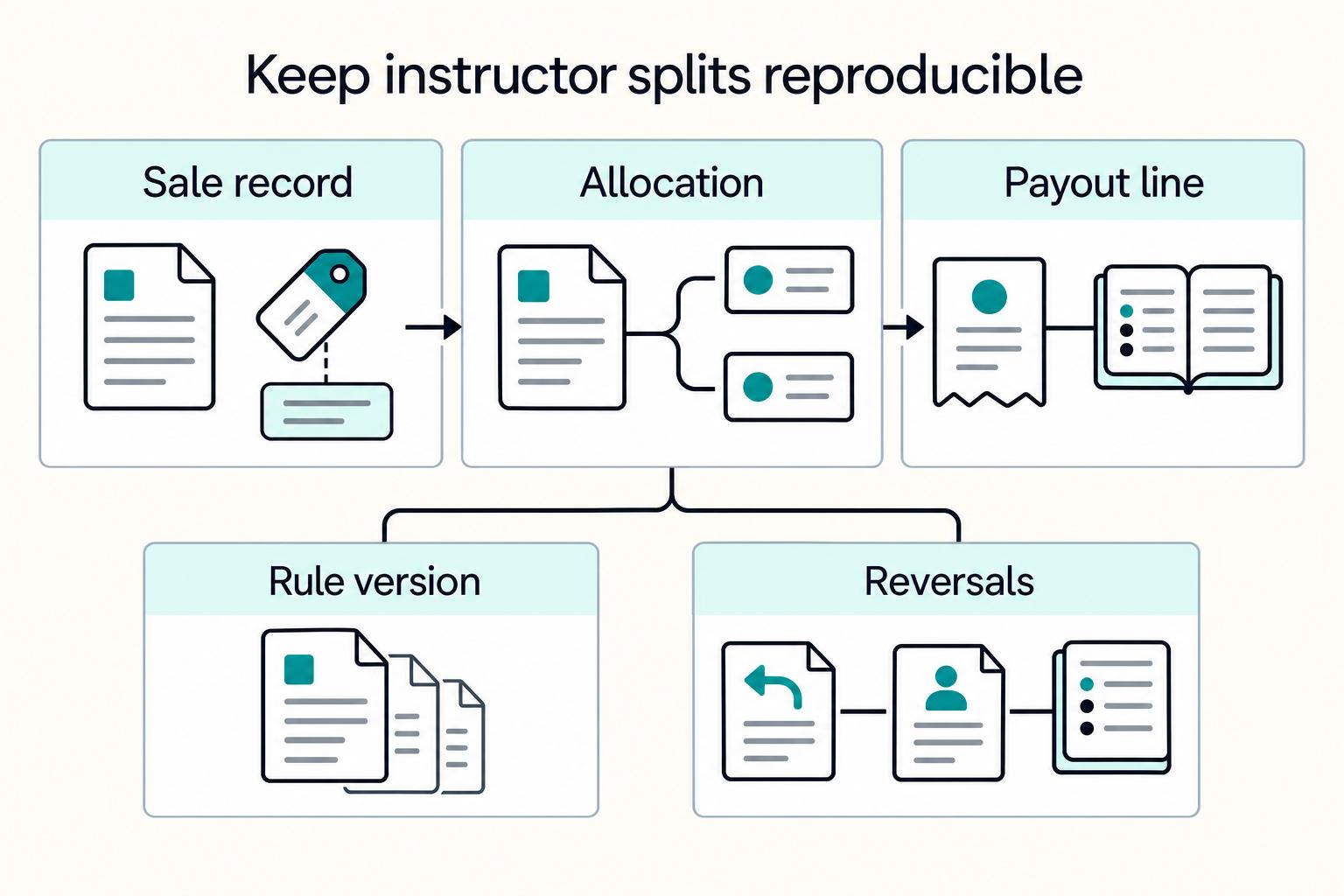
Your scale checkpoint is traceability: each payable line should map from sale record to allocation record to payout line without guesswork.
Publish one source of truth split spec and version it#
Use one internal split-and-reversal spec across product, finance, ops, and support, and version it. Include the effective date, owner, scenario samples, reversal matrix, and approval history. Each payout calculation should reference the split-logic version used.
Keep processor reporting in its role. Settlement reporting is passive, while reconciliation requires matching bank statements, processor reports, internal records, and gateway logs. Versioning only works if that control loop stays intact.
Before releasing spec changes, rerun known sample cases. If teams cannot reproduce outputs for coupon, affiliate, or enterprise allocation scenarios, pause the change until they can.
This pairs well with our guide on How Blockchain and Smart Contracts Will Change Marketplace Payouts by 2030.
Define payout timing and release controls by risk tier#
One payout schedule for every instructor is usually the wrong control. Set release timing by risk tier, with conditions ops and finance can actually verify.
Group instructors into risk tiers with written release conditions#
Use a small tier model your operations team can run consistently. The goal is to reduce risk without freezing normal payouts.
Define each tier with explicit thresholds or scored checks, then tie those checks to release outcomes. Keep the record clear enough that a reviewer can confirm, from system data alone, the current tier and the exact condition required before funds move.
Tie payout eligibility to documented risk-review outcomes#
Treat required risk-review outcomes as payout-release controls, not passive profile fields. If required review outcomes are incomplete or unresolved, keep balances unreleased until those outcomes are recorded.
Escalate accounts into tighter release tiers or manual review when patterns indicate higher risk, such as rapid withdrawals to the same beneficiary, odd time-of-day spikes, or shared device IDs. Keep payout eligibility separate from general account activity status so active does not get misread as payable.
Use controlled payout-batch approvals when risk signals are changing#
Automate only the lanes where failure patterns are stable. For higher-risk cohorts or new lanes, use a controlled Payout batch approval step by a named owner before submission.
Base approval on recent decline and exception data. Export declined transactions from the processor portal, group them by decline reason, and compare them with confirmed fraud cases. This checks both sides of control quality: missed fraud and false positives. If the team cannot explain why release is safe, hold and review.
Add recovery logic for payout failures and ambiguous outcomes#
Assume some payout attempts will fail or stay ambiguous. Build recovery controls into the release flow: hold unresolved payouts, alert ops, and require review before any follow-up release action.
Document each weakness, projected loss, and missed pattern so controls can be tuned over time. Target reasonable assurance, not perfect prevention, and adjust tier rules as new risk patterns appear.
Need the full breakdown? Read Legal Marketplace Payouts: Trust Accounts and ABA Compliance.
Build tax onboarding and reporting into the product path#
Treat tax onboarding as a payout control, not back-office cleanup. Make Tax profile collection part of the core path, and block the first payout until the required tax record is present, validated, and tied to payout eligibility.
Collect structured tax status during onboarding#
Collect tax status in structured fields so payout eligibility can be decided from system data alone. Capture profile type, requested document, received document, receipt date, validation status, and the payout account or legal profile the document is tied to. Store required tax documents as structured records, not loose files.
The checkpoint is simple: an ops reviewer should be able to see which document is on file and whether payout is blocked from one account view. If that depends on spreadsheets or ticket notes, the control is weak.
Define downstream reporting outputs by market before launch#
Define reporting outputs by market before launch so product, finance, and ops work from one list. Even if a market is currently "not in scope," assign an owner, output status, and record path now.
| Market or cohort | Output to track | Record to retain |
|---|---|---|
| Cohorts with reporting outputs in scope | Named owner, status, source-record mapping | Tax profile record, payment totals, payout ledger link |
| Markets with additional reporting exposure | Reporting owner, market status | Seller identity data, transaction history, reporting-period extract |
| Markets where records may be requested | Retrieval path, retention owner | Tax document received, validation result, payout eligibility history |
If you cannot name the owner, output, and underlying record for each market, you are carrying reporting debt into launch.
Separate user education from platform filing assumptions#
Keep FEIE (Foreign Earned Income Exclusion) and FBAR (Report of Foreign Bank and Financial Accounts) in the user-education lane, not as default platform filing obligations. FEIE applies only to qualifying individuals with foreign earned income, and IRS guidance says the person still files a tax return reporting that income.
If you provide help text, keep it narrow and factual. For the physical presence route, IRS guidance uses 330 full days in 12 consecutive months, and those days do not have to be consecutive. If the person is short of 330 full days, the test is not met unless a waiver applies for war, civil unrest, or similar adverse conditions. If you reference FEIE claim paperwork, use Form 2555 as the user-side artifact; IRS practice materials also mention Form 2555-EZ, but those materials are not binding legal authority.
Add a hard checkpoint before first payout#
Require a hard system checkpoint before the first payout: required document present, validation recorded, and status directly tied to payout eligibility. Put this gate in the payout queue, not only in onboarding.
Keep evidence you can audit later: document type, submission timestamp, validation state, reviewer or service outcome, and linked payout account at approval time. If that chain cannot be reconstructed for a sample account, hold that cohort's payouts and fix the linkage before release.
For a step-by-step walkthrough, see How to Build a SaaS Marketplace That Manages Subscriptions and Contractor Payouts.
Launch one country at a time with explicit go and no-go gates#
Country expansion should follow proof, not optimism. Launch a country only when ownership, timelines, and exception handling are explicit in writing, not just when payouts are technically possible.
Build a one-row country launch record#
Use one row per country with clear owners and escalation. At minimum, track seller eligibility assumptions, UK Self Assessment support ownership, non-financial review owner, and escalation contact.
For the UK, make the row operational, not binary. Record whether launch assumes sole traders, limited companies, or both, what user tax guidance you will show, and who handles edge cases. If an ops reviewer cannot identify who owns UK tax questions, who owns UK trust and safety questions, and who can stop payouts, do not launch.
Start where the user tax path is explicit#
Start with a jurisdiction where support, risk, and finance can follow a clear user-facing tax path. In the UK, HMRC Self Assessment provides concrete checkpoints your team can use for support readiness.
If your launch includes sole traders, keep the key HMRC markers in your row and support notes:
| UK marker | Operational use |
|---|---|
£1,000 in a tax year (6 April to 5 April) | Registration trigger context for sole traders |
Tell HMRC by 5 October (when a return is required for the previous year) | Notification deadline checkpoint |
File online on or after 6 April | Filing window start |
Pay by 31 January | Payment deadline checkpoint |
Unique Taxpayer Reference (UTR) needed for online filing | Support prerequisite |
If support cannot explain this timeline consistently, defer launch.
Mark hard no-go cases before launch#
Use a hard no-go rule: if tax ownership is ambiguous, defer the market even if payouts are available.
Also mark UK Self Assessment routing limits before launch. HMRC states some users cannot file through the standard online service. Examples include some partnerships, trusts and estates, and people who lived abroad as non-residents. GOV.UK directs those cases to commercial software or other forms. If your product copy implies every UK instructor can file through the same online path, fix that before go-live.
Include non-financial blockers in the same go or no-go row, with a named owner and launch status alongside payments and tax checkpoints.
Require an evidence pack for the go decision#
Approve the country only with a compact evidence pack attached to the row:
| Artifact | Include |
|---|---|
| Country row | Named owners and escalation contact |
| Support or help text | Final UK Self Assessment scenarios |
| Routing note | Unsupported online filing cases |
| Record-keeping reminder | Bank statements or receipts |
| Escalation rule | Profiles missing required tax data |
Capture reactivation as a known UK failure mode: HMRC says returns may be delayed if an existing Self Assessment account is not reactivated before filing. Put that in support guidance so teams can route "already registered" users correctly.
Country sequencing can feel slow, but it prevents launching into markets where ownership and exception handling are still assumptions.
Set reconciliation evidence before finance sign-off#
Do not sign off a payout cycle from settlement reporting alone. Require an evidence pack for each payout cycle that shows internal records match processor and bank records.
Require a three-part evidence pack#
Make sign-off contingent on three artifacts:
| Artifact | What it must include |
|---|---|
| Payout ledger extract | For the period |
| Payout batch status log | released, held, failed, retried |
| Unresolved exception list | Each break, owner, and status |
Build this from multiple systems, not one export. Reconciliation means checking amounts and dates across internal records, processor reports, gateway logs, and bank statements.
Tie every reversal to the original transaction#
Treat reversals as traceable events, not generic negatives. Each Refund clawback, Chargeback, and retry outcome should link to the original transaction and the affected Payout batch.
That helps prevent balance drift at close. If a retry succeeds after a failed payout attempt, confirm the failed attempt is not still counted as payable.
Make retrieval fast for audit requests#
Keep payout artifacts retrievable on demand for internal audit. Finance should be able to pull the payout ledger, status history, and exception list without rebuilding the trail from emails or ad hoc sheets.
Use a simple check: select one instructor and one disputed transaction, then verify the full history is available in one pass.
Assign one owner and one correction SLA#
Set one named owner for reconciliation breaks, even when multiple teams provide inputs. Without clear ownership, exceptions linger and surprises surface late, including large gaps such as an unexplained £15,000 difference between processor reports and bank statements.
Set one correction SLA for reconciliation breaks. If a break misses that SLA, hold the affected payout.
Related reading: Building a Virtual Assistant Marketplace with Operable Payout and Tax Controls.
Common payout mistakes and how to recover quickly#
When your reconciliation pack shows a break, stop the affected flow first, then fix the missing control with evidence. Speed matters, but restarting without clear ownership and verified records usually creates a bigger problem in the next payout cycle.
Freeze unverified cross-border payouts#
If Cross-border payouts went live before your verification controls were ready, pause new payouts in the affected corridor and backfill verification before the next Payout batch. Use a strict checkpoint: every instructor marked payable should have a recorded verification outcome, not just a status of "submitted."
This gets harder when multiple processors and currencies are involved. Chargebacks are tougher to trace across different systems, and they can arrive weeks after an instructor was paid. If you cannot show who was verified at release time, keep the flow paused while you investigate.
Assign reporting ownership in writing#
If ownership of tax reporting is unclear, pause expansion and document responsibilities. Verbal assumptions across product, finance, and legal are not enough. Issue a short addendum that names the reporting owner, filing support owner, data-prep owner, and escalation owner.
Use one concrete check: if Form 1099-K may apply, confirm who prepares filing data and who can file through IRIS or FIRE. IRS e-filing obligations can also depend on annual filing volume, including cases where 10 or more information returns are required, so this should not stay informal. If you need more background, see Digital Platform Reporting: What Every Online Marketplace Must Report to Tax Authorities Worldwide.
Run corrective offsets for split errors tied to reversals#
If split payouts and reversal adjustments are out of sync, correct at transaction level instead of using a rough holdback. Build an adjustment file that ties each reversal to the original sale, the original split logic, and the affected payout batch, then apply the offset in the next cycle.
Tell instructors what happened and when the correction will post. A common failure mode is timing: a chargeback lands after settlement, then a later negative adjustment looks like a platform error. A short notice with the transaction reference can reduce avoidable disputes.
Hold payouts on incomplete tax profiles#
Treat incomplete tax-profile collection as an internal payout-eligibility control, not a back-office cleanup item. Consider holding payouts until tax-profile collection is complete, then verify the profile is attached to the instructor record before release.
Run a batch-level check before restarting payouts. Pull all held instructors with missing tax-profile data and compare that list to the upcoming payable list. If ops cannot produce that list in one query, the control is still not reliable enough to reopen payouts.
Related: eCommerce Reseller Payouts: How Marketplace Platforms Pay Third-Party Sellers Compliantly.
The copy-paste launch checklist for payout and tax readiness#
Use this as a launch gate for your payout and tax rollout. If reporting ownership or reversal handling is still unclear, pause launch.
Document ownership before anyone can activate instructors#
Decide and record your market model before activation starts. Make the Merchant of Record (MoR) decision explicit, name who owns payout operations, name who owns reporting to tax authorities, and name who approves ownership changes.
Your readiness check is one dated internal record with clear owners and signoff. Do not assume MoR resolves reporting ownership on its own.
Turn on onboarding controls and test activation, not just registration#
Activation readiness matters more than registration alone. Make sure the production onboarding flow covers full setup before activation, for example profile and payout details, plus any compliance or tax-profile fields your program requires.
Run a test instructor to active status and confirm profile, payout details, and any required fields are complete before activation. Poor onboarding usually shows up as friction and support load, not one clean error.
Version the payout math and test reversals end to end#
Lock your Instructor revenue split logic in a versioned spec before the first payout. Assign Payout batch approvers and define who can stop a batch when balances look wrong.
Before launch, test Refund clawback and Chargeback handling end to end. Confirm each event maps to the original transaction, updates the intended instructor balance in your system, and is visible before settlement finalizes.
Assign tax outputs and validate the filing path#
Set ownership for tax outputs in writing, then validate your operational path. For W-8 and W-9 decision rules, confirm with a qualified tax adviser which form your product must capture for each instructor profile and how to handle incomplete profiles per your policy.
Where Form 1099-K applies, keep the filing path explicit: filings can go through IRIS or FIRE, and filers with 10 or more Information Returns in a calendar year must file electronically. IRS FAQs also note a Third party settlement organization (TPSO) is not required to file Form 1099-K unless gross payments exceed $20,000 and 200 transactions; treat that as context, not a universal rule for every marketplace model. For broader jurisdiction coverage, use Digital Platform Reporting: What Every Online Marketplace Must Report to Tax Authorities Worldwide.
Validate operations before expanding scope#
Before expanding scope, run reconciliation and reporting checks for the current launch setup. At minimum, complete one payout cycle, log unresolved exceptions, and confirm the needed tax data can be produced from records.
If your evidence pack is incomplete, keep expansion blocked. Minimum pack: ownership memo, onboarding field proof, one successful payout batch, tested reversal cases, and a named reporting owner.
When your launch checklist is complete and you need to validate payout-batch controls, retries, and traceable status flows, review Gruv Payouts.
Frequently Asked Questions
How do online course marketplaces usually calculate an `Instructor revenue split`?
Most marketplaces calculate the instructor share with automatic payment splitting between seller proceeds and platform commission. The split should be defined as an explicit calculation sequence so each payout can be explained from the transaction record. The article also recommends versioning the split spec and testing sample transactions before release.
Who should handle tax reporting in a course marketplace, the platform or the instructor?
There is no single default owner across all marketplace models. The platform should document, by market, who owns reporting, filing support, and data preparation, and make sure product requirements match that decision. If Form 1099-K analysis is needed, the filing path and responsible team should be assigned in advance.
What are the most common reasons instructor payouts get delayed?
Payouts are often delayed by policy controls rather than simple operational failure. Platforms may hold funds until service delivery, run monthly payout cadences, or use terms like Net 45 or Net 60. Missing or delayed information can also shift payout communication and release timing.
How should a platform treat `Refund clawback` and `Chargeback` events in payout calculations?
Refund clawback and Chargeback events should be handled with a documented, consistent method inside the same split-and-reversal spec as the original payout rules. For each cohort, define the trigger event, timing window, clawback handling for paid instructor earnings, affiliate reversal behavior, and fee ownership. Each adjustment should stay linked to the original transaction and affected payout batch.
What changes operationally when you enable `Cross-border payouts`?
Cross-border payouts make coverage validation a core operating gate. The platform needs provider country and currency support that matches both buyer and instructor locations, and it should verify whether local-currency payouts are reliably supported. If verification controls are not ready, pause new payouts in the affected corridor.
When do you need `W-8` vs `W-9`, and how do they connect to `Form 1099` reporting?
This article does not define decision rules for when to use W-8 versus W-9. It recommends treating tax form collection and Form 1099 reporting ownership as related but separate controls, and documenting both clearly in the operating model. Product should capture the fields the tax owner requires and handle incomplete profiles according to policy.
Does choosing `Merchant of Record (MoR)` reduce compliance burden for new market launches?
No. The article says MoR and non-MoR are only starting labels and do not by themselves establish who calculates tax, withholds, or reports. You still need written ownership, filing paths, and payout operations documented before launch.
Researched and edited by the Gruv editorial team. Gruv builds cross-border billing, payouts, and finance-operations software for global businesses.
Sources
Educational content only. Not legal, tax, or financial advice.
Related Posts

The Freelance Payment Penalty: A Modeled Audit of Platform Fees, FX Spreads, and Payout Delays
The money rarely disappears through a single, easy-to-spot fee. The real loss is stacked. A marketplace takes its commission, a processor adds a charge for international cards, a bank or payment company converts the currency at a spread, a platform holds the funds before release, and a wire sheds a little to intermediaries on the way in. Each layer looks defensible on its own, but the worker feels the combined result as a smaller deposit and a later payday.

How to Respond to a Subpoena for Business Records
Move fast, but do not produce records on instinct. If you need to **respond to a subpoena for business records**, your immediate job is to control deadlines, preserve records, and make any later production defensible.
A US Expat's Guide to Investing in UCITS ETFs to Avoid PFIC Issues
The real problem is a two-system conflict. U.S. tax treatment can punish the wrong fund choice, while local product-access constraints can block the funds you want to buy in the first place. For **us expat ucits etfs**, the practical question is not "Which product is best?" It is "What can I access, report, and keep doing every year without guessing?" Use this four-part filter before any trade: