
Quick Answer
Start with a constrained launch: one country, one VA segment, and one approved classification record. Treat tax intake as an eligibility control by requiring valid Form W-8BEN where applicable, and route missing forms, identity mismatches, or unsupported countries into logged hold states. Choose between direct rails and escrow-style controlled release based on dispute exposure, not headline fees. Expand only after idempotent payout retries and ledger reconciliation are passing.
What It Takes to Run a Virtual Assistant Marketplace#
Lock your marketplace model, payment system, and legal framework first. If those three are unsettled, product scope stays provisional and may need rework.
A marketplace can stay light on inventory because it connects buyers and sellers without carrying stock. That does not remove complexity; it moves it into money movement, rules, and support. In practice, payment design and legal structure belong at the start of build sequencing, not after design and growth planning.
Before you start#
- Step 1. Define your marketplace model.
State how your marketplace will connect buyers and sellers without managing inventory, and use that as the baseline for product decisions.
- Step 2. Determine the payment system before deeper build work.
Document the core payment flow early so Product, Operations, and Support can align on how transactions are supposed to work.
- Step 3. Address the legal framework early.
Identify the legal framework for your marketplace before you scale onboarding or expansion plans.
This discipline is operational, not academic. Early startups often run into cash-flow strain and pricing decisions made without enough market data, and both surface quickly when core operating decisions are underdesigned.
The goal of this guide is to help you choose a first model you can operate and review, not just one that looks good in a market slide. If your model, payment system, or legal framework are still fuzzy, narrow the launch before you add more product.
For the fuller breakdown, read Does Your Non-EU Marketplace Owe DAC7 Tax Reporting in Europe?.
Start with one launch country and one supply segment#
Once you have a draft money path, narrow the launch further. Start with one country and one VA segment you can assess, pay, and support without policy exceptions on day one.
Build a country-first decision table#
Use one operating table for Legal, Payments Ops, and Support. The goal is not to prove low risk. It is to surface unknowns before GTM and engineering commit.
| Launch market | Classification risk | Tax form burden | Payout rail options | Support overhead | Market unknowns |
|---|---|---|---|---|---|
| United States | Needs country-specific review before contractor assumptions are locked | Define intake and storage paths before build. Do not assume one form works for all seller types | Common marketplace rails can include ACH, PayPal, wire transfers, prepaid cards, and digital wallets | Platform teams still carry onboarding, invoicing, and dispute-resolution load | Which seller types are allowed first, what documentation is required for payout eligibility, and what triggers manual review |
| Philippines | Needs country-specific review before reusing contractor logic from another market | Map document collection and re-verification early. Avoid broad automation until requirements are clear | Cross-border options may exist through providers that support payouts in 100+ countries and multiple currencies | Support load can rise when payout coverage, disputes, and document questions are handled manually | Which payout methods are reliable for your provider mix, what support scripts are needed, and which exceptions appear in pilot |
| Next target market | Treat as unresolved until you have market-specific guidance | Unknown until country and entity assumptions are documented | Verify provider coverage, currency handling, and fallback methods before launch | Often underestimated because each market can add onboarding and dispute variation | Classification guidance, payout coverage gaps, document rules, and refund edge cases |
Keep this table blunt. If a cell is unknown, leave it unknown until someone owns the answer.
Separate supply by task sensitivity, not just by VA label#
Do not put all VAs into one initial policy bucket. Generalist VAs can cover a wide range of tasks. Specialist VAs are tied to higher-precision work. Those differences can create different onboarding, support, and dispute patterns.
That is why high-trust finance or executive-admin work may need a different initial policy set than generic admin supply. Mix them too early and dispute handling can get vague, which can lead to payout holds you did not design for.
Narrow to one contractor segment if guidance is unclear#
If classification guidance is ambiguous in your first country, pause expansion and narrow scope to one clearly defined contractor segment. You can run a tighter cohort more consistently across onboarding, payout release rules, and exception handling.
One common failure mode is adding a second country or a more sensitive task category before the first model is stable. As supplier bases become more international, payout eligibility, document handling, and support scripts can diverge, and teams may need to retrofit manual-review states after launch.
Use market unknowns as a release gate#
Treat the market-unknowns column as a launch gate, not admin overhead. In multi-vendor marketplace operations, the platform is expected to facilitate onboarding, checkout, invoicing, and dispute resolution, so unresolved items become operating risk.
Before you greenlight build, confirm four basics for the first country and segment: approved payout rails, documents required before payout, dispute owner, and manual-review triggers. If any of those are not clear, stop and hold expansion. For payout architecture detail, see How to Build a Virtual Assistant Platform: Payments Compliance and Payout Design.
Related: How Photo and Stock Image Platforms Pay Photographers with Royalty and Licensing Payout Models.
Prepare the evidence pack before product build starts#
Do not start build on verbal assumptions. If your team cannot produce one evidence pack for the first country and seller segment, you are still defining policy, not shipping product.
Assemble one launch pack with named artifacts#
Keep the pack short enough to use and concrete enough to survive review. It should work across Legal, Payments Ops, and Engineering.
| Artifact | What it must answer | Primary owner | Supporting owners |
|---|---|---|---|
| Country memo | Which country is in scope, which seller segment is allowed first, and which questions remain unresolved | Legal | Payments Ops, Engineering |
| Classification rationale | How the seller relationship is being treated for launch, plus reviewer and approval date | Legal | Engineering |
| Tax documentation matrix | Which seller types follow which documentation path (as applicable to your model) and who approved each path | Legal | Payments Ops |
| Social tax handling note | How Social Security tax and Medicare tax are handled or excluded for each seller type | Legal or Payroll lead | Payments Ops, Engineering |
| Payout-risk assumptions | What must be true before payout release, including missing-document and manual-review cases | Payments Ops | Legal, Engineering |
Keep owners explicit. No named owner means no launch.
Record documentation paths as decisions, not placeholders#
Record only the documentation paths that apply to your model, and attach the decision context for each path. Seller type, jurisdiction, trigger condition, and approver matter, not a generic checklist.
This is where execution often breaks. Engineering may ship one "tax complete" state, but Ops needs separate states for missing document, mismatched identity, unsupported country, and held payout. If those states are not designed upfront, they will be improvised after launch.
Prove U.S. Social Security and Medicare handling before launch#
Use a simple checkpoint: can you prove how Social Security tax and Medicare tax are handled for every seller type you plan to onboard?
For cross-border cases, document your U.S. Totalization agreement analysis. These agreements are meant to prevent dual Social Security taxation, and for U.S. scope they cover Social Security taxes and Medicare taxes. When agreement rules assign coverage to the United States, the SSA issues a U.S. Certificate of Coverage. If you cannot show whether a certificate is needed, who requests it, and where it is stored, the pack is not launch-ready.
Add document-level verification and one country proof#
Add at least one operator-grade document check: required fields, missing-field blocking, and submission logging for each certificate or social-tax document path. The SSA online Certificate of Coverage flow includes data verification for keying errors and missing information before submission. Your intake should be at least that strict.
Also include one country-specific proof example in your design. Italy is a useful test case: for Italy employee cases, exemption proof depends on requesting certificate form IT/USA 4 from Italy. That level of specificity matters because the failure mode is specific too. Without correct agreement handling, the same earnings can face dual Social Security taxation.
For a deeper dive, read How to Build a Vendor Portal for Platforms: Tax Forms Invoices Payouts and Disputes in One Workspace.
Classify seller relationships before you design onboarding#
Treat classification as a documented decision process before you build onboarding flows. Use a comparison matrix with explicit columns for issue, approach options, and notes so each seller pattern is assessed the same way and can be reviewed later.
| Matrix field | What to capture |
|---|---|
| Issue | The classification question being decided |
| Approach options | Broad, medium, and narrow policy approaches |
| Notes/comments | Facts considered, constraints, and open items |
Prefer an approach that can adapt as services and technology change. A narrow approach can be harder to adapt and may require legislative or other formal policy changes. A broad approach is more flexible but increases the need for clear guidance tied to specific facts.
Before you automate onboarding logic, record the rationale and unresolved items for each policy version, and capture reviewer sign-off only as an internal governance control. Keep internal terms consistent unless you have a documented, context-specific exception.
Design tax document collection as an operating system#
Treat tax intake as a controlled lifecycle, not a one-time upload. If you gate first payout on tax-profile completion, define that as an internal operating policy, not as a requirement established by the IRS excerpts.
Set source authority before workflow design#
Start by defining which tax-document paths apply to each classification outcome, and store the authority used for each policy version. IRS bulletin synopses are described as aids that "may not be relied upon as authoritative interpretations," and FederalRegister.gov notes its XML rendition does not provide legal notice; legal research should be verified against an official Federal Register edition.
Build lifecycle states with traceable decisions#
Do not rely on one generic approved or rejected status. Use explicit states such as draft, submitted, under review, approved, blocked, needs refresh, and archived. For each transition, store timestamp, reviewer, reason code, policy version, and submitted document variant.
The minimum operating standard is simple. An operator should be able to retrieve the current and prior record, explain the approval or block, and tie that decision back to documented controls and classification context.
Separate support visibility from tax-review access#
Give routine operations teams the status, review date, and rejection reason they need, while limiting full tax identity details and document images to approved roles. Before approval, compare submitted identity details with seller and payout profiles, and route mismatches to review instead of allowing ad hoc edits in payout tools.
Convert failure modes into explicit hold states#
Decide your failure paths before launch, including missing form, internal refresh-required status, identity mismatch, and unsupported country path. If your policy uses payout holds for these cases, route each one to a clearly logged ineligible state. If you allow exceptions, require a named owner and a dated approval note.
Keep retrieval and versioning audit-ready#
Store approved forms, prior versions, reviewer notes, and the authority behind each policy decision in one retrievable record. Where relevant to your tax-document operations, keep source-specific references with the policy record. That includes Rev. Proc. 2024-27 (July 29, 2024), which supersedes Rev. Proc. 2023-25 for 2024 substitute Forms W-2/W-3 and is reproduced as the next revision of IRS Publication 1141.
We covered the broader workflow in How to Build a Global Tax Withholding Engine: W-8 W-9 and Treaty Rate Automation. Before you automate payout release, pressure-test your intake flow with a reusable W-8 form generator.
Choose payout model by dispute risk, not only by fee math#
Start with reversal and dispute exposure, then price the rail. Use direct payouts for low-dispute work. Use controlled release when acceptance, delivery quality, or post-delivery disputes are more likely.
Pick the first-cohort rail before you pick the forever rail#
At launch, separate direct payout rails from controlled release.
| Model | Best fit | Verify before launch | Main tradeoff |
|---|---|---|---|
| Direct payout via Wise | Lower-dispute payouts where fee transparency matters | Corridor-level pricing, because Wise says fees vary by currency. Keep both the pricing view and the regulator-standardized format in your evidence pack | Lower friction, less control once funds are released |
| Direct payout via PayPal | Lower-dispute flows where PayPal fits your market | Your own PayPal program terms | Easy to mis-model margins if assumptions are generic |
| Controlled release with escrow and scheduled split payouts | Higher-risk categories, milestone work, or buyer-funded transactions with plausible reversals | Release triggers, hold reasons, release authority, and dispute-close evidence | More operational overhead, stronger exception control |
If you use Wise, do not model it as a flat-cost rail. Wise states send-money fees start from 0.57% and vary by currency. Some receiving methods also include a fixed fee per payment, including 6.11 USD for receiving USD wire and Swift payments on the pricing page. Wise also states discounts start after 25,000 USD cumulative transfers, continue for the rest of the month, and reset on the first of the month, so early-stage and higher-volume economics can differ.
Wise-native escrow, split payouts, dispute holds, and chargeback reserves are not established. Treat those as controls you define and validate in your own payout policy unless you have separate provider evidence.
Tie release timing to dispute pattern#
Release timing should follow how objectively you can verify completion. Short scheduled releases can work for recurring tasks with clear approval signals. Delayed release windows and explicit dispute-hold logic fit subjective, milestone, or access-sensitive work.
For each category, make three points explicit: what event starts payout timing, what event releases funds, and what event stops payout. If that still depends on ad hoc Slack or email judgment, the rule is not ready for scale.
Add chargeback reserve logic only where reversals are plausible#
Do not spread reserve logic across every category by default. If buyer-funded transactions can be reversed after delivery, define a chargeback reserve policy before launch and keep it scoped to categories with credible reversal risk. Define when reserve applies, how it is funded, and when it is released.
Track reserve and hold decisions with clear reason codes so operators can show, per transaction, whether payout was direct, held, split, or reserve-adjusted. Fee math matters, but release control is what keeps disputes contained.
Related reading: How EdTech Platforms Pay Instructors Globally: Compensation Models, Payout Controls, and Reconciliation.
Set commission and settlement rules that survive real operations#
Commission only works if the settlement math works. Define transaction-level settlement first, then revisit reserve and release controls and headline commission together when support load or disputes rise.
Build a settlement table that explains every payout#
Set this before launch and use it across finance, support, and seller-facing receipts. At minimum, each payable transaction should include gross amount, platform take rate, reserve contribution, payout rail fee, and net seller payout. If you support multiple methods, for example ACH, PayPal, wire transfers, prepaid cards, or digital wallets, keep the rail fee method-specific instead of fixed.
| Arrangement | Gross amount | Platform take rate | Reserve contribution | Payout rail fee | Net seller payout |
|---|---|---|---|---|---|
| Freelance hiring model, direct payout | Buyer-paid task amount | Marketplace commission | Applied when your policy requires it | Method-specific | Gross minus take rate, reserve, and rail fee |
| Freelance hiring model, controlled release | Buyer-paid milestone amount | Marketplace commission | Applied per hold/release policy | Method-specific | Released amount after policy deductions |
| Agency-managed model | Buyer-paid managed-service invoice | Platform fee or service margin structure | Applied per contract and policy | Method-specific | Amount remitted after deductions |
Use a simple check before you trust the model: recompute a sample of transactions outside the product. If finance, support, and seller receipts do not land on the same net payout, the rule set is still too abstract.
Compare models side by side before you lock pricing#
If you use both a freelance hiring model and an agency-managed model, compare them using the same settlement fields and the same support metrics. That keeps the tradeoffs in one view instead of separating commission from operations.
Track at least failed payouts, fee-related tickets, dispute volume, refund leakage, and manual adjustments. Use that evidence to decide whether the economics hold under real operating pressure.
Tighten reserve and release rules before changing commission#
If disputes, failed payouts, or refunds rise above plan, review reserve and release settings alongside commission changes. A commission change may hide settlement-control problems without fixing them.
Run a recurring checkpoint to review:
- Failed payouts by rail and reason code
- Refund leakage and manual adjustments
- Reserve held versus open disputes or pending reversals
Keep policy evidence auditable#
Version your commission and settlement policy with the records that justify payout eligibility, deductions, holds, and release decisions. For legal-reference artifacts, do not rely only on FederalRegister.gov XML. FederalRegister.gov states you should verify against the official Federal Register edition, and each document includes a link to the corresponding official PDF on govinfo.gov.
For the CFPB rule entry titled Defining Larger Participants of a Market for General-Use Digital Consumer Payment Applications (89 FR 99582), keep that official PDF verification artifact with your policy records.
For a step-by-step walkthrough, see How Supply and Demand Dynamics Should Set Your Marketplace Payout Strategy.
Sequence compliance gates in the order ops can support#
There is no single evidence-backed order here for KYC, KYB, tax profile completion, and payout activation. Define any gate sequence as internal policy.
If you use a "pending review" state, treat owner, response target, and allowed actions as internal operating choices.
Country-level onboarding, verification, and payout coverage rules are also not established. Keep market toggles or program-specific controls documented as policy decisions, not evidence-backed requirements.
What the evidence does support is auditable state tracking: a visible current status and a dated action history, as reflected by Current Bill Status and Date of Action.
Build ledger and retry behavior before scaling payout volume#
Before you scale payout volume, make sure every money movement is traceable, retries are safe, and reconciliation is routine, especially for cross-border releases.
| Control | What to verify | Why it matters |
|---|---|---|
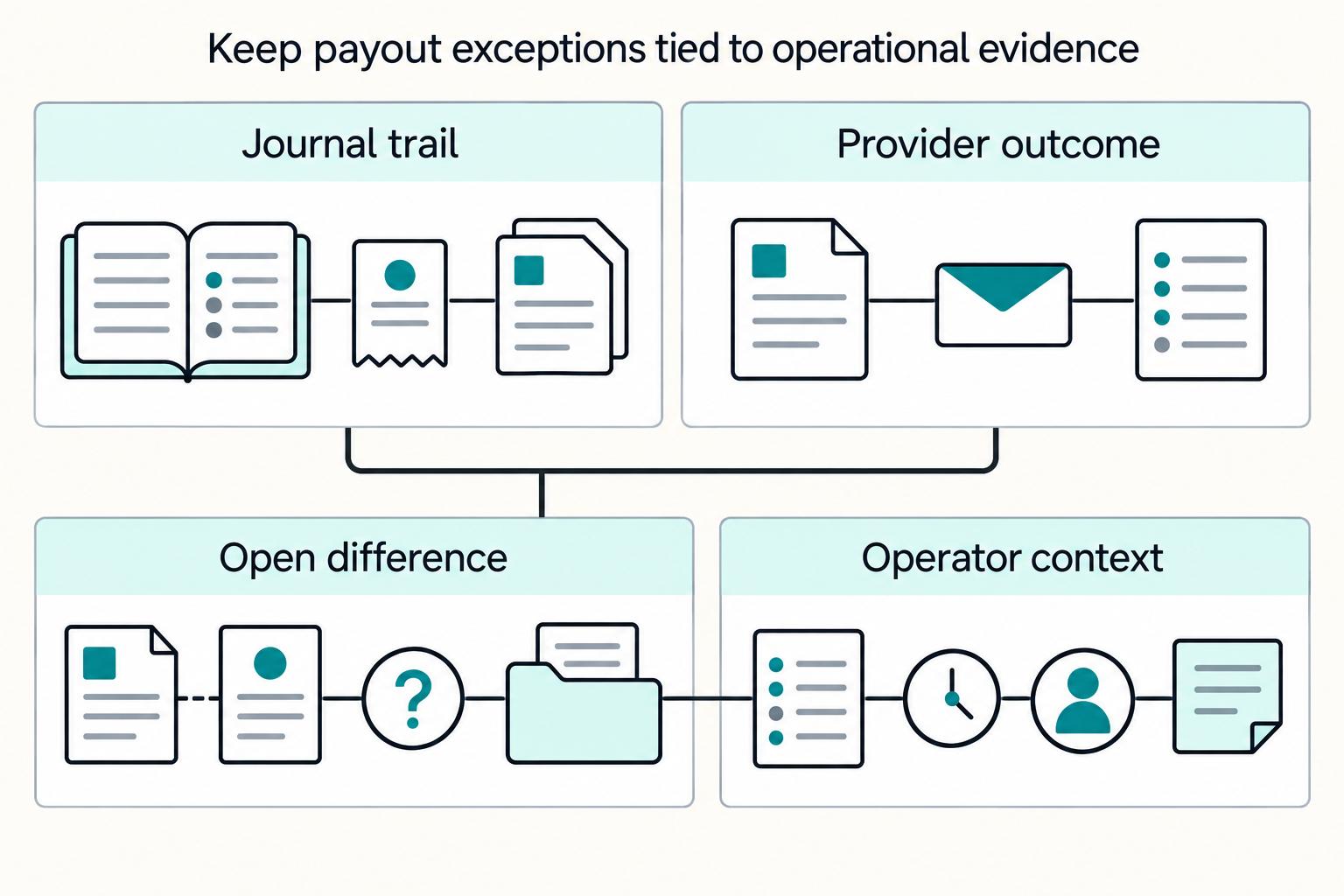
| Traceable journal trail | Record each collection, reserve move, fee capture, refund, and payout so history remains reconstructable | Lets you trace one completed order end to end and confirm the full journal trail is clear |
| Duplicate-safe retries | Replay the same payout request and the same incoming event; state should not change after the first successful write | Helps prevent duplicate transfers or duplicate balance deductions |
| Reconciliation cadence | Run reconciliation between internal balances and provider-reported payout outcomes, and keep unresolved deltas in a short, owned queue with clear due times | Helps you catch mismatches early; if provider outcomes do not match internal balances, pause new releases where needed and investigate |
| Operator failure context | Show failed, held, and returned payouts with payout state, last action time, allowed next actions, and reason codes when available | Supports transparent risk handling, early alerts, and SLA-backed support commitments |
Create a traceable journal trail for every balance change#
Start with a ledger approach you can audit, not just payout API calls. Each collection, reserve move, fee capture, refund, and payout should be recorded so history remains reconstructable.
This is what keeps payout operations explainable as complexity grows. Digital payment channels are described as growing about 4 to 5x faster than traditional acquiring, and the same excerpt describes a large marketplace-intermediated and cross-border share. That means more operational state changes to track. A practical check is to trace one completed order end to end and confirm the full journal trail is clear.
Make retries duplicate-safe before you trust them#
Retries only help if repeated requests do not create duplicate transfers or duplicate balance deductions.
Test this before launch. Replay the same payout request and the same incoming event, then confirm state does not change after the first successful write. This helps prevent payout-state confusion that can turn into support and trust issues.
Reconcile internal and provider payout records on a defined cadence#
Run reconciliation between internal balances and provider-reported payout outcomes, and keep unresolved deltas in a short, owned queue with clear due times.
If provider outcomes do not match internal balances, pause new releases where needed and investigate. If provider reporting lags internal balances, mark that explicitly instead of assuming it will self-correct.
Give operators clear failure context and next actions#
Operators need a clear view of failed, held, and returned payouts, including payout state, last action time, and allowed next actions. Include reason codes when they are available.
That visibility supports transparent risk handling, early alerts, and SLA-backed support commitments. It also addresses a common dissatisfaction pattern in payout operations: holds and reserves friction, plus opaque support.
This pairs well with our guide on How to Build a SaaS Marketplace That Manages Subscriptions and Contractor Payouts.
Common mistakes that force expensive rebuilds#
Expensive rebuilds usually come from one bad assumption repeated across product, ops, and finance. Fix these early so you do not have to rework onboarding, payout eligibility, and margin logic after launch.
Stop cloning one-country contractor logic#
A single-country contractor model can break once you expand. U.S. classification is facts-and-circumstances based, and IRS guidance says it is not determined only by how or how often someone is paid. DOL and other legal frameworks also use different standards, so one decision tree does not transfer cleanly.
A practical check is simple: compare one future launch country and one U.S. seller type against your current onboarding questions. If both would be auto-approved the same way by default, treat that as a warning. Keep jurisdiction as a core field in policy and eligibility logic, not a document note.
Treat tax forms as active records, not uploads#
Tax forms should drive payout eligibility, not just document collection. Form W-8BEN is submitted when requested by the payer, and its validity generally ends on the last day of the third succeeding calendar year unless circumstances change. That requires lifecycle fields like issue date, status, re-verification, and payout pause behavior.
Apply the same logic to U.S. reporting workflows. Form 1099-NEC reporting is tied to thresholds of $600 and $2,000 for payments made after December 31, 2025. Your ledger should total reportable payments by seller and year, and Ops should be able to explain why a seller is tracked under W-8BEN, 1099-NEC, or neither.
Price payout operations with disputes in the model#
Payout-fee optimization on its own is incomplete. Disputes can reverse payments immediately and add dispute fees, and reserves are temporary holds meant to absorb expected losses.
Model dispute exposure and chargeback reserve before you optimize rail cost. In indirect-charge settlement designs, refunds, disputed amounts, and related fees can be debited from your platform balance first. That balance risk can matter more than reducing visible payout fees like 1% instant payout pricing or 0.25% + 25¢ per payout.
Rebuild unit economics for marketplace settlement#
Service-company math does not map cleanly to marketplace settlement. Reserves, failed refunds, dispute reversals, and reporting operations all sit between gross and net, and skipping them inflates apparent take rate.
Run a verification pass on one real order with gross amount, platform fee, reserve contribution, payout fee, dispute exposure, and net seller payout. If finance cannot reconcile that flow to the ledger and tax-status path, pause expansion and fix the model first.
Related: How to Build a Tiered Commission Structure for Your Marketplace: Performance-Based Fee Models.
Recovery steps when tax or classification is unclear at launch#
When you find a real gap, contain risk first. Reopen only after you can show which rules apply to which users and which controls govern payout.
| Step | Action | Key check |
|---|---|---|
| Pause activation and contain funds | Pause new seller activation in the affected jurisdiction or segment, and keep unreleased funds in a controlled state until policy review is complete | Before reopening, confirm that Ops can identify every seller in scope, each payout state, and whether funds are released, held, or pending review |
| Apply temporary controls during review | Disable instant payout, tighten KYC checks, and route tax-document exceptions to manual review | If reviewers cannot see jurisdiction, tax-form status, and payout history together, keep the pause in place |
| Escalate when foreign-reporting signals appear | Escalate tax and legal review when facts may involve FBAR (FinCEN Form 114) or Form 8938 | Form 8938 is not universal; it depends on filer type, whether an income tax return is required, and whether the applicable threshold is exceeded. Filing Form 8938 does not replace a separate FinCEN Form 114 obligation when that obligation applies |
| Reopen only after decisions and controls align | Publish a dated decision log with the issue, affected cohort, reviewer, decision, and explicit reopen criteria | Resume rollout only after policy text, product controls, and support scripts are aligned |
Pause activation and contain funds#
Pause new seller activation in the affected jurisdiction or segment. For already-onboarded sellers, keep unreleased funds in a controlled state (for example, a platform hold where your policy allows) until policy review is complete.
Before reopening, confirm that Ops can identify every seller in scope, each payout state, and whether funds are released, held, or pending review.
Apply temporary controls during review#
Use temporary controls for the impacted cohort as available in your platform, such as disabling instant payout, tightening KYC checks, and routing tax-document exceptions to manual review. Treat these as containment, not as proof that any single filing rule applies. If reviewers cannot see jurisdiction, tax-form status, and payout history together, keep the pause in place.
Escalate when foreign-reporting signals appear#
Escalate tax and legal review when facts may involve FBAR (FinCEN Form 114) or Form 8938. Form 8938 is not universal. It depends on filer type (a specified person), whether an income tax return is required, and whether the applicable threshold is exceeded.
IRS materials note $50,000 in aggregate specified foreign financial assets for certain U.S. taxpayers, higher thresholds for some profiles, and instructions that reference $75,000 at any time during the tax year for specified domestic entities. If Form 8938 is required, attach it to the annual return and file it by that return's due date, including extensions. Filing Form 8938 does not replace a separate FinCEN Form 114 obligation when that obligation applies.
Reopen only after decisions and controls align#
Publish a dated decision log with the issue, affected cohort, reviewer, decision, and explicit reopen criteria. Resume rollout only after policy text, product controls, and support scripts are aligned.
Conclusion and copy-paste launch checklist#
Treat this as a hard go/no-go gate. If any checkpoint fails, pause expansion and fix controls before you add countries or VA segments.
| Launch gate | What must be true | Key detail |
|---|---|---|
| Classification record | Approve the first country, first VA segment, and classification rationale in one dated record with owners and reviewed facts | If the relationship is employee-status, route it to the employee path, including applicable payroll withholding obligations |
| Payout model | Set release timing, who can trigger a dispute hold, whether and when funds move to a chargeback reserve, and which balance absorbs reversals and related adjustments | Each payout-state change should map to an auditable event with reason, owner, and a clear-to-release condition |
| Tax lifecycle | Collect Form W-8BEN when requested by the payer or withholding agent, validate it, store it securely, and make it retrievable | Track re-verification timing, since Form W-8BEN is generally valid through the last day of the third succeeding calendar year unless circumstances change |
KYC/KYB gates | Require verification in the payout-eligibility flow, with ordered gates and country-level controls where requirements differ | Define an exception lane with ownership, response timing, and allowed actions during review |
| Ledger and reconciliation | Record every collection, hold, reserve move, release, and payout in a ledger-style event trail | Use idempotency keys for payout creation and retry paths, reconcile each payout to its settled transaction batch, and treat unresolved deltas as launch blockers |
- Classification record is approved and consistent
Approve the first country, first VA segment, and classification rationale in one dated record with owners and reviewed facts. Worker status should reflect control and independence facts, not contract labels. If the relationship is employee-status, route it to the employee path, including applicable payroll withholding obligations (for U.S. context: 6.2% + 6.2% Social Security, 1.45% + 1.45% Medicare, and 0.9% Additional Medicare withholding above $200,000).
- Payout model is operationally explicit
Set release timing, who can trigger a dispute hold, whether and when funds move to a chargeback reserve, and which balance absorbs reversals and related adjustments. Each payout-state change should map to an auditable event with reason, owner, and a clear-to-release condition.
- Tax lifecycle is live before first payout
For foreign individuals, collect Form W-8BEN when requested by the payer or withholding agent, validate it, store it securely, and make it retrievable. Set a payout gate around a complete tax profile before release. Track re-verification timing, since Form W-8BEN is generally valid through the last day of the third succeeding calendar year unless circumstances change.
KYC/KYBgates and exception handling are active
Require verification in the payout-eligibility flow, with ordered gates and country-level controls where requirements differ. Define an exception lane with ownership, response timing, and allowed actions during review. Do not treat provider verification alone as a substitute for independent legal obligations.
- Ledger, idempotency, and reconciliation are proven
Record every collection, hold, reserve move, release, and payout in a ledger-style event trail. Use idempotency keys for payout creation and retry paths to avoid duplicate effects. Reconcile each payout to its settled transaction batch, treat unresolved deltas as launch blockers, and assign explicit ownership for any manual payout reconciliation.
When you're ready to implement these gates and payout states, use the Gruv docs to map the workflow into API and ops controls.
Frequently Asked Questions
Is a foreign virtual assistant always an independent contractor rather than an employee?
No. Worker status depends on the relationship facts, not country or contract labels. IRS analysis looks at behavioral control, financial control, and the relationship of the parties, and the DOL FLSA framing focuses on economic dependence versus being in business for yourself. If a role is trending employee-like, pause contractor onboarding for that segment and review whether an employee path, including W-2 reporting, is needed.
When do you need `Form W-8BEN`, and what happens if you do not collect it before payout?
Collect Form W-8BEN for payments to a foreign person when the payer or withholding agent requests it, even if no reduced rate is claimed. The form is provided to the payer or withholding agent, not filed by the payee directly with the IRS. If you release payout without valid tax documentation, the payer can face withholding exposure under presumption rules, including 30% nonresident withholding or, in some cases, 24% backup withholding, and reporting may require Form 1042-S.
How should founders decide between a direct freelancer payout setup and an agency-managed model?
Direct payouts can give you more control over onboarding, payout timing, and dispute handling, but only if you are prepared to run the related tax and payout operations. An agency-managed model can narrow your direct operating surface, but do not assume it removes classification or reporting risk by itself. The key check is explicit ownership: who collects tax forms, who handles disputes, and who absorbs fees, refunds, and chargebacks.
What should be in a minimum tax and compliance evidence pack before engineering starts?
At minimum, document your worker-classification rationale and the required tax-document path by seller type, including where W-8BEN, W-9, W-2, and 1042-S workflows apply. Include decision ownership and dated approvals so teams can show why controls exist and when they were last reviewed. Before build starts, confirm you can map each seller type to jurisdiction, documentation status, payout eligibility, and withholding or reporting handling in one place.
How do `escrow`, `split payouts`, and `dispute hold` rules change marketplace trust and risk?
They directly shape payout reliability and platform risk, so they are product rules, not just finance settings. Split payouts can route one payment across multiple connected accounts, and hold or reserve controls can delay fund availability during dispute review. If your platform balance absorbs fees, refunds, and chargebacks, these controls require tighter reconciliation and reserve operations to manage dispute losses.
What signals mean you should pause country expansion and fix operations first?
Pause when you cannot consistently classify workers or reliably collect valid tax documentation before payout. Pause when planned corridors fail because of unsupported border or balance-transfer constraints from your payout provider. Pause when dispute and complaint patterns are moving toward reserve-risk conditions instead of staying in a stable range, for example below the 1% complaint-rate target noted in PayPal guidance.
Try a related tool
Researched and edited by the Gruv editorial team. Gruv builds cross-border billing, payouts, and finance-operations software for global businesses.
Sources
Educational content only. Not legal, tax, or financial advice.
Related Posts
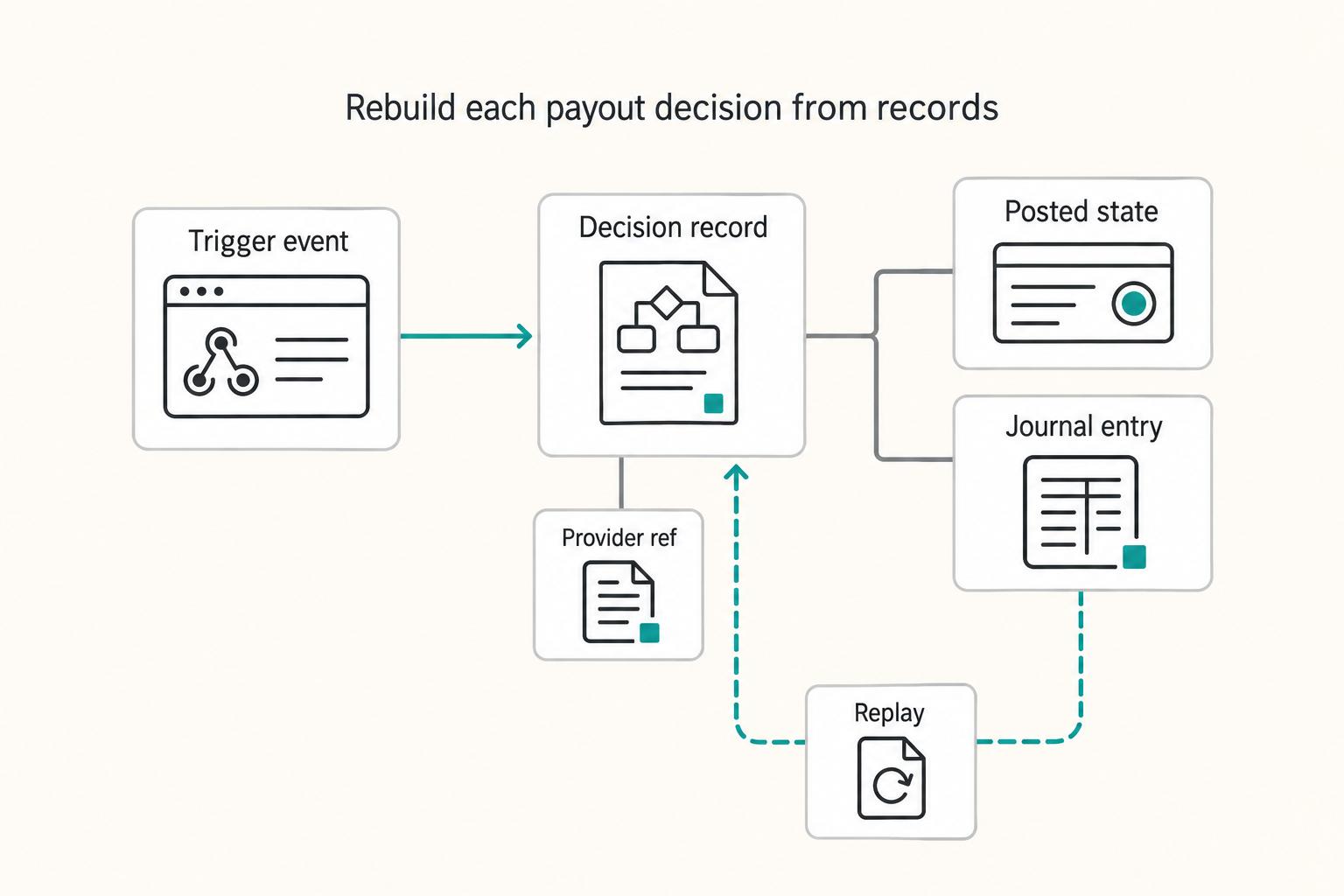
Building a Virtual Assistant Platform Around Payments Compliance and Payout Design
Start with country choice and money movement, not screens or matching logic. For virtual assistant platform payments compliance, many costly mistakes happen before launch. Teams treat corridor support as automatic, assume a provider absorbs all regulated work, or reuse one onboarding flow across markets.
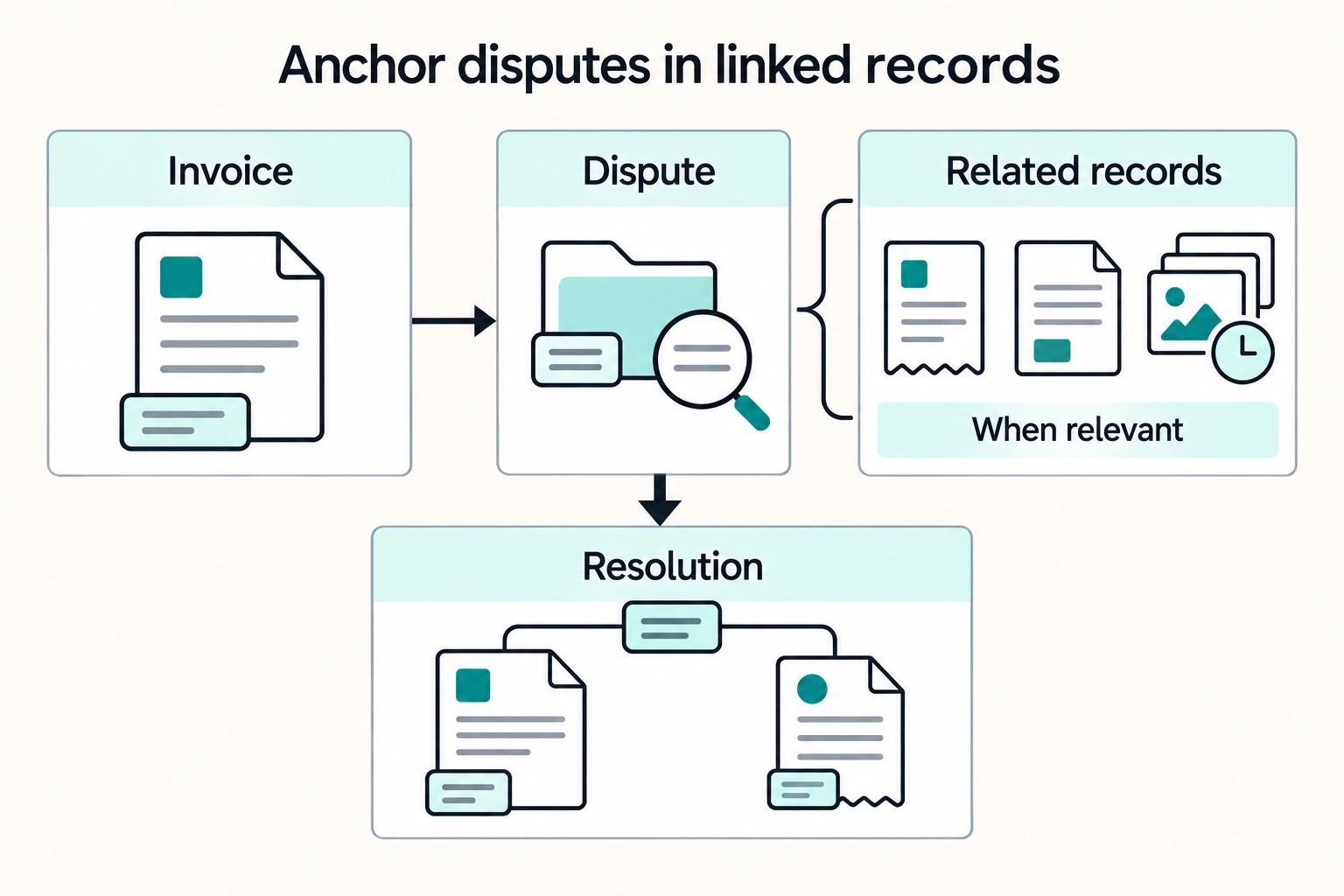
How to Build a Vendor Portal for Platforms: Tax Forms Invoices Payouts and Disputes in One Workspace
Treat the **vendor portal for platforms** as an operating surface, not a file drop or message inbox. If it cannot support onboarding checks, invoice and payment visibility, clear access boundaries, and a reliable record of status changes, it will not take real work off finance and ops.
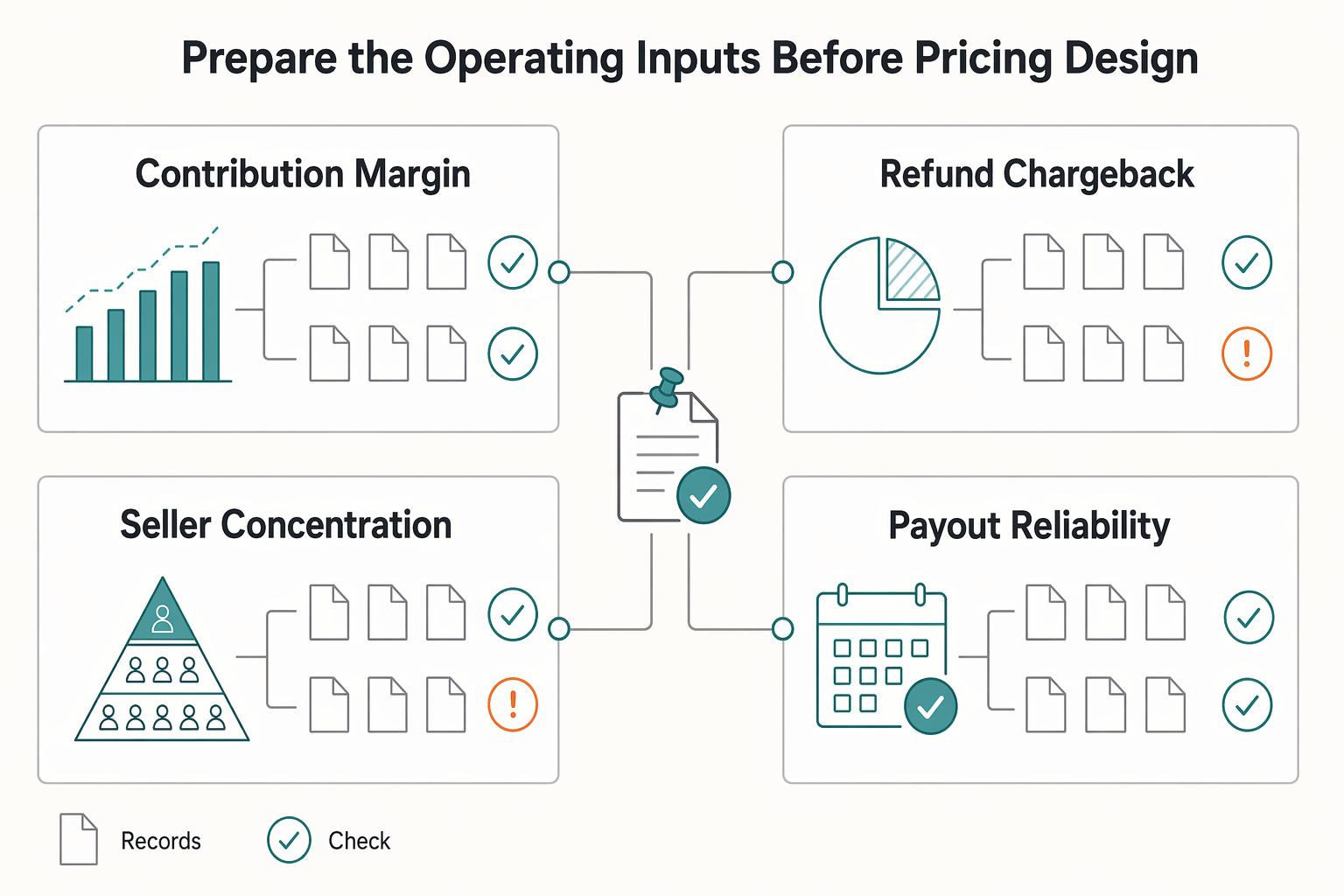
Building Tiered Commission Structures for Marketplace Performance-Based Fees
A tiered commission structure works best when you design seller growth and contribution margin together. In a commission marketplace revenue model, the operator earns a percentage or flat fee on each sale made by third-party sellers, so your upside rises when sellers perform. That alignment helps, but it does not manage itself. Revenue still moves with demand and seller activity, and an aggressive rate can create seller resistance instead of improving marketplace performance.