
Quick Answer
EdTech platforms pay instructors globally by defining a compensation model, one payable trigger per instructor segment, and release gates that finance and ops can defend. A workable setup uses an internal earnings ledger, identity and tax checks such as W-9 or W-8BEN collection, FX after the payable amount is locked, batched payouts with idempotent retries, and reconciliation from webhooks to bank and accounting records.
What Global Instructor Payout Operations Need to Cover#
Treat public payout content as market color, not implementation guidance. If you searched online learning platform pay instructors globally edtech payout, you probably found comparison posts about which platform pays instructors the most. That is not the same as a buildable path for an EdTech team that has to ship payouts, reconcile them, and defend the result to finance.
That mismatch shows up quickly in search results. Some pages promise to "compare payment models" across course platforms, while others focus on "which sites pay instructors the most" or which courses earn bigger paychecks. That can help an individual instructor benchmark upside. It does not tell a platform operator how to design payout rules, controls, and reconciliation.
The same gap shows up in community sources. Stack Exchange describes itself as community-powered Q&A, which is useful for edge cases but not the same thing as an operator guide. One MOOC compensation discussion says there is "remarkably little information available on the compensation offered to the instructors teaching the courses." Some of those discussions are also old. One finance-worth-it thread was published 9 years ago. That is a red flag if you are trying to design a current payout program from forum fragments.
Before you start#
Use this guide if you are on the platform side, not the instructor side. It is written for product, finance, operations, and engineering owners who need to decide how instructors get paid, what must be true before money is released, and how the process holds up under audit or month-end close.
Before you go further, confirm who owns each decision inside your team. You need a business owner for the compensation model, a finance owner for reconciliation, and an operations or compliance owner for tax and identity gating. If those owners are unclear, payout architecture work can stall or get rebuilt later.
This guide moves in implementation order. You will start by defining instructor segments and choosing a compensation model. Then you will turn that model into policy, build the payout architecture in the right sequence, add compliance and tax controls, and set up exception handling and reconciliation. Use a simple verification standard: you should be able to explain why a payout happened, prove it was allowed to happen, and trace it from trigger to ledger to accounting export.
Expect decision rules, not payout folklore. Public examples often stop at revenue-share anecdotes or creator earnings talk. This guide stays on the operator questions that matter: what to build first, what can block launch, how failures show up, and what evidence you need to keep. By the end, you should have concrete decisions, failure checks, and a copy-paste launch checklist your team can actually use.
What to prepare before you design payouts#
Set these decisions before you choose rails, ledger shape, or provider features, or you will likely rebuild around tax gaps, unclear ownership, or unresolved scope.
-
Define instructor segments first. Split groups that are likely to need different terms, for example MOOC partners, cohort instructors, and marketplace creators. The goal is not perfect segmentation on day one. It is avoiding one payout policy for groups with different triggers, contracts, and support needs. For each segment, confirm what earns money, when it becomes payable, and what can reverse it.
-
Collect minimum artifacts before architecture work. Have a draft payout policy, a tax-form intake plan, and a named reconciliation owner. For US tax intake, decide where Form W-9 and Form W-8BEN are collected, stored, and checked before release. Use current IRS references when designing intake fields (W-9 page last reviewed 30-Mar-2026; W-8BEN page last reviewed 01-Oct-2025). Assign one owner for QuickBooks Online reconciliation, since reconciliation matches entered transactions to bank and card statements.
-
Confirm program boundaries early. Decide whether Merchant of Record is in scope, because the MoR is the entity legally responsible for processing customer payments. Then confirm where Virtual Accounts are actually enabled and which markets require additional KYC or KYB collection during onboarding. Teams often fail here by promising market coverage before identity or business verification paths are available.
-
Set measurable success criteria up front. Define your payout timeliness target, failure-rate target, and month-end close timeline for your program. Do not borrow generic benchmarks. If finance cannot clearly define "on time" and "fully reconciled," pause design and resolve that first.
For more on catching payout errors before they affect instructors, see Catching Payout Errors Early in High-Volume Platform Operations.
Choose the compensation model that matches your economics#
Start with the model you can measure and defend in operations, not the one that looks best in a deck. If revenue is volatile and content quality is hard to police, a hybrid contract (base + variable) is usually safer than pure rev-share. If finance needs predictable accruals, do not use pure watch-time until qualified minutes, thresholds, and anti-gaming controls are written and testable.
Step 1 Pick the model that matches what you can actually measure#
Revenue share works when attribution is reliable and the earning event is easy to prove. Udemy's documented structure shows how much mechanics matter: 97% when a sale uses an instructor coupon or referral link, and 37% for certain sales without one. The lesson is not the exact split. It is that rev-share breaks down fast when channel attribution, discounting, and refund handling are unclear.
Watch-time share works when recurring-access revenue and usage data are both defensible. Skillshare states teacher earnings come from a monthly minutes-watched pool and that approximately 20% of subscription revenue is allocated to teacher payments. It also defines qualification boundaries: not all minutes count, and as of the update effective January 1, 2026, teachers need at least 75 total minutes watched by members on an active subscription to qualify for royalty payment.
Fixed-fee or hybrid contracts fit programs where cost predictability and delivery control matter more. A published LinkedIn Learning compensation summary describes upfront fees plus royalties, which is a practical hybrid example even without primary contract terms. For mixed instructor types, hybrid is often the cleanest starting point because it gives you budget control with performance upside.
| Model | Cash-flow risk | Instructor incentives | Fraud exposure | Operational complexity | Auditability |
|---|---|---|---|---|---|
| Revenue share | Medium to high; payouts move with sales, discounts, and refunds | Strong incentive to market and convert, especially with referral attribution | Medium; mainly attribution disputes and refund reversals | Medium to high when channel logic varies by source | Good if each payout line ties to order, referral source, and refund status |
| Watch-time share | Medium at pool level, lower predictability per course | Incentivizes engagement and catalog depth | High without anti-gaming controls on minutes watched | High; requires qualified-minute rules, thresholds, and period closes | Moderate unless minute logs, qualification filters, and pool math are reproducible |
| Fixed-fee or hybrid | Lower and easier to forecast | Balanced when variable upside is meaningful | Lower on usage fraud; quality under-delivery remains a risk | Medium; contract admin matters more than event volume | Strong if fee schedule, milestone acceptance, and variable formula are documented |
Step 2 Define the payout trigger before you discuss rates#
Define one payable trigger per instructor segment in contract language and ledger logic: sale booked, refund window expiry, watch-time window close, course completion (if you choose that rule), or cohort run completion for fixed-delivery programs. If finance, product, and ops would answer "when is this payable?" differently, the model is not ready.
Test one sample earning end to end before launch. For rev-share, reproduce the payout from order record, referral flag, discount, and refund status. For watch-time, reproduce raw minutes, qualification filtering, period close, and threshold checks such as the 75-minute minimum.
Step 3 Write the evidence pack for known failure modes#
Each model fails in predictable places, so document controls before scale. Rev-share fails when coupon attribution is missing or refunds hit after payout release. Watch-time fails when low-quality viewing inflates minutes, when qualified watch time is loosely defined, or when dispute handling spans multiple processors and currencies.
Keep, at minimum, the contract rate card, exact trigger definition, reversal rule, and source fields used for each payout line. If you cannot explain one payout line from contract text plus source records, simplify the model first. Related reading: Platform Economics 101 for Commission Fees, Payout Costs, and Gross Margin.
Write a payout policy operators can enforce#
Write the policy so operators can enforce it. They should be able to explain any payout line item from the text alone, including why it was released, reduced, or held.
Step 1 Define eligibility and timing per instructor segment#
For each segment, state four fields in one complete rule: who is eligible, when earnings become payable, payout cadence, and the minimum balance required before release.
A refund-adjusted cadence plus a payout floor is usually clearer than "paid monthly." Public examples show why: Udemy documents a $25 USD minimum payout threshold effective September 1, 2025, and pays Month 1 earnings in Month 3 after refunds, corrections, and adjustments. Eligible course purchases can be refunded within 30 days, so policy text needs to account for that window explicitly.
Before launch, test one sample instructor account and confirm four answers from policy text alone: eligibility today, closed earning period, threshold met or not, and handling if a refund or dispute arrives before release.
Step 2 Encode reversals, disputes, takedowns, and exits before launch#
Define clawbacks, chargeback allocation, content takedown effects, and instructor exit terms up front. If these are not written before launch, payout operations become inconsistent.
Be explicit about dispute liability. Stripe's marketplace guidance says the platform is in the end liable for chargebacks and related costs for both destination charges and separate charges and transfers. Your policy should state whether those amounts are netted from future earnings, held pending resolution, or pursued after exit if the balance is negative. Do the same for takedowns: if content is removed before period close, say whether unpaid earnings are frozen, reduced for later refunds, or released because the trigger already occurred.
Step 3 Attach a tax and region matrix to the policy#
Tie payout release gates to tax-form collection and regional tax review in the policy itself, not in separate onboarding notes.
| Instructor case | Release gate | Reporting or tax note | Operator instruction |
|---|---|---|---|
| U.S. resident instructor, any model | W-9 on file before payment release | IRS states Form W-9 provides the TIN for payers filing information returns; IRS FAQ language for Form 1099-NEC includes $600 and $2,000 for payments made after December 31, 2025 | Parameterize reporting thresholds by payout year instead of hard-coding one number |
| Non-U.S. resident instructor, any model | W-8 on file before payment release | IRS says submit Form W-8 BEN when requested by the payer; Skillshare notes W-8/W-9 collection supports withholding and IRS obligations | Use a specific "cannot pay yet" status for missing forms |
| Any instructor segment selling digital services to UK private consumers | Residency form still required, plus regional tax review where supported | HMRC ties VAT treatment to place-of-supply rules for digital services | Add a VAT review flag in policy and settlement review instead of assuming one global VAT rule |
Build the payout architecture in the right order#
Build this flow in sequence, because payout reliability depends on locking accounting facts before you send money: onboarding and identity (KYC/KYB) -> ledger posting -> FX conversion -> payout initiation -> webhook reconciliation.
Step 1: Gate payouts on onboarding and identity completion. Do not allow payable release until the account is verified. Keep a distinct cannot pay yet state for incomplete verification so ops can resolve the real blocker instead of treating it as a payment rail failure.
Step 2: Post earnings to a journaled ledger first. Create the payable balance from journaled earning events, and treat that ledger as accounting truth. Provider payout objects and webhooks should update operational state, not replace ledger logic.
Where supported, Virtual Accounts can help you collect inbound local-currency funds before outbound payout runs. Treat availability as program-specific, not universal.
Step 3: Apply FX after the payable amount is locked. Store the quote reference, currency pair, and converted amount with the payout instruction so finance can trace the final disbursement back to the original earning event.
Step 4: Initiate payouts in Payout Batches with idempotent retries. Run grouped payout batches instead of one-off calls where possible. Use an idempotency key on each payout request to make retries replay-safe, and keep your own payout-intent fingerprint long enough to catch delayed retries.
Step 5: Reconcile webhooks as telemetry and enforce duplicate safety. Webhook deliveries can be duplicated, so de-duplicate by event ID, then update operational status and evidence records. The verification checkpoint is non-negotiable: replay a duplicate payout request and confirm no duplicate disbursement occurs.
| Component | Owner | Failure mode | Retry behavior | Audit evidence |
|---|---|---|---|---|
Onboarding + KYC/KYB gate | Compliance / platform ops | Unverified account reaches payout path | No retry until verification state changes | Verification state, timestamps, account record |
| Earnings ledger posting | Finance engineering | Duplicate or missing earning journal event | Idempotent event write; manual review on mismatch | Journal ID, earning reference, policy version |
| FX quote/conversion | Treasury / payments ops | Missing or stale quote | Re-quote before send | Quote reference, currency pair, converted amount |
| Payout batch initiation | Payments engineering | Timeout or duplicate submission | Retry with same idempotency key | Batch ID, request fingerprint, provider reference |
| Webhook reconciliation | Payments ops | Duplicate delivery or unmatched status | De-duplicate by event ID; replay-safe consumer | Event ID, raw payload, processing log, final status |
For a step-by-step walkthrough, see How to Hedge FX Risk on a Global Payout Platform.
Implement compliance and tax controls without blocking growth#
Treat compliance and tax controls as payout-release gates, not cleanup work. If any code path can create, approve, or release a payout before those gates pass, treat it as a launch blocker.
Step 1 Gate payout release on AML, screening, and policy holds#
Make AML controls enforceable in code, then require a clean eligibility check before release: completed identity status, clear screening result, and no active market or program hold. For screening, use core name-match inputs such as names, addresses, and identification numbers.
Keep unresolved matches in cannot pay yet, not payment failed. A practical test is to simulate an unresolved screening match and confirm it never moves into the next Payout Batch, while the hold reason is logged for audit.
Step 2 Collect tax profiles early and keep them reporting-ready#
Collect tax profiles before payout and reporting flows diverge, so both rely on the same source record. Route U.S. persons to Form W-9 and foreign beneficial owners to Form W-8 BEN; where supported, collect W-8/W-9 data before issuing 1099s so reporting uses the correct profile.
In admin workflows, keep tax data tightly controlled: masked views for most users and an audit trail for who changed tax form status, when, and which version is active. If you surface tax-help content, label scope clearly: FEIE may apply only to qualifying taxpayers, and FBAR is a separate filing on FinCEN Form 114 for qualifying foreign financial accounts, with the IRS summary trigger above $10,000, due April 15 with automatic extension to October 15.
Step 3 Separate eligibility blocks from execution failures#
Model cannot pay yet and payment failed as separate states in product logic and ops queues. Missing W-8/W-9, outstanding verification, and compliance holds belong in eligibility; bank rejection, canceled payout, or provider execution failure belong in payment failure.
This separation prevents wrong-owner triage and pointless retries. Final checkpoint: review blocked payouts by reason code and confirm each reason maps to a clear human action.
For a market-by-market comparison of payout rails, see PIX vs. SEPA vs. ACH vs. SWIFT for Platform Payout Decisions by Market.
Operate payouts at scale and recover from failures fast#
Run payouts at scale with an explicit exception matrix, not generic support tickets. Each exception should map to a clear owner, recovery action, and verification check, then be reviewed daily against your Payout Batches.
Step 1 Build the exception matrix around real failure types#
Keep the matrix focused on failures your team actually sees. For each row, show the payout state, whether funds moved, and who acts next.
| Exception type | Typical signal | Default action | Verification checkpoint |
|---|---|---|---|
| Failed bank route | Provider payout status is failed | Manual review, confirm destination details, then retry with a new payout request | Confirm the original payout is closed and the retry uses a new idempotency key |
| Stale FX quote | Quote expires before release | Reprice, then reapprove if amount changes | Check quote duration against release time; quote locks can be 5 minutes, 1 hour, or 24 hour, with a maximum of 1 day |
| Webhook timeout | No status update received | Reconcile missed events and pause further action until status is confirmed | Verify reconciliation covers the missed window; live-mode webhook retries can continue for up to 3 days |
| Unmatched return | Returned funds are credited back in a separate transaction without a clean instructor match | Manual review plus finance queue | Confirm the returned-funds transaction is linked to the original payout before reissuing |
| Duplicate event | Same event delivered more than once | Auto-ignore duplicate side effects | Replay and confirm no duplicate disbursement or ledger posting |
| Missing tax form | Tax record is missing or unusable for release | Block release, notify instructor, and route to tax review if needed | Confirm the payout stays in cannot pay yet, not payment failed |
Do not mix release blocks with execution failures. Missing or obviously incorrect TIN data is a release-block condition, not a retry condition.
Step 2 Define recovery actions before volume arrives#
Set the default recovery path in advance: auto-retry, manual review, instructor notification, or finance escalation. Duplicate events are usually handled through idempotent requests; unmatched returns are not, because returned funds arrive as a separate transaction and can create reissue risk.
Set escalation SLAs by exception class, especially for returned payouts and batch variances. You do not need one universal timer, but you do need a rule for when an open item becomes a month-end close risk.
Step 3 Run daily controls against Payout Batches#
Use daily controls to keep exceptions from accumulating:
- Pending-age report: Flag items still pending beyond the normal window for your program and rail, including payouts waiting on webhook confirmation.
- Returned funds report: Review all
returneditems and reconcile the separate credit-back transaction before reissuing. Returns are often seen within 2-3 business days, though they can take longer by country. - Batch variance check: Compare batch total, successful, failed, returned, and blocked totals across
Payout Batches. If batch outcomes and ledger totals diverge, treat it as a same-day finance issue.
This is what keeps month-end close from turning into late nights, endless reconciliations, and unexplained discrepancies.
For more on tax classification and payout architecture for tutors and instructors, see How EdTech Platforms Pay Tutors and Instructors at Scale: Tax Classification and Payout Architecture.
Close the month with audit-ready reconciliation#
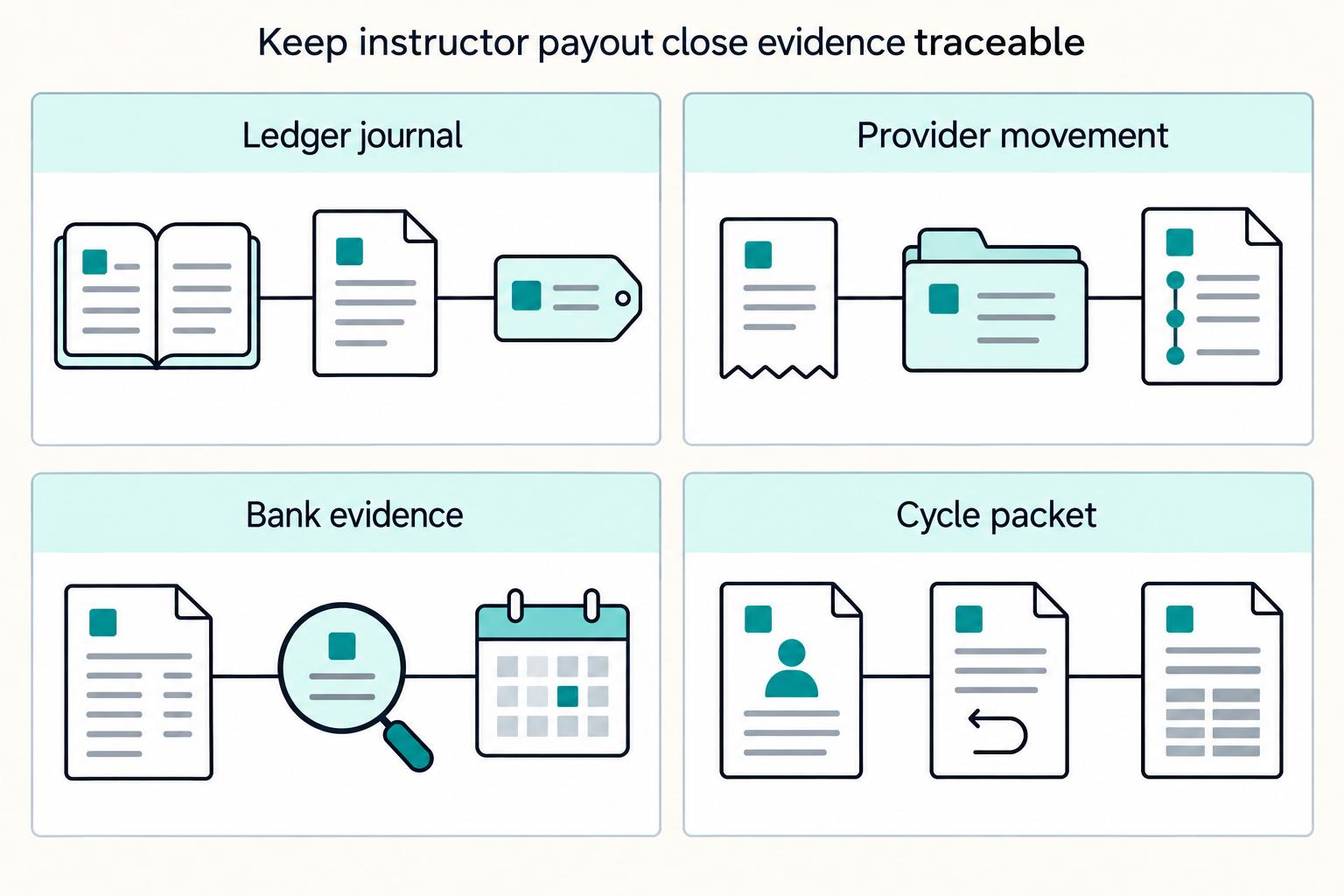
Close faster by reconciling in a consistent sequence and documenting gaps instead of guessing. A practical operating order is ledger journals, then provider references, then bank statements, then QuickBooks Online exports.
Step 1 Reconcile money movement before accounting exports#
Start in your internal ledger, then match each payout journal to provider-side movement records. In Stripe, balance transactions are the provider reference for funds entering or leaving your balance. If you run automatic payouts, use the payout reconciliation report for settlement-batch reconciliation; if you run manual payouts or reconcile the provider balance like a bank account, use the Balance report.
Starting in QuickBooks Online and working backward can hide where a break actually happened: posting, provider release, or bank settlement.
Step 2 Require an evidence pack for every payout cycle#
Keep one evidence pack per cycle with approvals, policy checks, current tax status (for example W-8/W-9), and resolution notes for any exception in the batch. QuickBooks Online reconciliation reports and Excel exports are useful accounting evidence, but they do not prove policy or tax decisions on their own.
If a payout was blocked, returned, or retried, include that history explicitly so reviewers can see why the payment path changed.
Step 3 Sample traceability and log unknowns#
Before signoff, sample payouts end to end and confirm traceability across your records: request, ledger posting, provider reference, bank match, and accounting export. Use the QuickBooks Online audit log to verify who changed the books and what changed.
When coverage differs by market or program, record unknown or not confirmed in the close file rather than inferring behavior from another rail, country, or program.
Conclusion and copy-paste launch checklist#
If you remember one thing, make it this: instructor payouts are financial infrastructure. Teams that scale cleanly decide policy, ledger behavior, and reconciliation rules before they add more instructors, countries, or payout rails.
That matters because the hard part of an online learning platform pay instructors globally edtech payout setup is rarely the transfer itself. It is whether you can prove why a payout was released, blocked, retried, reversed, or booked in accounting without guessing from provider logs.
- Choose the compensation model.
Pick revenue share, watch-time, or another clearly defined model on purpose. Mainstream platforms use materially different payout logic, and a watch-time approach needs controls that are distinct from revenue share. Expected outcome: every earnings line can be traced back to one contract rule and one measurable trigger.
- Define the payout triggers.
Write the exact event that makes earnings payable: sale booked, watch-time window closed, refund window expired, or cohort completed. A strong checkpoint is to hand two edge cases to finance and ops, such as a late refund or a disputed completion, and confirm both teams produce the same payout answer.
- Publish an enforceable policy.
Set cadence, minimum threshold, reversals, missing-form holds, and who can approve exceptions. If you want monthly payouts, say so plainly. If you use a date-based cadence like the 16th of each month, write that exact date instead of saying "monthly." Failure mode: vague policy text forces manual exceptions, and those exceptions multiply at month-end.
- Implement verification and compliance gates before release.
Verification is not optional in platform flows. Providers can require users to be verified before you can process payments or pay out funds, so keep payout release blocked until required verification and compliance states are complete. Do not treat KYC completion as proof that sanctions, tax, or market-specific review is finished.
- Ship idempotent payout orchestration.
Every payout initiation call should use an idempotency key so retries do not create duplicate disbursements. Verification checkpoint: replay the same payout request and prove the second attempt does not send money twice. One practical detail from provider behavior is that same-key retry safety may depend on a limited window, such as 24 hours in one documented Stripe error-handling path, so store your own payout intent and status history too.
- Test failure recovery.
Simulate a webhook outage and duplicate event delivery. Webhook redelivery can help during temporary endpoint outages, and one documented provider retries undelivered events for up to three days, but retries alone do not guarantee clean recovery. You still need manual review states, owner assignment, and evidence for what happened.
- Complete a month-end reconciliation dry run.
Reconcile the transactions in your system with bank and card statements, then confirm your accounting export matches. The goal is simple: match what you recorded to what actually settled. If you cannot assemble an evidence pack for a sampled payout, including approvals, policy checks, tax status, and exception resolution, you are not ready to scale. For deeper accounting handoff detail, see QuickBooks Online + Payout Platform Integration: How to Automate Contractor Payment Reconciliation.
One last rule: if market coverage or rail availability is uncertain, say "where supported" and confirm program and country details before you promise timelines. Do not let sales copy outrun what your payout stack can actually deliver.
Related: How to Pay Translators and Interpreters Globally: Language Services Platform Payout Infrastructure. Want a quick next step? Try the free invoice generator.
Frequently Asked Questions
How do online learning platforms pay instructors globally without building everything in-house?
There is no single required architecture. A workable split is to use a payout provider for money movement and screening while keeping your own earnings ledger, payout policy, and approval records. Include controls that prevent duplicate disbursements and preserve an audit trail.
When should an EdTech platform use revenue share vs watch-time payouts vs fixed fees?
Use revenue share when the sale is attributable and refunds or clawbacks can be mapped back to the instructor. Use watch-time only if the measurement window and anti-gaming controls are defined and reproducible. Use fixed fees or hybrids when predictability matters more than variable upside or attribution is too weak for a clean audit trail.
What must be in an instructor payout policy before launch?
At minimum, define eligibility, payout trigger, cadence, minimum threshold, reversal handling, and what happens when tax or compliance status is incomplete. The policy should also state which payees submit Form W-9, when foreign payees submit Form W-8BEN if requested, and who can place or clear a hold. If the text cannot explain why a payout was released, blocked, or reduced, it is not ready.
What usually breaks first when global instructor payouts scale?
Status handling often breaks first. Teams can blur cannot pay yet cases, such as missing W-9, missing W-8BEN, or review holds, with true payment failures like a returned bank transfer. A growing bucket of unresolved exceptions with no owner or evidence pack is a red flag.
Which systems are mandatory before paying instructors across borders?
For a lean launch, define four core capabilities: onboarding with identity and compliance checks, an internal earnings ledger, payout orchestration with retry control, and reconciliation into accounting. Compliance controls should follow a risk-based approach aligned with the FATF Recommendations. If any code path can release funds without those gates, treat it as a launch blocker.
How should platforms handle `W-8`/`W-9`, `1099`, `VAT`, and compliance checks together?
Treat them as separate controls that meet at payout release, not as one form-collection task. Form W-9 is the baseline U.S. payer-side form for collecting a correct TIN for information returns, and Form 1099-NEC is the IRS reporting track for nonemployee compensation. W-8 or W-9 alone does not finish global tax analysis, and VAT rules should be written by market because platform liability can shift in some supplier scenarios.
What is still unknown from public examples like LinkedIn posts, Medium articles, and forum threads?
Usually the operational details that matter most: who is the liable party, which market exceptions apply, what tax documents were collected, and how failed payouts were reconciled. Those posts can help you spot patterns, but they are not launch evidence. If a claim affects policy, tax, or liability, mark it as not confirmed until you have primary documentation or counsel-backed review.
Try a related tool
Where Gruv fits
See reconciliation and mismatch review
Compare ledger entries, provider payment records, and statement rows to see what matches and what finance needs to review.
Plan and approve payout batches
See how payee status, approval rules, route review, and exception handling sit in one payout workflow.
Researched and edited by the Gruv editorial team. Gruv builds cross-border billing, payouts, and finance-operations software for global businesses.
Sources
Includes 2 external sources outside the trusted-domain allowlist.
- docs.stripe.com/api/idempotent_requeststrusted
- docs.stripe.com/financial-accounts/connect/examples/onboardi...trusted
- ecfr.gov/current/title-31/subtitle-B/chapter-X/part-1...trusted
- irs.gov/forms-pubs/about-form-w-9trusted
- irs.gov/forms-pubs/about-form-w-8-bentrusted
- stripe.com/resources/more/merchant-of-recordtrusted
- fatf-gafi.org/en/topics/fatf-recommendations.htmlexternal
- help.skillshare.com/hc/en-us/articles/4415798406285-Earn-From-Yo...external
Educational content only. Not legal, tax, or financial advice.
Related Posts
How EdTech Platforms Pay Tutors: Tax and Payout Architecture
If you are deciding whether to open a new tutor market, set your operating model before you localize pricing, onboard tutors, or connect payout rails. You should treat classification, tax ownership, and payout architecture as launch decisions, not cleanup work for after go-live.
Pay Translators and Interpreters Globally for Language Services Platforms
Use Indeed, ZipRecruiter, and Vaia Talents for market signal only: they help you gauge demand and pricing, but they do not tell you how to run cross-border payouts.
QuickBooks Online + Payout Platform Integration: How to Automate Contractor Payment Reconciliation
For platform operators, this is an operations design problem. You need a reliable path from each payout event to a bank-matched close in QuickBooks Online, with controls finance can trust and automation engineering can replay safely.