
Quick Answer
Determine the tutor relationship from actual facts and applicable rules, then define when each lesson earns compensation. Separate learner receipts, tutor earnings, deductions and verified settlements. Apply tax duties to the real payer/payee and service location, protect retries and reconcile refunds and later adjustments without rewriting completed payouts.
Connect the lesson record to the tutor’s money#
An EdTech payout system must explain why a tutor earned an amount, which deductions were applied and whether the payment reached the intended recipient. A learner’s subscription charge, a completed lesson, a tutor’s accrued earnings and a bank payout are separate records. Treating them as one transaction makes cancellations, tax decisions and refunds difficult to reconcile.
Start with the teaching relationship and compensation terms, then design the earning and payout lifecycle. This guide gives six steps for live tutoring platforms, with a worked four-lesson example. Recorded-course royalties, school procurement and employee payroll can require different arrangements. Provider and US tax references were checked on October 4, 2026; local employment, tax and payment requirements still depend on the actual operation.
Step 1: Establish the teaching relationship and legal roles#
Document the contracting parties, where tutors perform services, worker/entity status and who controls pricing, scheduling and teaching. Assess classification under the applicable employment and tax rules before configuring compensation and payroll or contractor flows. Record the facts and responsible reviewer, not just a preferred label for each country.
Classification is not a product choice that a contract can settle alone. The IRS classification guide considers behavioral control, financial control and the relationship for US federal employment-tax purposes. Remote work does not automatically imply self-employment. Labor-law and state or foreign tests can differ, so an IRS assessment is not universal clearance for the same tutor relationship.
Examine the actual work: mandatory hours, training, teaching methods, performance monitoring, substitution, tools, dependence and continuity can matter under the relevant test. A company’s entity type and a person’s authority to access student data are separate from whether an individual is an employee. Reassess material operational changes instead of relying forever on the original onboarding description.
Also identify who sells the lesson to the learner and who owes the tutor. A collection provider, marketplace or merchant-of-record arrangement does not automatically become the tutor’s employer or take over every compensation duty. If tutors are employees, use the appropriate payroll, withholding and employment controls rather than disguising wages as marketplace withdrawals.
Step 2: Define earned compensation and each deduction#
Specify the earning trigger, rate or revenue-share base, eligible lesson types, discounts, no-shows, cancellations, refunds, bonuses and payout cadence. Distinguish the tutor’s gross compensation from learner gross receipts. State who absorbs platform, processing, payout and FX costs, and apply only deductions permitted by the agreement and law.
Hourly teaching pay, a share of lesson revenue and a guarantee plus bonus produce different calculations. A subscription may fund several lessons delivered by different tutors; do not credit all subscription cash to the first instructor or treat unused learner credit as already-earned tutor pay. Link each earning to the lesson/service record and the terms version that determined it.
Provider examples can reveal important exceptions. Preply’s commission model describes 100% commission on a trial lesson with a new student and 18%–33% on subsequent lessons, depending on accumulated teaching hours. That is one platform’s documented model, not an EdTech benchmark or a recommendation to make all trials unpaid. Keep trial and regular earning rules explicit if your model distinguishes them.
Call the amount after agreed fees and required withholding a net payout, not guaranteed after-tax take-home income. Tutors can owe additional taxes and incur receiving-bank or conversion costs. A planning estimate should identify assumptions and excluded charges; an actual statement should show the applied amounts and currency.
Worked example: four booked lessons, three earned payouts#
Assume a hypothetical contractor marketplace collects $50 for each of four lessons, $200 total. Three lessons are completed and one is canceled before it earns tutor compensation, with a full $50 learner refund. The agreement allocates 80% of completed-lesson revenue to the tutor and 20% to the platform. The platform absorbs an illustrative $6 collection fee and $2 payout fee. No taxes, FX or other costs apply in this example.
| Component | Calculation | Amount |
|---|---|---|
| Learner receipts | 4 × $50 | $200 |
| Refunded canceled lesson | 1 × $50 | $50 |
| Completed-lesson revenue | 3 × $50 | $150 |
| Tutor gross earnings and net payout | 80% × $150; no tutor deductions | $120 |
| Platform allocation | 20% × $150 | $30 |
| Platform fees | Collection $6 + payout $2 | $8 |
| Platform contribution after those fees | $30 − $8 | $22 |
The cash check is $200 = $50 learner refund + $120 tutor receipt + $8 provider fees + $22 remaining platform cash. This simplified allocation is not a revenue-recognition conclusion or a tax rule. If the terms instead compensate a late cancellation, that lesson needs its own earning rule; the platform cannot assume every refund erases tutor entitlement.
Before payout, suppose one completed $50 lesson is also fully refunded and the agreed lawful policy reverses that lesson’s tutor earning and platform allocation. Record a new $50 learner refund, a $40 earning reversal and a $10 platform-allocation reversal. Tutor payable becomes $80 and retained completed-lesson revenue $100. Keeping the same assumed $8 fees, remaining platform contribution becomes $12: $200 = $100 refunds + $80 tutor receipt + $8 fees + $12 remaining cash.
If the $120 tutor payout had already completed, do not rewrite it to $80 or claim $40 was automatically recovered. The actual receipt remains $120. Record any permitted recovery claim or future adjustment separately, obtain the required authorization and explain it on the statement. If recovery is not allowed or succeeds only partly, the platform must reflect that actual result rather than silently forcing the old cycle to reconcile.
Step 3: Map applicable tax data, withholding and reporting#
For each relevant tutor and payment type, document tax status, service location, required certifications, withholding decision, remittance and reporting party. Separate tutor obligations from platform obligations. Implement the approved rules and change/renewal handling, with restricted evidence access and a clear escalation path for missing or contradictory facts.
For US sourcing of personal-service income, the IRS guidance generally looks to where services are performed, regardless of the contract, payer residence or payment location. Online delivery to a US student therefore does not by itself establish that a tutor teaching abroad earned US-source service income. Mixed-location services need the appropriate allocation and exceptions reviewed.
Form W-9 supplies US taxpayer identification and certification for relevant reporting. Form W-8BEN instructions distinguish foreign individual status documentation from other forms and explicitly direct certain nonresident personal-service treaty claims for US-performed services to Form 8233 or W-4. A W-8BEN is not a universal exemption from withholding, and an entity may need a different certification.
Determine whether compensation information returns, foreign-person reporting, backup withholding or other duties apply to the actual payer/payment configuration and current tax year. Do not apply one permanent threshold to every tutor or assume the payout processor is always the filing party. Sales/VAT rules for learner charges and platform reporting duties are separate workstreams from withholding on tutor compensation.
FATCA concerns specified US account/withholdable-payment contexts; Form 8938 and FBAR address their own foreign-asset/account obligations. They are not generic tutor earning or payout-release tests. Establish any actual applicability independently. Where required documentation is missing, follow the approved withholding or release rule rather than assuming every missing form must cause the same hold or every completed form guarantees zero withholding.
Step 4: Implement the lesson-to-payout lifecycle#
Link lesson/service evidence, earnings, approved deductions, tutor payable, payout instruction and provider outcome with stable references. Keep earned, held, eligible, submitted and delivered amounts distinguishable. Use one execution owner per authorized logical operation and investigate unknown results before creating another payment.
| Stage | Record to preserve | Boundary |
|---|---|---|
| Lesson scheduled/completed/canceled | Lesson ID, service location, attendance/outcome and terms | Booking or learner charge alone does not prove earnings |
| Earnings approved | Rate/share, base, adjustments and approver where required | A held payable is still an obligation where earned |
| Release eligibility | Beneficiary, required data, holds, liquidity and cutoff | Eligibility is not external submission |
| Payout submitted | Internal operation and provider reference, amount/currency | Acceptance is not necessarily recipient receipt |
| Outcome verified | Defined delivery evidence, fee and return records | Later returns/adjustments remain linked history |
A tutor can have several lessons in one payout and one earning can be paid in parts. Use allocation records rather than requiring every learner charge to match exactly one external payout. Keep learner funds, unearned balances and tutor payables distinct under the applicable custody and accounting model. An ordinary platform bank account does not by itself authorize holding third-party funds.
Use the chosen API’s documented retry/idempotency rules and durable internal operation identity. Verify webhook signatures, deduplicate repeated deliveries, handle late or out-of-order outcomes and retrieve authoritative status as needed. Stripe’s webhook documentation provides a provider-specific example of duplicate and ordering concerns. A temporary idempotency cache alone is not long-term protection against paying the same operation again.
Learner refund, connected-account transfer reversal and external bank payout recovery are distinct actions. Verify what the provider automatically performs and what your platform must request. A refund to a student does not prove that the tutor’s funds were recovered. Keep actual money movement and any contractual adjustment separate, including when the platform absorbs the loss.
Step 5: Choose routes and tutor statements that match the obligation#
Confirm supported recipient countries/entity types, currencies, limits, beneficiary requirements, timing and fees for the selected provider and rail. Tell tutors the cadence, cutoff/time zone, minimums where applicable, required actions and fee/FX treatment. Provide an itemized statement linked to lesson earnings and actual payout outcomes.
Compare the recipient’s usable amount and expected timing, not just advertised transfer speed. A local bank route may reduce receiving costs; a cross-border route may require conversion or extra beneficiary data. Provider coverage can vary by platform country, account type and use case. Do not promise that every tutor can receive every currency or that a named backup rail is automatically eligible.
Show beginning payable, newly earned compensation, agreed fees, required withholding, adjustments, paid amounts, held amounts and ending payable with clear definitions. Explain estimated versus executed FX rates and source versus receiving currency. If the tutor’s net amount drops after changing providers, determine which fee, conversion or tax change caused it instead of claiming unchanged gross compensation guarantees unchanged receipt.
For an unknown payout result, communicate verification pending, the current owner and next update. A replacement route needs eligibility, consent where required, authorization and evidence that the original will not also discharge the same amount. A compliance restriction cannot be resolved simply by moving the payout to another provider.
Step 6: Reconcile the pilot and preserve later adjustments#
Test a contained cohort through lesson evidence, earning approval, payout execution, tutor statements and provider/funding reconciliation. Include cancellations, learner refunds before and after payout, repeat callbacks, changed beneficiaries and uncertain submissions. Define readiness from those outcomes and owned exceptions rather than a universal launch duration.
Use a payable roll-forward: beginning payable + approved earnings + payable-increasing adjustments − payable-reducing adjustments − verified settlements = ending payable. Required withholding that discharges part of the obligation must be represented under the approved accounting policy alongside the tutor payment and remittance liability. Do not treat a held amount as paid merely because it is excluded from the current batch.
In the first worked example, beginning payable $0 plus approved earnings $120 minus verified tutor settlement $120 leaves $0. In the pre-payout refund variation, earnings $120 minus the approved $40 reversal minus settlement $80 also leaves $0. If only $70 is verified settled, $10 remains payable; a clean-looking batch total must not hide it.
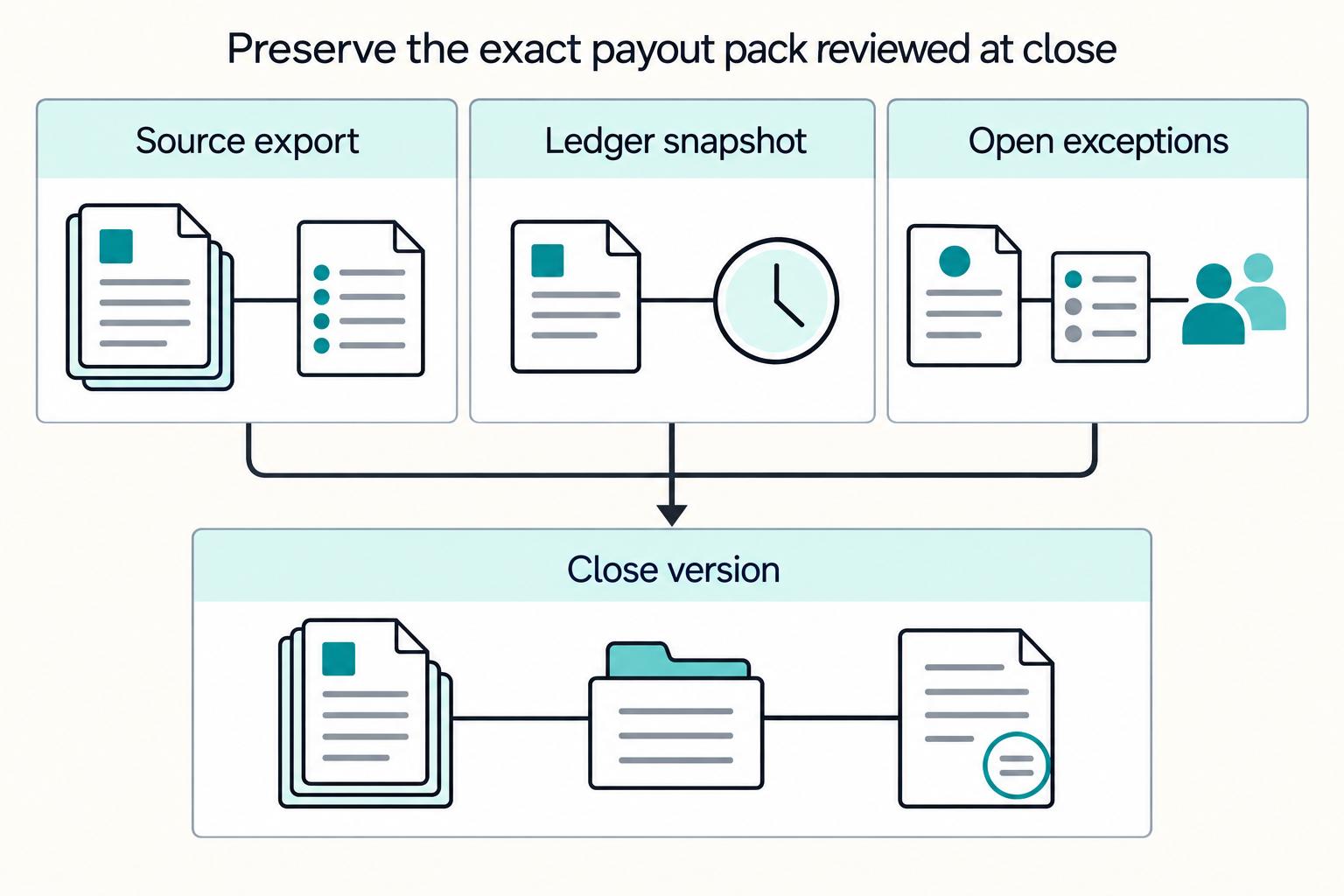
The diagram keeps source exports, a ledger snapshot and open exceptions tied to the exact close version. Preserve the cutoff, reviewer and reconciliation definitions. Later corrections should link to the original cycle and retain actual completed payments. Closing a period does not erase a later return, and a known unresolved item can be accounted for visibly instead of being silently dropped from the pack.
Track success with a defined denominator, unresolved results and returns, exception age, tutor support cases and reconciliation differences. Provider-complete responses alone do not establish recipient receipt for every rail. Expand only when the documented classification, tax and payout controls are operable for the next cohort, with clear ownership for remaining cases.
For shared evidence controls, see Build a Compliance Audit Log That Survives Scrutiny. The payment fee comparison tool can help compare entered fee assumptions; it does not determine classification or withholding.
Frequently Asked Questions
How do EdTech platforms calculate tutor take-home income from gross payout?
Calculate earned gross compensation from the agreed lesson/rate/share rules, then separately show lawful fees, required withholding, adjustments and executed FX/payout costs. Net payout is not necessarily final after-tax income. Reconcile the statement with actual settlements and keep learner gross receipts distinct from tutor earnings.
Who should handle taxes on tutor payouts, the platform or the instructor?
Both can have different duties. Determine classification, service location, tax status, payer role and applicable law; assign platform/provider withholding, remittance and reporting where required while tutors retain their own tax obligations. A contract label or outsourcing agreement does not automatically transfer every legal duty.
Can a platform change payout structure without reducing total tutor compensation?
A platform may absorb new costs or adjust the agreed structure to preserve receipt, subject to contract and law. Compare each affected tutor’s earned compensation and actual net payout, not only averages or learner prices. Unchanged gross figures do not guarantee unchanged fees, withholding, FX outcome or after-tax income.
What is the minimum payout architecture needed before multi-country launch?
You need linked service/earnings records, tutor payables and adjustments, recipient/release controls, supported execution and retry recovery, verified outcomes, statements and reconciliation with evidence. Use the payroll path where applicable. The architecture can combine existing stores and services; it need not be one payout per lesson.
What usually breaks first when tutor payouts scale across countries?
There is no universal first failure. Watch incorrect earning triggers, mismatched tax/beneficiary data, duplicate execution, unclear refund allocation, uncertain outcomes and weak reconciliation. Define owners and monitor evidence for the actual cohort rather than asserting traceability always fails before throughput.
When do FATCA and W-8 requirements become operational blockers for payouts?
Determine the relevant US withholding/account context and the appropriate payee certification. A W-8 form is not a blanket exemption or universal release requirement; some US personal-service treaty claims require other forms. Missing data follows the applicable withholding/release policy. Form 8938 and FBAR are separate obligations, not generic tutor payout gates.
Try a related tool
Researched and edited by the Gruv editorial team. Gruv builds cross-border billing, payouts, and finance-operations software for global businesses.
Sources
Includes 1 external source outside the trusted-domain allowlist.
Educational content only. Not legal, tax, or financial advice.
Related Posts
How EdTech Platforms Pay Instructors Globally: Compensation Models, Payout Controls, and Reconciliation
Treat public payout content as market color, not implementation guidance. If you searched **online learning platform pay instructors globally edtech payout**, you probably found comparison posts about which platform pays instructors the most. That is not the same as a buildable path for an EdTech team that has to ship payouts, reconcile them, and defend the result to finance.

Host Payout Architecture for Short-Term Rental Platforms
Choose your payout architecture before you pick your next country. The usual break point is where host payments meet local payout-method coverage, identity checks, risk review, and finance close requirements.
FATCA and W-8 Tax Compliance for Platforms: When to Release, Hold, or Withhold Foreign Payouts
The decision is not whether you collected a tax form. The question is whether you can **release, hold, or withhold** a foreign payout based on documentation you can rely on, the payee's status, and whether the payment is in scope for U.S. withholding.