
Quick Answer
E-learning marketplaces should choose creator payout logic and tax ownership before launching each market. The article recommends deciding market by market whether the model is marketplace-led, merchant of record, or direct, then locking the earnings formula, naming who handles registration and remittance, and requiring auditable records before first payout or country rollout.
How e-learning marketplace payouts work#
Choose your payout and tax operating model before you commit product or go-to-market resources in a new country. In the United States, Canada, and similar multi-jurisdiction rollouts, that early choice shapes who controls creator earnings, who carries tax obligations, and how much operational complexity your team takes on.
Some teams do this in reverse. They build catalog and launch plans first, then try to retrofit royalty and tax ownership. Once money starts moving, mixed ownership can be hard to unwind.
There is also a scale reason to decide early. One 2025 LearnWorlds article frames its experience as lessons from "$1B in course sales and 23M learners." In the same narrative, the founders say they started building what became LearnWorlds in 2011, following earlier learning-management-system work in 1999. The point is not that one company offers a universal template. It is that early operating choices may carry forward into very large transaction volume.
This guide stays focused on three linked decisions:
- How creator royalties are calculated and paid
- Who owns tax handling on the sale side and reporting side
- What rollout controls are required before opening a market
The central tradeoff is simple. A more direct model can give you more control over creator economics. Convenience models can lower day-one operational load across jurisdictions but may limit flexibility in payout and pricing.
Before you commit resources#
Use one launch checkpoint per target market. Define who owns the sale, who owns creator payout instruction, and who owns the tax obligation. If those owners are not explicit for the United States and Canada separately, the model is not ready for direct launch.
Confidence note: public material is stronger on growth narratives than on exact payout and tax mechanics, and one candidate tax-guide source was inaccessible due to an access block. So this article avoids unsupported threshold claims and stays focused on decision structure, evidence requirements, and rollout discipline.
What to prepare before you choose a model#
Do not choose a model from memory or assumptions. Build a minimum evidence pack first, or you will end up debating margin and launch speed without clarity on operating mechanics or tax workflow checkpoints.
Step 1 Build the minimum evidence pack#
Start with four fields for each target market: marketplace model (two-sided or direct), who handles content delivery and payments, pricing approach (subscription access or per-course), and known creator tax checkpoints. Keep each market on one page, and keep the entries specific. If any shortlisted market has a blank field, comparison is premature.
| Field | Options or focus | Note |
|---|---|---|
| Marketplace model | Two-sided or direct | Record for each target market |
| Content delivery and payments | Who handles content delivery and payments | Keep each market on one page |
| Pricing approach | Subscription access or per-course | Keep the entries specific |
| Creator tax checkpoints | Known creator tax checkpoints | If any shortlisted market has a blank field, comparison is premature |
Step 2 Gather the tax question set before you seek answers#
You do not need final rulings yet, but you do need a clean intake list. For U.S. creator workflows, include who tracks self-employment tax (both employer and employee portions of Social Security and Medicare), quarterly estimated payments, reporting all income even without a Form 1099, and Schedule C income and expense records. For jurisdiction-specific obligations you haven't confirmed yet, mark them as unknown and assign follow-up.
Step 3 Confirm owners and approval authority#
Assign a product owner and a finance owner before comparison starts. Also name who can approve marketplace assumptions and U.S. creator tax workflow checkpoints. If unresolved jurisdiction-specific questions have no clear owner, the launch sequence is unstable.
Step 4 Set non-negotiables for operating model and records#
Set your hard filters before you compare models. Define whether the platform will handle content delivery and payments and whether you are optimizing for subscription access or per-course sales. Require recordkeeping that supports quarterly estimated payments and complete income reporting from day one.
In the United States, creators may still need to report all income even without a Form 1099, so your records should remain auditable beyond year-end form delivery.
Step 1 choose your operating model by market#
Choose your model market by market, not once for the whole business. If your team cannot operationalize tax registration obligations in a target market, treat direct as not ready there for now. Consider a marketplace-led or merchant of record path while you close ownership gaps.
Score control before margin#
Score control before margin. In marketplace-led setups, pricing and creator-term control can be more constrained than in self-managed setups, so confirm contract scope before you commit.
Packaging decisions also lock in commercial behavior early. In one grounded example, a membership model with unlimited access at $99 annually is contrasted with a pay-per-course pattern of $50-200 per course, showing how pricing structure can differ before tax-design details are finalized.
That same example shows why marketplace-led models can simplify operations. The platform facilitates delivery, handles payments, and provides tools for both sides. For many teams, that reduces creator-side operational burden compared with building a self-hosted site and funnel.
A merchant of record path may sit between marketplace-led and direct, but treat it as a candidate until ownership is explicit. Confirm liability allocation, fees, implementation effort, and country-level tax remittance ownership with a qualified adviser.
A direct or self-managed path can increase internal control, but it also shifts more operational responsibility to your team, including registrations, exceptions, and ongoing tax operations.
Apply the hard rule on tax ownership#
Do not score tax ownership by assumption. For each market, name the owner for:
tax registration obligationstax remittance- exception, refund, and clawback approvals
- the current source used, with a visible date or revision date
Source quality is also a gate. The IRS Entertainment Audit Technique Guide explicitly says it is not an official pronouncement of law and warns that technical accuracy may change after its revision date. Use it as an operational aid, not a substitute for binding authority or explicit internal ownership.
Use one readiness test across teams. Ask finance, product, and the registration approver the same question: "Who registers, who remits, and who handles exceptions in this market?" If the answers do not match, treat direct readiness for that market as unresolved.
Use a compact go/no-go table per market#
Apply this table separately to each target market.
| Path | Pricing / creator-term control | Tax ownership checkpoint | Launch speed signal | Expected margin signal | Exception handling load | Go/no-go rule |
|---|---|---|---|---|---|---|
| Marketplace-led | Validate in platform terms and contracts | Verify contract scope; do not assume | Can reduce setup burden where platform delivery and payments are already in place | Contract-dependent | Often lower for your team when platform operations are included | Go when you need entry but cannot yet operationalize direct tax ownership |
merchant of record | Must be defined in contract | Must be explicit in contract | Vendor- and market-dependent | Contract-dependent | Vendor- and contract-dependent | Go only when ownership and operating scope are contractually clear |
| Direct / self-managed | Internally defined by your operating model | Must be operationalized internally before launch | Readiness-dependent by market | Depends on your cost-to-comply and operating model | Plan as highest on your team until proven otherwise | No-go until tax registration and exception ownership are named, approved, and testable |
Expected output from this step: one clear green, yellow, or red model decision per market, with named tax ownership. If that is missing, you have not chosen a model yet.
You might also find this useful: How Online Course Marketplaces Handle Instructor Revenue Splits and Tax Reporting.
Step 2 lock creator earnings logic before you design tax logic#
Lock creator earnings logic before you design tax logic. If your team cannot trace how a creator moves from a sale or subscription period to a payout amount, tax treatment will sit on top of a moving target.
Write one shared policy that product, finance, and support all use. At minimum, define the earning event, the revenue split basis, any subscription-pool allocation method, how refunds and chargebacks affect earnings, and how payout approval and instruction are handled.
Define the earning event and exception rules first#
Document what creates earnings and what can reverse or hold them for each royalty pattern you use. Refunds and chargebacks need to be explicit rules, not footnotes, including what happens before payout approval and after payout.
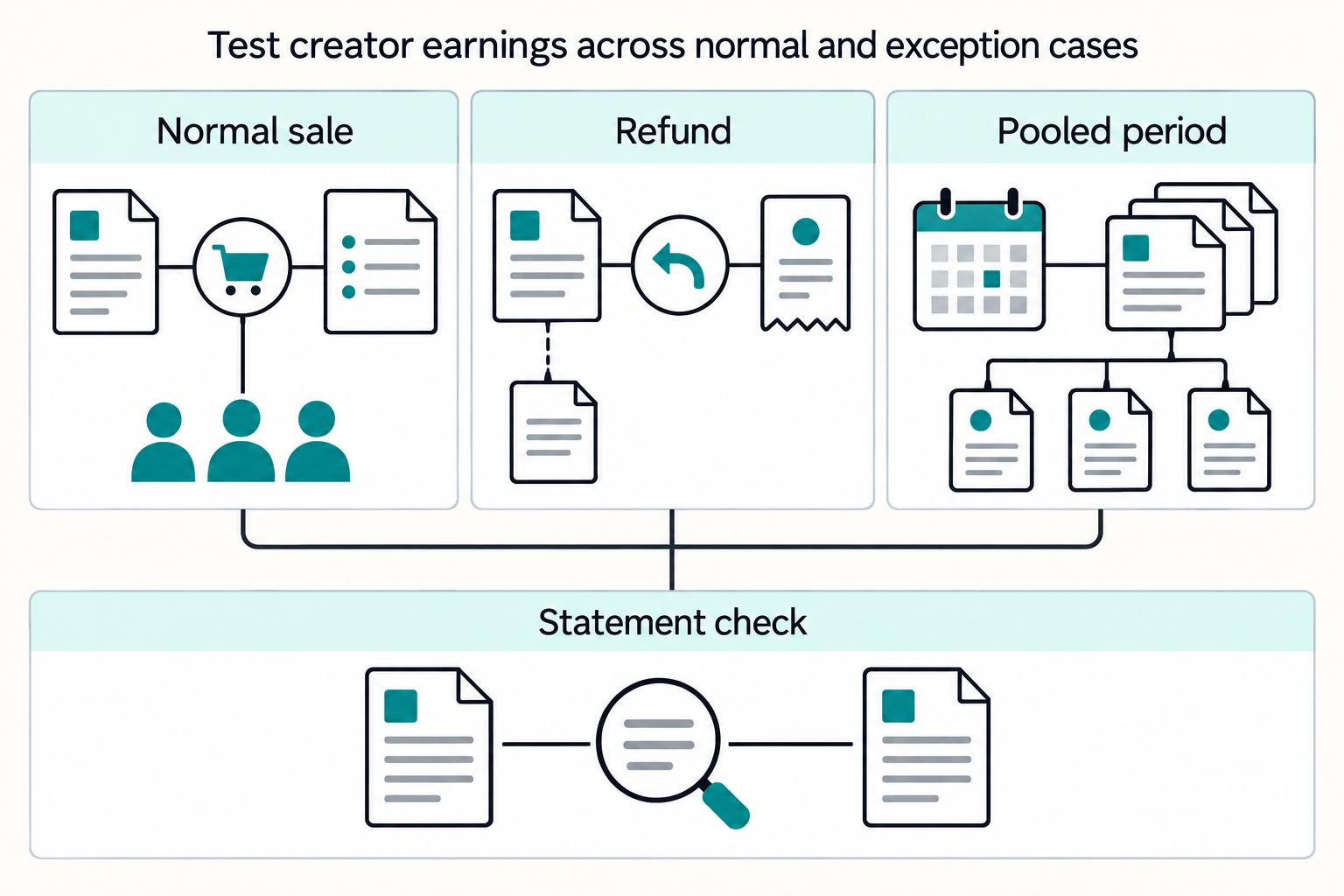
Before you touch tax logic, run a readiness check. Have finance and product independently calculate the same creator statement for a normal case, a post-payout refund case, and a pooled-period case. If the outputs or reason codes differ, earnings logic is not locked.
Keep gross-to-net steps separated in one internal sequence#
Use one documented internal workflow, and keep each step visible in your ledger and statements: sale event, platform fee, creator share, tax or VAT handling, and payout instruction. Keep this as an internal control choice, not a universal legal ordering rule.
That separation can make disputes and reconciliation easier. A creator can see whether a change came from pricing, fees, refunds, tax treatment, or payout status instead of seeing one unexplained net number.
Compare royalty patterns without false precision#
Use a compact comparison that reflects what you actually operate and what public material does not confirm.
| Royalty pattern | Define internally | Main operating tradeoff | Mark as unknown if not documented |
|---|---|---|---|
| Transaction split | Revenue base, creator share trigger, refund and chargeback treatment, payout timing policy | Simpler to explain, but reversals can create statement volatility | Split details, reserves, adjustment sequencing |
| Pooled subscription revenue | Pool period, allocation inputs, adjustment timing, minimum data per creator and course | Fits membership products, but disputes are harder without clear statement logic | Allocation formula detail, weighting, exception handling |
If you use advances, apply the same discipline. Define when advances are recognized, how offsets work, and how records flow into statements.
Build records now for later reporting review#
Design the data now so you can evaluate later reporting paths. This step is about reportability readiness, not deciding the final form outcome now.
The IRS Entertainment Audit Technique Guide, with revision date 3/20/2023, explicitly includes royalties, advances, and recordkeeping topics. It also includes Exhibit 4-1 - Decision Path for Capitalization as a named checkpoint artifact. It says it is not an official pronouncement of law, so use it as an operational checkpoint, not binding authority.
If you want a deeper dive, read Music Royalty Tax Compliance: How Platforms Handle 1099-MISC vs. 1099-NEC for Artist Payments.
Step 3 map tax ownership by jurisdiction and course type#
Do not assume tax ownership is obvious. Build a market-by-market matrix before launch, and review live, interactive, and recorded delivery as separate product classifications unless written support says they can be grouped.
Build the matrix around classification first#
Build the matrix around what is actually being sold. Each row should say what the buyer is purchasing and who is expected to own the tax obligation for that sale path. Do not let a label like "online course" stand in for classification. In the U.S., state treatment of digital goods and services is not uniform, so one default rule is risky.
| Market and sale path | Course format to review | Tax lens to classify | Provisional liable party to confirm | Minimum evidence before go-live |
|---|---|---|---|---|
| United States, direct sale by your platform | Recorded or automated on-demand | sales tax or transaction privilege tax treatment of digital goods and services | Platform, pending legal review | State tax memo, multi-state consistency-check note, checkout tax owner, registration owner |
| United States, marketplace-led sale | Live or interactive cohort | sales tax review plus marketplace-responsibility review | Marketplace or platform, confirmed by contract and invoicing flow | Contract clause, sample invoice or receipt, reporting extract, support escalation owner |
Non-U.S. indirect-tax market, direct or merchant of record path | Recorded, live, and hybrid reviewed separately | Indirect-tax and digital-tax classification review (for example VAT or GST) | Direct seller or merchant of record, confirmed by legal and commercial records | Seller-of-record evidence, tax invoice owner, remittance evidence, return filing owner |
To verify this, finance, tax, and product should all point to the same row and identify the seller shown to the buyer, tax collected at checkout, and the entity expected to remit.
Use consistency checks, not shortcuts#
When your team is tempted to carry one U.S. state assumption across many states, add a documented consistency check. Use it to test logic, not to prove classification. If the logic is "recorded course equals one rule everywhere," treat that as a red flag. A practical matrix note is: "multi-state check reviewed: yes or no; outcome: consistency check only / not sufficient for classification."
Set a hard revalidation rule for format changes#
Because laws are changing or still being clarified, if delivery changes from live interactive sessions to automated recorded delivery, revalidate classification before rollout. Treat that as a new product launch for tax analysis, even if pricing, branding, and creator terms stay the same.
A common failure mode is keeping the same SKU, tax code, or catalog category because the content is "the same course." If your support memo says only "digital course" and does not describe delivery, it is too weak to reuse.
Define liability and handoff evidence#
For each row, name who is expected to classify, register, collect, invoice, remit, respond to notices, and retain evidence. That turns "platform, marketplace, or merchant of record" from a label into an operating model.
Where responsibilities are split, require explicit handoff evidence before launch:
| Evidence item | Named detail | Timing |
|---|---|---|
| Executed contract language | Seller or tax responsibility | Before launch |
| Sample checkout and sample receipt or invoice | Checkout and receipt or invoice evidence | Before launch |
| Reporting output | Tax amounts and transaction identifiers | Before launch |
| Named owner | Audit or customer support escalations | Before launch |
If you retain a federal classification artifact, store the official citation, not only a web link. For the IRS rule on digital content and cloud transaction classification published on 01/14/2025, track TD 10022 and 90 FR 2977, and note that FederalRegister.gov advises verification against an official Federal Register edition. That supports traceability, but it does not by itself determine state sales tax, VAT, or GST outcomes. Related: EdTech Platform Payouts: Paying Tutors Course Creators and Content Authors.
Step 4 build the creator tax document and reporting lane#
Keep creator tax documentation in its own lane, and keep the scope explicit. Do not infer W-8, W-9, 1099-NEC, 1099-MISC, or 1099-K requirements from adjacent tax work; treat those rules as unconfirmed until verified separately.
Run the lane in two tracks:
- collect and track creator tax-profile fields required by your internal policy
- maintain a boundary log for tax topics that may matter to creators personally but are not the same as marketplace reporting duties
Separate supported facts from assumptions#
The supported anchor here is IRS Form 8938. It is used to report specified foreign financial assets, and it is attached to the taxpayer's income tax return. Treat it as a return-based filing artifact for certain taxpayers, not as a substitute for platform payout reporting.
From the same record, filing conditions include being a specified person and having an interest in reportable specified foreign financial assets. For certain U.S. taxpayers, the cited threshold is aggregate value exceeding $50,000, with higher thresholds for some joint filers and taxpayers residing abroad. If no income tax return is required for the year, Form 8938 is not required even when assets exceed that threshold.
Use that as the boundary. Form 8938 and FATCA can matter for some creators, but they are not interchangeable with your payout-side reporting logic.
Build an exception map before a form list#
| Topic | What is supported here | What not to assume |
|---|---|---|
Form 8938 | Used to report specified foreign financial assets; attached to taxpayer return | Not your platform payout reporting form |
FATCA | Listed as related to Form 8938 resources | Not interchangeable with marketplace reporting duties |
FBAR and FinCEN | No filing trigger or form detail is supported in this section | Do not include as payout-reporting requirements |
W-8, W-9, 1099-NEC, 1099-MISC, 1099-K | No requirement detail is supported in this section | Do not infer when they are required from this evidence |
Add a hard internal control before payout#
If you adopt this control, set an internal checkpoint: no first payout until the creator tax profile is complete enough to audit under your policy. This is an operational policy choice, not a claim of universal legal requirement.
Minimum audit trail:
- creator tax-profile status
- document or form family requested by policy
- reviewer or exception owner
- timestamped completion or escalation evidence
Test it by sampling a creator and confirming finance can show status, document trail, and exception approval before funds release. If payout can proceed without that record, the lane is not ready.
For a step-by-step walkthrough, see How Photo and Stock Image Platforms Pay Photographers with Royalty and Licensing Payout Models.
Step 5 design payout operations that stay reliable at scale#
Write payout handling down as an internal operating policy with named states and owners. That keeps execution consistent when platform payment options and fee structures differ, and it reduces cleanup later.
A reviewer-tested comparison, published September 4, 2025 and updated January 14, 2026, is useful here as a decision input, not as contract language. It shows wide fee variation in one category: 0% (paid), 7.5% (Starter), 10%+$0.50 (free), 30% (Discover), and ~50% revenue share, plus a royalty-model example with no platform fees.
5.1 Freeze the payout sequence you actually run. A universal payout workflow is not established, so define your own sequence and keep it stable in policy. Document the internal milestones your team will use from payout initiation through reconciliation reporting.
A practical operational test is traceability: each state has one owner, one timestamp, and one system record.
5.2 Match control depth to the fee model. Use the fee model as a control-design input so gross-to-net math stays reviewable across plan types.
| Example in comparison | Fee model shown | Ops design implication (internal policy choice) |
|---|---|---|
| Teachable | 0% (paid), 7.5% (Starter) | Track payouts by plan or fee-schedule version |
| Gumroad | 10%+$0.50 (free), 30% (Discover) | Reconcile fixed-plus-percentage charges at transaction level |
| Udemy | ~50% revenue share | Define the revenue-share base clearly in policy |
| Skillshare | No fees (royalty model) | Keep royalty handling auditable as a separate path |
These are comparison examples only. Confirm current commercial terms in your own agreements before you encode payout logic.
5.3 Prevent duplicates and detached payout records. Specific technical controls are not validated here, so treat the controls below as internal policy choices. Baselines can include unique payout references, status-based retry rules, and explicit linkage between payout records and the creator tax-profile status from Step 4.
Treat this as an auditability problem: design for duplicate risk on retries and for clear linkage between successful payouts and tax-profile evidence.
5.4 Route exceptions to policy review before reattempts. Exception-handling rules are not defined here, so set them explicitly in policy before you reattempt failed payouts.
A monthly reconciliation proof standard is also not defined here. If you set one internally, require finance to trace creator gross-to-net calculations and internal tax-treatment labels back to the same record set. We covered a related framework in Gig Worker Tax Compliance at Scale: How Platforms Handle 1099s W-8s and DAC7 for 50000+ Contractors.
Common mistakes that create compliance debt#
Compliance debt usually comes from ambiguity, not one dramatic failure. The recurring pattern is launching or scaling before responsibilities, records, and review triggers are explicit.
| Common mistake | Why debt builds | Minimum control to document |
|---|---|---|
| Using one-sided revenue-share terms | Terms can look beneficial in the short term but break down over time for either side | Document revenue sources, calculations, payment terms, and dispute resolution in the agreement |
| Leaving revenue definitions and payout math vague | Teams end up reconciling payments after the fact, which creates disputes and rework | Define what revenue is included and how shares are calculated before payouts start |
| Tracking revenue shares manually or inconsistently | Weak tracking increases underreporting risk and reduces transparency | Use LMS, analytics, and revenue-tracking tools to keep share tracking accurate and reviewable |
| Skipping clear audit and compliance procedures | Contract enforcement becomes ambiguous, creating accountability gaps | Include clear audit rights and compliance procedures, including when reviews are triggered |
Tax-specific obligations are not established, so validate them separately.
A practical test is simple: if your team cannot explain who owns each step and produce the supporting records quickly, the debt is already building.
How to recover when rollout goes wrong#
When rollout goes wrong, a practical recovery pattern is to reduce ambiguity before you add more volume. In complex, unresolved-rule environments, progress can stall, so contain the affected flow, align on one documented compliance position, and reopen only after controls match that position.
Step 1. Contain the affected flow. Treat the issue as a system-level mismatch, not a queue of one-off fixes. Limit new activity in the affected lane while teams confirm they are using the same policy interpretation and record set for the same period.
Step 2. Re-establish a single documented position. Write the updated compliance position in a form reviewers can audit. The key check is consistency across policy, product configuration, and finance records. If those disagree, recovery is not complete.
Step 3. Remediate exceptions with policy-first execution. Run a focused remediation pass using documented internal policy and traceable records. Avoid ad hoc exceptions, and defer decisions where rules are still unresolved until policy is explicit.
Step 4. Restart with checkpoint-based review, and expect revisions. In complex or unresolved rule environments, restarting without checkpoints can recreate the same debt. Use explicit restart gates, then review early outcomes and revise quickly when needed, since compliance updates can require iterative amendments rather than one final fix.
This pairs well with our guide on How Platform Operators Pay Creators Globally Across YouTube, Twitch, and Substack.
Country rollout checkpoints for founders and operators#
Treat each new country as a gated launch, not a config toggle. Do not enable payouts until you can name the liability owner, confirm registration status, validate payout-rail readiness, and identify escalation contacts.
Step 1 gate the market with one launch checklist#
Use one checklist per country, with four required fields: liability owner, registration status, payout-rail readiness, and escalation contacts. The control is consistency: the same position should appear in product configuration, finance records, and the launch memo.
| Checklist field | What to confirm | Should match |
|---|---|---|
| Liability owner | Name the liability owner | Product configuration, finance records, and the launch memo |
| Registration status | Confirm registration status | Product configuration, finance records, and the launch memo |
| Payout-rail readiness | Validate payout-rail readiness | Product configuration, finance records, and the launch memo |
| Escalation contacts | Identify escalation contacts | Product configuration, finance records, and the launch memo |
For markets with formal invoice controls, add the exact local artifact checks. In India, the e-invoicing system has been live since 2020 for in-scope B2B and B2G invoices, while B2C invoices are not currently issued through that CTC flow. If you are in scope for B2C dynamic QR requirements, verify that invoice output includes required fields such as supplier GSTIN.
Step 2 require explicit internal sign-off before payouts go live#
In markets with GST or VAT complexity, set a documented internal sign-off process before you enable payouts. Approver roles can vary by organization, and this is an internal control, not a universal legal requirement.
One source example used a multi-office evaluation team and legal contract review before approval. Your structure can differ, but the approvers should be named and the approved position should be recorded.
Step 3 expand one jurisdiction at a time#
Expand one jurisdiction at a time. Launch one market, complete one full reconciliation cycle, then move to the next. This sequencing is especially useful where digital tax treatment is fragmented, as in U.S. state-level rules, so legal conclusions should be verified against current sources before rollout.
A market should leave pilot status only when sale, tax treatment, and payout outcomes reconcile without unresolved ownership questions.
Step 4 add a stop rule before exception volume outgrows capacity#
Define a stop rule before launch so pause decisions are operational, not ad hoc. You do not need a universal numeric threshold, but you do need a documented trigger to pause expansion and harden controls.
Practical stop signals include exception volume rising faster than your team can clear it, escalations bouncing between functions, and missing invoice or payout data in source systems. If gaps are structural, pause expansion first and fix the records path before adding another market.
Related reading: VAT and SEPA: How European Platforms Combine Tax Compliance with Automated Euro Payouts.
Copy and use this prelaunch checklist#
Use this as a launch gate: if any line is still TBD, hold payouts for that market.
Step 1 confirm the operating model for each market#
Document the model for each market, whether marketplace-led, merchant of record, or direct, in one record, with the contracting entity and approver named. Your pass condition is consistency: product copy, contracts, and finance assumptions should all reflect the same model for that market.
Step 2 document tax ownership, including unknowns#
Map who owns sales tax, VAT, GST, and digital-tax questions, then attach the current jurisdiction-level authorities you relied on. For U.S. digital goods and services, treat this as a high-attention item: approaches vary by state, and rules can change quickly.
Your pass condition is a dated memo or matrix that marks open questions clearly and is rechecked when your course format or delivery model changes.
Step 3 verify creator tax-data and reporting readiness#
Confirm and document whether your onboarding flow supports the tax-data and reporting path you plan to run for each market.
Run one end-to-end test creator record and confirm the data is retrievable, auditable, and linked to payout records. If you use IRS audit material as a checklist aid, treat it as audit context rather than binding law. The guide revision date is 3/20/2023, and it states it is not an official legal pronouncement.
Step 4 confirm payout reliability controls before first live batch#
Before launch, document your payout-process controls and unresolved-issue ownership. Your pass condition is one dry-run evidence pack with a test payout outcome, exception notes, and a named owner for follow-up.
If your checklist shows gaps in tax ownership or payout operations, compare your internal responsibilities with Merchant of Record for business.
Conclusion#
The practical takeaway is simple: make expansion decisions market by market, not by analogy. Use the model where ownership of creator economics is explicit, records are traceable, and your team can explain each payout and reporting output without guesswork.
Execution discipline matters more than a fast launch narrative. Provenance gaps and weak compensation evidence create risk, and higher data volume does not fix low-quality records. The model is ready only when sale events, creator earnings, payout instructions, and compliance records reconcile cleanly.
Before your next launch, run the checklist and treat unresolved evidence as a stop signal:
- Confirm who owns pricing logic, creator compensation calculations, and tax handling, and treat unresolved tax or royalty specifics as unknown until separately validated.
- Trace one sample transaction end to end from sale to payout and supporting records.
- Recheck when market, creator location, or delivery format changes.
Use broad references, including the August 2024 review (DOI 10.14445/23497157/IJRES-V11I4P108), as context only. If ownership or evidence is still unclear, delay launch until the operating proof is defensible.
Before enabling the next market, validate coverage, compliance gates, and payout flow assumptions against your exact rollout plan via Gruv contact.
Frequently Asked Questions
How do e-learning marketplaces typically pay course creators?
Platforms may use transaction splits or pooled subscription revenue, but teams should define the earning event, refund and chargeback rules, and payout approval process before launch.
What is the operational difference between marketplace payout handling and a self-managed model?
The difference is model-specific rather than one-size-fits-all. Marketplace-led paths can reduce setup burden when platform delivery and payments are already in place, while direct or self-managed paths usually give more control and put more operational responsibility on your team.
When does a platform need to collect `sales tax` on course sales?
There is no single trigger that fits every case in this article. In the United States, state treatment of digital goods and services varies, so a platform should validate current official guidance for each market and sale path before launch.
How do `sales tax nexus` and `economic nexus` change launch timing in the `United States`?
This guide does not provide numeric thresholds or one national timing rule. State requirements can change, so launch timing should depend on current official rules and a market-by-market readiness check.
Do live or interactive courses change `digital tax`, `VAT`, or `GST` treatment?
They can change the analysis, but this article does not support a universal rule either way. Treat a delivery change from live to recorded, or vice versa, as a revalidation trigger and confirm current official guidance before expanding.
Which U.S. tax forms matter most for creator payouts: `W-9`, `W-8`, `1099-NEC`, `1099-MISC`, or `1099-K`?
This section does not support a one-size-fits-all form answer. The article says not to infer W-8, W-9, 1099-NEC, 1099-MISC, or 1099-K requirements from adjacent tax work and to confirm applicability from current official guidance.
When should a founder choose a `merchant of record` model instead of direct expansion?
Treat it as a tradeoff, not a universal ranking. If your team cannot yet operationalize direct tax ownership in a market, a marketplace-led or merchant of record path may be a candidate, but go only when ownership and operating scope are contractually clear.
Researched and edited by the Gruv editorial team. Gruv builds cross-border billing, payouts, and finance-operations software for global businesses.
Sources
- commerce.mt.gov/_shared/business/SBDC/docs/StartUpGuides/Tri...trusted
- eda.gov/sites/default/files/files/tools/research-rep...trusted
- federalregister.gov/documents/2025/01/14/2024-31372/classificati...trusted
- federalregister.gov/documents/2024/06/28/2024-13597/distribution...trusted
- hcpf.colorado.gov/sites/hcpf/files/Northeast%20Health%20Partne...trusted
- irs.gov/pub/irs-pdf/p5774.pdftrusted
- irs.gov/businesses/corporations/do-i-need-to-file-fo...trusted
- law.utexas.edu/coursestrusted
Educational content only. Not legal, tax, or financial advice.
Related Posts

The Freelance Payment Penalty: A Modeled Audit of Platform Fees, FX Spreads, and Payout Delays
The money rarely disappears through a single, easy-to-spot fee. The real loss is stacked. A marketplace takes its commission, a processor adds a charge for international cards, a bank or payment company converts the currency at a spread, a platform holds the funds before release, and a wire sheds a little to intermediaries on the way in. Each layer looks defensible on its own, but the worker feels the combined result as a smaller deposit and a later payday.

How to Respond to a Subpoena for Business Records
Move fast, but do not produce records on instinct. If you need to **respond to a subpoena for business records**, your immediate job is to control deadlines, preserve records, and make any later production defensible.
A US Expat's Guide to Investing in UCITS ETFs to Avoid PFIC Issues
The real problem is a two-system conflict. U.S. tax treatment can punish the wrong fund choice, while local product-access constraints can block the funds you want to buy in the first place. For **us expat ucits etfs**, the practical question is not "Which product is best?" It is "What can I access, report, and keep doing every year without guessing?" Use this four-part filter before any trade: