
Quick Answer
Choose your base model first, then add tiers only if your team can enforce and reconcile them. For most operators, that means comparing flat take rate, tiered, and category-based options against real transaction visibility, then setting cohort-level margin floors before launch. Run historical replays with refunds and reversals, and require matching results across invoice lines, payout calculations, and ledger journals. If those checks fail, simplify the structure before expanding incentives.
How tiered marketplace commission structures work#
Step 1. Anchor the model to growth and margin#
Here, commission means the platform fee retained from the seller’s commissionable sales. Some tools call the seller’s retained share commission instead. State the direction explicitly: a lower platform take rate means a higher seller share before other deductions.
A useful fee rule lets sellers reproduce their statement and lets finance explain the remittance. Define what sales count, when the period resets and how returns change the calculation before adding performance incentives.
Start with a practical rule. If finance cannot trace a fee decision back to transaction data, and product cannot reproduce that same result in the pricing engine, keep the model simpler until they can. Complexity is usually where leakage starts. Tiered plans can work well, but they add moving parts. Failures often show up first in edge cases and exception paths when rules are not implemented consistently.
Pick the right fee model before you set tiers#
Use tiers when a measurable behavior and a funded incentive justify them. Seller concentration alone does not establish that discounts will improve growth; compare the incentive with a simpler flat or category-based fee.
Step 1. Choose the simplest model that still fits your economics#
A flat take rate is usually the easiest to explain and operate. The tradeoff is flexibility: it is predictable, but less precise if you want different incentives across performance levels.
A tiered model is built for that kind of performance logic. Tiered pricing varies cost by level or volume, and it is commonly used with revenue and margin optimization goals. The tradeoff is implementation complexity, because there are more moving parts to maintain.
A category-based commission model addresses a different axis. It can be useful when pricing differences are mainly about what is being sold, rather than who is selling or how seller performance should be rewarded.
| Model | Rule to explain | Calculation risk |
|---|---|---|
| Flat take rate | One rate on the defined commissionable base | Base exclusions and refunds still need consistent treatment |
| Tiered fee | Trigger, bands, reset and rate direction | Threshold boundaries, retroactive cliffs and adjustments |
| Category fee | Category assignment and applicable rate | Mixed carts and disputed classifications |
Step 2. Match model complexity to your monitoring maturity#
Performance-based pricing depends on monitoring real behavior and feeding that back into decisions. Before you add complexity, confirm you can reproduce fee outcomes from transaction data and track whether the model is changing behavior the way you intend.
If you cannot, keep the model simple. If you can, and you need stronger incentive targeting, tiering is more defensible.
Step 3. Use accelerators only when evidence supports them#
Commission accelerators can reinforce performance incentives, but they can also reduce take rate without changing behavior. Treat them as optional logic, not default logic.
Test the idea on historical periods before launch: who benefits, how effective take rate changes, and whether contribution margin improves after normal adjustments. If the result is mostly discounting existing top performers, skip the accelerator and keep the core model simpler.
Use flat pricing when operational clarity is the priority, tiers when targeted incentives are the priority, and category pricing when differentiation is mainly category-driven.
Related: How to Structure a Success Fee in a Consulting Agreement.
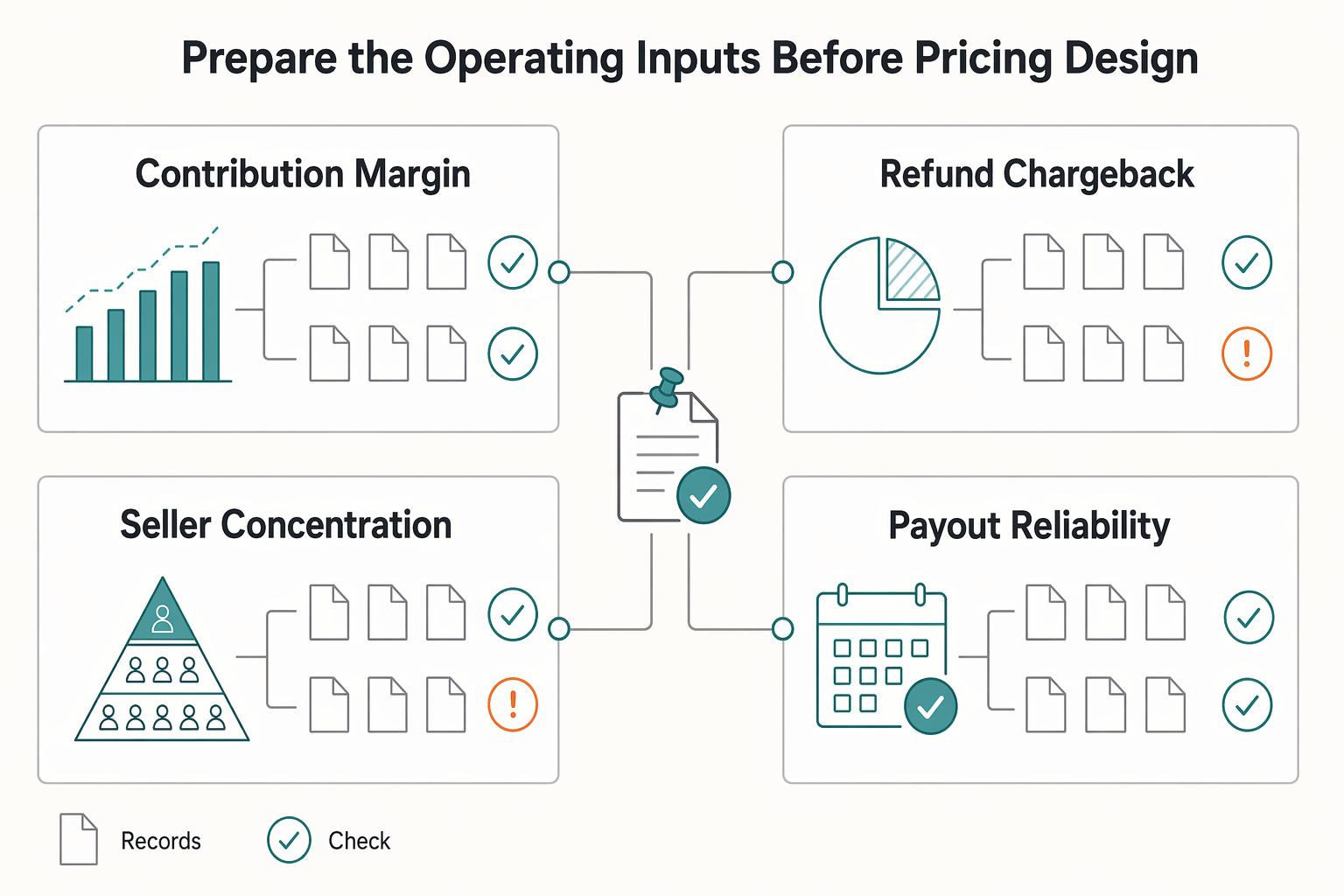
Prepare the operating inputs before pricing design#
Before you set tier thresholds, make sure your operating inputs can be evidenced and replayed. If you cannot verify outcomes through normal transaction changes, pricing design will be fragile.
| Evidence item | What to include |
|---|---|
| Contribution margin by seller cohort | After attributable direct costs |
| Refund and chargeback patterns | By seller and order status |
| Seller concentration | See who drives volume and fee outcomes |
| Payout reliability | Including failed, reversed, or manually adjusted payouts |
Step 1. Build the minimum evidence pack. Start with a small pack you can actually use: cohort-level contribution margin, refund and chargeback behavior, seller concentration, and payout reliability. Grouping by cohort matters because pricing decisions are stronger when they reflect real differences across seller groups, not just account size.
Your checkpoint: finance can reproduce fee outcomes on settled orders, then reproduce them again after reversals and refunds.
Step 2. Confirm the money trail and event handling. Choose one source of truth before you add pricing complexity. A ledger-first approach is usually easier to audit across settlement, reversal, and payout, while dashboards are better for monitoring than reconciliation.
Link order, refund and dispute events to a versioned fee calculation. Deduplicate delivered events and accounting effects separately. A repeated webhook must not create a second fee, refund or seller-payable adjustment.
Step 3. Separate commercial tier eligibility from payout eligibility. Define any promotional conditions, then enforce the action-specific payout capability, blocking requirements and policy holds. A higher seller tier does not bypass a compliance hold.
Step 4. Assign signoff and rollback ownership. Set explicit owners for rule logic, reconciliation impact, policy fit, and seller communications before rollout. Also assign one rollback owner with authority to pause or revert changes when outcomes diverge from expected ledger and payout behavior.
Document each pricing change with the rule edited, affected cohorts, approval date, and rollback trigger so reversals are fast and controlled.
Set tier thresholds that protect contribution margin#
Set a margin floor in a defined unit, such as dollars per seller-month or a percentage of commissionable sales. Calculate platform fee revenue minus attributable processing, support and expected loss costs. Seller remittance is not platform fee revenue, so do not subtract it twice.
Step 1. Segment sellers before you set thresholds#
Use cohorts with meaningfully different economics: contribution margin, refund and chargeback behavior, support burden, and payout reliability. A single threshold across unlike cohorts can hide margin risk in one group while over-rewarding another.
If a cohort has $500 of attributable direct costs and a $300 contribution target, it needs at least $800 of platform fee revenue for that period. Divide by the commissionable base to test the minimum effective take rate. For $10,000 of sales, that illustrative floor is 8%, before any separately specified costs or revenue.
Use that floor to assess the incentive budget. A lower take rate can be justified by incremental volume or lower service costs, but a historical replay alone does not prove sellers will change their behavior. Run a pilot with a defined success measure.
Step 2. Apply guardrail floors and define the tier mechanic#
A higher platform take rate increases fee revenue on a fixed sale before behavioral effects; it can also reduce seller margin or participation. A lower platform rate reduces fee revenue unless volume or costs change. Test both platform contribution and seller economics.
If a modeled tier breaches the margin floor, reduce the discount, change the qualifying threshold or revise eligibility before launch.
Progressive tiering changes the rate only for sales within each band. Retroactive tiering can change the rate on all qualifying sales in the period after a threshold is met. Model the resulting fee cliff and refund adjustments explicitly.
| Design checkpoint | What to define | What to verify before launch |
|---|---|---|
| Tier trigger | Exact event and measurement window by segment | Same field is used in pricing logic, ledger journals, and seller reporting |
| Reset window | Fixed period and reset behavior | Near-threshold sellers do not show inconsistent tier status across reports and payouts |
| Exception policy | Overrides, disputed orders, reversals, and ineligible sellers | Support, finance, and ops can apply the same rule to edge cases |
| Margin floor test | Minimum contribution margin after direct costs | No modeled tier breaches the floor in normal and refund-heavy months |
Step 3. Simulate historical months and confirm the money trail#
Before launch, replay historical months, including periods with elevated refunds, chargebacks, or manual payout adjustments. Tiered structures add moving parts, so evidence-based measurement matters.
Use two verification gates: expected outcomes in ledger journals and matching outcomes in payout previews. Focus on sellers just below and just above each threshold, where trigger, reset, and reversal logic most often diverge.
If journals and payout previews do not match, pause launch and fix the rule first.
Choose tier mechanics sellers can understand and finance can audit#
Pick the simplest tier mechanic that still fits your business and your sellers' needs, then make it explicit enough for finance to audit. More variable tiered models are harder to explain than fixed models, so if trust is fragile, favor clarity over squeezing for maximum modeled yield.
Step 1. Define each mechanic with one clear rule#
Illustrative monthly terms: retain 12% on the first $10,000 of qualifying sales and 8% above it. At $12,000, progressive fees are $1,200 + $160 = $1,360, leaving $10,640 before other deductions. If the agreed retroactive rule applies 8% to the whole month once sales exceed $10,000, the fee is $960 and the seller share $11,040. These are design examples, not recommended market rates.
Step 2. Lock reset cadence and anti-gaming treatment before launch#
Define whether the threshold is reached at, above or after the stated volume; which currency and valuation date apply; and which orders count. State how linked accounts, cancellations and refunds affect period volume. A refund can push retroactive volume below a threshold and increase the remaining fee rate, so publish that consequence or choose a different adjustment rule.
Step 3. Publish one shared exception rulebook#
Keep exception handling in one rulebook shared by support, finance, and sellers: eligibility, excluded transactions, disputes, manual adjustments, reversals, related accounts, reset timing, and override ownership. If the rule cannot be explained plainly in a short seller example and checked in finance review, simplify it before launch.
When in doubt, do not rely on instinct alone. Choose the model that balances your revenue needs with seller clarity.
Implement billing and payouts without reconciliation drift#
Record a durable fee decision before creating the related invoice or seller statement. Keep corrections as versioned adjustments rather than recalculating old transactions under today’s rate without explanation.
Step 1. Update the pricing engine before invoices or payouts#
Lock the fee decision first: which tier applied, to which transactions, for which measurement window. Then update invoice logic, then payout calculation, then reconciliation checks. If you invert that order, finance ends up reconciling payouts that were never cleanly tied to a fee decision.
Reconcile the amounts rather than requiring them to be identical: collected amount minus the platform fee and agreed deductions establishes the seller amount owed under the contract. Track holds and reserves separately: they reduce the amount currently available for payout, but generally leave that seller liability outstanding. A payable can be split across payouts or remain held. Link each deduction, hold and payout to its own record.
Step 2. Tie the fee rule to the money movement primitive you actually use#
Use the documented payment flow for your program. With Stripe destination charges, application-fee handling differs from separate charges and transfers; refunds can also require an explicit fee refund or transfer reversal. Keep the commercial fee decision outside those transport mechanics so it survives a provider change.
The main red flag is hidden state: storing tier outcomes in one system, then rebuilding payouts elsewhere from raw transactions. Keep one durable fee-decision reference and pass it through every downstream step.
Step 3. Require a traceable chain from decision to cash#
For each billed period, keep a chain you can audit end to end:
| Stage | Record |
|---|---|
| 1 | Fee decision from the pricing engine |
| 2 | Invoice or charge record |
| 3 | Payout calculation record |
| 4 | Ledger journals |
| 5 | Provider references captured from webhooks |
| 6 | Final payout batch or seller remittance record |
If any link is missing, support disputes and finance review both get harder. Ledger journals should anchor the accounting view, and webhook references should anchor external payment events to internal records.
Step 4. Replay sample periods before go-live#
Run a pre-production replay on messy periods before launch. Include a reversal case, a seller near a tier cutoff, and a payout batch under idempotent retry conditions.
Replay the same inputs and rule version and require the same fee, seller payable and journals. Keep payment execution disabled during a replay; generating new live payout requests on each run would turn a pricing test into duplicate money movement.
Launch with seller communication and policy gates#
Treat launch messaging as part of the product. Sellers trust fee changes when they can predict the outcome on a real transaction.
Step 1. Publish plain-language terms before the first affected transaction#
Make the terms answer-first: what triggers a tier, when it applies, and how transaction changes like refunds or reversals are handled. Digital marketplaces depend on clear rules and transaction-governed fees, so your policy language should be specific enough that a seller and support agent reach the same fee result on a sample order. Avoid vague wording like "may apply" unless you clearly define the exception.
Step 2. Roll out by cohort, then expand after a clean initial cycle#
Start with a smaller seller cohort so you can isolate issues before broader launch. Expand only after your first cycle is internally consistent across published examples, seller statements, payouts, and ledger journals. If those views conflict, fix the policy or implementation before widening rollout.
Step 3. Explain KYC and AML gates in the same seller docs#
If KYC or AML checks can affect payout flow in your setup, state that in onboarding, help docs, and remittance communications. Tell sellers what they need to complete, where they can see status, and what to expect while reviews are open. This reduces the risk that operational holds are misread as commission-model changes.
Recover quickly when the model underperforms#
Diagnose weak pilot results before repricing. Check calculation defects, unexplained deductions, refund treatment and seller feedback. If the implementation is correct but the incentive fails to change behavior, reassess the commercial model.
Step 1. Identify the failure mode before you change the fee#
Start by isolating four failure modes: margin leakage, seller gaming, dispute spikes, and reconciliation mismatches in ledger journals. Use one trace from fee decision through order, refund, dispute, payout, and reversal so you can see where value is actually leaking.
Use this checkpoint: finance should be able to trace one seller-month from transaction to payout without manual overrides. If journals, seller statements, and payout batches do not align, treat that as an operating defect first. Tier logic can be correct in pricing and still post incorrectly after refunds.
Step 2. Apply simple if-then recovery rules#
Pick the smallest fix that matches the signal:
| If | Then |
|---|---|
| Disputes rise faster than GMV | Separate fraud, refund-policy and calculation causes before changing eligibility or rates |
| Top sellers start to churn | Review seller feedback, economics and unexplained deductions before choosing a pricing change |
| Behavior suggests gaming around thresholds | Review anti-gaming controls and exception handling before changing the whole model |
| Support volume rises because fees are hard to predict | Simplify rule language and examples |
Verify behavior, not just totals: support should be able to explain a sample payout from published terms, and finance should see fewer manual journal corrections.
Step 3. Check cross-border tax documentation before blaming pricing#
Treat W-9 or the appropriate W-8 as tax-status documentation where required; Form 1099 is a reporting output, not an onboarding substitute. Reconcile reportable gross amounts separately from net seller remittances. Missing documents and withholding can affect payout amounts without changing the commission rate.
Step 4. Define rollback triggers and handoff ownership#
Set rollback triggers and assign product and finance owners. Stop new use of the faulty rule version, preserve historical decisions and correct affected periods with traceable adjustments and seller notices. Do not silently reprice completed orders or issue repeat payouts while restoring service.
Prove one seller period before expanding#
Give finance and support the same seller-month example with a threshold crossing, a refund and a held payout. They should calculate the same platform fee and explain why the remittance differs from gross sales. Use the pilot to test the incentive, then expand only when both the calculation and seller response justify it.
Frequently Asked Questions
What is a tiered commission structure in a marketplace, and how is it different from sales-rep compensation tiers?
A marketplace tier changes the platform’s fee or seller share using a defined sales or performance measure. A sales-rep plan instead determines compensation owed to a salesperson. State which side receives the percentage: a plugin’s vendor commission can mean the seller share, while a platform take rate means the platform fee.
How do flat take rate, tiered, and category-based commission models differ in practice?
A flat take rate applies one rate to its defined base. Category pricing assigns rates by product category. Tiering changes the rate when a defined volume or performance condition is met. They can be combined, but every added condition needs a reproducible fee calculation and seller explanation.
How do we set tier thresholds without damaging contribution margin?
Calculate platform fee revenue minus attributable direct costs and expected adjustments, then compare it with the chosen contribution floor. Test both threshold sides and refund-heavy periods. Do not treat seller remittance as an additional expense after already using net platform fee revenue.
When should we use progressive tiering instead of retroactive tiering?
Use progressive bands when you want a marginal discount without repricing all earlier sales. A retroactive rule can provide a stronger threshold incentive but creates a fee cliff and harder refund adjustments. Publish a numerical example and choose the approach your economics and statement process can support.
What are the most common risks in performance-based fee models, and how do we mitigate them?
Key risks include threshold gaming, fee cliffs, inconsistent refund treatment and duplicate adjustments. Define qualifying sales and linked-account treatment, preserve rule versions and event identities, and reconcile sample seller statements before expansion.
When should a marketplace avoid tiered commissions entirely?
Avoid tiered commissions when your team cannot reliably operate a more complex model yet. If implementation consistency is still weak, a simpler commission structure is usually the safer starting point.
Try a related tool
Researched and edited by the Gruv editorial team. Gruv builds cross-border billing, payouts, and finance-operations software for global businesses.
Sources
Includes 1 external source outside the trusted-domain allowlist.
Educational content only. Not legal, tax, or financial advice.
Related Posts
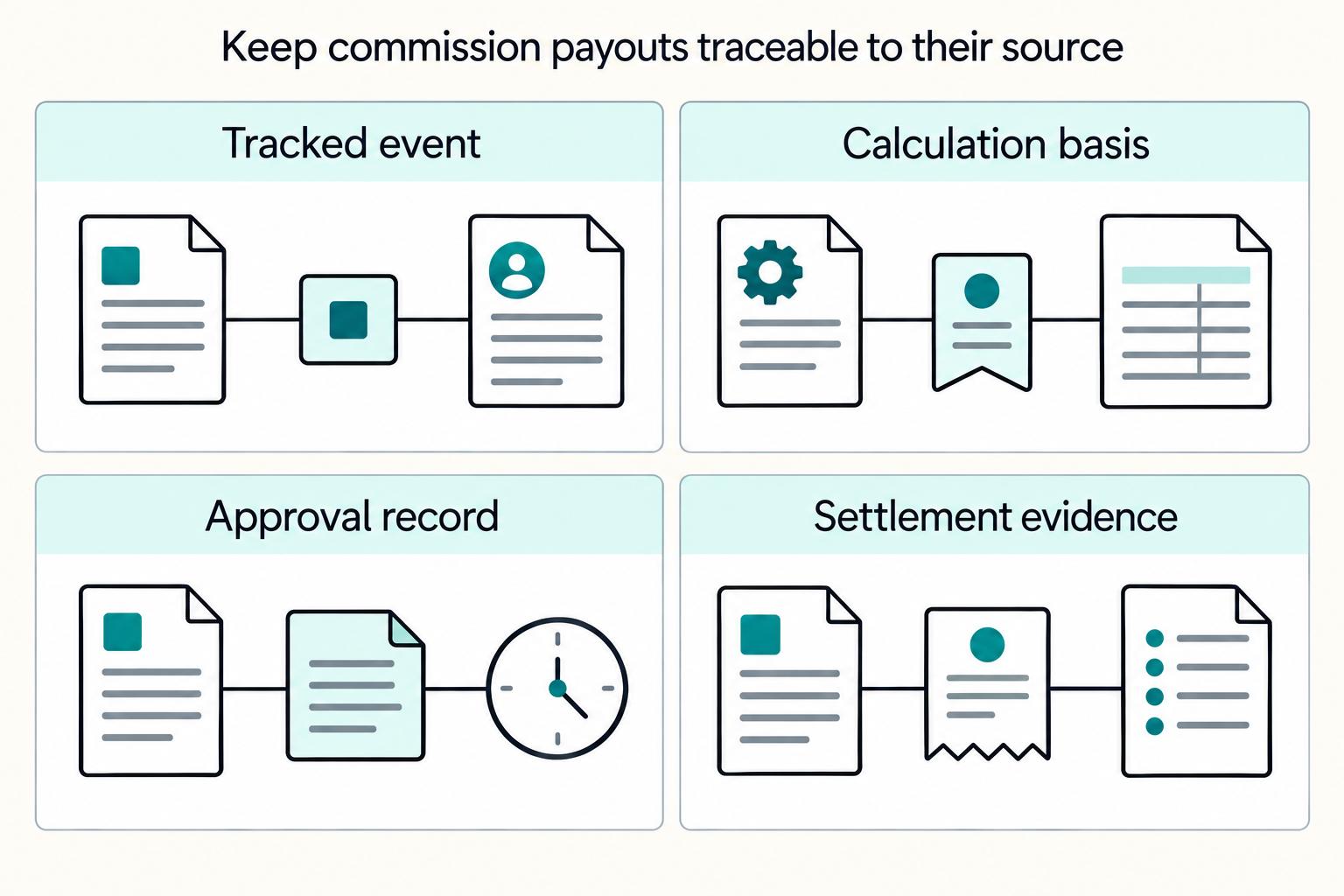
Affiliate Network Payout Structures for Publisher Commissions
Commission design is an operating decision, not a pricing footnote. The structure you choose affects what behavior you reward and the economics of the program. It is easy to announce rates. It is much harder to define a model that still holds up once reversals, edge cases, and partner questions start showing up.
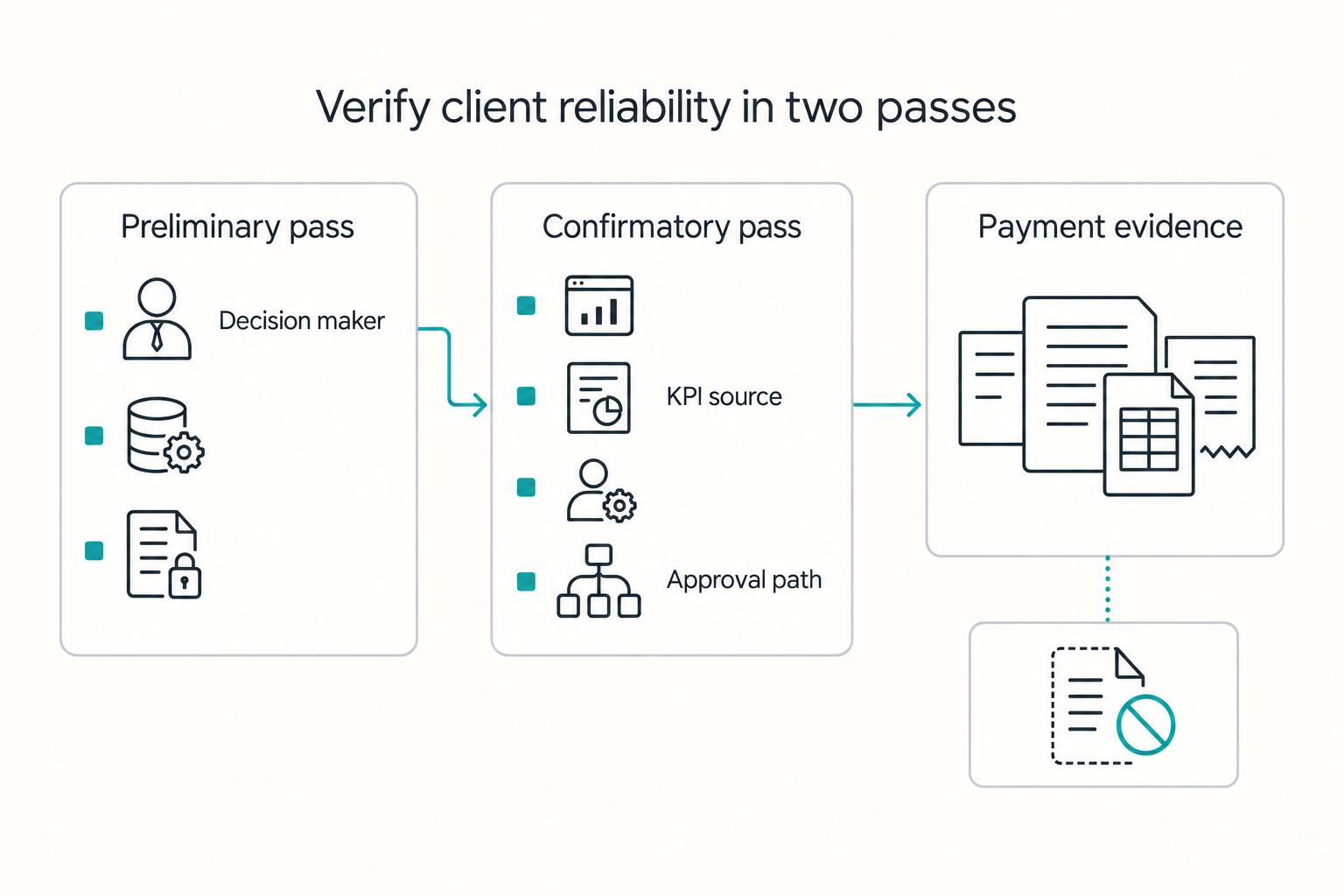
How to Structure a Success Fee in a Consulting Agreement
Before you propose a consulting success fee, use a three-part screen: your cash position can absorb delay, the client is reliable enough to measure and pay, and the outcome is materially within your control. If any one of those fails, the upside may stay theoretical while most of the downside sits with you.
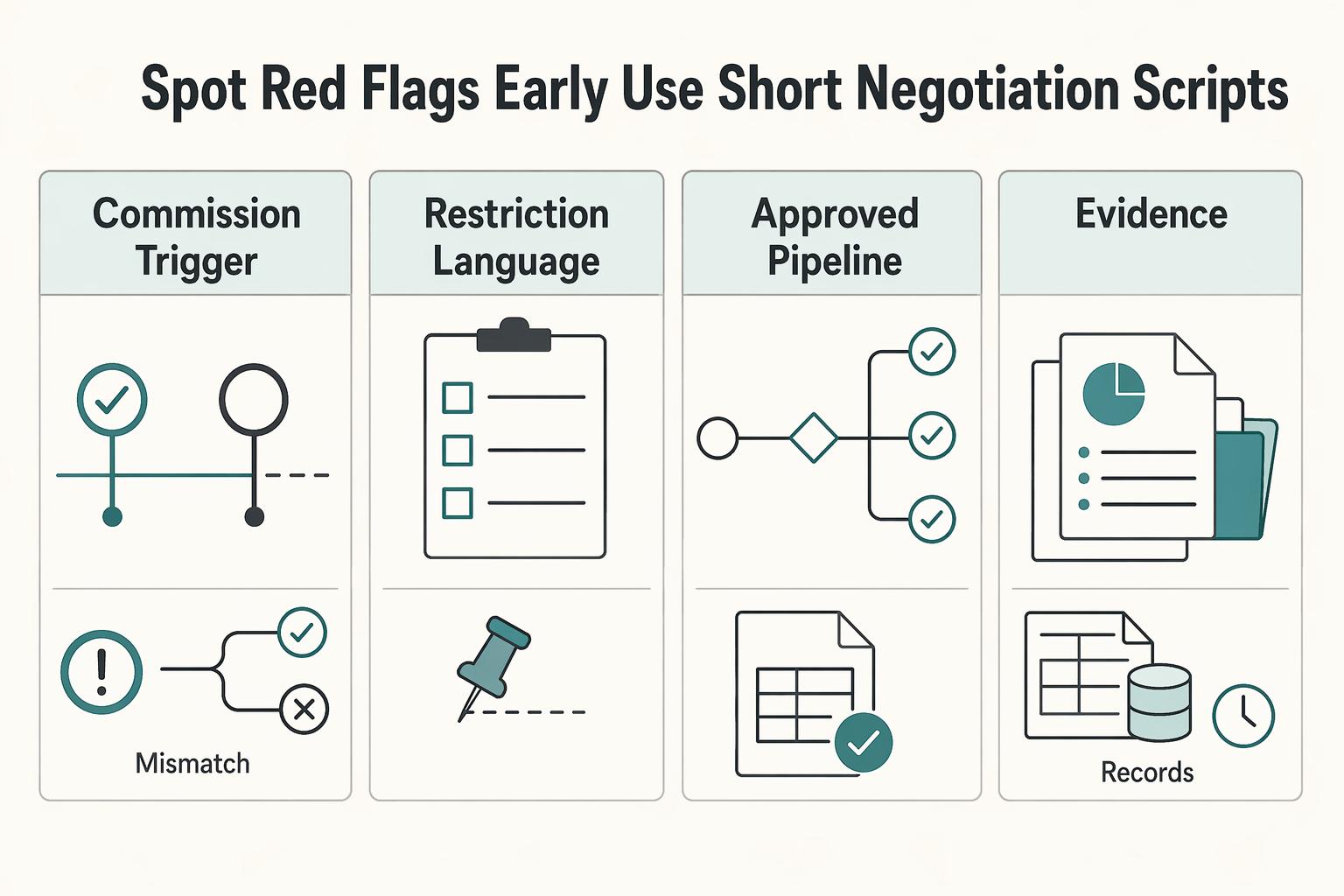
How to Structure a Commission-Based Independent Contractor Agreement
Commission agreements usually fail when key terms stay ambiguous. In practice, disputes start when the contract blurs contractor classification, leaves payout timing unclear, or leaves room for competing interpretations.