
Quick Answer
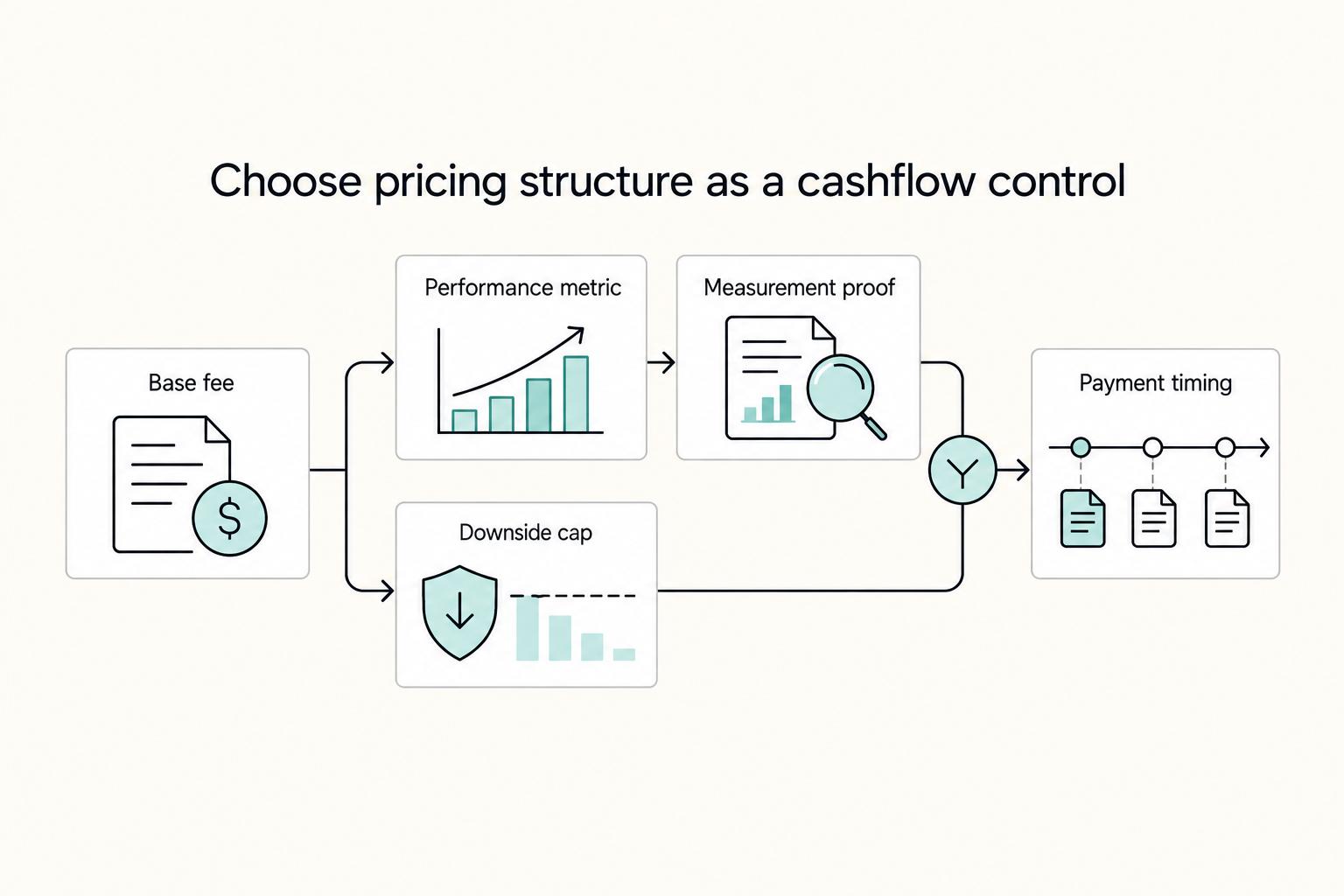
Use an auditable outcome and written bonus formula over a base fee you can afford to deliver against. For example, a 2,000 base plus 25 per qualifying lead above 40, capped at 1,000, pays a 500 bonus for 60 qualifying leads. Confirm reporting access, due dates, refunds and dispute handling before kickoff.
What Performance-Based Pricing Means for Freelancers#
Performance-based pricing ties part or all of your fee to a defined result, such as qualified leads or collected sales. A fixed fee pays for the agreed work; a bonus adds upside when the measurement rule is met. Before offering that bonus, calculate what you can afford if it pays zero or arrives late.
No single model fits every client. The right choice depends on the project, the client, and payment reliability. A model that worked on your last project can fail on the next one when those conditions change.
Choose the structure for this engagement. Selling a campaign does not give you control over the client’s sales follow-up, stock, pricing or website uptime; those dependencies belong in the commercial discussion.
Before You Start#
Before scope discussions, confirm three basics: what outcome will be measured, how it will be verified, and whether the client can pay on time. That credit check belongs in the pricing conversation, not after delivery starts. If this step feels uncomfortable, remember the alternative can be financing client risk with your own cashflow.
- Step 1: Define your cashflow floor.
Set the minimum predictable payment you need before variable compensation. This is your practical stop line for how much risk you can absorb. Checkpoint: both sides can state the minimum recurring payment and payment timing before kickoff.
- Step 2: Match the model to the situation.
Choose the pricing tool based on project and client conditions, not habit. If risk is higher or payment reliability is unclear, fixed-heavy terms can reduce downside. Checkpoint: both sides can explain why this model fits this engagement.
- Step 3: Set clear measurement rules.
Agree on the primary outcome and the report used to verify it. If two people pull two different totals, payout disputes become much more likely. Checkpoint: both parties accept one source of truth before work starts.
- Step 4: Write payment rules before delivery starts.
Document metric definitions, payout timing, approval responsibility, and what happens if reporting access breaks. Keep the wording plain enough that finance, delivery, and legal teams can read it the same way. Checkpoint: run a test payout before launch and tighten the wording if totals differ.
Decide if Performance-Based Pricing fits this client#
Decide fit before you discuss upside. Performance-based pricing is safer when control, visibility, and payout logic are clear. If those conditions are weak, variable pay can shift more risk to you while the client keeps more decision control.
Treat model choice as tool selection. There is no one-size-fits-all pricing model, and billing structure affects both payment speed and earnings. A deal can look attractive on upside and still be a poor fit if approval paths are slow or reporting access is unreliable.
One practical way to keep this grounded is to separate commercial fit from capability fit. You may be fully capable of delivering results and still have a poor commercial setup because payment depends on data you cannot audit or approvals you cannot time.
Run the go or no-go screen#
| Factor | What to confirm | If weak |
|---|---|---|
| Control | Map what you can directly influence versus what the client controls | If most drivers sit outside your control, consider not leading with performance terms |
| Visibility | Agree on a reporting source and clear metric definitions before kickoff | If access is partial or delayed, start with a fixed component, then revisit variable terms later |
| Payout timing | Compare options by payment speed, not branding | When outcomes take time to appear, fixed-heavy structures may protect cashflow better |
| Profit or revenue-share asks | Treat pure variable compensation as high risk | If a client wants upside-only pay, use a hybrid with a fixed base fee or decline |
| Attribution risk | Define ownership before launch | If ownership stays unclear, keep variable exposure low |
- Control: Map what you can directly influence versus what the client controls. If most drivers sit outside your control, consider not leading with performance terms. A clear no now can be cheaper than prolonged payout disputes.
- Visibility: Agree on a reporting source and clear metric definitions before kickoff. If access is partial or delayed, start with a fixed component, such as a scoped project fee or day rate with tight boundaries, then revisit variable terms later.
- Payout timing: Compare options by payment speed, not branding. When outcomes take time to appear, fixed-heavy structures may protect cashflow better.
- Profit or revenue-share asks: Treat pure variable compensation as high risk. If a client wants upside-only pay, use a hybrid with a fixed base fee or decline.
- Attribution risk: If multiple teams influence outcomes, define ownership before launch. If ownership stays unclear, keep variable exposure low.
For example, a hypothetical 4,000 invoice delayed by an internal approval queue still leaves you funding the work. Confirm the payer, billing contact and due date as well as the result metric; a documented bonus is a receivable, not available cash.
One useful decision rule before you sign is this: if the person approving scope is not the person approving payout evidence, ask for the approval chain in writing. If you cannot get that chain, lower variable exposure.
Choose the metric you will get paid on#
Pick a payout metric you can influence and verify. If either side cannot reproduce the number, the upside is hard to collect even when performance is strong.
Start with Leads, Customers, or Revenue when they are controllable and auditable. Treat Profits as high risk because client-side allocation or reinvestment choices can erase your payout even when your work clearly contributed to growth.
| Payout base | When it is practical | Main failure mode |
|---|---|---|
| Leads | You can influence lead generation and both sides can audit one report | Definitions or tracking are inconsistent |
| Customers | Sales handoff and conversion tracking are reliable | Handoff or conversion tracking gaps blur ownership |
| Revenue | Revenue reporting and attribution rules are agreed | Attribution methods are unclear or disputed |
| Profits | Rarely suitable for freelancer payout | Reinvestment or allocation decisions can leave no payout pool |
Pressure-test any candidate metric with two checks before you sign:
- Can both sides audit it from one agreed source?
- Can both sides approve period results through an agreed review process?
Then keep it simple: use one primary payout metric and one secondary guardrail metric. The primary metric drives payout. The guardrail helps explain context without creating a second billing argument.
If you use a sales-percentage payout, define the sales base: invoiced or collected amounts, tax, shipping, discounts, cancellations, refunds, eligible products and attribution window. A percentage of ad spend is a management fee based on expenditure, not a performance bonus based on results.
A practical failure mode to watch is inconsistent metric definitions across teams. If definitions diverge, invoice approval becomes a negotiation. Fix this before kickoff, not at month end. Decision rule: if a metric is not controllable, auditable, and jointly approvable, it is not a payout base yet.
Set the baseline period and KPI definitions before kickoff#
Choose comparable dates, seasonality, channel mix and sales capacity for the baseline. A rise above that baseline is the agreed billing calculation; it does not by itself prove that your work caused the entire rise.
Use one written measurement sheet and finalize it before delivery starts. For each metric, record the definition, data source, owner, and review cadence. If any row in that sheet is ambiguous, the decisions based on it can be ambiguous too.
- Create one KPI sheet in writing.
Document each KPI in plain language so both sides can reproduce the same number from the same report.
- Freeze KPI definitions in plain language.
For each KPI, state what is included, what is excluded, and which report is the source of truth. Keep this readable enough that a new team member can follow it without verbal context.
- Document data ownership and cadence.
Name who owns the tracking workflow, and set the reporting rhythm in writing. A practical starting point is monthly review for financial KPIs and weekly review for operational metrics.
- Define how outputs feed decisions.
Clarify which tracked outputs are used for financial decisions so expectations stay aligned before launch.
- Require one written pre-launch checkpoint.
Keep the original baseline export and a worked payout calculation. Agree the report time zone, currency, cutoff and treatment of late conversions or refunds. A changed baseline needs agreement, with an effective date and retained prior version.
When this sheet is complete, review calls stay focused on performance, not interpretation. You can still disagree on strategy, but the measurement logic stays stable.
A simple operational test is to have both sides run the same period report independently and compare outputs before launch. If totals differ, resolve the mismatch before relying on those numbers for decisions.
Build the pricing model that protects cashflow#
Price the fixed component from realistic delivery costs and billable capacity. Model zero bonus, expected bonus and the contractual maximum, then compare the timing of each payment with your own commitments.
Hypothetical campaign: 2,000 base fee plus 25 per accepted qualified lead above 40 in a month, with a 1,000 bonus cap. The lead definition requires a new prospect, target geography, valid contact and stated buying need; duplicates and existing customers are excluded.
The report contains 70 leads: six duplicates and four existing customers leave 60 qualifying leads. Bonus = min(1,000, max(0, 60 − 40) × 25) = 500; total fee is 2,500. At 35 qualifying leads the bonus is zero and the base remains 2,000. At 100 qualifying leads the cap limits the bonus to 1,000.
If delivery costs 1,600, contribution before overhead and tax is 400 at zero bonus or 900 in the 60-lead case. Suppose the base is paid at kickoff and the 500 bonus is due after the monthly review: that later 500 is not kickoff cash. A bonus cap limits the client’s variable bill; a base fee and a limit on unfunded work address your downside.
Build terms before kickoff#
- Set the core structure first.
There is no universal pricing model. Hourly, project-based, and other models can all work depending on the project, client, and your level of experience.
- Define what is being priced in writing.
State what the base buys, any hour or spend limits, whether it is an advance or earned fee, and the actual invoice trigger. For hourly work, record the agreed rate and authorization ceiling; do not assume a client can retroactively reduce agreed rates or recorded authorized hours.
- Pressure-test negotiation points early.
Before you sign, check where negotiation is most likely to happen, especially around rates and hours.
- Choose the model for this specific engagement.
Prioritize the option that best manages risk, supports earning potential, and strengthens your positioning.
Run the worked calculation with both teams. Test zero eligible results, a cap hit, duplicate results, a refund after close and missing access. Record which rule resolves each case before signing.
Write contract terms that prevent payment fights#
Many payment fights become contract fights. Write terms so payout can be verified from records, not memory.
| Contract area | Define in writing | Records or process |
|---|---|---|
| Scope and billing | Define base scope, actual advance/time/milestone billing trigger, result bonus and revision rules | Separate delivery, acceptance where required, billing and bank availability; use evidence relevant to each trigger |
| Early termination | Set accrued base/time fees, committed costs, unearned advances, in-flight settlement and attribution tail | Apply existing terms and records; retain earned bonuses and define final reporting deadline |
| Missing records | Set fallback evidence, named owners and a resolution deadline for outages or revoked access | Keep undisputed fees on schedule; record affected bonus items and agreed adjustments |
| Disputes | Define review window, evidence access, escalation and independent resolution route where agreed | Pay undisputed amounts; internal approver is not automatically a binding arbitrator |
Here, outcomes depend on the written agreement, the governing jurisdiction, and the facts on file. Keep each payment clause specific enough that both sides can review the same records and reach the same payout result.
This is where freelancers can lose ground. The commercial model may be sound, but the agreement leaves key terms open to interpretation. When interpretation decides payment, cash timing can slip.
Step 1 Translate Scope of Work into payout logic#
Map each Scope of Work item to its actual billing trigger. An advance may fall due before delivery, time-based work may invoice on an agreed schedule, and a bonus may depend on a verified result. Acceptance evidence belongs where the agreement requires it; do not make every base-fee invoice depend on a final campaign outcome.
Separate three moments in writing: delivery, acceptance, and payout. When those moments blur together, either side can dispute completion and delay payment.
If your contract separates acceptance from payment timing, state that directly. If both parties cannot run the same payout check from the same project records, tighten the wording before kickoff.
A simple document structure helps here: one row per deliverable, one acceptance evidence field, and one payout trigger field. This reduces ambiguity when teams change mid-project.
Step 2 Clarify payment if work stops early#
Specify accrued base fees, completed or in-flight work, committed costs, unearned advances and any qualifying results arriving after termination. Set the attribution tail and final reporting deadline; termination should not silently erase an already earned bonus or create an automatic charge for undelivered work.
Do not treat this language as a formality. If the relationship ends early, clear terms reduce the chance of fragmented payment disputes.
Keep the tradeoff explicit during negotiation so both sides understand how unfinished work and approvals affect payment timing.
One practical tactic is to align each payment condition to records you already keep, rather than creating new evidence rules only for edge cases. Reusing your normal evidence pack makes enforcement easier when pressure is high.
Step 3 Define how to handle missing or unusable records#
Define what happens if access is removed, tracking breaks, or reporting definitions change mid-cycle. Set a temporary review process both sides can follow until records are reliable again.
Keep undisputed base fees and established bonus amounts on their agreed schedule. A tracking outage needs a defined evidence fallback or resolution deadline, not an indefinite freeze on every payment.
Describe the restart test in plain terms so payout reviews stay anchored to usable records. For example, require both sides to confirm that the agreed report can be reproduced and that the same definition set is active again.
If restart conditions stay vague, the unresolved period can stretch and turn into payment disputes. Tight language avoids that drift.
Step 4 Lock dispute handling before the first invoice#
Set a short review window, evidence access, escalation contacts and a way to pay undisputed amounts while the disputed component is reviewed. An internal approver is a workflow owner, not automatically a binding arbitrator or the only legal remedy.
Avoid role ambiguity. Approval titles like team lead or stakeholder are too loose when multiple groups are involved. The agreement should make clear who can close a dispute and what evidence they must review, because vague ownership tends to stall payment decisions.
Before launch, run one dry dispute test using a sample record mismatch. Walk through who submits evidence, who reviews it, and how the final decision is recorded. This small rehearsal exposes weak wording while stakes are still low.
Prepare payment operations before work starts#
Set payment operations before kickoff so payout decisions come from records, not memory.
The contract defines rights, but operations determine whether those rights turn into on-time payment. If records are scattered across chat threads and inboxes, even clear terms can be hard to enforce quickly.
Step 1 Set payment workflow before kickoff#
Document payment terms, method, and workflow in the agreement or payment schedule before work begins. Use one sequence the whole team can follow from invoice submission through approval and payment. For each invoice type, define who issues it, what unlocks it, and what approval record is required.
Hand delivery and metric records to billing on the agreed schedule. Record base and bonus separately, so a disputed result does not quietly stop an advance or time-based invoice.
Step 2 Build one evidence pack per payout cycle#
Keep one evidence pack for each payout cycle with approval notes, invoice IDs, and related records tied to the same trigger. If acceptance and payment happen on different dates, log both dates so status stays clear. This pack is your audit trail, and it also cuts disputes caused by fragmented records.
A practical structure is to index each pack by cycle and trigger, then include links or attachments for every required proof item. The goal is fast retrieval, not a perfect archive design. If you can produce complete proof quickly, dispute conversations stay short.
Step 3 Preconfirm cross-border payment handling#
Agree on payment terms and method before work starts, and choose deliberately because methods differ in cost and security. For cross-border work, confirm how payments will be handled and align on realistic timing expectations. Even when a provider supports contractors across many countries, process differences can still delay release.
Set expectation language early so both sides understand the difference between payment initiation and funds availability. If both sides understand that distinction, you avoid unnecessary conflict when timing extends.
Step 4 Keep one system of record from invoice to payout#
Track invoice state, payment confirmation, and payout status in one shared record. Include invoice ID, related trigger, issue date, due status, current state, and proof reference in the same place, because small process gaps can create delays and relationship strain.
Fill missing status fields promptly while continuing valid invoices on their deadlines. Mark unknowns and assign an owner rather than delaying all billing until the tracker is perfect.
Run the first 30 days with verification checkpoints#
Use the first 30 days as a controlled verification cycle. The goal is to catch obvious measurement issues early with quick, practical checks.
| Week | Focus | Output |
|---|---|---|
| Week 1 | Confirm the baseline is documented the same way on both sides | One-page baseline confirmation kept with the measurement sheet |
| Week 2 | Run one mock measurement pass using shared data, then compare both sides' results | The number plus a short note on what changed and why |
| Week 3 | Run a joint check of core reporting inputs and confirm both sides are reading the same exports | Archived exports verified as readable and complete |
| Week 4 | Close with available evidence, unresolved-item owners and agreed adjustments; bill undisputed amounts on schedule | The exact exports and notes used in prior checks attached to the month close |
Treat the four-week cadence below as a practical template, not a validated standard. Early checks are cheap insurance, and a tight plan usually makes validation faster with less wasted effort.
Week 1 Lock the baseline#
Confirm the agreed payout metric and comparable baseline, including dates and exclusions. Adoption or willingness to pay is relevant only if it is actually part of this engagement’s measurement rule.
A useful output for week one is a one-page baseline confirmation. Keep it with the measurement sheet so every later discussion starts from the same anchor.
Week 2 Rehearse one measurement pass#
Run one mock measurement pass using shared data, then compare both sides' results. Pair the number with a short note on what changed and why, so decisions stay tied to meaningful signals.
Use qualitative context to investigate an unusual result, while applying the agreed quantitative billing rule. A persuasive narrative should not replace the report or change eligibility after the work is done.
Week 3 Verify reporting quality before major decisions#
Run a joint check of core reporting inputs and confirm both sides are reading the same exports. If metrics conflict, pause and fix definitions before using them for major decisions.
Week three is also the time to verify that archived exports are readable and complete so the next review can be repeated quickly.
Week 4 Close the month with evidence#
Close the month using available evidence, identify unresolved items and follow the agreed adjustment process. Keep undisputed billing on schedule; a missing export should not create an unlimited close or payment delay.
The first month sets operating norms for the rest of the engagement. Clean evidence and consistent reviews usually lead to faster, lower-noise decisions in later cycles.
Review monthly and adjust terms without resetting trust#
After the first month, consistency matters more than speed. Keep a fixed monthly review cadence so decisions stay stable and trust stays intact.
Monthly adjustments are normal. Unstructured adjustments are the problem. If every change happens in chat and memory, teams can drift while each side thinks it is following the same terms.
Step 1 Run the same monthly review template every time#
Use one template each month with five fields: KPI variance, ROI narrative, trigger outcomes, invoice status, and next-month risks. Tie every field to the same evidence pack used for invoicing so narrative and numbers stay aligned.
Before changing terms, map leading indicators to revenue in a simple KPI tree. This keeps decisions tied to business outcomes instead of vanity metrics.
Keep the template short enough that it is actually used. A repeatable one-page summary with linked evidence is often more effective than a long deck no one revisits.
Step 2 Change payout triggers only at scheduled review points#
Review proposed changes at planned dates and obtain agreement before they take effect. Keep earlier versions and accrued amounts; a monthly meeting does not itself authorize a new payout rule.
For an urgent mid-cycle issue, record it immediately and agree any commercial change and effective date before applying it. An operating note alone does not rewrite the contract.
A clear operating rule helps: avoid trigger changes that affect an already open invoice cycle unless both sides explicitly agree and record the exception. This reduces retroactive reinterpretation risk.
Step 3 Narrow attribution when data quality drops#
Use reliable leading indicators to manage delivery while investigating poor attribution. Change the payout metric only through the agreed amendment process; do not substitute a cheaper metric unilaterally after results accrue.
Reallocate budget only within the authority the client has granted. Size a test from actual cost, evidence and risk; there is no general 10–20% shift that fits every campaign.
Retain the original reporting rule and mark affected results for the agreed fallback or adjustment. Keep a management decision about channels separate from the compensation calculation.
Step 4 Escalate governance when metrics drift#
Without a governance model, teams can optimize vanity metrics that do not move the business. Use each monthly readout to confirm that leading indicators still connect to revenue outcomes.
Run one failure-mode check every month: compare what looked efficient in-channel with downstream payback. If a channel looks strong on surface metrics but weak on payback, rebalance in the next cycle.
Do not wait multiple quarters to correct drift. A repeated pattern across reviews is enough to tighten governance in the next review window.
Common mistakes and how to recover quickly#
When payout terms start creating friction, recover before the next invoice cycle. Fast correction can be cheaper than carrying one more disputed period.
A practical recovery path is to narrow the metric, tighten ownership, and reduce ambiguity in evidence. The goal is not perfect contract language. The goal is predictable payment behavior under normal pressure.
Step 1 Reset payout to controllable KPIs#
Propose a more verifiable KPI for future periods if the current metric is failing. Agree its price, exclusions and effective date, while resolving accrued fees under the existing terms.
Recovery checkpoint: both sides should be able to run the same report for the same period and land on the same payout input without manual reconciliation.
Step 2 Tighten Attribution Rules before the next cycle#
Vague attribution can drive avoidable disputes. Define channel ownership, evidence requirements, and a clear dispute process in writing before the next invoice cycle, and if data arrives late, handle it through a written adjustment rather than reopening closed periods.
Recovery checkpoint: every disputed item can be mapped to a stated ownership rule or a documented adjustment path.
Step 3 Reintroduce a floor when variable pay is not enough#
If performance-only terms keep shifting risk to you, negotiate a fixed component at renewal from real delivery costs, billable capacity, overhead and required surplus. If risk protections are refused, consider ending under the existing terms and resolving accrued payments rather than taking on another unfunded cycle.
Recovery checkpoint: the next cycle has a fixed component that covers baseline operating needs even if variable approval is delayed.
Step 4 Rewrite Scope of Work into trigger-ready deliverables#
Rewrite unclear scope for the next agreed phase, retaining records of commitments already made. Test a sample approval packet against the actual billing trigger; correcting your own nonconforming work is not automatically a paid scope change.
Recovery checkpoint: a third party can read the scope row, find the matching evidence, and confirm the associated payout trigger without additional verbal context. For a quick next step, try the free invoice generator.
Conclusion#
Performance-Based Pricing works better when payout terms are defined before work starts and checked against shared records. If approval depends on interpretation at invoice time, tighten terms before kickoff.
No single pricing model is best for every client or scope. Treat models as tools, choose what fits current reporting reality, and change approach when conditions change.
Screen the downside first: control, auditable data, sales-cycle lag and a base you can afford to deliver against. Profit sharing adds cost-allocation risk; use it only when those rules and audit access are workable. Before agreeing, use this checklist:
- Confirm fit: controllable metric, auditable data, and acceptable sales-cycle lag.
- Choose a metric whose eligibility, attribution, deductions and reporting access you can audit.
- Lock KPI definitions and reporting rules in writing before launch.
- Agree on invoice timing and the records required to approve payout.
- Define how disputes or missing data will be handled in the contract.
- Confirm payment operations: invoice schedule, evidence-pack owner, and late-payment escalation path.
Run this checklist in your next client call and mark any item that is still unresolved. If key items are still open, delay performance terms and use a safer structure first.
Set the base using How to Calculate Your Billable Rate as a Freelancer, then test the bonus calculation with a real sample report before final negotiation.
Frequently Asked Questions
What is performance based pricing freelance, in one practical definition?
It is a pricing approach where compensation can be tied to agreed outcomes, not only hours. In practice, define the metric and how results are checked before work starts. No single structure fits every client, project, and situation.
Should I charge on Leads, Customers, Revenue, or Profits?
Use qualified leads when their definition is stable, customers when sales handoff is visible, or revenue when collection, refunds and attribution can be audited. Profit sharing needs agreed cost allocations and audit access because the client controls many deductions. Choose by these conditions rather than assuming one metric always pays more.
What is the safest model for cashflow if I still want upside?
A base plus bonus can fund delivery while retaining upside, but only if the base amount and timing meet your costs and the client pays. Model a zero-bonus case and late payment. Percentage-of-ad-spend fees do not measure performance; keep them distinct from lead, sales or revenue bonuses.
How do I set a Baseline Period that both sides trust?
Use one agreed baseline window and one agreed source report before work begins. Record a shared starting snapshot so both sides reference the same numbers. If the baseline cannot be reproduced from that source, tighten the setup before tying payouts to it.
What contract terms matter most for avoiding payout disputes?
Specify the base scope and billing schedule, bonus formula and cap, qualifying/excluded results, attribution window, reporting cutoff, refund adjustments, access, review deadlines, termination tail and dispute process. Preserve undisputed payment and define what happens when tracking fails.
When should I refuse a performance-only deal?
Consider refusing when the pricing model does not fit the project or client situation, or when payout cannot be measured and approved reliably. If risk is too one-sided, move to a model with more fixed compensation, such as hourly pricing in PPC contexts.
Watch
Performance-Based Pricing for Freelancers
Try a related tool
Researched and edited by the Gruv editorial team. Gruv builds cross-border billing, payouts, and finance-operations software for global businesses.
Sources
Includes 1 external source outside the trusted-domain allowlist.
Educational content only. Not legal, tax, or financial advice.
Related Posts
How to Calculate a Freelance Rate You Can Actually Get Paid On
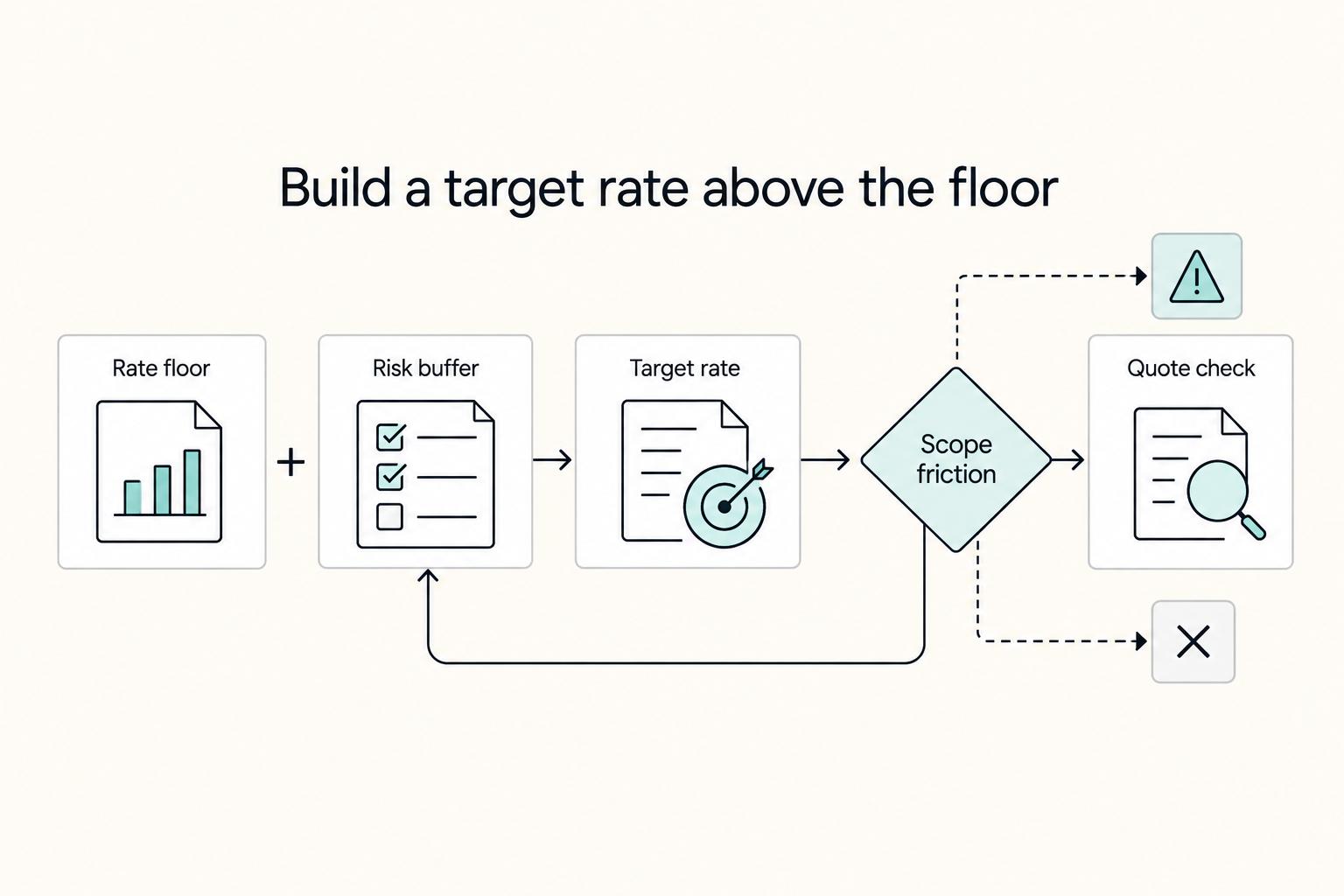
A workable rate is not the neat number a calculator produces. It is the number that still works after you account for real billable capacity, non-client time, scope drift, and the gap between sending an invoice and receiving cleared cash. Start with hourly math even if you do not plan to bill hourly, then turn that number into a quote with clear `payment terms`.

The Best Financial Podcasts for Freelancers and Solopreneurs
For irregular-income planning, start with Money with Katie. For broader money decisions, try Afford Anything; for consumer costs, The Clark Howard Podcast; for saving and investing priorities, The Money Guy Show; and for freelance business growth, Freelance to Founder. Choose one current constraint and one show before adding a larger listening queue.

The Freelance Payment Penalty: A Modeled Audit of Platform Fees, FX Spreads, and Payout Delays
The money rarely disappears through a single, easy-to-spot fee. The real loss is stacked. A marketplace takes its commission, a processor adds a charge for international cards, a bank or payment company converts the currency at a spread, a platform holds the funds before release, and a wire sheds a little to intermediaries on the way in. Each layer looks defensible on its own, but the worker feels the combined result as a smaller deposit and a later payday.