
Quick Answer
Use a consulting success fee only when your downside is covered, the client can verify results, and the outcome is within your influence. Start with your operating floor, then validate one decision-maker, one reporting source, and one approval path. Structure pay with a protected base component plus contingent upside, and document a clear Success Event tied to a named metric, a source of truth, and a measurement window. For cross-border work, define currency, transfer costs, and tax responsibility in writing.
Decide whether the engagement fits a success fee#
Before you propose a consulting success fee, use a three-part screen: your cash position can absorb delay, the client is reliable enough to measure and pay, and the outcome is materially within your control. If any one of those fails, the upside may stay theoretical while most of the downside sits with you.
This guide focuses on ordinary operational and strategic consulting. Capital raising and securities transactions need a separate regulatory assessment: the SEC explains that transaction-related compensation for helping with securities transactions may require broker-dealer registration. Do not copy this bonus structure into those activities without checking applicable registration requirements and exemptions.
Step 1. Audit your own downside first#
Start with your baseline revenue, not the client's promised upside. You need a clear view of how much of your income is fixed, how much is already variable, and whether your ordinary work covers your operating costs without this deal. If your portfolio is already lumpy, this arrangement is usually safer on top of a fixed fee, not in place of it. If you have not pressure-tested your floor, use your normal pricing math first in How to Calculate Your Billable Rate as a Freelancer.
The go or no-go check here is simple: can you keep delivering if the contingent payment arrives late, is disputed, or never triggers? Put that in writing for yourself with a short forecast, not just instinct. A common failure mode is treating a risky fee model like free upside, when in practice you are financing the client's result with your own cash flow.
The tradeoff is straightforward. Hourly pricing bills time worked and can cap upside to time sold, but it ties payment to work completed instead of a future event. If taking the risk would squeeze payroll, rent, tax reserves, or core delivery, keep the base fee conventional and treat any performance pay as optional upside.
Step 2. Verify client reliability with staged diligence#
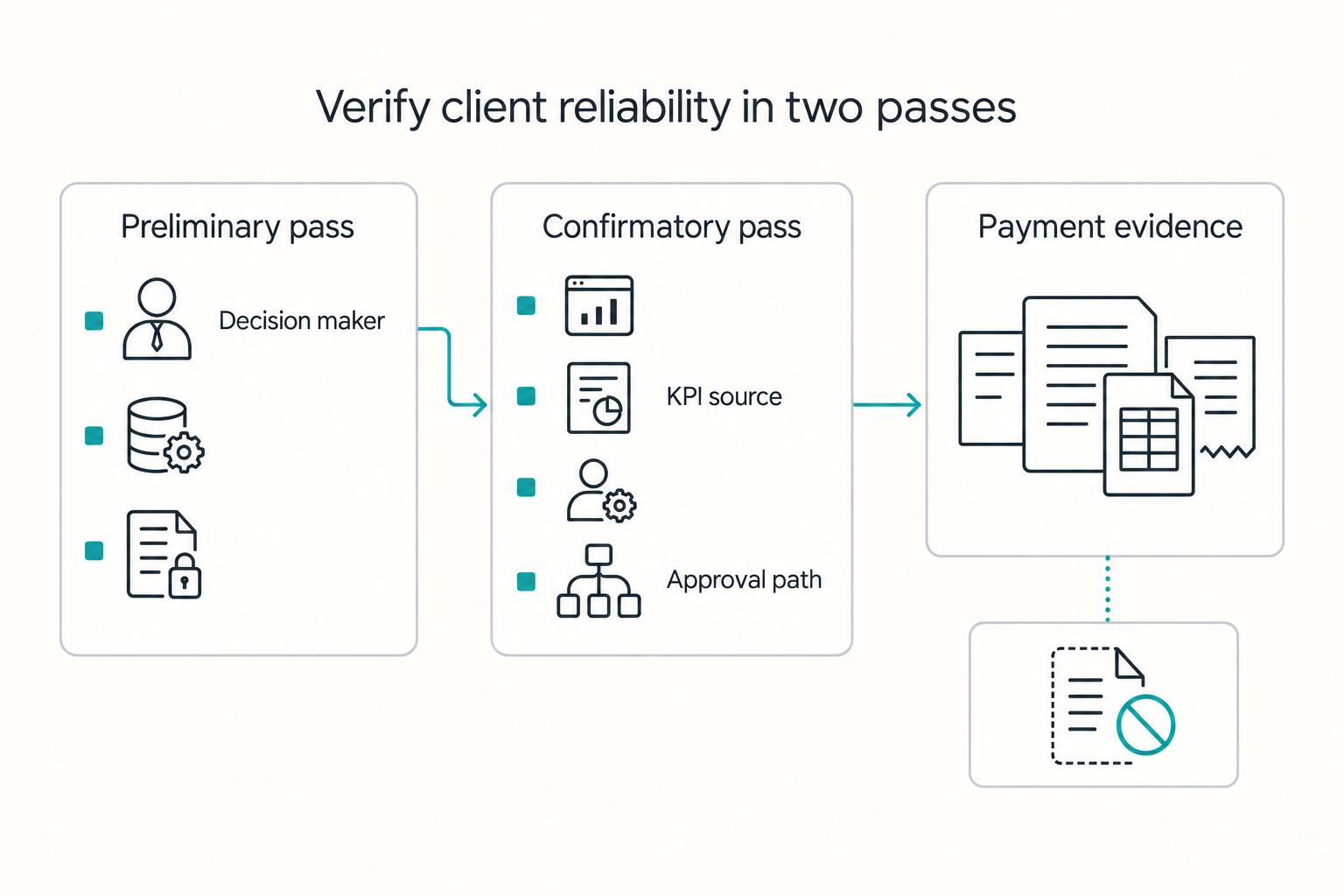
Treat client review like diligence, not a chemistry call. Run it in stages rather than as a single check. A practical approach is to do preliminary diligence before you raise the fee idea, then confirmatory diligence before signature. That helps you avoid building terms around assumptions the client cannot support.
In the preliminary pass, look for three things: one real decision-maker, a willingness to share the data that would measure success, and evidence that the company can act without getting stuck in committee. Include customer diligence basics too: whether current services meet customer needs and whether customers are likely to stay. This is also where you decide whether the engagement really fits performance-based compensation rather than another value-based pricing structure. If the client cannot explain how value is created, tracked, and approved, do not make your payment depend on that story later.
In the confirmatory pass, ask for the evidence pack you would need if you later had to defend the payout: the current KPI view, the reporting source, who owns that data, who approves invoices, and which internal team must execute your recommendations. Do not settle for verbal reassurance when the fee will turn on a report later. You want to know what the actual dashboard, export, or internal report looks like, who can pull it, and whether that same view will still exist when you send the invoice. If metrics are manually assembled, customer data is tightly guarded, or your sponsor cannot name the approval path, payment risk is usually higher.
Step 3. Score delivery control before tying pay to outcome#
If the result depends mostly on other people executing after you leave, tying your pay to that result is usually a bad bet. Operational diligence helps here because it inspects the step-by-step process required for the result to happen. Ask the client to walk you through a typical order, campaign, handoff, or implementation path from your recommendation to the customer-facing outcome. That is usually where execution dependency shows up.
| Viability factor | Score 1 to 5 | Why it matters | What to verify |
|---|---|---|---|
| Control over implementation | Low control increases execution dependency and raises the chance you do the work but someone else determines whether you get paid. | Who executes the plan, who has authority to change it, and where your direct influence starts and stops | |
| Clarity of objectives | Vague targets create attribution risk because the client can later argue the event did not happen or happened for another reason. | One measurable outcome, one reporting source, one review date | |
| Client resource availability | Thin staffing, weak budget, or missing tools can raise execution and payment risk because the client may never create the conditions needed for success. | Named owners, committed time, and the tools or budget required to execute |
Do not hard-code a universal passing score. Score each line after you verify the facts, then set your go or no-go cutoff. If control is low, objectives are fuzzy, or client resources are missing, move to a fixed fee, retainer, or a hybrid with only a limited bonus component. Only opportunities that survive this screen should move into Phase 2, where you design the actual fee model.
You might also find this useful: How to Structure an SOW for a Retainer-Based Consulting Engagement.
Want a quick next step? Try the free invoice generator.
Choose the base fee and contingent upside#
Choose the model that protects your downside first, then layer upside on top. In this phase, your job is to match fee structure to four realities: baseline metric quality, attribution method, implementation control, and reporting reliability.
Before you lock a model, pressure-test whether this should be a performance structure at all or a standard value-based pricing engagement with clearer payment timing.
Model selection checklist#
Use this screen before you propose terms:
Baseline metric quality: Is there one agreed starting point you can verify now?Attribution method: Can both sides explain how your contribution will be measured against other factors?Implementation control: Do you control execution, or are you dependent on client teams after your recommendations?Reporting reliability: Is there one report/dashboard owner and one review cadence both sides accept?Timing risk: If results are delayed, can your cash flow still support delivery?
If any of these are weak, move toward more fixed compensation and limit the contingent portion.
Decision matrix: match model to risk profile#
| Outcome type | Attribution strength | Your operational control | Model that usually protects you most | Why |
|---|---|---|---|---|
| Work delivered (time-based support, advisory blocks) | Low to mixed | Mixed | Hourly or fixed scope | Hourly billing is simple and tied to work completed, but can cap upside by time. |
| Ongoing access and recurring guidance | Mixed | Mixed | Retainer (Pay for Work or Pay for Access) with optional limited bonus | Retainers can improve income predictability while keeping performance exposure bounded. |
| Single measurable business result with clear measurement | Strong | High to shared | Base fee + success fee (value-based structure) | Keeps core pay protected while aligning upside to a defined result. |
| Multi-stage result with delayed realization | Moderate | Shared | Staged model (milestones + deferred performance component) | Reduces all-or-nothing exposure when outcomes depend on sequence and timing. |
Pre-proposal workflow: model upside and downside before you pitch#
- Verified baseline: confirm the metric name, current value, and agreed reporting source with the client before proposing.
- Verified target range: confirm the conservative target, stretch target, and review date with the client before proposing.
- Attribution method: agree the attribution method with the client before proposing, and note known limits in plain language.
- Payout scenarios: model payout assumptions for worst case, base case, and best case before proposing.
- Protected floor: set a retainer or base-fee floor before proposing; anchor it to your operating floor and pricing math from How to Calculate Your Billable Rate as a Freelancer.
- Timing stress test: define the payment-delay window you can absorb, and confirm delivery still works without cash strain.
- Lock measurement timing early: define success measurement during scoping or RFP framing, not after delivery.
Tiered structure template for terms to confirm before signing#
Use tiers so partial progress still pays instead of turning the deal into a single cliff event.
| Tier | Trigger | Payout logic |
|---|---|---|
| Tier 1 | Minimum verified improvement, defined with the client in the agreement | Partial success payout, set in the agreement |
| Tier 2 | Target improvement, defined with the client in the agreement | Standard success payout, set in the agreement |
| Tier 3 | Outperformance band, defined with the client in the agreement | Enhanced success payout, set in the agreement |
For an illustrative cost-reduction project, suppose the agreed base fee is $6,000 and the bonus is 10% of verified net savings above a $20,000 threshold, capped at $8,000. With $50,000 of eligible savings, the bonus is 10% × ($50,000 − $20,000) = $3,000, for total fees of $9,000. Below the threshold, only the base fee is due. Define which implementation costs and external changes enter the savings calculation; these numbers illustrate the mechanism, not a market benchmark.
This keeps negotiation focused on mechanism and trust, not just the headline price, and lowers the risk of value disputes later.
For a related structural example, see How to Structure a 'Referral Fee' Agreement with a Partner.
Once the model logic is chosen, move to Phase 3 and turn it into enforceable clause language and payment mechanics.
Write the result and payment rules into the agreement#
After you choose the fee model, your contract should remove interpretation risk and payment delay. Keep this phase focused on three enforceable clauses: the Success Event, payout mechanics, and cross-border payment protections.
Before drafting: confirm the fee structure, exact business metric, reporting source, and client legal entity name. If any of these are unclear, pause and resolve them first.
Step 1: Define the Success Event#
Your trigger should read like a verification checklist, not a narrative. Build it with four required elements:
| Required element | Clause text |
|---|---|
| Defined outcome | State the agreed defined outcome in the clause. |
| Verified metric | Write the agreed metric and its current threshold into the clause. |
| Source of truth | Name the agreed data source, report, or dashboard in the clause. |
| Completion window | State the agreed completion date or measurement window in the clause. |
If reporting is messy, manually compiled, or politically guarded, treat that as dispute risk and tighten the clause before you sign. Keep this language aligned with the fee model selected in Phase 2; if needed, revisit the pricing logic in value-based pricing.
Step 2: Sequence the payout mechanics#
Write the payment clause as a timeline so each handoff is explicit:
- Base fee: specify the amount, due dates, scope and any refund or termination treatment in the agreement. Size it against your delivery costs so ordinary work does not depend on the bonus.
- Milestone release logic: for longer engagements, tie staged payments to specific deliverables, approvals, or implementation checkpoints.
- Invoice trigger: "The success invoice may be issued upon verification of the Success Event using the agreed source of truth." Define the payment due period in the agreement.
- Late-payment remedy: set late-payment remedy language with qualified legal review before you sign.
Name the person who verifies the metric and a deadline for the client to provide the agreed report. Define how disputed calculations are reviewed and when undisputed amounts become payable. State the effect of client silence explicitly rather than leaving the bonus subject to an open-ended internal approval.
Step 3: Clarify cross-border protections#
For international deals, allocate payment burdens in plain language. KYC, sanctions checks, legal risk, liability, and fraud can affect cross-border payments, but your agreement still needs to define the commercial terms directly.
| Clause item | What to write clearly |
|---|---|
| Settlement currency | State the agreed settlement currency in the agreement. |
| Conversion costs | "Client bears any bank, correspondent, or currency conversion costs so Consultant receives the full invoiced amount in the settlement currency." |
| Transfer method | State the agreed transfer method in the agreement. Use one method unless both parties approve a change in writing. |
| Tax responsibility | "Each party is responsible for its own taxes, except where withholding is required by law. If withholding applies, client will provide supporting documentation and handle required filings as specified in the agreement." |
Final enforcement note: keep one audit trail with the metric report export, approvals, invoice, and written confirmations. Clear drafting helps only if you can prove when the trigger was met and when payment became due.
Related: How to Handle Severance and Termination Clauses in a Consulting Agreement.
Before you send the proposal#
A success fee is not a lottery ticket. It can align your upside with the client's outcome, but only if you structure it with discipline. The real shift is to treat it not as a windfall, but as a deliberate part of your business model.
That is what this 3-phase approach is for. It moves the decision from hope to verification, then from verification to clear terms.
- Phase 1: Assess. Before you propose any terms, evaluate your own financial readiness, the client's operating context, and the project's underlying viability. That helps protect your business from a badly chosen engagement.
- Phase 2: Design. Build a fee structure that reflects reality. By choosing the right mix of base compensation, variable upside, and downside protection, you create a model that pays you for the value you actually deliver.
- Phase 3: Fortify. Turn the strategy into clear contract language. Precise definitions of success, clear payment clauses, and explicit protections reduce ambiguity and make payment easier to defend.
Before sending the proposal, confirm that the miss case still pays for the work, the client can produce the agreed report, and the payment deadline follows a defined verification process.
If you want a deeper dive, read How to Structure a 'Key Person' Clause in a Consulting Agreement.
Frequently Asked Questions
How do you legally structure a consulting success fee?
There is no one contract template you can safely copy from this article. Treat the legal structure as context-specific and get qualified legal review before you finalize terms.
Before you negotiate, define your pricing model and minimum viable rate so you do not price below your floor.
How should I choose the success fee amount?
Choose the bonus from the value of the measured improvement, the attribution you can support and the risk you are taking. Keep a base fee that covers agreed delivery, then compare the miss, target and stretch cases. A percentage without a defined baseline and calculation method is not a usable price.
Then model best case, base case, and miss case. Too high can price you out, and too low can hurt perceived value.
How do success fees work with international clients?
Agree on invoice currency, payment deadline and responsibility for transfer and conversion costs. Where withholding is legally required, specify the evidence the client must provide and whether the price is grossed up; a tax-allocation clause does not override local law.
Keep the metric report, written verification, invoice and transfer record together so the fee can be traced across both the result and the payment.
How do you protect yourself with a success fee agreement?
Protect yourself by using the pricing structure that fits the situation instead of forcing one model every time. Common structures include hourly, project-based, and monthly retainer, and any success-linked component should still keep total pricing above your minimum viable rate.
Before you send the quote, pressure-test it for both pricing-floor and market-fit risk.
When should you NOT use a success fee?
Do not force a success-fee model when another structure is a better fit. Common alternatives include hourly, project-based, monthly retainer, or value-based pricing, and a flexible approach is usually stronger than using one model for every engagement.
If one model pushes you too high for market fit or too low for positioning, switch structures.
Are success fees ethical or legal?
Legality depends on the activity, profession and jurisdiction. This structure is for ordinary business consulting; it does not establish permission to receive transaction-based compensation for securities deals.
Before you use success-fee terms, verify profession-specific and local legal requirements.
Try a related tool
Researched and edited by the Gruv editorial team. Gruv builds cross-border billing, payouts, and finance-operations software for global businesses.
Sources
Includes 2 external sources outside the trusted-domain allowlist.
- fastpayments.worldbank.org/sites/default/files/2021-10/Cross_Border_Fas...trusted
- sec.gov/resources-small-businesses/capital-raising-b...trusted
- som.yale.edu/sites/default/files/2025-04/On%20the%20Natur...trusted
- consultingsuccess.com/consulting-feesexternal
- consultingsuccess.com/consulting-pricing-modelsexternal
Educational content only. Not legal, tax, or financial advice.
Related Posts
How to Calculate a Freelance Rate You Can Actually Get Paid On
A workable rate is not the neat number a calculator produces. It is the number that still works after you account for real billable capacity, non-client time, scope drift, and the gap between sending an invoice and receiving cleared cash. Start with hourly math even if you do not plan to bill hourly, then turn that number into a quote with clear `payment terms`.

Value-Based Pricing for Strategic Consultants Under Real Payment Risk
Value-based consulting fees reflect what solving a problem is worth to the buyer. The fee can still be fixed and paid in advance or by delivery milestones. Separate that pricing decision from a performance-linked bonus: a value-based fee does not automatically make payment conditional on the client achieving a future business result.

The Freelance Payment Penalty: A Modeled Audit of Platform Fees, FX Spreads, and Payout Delays
The money rarely disappears through a single, easy-to-spot fee. The real loss is stacked. A marketplace takes its commission, a processor adds a charge for international cards, a bank or payment company converts the currency at a spread, a platform holds the funds before release, and a wire sheds a little to intermediaries on the way in. Each layer looks defensible on its own, but the worker feels the combined result as a smaller deposit and a later payday.