
Quick Answer
Implement OAuth 2.0 for your payment platform API by defining clear roles for the authorization server and resource servers, assigning each client only the scopes it needs, treating granted scopes in the access token as the source of truth, validating tokens on every request, and separating OAuth permissions from payout or withdrawal policy gates.
Why this guide exists for payment platform teams#
This guide is for teams implementing OAuth 2.0 in a payment API and trying to avoid long-term auth debt across core platform workflows. It is written for CTOs, engineering leads, and solution architects who need sequencing, tradeoffs, and verification points they can use in real delivery work.
Step 1. Use it when auth decisions will outlive the first launch#
If you are building user-delegated access to protected web APIs, early OAuth choices can turn into platform constraints for multiple teams. This article stays focused on the implementation checkpoints that tend to stick: which clients request which permissions, how consent behaves, where token validation belongs, and what to verify before production.
Use authorization code with PKCE for redirect-based delegated access. Add OpenID Connect when the client also needs user authentication; OAuth API authorization does not itself require OIDC. Public clients cannot protect a shared client secret. Use supported libraries and register the correct client type.
Step 2. Keep scope focused on the auth seams that create debt#
This guide stays intentionally narrow and focuses on four auth seams:
- OAuth scopes as permission groupings users can allow or deny.
- Access token strategy for predictable API behavior.
- Consent handling, including what happens when requested access is not fully approved.
- Production-readiness choices for multi-team, multi-client platforms.
An access token is what the app uses to call another service on a user's behalf, so issuance and validation decisions need to be explicit. Scopes and consent work best when they stay tied to the minimum user-related access required.
Step 3. Keep API authorization separate from market obligations#
Platform API authorization design is the focus here, not jurisdiction-specific or program-specific compliance obligations. Keep that line clear. OAuth consent is meant to limit access to needed data with user approval, and scope design is most useful when that access is tied to end-user data.
Machine-to-machine clients can use scopes without a user consent screen. Define their service permissions and resource boundaries explicitly rather than treating scopes as useful only for end-user data.
What to prepare before you touch production#
Before you wire OAuth into production, lock down four decisions: system boundaries, client trust and scopes, policy gates, and release artifacts. Doing this early keeps token trust and failure handling explicit while the surface area is still manageable.
Step 1. Define boundaries on one page#
Start with one page that names the authorization server that issues tokens and the resource servers that validate tokens and enforce access. Then map which services trust which token claims and where authorization checks run.
Checkpoint: trace one real request from sign-in to token issuance to the final API authorization decision. If that path is hard to explain, your boundary design is still too fuzzy, and interaction bugs are more likely than isolated component tests will show.
Step 2. Classify clients by trust before you assign scopes#
Do the client split first. Separate client types, for example first-party dashboard clients, third-party applications, internal ops tooling, and machine clients. Then configure each client with scopes that limit API privileges instead of inheriting broad default access from early integration.
For third-party clients, enable consent at the authorization server and plan for granted scopes to be a subset of requested scopes. Before build moves forward, complete the client registration artifacts, including sandbox and production environment setup plus client_id and client_secret where applicable.
Step 3. Map policy gates to money movement actions#
Scopes should not carry payment-policy decisions for you. Decide early where KYC, KYB, and AML checks must block payout or withdrawal actions. Keep the boundary clear: scopes restrict API access, but they are not the only control for fund movement.
Checkpoint: for each payout or withdrawal endpoint, name the policy dependency and the owning service or team for block decisions. If ownership is unclear now, you will probably bolt critical gates on after launch.
Step 4. Lock the release artifacts before build#
Before engineering gets deep into implementation, agree on the pre-production artifacts and owners. At minimum, define client registration and environment setup expectations, consent behavior for third-party clients, and who handles auth failures and denied requests. Also define the pre-production OAuth tests for flow enforcement, token issuance and validation, and scope-boundary enforcement.
Red flag: vague ownership. When consent is partial, token validation fails, or a payout is blocked by policy, the response path should already have a clear owner.
Related: Key Best Practices for Improving Accounts Payable on a Two-Sided Payment Platform.
Set your architecture boundaries before scope design#
OAuth leaves scope names and meanings to the API. The granted scope set may be supplied in a token response, a JWT claim or an introspection result; opaque access tokens are not client-readable permission documents.
Step 1. Assign clear ownership for scope meaning and consent behavior#
Give one designated component clear ownership of client scope configuration, consent handling, and scope issuance, then document that ownership. APIs can enforce access locally, but they should enforce the same meaning for the same scope strings.
For third-party clients, make consent behavior explicit at issuance time and expect the granted set to be smaller than what was requested. Check one real path from requested scopes to granted scopes in the token, then to the final API authorization decision. Confirm each API interprets that granted set the same way.
Step 2. Define token validation boundaries per route class#
Choose and document how tokens are validated for each route class. Do not leave this implicit. What you want is a clear, testable contract for both validation behavior and failure behavior.
Document how higher-risk routes fail when validation dependencies are unavailable. Use RFC 9700, the current OAuth security BCP, alongside the base protocol specification.
Step 3. Keep permission checks distinct from identity or profile data#
Treat scopes as the API privilege signal, and document separately where identity or profile claims are used. This reduces the chance that profile attributes turn into permission shortcuts.
Checkpoint: for one money-movement endpoint, list the exact scope check and any separate policy gates. If profile data alone can trigger the action, your boundary is still unclear.
Step 4. Isolate legacy compatibility from new scope design#
If legacy constraints exist, document them instead of letting them quietly drive new scope design by default. Capture older protocol dependencies in a separate compatibility note with owners and affected clients.
A clear naming pattern belongs in this same boundary work. Without it, scope names drift across teams and control gets weaker over time.
If you're designing OAuth scopes for payout flows, see Payout API Design Best Practices for a Reliable Disbursement Platform.
Design a payment scope taxonomy that matches real actions#
Design scopes around what a client can actually do in the API, not around which internal team owns the service. OAuth 2.0 leaves scope taxonomy to each system, so the real job is choosing boundaries you can enforce per method and explain clearly in consent.
Step 1. Group scopes by product surface, not org chart#
Use domain families only when they reflect a real capability clients understand. For example, you might organize scopes under onboarding, reporting, payouts, and Merchant of Record operations, then split by access level.
A practical starting pattern is resource plus access level:
onboarding.read,onboarding.writereporting.readpayouts.read,payouts.writemor.read,mor.write, with separate admin scopes when needed
This keeps scope meaning stable even when services move between teams. It also maps cleanly to third-party consent, where the granted set may be smaller than the requested set.
Step 2. Use action-oriented names that map to method checks#
Every scope needs one clear meaning in enforcement. A token should authorize a method only when it carries that method's required scope, so vague names turn into real authorization failures.
Default to read and write separation. If a scope is read-only, it should not authorize state-changing methods. Keep admin power explicit too. If routine operational writes and sensitive admin actions are different in practice, make them different scopes.
Step 3. Split money-movement permissions from visibility permissions#
If a scope can initiate payouts or other fund movement, keep it separate from read scopes even if that makes consent a little heavier. That separation makes client intent, consent, and enforcement easier to audit and maintain.
| Scope example | Endpoint coverage | Risk level | Extra gates (policy-defined) |
|---|---|---|---|
onboarding.read | Read-only onboarding/account-status methods | Low | Check tenant and target-resource authorization on every read; additional risk gates depend on policy |
reporting.read | Read-only reporting/reconciliation methods | Low to medium | Check tenant, target-resource and sensitive-data authorization; additional policy gates as applicable |
payouts.read | Payout status/history/detail retrieval methods | Medium | Visibility may depend on compliance or tenant policy |
payouts.write | Payout initiation/instruction methods | High | Execution gates may include compliance checks per policy |
mor.write | MoR operational update methods | Medium to high | Some operations may require additional policy gates |
mor.admin | Sensitive MoR admin methods | High | Strong operator and policy controls are typically required |
Use this as a design template, then verify it against your real methods and consent screens.
Step 4. Publish one scope matrix and verify against registration and tokens#
Once you define the taxonomy, publish one scope matrix that the whole platform can use. For each scope, document covered methods, consent label, excluded methods, and any non-scope policy dependencies. Then verify one real client path end to end: assigned scopes at registration, granted scopes in the token, and method-level enforcement in the API.
If your platform has a developer portal view for assigned scopes, such as an Application Keys or OAuth Scopes page, use it as a checkpoint artifact.
Step 5. Keep a short never-bundle list for dangerous combinations#
A short internal never-bundle list is a good guardrail. Use it for combinations you do not collapse into one broad scope unless there is a documented exception and stronger controls. Examples include:
- Payout initiation plus beneficiary or destination-account change
- Read-only reporting plus merchant admin changes
- MoR admin actions plus routine operational writes
These are guardrails, not OAuth standards requirements. Keep visibility, configuration change, and fund movement separable by design.
Related reading: How to Build a Payment Reconciliation Dashboard for Your Subscription Platform.
Design consent behavior for partial grants and fallback paths#
Treat partial consent as a normal OAuth 2.0 outcome. Design both client and API behavior around the granted scope set, not the requested one.
Step 1. Treat partial grants as expected, not exceptional#
Where the authorization server supports partial grants, compare requested permissions with the authoritative granted set returned by the server. Do not assume every requested scope was approved or try to decode an opaque token to determine permissions.
After authorization completes, compare requested scopes with granted scopes and store that result with the client context. That gives engineering and support a clearer record when access is denied later.
Step 2. Keep third-party consent explicit and scope-level#
For third-party clients, enable user consent at the authorization server and keep scope labels clear enough to reflect real actions. Users should be able to tell what they are approving at a glance.
The consent prompt is also an operational checkpoint. If that step is not visible or captured in the flow, it is harder to confirm which permissions were approved.
Step 3. Define fallback behavior before integration starts#
Decide up front how your product should respond when consent returns fewer scopes than requested. Then keep the product response consistent with that decision.
When needed permissions are not granted, either reduce available functionality or request reauthorization for broader access, based on your workflow requirements. Make that behavior explicit so users are not surprised later.
Step 4. Enforce denied-scope behavior consistently in the API#
Authorize every protected endpoint against the granted scopes in the access token. Scope control falls apart quickly when components do not consistently send, receive, and enforce those values.
In developer docs, provide a clear remediation path: check granted scopes, confirm consent for the needed permission, then reauthorize when broader access is required. Keep that behavior stable so partners can tell the difference between missing permission and other authorization failures.
For a step-by-step walkthrough, see Controller-Grade Accounting Best Practices for Payment Platform Finance Ops.
Set token lifetime and reuse policy that survives real traffic#
Token lifetime and validation policy need to be explicit before traffic scales, because they shape both security posture and operational risk. Keep access short-lived, define how automatic refresh works where it is allowed, and make sure your authorization layer and API boundary enforce the same validation behavior.
Step 1. Separate policy by token type and client class#
Write token policy by artifact and client class, not as one global rule. Access tokens are time-bound credentials consumed by APIs.
Document which token artifacts each client class can use, where they are allowed to live, and which component owns renewal behavior. The key control is one approved policy document teams can reference during integration and incident review.
Step 2. Set short-lived access and frequent validation#
Treat token lifetime as a risk tradeoff and choose deliberately. A long-lived token and a very short-lived token represent very different postures, and shorter-lived access reduces exposure if a token is intercepted.
Validate access on every protected request. For JWT access tokens, verify the allowed signature algorithm and trusted key, issuer, intended audience, token type, expiry and permissions. For opaque tokens, use the authorization server’s supported validation or introspection contract. Keep refresh and signing-key rotation under separate policies.
Lifetime, signing, and validation are core design decisions, not details to defer just because it works in dev.
Step 3. Publish a token handling table operators can use#
Publish a compact handling table as part of your auth design so engineering, security, and support share one source of truth.
| Artifact | Issuance point | Approved storage location | Renewal event to document | Validation check to document | Audit evidence to retain |
|---|---|---|---|---|---|
| Access token | Authorization server | Approved runtime location by client class | Expiry and reissuance path | JWT signature, trusted issuer, audience, type, expiry and permissions; or supported opaque-token validation/introspection | Evidence that issuance and validation followed policy |
| Refresh path (if used) | Authorization server | Approved location by client class | Automatic refresh behavior | Client-bound refresh validation; for public clients, sender constraint or rotation with reuse detection | Evidence that refresh behavior followed policy |
| Signing and validation config | Auth platform owner | Controlled configuration location | Key or policy change | Validation behavior at gateway and service boundary | Change record and validation evidence |
This table is practical incident tooling. It tells you where a token came from, where it was allowed to live, what should have renewed it, and what proves validation happened.
Step 4. Set a reuse rule that keeps issuance traffic predictable#
Client reuse rules matter more than many teams expect. Define clear reuse and renewal triggers so auth traffic stays stable and aligned with your token lifetime, refresh, and validation policy.
Then verify behavior in staging and early production by comparing token issuance patterns against request patterns. If issuance rises unexpectedly with normal request volume, revisit client behavior and policy enforcement.
If your API also initiates or tracks bank transfers, see ACH API Integration to Programmatically Initiate and Track Transfers in Your Platform.
Lock down client credentials and callback surfaces#
After token policy, many important OAuth failures come from callback validation and client-side handling gaps. Treat client credential paths, Redirect URI checks, and state parameter validation as release controls, not cleanup work.
Step 1. Define one controlled client credential path and verify it end to end#
Choose a single approved runtime path for client credentials, and document which component reads them during execution. Then verify that path in practice across the OAuth lifecycle so client, authorization server, and resource server behavior stays aligned.
Keep a small evidence pack for release review that includes the current credential path, ownership, and latest checklist results.
Step 2. Validate Redirect URI handling as a primary control#
Use exact matching against registered redirect URIs under RFC 9700, with the native-app localhost-port exception. Reject open redirectors and unexpected callback targets before exchanging the code.
This deserves release-level attention because open redirects and authorization code theft are known OAuth attack patterns. In operations, review each client's registered callback entries, remove stale values, and test how unregistered callback targets are handled before code exchange.
Step 3. Enforce state parameter checks before redeeming code#
Treat state parameter validation as required flow logic, not optional wiring. It is a listed OAuth security mechanism and should be exercised before callback acceptance and code redemption.
Test negative paths directly, including missing or modified state values, and verify the flow does not proceed when checks fail.
Step 4. Add lifecycle-level release gates, not component-only checks#
Use a short OAuth testing checklist that covers the whole lifecycle across client, authorization server, and resource server. Component-only testing can miss interaction bugs where vulnerabilities appear.
Minimum gate set:
- Redirect and callback handling tests are run for registered and unregistered targets.
state parametermismatch tests are included.- End-to-end lifecycle tests are included across participating components.
Retain the latest passing results and test code injection, callback substitution, token replay and refresh-token reuse. These failure cases establish whether your implementation enforces its intended boundaries; an unattributed vulnerability percentage cannot establish that.
Connect OAuth permissions to payment policy gates#
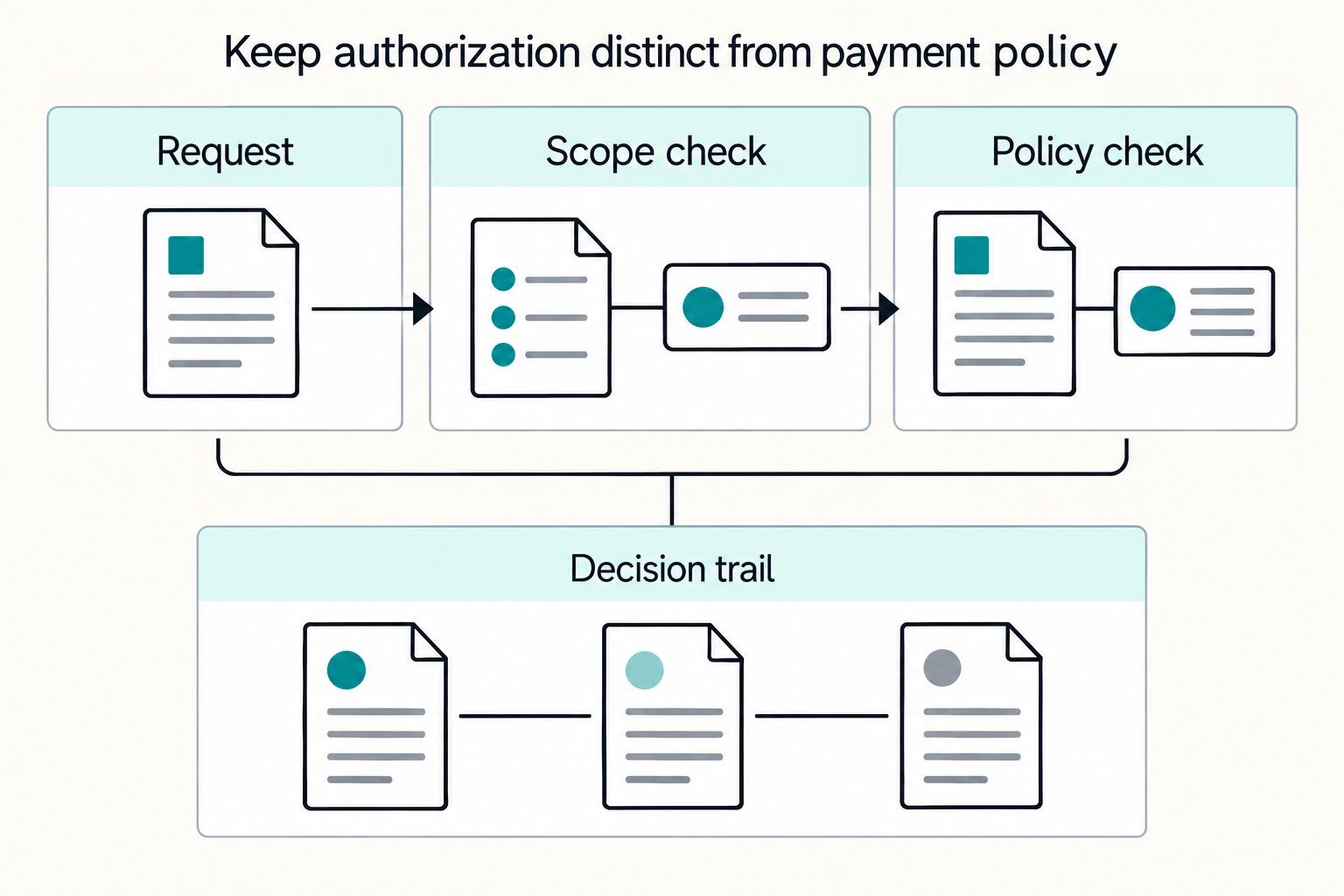
A valid access token should not be the final decision on money movement. Use OAuth scopes to control who can request an action, then run a separate policy decision before execution.
Step 1. Map scopes to actions, then require a second decision for risky payment events#
Keep scopes narrow and action-based. If a client initiates payouts, request only the payout scope it needs, since smaller scope sets reduce blast radius if a token is compromised.
Use a two-part gate:
- Authorization decision: does the token include the required scope, and is this principal authorized for this tenant and target resource?
- Policy decision: is this account currently allowed to execute it under your rules?
This matters most on risky operations and in Client Credentials flows, where there is no user consent prompt. A service can be authenticated and scoped correctly while still failing your policy eligibility checks.
Step 2. Keep one traceable record across auth and payment outcomes#
Keep one internal decision trail that links request ID, granted scopes, policy result, and final execution status. It does not have to come from one service, but it should be easy to reconstruct.
Use durable IDs for auth-linked mappings, not mutable fields like email, handles, or slugs. If identity claims are involved, OpenID Connect adds an identity layer on top of OAuth 2.0. It does not replace policy checks.
A practical checkpoint is to sample a recent payout request and confirm you can quickly answer:
- which client called the API
- which scopes were present
- which policy decision allowed or blocked execution
- what final execution status was recorded
Step 3. Re-check eligibility at explicit branch points#
At explicit branch points, run fresh checks instead of relying only on the first pass. Treat this as part of the flow so the system can re-evaluate current policy state when needed.
Step 4. Label authorization blocks separately from policy blocks#
Do not collapse different failures into one generic denial. If scope is missing, return an authorization outcome. If scope is valid but policy blocks execution, return a separate, documented policy outcome. That separation helps operators route incidents to the right owner instead of widening OAuth permissions to solve a policy hold.
If you want a deeper pattern for permission design before you wire in policy gates, see OAuth 2.0 Scopes for Platform Payment APIs: Design Patterns.
Roll out in three phases without breaking integrators#
A phased OAuth rollout helps integrators keep a stable contract while you tighten controls over time.
| Phase | Focus | Checks |
|---|---|---|
| Step 1. Ship a narrow MVP first | Baseline OAuth 2.0 and strict transport security | Require secure transport; register client type correctly; protect confidential-client credentials; test PKCE, granted scopes and token validation in the integration sandbox |
| Step 2. Harden without changing core endpoint behavior | Harden the auth layer behind the same integration surface | Reduce implementation confusion as integrations expand; make token and scope behavior easy for integrators to understand; checkpoint: explain which client called, which scopes were granted, and whether access changed recently |
| Step 3. Put scope changes under formal change control | Treat new or expanded scopes like release-governed API changes | Keep evidence of who had access, why they had it, and when that access changed; before phase rollout, map auth decisions to real endpoints and failure states in the Gruv docs |
Step 1. Ship a narrow MVP first#
Require secure transport and track client registration by environment. Keep confidential-client credentials on controlled server paths; public browser and native clients must not rely on an embedded secret. For public-client refresh tokens, use sender constraint or rotation with reuse detection.
Before production, run the auth flow in an OAuth Playground and repeat it in a sandbox company to confirm expected versus actual grants.
Step 2. Harden without changing core endpoint behavior#
Once MVP auth is stable, harden the auth layer behind the same integration surface. Focus on reducing implementation confusion as integrations expand, and keep token and scope behavior easy for integrators to understand.
Your checkpoint is operational clarity. Can you quickly explain which client called, which scopes were granted, and whether access changed recently?
Step 3. Put scope changes under formal change control#
As the platform grows, treat new or expanded scopes like release-governed API changes so integrators can adapt without surprise breakage.
For every phase, keep evidence that answers three questions: who had access, why they had it, and when that access changed. Before phase rollout, map your auth decisions to real endpoints and failure states in the Gruv docs.
Common implementation failures and how to recover fast#
When you need to recover quickly, remove ambiguity: tighten scopes, lock down Redirect URI and state handling, and make token decisions consistent across services.
Step 1. Replace the god scope with narrower permissions#
If one scope unlocks unrelated actions, treat it as a defect. OAuth 2.0 is built for limited, revocable permissions, and insufficient scope validation is a known implementation mistake.
Deprecate the broad scope and define smaller scopes around real actions or domains. For each sensitive endpoint, name the required scope and verify the API rejects calls that only present the old broad scope. Keep an endpoint-to-scope matrix during cleanup to reduce drift.
If you need more design patterns, see OAuth 2.0 Scopes for Platform Payment APIs: Design Patterns.
Step 2. Fix callback loops by validating Redirect URI and state#
When auth callbacks fail, check Redirect URI validation and state handling first, since both are documented OAuth 2 implementation mistakes.
Pause auth config changes and compare registered Redirect URIs with what clients actually send. Then run the Authorization Code Grant flow and confirm state is generated, returned, and verified every time. Any client depending on loose matching or undocumented callback values should be treated as a priority fix.
Step 3. Standardize token validation decisions across APIs#
Recovery gets much easier when every API applies the same token validation rules and returns the same error shape for the same token input.
Define one validation contract and shared error model for services that trust your authorization server. Keep authorization and authentication separate: OAuth 2 handles delegated access, and identity use cases should be an explicit OpenID Connect decision.
Step 4. Add execution-time policy gates, not after-the-fact checks#
A valid access token confirms delegated permission, not every downstream policy condition the operation may require. Put required policy checks in the execution path and log the policy result with the request and granted scopes.
If checks were missing, add them in-path first, then backfill records only where logs are sufficient to reconstruct outcomes confidently.
Final checklist to ship without auth debt#
Use this as a pre-launch evidence check. If a control exists in your design, document it, test it, and assign a clear owner.
- We documented our API gateway or edge controls, API ownership, and last review date.
- We verified least-privilege access against real payment actions and removed unnecessary permissions.
- We enforce authentication on every request and do not leave anonymous paths implicitly trusted.
- We verified encryption in transit and at rest anywhere auth data or payment metadata moves, and we tested API security against the OWASP API Top 10 with dependency patch status visible.
- If our implementation uses auth or token flows, we tested failure cases and documented expected recovery paths for integrators.
- If our payment flow uses provider-hosted secure fields and tokenization, we confirmed raw card data does not touch our servers.
- Where compliance gates are enabled, we can trace each request through to a final operation result in an auditable trail.
If you need a second set of eyes on scope design, payout gating, and rollout sequencing, contact Gruv.
Frequently Asked Questions
What OAuth scopes should a payment platform API start with?
Start with scopes named by resource plus access level, since that is a practical starting pattern. OAuth 2.0 does not define one universal scope model, so you need to design scopes for your API and configure each client with only the scopes it should have. For deeper scope patterns, see OAuth 2.0 Scopes for Platform Payment APIs: Design Patterns.
How short should an Access token be for payment operations?
Choose an access-token lifetime based on the exposure and recovery needs of your clients and operations. Validate each protected request through the supported token contract. JWT checks include issuer, audience, signature, expiry and permissions; opaque tokens need supported server-side validation rather than local signature checks.
When should we reuse tokens instead of requesting new ones?
Reuse a token while it remains valid for the intended resource and permissions. Renew through the supported grant or refresh path at expiry; request additional authorization when more permissions are needed. Keep the API’s JWT or opaque-token validation contract consistent on every protected request.
How do we handle users granting fewer scopes than requested?
Treat this as normal behavior, not an edge case. Users may grant only a subset of requested scopes, so your client should read granted scopes and adjust behavior accordingly. Do not assume requested scopes were all approved.
What OAuth mistakes break payment integrations most often?
Common failures include broad permissions, weak redirect checks and accepting tokens for the wrong resource. Validate JWT signature, issuer, audience, type and expiry before enforcing scope and resource ownership; use the supported validation contract for opaque tokens. A scope alone must not permit access to another tenant’s records.
Do first-party and third-party application consent flows need different rules?
Keep authorization-server consent explicit for delegated third-party access. First-party consent may be streamlined according to policy, but client permissions and tenant boundaries still need enforcement. Machine clients use a service grant without a user consent prompt.
How do OAuth controls interact with KYC, KYB, and AML policy gates?
OAuth authorizes API access; the payment service separately checks the account’s current eligibility before executing a payout or withdrawal. Link the authorization result, compliance or risk decision and execution outcome. A broader OAuth scope cannot clear a policy hold.
Researched and edited by the Gruv editorial team. Gruv builds cross-border billing, payouts, and finance-operations software for global businesses.
Sources
Includes 8 external sources outside the trusted-domain allowlist.
- curity.io/resources/learn/scope-best-practicesexternal
- datatracker.ietf.org/doc/html/rfc6749external
- datatracker.ietf.org/doc/rfc6819external
- developer.ebay.com/develop/guides-v2/authorizationexternal
- developer.intuit.com/app/developer/qbpayments/docs/develop/authen...external
- developers.google.com/identity/protocols/oauth2/web-serverexternal
- docs.github.com/en/apps/oauth-apps/building-oauth-apps/best-...external
- fusionauth.io/blog/how-to-design-oauth-scopesexternal
Educational content only. Not legal, tax, or financial advice.
Related Posts

The Freelance Payment Penalty: A Modeled Audit of Platform Fees, FX Spreads, and Payout Delays
The money rarely disappears through a single, easy-to-spot fee. The real loss is stacked. A marketplace takes its commission, a processor adds a charge for international cards, a bank or payment company converts the currency at a spread, a platform holds the funds before release, and a wire sheds a little to intermediaries on the way in. Each layer looks defensible on its own, but the worker feels the combined result as a smaller deposit and a later payday.

How to Respond to a Subpoena for Business Records
Move fast, but do not produce records on instinct. If you need to **respond to a subpoena for business records**, your immediate job is to control deadlines, preserve records, and make any later production defensible.

A US Expat's Guide to Investing in UCITS ETFs to Avoid PFIC Issues
The real problem is a two-system conflict. U.S. tax treatment can punish the wrong fund choice, while local product-access constraints can block the funds you want to buy in the first place. For **us expat ucits etfs**, the practical question is not "Which product is best?" It is "What can I access, report, and keep doing every year without guessing?" Use this four-part filter before any trade: