
Quick Answer
Start by treating cost reduction as an operating decision, not a billing exercise. Build a shared KPI stack, map payment flows to cost drivers, and sequence changes through gated reviews. Keep identity, AML, VAT, and reconciliation controls off-limits in early waves, test risky capacity changes in non-critical lanes, and require proof of both savings and payment performance before broader rollout.
Why Cloud Spend Management Matters for Global Payment Platforms#
Cloud spend management in payments is an operating decision, not a finance side task. If you cut cloud cost without checking payment reliability, reconciliation, and control coverage, you may lower the bill while making outcomes worse.
Treat cost work as a payment performance decision. Start with one rule: cost-optimized does not mean cheapest possible. It means resources are used well, the price point is practical, and the platform still meets functional requirements and business outcomes. For a payment platform, each savings change should be judged against payment success and failure signals, reconciliation visibility, and operational continuity.
That is why cloud spend belongs inside payment operations. Reliability is the workload performing correctly and consistently when expected. If your platform is targeting 99.9% or 99.999% availability, test cost actions against that bar, not against monthly savings alone.
Put finance, engineering, and product on the same side of the table. FinOps works here because it is shared financial accountability, not finance-only control. The model is explicitly cross-functional across engineering, finance, and business, which matches where payment cost drivers and failure modes actually live.
In practice, spend approvers, on-call owners, and teams carrying business or compliance impact can be different people. So this guide is built around one shared operating view: what to change, what to defer, and what evidence is enough to call a change successful.
Before you go deeper, confirm you have two visibility layers. If either layer is missing, optimize cautiously:
- Payment success and failure analytics
- Transaction-level reconciliation with transaction-level cost visibility
Protect compliance and reliability before chasing deeper savings. Payment infrastructure is more than compute and storage. It sits inside a control environment that may require secure, highly available APIs and baseline protections such as PCI DSS requirements for payment account data.
So do not assume every expensive component is waste. Some spend supports security controls, reliability, reconciliation operations, or compliance evidence. The rest of this guide stays operational on purpose. It covers what to measure first, who should decide each change, what usually pays back quickly, and what should wait until controls are stable and verified.
What to prepare before you optimize anything#
Before you try to save money, get the operating picture into one place. You need to show what you run, how spend is allocated, which payment paths are critical, and which controls cannot be weakened. That is what separates informed optimization from a cheaper bill with worse payout operations.
Build one baseline document for your actual cloud estate#
Create one shared baseline document that maps workloads across the clouds you use (for example, Amazon Web Services (AWS), Microsoft Azure, and Google Cloud), and clearly marks where you run multicloud, hybrid cloud, and serverless services. Be precise: multicloud means using more than one public cloud vendor for different workloads, while hybrid cloud means running common workloads across multiple computing environments.
For each workload, capture owner, cloud, region, environment, payment function, and dependency type. Include shared services, not just core payment services, because shared layers can hide both cost and operational risk.
Treat cross-cloud payment paths as one system. If fraud checks run in one cloud, ledger writes in another, and notifications in a third, a cheap-looking change in one place can simply shift cost and may shift latency elsewhere.
Gather the last full billing cycle and your current allocation logic#
Use the last fully closed billing cycle from each provider, not partial in-month snapshots. Provider timing differs. Azure may finalize a closed month up to the 5th day after month close, and Google Cloud says a monthly invoice should be available by the 5th business day of the following month.
| Provider | What to check |
|---|---|
| AWS | Validate tags and cost allocation tags. |
| Azure | A closed month may finalize up to the 5th day after month close, and cost allocation supports analysis but does not change invoice liability. |
| Google Cloud | A monthly invoice should be available by the 5th business day of the following month, and detailed billing export to BigQuery supports ongoing analysis by project, service, SKU, or location. |
Then document how spend is allocated by product line, region, and payment flow. In FinOps terms, scope should align to business constructs such as product or cost center, and allocation should define how shared costs are apportioned to responsible owners. Check a few provider-specific points as you do this:
- On AWS, validate tags and cost allocation tags.
- On Azure, note that cost allocation supports analysis but does not change invoice liability.
- On Google Cloud, use detailed billing export to BigQuery for ongoing analysis, especially when grouping by project, service, SKU, or location.
If you cannot explain how shared Kubernetes, networking, observability, or security costs are allocated, fix that before optimization. Otherwise, your reports will hide the real drivers.
Inventory payment-critical components before changing anything#
Build an explicit inventory for components tied to Merchant of Record (MoR), Virtual Accounts, and Payout Batches. Name the services that support the legal payment entity, routing and reconciliation identifiers, and payout batch paths to multiple recipients.
For each component, record business criticality, retry behavior, sequence, and rollback owner. Also record volume patterns, including end-of-day or end-of-week batch concentration.
Keep provider-specific limits provider-specific. For example, PayPal documents up to 15,000 payments per call for batch payouts, but that should not be generalized across providers.
Confirm compliance constraints that are off limits#
Before you optimize, define which KYC, KYB-style legal-entity checks, AML controls, and VAT validations cannot be degraded. FATF guidance requires customer identification and identity verification using reliable, independent sources, and US AML rules require procedures to identify and verify beneficial owners of legal entity customers.
For EU VAT checks, do not treat VIES results as always definitive in real time. VIES is a search engine using national databases, and the European Commission notes it cannot accept responsibility for web result accuracy.
The practical rule is simple. If a cost change can weaken identity verification, beneficial-owner checks, AML controls, or VAT validation, remove it from the first optimization wave. This is Inform-phase work in the FinOps cycle: Inform, Optimize, Operate. Skip it and later optimization turns into guesswork.
For tail-end spend workflows, read Tail-End Spend Management: How Platforms Can Automate Long-Tail Contractor Payments.
Define the KPI stack before any savings target#
Once the baseline is credible, lock the scorecard before you set a savings target. Finance and engineering should be jointly accountable for it. If they are not working from the same KPI stack, early cost wins are hard to trust and harder to sustain.
Build one shared scorecard#
Use one scorecard that finance and engineering review together. Start with unit-style metrics tied to business activity: cloud cost per transaction, cost per customer, and technology cost by revenue. Then pair them with performance metrics so lower spend does not hide weaker outcomes.
Define each metric clearly in the scorecard: denominator, exclusions, and source of truth. As a basic control, confirm finance and engineering are using the same transaction count for the same closed billing period.
Split efficiency metrics from risk metrics#
Keep efficiency and risk in separate KPI groups, then review them together. Do not collapse everything into one blended number. If efficiency improves but risk worsens, treat the savings claim as incomplete until both groups are reviewed together.
| KPI group | Example metrics | Why it matters |
|---|---|---|
| Efficiency KPIs | cloud cost per transaction, cost per customer, technology cost by revenue | Shows whether spend is improving relative to business activity |
| Risk and performance KPIs | service reliability, incident rate, reconciliation timeliness | Prevents savings claims that come with weaker outcomes |
Assign owners, cadence, and escalation#
Every KPI needs a named decision owner, a review cadence, and an escalation path. Weekly review is practical during active changes. Monthly review is reasonable once operations stabilize.
Keep the operating details in the scorecard itself: owner, cadence, threshold for investigation, and last refresh date. If spend drops while reliability worsens, or if a metric moves without clear attribution, escalate in the cross-functional review immediately instead of waiting for month-end.
For the accounts payable side of multi-country operations, read How to Build a Global Accounts Payable Strategy for a Multi-Country Platform.
Map payment flows to cloud cost drivers#
With the scorecard in place, map each payment step to its cloud billing unit. You want to explain spend changes before you try to cut them. Build one matrix from invoice creation through payout completion, then use it to separate healthy usage-based spend from fixed commitments.
Build the flow to cost matrix#
Start from the payment flow your operators use, not from cloud product names. A practical sequence is invoice created, payment intent or checkout call, fraud or compliance check, authorization result, ledger write, settlement event, webhook delivery, retry path, reconciliation step, and payout completion.
For each row, capture the business event, cloud component, billing unit, owner, and cost-allocation tag or label. That keeps direct cost drivers visible: API calls and outbound transfer, queue operations, and delivery attempts. It also makes retry paths explicit as both reliability controls and potential spend multipliers.
Use one closed billing period as a control. Finance should be able to trace the main flow to the same tagged resources engineering says handled that traffic.
Classify bursty versus steady workloads#
Traffic shape should drive pricing posture. Bursty paths usually fit serverless or consumption pricing first. Steady workloads are better candidates for fixed-term commitments, but only after usage is proven stable.
| Workload pattern | Good fit first | What to verify before commitments |
|---|---|---|
| Bursty checkout APIs, webhook handlers, event-driven callbacks | Serverless or consumption-priced compute | Traffic spikes and falls back, so avoid fixed commitments when idle time is common |
| Scheduled payout batches and periodic reconciliation bursts | Start elastic, then review windowed usage | Validate in your own billing data whether execution windows are consistent across periods |
| Always-on workers for steady queue drain, compliance screening, or ledger processing | Candidate for committed pricing after profiling | Usage is consistent enough for one- or three-year commitment terms |
This split is mechanical: some services scale down when idle and bill on active execution, while commitments require stable usage over fixed terms.
Tie each row to payment context#
Attach business context to each technical row so optimization risk is visible. For Merchant of Record checkout, clearly mark customer-facing and compliance-sensitive paths before any rightsizing.
For Virtual Accounts, document provider-specific settlement events, notifications, ledger updates, and reconciliation writes instead of relying on generic assumptions. For payout batches, record real execution windows and the payout grouping used for reconciliation, since concentrated windows may create short-lived spikes in API, queue, and webhook activity.
Flag failure modes in the same artifact#
Add failure-mode flags in the same matrix: duplicate retries, stale FX quote handling, webhook backlog, and asynchronous return processing. This keeps cost work from ignoring patterns that can increase billable attempts or blur spend signals.
For retries, document where idempotency keys are created and reused, and whether retries are client-initiated, queue-driven, or webhook redelivery. For webhooks, track asynchronous handling and redelivery behavior so backlog-driven attempts show up in both ops and cost views. If you use FX quotes, log quote duration and expiration handling so stale-quote reattempts are not misread as normal volume. Related: Solving Esports Prize Payment Distribution: How Tournament Platforms Pay Winners Globally.
Apply cost controls that protect payout reliability#
Once you can see the cost drivers, sequence controls by reliability risk. If a control could increase latency or failure probability, roll it out progressively in non-critical lanes and expand only after health checks pass.
Test risky controls in non-critical lanes first#
Use a canary-style rollout for any cost change that alters live capacity or execution behavior. Start with a small traffic slice, then move to full cutover only after that limited lane stays healthy and each phase passes health checks.
Validate with workload-specific signals, not only infrastructure status. Compare key business and operational metrics against a recent baseline before each expansion phase.
Remove waste that does not depend on architectural bets#
Take no-regret savings first: rightsize overprovisioned EC2 and remove or stop unused resources on schedules. That reduces waste without forcing early architectural commitments.
Before you schedule shutdowns, confirm ownership and criticality so non-production resources are truly non-critical. The goal is to avoid cutting something that still supports production operations.
Commit only after workload stability is proven#
Use AWS Savings Plans only when baseline usage is consistently stable. Savings Plans require an hourly spend commitment for a 1 or 3 year term, so they fit steady workloads better than lanes still moving with demand patterns.
| Option | When it fits | Commitment caution |
|---|---|---|
| AWS Savings Plans | Baseline usage is consistently stable and workloads are steady. | Requires an hourly spend commitment for a 1 or 3 year term. |
| Azure Hybrid Benefit | Eligible licensing rights apply. | Use the 180-day migration allowance only when target-state and licensing assumptions are already validated. |
| Azure commitment guidance | Consistent base usage is proven. | Over-committing leads to underutilization. |
Apply the same rule to Azure decisions. Azure Hybrid Benefit can reduce cost when eligible licensing rights apply, and Azure commitment guidance ties purchases to consistent base usage while warning that over-committing leads to underutilization.
Tune anomaly detection with payment context#
Configure anomaly detection so expected payout-cycle spikes are separated from true waste or incidents. In AWS, scope Cost Anomaly Detection monitors by member account, cost allocation tags, or cost categories so distinct spend patterns do not collapse into one noisy stream.
Use anomaly alerts for spend investigation, not real-time incident response. AWS monitoring runs approximately three times a day. Cost Explorer data can be delayed up to 24 hours, and new services need 10 days of history before anomaly detection can trigger.
For platform-level card controls, read How to Build a Spend Control Policy for Virtual Cards on Your Platform.
Set ownership and approval gates across teams#
Savings work moves faster when ownership is clear. Set one accountable owner for each cost decision, then require named approvers when a change can affect payout execution, identity controls, or VAT handling.
Assign one accountable owner per decision domain#
Cost governance should stay cross-functional, but each decision still needs a single owner. FinOps guidance supports shared accountability across finance, engineering, and business while pushing day-to-day cost ownership close to implementation teams.
| Team | Primary focus |
|---|---|
| Finance | Budget policy and forecasting |
| Engineering | Architecture and capacity |
| Payments ops | Payout execution impact |
| Compliance | Policy-gated actions |
A practical operating split is finance for budget policy and forecasting, engineering for architecture and capacity, payments ops for payout execution impact, and compliance for policy-gated actions. Treat this as an operating model, not a universal legal requirement.
Avoid dual ownership on the same decision. Keep one owner, and make other teams required reviewers when their controls or risk areas could be affected.
Define approval paths for policy-sensitive changes#
Use a written approve-or-disapprove path for any change that can touch identity controls, VAT handling, or payout-routing behavior. Change-control standards support explicit decisions with security and privacy impact considered.
For US-regulated identity flows, route cost changes that could affect CIP or legal-entity beneficial-owner checks through compliance review. CIP rules in 31 CFR 1020.220 require risk-based procedures to form a reasonable belief of customer identity. 31 CFR 1010.230 requires beneficial-owner identification and risk-based verification for legal-entity customers at account opening.
Apply the same gate to VAT-relevant flow changes. If routing or service consolidation could alter where VAT logic or records are handled, use joint finance and compliance review before deployment.
Require pre-change and post-change sign-off artifacts#
For high-impact changes, require a compact evidence pack before and after rollout so approvals, verification, and rollback decisions are auditable. Keep the pack compact:
- Pre-change sign-off: hypothesis and expected cost effect; affected flows, services, and regions; rollback trigger tied to FinOps and platform KPIs; named approvers
- Post-change sign-off: actual cost movement versus hypothesis; KPI verification against the same baseline; confirmation that policy-sensitive controls still operate as intended
Use change windows aligned to payment-volume patterns#
Use controlled change windows, then verify before each expansion step. As an operational safeguard, schedule risky cost interventions away from high-volume payout periods and known retry peaks where feasible.
Before rollout, confirm on-call ownership across engineering, payments ops, and compliance for policy-sensitive changes. After the first slice, verify checkpoints before expanding. If reliability or control signals degrade, roll back first.
For a step-by-step walkthrough, see Global Treasury Management for Platforms Across 50+ Countries.
Execute a 90-day implementation sequence#
Run the first 90 days in three controlled phases: clean visibility first, test architecture changes second, then lock operating discipline. Treat this as a risk gate: do not advance a phase if a change worsens reliability or security outcomes, or makes spend attribution less clear.
Map this sequence to FinOps Inform, Optimize, and Operate so savings work stays tied to operational control. This is a practical structure, not a mandated timetable from FinOps, AWS, Microsoft Azure, or Google Cloud.
| Phase | Days | Primary aim | Checkpoint before advancing |
|---|---|---|---|
| Inform | 1 to 30 | Baseline, tagging hygiene, shared KPIs, obvious waste removal | Allocation quality is usable, KPI owners are active, no reliability or security regression |
| Optimize | 31 to 60 | Controlled architecture changes, commitment planning, automation hardening | Results are attributable, rollback works, commitment candidates are stable |
| Operate | 61 to 90 | Review cadence, anomaly response, segment variance analysis | Review pack is recurring, anomalies are triaged, segment reporting is trusted |
Clean the baseline in days 1 to 30#
Start with data quality before discounts. Accurate cost and usage allocation makes later KPI variance analysis trustworthy, and tagging hygiene matters because tags drive cost visibility and allocation across teams.
Across AWS, Microsoft Azure, and Google Cloud, fix the minimum metadata needed to answer one question: which payment product, region, and flow created this spend? If you cannot separate segment-level spend, early savings signals and later variance analysis will be unreliable.
Launch a shared KPI scorecard in the same window using unit economics, not only aggregate cloud totals. Track cost per transaction, payout, or active merchant alongside operational risk measures. Hold this phase until you can explain bill movement by product segment and provider without heavy manual rework.
Then remove only the obvious waste: idle resources, overprovisioned services, and tighter non-production scheduling. In Azure, shutdown recommendations use the last seven days of inactivity as a verification signal. Still, confirm payment dependencies before action so quiet resources that support retries or buffering are not removed by mistake.
Test architecture changes in days 31 to 60#
Once the baseline is credible, run controlled experiments at small scope before broader rollout. This aligns with FinOps maturity guidance and reduces commercial risk when payment operations are uptime-sensitive.
Define one narrow lane per change, document expected cost impact, name the KPI to watch, and set rollback triggers before launch. If outcomes cannot be attributed to that change, do not expand.
Evaluate commitment pricing only after rightsizing and workload profiling. Azure guidance orders rightsizing or shutdown before reservations, then savings plans. Apply the same discipline to AWS Savings Plans and Azure options. One- or three-year commitments can lower cost, but only when usage is stable enough to justify commitment risk.
Use the same caution for Azure Hybrid Benefit. The 180-day migration allowance for Windows and SQL Server can help during migration or consolidation, but only when target-state and licensing assumptions are already validated.
Harden automation in this phase as well. Budget alerts alone are not enough. Add anomaly monitors and contextual alerts, and tune them to normal traffic patterns so expected spikes do not create alert noise. Azure anomaly emails compare changes against the previous 60 days, which helps interpret anomalies against historical behavior.
Lock governance in days 61 to 90#
In this phase, prove repeatability by showing the team can sustain savings without degrading core payment operations.
Run a recurring FinOps review across finance, engineering, and payments ops with one standard pack. Include spend by cloud, unit economics by product segment, top anomalies, actions taken, rollback events, and variance analysis. Monthly is a practical cadence here, not a universal requirement.
Use strict closure standards: each anomaly has an owner, disposition, and resolution note; each segment variance is explained by architecture, volume, or pricing changes. If spend movement still cannot be tied to payment context, pause expansion.
At day 90, reject false confidence. Lower cloud cost with worse reliability, weaker security outcomes, or unclear attribution is not optimization. It is operational debt that should be reversed or paused before scaling further.
As you operationalize days 31-90, align your runbooks with event and status handling patterns in the Gruv docs.
Choose tools with decision criteria, not feature hype#
Once your baseline is stable, tool selection should get stricter. Choose what improves spend decisions without increasing payout risk. For a payment platform, keep the scorecard focused on four checks: allocation depth, anomaly explainability, governance controls, and multi-cloud visibility.
Write the scorecard before demos#
Define selection criteria first, then test vendors against them. FinOps guidance supports criteria tied to framework capabilities and business priorities, including whether costs can be allocated to the owners who can act on them, shared costs included.
Make vendors prove this with your reality. Ask how they apportion shared services across product lines, regions, and payment flows, then ask them to explain a known spend spike at subcategory level. If they cannot drill down by service, account or project, and allocation tag to a credible root cause, the tool is unlikely to hold up in production.
Compare named options as candidates, not defaults#
Use public positioning to shortlist, not to decide. Then test the shortlisted tools against your own allocation and control requirements.
| Option | Publicly evident angle | What you still need to verify |
|---|---|---|
| Ternary | Emphasizes Kubernetes cost management and unified monitoring across clouds | Whether shared cluster costs can be allocated cleanly to payment services, teams, and tagged flows |
| Vertice | Emphasizes cloud usage analytics, savings identification, and continuous monitoring | Whether anomaly views explain spend by service, account, and tag in a way finance and engineering both trust |
| Flexera and RightScale Optima lineage | Flexera positions for unified visibility across AWS, Azure, and Google Cloud in multi-cloud or hybrid environments | Current packaging, allocation model, and governance controls; if your team still uses RightScale Optima naming, confirm current naming directly because Flexera acquired RightScale on September 25, 2018 |
Treat badges as a filter, not a decision#
Analyst badges can help you scan the market, but they do not prove fit for payment-platform controls. ISG Provider Lens spans 50+ categories and is a provider-comparison product, so use it as a secondary signal.
Primary evidence is operational fit: can the tool support your allocation model, explain anomalies at the level your teams need, and fit the governance boundaries your payout-risk model requires?
Require pilot evidence before broad rollout#
Do not commit platform-wide from demos alone. Run a pilot first to validate technical and user readiness on a bounded scope.
The pilot should produce evidence, not impressions. You want allocation outputs your team can review, anomaly drill-down that explains a known variance, and evidence that governance controls can be constrained around payment-critical infrastructure. Also validate scope limits early. For example, Azure Cost Management can auto-notify on anomalies, but anomaly alerts are not available for Azure Government customers. Related reading: How to Handle Payment Disputes as a Platform Operator.
Build an audit-ready evidence pack for finance and compliance#
Treat every optimization cycle as an auditable control change, not just a cost win. If you cannot show what changed, who approved it, how KPIs moved, and whether controls still held, the change is incomplete.
Open a folder for each optimization cycle#
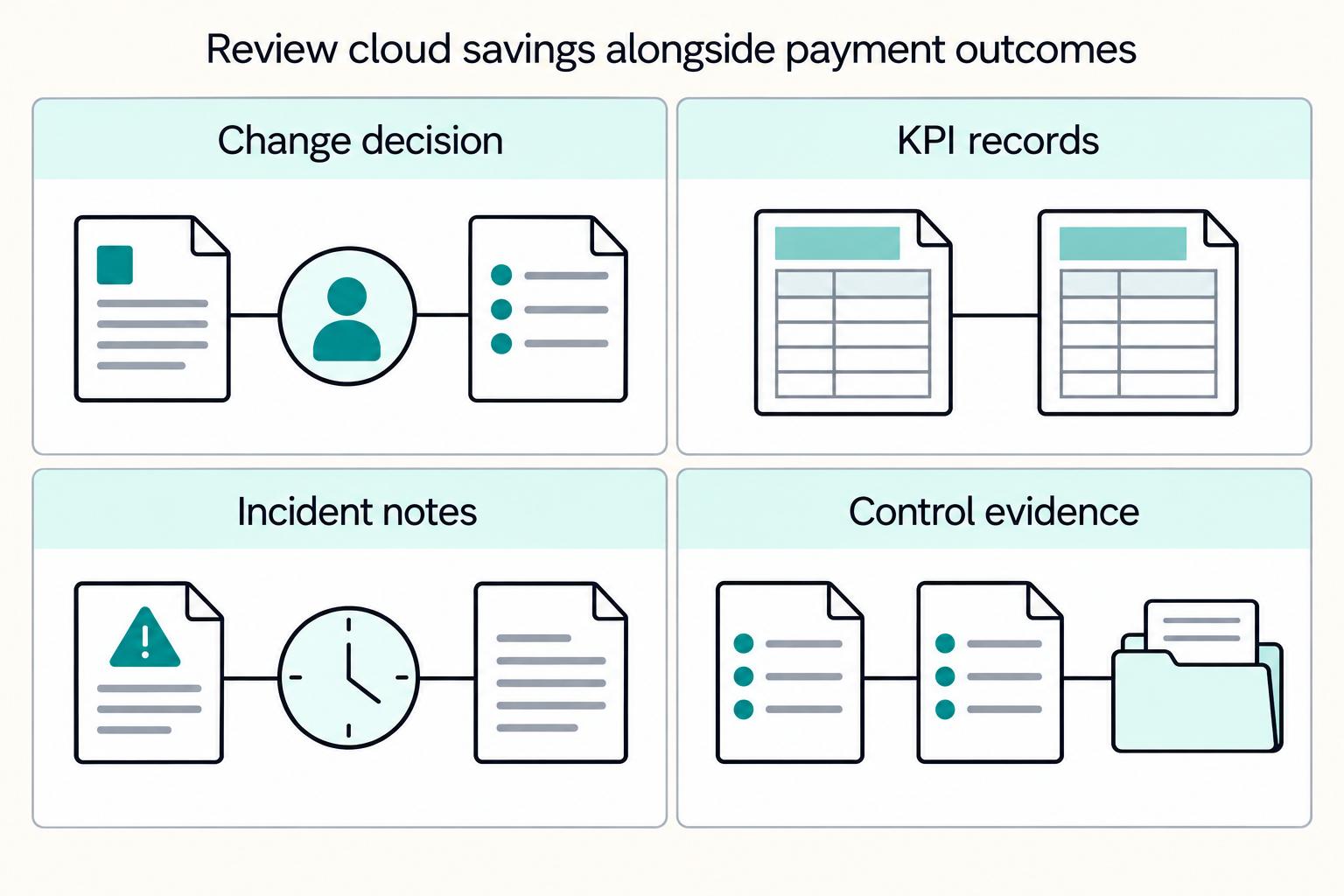
Create one evidence folder per cycle, aligned to your recurring FinOps cadence. Name it by date range and scope, for example, 2026-03 payout API rightsizing. Keep these five items together as an operating baseline (not a universal legal-sufficiency template):
- decision log: owner, approval date, hypothesis, affected services
- KPI snapshots before and after the change
- incident notes, including near misses
- rollback actions, or explicit confirmation rollback was not needed
- reconciliation outcomes for affected payment flows
Checkpoint: a reviewer outside the implementation team should be able to reconstruct the sequence without Slack history or memory screenshots.
Capture evidence finance and engineering can both use#
Connect cost movement to operational impact, not just infrastructure edits. Record KPI movement for the review period, sign-off owners, and whether reliability and reconciliation checks passed.
Keep the pack aligned to scheduled governance reporting. If spend drops but reconciliation slows or manual review increases, document that tradeoff directly.
Preserve compliance-sensitive traces for affected flows#
When a change touches onboarding, fraud, or payout decisioning, attach control evidence that the checks still executed as designed. For KYC and AML, retain traces showing risk-based identity verification paths. For legal-entity onboarding, retain beneficial-owner identification and verification evidence.
Do not break retention while optimizing storage or logging. For records required under US Bank Secrecy Act chapter X, those records must be retained for 5 years.
For EU VAT checks, keep the validation path and VIES result where used. Because VIES pulls from national databases and updates may lag, document what happened when checks were unresolved, whether that was a pause, added evidence collection, or tax-authority follow-up.
Add tax-adjacent records only where applicable#
Include tax artifacts only when the change affected those workflows. Do not add forms that were not in scope.
| Artifact | What to preserve |
|---|---|
| Form W-9 | Evidence the correct TIN collection step still ran where information returns are required |
| Form W-8 BEN | Evidence it was requested or maintained when required by the payer or withholding agent |
| Form 1099-NEC | Process impacts on filing data, especially records needed before the January 31 deadline |
| FBAR | If treasury or account-visibility tooling changed, note impacts on identifying foreign accounts that may exceed the $10,000 aggregate threshold; due April 15 with automatic extension to October 15 |
| FEIE | Only where taxpayer-reporting logic is in scope; reference amounts: $130,000 (tax year 2025) and $132,900 (tax year 2026) |
Final check: the pack should show both the savings decision and the control outcome. Finance or compliance should be able to verify later that payout gates, VAT checks, and identity-verification controls were not degraded. For a related implementation view, see How to Build a Deterministic Ledger for a Payment Platform.
Avoid common mistakes and recover fast#
When a cost change causes issues, recover in this order: restore control integrity first, then re-scope savings. Failures can follow cuts to controls that looked optional but were protecting retries, commitment sizing, or flow-level cost visibility.
Restore retry and idempotency controls first#
If you reduced retry or idempotency safeguards, restore them before chasing more savings. Idempotency lets a mutating request be retried without creating duplicate side effects, and retry logic should use backoff and jitter to avoid coordinated traffic spikes.
Use a direct checkpoint: resend the same idempotency key in a safe test lane and confirm one business outcome. Then verify retries are staggered, not flat repeated attempts.
Re-profile workloads before new commitments#
If commitments were locked too early, treat it as a sizing error. AWS Savings Plans are tied to consistent usage over a one-year or three-year term, and Azure reservation guidance similarly points to buying against consistent base usage.
Recover by separating steady workloads from bursty workloads, then committing only the stable floor. If historical usage does not support the committed level, you are likely carrying underutilized capacity.
Require finance, engineering, and payments ops to approve together#
Finance-only optimization can miss operational dependencies. FinOps is a cross-functional practice, so require joint review and explicit payments ops sign-off for changes that can affect payment operations.
Use the decision log as the gate: if rollback criteria are unclear or execution impact is unverified, do not proceed.
Split cost analysis by payment flow and region#
Avoid blending Merchant of Record, Virtual Accounts, and Payout Batches into one undifferentiated cost profile. These are distinct constructs. Managed-payments MoR scope can include tax, fraud, and disputes. Virtual accounts can be segmented by region, entity, or business unit. Batch payouts are a separate execution model with provider-specific batch guidance.
In the next cycle, allocate by flow first, then by region or entity where relevant. If one bucket mixes MoR checkout, virtual-account settlement, and batch execution, the optimization target is too coarse to trust.
Decide what to scale, pause, or reverse#
The decision point is simple: scale a control only when it lowers cloud spend without degrading payout reliability, weakening payment-data security guardrails, or increasing reconciliation effort across a real settlement boundary.
Step 1. Scale controls that are proven in production. Promote controls that stay stable through the settlement timing you actually run. If your flow follows an Adyen sales day, evaluate the full 24-hour window and confirm again when the settlement batch closes. Tie the call to unit economics, for example, cost per payout or cost per transaction, not spend reduction alone, and use canary or staged results as the decision evidence.
Step 2. Pause controls when attribution is unclear. In shared-service environments, KPI movement can be noisy. If results overlap with unrelated incidents or other changes, pause expansion until you can compare control and non-control lanes. Use anomaly signals, including comparisons to prior periods such as the previous 60 days, as investigation input, not proof of causation, and treat unallocated shared costs as ambiguous.
Step 3. Reverse controls that create material payment or reconciliation regressions. Roll back quickly when monitoring shows user-impacting payout issues or more manual reconciliation work. Keep payment-data security guardrails intact during rollback, and record the trigger, timing, affected flow, and evidence used.
Step 4. Publish a recurring decision memo. Use a short recurring memo as the operating record for scale, pause, and reverse decisions. Include what changed, affected flows, before-and-after KPIs, attribution confidence, rollback status, and next review date so leaders can see whether optimization is improving outcomes or only shifting spend.
For payout infrastructure at higher volume, read How to Scale Global Payout Infrastructure: Lessons from Growing 100 to 10000 Payments Per Month.
Conclusion#
The winning move is a decision-ready FinOps operating model, not a one-time cost cut. Keep finance, engineering, and business owners on shared KPIs, make tradeoffs explicit, and reject savings that weaken payment outcomes or controls.
If you want a copy-and-paste closeout, use this checklist:
-
Align one KPI scorecard. Use shared unit-economics metrics, for example, cost per transaction, with payment outcome signals, and assign clear owners with a recurring review cadence. FinOps accountability is cross-functional, so no single function should own the full story alone.
-
Map payment flows to cost drivers. Tie spend to real payment activity so decisions are based on workload behavior, not blended totals. The key checkpoint is whether you can explain what changed and why, not only whether spend dropped.
-
Apply low-risk controls first, then phase larger changes. Start with lower-risk optimizations, then run iterative FinOps execution through Inform, Optimize, and Operate. Move in increments on a regular cadence instead of waiting for a perfect one-shot plan.
-
Gate every change with reliability and compliance checks. Treat optimization as a tradeoff across cost, quality, and speed. For payment-data or payment-critical paths, require explicit accountability and escalation paths, and keep PCI DSS baseline controls intact, including log-monitoring expectations such as Requirement 10.6.3.
-
Maintain an audit-ready evidence pack and publish decisions on a steady cadence. For each change, capture the hypothesis, affected services, pre-change baseline, post-change results, and decision notes. Then record a scale, pause, or reverse decision on a recurring schedule.
If you cannot show the spend change, the payment outcome, and the control evidence together, the optimization is not ready to scale. If you want to pressure-test your MoR, virtual account, and payout architecture against these checkpoints, talk with Gruv.
Frequently Asked Questions
What does cloud spend management actually mean for a global payment platform?
It means tying infrastructure spend to payment outcomes, not just lowering the cloud bill. In FinOps terms, the focus is unit economics: connect what you spend to the value the platform delivers, such as cost per transaction or per customer. If spend drops but key operational outcomes worsen, the change did not improve the business.
How do we cut cloud costs without increasing payout failures or settlement delays?
Use an iterative approach: start with Inform capabilities, then move into Optimize and Operate in controlled rollouts. Judge results on both cost and operational outcomes, not on short-term cost movement alone. Keep reliability and reconciliation checks alongside cost so you do not trade resilience for a lower bill.
Which KPIs should finance and engineering share to manage payment infrastructure spend?
Use one shared scorecard that combines cost and operational outcomes. At minimum, track unit economics, for example, cost per transaction or per customer, and review those with the operational measures your payments teams use. Finance and engineering should review spend and performance together rather than in separate tracks.
What are the first 90 days of FinOps implementation for a Multi-cloud payments stack?
There is no universal FinOps Foundation 90-day calendar, so avoid forcing a fixed day-by-day template. Start with Inform capabilities such as allocation, reporting and analytics, forecasting, and unit economics, then move iteratively into Optimize and Operate. At each checkpoint, continue only when KPIs improve or hold steady across business-critical workloads.
How should we use AWS Savings Plans and Azure Hybrid Benefit without overcommitting?
Treat both as commitment decisions and phase them in after you understand baseline usage. AWS Savings Plans use a committed hourly spend for a 1- or 3-year term, and AWS recommends using Recommendations and Purchase Analyzer before buying; those recommendations are based on historical lookback windows (7, 30, or 60 days), do not forecast future usage, and are generated for immediate purchases. For Azure Hybrid Benefit, confirm you have qualifying licenses with active Software Assurance or qualifying subscriptions; eligibility depends on active entitlement, and workloads can run only while that entitlement is active.
How do anomaly detection and automation fit into payout operations safely?
Treat anomaly detection as an investigation trigger, not proof of root cause. AWS Cost Anomaly Detection runs about three times a day and can lag by up to 24 hours, so it supports triage rather than real-time protection. Use automation to alert owners and open response workflows, and keep final decisions on payment-critical changes under explicit operational control.
How should ownership be split across product, engineering, finance, and payments ops?
FinOps works when engineering, finance, and business teams share accountability, and payment operations should be included for payment-critical changes. Define explicit shared ownership for budget policy, implementation, and operational impact checks so spend, performance, and risk are reviewed together. Require clear pre-change evidence and rollback triggers before approving high-impact changes.
Try a related tool
Where Gruv fits
Plan and approve payout batches
See how payee status, approval rules, route review, and exception handling sit in one payout workflow.
See reconciliation and mismatch review
Compare ledger entries, provider payment records, and statement rows to see what matches and what finance needs to review.
Researched and edited by the Gruv editorial team. Gruv builds cross-border billing, payouts, and finance-operations software for global businesses.
Sources
Includes 1 external source outside the trusted-domain allowlist.
- csrc.nist.gov/pubs/sp/800/53/r5/upd1/finaltrusted
- ecfr.gov/current/title-31/subtitle-B/chapter-X/part-1...trusted
- ecfr.gov/current/title-31/subtitle-B/chapter-X/part-1...trusted
- ed.gov/media/document/2024-cm-configuration-managem...trusted
- irs.gov/businesses/small-businesses-self-employed/re...trusted
- irs.gov/instructions/i1099mectrusted
- nvlpubs.nist.gov/nistpubs/SpecialPublications/NIST.SP.800-128...trusted
- fatf-gafi.org/en/publications/Fatfrecommendations/Fatf-rec...external
Educational content only. Not legal, tax, or financial advice.
Related Posts

The Freelance Payment Penalty: A Modeled Audit of Platform Fees, FX Spreads, and Payout Delays
The money rarely disappears through a single, easy-to-spot fee. The real loss is stacked. A marketplace takes its commission, a processor adds a charge for international cards, a bank or payment company converts the currency at a spread, a platform holds the funds before release, and a wire sheds a little to intermediaries on the way in. Each layer looks defensible on its own, but the worker feels the combined result as a smaller deposit and a later payday.

How to Respond to a Subpoena for Business Records
Move fast, but do not produce records on instinct. If you need to **respond to a subpoena for business records**, your immediate job is to control deadlines, preserve records, and make any later production defensible.

A US Expat's Guide to Investing in UCITS ETFs to Avoid PFIC Issues
The real problem is a two-system conflict. U.S. tax treatment can punish the wrong fund choice, while local product-access constraints can block the funds you want to buy in the first place. For **us expat ucits etfs**, the practical question is not "Which product is best?" It is "What can I access, report, and keep doing every year without guessing?" Use this four-part filter before any trade: