
Quick Answer
Place circuit breakers around measured unhealthy payment dependencies. Block new unsubmitted requests promptly, preserve unknown prior payment outcomes for verification, and queue only eligible new work durably. Set bounded timeouts, retries and capacity, then test Closed, Open and Half-Open recovery without extra live payment intents.
Stop payment API failures from taking down checkout and payouts#
A practical way to stop a payment incident from spreading is to isolate the dependency where one slow call starts blocking upstream flows. If you need to implement circuit breakers in payment APIs, start with the boundary that can prevent cascade failures in checkout, payouts, and reconciliation. We focus on choices you can verify: where to place protection first, how to roll it out, and how to keep degraded behavior clear. Microsoft's circuit breaker pattern reference is a useful baseline for Closed, Open, and Half-Open behavior.
Step 1. Define the dependency boundary that can trigger the cascade#
Start with the synchronous call path that forces upstream services to wait. In practice, this is often where one internal API waits on another service or on an external dependency.
Choose boundaries from measured dependency behavior. Synchronous coupling can propagate waits; asynchronous work introduces queue, ordering and recovery responsibilities. Neither architecture alone guarantees resilience.
Before you do anything else, compare the same call path locally and in production. A simple example is 200 ms locally versus 5 seconds in production when data volume and network effects change. That kind of gap is a strong signal that this boundary is a high-priority breaker candidate.
Step 2. Decide what must stay correct when payment calls degrade#
Define correctness before implementation, not after the first incident. For each critical flow, make the first-order outcome explicit: what the customer sees, which state is allowed, and which internal record remains authoritative for reconciliation.
Distinguish a request blocked locally before submission from an attempted payment whose provider outcome is unknown. Never infer success or failure from a timeout alone. Preserve the original intent and communicate pending verification where necessary.
Before you code, document the expected outcomes for key customer and finance flows in plain language. If your team cannot describe those outcomes clearly, breaker logic will hide uncertainty rather than reduce risk.
Step 3. Sequence the rollout around evidence, not ambition#
Keep the first rollout narrow. Protect the highest-impact boundary first, then prove behavior under production-like conditions. That keeps resilience work from turning into broad platform debt.
Keep the first deliverable small and testable: one protected boundary, one defined degraded outcome, and one normal-versus-stressed latency baseline. Sudden traffic surges are a known pressure point in e-commerce systems, so do not treat local success as a release signal.
That sequence sets the approach: start by isolating the highest-risk boundary, validate production behavior early, and expand only after you can show the first boundary fails safely.
If you want a deeper dive, read Revenue Leakage from Payment Failures: How Much Are Failed Transactions Really Costing Your Platform?.
Prepare the architecture and evidence before you implement#
Do this before you implement breaker logic. It determines which boundary you protect first and how you'll verify outcomes when failures happen.
Step 1. Inventory every external boundary that can stall or mutate money movement#
Create a short dependency register for each boundary your Payment Service crosses: gateway, payout provider, FX service, webhook consumers, and event-driven sync jobs. For each boundary, mark whether the call is synchronous or asynchronous, read or write, and whether failure is customer-visible at checkout, payout-visible to ops, or back-office only.
Document the commercial boundary next to the technical one. Payment gateway fees affect profitability, and the effect grows with transaction volume. Link each dependency to the current provider pricing page rather than relying on copied internal fee notes. If you use Stripe, verify country-specific pricing from live pages before you make design decisions.
- Owner: name the team that changes thresholds and handles alerts.
- Review date: record the provider URL and the exact review date, such as
2026-04-05. - Fallback: note what your users or operators should see when the circuit is
Open. - Evidence fields: keep the IDs and references your team will need to reconcile retries and replays.
Use this register as a live control, not a one-time worksheet. If you cannot point to the owner, the latest 2026 doc review, and the fallback on the same page, you are not ready to implement circuit breakers in payment APIs on that path.
Step 2. Define the critical paths and the business counting rules#
Protect flows by business impact, not convenience. Define checkout authorization or capture and payout initiation as separate critical paths, and keep reconciliation work as its own path in your dependency map. If your dependency map mixes checkout-critical authorization with payout or FX behavior as a single failure class, treat that as a design issue.
Define authorization, capture, internal transfer and external payout separately using the actual provider product. Pricing definitions such as an active account are commercial measures, not proof that an API call completed or funds settled.
As a simple scenario, a checkout authorization for $50, a queued payout batch for $4,500, and a reconciliation target of $0 unexplained variance should not share one success rule. Therefore, your design review should name the amount, the state owner, and the evidence field for each path before you ship.
Step 3. Verify replay coverage and choose evidence artifacts now#
Do not roll out resilience changes on a write path until replay behavior is clear. For each write path, document expected behavior on retry, timeout, and duplicate delivery. If that behavior is unclear, pause breaker rollout for that path.
Choose provider request IDs, durable internal intent IDs and reconciliation evidence before rollout. Record the actual endpoint, idempotency scope/retention and outcome-query method for each write path.
According to Microsoft's circuit breaker pattern reference, the pattern acts as a proxy for operations likely to fail. We use that as shared vocabulary, not as a numeric policy. If you review provider docs in 2026, record the URL, the review date, and the response fields your team will inspect during an incident.
For related architecture work, see ERP Integration Architecture for Payment Platforms: Webhooks APIs and Event-Driven Sync Patterns.
Choose breaker placement by failure blast radius#
Put the first breaker where failure can spread fastest into customer-visible disruption. Then isolate the remaining boundaries so one unhealthy dependency does not ripple through the whole payment flow.
Step 1. Rank boundaries by impact and fan-out#
Rank each external boundary on three points:
- User visibility: how visible the failure is to users
- Downstream fan-out: how many downstream operations depend on that call
- Call mode: whether the call is synchronous or asynchronous
A practical starting point is synchronous, customer-facing calls. Keep non-blocking reporting paths lower priority when delay is acceptable.
Step 2. Place the first breaker at the failing dependency boundary#
Put the breaker directly around the external call that is failing or stalling. The goal is to stop repeated attempts to an unhealthy service before they cascade.
Use operational signals over a rolling window:
- Latency
- Error rate
- Timeouts
When thresholds are met, the breaker should move from Closed to Open and return fast errors rather than making repeated connection attempts.
Step 3. Use state transitions to control recovery#
Recovery needs clear rules, not ad hoc judgment during an incident. Use the standard three-state model: Closed, Open, Half-Open.
- Open: fail fast and use a defined fallback, such as controlled queueing or a default error path.
- Half-Open: allow limited appropriate health checks or controlled replay-safe requests; do not create extra live payment intents as probes
- Probe result: if probes fail, keep the breaker open longer. If they pass, return to normal traffic.
Treat example trip counts, such as failing three times in a row, as examples rather than universal defaults.
| Boundary | Typical failure signal | Customer impact | Breaker location | Fallback behavior | Verification signal |
|---|---|---|---|---|---|
| Customer-facing synchronous dependency | Timeouts, rising latency, errors | Immediate user-visible failure or delay | Around that external synchronous call | Fast error path or controlled degradation | Transitions to Open; requests fail quickly |
| Operational submission dependency | Errors, slow acknowledgements | Ops-visible delay | Around that external dependency | Queue eligible unsubmitted work; resolve already-attempted unknown outcomes separately | Backlog stays controlled; Half-Open probes confirm recovery |
| Event-delivery dependency | Repeated delivery or consumer failures | Delayed state propagation | Around delivery or consumer dependency | Queue and retry with controlled handling | Probe success in Half-Open; backlog drains cleanly |
| Reporting or back-office dependency | Slow or failed batch or report calls | Lower immediate user impact | Around reporting dependency | Defer, cache, or skip temporarily | Core payment traffic remains stable |
Step 4. Isolate breaker domains for unrelated money movement#
Do not share one breaker across unrelated money flows. Keep breaker domains separate by operation and dependency so one incident does not freeze unrelated flows.
Apply the same rule to adjacent flows that need different fallback and recovery behavior. For a step-by-step walkthrough, see How to Maximize Your Xero Investment as a Payment Platform: Integrations and Automation Tips.
Define failure signals and state behavior the team can operate#
Breaker behavior has to be operable, not just implemented. If engineering, ops, and product cannot describe the same transition the same way during an incident, the design is still too implicit.
Step 1. Write the states in plain language#
Write the three states next to the payment API boundary, not only in implementation notes.
- Closed Circuit: calls flow to the dependency normally.
- Open Circuit: calls stop hitting the dependency and fail fast or follow the defined fallback.
- Half-Open Circuit: limited appropriate health checks or controlled replay-safe operations test recovery without creating extra live payment intents.
Use the same labels in alerts, dashboards, and incident notes so the on-call team can tell immediately whether traffic is reaching the provider or being blocked locally.
Step 2. Separate the trigger types you will watch#
Do not lump all failures into one bucket. Keep trigger classes explicit: hard failures, timeout bursts, and slow-call accumulation. Track them over a rolling window using latency, error rate, and timeouts. A dependency can be reachable and still be too slow for stable payment flows. Classify ordinary business declines and validation errors separately; do not count them as dependency outages without a reason tied to the selected provider behavior.
- Latency bucket: what your team treats as slow enough to threaten checkout.
- Timeout bucket: how you separate one-off timeouts from a burst.
- Error bucket: which provider or internal responses count as hard failures.
- Review note: what changed in your most recent
2026game day or incident review.
Specifically, keep the signal examples and the trip policy separate. A move from 0.2% timeout rate to 2% on the same path is worth investigating, but it is not a universal open-circuit rule. Record the example percentage, the owner, and the action in one note so responders interpret the spike the same way.
Do not rely on hard errors alone. Public examples differ, such as three failures, five failures, or a 30-second wait, so treat them as illustrations rather than defaults.
Step 3. Assign owners and record what is still unknown#
Make ownership explicit before you trust the design in production. Set ownership in the runbook for each breaker and dependency. Decide who maintains transition and probe logic, who runs on-call actions when it opens, and who owns customer-facing degradation messaging.
Also write down what remains unknown. There is no universal payment API breaker threshold in public guidance. Data from your own latency and error distributions should drive trip and recovery values, and you should recheck them with failure testing and incident learnings.
Set timeouts retries and bulkheads before enabling open-circuit behavior#
Define per-attempt timeouts, an overall deadline, bounded retries and isolated capacity before rollout. Circuit-breaker and retry composition affects which attempts count toward thresholds; test the selected library and ordering rather than treating one wrapper sequence as universal.
Step 1. Bound each outbound call with a timeout#
Start on the caller side, where threads and connections are consumed. Timeouts should end slow attempts early enough to release capacity before queues build.
Record the per-attempt timeout, overall deadline and retry/attempt budget together. Verify that retry logic respects an open circuit and does not multiply attempts across service layers.
- Timeout budget: the maximum wait your checkout can absorb before the user abandons the flow.
- Retry budget: how many extra attempts your dependency pool can afford.
- Pool limit: how many blocked calls you are willing to isolate before opening the circuit.
- Replay gate: which write APIs remain non-retryable until your team validates idempotency.
Treat those as one budget sheet. If a duplicate checkout could turn into a $75 dispute and the queued payout batch behind it is $7,500, block new unsubmitted work promptly and recover under control. Preserve an uncertain prior attempt as pending verification rather than labeling it failed. Review customer wait tolerance and money-movement risk together rather than tuning retries in isolation.
Step 2. Cap retries inside isolated dependency pools#
Retries without isolation spread damage. Use retries and bulkheads together, and keep retry budgets inside the pool dedicated to that dependency so failing payment calls do not consume capacity needed by other routes.
Verify this with a partial-outage test where some calls succeed and some time out. The payment pool can degrade, but unrelated paths should stay responsive.
Step 3. Fail fast when retries exceed checkout tolerance#
If the initial attempt plus retries can outlast what users will tolerate in checkout, fail fast rather than extending the chain. Retries help with transient faults, but on sustained failure they also add load and delay recovery.
Keep retries within a bounded budget in the Closed state, open when timeout and error signals stay elevated, and allow only limited Half-Open probe traffic during recovery.
Step 4. Retry only replay-safe operations#
Retry only the same supported logical operation under its validated replay conditions. For an unknown payment outcome, preserve the original ID, query/reconcile provider evidence and hold replacement execution until resolved. A fast local response does not cancel a remote write already in flight.
Capture enough request-level evidence during tests and incidents to confirm whether replays are safe on payment write paths. If this area still needs tightening, Prevent Duplicate Payouts and Double Charges with Idempotent Payment APIs is the next read.
Step 5. Verify with failure injection before enabling open-circuit behavior#
Before you enable open-circuit behavior in production, run three tests: slow upstream, partial outage, and full timeout. Confirm that timeouts bound wait time, retries stay within pool limits, and full-timeout behavior opens the breaker to fast-fail before allowing limited Half-Open probes.
| Test | What to confirm | Containment goal |
|---|---|---|
| Slow upstream | Timeouts bound wait time | Failure stays at the payment dependency boundary, and checkout and order paths keep usable capacity |
| Partial outage | Retries stay within pool limits | Failure stays at the payment dependency boundary, and checkout and order paths keep usable capacity |
| Full timeout | Breaker opens to fast-fail before allowing limited Half-Open probes | Failure stays at the payment dependency boundary, and checkout and order paths keep usable capacity |
Pass only if failure stays at the payment dependency boundary, and checkout and order paths keep usable capacity.
For team enablement context, see How to Build a Payment Compliance Training Program for Your Platform Operations Team. Before enabling open-circuit trips in production, validate timeout, retry, and idempotency behavior against the Gruv docs.
Implement the first breaker on checkout-critical payment calls#
Your first breaker should sit on the payment dependency most likely to stall checkout. In many architectures, that is a synchronous payment call in the checkout path. When that dependency slows down, blocked user flow and caller-capacity pressure follow quickly.
Step 1. Place the first breaker on the highest-blast-radius payment call#
Start on the path where the user is waiting. Breakers help most where dependency failure can consume caller capacity faster than recovery can happen.
Keep the first rollout intentionally narrow: one breaker and one fallback path. You will not cover every payment path on day one, but you will lower rollout risk while your team learns how Open and Half-Open behave under production traffic.
Step 2. Define one fallback that product and ops can support#
When the circuit blocks a new unsubmitted request, return a clear unavailable response. If an earlier attempt might have reached the provider, show pending verification and reconcile that original intent; do not invite a new charge that could duplicate it.
Define that message and action path before release so users get a clear outcome quickly. The breaker does not replace timeouts and retries. It limits repeated damage when failure signals stay elevated.
Step 3. Define explicit state triggers before release#
Document how the breaker moves between Closed, Open, and Half-Open, and what signals trigger each transition.
That shared state model gives support and engineering one path for handling incidents when dependency health is unstable.
Step 4. Keep Half-Open recovery rules simple for the first release#
Limit Half-Open traffic and check results before ramping. Prefer an appropriate health/read probe where available; any payment write probe must be a controlled, replay-safe operation with a known business intent, not an extra test charge on a live customer.
During failure injection, verify that your operational signals line up: breaker state transitions, blocked checkout-request volume, and dependency error or timeout signals. If they do not line up, fix the instrumentation before you expand beyond this first breaker.
Related: How to Use Machine Learning to Reduce Payment Failures on Your Subscription Platform.
Design fallback behavior by money flow not by service name#
Fallbacks should follow the money flow, not just the service boundary. Checkout, payout initiation, and reconciliation updates can have different latency and reliability needs, and treating them the same makes cascading failures more likely.
Step 1. Classify fallback by flow, not by ownership#
Map flows side by side before you change logic: checkout, payout initiation, and reconciliation updates. That keeps the critical path, checkout, from inheriting fallback behavior meant for lower-urgency work.
| Flow type | Fallback when circuit is Open | User or operator message | Recovery trigger | Evidence to retain |
|---|---|---|---|---|
| Checkout | Reject new unsubmitted requests promptly; preserve unknown prior payment outcomes for verification | Unavailable for a blocked new request; pending verification for an uncertain prior attempt | Dependency health improves | Request ID, checkout or order ID, circuit state, provider reference if present |
| Payout initiation | Durably queue eligible new instructions; fence recovery and resolve unknown prior attempts before replay | Confirm receipt for processing, not fund movement | Provider path recovers and queued work is replayed under control | Request ID, payout or batch reference, circuit state, provider response or reference |
| Reconciliation updates | Defer to async catch-up | Internal status-first messaging | Async update path resumes after recovery | Event ID, payment or reference ID, internal record reference, circuit state, last known status |
As a simple check, define for each row who sees degradation, what they see, and which fields let your team reconstruct the outcome later.
Step 2. Default checkout to explicit fail-fast#
For a new checkout request blocked before submission, fail fast with a clear unavailable response. Preserve an already-attempted payment with unknown outcome as pending verification. Outages on this path have immediate revenue impact, and hidden retries can add pressure or duplicate execution instead of helping recovery.
Keep retry behavior tightly controlled. Retries can amplify incidents by adding load during dependency failure, and traffic spikes can arrive fast, for example 10x in minutes. After rollout, verify that breaker-open behavior keeps wait times controlled and messaging consistent across client surfaces.
Step 3. Queue payout initiation with controlled replay#
Queue eligible new payout instructions durably when the submission path is unavailable, with bounded capacity, expiry and an explicit receipt-for-processing status. Track already-attempted instructions separately: resolve unknown provider outcomes before replay or replacement. Queue admission is not evidence of payment.
Preserve each instruction ID, original provider key and attempt history. Check provider retention/scope before replay and use durable internal outcomes beyond that window. Fence competing workers or manual paths so one instruction cannot execute concurrently through multiple routes.
Step 4. Let reconciliation catch up asynchronously#
Reconciliation updates can often recover through async catch-up rather than checkout-style handling. The goal is to restore consistency after dependency recovery without reopening customer-facing disruption.
Preserve linkage across request identifiers, payment references, and circuit state so late events can be matched to earlier degraded behavior. Designing by money flow up front makes delayed-update mismatches easier to detect and resolve.
For the full breakdown, read How to Set Up a Healthy PO System for a Platform: From Requisition to Payment in 5 Steps.
Protect idempotency and ledger consistency during degraded operation#
When a circuit is open, you may need to trade throughput for consistency. Retries, replays, and late events must not create a second outcome for the same intent.
Step 1. Use one stable identity for replayable writes#
Use a durable business-intent ID for payment execution and provider keys within their documented scope/retention. Keep webhook event IDs separately for delivery deduplication, linking each event to the intent. Different lifecycle events for one payment need distinct event records; they must not be discarded merely because the intent ID is shared.
As a quick check, trace one degraded-path request or event end to end and confirm the same identity is preserved through decision, replay, and final write.
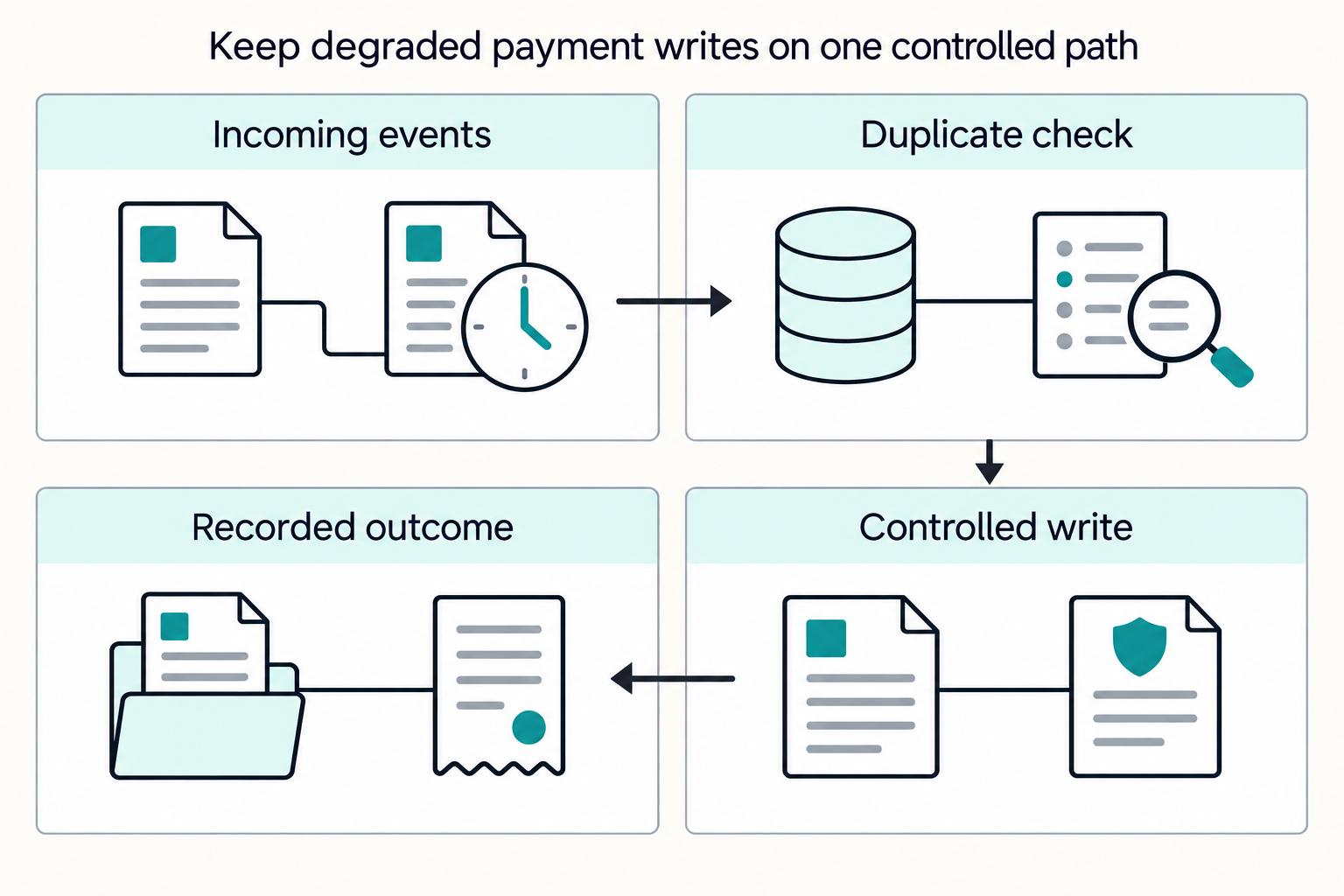
Step 2. Keep critical state changes on a single controlled path#
Avoid introducing alternate state-change paths during recovery. Route critical writes through one controlled path, and let downstream or derived views catch up from that result instead of applying separate recovery writes.
This reduces hidden coupling between queue consumers, async handlers, and manual recovery actions.
Step 3. Add duplicate detection where state changes happen#
Run duplicate detection where state actually changes, not only where a message arrives. Asynchronous patterns can improve responsiveness, but event ordering, idempotency, and fault tolerance remain core challenges. During recovery windows, late events and catch-up processing may overlap.
Test duplicate callbacks, distinct lifecycle events, late acknowledgments and concurrent recovery workers. Require one execution of the intended payment with a truthful evolving status and consistent linked journal entries; later returns can reopen the operational record.
Step 4. Verify lineage and controls before incident close#
Treat degraded-mode recovery as a control point. Use monitoring, data-lineage validation, anomaly detection, and compliance enforcement while backlog clears.
Before you close the incident, run an end-to-end lineage check from the incoming request or event through degraded handling to the final recorded state.
Implement observability that proves resilience is working#
Observability should show whether the breaker is reducing cascade risk, not just hiding failures. Track breaker behavior per dependency, then read those signals alongside business impact so fast failure in OPEN is not mistaken for health.
Step 1. Instrument breaker states per dependency#
Start at each external API boundary protected by a breaker, and keep metrics split by dependency. At minimum, track:
- State transitions: transitions into
OPENandHALF_OPEN - Open time: total time in
OPEN - Probe success:
HALF_OPENsuccess rate - Blocked volume: request volume in
OPEN
That helps you see whether the breaker is failing fast against a slow or failing downstream service, and it lets the team confirm whether recovery appears isolated or starts to spread.
Step 2. Pair control signals with business impact#
Breaker metrics show control behavior, not service impact on their own. Put business-impact signals next to breaker metrics so responders can tell quickly whether fallback paths are containing damage or whether user and operational outcomes are degrading.
Use this decision rule during incidents: if fallback success drops while OPEN frequency rises, tighten dependency isolation and review thresholds before you add retries.
- Control metrics: transitions into
OPEN,HALF_OPENsuccess, and blocked volume. - Business metrics: checkout completion, payout backlog, and reconciliation age.
- Freshness fields: dashboard timestamp, log delay, and the last successful probe.
- Recovery markers: which flows can reopen automatically and which continue to need manual review.
In contrast, a dashboard that shows only control metrics can make a contained failure look healthy. Data from your own incident review should sit beside those live signals. When you revisit this design, record the last good export, the last good probe, and the business metric responders trust most.
Step 3. Keep traces and logs joinable#
Metrics alone are not enough. Keep a consistent set of identifiers and breaker context across logs and traces so you can reconstruct whether a request was blocked, retried, or recovered.
Also plan for observability limits during incidents. Telemetry can be delayed, and historical logs can have gaps. Show data freshness so operators do not make decisions from stale signals.
Step 4. Use one operator view across recovery paths#
Responders need correlation, not screen-hopping. Give them one dashboard across critical recovery paths so breaker state, fallback outcomes, recovery progress, and telemetry freshness sit in one place.
Before you close an incident, confirm both control recovery and data recovery, not just that circuits moved out of OPEN. This pairs well with our guide on How to Build a Payment Reconciliation Dashboard for Your Subscription Platform.
Handle common implementation mistakes and recovery paths#
Breaker failures often come from boundary and recovery design issues, not syntax. Fix scope, isolation, retry behavior, and recovery checks so the pattern contains failure instead of relocating it.
Step 1. Scope breakers to real dependency boundaries#
A single global breaker across unrelated calls can block healthy paths when one dependency is failing. Scope breakers to dependency boundaries so one failing downstream does not trip unrelated traffic.
You know containment is working when blocked traffic stays localized rather than spreading across services.
Step 2. Combine circuit breakers with bulkheads#
A breaker alone will not prevent resource exhaustion. Timeout-driven waits can block concurrent requests until timeout expiry, which can drain thread pools or connection pools.
Use bulkhead-style isolation, such as separate pools or queue boundaries, so one slow service cannot consume shared capacity.
Step 3. Keep retries bounded for transient faults#
Retry storms amplify cascading failures, and operations that are unlikely to succeed should not be retried continuously. Limit retries to transient faults and route longer-lived failures to a controlled error path.
Validate this in testing by confirming downstream degradation does not trigger uncontrolled retry loops.
Step 4. Verify containment before declaring recovery#
A breaker returning to normal operation is not enough on its own. Cascades can progress from one slow dependency to blocked threads and then gateway overload if pressure is still moving through the stack.
Do not declare recovery until those cascade checkpoints are clear and traffic is no longer spreading across dependencies.
Ship in phases and close with an operator checklist#
Roll this out by failure blast radius, not all at once. After you prove the first breaker in test, expand in order: highest-risk synchronous calls first, then adjacent critical paths, then async paths such as Webhooks and reconciliation jobs. Each added boundary increases coordination, timeout complexity, and operational burden.
Step 1. Ship one breaker where checkout damage is highest#
Start with the single synchronous dependency boundary that can stall checkout when latency or timeouts rise. Keep the first release narrow: one breaker, one fallback message, one dashboard, and one on-call path.
Verify it operationally. Under failure injection, new unsubmitted checkout requests should fail fast while uncertain prior attempts retain their intent and pending-verification status. Keep unrelated paths healthy. Track status code, error count, and circuit state together, because a 200 or a low error count alone can still hide failure conditions.
Step 2. Assign ownership before you widen scope#
Do not widen scope until ownership is explicit. Assign one owner for thresholds, one for fallback messaging, and one for post-incident reconciliation sign-off.
If expansion requires many coordinated service changes, review coupling and boundaries before continuing. Keep legitimate transaction dependencies rather than simplifying away required consistency controls.
Step 3. Extend to payouts and async recovery, but keep isolation intact#
Once checkout protection is stable, extend it to payouts and then async recovery paths. Keep these domains separate even when they share an upstream dependency, so one dependency issue does not spread across flows.
For async recovery, do not treat a single Half-Open probe as proof of health. Require repeated success checks and keep traceability for circuit transitions and request handling decisions.
Step 4. Gate production with an operator checklist#
If any line below is unchecked, do not activate the breaker in production.
- Dependency map completed for checkout, Webhooks, and payout rails
- Timeout order configured before breaker activation
- State transitions tested with failure injection
- Observability live for breaker state, fallback success, and recovery status
- Operator view includes status code, error count, and circuit state together
- Recovery sign-off runbook tested after a simulated outage
The goal is a controlled rollout: a failing dependency stays isolated, observable, and recoverable without dragging checkout, payouts, and follow-up operations into uncertainty.
If you implement the next breaker only after this checklist is green, you are more likely to prevent cascade failures in payment APIs without creating new reconciliation debt for your team.
Related reading: QuickBooks Online + Payout Platform Integration: How to Automate Contractor Payment Reconciliation.
If you want to pressure-test your phased rollout for checkout and payouts, contact Gruv.
Frequently Asked Questions
What causes cascade failures in payment integrations?
Cascade failures in payment integrations usually start with slow gateway or payment responses, not just hard outages. Waiting requests pile up, retries add load, and timeout-driven blocking can exhaust shared resources such as server threads. If latency is climbing before errors spike, that is often an early sign the failure is spreading.
When should we use circuit breakers versus retries and timeouts?
Use them together because each handles a different failure mode. Timeouts cap wait time, retries are for transient faults, and circuit breakers stop repeated calls when latency, timeout, or error signals keep breaching your acceptable threshold over a rolling window. Retries alone on a dependency that is not recovering can make the incident worse.
Where should we place the first circuit breaker?
Place the first breaker on the synchronous external dependency with the biggest blast radius in checkout flow. In many payment stacks, that is where payment authorization or capture calls leave your service and cross a provider boundary. The validation check is whether degradation at that dependency is contained instead of cascading into unrelated paths.
What should happen when a circuit opens during checkout?
For a new checkout request blocked before provider submission, return a clear unavailable response. For an already-attempted request with unknown outcome, preserve its intent and show pending verification while querying/reconciling evidence. An open circuit or timeout does not prove the original payment failed, and a new customer retry must not create a duplicate charge.
How do we test breaker behavior before production?
Inject slow calls, hard timeouts, and hard failures on the checkout-critical dependency. Confirm predictable transitions across Closed, Open, and Half-Open, and verify fallback behavior is consistent. Also test for secondary pressure paths so retries or queued work do not keep overloading the system after the breaker opens.
Which metrics prove the setup works?
Track latency, timeout, and error-rate signals over the rolling window that drives breaker state changes. Verify those signals line up with expected transitions across Closed, Open, and Half-Open, including whether Half-Open probes succeed.
Researched and edited by the Gruv editorial team. Gruv builds cross-border billing, payouts, and finance-operations software for global businesses.
Sources
Includes 1 external source outside the trusted-domain allowlist.
Educational content only. Not legal, tax, or financial advice.
Related Posts

The Freelance Payment Penalty: A Modeled Audit of Platform Fees, FX Spreads, and Payout Delays
The money rarely disappears through a single, easy-to-spot fee. The real loss is stacked. A marketplace takes its commission, a processor adds a charge for international cards, a bank or payment company converts the currency at a spread, a platform holds the funds before release, and a wire sheds a little to intermediaries on the way in. Each layer looks defensible on its own, but the worker feels the combined result as a smaller deposit and a later payday.

How to Respond to a Subpoena for Business Records
Move fast, but do not produce records on instinct. If you need to **respond to a subpoena for business records**, your immediate job is to control deadlines, preserve records, and make any later production defensible.

A US Expat's Guide to Investing in UCITS ETFs to Avoid PFIC Issues
The real problem is a two-system conflict. U.S. tax treatment can punish the wrong fund choice, while local product-access constraints can block the funds you want to buy in the first place. For **us expat ucits etfs**, the practical question is not "Which product is best?" It is "What can I access, report, and keep doing every year without guessing?" Use this four-part filter before any trade: