
Quick Answer
Choose an expat tax advisor by verifying written scope, documented assumptions, deadline ownership, escalation rules, and technical depth on your actual facts. Classify residency and filing posture before comparing firms, build a complete document pack, and test the advisor on FEIE, FTC, FBAR, and Form 8938 scenarios. Then require named accountability, controlled pricing, and a pilot file before broader rollout.
Choose an expat tax advisor by documented controls#
Choosing an expat tax advisor is a control decision first and a branding decision second. If your team owns compliance risk across multiple markets, focus on what an advisor can show in writing: scope, change handling, documented assumptions, deadline ownership, and escalation before issues become filing problems.
Step 1 Set the selection goal correctly#
If you are deciding how to choose expat tax advisor support, do not optimize for the broadest package. Buy enough technical depth and accountability to manage U.S. expat taxes without building a process that looks rigorous but does not lower risk. Match advisor depth to your facts, not to polished marketing, testimonials, or generic cross-border claims.
One provider says it plainly: "Expat taxes are complicated. Seriously." The takeaway is practical. Complexity can show up in edge cases and incomplete or changing facts. A strong advisor should reduce surprises there, not just at form-prep time.
Step 2 Ask for checkpoints you can verify#
Use an audit mindset from the start. The GAO's FISCAM is not an expat tax manual, but it presents a documented methodology for evaluating controls. In practice, ask each firm for process evidence: what they collect, who reviews it, how edits are controlled, and what happens when facts change mid-engagement.
A simple early checkpoint is a written scoping note or engagement draft that states:
- Work covered
- Client inputs required
- Handoff points
- Escalation contact
If a candidate cannot explain those items clearly before signing, execution risk is already visible. Another strong signal is whether they welcome hard questions. "Ask the tough questions" is useful advice here. You want plain answers, documented assumptions, and clear statements about where more facts are still needed.
Step 3 Treat deadline handling as a risk signal#
Deadline language is where weak controls can hide. If a provider points to an extension path to October 15, do not treat that alone as reassurance. Ask who owns the extension decision, what must be in hand before action, and how missing inputs are tracked when late-filing-penalty risk is still possible.
Treat missed deadlines as a possible scope failure, not just a calendar failure. Scope should clearly state what is included, who is accountable, how pricing changes when facts change, and when escalation starts. Keep that same posture through the rest of this guide: verify what can be verified, and do not pay for extra process unless it changes the risk outcome.
For compensation-policy context, see How to Handle Tax Equalization for Expat Employees.
Define your risk tier before you compare advisors#
Set the risk tier from residency and filing posture first, then compare advisors. If a case may be nonresident for U.S. tax purposes, scope that before you compare firms on price.
Step 1 Classify the facts before the advisor#
Start with a plain-English fact pattern: employee wages, contractor income, business ownership, Green Card status, and nonresident investor facts. These are inputs, not risk tiers, and they tell you what must be confirmed before scoping is credible.
Step 2 Map the filing surface early#
One of the first things to pin down is whether the taxpayer may file as a nonresident. Nonresident filers use Form 1040-NR, and the filing options and limits can change what kind of advisor you need.
For Form 1040-NR, available statuses may include single, married filing separately, and qualifying surviving spouse, with foreign trust and foreign estate also listed. If someone is nonresident at any point in the tax year, head of household is not available, and married filing jointly is generally not available if either spouse was nonresident at any point, though some couples may elect resident treatment and file jointly. Nonresidents also generally cannot claim the standard deduction, with an exception noted for students and business apprentices from India.
Step 3 Assign advisor depth from that map#
Use the filing surface to set a working tier:
| Working tier | Use when |
|---|---|
| Basic filing support | Stable, resident-style facts with no meaningful status-shift questions |
| Specialist expat support | Uncertainty around resident versus nonresident treatment, or cross-border fact patterns that need technical review |
| Complex cross-border escalation | Likely nonresident treatment, unresolved filing-status constraints, or combined multi-country and ownership facts that may need deeper technical review |
A practical screen is to flag income across multiple countries plus entity ownership for deeper technical review from day one.
Step 4 Confirm the tier in writing before proposals#
Before you ask firms to price the work, require them to confirm the tier in writing. Ask each advisor to state the expected return type, the filing statuses they would consider or rule out, and the open questions that could move the case to a higher-complexity track. Comparing firms before residency and filing posture are clear can lead to re-scoping later, with extra cost, time, and burden.
If you want a deeper dive, read Best CPA Firms for US Expat Taxes: How to Choose a Cross-Border Tax Advisor.
Before outreach, tighten your residency assumptions with a single working record: Track residency days and tests.
Build the document pack before outreach#
Build the document pack before you contact firms. If key account details or filing facts are unclear, advisor scoping turns into guesswork.
Step 1 Gather the scoping file#
Create one working folder with an account list and filing records for foreign financial accounts or other assets that may matter for Form 8938 or FBAR (FinCEN Form 114). For Form 8938, capture the fields the form asks for: the number of deposit accounts, the maximum value of those deposit accounts, and whether any foreign assets were acquired or sold during the tax year.
Keep the asset definition practical while you collect. A specified foreign financial asset can include a financial account maintained by a foreign financial institution.
Step 2 Split facts from assumptions#
This split matters more than most teams expect. Facts include the number of deposit accounts, maximum value, and whether assets were acquired or sold during the year. Assumptions include whether an item is excluded from Form 8938 reporting or whether one filing covers another.
| Item | Treat as | Note |
|---|---|---|
| Number of deposit accounts | Fact | Form 8938 asks for this field |
| Maximum value | Fact | Form 8938 asks for this field |
| Whether assets were acquired or sold during the year | Fact | Form 8938 asks for this field |
| Whether an item is excluded from Form 8938 reporting | Assumption | Listed as an assumption |
| Whether one filing covers another | Assumption | Filing Form 8938 does not remove a FinCEN Form 114 filing obligation when FBAR applies |
Do not treat Form 8938 as a substitute for FBAR. Filing Form 8938 does not remove a FinCEN Form 114 filing obligation when FBAR applies.
Step 3 Keep a simple filing timeline#
Keep a one-page timeline for the tax year that tracks dated account events and filing deadlines, including extensions where relevant. Make the timeline clear so an advisor can scope from dated facts instead of reconstructed history.
Step 4 Verify filing posture before outreach#
Before outreach, confirm whether an income tax return is required for the year. If no income tax return is required, Form 8938 is not required, even if foreign assets exceed reporting thresholds. If a return is required, attach Form 8938 to that annual return and file it by the return due date, including extensions.
If key account records are missing or maximum values cannot be reconciled, pause outreach and close those gaps first.
You might also find this useful: Closer Connection Exception and U.S. tax residency.
Set credential escalation rules your team will follow#
Set role boundaries before you compare firms so the same fact pattern gets the same escalation outcome every time.
Step 1 Define role boundaries as operating rules#
Treat credentials as scope controls, not status markers. Use your internal policy to map routine filing work, broader technical complexity, and legal-controversy risk to the right practitioner category (for example, Enrolled Agent, Certified Public Accountant, or Tax attorney). IRS guidance distinguishes practitioner categories under practice-before-IRS/TAS rules.
| Role | Use as your default for | Escalate beyond this role when |
|---|---|---|
| Enrolled Agent | Work your policy assigns within enrolled-agent representation scope | Facts are disputed, residency is unclear, or treaty positions materially affect the outcome |
| Certified Public Accountant | Cross-border tax and accounting work within CPA engagement scope | The issue may turn into a legal dispute or formal controversy |
| Tax attorney | Legal-risk review and controversy-sensitive matters | N/A, this is your legal escalation lane |
This is an internal governance policy, not a universal legal rule. What matters is consistency, regardless of vendor price or relationship history.
Step 2 Write the non-optional escalation triggers#
Do not leave escalation to case-by-case judgment. Name the situations your team cannot treat as business as usual. A practical starting point is unresolved residency tests and treaty interpretation questions that materially affect the filing position, then requiring escalation under your policy.
Treaty outcomes are not uniform. Eligibility depends on the treaty country and the income item. If the treaty does not cover the income at issue, baseline nonresident treatment applies instead, including Form 1040-NR and the framework in Publication 519.
Add a state check as a mandatory trigger. Some states honor U.S. treaty provisions and others do not, so treaty-reliant positions with a state filing footprint should receive documented senior review before filing.
Step 3 Tie escalation to the right authorization document#
Escalation only works if authority is documented. For IRS representation, use Form 2848 when power-of-attorney scope is needed, and Form 8821 when the advisor needs tax information authorization.
Before work starts, confirm which form is required, who signs it, and which years and matters it covers. If a firm cannot specify whether it needs Form 2848 or Form 8821, treat that as a control gap.
Step 4 Lock an exception rule procurement cannot override#
Cost pressure is where escalation policies usually break down. Put in writing that procurement cannot waive legal-risk triggers just to keep work with a lower-cost provider.
If an issue could become an IRS legal controversy, route it to a Tax attorney under policy. Keep exceptions narrow and auditable with a written record of the fact pattern, skipped trigger, reason, and risk owner.
Test technical depth with scenario-based questions#
Use one shared fact pattern and make each candidate explain their reasoning out loud, including forms, assumptions, and failure points.
Step 1 Make them choose between FEIE and FTC on your facts#
Start with a first-year-abroad case that includes salary, foreign tax withheld, and travel back to the U.S. Do not accept "we'll see which is better." A capable advisor should explain what they need to choose between FEIE and FTC, and name the filing artifacts: Form 2555 for FEIE and Form 1116 for FTC.
Test whether they can apply the physical presence test in your scenario: a 12 consecutive months window and 330 full days abroad. A counted day is a full 24 consecutive hours in a foreign country, and the 330 days do not have to be consecutive. Also check that they understand FEIE does not remove the filing obligation. You still file a U.S. return reporting the income.
Ask what happens if the taxpayer misses the 330-day count because of travel, vacation, or illness. A strong answer should recognize that missing the day requirement breaks the test, while noting the narrow adverse-conditions waiver, for example leaving because of war or civil unrest.
Step 2 Force precision on forms and reporting overlap#
Use an account-reporting scenario, for example personal accounts, a joint account, and one opened midyear, and ask what gets filed, when, and why. You are checking whether they separate FBAR, FATCA-related reporting, and Form 8938 work instead of lumping everything into one bucket.
One technical checkpoint is non-negotiable: Form 1116 is category-based, with a separate form for each income category, and only one category box per form.
| Scenario area | What you ask | What a credible answer sounds like |
|---|---|---|
| FEIE vs FTC | "Would you use Form 2555, Form 1116, or both here?" | Names forms correctly, asks for foreign tax and travel dates, and explains Form 1116 category treatment |
| Account reporting | "How do you handle FBAR, FATCA, and Form 8938 without inconsistency?" | Separates filing tracks, requests full account records, and reconciles overlapping facts before filing |
| Residency transition | "How would you approach a midyear move with possible resident/nonresident periods?" | Starts with fact gathering, flags possible Form 1040NR or dual-status implications, and defines senior-review triggers |
| Catch-up filing | "How would you scope a late cleanup that may involve Streamlined Filing Procedures?" | Requests prior returns and account history, avoids instant eligibility conclusions, and explains a documentation-first review |
Step 3 Probe residency edge cases through facts, not trivia#
For Substantial Presence Test edge cases, Form 1040NR situations, and dual-status transitions, use a realistic partial-year move scenario. Then evaluate method, not confidence.
A strong advisor asks for travel records, entry and exit dates, prior filing history, and timeline context before committing to a position. If they jump to conclusions without first asking for evidence, treat that as a control failure.
If they reference IRS practice units, they should also clarify that those materials are process aids, not binding legal authority.
Step 4 Use a catch-up case to expose brochure language#
End with a late-filing case that could involve Streamlined Filing Procedures. You are not asking for an instant eligibility ruling. You are testing whether they scope cleanup work responsibly.
Better answers begin with document requests: prior returns, account records, income records, and a written timeline of what was filed and what was missed. Weak answers begin with promises.
If you want one decision rule, use this: if a candidate cannot explain why they would choose Form 2555 or Form 1116, cannot show the 330-full-day count within a 12-month window, or cannot separate overlapping account-reporting work without guessing, they have not shown enough technical depth.
This pairs well with our guide on How to Handle Tax on US Partnership Income as an Expat.
Compare commercial terms and accountability in one scorecard#
Use one written scorecard to compare scope, cost exposure, and accountability before any finalist advances. That is the practical way to compare advisors without relying on marketing claims.
Step 1 Standardize scope before comparing price#
Do not compare pricing until the scope format is the same. Send one shared fact pack and require the same pricing lines from every candidate. If proposals use different scope formats, you are comparing packaging, not risk-adjusted cost.
| Scorecard item | Require in writing | Why it matters |
|---|---|---|
| Base annual return fee | Which annual return type and tax year(s) are included | Form 8938 is attached to an annual return, and return type affects scope |
| FBAR pricing | Whether FinCEN Form 114 is included, priced separately, or priced per year | Form 8938 does not replace FBAR |
| Form 8938 handling | Whether determination, preparation, and attachment are included | Form 8938 is filed with the return by that return due date, including extensions |
| Amendment pricing | What triggers amended-return work and how it is priced | Prevents post-intake pricing surprises |
| Multi-year cleanup pricing | Year-by-year assumptions and reprice triggers | Keeps catch-up work controlled as facts expand |
Also require the proposal to state how the firm decides whether Form 8938 is required, including exclusions. If no income tax return is required for a year, Form 8938 is not required. Ask them to confirm they use current Form 8938 materials, since IRS forms and instructions are updated as needed.
Step 2 Require named accountability, not firm-level promises#
Firm-level promises are not enough. Get named owners in writing: preparer contact, reviewer contact (if any), and escalation contact. Add who is responsible for filing-package completion and who handles IRS communications if questions arise.
Ask for written response-time commitments for routine questions versus escalations. For cross-border cases, require a specific escalation path for Form 8938 and FBAR inconsistencies so overlapping account facts are reconciled before filing.
Step 3 Flag terms that transfer uncontrolled risk to you#
Treat these terms as red flags unless they are rewritten:
- Refund-percentage pricing without clear scope terms.
- Vague scope language, for example "international reporting if applicable."
- Unlimited "additional complexity" clauses.
If complexity can change pricing, require a bounded change mechanism: examples of triggers, approval owner, and written reprice confirmation before work continues.
Step 4 Compare firm types with the same weighted criteria#
Score national tax preparation companies and specialist firms with the same weights. Put the most weight on scoped cost clarity, named accountability, technical fit to your facts, and escalation quality, not brand polish.
Use a hard checkpoint: no finalist advances without a written max-cost range and a documented escalation path. If a bidder cannot clearly state Form 8938 scope, FBAR handling, return-form scope, and complexity change control, do not advance them.
For a step-by-step walkthrough, see How to Amend a Tax Return as a US Expat (Form 1040-X).
Run structured interviews and score candidates consistently#
Use one controlled interview process for every finalist so you can compare judgment quality, not presentation style. The goal is simple: confirm they can explain cross-border positions clearly enough to support reliable written filings.
Step 1 Use one fixed script for every candidate#
Ask the same questions in the same order. Include experience questions on FEIE, Foreign Tax Credit, and residency-test scenarios, then ask where those cases usually get difficult and when they escalate.
Use technical checkpoints that are easy to verify. A qualified answer should state that the Foreign Earned Income Exclusion applies only to a qualifying individual with foreign earned income, is claimed on Form 2555, and still must be reported on a U.S. return.
For day-count and residency discussions, listen for precision. The physical presence test is 330 full days during any period of 12 consecutive months and is based on time physically abroad. Missing the day count is disqualifying regardless of reason, though a waiver can apply for war, civil unrest, or similar adverse conditions.
Step 2 Score each interview with the same criteria#
Use one scorecard across all candidates. Consistency matters more than complex weighting.
| Criterion | What good looks like | Red flag |
|---|---|---|
| Technical depth | Explains FEIE, Foreign Tax Credit, and residency tests with correct forms and mechanics | Mixes up forms, stays vague, or treats nonbinding IRS practice material as binding law |
| Communication clarity | Answers directly, states assumptions, separates facts from judgment | Long response that never resolves the question |
| Control discipline | Names review steps, escalation points, and conflict checks before filing | "We handle that if needed" with no clear process owner |
| Evidence quality | Identifies records needed to support the position | Gives conclusions without identifying required evidence |
If they discuss Form 1116, they should know it is filed separately by income category with one category box per form, and that multiple countries or territories require separate country columns and lines.
Step 3 Require a timed written response before final selection#
Before you choose a finalist, require one short written response to the same fact pattern covering FEIE, the Foreign Tax Credit, and residency tests. Keep it tight enough that they have to prioritize clearly.
Check for three things:
- They separate the physical presence test from the tax home test.
- They explain FEIE-versus-credit tradeoffs without claiming one is always better.
- They identify the evidence they still need, for example travel records, foreign wage or self-employment details, and foreign tax information by country.
If a candidate cannot explain tradeoffs clearly in writing, treat it as an operational risk signal and do not advance them.
Validate governance and data handling controls#
If a finalist cannot show clear ownership of account data and filing changes, do not proceed. This is the point where a strong interview either becomes a controlled engagement or turns into inconsistent files and reporting risk.
Step 1 Confirm who can access FBAR and Form 8938 support files#
Start by confirming who can access records used for FinCEN Form 114 (FBAR) and Form 8938. Ask who can view raw account records, who can upload or replace documents, and who can access Form 8938 support files.
Keep this practical. Ask for a redacted document checklist or folder map and have them show where foreign account statements, account inventories, and valuation support are maintained. If the answer is effectively "everyone can access everything," treat it as a governance weakness.
Use Form 8938 content as a control test. The form includes checkpoint fields such as account counts, maximum values, and whether foreign deposit or custodial accounts were closed during the tax year. If they cannot explain how those fields tie back to source records, filing accuracy risk is higher.
Step 2 Verify change control before filing#
Set traceability expectations before anything is filed. Confirm who can edit returns, who approves changes, and whether prior versions can be reconstructed.
Ask for one walk-through from draft to final using Form 8938: who prepares the foreign account list, who validates maximum values, who confirms closure status, and who gives final approval before filing. Because Form 8938 must be attached to the annual return and filed by that return's due date, including extensions, late-cycle edits need clear controls.
If they cannot show who changed what, when, and why, treat that as operational risk in both defense and amendment work.
Step 3 Test coordination between IRS and FinCEN reporting#
Use a single reconciliation process across IRS return support and FBAR workpapers. The control objective is consistency in account inventory, values, and closure status across both paths.
A qualified advisor should state clearly that filing Form 8938 does not remove a separate FBAR obligation when FBAR is otherwise required. Form 8938 is attached to the annual return. FBAR is separate.
Also test intake scoping. For certain U.S. taxpayers, Form 8938 can be triggered when specified foreign financial assets exceed $50,000 in aggregate, and Form 8938 is not required if no income tax return is required for that year. A careful advisor should use that to scope the IRS path without treating it as a substitute for separate FinCEN analysis.
A practical gate at this stage is to request a redacted change log and a redacted reconciliation sample before award. If they will not provide either, you are being asked to trust controls you cannot verify.
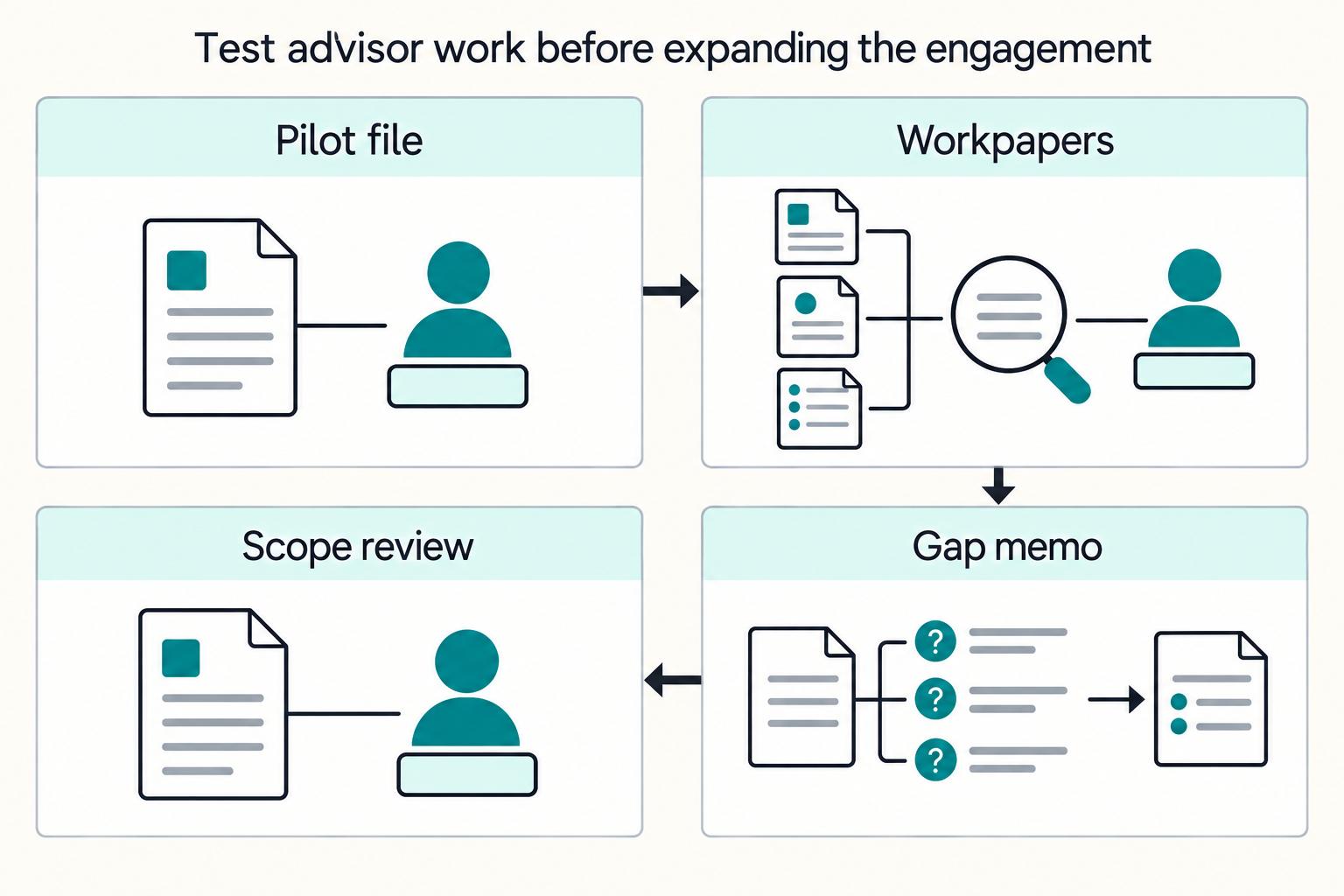
Pilot one scoped engagement before annual rollout#
After you verify controls, require one real pilot file before annual scope. One controlled case will show whether the advisor can execute the process they described.
Step 1 Choose a case with real technical tension#
Use one taxpayer file that requires a documented FEIE-versus-FTC decision and at least one evidence-backed day-count position. A strong pilot case is one where the physical presence test may apply, so the advisor must show how they counted 330 full days in 12 consecutive months, with day counting based on midnight-to-midnight full days.
Require workpapers, not conclusions. If FEIE is claimed, you should see Form 2555. If FTC is claimed, you should see Form 1116 prepared by income category, one category per form, plus the date log or travel record supporting the day count. Treat it as a control failure if a draft treats FEIE as removing the duty to report income on the U.S. return.
Step 2 Define success before the pilot starts#
Define success before work begins so the pilot is auditable:
| Pilot measure | Success definition |
|---|---|
| Error rate | No unsupported entries, no missing forms, and no internal mismatches across return support files |
| Turnaround time | Track elapsed time from complete evidence pack to first draft, then to revised final |
| Clarity of assumptions | Day-count and income-categorization assumptions are explicit |
| Evidence completeness | Each income item ties back to source records |
| Part-year FEIE qualification | Confirm the exclusion limit is adjusted by qualifying days |
Step 3 Require a post-pilot gap memo#
Before broader rollout, require a short internal memo that lists unresolved issues, open assumptions, and required follow-up. This is the practical gate for deciding whether to expand scope or re-scope.
If they cite an IRS Practice Unit, treat it as explanatory support, not binding authority. If the memo is thin, evasive, or missing clear document follow-up, pause expansion and re-scope the engagement.
We covered this in detail in How to Choose a Tax Preparer for Your Freelance Business.
Catch common failure modes early and recover fast#
Use the pilot to catch filing-logic failures early, not just to confirm general competence. If any of the patterns below shows up, pause, document the gap, and require a written correction before filing.
Step 1 Re-scope if the filing set is not defined first#
If the conversation starts with outcomes before defining deliverables, move immediately to a written filing scope. Require a form-level list of IRS and FinCEN obligations, clear ownership, and required evidence for each filing.
At minimum, make the separation explicit: Form 8938 is an IRS filing attached to the annual return and filed by that return's due date, including extensions, while FBAR is a separate FinCEN obligation when required. Do not treat one as automatically satisfying the other.
Step 2 Run a control check across FBAR and Form 8938#
Clean FBAR handling does not finish foreign-asset reporting. Require a written check that answers: whether the taxpayer is a specified person, whether an income tax return is required for the year, whether the applicable Form 8938 threshold is met, and whether FBAR is separately required.
Keep the review concrete against the Form 8938 draft itself, including whether foreign deposit or custodial accounts were closed and whether foreign assets were acquired or sold during the tax year. If FBAR is drafted but there is no explicit Form 8938 conclusion, treat the work as incomplete.
Step 3 Require support for any Form 8938 threshold position before filing#
Do not accept a threshold conclusion without short written support. The memo should state whether the position depends on specified-person status, whether an income tax return is required for the year, and whether higher thresholds are being applied for joint filing or residence abroad.
If the return position and underlying records do not align, hold filing until the inconsistency is resolved.
Step 4 Freeze scope when filing boundaries start drifting#
If scope starts expanding informally, stop and capture updates in writing. Keep one current schedule of what is included, what is excluded, and who owns each filing item.
This helps prevent missed or duplicated reporting. You can verify why each filing was included, who owned it, and what evidence supported final submission.
Related: How to Open a 'Livret A' Tax-Free Savings Account in France.
Make the final decision and lock contract guardrails#
Choose the finalist with the strongest verified technical depth, control quality, and accountability, not the lowest headline fee. The final decision should favor a credentialed return preparer and a team that can adapt quickly when rules change.
Step 1 Select the highest verified operator#
Keep your shortlist anchored to Circular 230 professionals, including Enrolled Agents, Certified Public Accountants, and tax attorneys. If two firms are close, use one tie-breaker: whether they run a standing change process that updates organizers, checklists, software, training, and client communications on a set cadence.
Step 2 Put operating controls into the engagement letter#
Do not rely on a generic proposal. Put your scorecard, filing scope, and ownership matrix into the contract or an attached schedule.
Consider documenting:
- named preparer, named reviewer, and escalation contact
- review cadence and final approval checkpoints
- filing calendar obligations, including who tracks due dates, extensions, and missing documents
- change-control rules for added scope or rework
- which authority set the firm relies on for interpretation
If the firm uses IRB highlights or synopses, require confirmation that those summaries are not treated as authoritative interpretation.
Step 3 Define escalation triggers before work starts#
Set explicit triggers for when EA or CPA handling should escalate to tax attorney review. Make the trigger logic operational: what issue starts escalation, who owns the handoff, and what written analysis supports the final filing position.
Conclusion#
Do not sign until the advisor can tie your facts to specific IRS tests, specific forms, and a written scope.
Start with FEIE and verify mechanics, not marketing. If FEIE is recommended, the advisor should state that income is still reported on a U.S. return and the claim is made on Form 2555. If they use the physical presence test, they should apply the actual standard: 330 full days in any 12 consecutive months, with a full day defined as 24 consecutive hours from midnight to midnight, and explain how disruptions or waiver scenarios are handled.
Then verify the FTC approach in writing. Form 1116 should be mapped by income category, with separate forms where required and one income-category box checked per form. If FEIE is in play, confirm they are using the correct tax-year limits for your filing year.
Before award, require a short pilot memo that lists assumptions, unresolved points, and the documents used for filing support. Scope should also clearly state which related reporting items are reviewed and what is out of scope. If IRS LB&I Practice Unit material is cited, treat it as non-binding guidance rather than final legal authority.
Use this sign-off checklist before you commit:
- FEIE position is tied to return reporting and Form 2555
- Physical presence test is documented with 330-day / 12-month / full-day rules
- FTC approach is documented with Form 1116 category handling
- Tax-year FEIE limits used match the filing year
- Scope names related reporting checks and explicit out-of-scope items
- Pilot memo delivered with assumptions, open issues, and supporting documents
- Any non-binding guidance is identified as non-binding
Related reading: How to Handle Tax on Employee Stock Purchase Plans (ESPP) as an Expat.
If you want your tax-advisor controls to connect cleanly with cross-border payment operations and audit-ready records, talk to Gruv.
Frequently Asked Questions
How do I choose an expat tax advisor without relying on marketing claims?
Choose based on verifiable expat specialization and written process evidence, not broad international marketing. Ask the advisor to explain your fact pattern and how they handle FEIE, FBAR, FATCA-related reporting, and Streamlined Filing Procedures when relevant. If the answers stay generic or sales-led, treat that as a caution flag.
What should I look for between an Enrolled Agent, Certified Public Accountant, and Tax attorney?
For U.S. expat return preparation, both EAs and CPAs are qualified, and both have unlimited IRS representation rights. The practical separator is expat tax experience, especially with treaties and specialized forms. For legal-risk or controversy-sensitive issues, ask how the matter is escalated to tax attorney review.
What questions should I ask in the first advisor interview?
Ask what expat cases they handle most and how they evaluate FEIE, the Foreign Tax Credit, and residency-test issues on your facts. Ask how they check FBAR and FATCA obligations and how they handle catch-up situations such as Streamlined Filing Procedures. If broader planning is in scope, ask what they cover and what they do not.
What are the most serious red flags when evaluating a tax preparer?
Red flags include advice you cannot verify, credential-first selling without clear expat depth, and vague treatment of treaties or specialized forms. Be cautious if the preparer cannot explain catch-up paths such as Streamlined Filing Procedures. Generic promises without clear scope or accountability are also a warning sign.
Can national tax preparation companies handle complex expat cases?
Sometimes, but size is not the deciding factor. What matters is whether your assigned preparer specializes in international taxes and in the countries tied to your filing footprint. For complex cases, you may also want independent tax advice in both your home and destination countries.
Am I still responsible if my advisor makes a filing mistake?
This article does not establish liability outcomes for filing errors. It does support verifying advice rather than treating filings as a black box. Clear scope, documented assumptions, and named accountability help reduce that risk.
How much should I expect to pay for expat tax support?
There is no single reliable price point here. Ask for written scope, what is included, and what triggers added fees. Do not compare price until each firm is using the same scope format.
Researched and edited by the Gruv editorial team. Gruv builds cross-border billing, payouts, and finance-operations software for global businesses.
Sources
- eac.gov/sites/default/files/TestingCertification/Vol...trusted
- fincen.gov/report-foreign-bank-and-financial-accountstrusted
- gao.gov/assets/a77127.htmltrusted
- irs.gov/businesses/corporations/do-i-need-to-file-fo...trusted
- irs.gov/individuals/international-taxpayers/foreign-...trusted
- taxpayeradvocate.irs.gov/wp-content/uploads/2024/01/ARC23_MSP.pdftrusted
Educational content only. Not legal, tax, or financial advice.
Related Posts

The Freelance Payment Penalty: A Modeled Audit of Platform Fees, FX Spreads, and Payout Delays
The money rarely disappears through a single, easy-to-spot fee. The real loss is stacked. A marketplace takes its commission, a processor adds a charge for international cards, a bank or payment company converts the currency at a spread, a platform holds the funds before release, and a wire sheds a little to intermediaries on the way in. Each layer looks defensible on its own, but the worker feels the combined result as a smaller deposit and a later payday.

How to Respond to a Subpoena for Business Records
Move fast, but do not produce records on instinct. If you need to **respond to a subpoena for business records**, your immediate job is to control deadlines, preserve records, and make any later production defensible.
A US Expat's Guide to Investing in UCITS ETFs to Avoid PFIC Issues
The real problem is a two-system conflict. U.S. tax treatment can punish the wrong fund choice, while local product-access constraints can block the funds you want to buy in the first place. For **us expat ucits etfs**, the practical question is not "Which product is best?" It is "What can I access, report, and keep doing every year without guessing?" Use this four-part filter before any trade: